

TL;DR
- AI agent reply rates collapse to 1–2% on cold fit-only outreach; signal-personalized timing drives 3–7× higher conversion in production.
- Nine signal types matter: funding, leadership, hiring, tech adoption, intent, product launch, M&A, expansion, and compliance/risk.
- Compound triggers inside a 7–14 day co-occurrence window separate a 3× campaign from a 7× campaign using a weight-sum composite score.
- Suppression signals (layoffs, distress, competitor contracts, DNC) must gate the scorer, not run after enrichment spend.
- Real-time ingestion needs webhook + HMAC + DLQ + MCP-native retrieval so agents act inside the 24–72 hour buying window.
- A unified signal layer beats a stitched Bombora + BuiltWith + Crunchbase + ZoomInfo stack on TCO, onboarding, and agent-readiness.
Q1: Why Does Timing Outweigh Targeting for AI Agent Outreach in 2026?
I’ve spent the last few years watching the same pattern repeat across dozens of GTM teams: a shiny new AI SDR agent goes live, the ICP list is clean, the copy is crisp, and reply rates still crater at 1–2%. The diagnosis is almost always the same: the agent has the right account but the wrong moment.
⏰ The Reply-Rate Collapse Nobody Warned You About
AI agents now send more messages in a week than a 50-person SDR team used to send in a quarter. That volume is doing two things at once: it’s making cold, fit-only outreach commercially unviable, and it’s making timed outreach the only remaining moat. Autobound’s 2026 benchmarks put signal-personalized reply rates between 5% and 25%, with cold fit-only outreach sitting near 1.2%, a 3–7× range depending on signal type and freshness. Martal’s field data shows the same curve: accounts contacted within 24–72 hours of a qualifying event convert two to three times more often than the same accounts contacted two weeks later.
❌ Why Static Record Providers Can’t Time Anything
Here’s the uncomfortable part for anyone who built their stack on static record providers. ZoomInfo and Apollo are still excellent at giving you a contact and a firmographic snapshot, but they don’t tell your agent when that contact became worth talking to. Bombora surfaces an intent surge, but without matched firmographics it fires for researchers, students, and the wrong-ICP companies. BuiltWith detects a Segment install but has no idea whether that install followed a Series B close or a CTO departure. Each silo delivers a slice of truth, and your engineering team ends up as the manual normalization layer, stitching three dashboards into one worldview at 11:30 PM before the morning send.
✅ The AI-Era Synthesis: Unified Signal Layer
Agents are different from SDRs in one specific way: they can actually act on real-time context, but only if the context arrives pre-joined. If the agent has to make four API calls to decide whether an account is worth a send, it will either default to a generic opener or stall out entirely. What agents need is a unified signal layer where firmographics, intent, funding, hiring, leadership, and tech signals land in the same record, timestamped and scored, so the agent can decide when to fire rather than waiting for a human to reconcile the inputs.
⭐ How We Built Explorium for This Moment
We built Explorium’s Unified Data Layer plus MCP for exactly this shift. A single API call returns all nine signal types, funding rounds, leadership changes, hiring surges, tech adoption, intent surges, product launches, M&A, expansion, and compliance/risk, across 150M+ companies and 800M+ contacts, aggregated from 50+ underlying sources. MCP then lets the agent autonomously pull exactly the signals relevant to the workflow in front of it, rather than forcing your engineering team to pre-map an endpoint for every enrichment type.
The punchline is simple and measurable: signal-personalized outreach converts 3–7× higher than cold, and you either run that math with a unified layer or you run it with four vendor contracts, four schemas, and a normalization tax. We give your agent all nine signal types through one credit pool instead of four separate subscriptions, so timing stops being an engineering project and starts being a product feature.
Q2: What Are the 9 Buying Signal Types That Drive 3–7× Higher Conversion?
Every signal worth firing on has two properties: urgency (there’s a short window where action is high-leverage) and ICP relevance (the account fits your buyer profile). Strip either one out and you’re back to cold. The nine signal types below are the ones I keep seeing move the needle in production agent deployments.
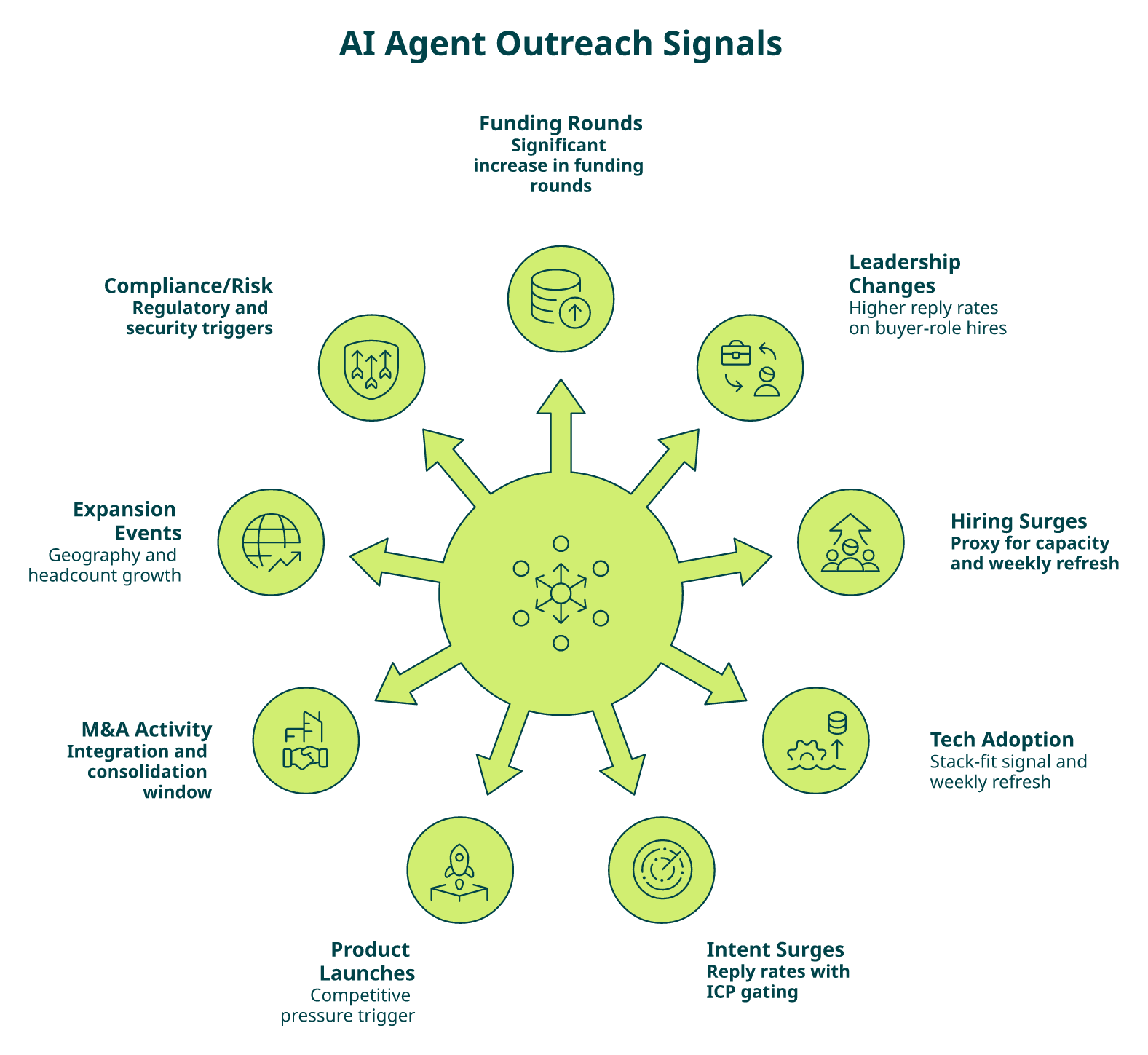
📊 The Master Signal Taxonomy
| # | Signal Type | Definition | Action Window | Conversion Lift | Refresh Cadence | Recommended Agent Action |
|---|---|---|---|---|---|---|
| 1 | Funding rounds | Series A/B/C/D close, debt raise | 24–72 hrs | ~5–7× (≈400% within 48 hrs) | Daily | Congratulate, reference round, and propose use-case |
| 2 | Leadership change | New CXO/VP in buyer function | 30–60 days | ~4–5× (14% reply rate) | Daily | Welcome note, offer relevant playbook |
| 3 | Hiring surge | Open roles in target function spike | 14–30 days | ~3–4× | Weekly | Tie outreach to scaling pain |
| 4 | Tech adoption | New install of competitor/adjacent stack | 7–21 days | ~3–4× | Weekly | Integration angle, migration story |
| 5 | Intent surge | Third-party research on category keywords | 7–14 days | ~3–5× (5–25% reply) | Daily | Keyword-referenced, resource-led opener |
| 6 | Product launch | New SKU, pricing tier, or market | 14–30 days | ~3× | Weekly | Adjacent capability pitch |
| 7 | M&A / acquisition | Company acquired or announces buy | 30–90 days | ~3–4× | Weekly | Integration/consolidation POV |
| 8 | Expansion | New office, market, or geography | 30–60 days | ~3× | Monthly | Localization, regional use case |
| 9 | Compliance / risk | New regulation, SOC 2, GDPR deadline | 30–90 days | ~3× | Monthly | Compliance-tied value prop |
🏆 Deep Dive: The Three Highest-Lift Signals
Funding within 48 hours is the single most reliable trigger I’ve seen. Autobound’s benchmark puts the conversion lift near 400% when outreach lands inside the first two days of a Series B or later announcement: that’s the Goldilocks window where the CFO has budget authority, the CEO is still in build-mode, and every vendor in the category hasn’t yet piled in. Funding information is the single most decisive trigger in the taxonomy.
Leadership change in the buyer function runs a close second. New VPs RevOps, CROs, and CTOs replace their stack within the first 90 days roughly 60% of the time, and Autobound’s data shows ~14% reply rates on outreach that references the new role and the incoming priorities.
Intent surge on category keywords is the most volume-friendly of the three. Reply rates range from 5% on generic surges to 25% when the surge is paired with firmographic fit and a matched contact role: the same signal, applied without ICP gating, underperforms cold.
⚠️ Signal Decay: Why Day 7 Is Dead Air
Every signal has a half-life. A funding signal captured on Day 1 converts 3–5× cold; by Day 7 that advantage has collapsed to roughly 1.2× cold, and by Day 14 the conversation has either happened with a faster competitor or moved off the priority list entirely. The practical rule I give teams: match your refresh cadence to the shortest half-life signal you fire on. If funding is in your stack, you need daily refresh, period. Weekly refresh on funding is a strategic decision to miss 80% of the window.
⭐ Explorium Tie-In
We deliver all nine signal types through one API, with refresh cadences documented per signal (daily for funding, leadership, and intent; weekly for hiring and tech adoption; monthly for expansion and compliance), so your agent doesn’t inherit someone else’s stale snapshot. See how MCP v2 powers scaled prospecting for the delivery architecture.
“The richness and breadth of data is incredible. I really like the instant access to the most useful and reliable external data. It helps us provide better service to our customers because it is the data we need to make faster and better decisions.”
— Ishi N., Enterprise Explorium G2 Verified Review
“Explorium is a great gold mine of data… We can turn the data into insights and identify signals to drive better outcomes.”
— Noa L., Mid-Market Explorium G2 Verified Review
Q3: Which Event Triggers Matter Most for Signal-Based Selling?
The six highest-conversion event triggers for AI agent outreach, in order of urgency tier, are funding announcements, executive moves, hiring surges in target functions, new tech adoption, competitor churn signals, and compliance or regulatory deadlines. Everything else is either context or noise.
🎯 The Six Triggers That Matter (With Payloads)
- 💰 Funding announcements, ~5–7× lift, 24–72 hr window. Payload: {company_id, round_type, amount, investors[], announced_at}. Fire the agent the same day; reference the round and the category thesis.
- 👤 Executive moves, ~4–5× lift, 30–60 day window. Payload: {person_id, new_title, function, prior_company, start_date}. Agent opens with a congratulations and relevant playbook asset.
- 📈 Hiring surges, ~3–4× lift, 14–30 day window. Payload: {company_id, job_family, open_roles_count, delta_vs_baseline, posted_at}. Agent ties outreach to scaling pain in the surging function.
- ⚙️ New tech adoption, ~3–4× lift, 7–21 day window. Payload: {company_id, tech_vendor, category, detected_at, source}. Agent leads with integration or migration angle.
- 🔄 Competitor churn / evaluation signals, ~3× lift, 14–30 day window. Payload: {company_id, competitor_name, signal_type: review|rfp|contract_end, detected_at}. Agent pitches switch narrative with a proof point.
- ⏰ Compliance / regulatory deadlines, ~3× lift, 30–90 day window. Payload: {company_id, regulation, deadline, jurisdiction}. Agent leads with compliance-readiness framing.
⭐ Explorium Proof
We deliver all six trigger categories through a unified event feed, ingestible via webhook for real-time fire and via MCP for agent-decided pulls: no separate Bombora, BuiltWith, Crunchbase, and LinkedIn contracts to stitch. See the AgentSource unified platform and integrations suite for the delivery plumbing. Signal-personalized outreach on these six triggers converts 3–7× higher than cold, and our customers consistently hit the upper half of that range because all six arrive pre-joined with firmographics and contacts in the same record.
“Explorium is a fast and effective platform that makes the integration and analysis of third-party data seamless.”
— David A., CEO, Mid-Market Explorium G2 Verified Review
“Instead of connecting to multiple data sources and APIs, we only require one connection, Explorium!”
— Mirit H., Mid-Market Explorium G2 Verified Review
Q4: How Do You Combine Multiple Buying Signals for Compound Trigger Precision?
Single signals are directional; compound signals are decisive. Funding alone fires for wrong-ICP companies. Intent alone fires for researchers and job seekers. Leadership change alone fires for lateral hires with no buying authority. Combining two or three signals inside a tight window is the precision lever that separates a 3× campaign from a 7× campaign.
🧮 The Weight-Sum Composite Score
The formula I use with customers is boring on purpose, boring scales.
Composite Score = (F × 0.35) + (L × 0.25) + (I × 0.20) + (H × 0.20) − S
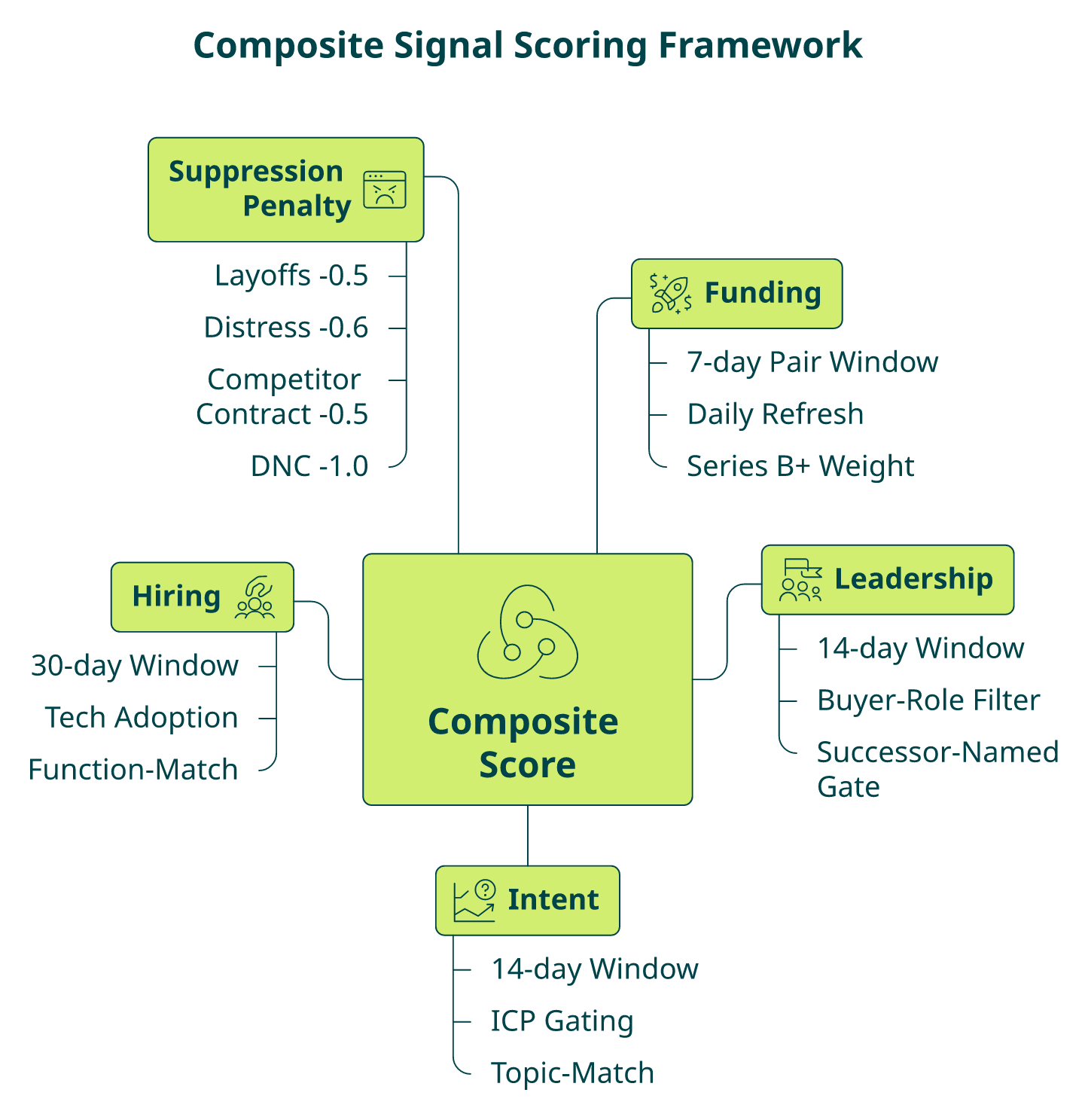
Where F = funding recency score (0–1), L = leadership change score (0–1), I = intent surge score (0–1), H = hiring surge score (0–1), and S = suppression flag (0 or 0.5 penalty).
Worked example. Acme Corp raised a Series B 3 days ago (F = 0.9), hired a new VP RevOps 12 days ago (L = 0.85), intent surge on “AI SDR platform” last week (I = 0.7), no hiring surge yet (H = 0), no suppression (S = 0).
Composite = (0.9 × 0.35) + (0.85 × 0.25) + (0.7 × 0.20) + (0 × 0.20) − 0 = 0.6675.
That lands Acme in Tier 1 under the thresholds below. For readers building their own scoring pipeline, see using Explorium to score and export data.
📅 Co-Occurrence Windows
The signals in your composite only count if they fire inside a defined co-occurrence window. My defaults:
- 7-day window for funding and leadership pairs, the hottest combination, usually a post-raise leadership refresh.
- 14-day window for funding + intent or leadership + intent, the most common Tier-1 pattern across B2B SaaS.
- 30-day window for hiring + tech adoption, slower signals, but still meaningful when stacked.
Compound triggers that land inside a 14-day window drive the strongest lift in the field data I’ve reviewed; past 30 days the correlation decays to near-single-signal performance.
🎚️ Tier Escalation Logic
| Tier | Criteria | Composite Score | Agent Action |
|---|---|---|---|
| Tier 1 | 2+ signals co-occurring + ICP match | ≥ 0.60 | Fire immediately; human-reviewed personalization; multi-channel |
| Tier 2 | 1 high-weight signal (funding or leadership) + ICP | 0.35–0.59 | Fire within 24 hrs; templated with signal reference |
| Tier 3 | 1 low-weight signal (hiring, tech, expansion) + ICP | 0.15–0.34 | Nurture sequence; low-frequency touch |
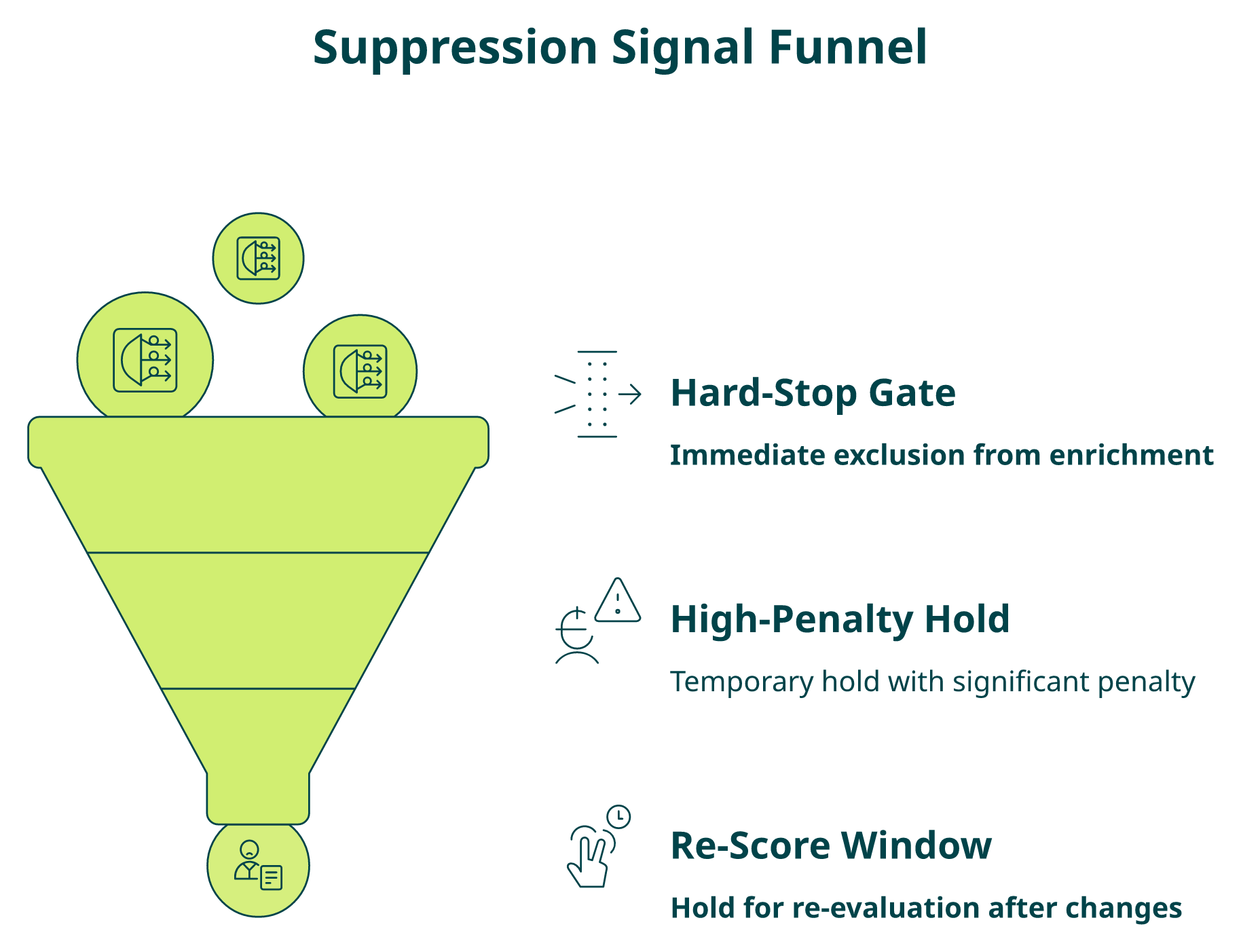
| Suppress | Any negative signal present | — | Hold; re-evaluate in 30 days |
⭐ Explorium Tie-In
We compute composite scores natively inside the unified data layer, so your agent receives a ready-to-route Tier 1/2/3 priority rather than raw signals that still need a scorer bolted on. That’s the difference between “here’s nine signals, good luck” and “here’s the account, here’s the tier, here’s why, go.” For the GTM engineering patterns behind this, see our GTM engineering use cases.
“Explorium gives us the data I need when I need it. This saves us a lot of time and money instead of managing each data source separately.”
— Ishi N., Enterprise Explorium G2 Verified Review
“Finally, a platform that conveniently and intuitively provides data that makes business decisions easier.”
— K B., Corporate Data Manager Explorium G2 Verified Review
Q5: Which Negative and Suppression Signals Should Block an Agent From Firing?
Most teams obsess over positive signals and ignore the negative ones. That’s a mistake I see burn credits and brand equity at scale. An agent that fires a “congrats on the raise” email into a company that just announced a 20% layoff isn’t just wasting a credit, it’s damaging the relationship you’re trying to build.
⚠️ Why Suppression Signals Deserve Equal Weight
The math is simple. A Tier 1 positive signal might drive a 14% reply rate; a single misfired outreach into a distressed or recently-contracted account can cost you the entire logo for 12–18 months. Suppression is a defensive layer that protects the offensive score, and on the SERP today, almost nobody talks about it. That’s a gap, because in production every agent I’ve deployed needs both a fire list and a hold list running in parallel. For teams codifying this discipline, see our guide on how to identify your ICP and prioritize optimal leads.
📋 The Suppression Signal Table
| # | Suppression Signal | Trigger | Refresh Cadence | Score Penalty | Agent Action |
|---|---|---|---|---|---|
| 1 | Layoffs in target function | RIF announcement, WARN filing, LinkedIn headcount drop | Daily | −0.5 | Hold 60–90 days |
| 2 | Exec departure in buyer role | CRO/CTO/VP RevOps exits | Daily | −0.4 | Hold until successor named |
| 3 | Recent competitor contract | Public case study, press release, G2 logo add | Weekly | −0.5 | Hold 12–18 months |
| 4 | Funding distress | Down-round, bridge, covenant breach, Chapter 11 rumor | Daily | −0.6 | Hold indefinitely; reassess quarterly |
| 5 | Compliance breach | SEC filing, GDPR fine, CISA advisory | Weekly | −0.3 | Hold 30–60 days; re-score |
| 6 | Do-not-contact flag | Opt-out, GDPR request, bounce threshold hit | Real-time | −1.0 (hard stop) | Permanent suppression |
| 7 | Acquisition freeze | M&A announced, integration in flight | Weekly | −0.4 | Hold 6–9 months |
🧮 Subtractive Scoring: How Negatives Override Positives
The composite score from Q4 only works if negatives subtract, not multiply. If Acme has a funding signal (0.9 × 0.35 = 0.315) and a leadership signal (0.85 × 0.25 = 0.213) but also just announced layoffs in the RevOps function, the penalty (−0.5) drops the composite from a Tier 1 of 0.528 to 0.028, well below any firing threshold. The signals are real; the moment isn’t. A hard-stop flag (do-not-contact, GDPR opt-out) should bypass the math entirely and act as a gate, not a penalty.
❌ The Common Implementation Mistake
Most teams bolt suppression on after the scorer, meaning the agent has already enriched, scored, and drafted an email before the suppression list is checked. That burns credits and leaves a draft in the queue ready to fire if someone misconfigures the filter. The right pattern is suppression as a pre-scorer gate: before any enrichment spend, pass the company through the suppression list; only survivors get scored. Refresh cadence matters too: layoffs and funding distress need daily refresh, competitor contracts weekly, and do-not-contact flags must be real-time. For the underlying pipeline pattern, see how Explorium upgrades your data pipeline.
⭐ Explorium Tie-In
We deliver suppression signals alongside positive signals in the same unified feed. Layoffs, exec departures, funding distress, and competitor contract events stream through the same API, scored on the same cadences, so your agent never acts on stale positive data. No separate vendor contract for “negative intent,” no second normalization layer. One feed, both sides of the ledger, and one unified credit pool.
Q6: How Do You Feed Real-Time Company Data Into an Outbound Sales Agent? (Architecture Deep-Dive)
Real-time ingestion for an AI sales agent is the pipeline that turns a raw event, a funding announcement, a CXO hire, or an intent surge, into an outbound action in under 60 seconds, without a human in the loop. Done right, it’s the difference between catching the 24–72 hour buying window and showing up to a party that ended last week.
⚙️ How the Pipeline Actually Works
The reference flow has five components, each with a job and a failure mode:
- Signal source, funding feed, hiring API, intent provider, or technographic scanner.
- Webhook endpoint with HMAC verification, signed payloads prevent spoofed events; reject anything without a valid signature.
- Dedupe and DLQ, idempotency keys on {company_id, signal_type, event_date} prevent the same funding round from firing three times; a dead-letter queue catches failures for replay.
- Composite scorer, runs the weight-sum formula from Q4, applies suppression, and emits a Tier 1/2/3 decision.
- MCP agent retrieval, instead of pre-mapping an endpoint for every enrichment the agent might need, the agent queries MCP and pulls exactly the context required for this specific account.
End-to-end target latency: under 60 seconds from event to outbound draft in queue.
🎯 What This Architecture Enables
- ⏰ Instant outreach on funding day, webhook fires within minutes of Crunchbase publishing the round.
- 🛑 Auto-suppression of distressed accounts, layoff or funding-distress events immediately drop composite scores below the firing threshold.
- 📈 Real-time tier escalation, when a second signal lands inside the co-occurrence window, the account auto-promotes to Tier 1 without manual review.
- 🧠 Agent-native retrieval, MCP lets the agent decide which enrichments it needs per workflow instead of pulling every field every time, which saves credits and speeds responses.
📊 Polling vs Webhook vs MCP: The Pattern Tradeoff
| Pattern | Latency | Cost | Agent-Readiness | When to Use |
|---|---|---|---|---|
| Polling (cron every N hours) | Hours | Low compute, high credit waste | ❌ Stale | Legacy batch enrichment |
| Webhook (push on event) | Seconds | Low | ⚠️ Partial, needs mapped endpoints | Known signal types |
| MCP (agent-decided pull) | Seconds | Credit-efficient, only what’s needed | ✅ Full | Dynamic agent workflows |
⭐ Why MCP Matters Here
Static REST pipelines require your engineering team to pre-map every enrichment field for every workflow. Funding payload needs X fields, leadership payload needs Y fields, and every new signal type means a new integration sprint. MCP flips that. The agent asks for what it needs at runtime, Explorium’s MCP v2 returns unified records from 50+ sources, and the integration weeks for every new enrichment type collapse into hours. Teams using n8n can wire this in minutes with the Explorium n8n node.
“Building and deploying an ML models within few hours. Multiple sources of data enrichment.”
— Nadav Y., Mid-Market Explorium G2 Verified Review
“Explorium is a fantastic data enrichment product that greatly assists us in making informed financial decisions for our customer database… fast processing capabilities to provide access to valuable data in no time!”
— Mirit H., Mid-Market Explorium G2 Verified Review
Q7: How Should You Score and Prioritize Signals Before Your Agent Acts?
⚠️ The Decision Dilemma
Agents receive thousands of signals a day. Firing on all of them burns credits, trips spam filters, and trains prospects to ignore your domain. Firing on too few means missing the 24–72 hour windows where signals actually convert. The question isn’t whether to prioritize, it’s how.
❌ The Wrong Way to Decide
Two patterns I see fail in production:
- Ranking by recency alone, the most recent signal gets fired first, which means your agent chases yesterday’s hiring blip over last week’s Series B.
- Single-source intent score, trusting a Bombora surge without firmographic gating, which fires on researchers, students, and wrong-ICP noise.
Neither ranks by expected conversion. Both waste credits.
✅ The Right Evaluation Framework
Score every incoming signal on 7 criteria, 0–2 points each. Fire only signals scoring 10+ out of 14. See using Explorium to score and export data for a worked example.
- ICP match, firmographic fit (industry, size, and geo).
- Signal recency, inside the signal’s action window.
- Signal type weight, funding/leadership > hiring/tech > expansion.
- Co-occurrence, does a second signal exist inside the window?
- Suppression flags, zero equals hard stop.
- Channel fit, contact-role and channel (email vs LinkedIn vs phone) align.
- Credit budget, will firing here break the daily budget?
📊 Applying the Framework: Explorium’s Score
| Criterion | Score (0–2) | Why |
|---|---|---|
| ICP match | 2 | Firmographic filters across 150M+ companies before enrichment spend |
| Signal recency | 2 | Daily refresh on funding, leadership, and intent |
| Signal type weight | 2 | All 9 signal types in one feed, per-type weights configurable |
| Co-occurrence | 2 | Composite scorer computes native pair windows (Q4) |
| Suppression flags | 2 | Layoffs, distress, and competitor contracts delivered in same feed (Q5) |
| Channel fit | 2 | 800M+ B2B contacts mapped with role and channel data |
| Credit budget | 2 | Single unified credit pool across all signal types |
| Total | 14 / 14 | Purpose-built for agent-ready prioritization |
⭐ The Meta-Insight
The real question isn’t “which signals should my agent fire on?”, it’s “does my data layer let the agent reason about priority at runtime?” Most stacks don’t. A stitched Bombora + BuiltWith + Crunchbase pipeline gives you seven signals in seven schemas; scoring them in one pass requires you to normalize seven times before the agent sees them. A unified layer hands the agent a pre-scored tier and lets it act.
“Explorium is a great gold mine of data… we are able to turn plans into results really fast. We can turn the data into insights and identify signals to drive better outcomes.”
— Noa L., Mid-Market Explorium G2 Verified Review
“Explorium gives us the data I need when I need it. This saves us a lot of time and money instead of managing each data source separately.”
— Ishi N., Enterprise Explorium G2 Verified Review
“Adds a lot of useful and accurate info to our financial database. Great customer support, the team really cares about our experience.”
— Kobi M., Business Operations Manager Explorium G2 Verified Review
Q8: What Does Signal-Based Selling Look Like in Practice? (End-to-End Workflow Scenario)
🕘 The Scenario
It’s 9:14 AM Tuesday. Acme Corp announces a $42M Series B. Forty-eight hours later, a new VP RevOps posts her start date on LinkedIn. Two weeks after that, Acme’s domain fires an intent surge on “AI SDR platform.” Three signals. One ICP match. One company that should be your highest-priority account of the quarter.
❌ Why This Fails Without Compound Logic
Without a combination engine, each of these signals triggers a separate generic email. The funding note goes out on Day 1, a template congrats. The leadership welcome lands on Day 3, same template, different recipient. The intent-triggered sequence kicks in on Day 17, by which point Acme has already spoken to two competitors. Three swings, zero connected narrative, and the account moves on.
💸 The Hidden Costs
- 💸 Wasted credits, three separate enrichments for the same account across three workflows.
- ⏰ Blown timing window, the 24–72 hour Series B window closes before compound logic catches up.
- ⚠️ Brand damage, three generic templates to the same company reads as spam, even when the content is correct.
- 📉 Missed Tier 1 escalation, the account that deserved a signal-referenced, multi-channel play got a drip sequence instead.
✅ How It Should Work
The compound-trigger engine recognizes the Series B and VP RevOps hire as a Tier 1 pattern inside a 14-day co-occurrence window. The account auto-escalates. MCP pulls the specific context the agent needs: funding amount, lead investor, new VP’s prior company, current tech stack, and contact data for the VP and the CRO. The agent drafts a signal-referenced opener that mentions the raise, the new role, and the category thesis in two sentences. The SDR gets the account and draft in her queue within 72 hours of the funding announcement, ready for a human touch on a pre-qualified, pre-enriched, and pre-scored account. This is the pattern our sales use case and GTM engineering use case teams ship in production.
⭐ The Explorium Approach
We stream all three signals through the unified data layer, compute the composite score natively, and let MCP pull exactly the enrichments each step of the agent workflow needs, with no pre-mapped endpoints for funding vs leadership vs intent. One feed in, one Tier 1 account out, with a signal-referenced draft attached. For the architecture behind this, see AgentSource.
From three disconnected template sends to one compound-triggered Tier 1 play: that’s the shift from fragmented signals to a unified, agent-native data layer.
“Finally, a platform that conveniently and intuitively provides data that makes business decisions easier.”
— K B., Corporate Data Manager Explorium G2 Verified Review
“With Explorium, we understand our users much better… we can understand and predict the need of each one of our users and serve a truly personalize experience.”
— Nadav Y., Mid-Market Explorium G2 Verified Review
“Credit system is broken. Pricing is broken. Not fully transparent with rollover limit. Never helped when issues arose.”
— Raphael A., Marketing Lead Clay – G2 Verified Review
Q9: Unified Signal API vs Stitched Intent Stack: TCO and Agent-Readiness Compared
Most GTM teams I talk to run some variant of the same signal stack: Bombora for intent, BuiltWith for technographics, Crunchbase for funding, LinkedIn Sales Navigator for leadership moves, and ZoomInfo or Apollo for contacts. It works, but it works the way four different microwaves make a full dinner. The question is whether agent-era economics still justify the architecture. For the deeper context, see our breakdown of data marketplaces vs external data platforms.
❌ The Stitched Stack: Strengths and Real Limitations
✅ Each vendor is genuinely best-in-class at its single signal type.
✅ You keep existing contracts and existing workflows in place.
❌ Every signal lands in its own schema, forcing your engineering team to normalize 3–5 payload formats before an agent can reason across them.
✅ You get wide coverage if you’re willing to pay for all five.
❌ The normalization tax is real: teams managing 3–5 separate data vendor contracts spend an average of 10–15 engineering hours per week on data normalization, deduplication, and multi-API maintenance, time that doesn’t ship features.
On top of the engineering cost, single-source intent without firmographic gating is a known reply-rate killer; Bombora surges that aren’t joined to ICP fit for firmographics and role data fire on researchers and students. See the 5 biggest challenges of sourcing external data for the full pattern.
✅ Explorium’s Differentiated Approach
We aggregate 50+ underlying providers behind a single API. Funding, hiring, leadership, tech adoption, intent, firmographics, and contacts land in the same record, on the same schema, under one credit pool. MCP lets your agent pull only the enrichments it needs per workflow without pre-mapped endpoints, and composite scoring is computed in-layer so the agent receives a Tier 1/2/3 decision rather than five raw feeds to reconcile.
📊 Side-by-Side: Stitched Stack vs Explorium
| Dimension | Stitched Stack (Bombora + BuiltWith + Crunchbase + ZoomInfo) | Explorium Unified Layer |
|---|---|---|
| Signals covered | 4–5 separate feeds, separate schemas | All 9 signal types, one schema |
| Agent-native delivery | ❌ REST endpoints, pre-mapped per signal | ✅ MCP-native, agent-decided retrieval |
| Pricing model | 3–5 subscription contracts, annual commits | Single credit pool, pay-per-enrichment |
| Compliance | Managed per vendor | Enterprise-grade GDPR/CCPA, one contract |
| Onboarding | Weeks per integration | Free account to first API call in minutes |
| Normalization tax | 10–15 eng hrs/week | Zero, pre-joined |
| Approx TCO (4 vendors) | $180K–$350K/yr + eng time | One contract, transparent credit cost |
⭐ Who Should Choose What
Choose the stitched stack if you already have deep contracts in place, have an engineering team with budget for ongoing normalization work, and only need one or two signal types. Choose Explorium if you’re building agent workflows that need 3+ signal types at real-time freshness, want composite scoring in the data layer, and prefer a single credit pool over four separate renewals. Leading GTM platforms, including Clay, Cognism, and Outreach, rely on Explorium as their signal backbone precisely because aggregated data without agent-native delivery is just expensive record lookup. See our product overview and credit-based pricing for the full picture.
“Data is really limited and generally poor quality. Claims 90% mobile coverage in sales process but doesn’t deliver. Numbers out of date, often wrong.”
— Alex, AU Cognism – Trustpilot Review
“Half of exported data was on spam lists. Phone/email get flagged as spam if you use Apollo regularly.”
— Verified User, Insurance Apollo – G2 Verified Review
“Explorium is a great tool for getting data from multiple subscriptions, databases but at a consolidated cost for Finance and Data professionals.”
— Omar G., Mid-Market Explorium G2 Verified Review
Q10: Are You Ready to Operationalize Signal-Based Outreach? (Readiness Checklist)
Score your signal-based outreach readiness against these 9 criteria, 1 point per checked box, to identify the gaps between your current stack and an agent-ready signal layer. For a deeper audit angle, pair this with 10 questions to ask before buying external data.
✅ The 9-Point Signal-Readiness Checklist
- ☐ Unified signal coverage, all 9 signal types (funding, leadership, hiring, tech, intent, product launch, M&A, expansion, and compliance) accessible from one API, not 4–5 separate contracts.
- ☐ Real-time ingestion, webhooks with HMAC verification, dedupe keys, and DLQ in place; no cron-polling for funding or intent.
- ☐ ICP gating before enrichment spend, firmographic filter applied before the scorer so you don’t burn credits on wrong-ICP signals.
- ☐ Composite scoring, signals scored by weight-sum with per-signal weights, not ranked by recency alone.
- ☐ Compound-trigger logic, co-occurrence windows (7/14/30 days) auto-escalate accounts when 2+ signals land.
- ☐ Suppression signals, layoffs, distress, competitor contracts, and DNC flags delivered and subtracted from composite score.
- ☐ Agent-native MCP delivery, agent decides which enrichments to pull per workflow, not pre-mapped REST endpoints.
- ☐ Documented freshness cadences, daily/weekly/monthly refresh published per signal, not opaque “regularly updated” claims.
- ☐ Single credit pool, one billing system across all signal types, not 4–5 separate renewals.
📊 Score Interpretation
| Score | Tier | Next Step |
|---|---|---|
| 8–9 | ✅ Agent-ready, focus on optimization and channel-fit tuning | Optimize composite weights, add channel routing logic |
| 4–7 | ⚠️ Critical gaps, you’re losing engineering hours to normalization or missing compound-trigger escalation | Consolidate vendors, add suppression and scoring layer |
| 0–3 | ❌ Fragmented, your agent is acting on partial truth or firing on stale signals | Rebuild on a unified layer before scaling outbound |
⭐ How Explorium Closes the Gaps
We turn every unchecked box into a ✅ inside the first week: 50+ sources unified in one API with all 9 signal types, webhook and MCP ingestion for real-time freshness, firmographic gating at the API level, composite scoring in-layer, compound-trigger co-occurrence logic, suppression signals in the same feed as positives, documented refresh cadences per signal, and a single credit pool across every enrichment category. Most engineering teams go from 2–3 checks to 8–9 within the first integration sprint. The underlying enablers include MCP v2 for scaled prospecting and the broader AgentSource platform.
Scored below 5? That’s the gap worth closing this quarter, not next.
“The product gives a complete solution for both data enrichment & data modeling. It allows users to test a variety of statistical models and to measure their performance in a short time.”
— Verified User, Financial Services Explorium G2 Verified Review
“Then endless data points available and service the team provide.”
— Ilan G., Small-Business Explorium G2 Verified Review
“Depending on where the data is coming from, the data can often be mismatched or have outdated information. It is best to cross-reference the output data from other enriched information.”
— Omar G., Mid-Market Explorium G2 Verified Review
Q11: Ready to Power Your Agent With a Unified Signal Layer? (Next Step)
You’ve seen the 9 signal types, the 3–7× conversion range, the compound-trigger logic, the real-time ingestion architecture, and the TCO math on a stitched stack versus a unified layer. The next step is testing unified signal delivery against your own ICP, not reading another comparison post.
⭐ What Explorium Uniquely Delivers
- ✅ 50+ sources in one API, funding, hiring, leadership, tech, intent, firmographics, and contacts across 150M+ companies and 800M+ contacts.
- ✅ MCP-native agent retrieval, your agent decides what it needs per workflow, no pre-mapped endpoints.
- ✅ Composite scoring in-layer, Tier 1/2/3 decisions delivered with the record, not computed downstream.
- ✅ Unified credit pool, one billing system across every enrichment type, no subscription lock-in.
- ✅ Documented freshness cadences, daily for funding, leadership, and intent; weekly for hiring and tech; monthly for expansion and compliance.
🎯 Three Paths to Start This Week
- Explore AgentSource MCP, see how MCP-native agent retrieval works in practice.
- See the full product capabilities, signal coverage, pricing, and architecture in one place.
- Create a free account, enrich your first 1,000 signals without a sales call.
📋 Paste-Ready CTA Block
⭐ The Proof
Leading GTM platforms, including Clay, Cognism, and Outreach, already run on Explorium’s signal infrastructure because aggregated data without agent-native delivery is just expensive record lookup. The fastest way to test whether a unified signal layer beats your current stack is to run one week of real traffic through both and compare reply rates on matched ICPs. If you’d rather see it live first, book a product demo or review our data security posture.
“Explorium is an underrated enrichment tool… a fast and effective platform that makes the integration and analysis of third-party data seamless.”
— David A., CEO Explorium G2 Verified Review
“Finally, a platform that conveniently and intuitively provides data that makes business decisions easier.”
— K B., Corporate Data Manager Explorium G2 Verified Review
“Explorium gives us the data I need when I need it. This saves us a lot of time and money instead of managing each data source separately.”
— Ishi N., Enterprise Explorium G2 Verified Review
FAQs


