

TL;DR
- Always require SOC 2 Type II with Processing Integrity and Privacy TSCs in scope, not just a Security-only Type I checkbox.
- Audit your vendor's data sourcing methodology using a five-tier risk taxonomy from registry-based to AI-inferred data.
- GDPR legitimate interest documentation and real-time suppression lists are non-negotiable for AI agent outreach compliance.
- A unified data layer eliminates 2-3x compliance overhead by collapsing multi-vendor SOC 2 reviews, DPAs, and audits into one.
- Use the 15-point cross-functional checklist to align Security, Legal, and RevOps on a single vendor evaluation framework.
Q1. Why Does SOC 2 Compliance Matter Specifically for B2B Data Enrichment APIs?
The Compliance Surface Area Nobody Talks About
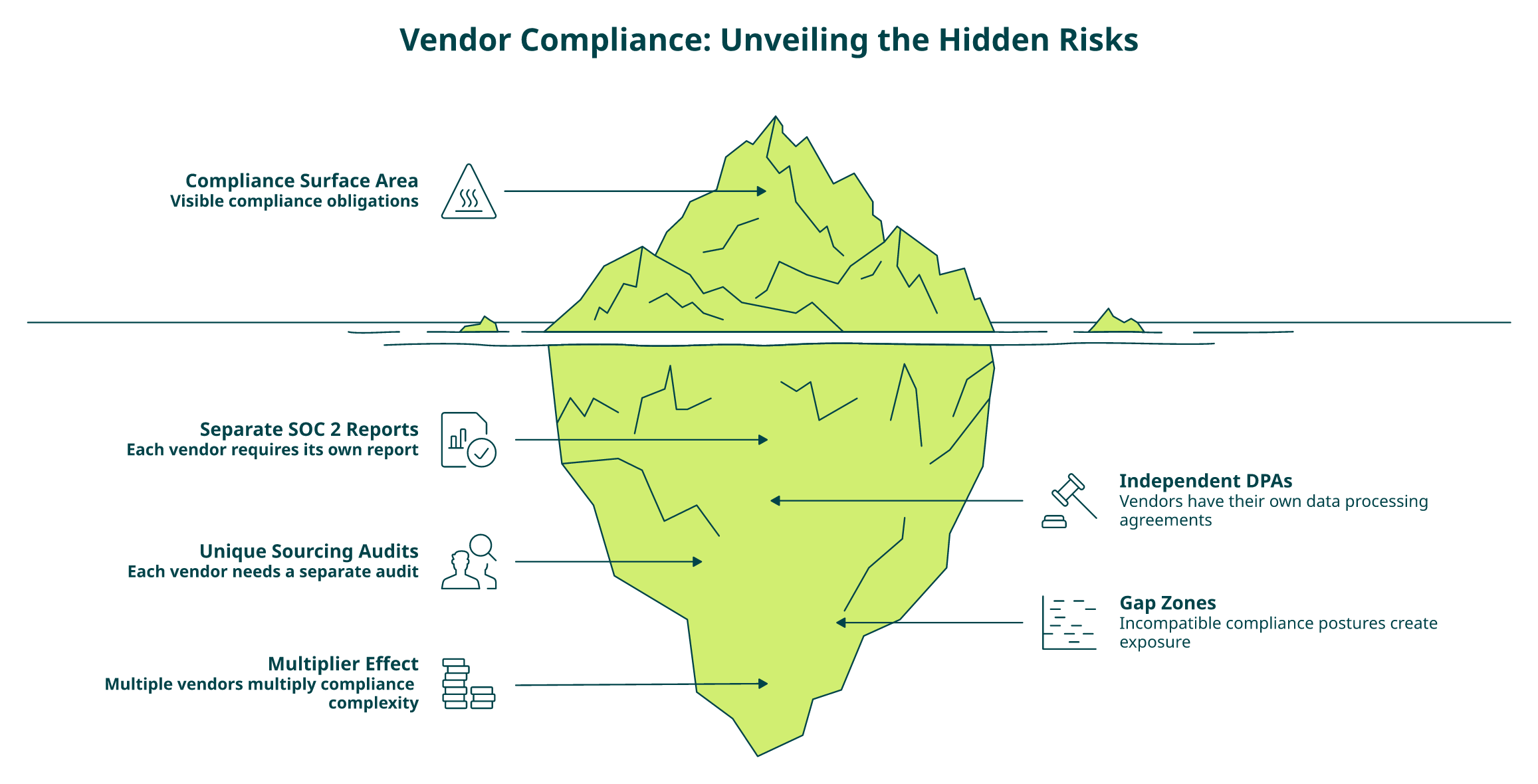
Every time you connect an enrichment API to your CRM, outbound sequences, or autonomous AI agents, you inherit that vendor’s security posture as your own. This isn’t theoretical; it’s how breach liability works. When your GTM stack runs Apollo for contacts, Bombora for intent, and BuiltWith for technographics, you’re not managing three integrations. You’re managing three separate compliance postures, three risk profiles, and three audit obligations that your security team has to review independently.
The compliance surface area multiplies with every vendor in the stack. Each one handles PII differently, refreshes data on different cadences, and sources records through different methodologies: some licensed, some scraped, some inferred. Your legal exposure isn’t limited to the vendor with the weakest posture; it extends across every data enrichment source flowing into your pipeline.
Why the “SOC 2 Checkbox” Approach Fails
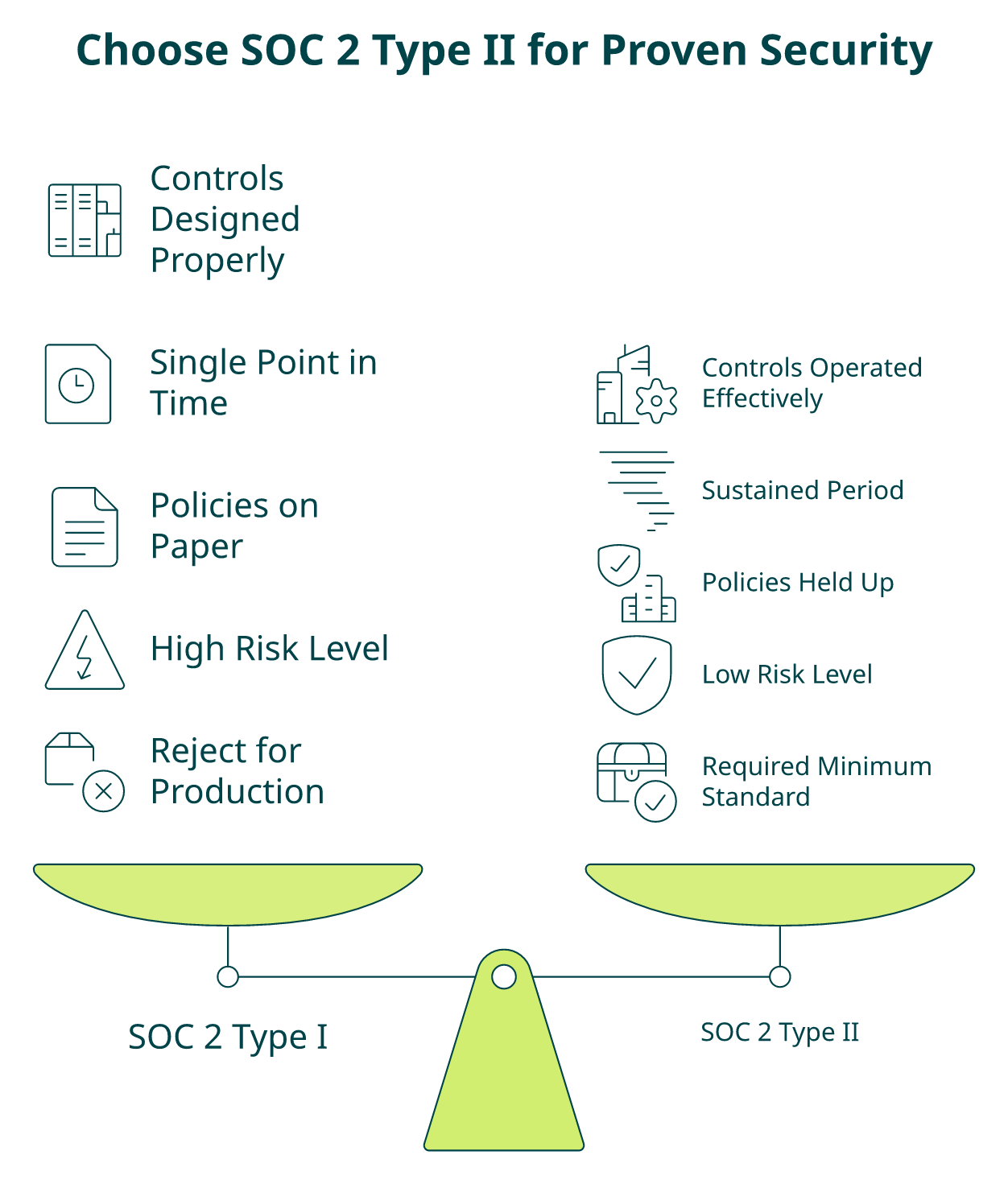
Most procurement teams treat compliance as a single question: “Are you SOC 2 compliant?” They get a yes, check the box, and move on. But that question hides enormous variance. A vendor can hold SOC 2 Type I, a point-in-time snapshot, while lacking Type II, which proves controls actually worked over an extended observation period.
Traditional providers like ZoomInfo, Apollo, and People Data Labs offer varying levels of compliance transparency. Some publish trust center pages; others require NDAs before sharing reports. ❌ The real problem? Single-source providers may hold their own SOC 2, but when achieving full enrichment coverage requires 3–5 vendors, you’re performing due diligence 3–5 times, with no guarantee the compliance postures are compatible or that gaps between them won’t create exposure.
“Contact info frequently missing or incorrect. Half the day calling wrong/disconnected numbers.”
— Verified User, IT Services Apollo – G2 Verified Review
When data accuracy itself is inconsistent, the compliance question goes deeper than security controls. It extends to Processing Integrity, one of SOC 2’s five Trust Service Criteria that most vendor evaluations ignore entirely.
The AI-Era Compliance Shift
Compliance requirements fundamentally change when agents, not humans, consume enrichment data. SOC 2’s Trust Service Criteria take on new meaning when data flows through MCP into non-deterministic agent workflows. The question shifts from “Is my vendor secure?” to “Is my vendor’s compliance architecture designed for how agents actually consume and act on data?”
Traditional compliance frameworks weren’t built for agent-to-agent data flows. When your AI agent autonomously queries an enrichment API, decides which records to pull, and triggers outbound sequences without human review, the compliance chain stretches beyond what a standard SOC 2 evaluation covers.
How Explorium Approaches This Differently
This is exactly why we built Explorium’s compliance architecture around the unified data layer model. Enterprise-grade GDPR/CCPA compliance across 50+ data sources, managed through one API and one compliance posture. Instead of auditing five vendors with five different security postures, you perform due diligence once.
✅ Clay, Cognism, Outreach, Monday.com, and global enterprises like Pepsi trust this infrastructure, not because we aggregate more sources, but because unified infrastructure means unified security accountability.
“Instead of connecting to multiple data sources and APIs, we only require one connection — Explorium!”
— Mirit H., Mid-Market Explorium G2 – Verified Review
“Explorium gives us the data I need when I need it. This saves us a lot of time and money instead of managing each data source separately.”
— Ishi N., Enterprise Explorium G2 – Verified Review
Q2. What Should You Verify in a B2B Data Vendor’s SOC 2 Report: Type I vs Type II, Trust Service Criteria, and How to Read It?
Type I vs Type II: The Distinction That Changes Everything
Most teams request a SOC 2 report but never look past the cover page. Here’s what actually matters. SOC 2 Type I evaluates whether security controls are designed properly at a single point in time. SOC 2 Type II evaluates whether those controls operated effectively over a sustained period, minimum six months, typically twelve.
For B2B data vendors specifically, always require Type II. A Type I report from an enrichment provider tells you they had the right policies on paper on one particular Tuesday. A Type II report tells you those policies held up across millions of API calls, data refreshes, and access requests over an entire year. The difference is a promise versus proof.
⚠️ Watch for vendors who say “SOC 2 compliant” without specifying which type. That ambiguity is a red flag.
The 10-Point SOC 2 Verification Checklist
Score your B2B data vendor’s SOC 2 report against these criteria before signing:
- ☐ Type II confirmation, observation period ≥6 months. Reject Type I-only reports for production enrichment vendors.
- ☐ Full TSC scope, verify all 5 Trust Service Criteria are included: Security, Availability, Processing Integrity, Confidentiality, and Privacy. Most vendors only scope Security.
- ☐ Processing Integrity in scope, this is critical for enrichment APIs. It answers: are the records your API returns accurate, complete, and timely? If this TSC is missing, you have no audited assurance about data quality.
- ☐ Privacy TSC in scope, non-negotiable when the vendor handles contact data (emails, phone numbers, and job titles). Covers PII handling, opt-out compliance, and data subject rights.
- ☐ Auditor exceptions reviewed, check the “Description of Tests and Results” section for any exceptions or qualifications noted. Every finding must have a documented remediation plan.
- ☐ CUECs documented, Complementary User Entity Controls define what security responsibilities fall on you, not the vendor. Miss these, and you own gaps you didn’t know existed.
- ☐ Subservice organizations listed, does the vendor rely on sub-processors for data storage, processing, or delivery? Critical for multi-source aggregators who pull from 50+ underlying providers.
- ☐ Encryption standards specified, at rest: AES-256 minimum. In transit: TLS 1.2+.
- ☐ Penetration testing cadence, annual minimum, conducted by a third party. Ask for the most recent remediation summary.
- ☐ Incident response procedures, documented breach notification timeline (GDPR requires 72 hours), escalation protocol, and communication plan.
How to Interpret Your Score
| Score | What It Means |
|---|---|
| ✅ 9–10 checked | Robust SOC 2 posture. Vendor demonstrates sustained, comprehensive compliance. |
| ⚠️ 6–8 checked | Gaps exist. Request written clarification on unchecked items before proceeding. |
| ❌ 5 or below | Significant SOC 2 weaknesses. Consider alternative vendors or require a remediation timeline with deadlines. |
Why the Unified Data Layer Changes the SOC 2 Equation
Here’s the operational reality: if your enrichment stack requires Apollo + Bombora + BuiltWith, you’re reviewing three separate SOC 2 reports with potentially three different TSC scopes, three different audit firms, and three different observation periods. Gaps between them are where compliance risk hides.
With Explorium’s unified API, you review one SOC 2 report covering the complete data layer: 50+ sources, one compliance posture, one audit cycle. We handle the sub-processor complexity so your security team doesn’t spend quarters reconciling inconsistent vendor reports.
Q3. Beyond SOC 2: What Other Compliance Certifications Should a B2B Data Vendor Hold?
The Certification Stack Dilemma
SOC 2 is necessary but not sufficient. A B2B data vendor handling contact data across multiple jurisdictions needs a layered certification stack, and most teams underestimate how many layers matter. Choosing a vendor with SOC 2 but no ISO 27001, no data broker registration, and no privacy-specific certification leaves gaps that regulators and enterprise procurement teams will flag during review.
Badge-Counting Is Compliance Theater
The wrong way to evaluate this: accept a vendor’s trust center page at face value. A vendor can display SOC 2 and ISO 27001 badges while lacking ISO 27701 (the privacy-specific extension), state data broker registrations in jurisdictions that require them, or meaningful audit scope that actually covers enrichment operations.
Badges without scope verification is the compliance equivalent of checking “GDPR compliant” on a vendor questionnaire and moving on. It tells you nothing about what was actually audited.
The Right Certification Evaluation Framework
Score each vendor 0–2 on these six criteria (0 = absent, 1 = partial, 2 = fully certified/compliant):
| # | Certification | What It Covers | What It Doesn’t | Why Enrichment Vendors Need It |
|---|---|---|---|---|
| 1 | ISO 27001 | Information security management system: risk assessment, access controls, and operational security | Doesn’t cover privacy-specific PII handling | Proves systematic security management beyond point-in-time SOC 2 audit |
| 2 | ISO 27701 | Extends ISO 27001 to privacy information management: PII controller/processor obligations | Doesn’t replace GDPR compliance; complements it | Essential when vendor processes contact data (names, emails, and phone numbers) |
| 3 | State data broker registrations | Legal registration as a data broker in California (CCPA/CPRA), Vermont, Oregon, and Texas | Doesn’t guarantee data quality or sourcing methodology | Required by law. Unregistered vendors expose you to regulatory liability. |
| 4 | Industry-specific certifications | HIPAA BAA (healthcare data), SOX-adjacent controls (financial services) | Varies by industry; not universally applicable | Mandatory if your organization operates in regulated verticals |
| 5 | Third-party penetration testing | Annual independent security testing with published remediation | One-time test doesn’t prove ongoing security | Validates that security controls withstand real-world attack scenarios |
| 6 | Bug bounty / responsible disclosure | Structured program for external security researchers to report vulnerabilities | Doesn’t replace formal pen testing | Signals mature security culture and continuous vulnerability management |
Applying the Scoring
Combined with the SOC 2 checklist from Q2, vendors scoring 10+ across the full stack are enterprise-ready. Below 7 indicates certification gaps that transfer risk directly to your organization.
“CRM integration harvests your CRM data and sells it to other customers without clear disclosure.”
— Verified User, Insurance, Small-Business Apollo – G2 Verified Review
“Obtained private phone number and sold it for sales purposes without consent. Not in line with GDPR.”
— Lex Houweling Cognism – Trustpilot Review
These aren’t edge cases. They illustrate what happens when certification scope doesn’t extend to actual data handling practices.
Where Explorium Fits in the Full Stack
We built Explorium’s compliance architecture to satisfy the entire certification stack through a single vendor relationship. Enterprise-grade GDPR/CCPA compliance across all 50+ aggregated sources means your procurement team evaluates one certification stack, not five separate stacks with five different gaps.
✅ “Benefit from an API suite trusted by global enterprises, ensuring robust compliance and security standards across all data endpoints. Eliminate the complexity of individually managing security compliance with multiple providers.”
Q4. GDPR, CCPA, and DPA Essentials: How to Evaluate a B2B Data Vendor’s Regulatory Compliance
Certifications vs. Regulatory Compliance: A Critical Distinction
Certifications (Q2 and Q3) prove a vendor has security controls. Regulatory compliance proves they handle your data legally. These are different dimensions. A vendor can be SOC 2 Type II certified with ISO 27001 and still violate GDPR because they lack a documented legitimate interest basis for processing B2B contact data.
Use this 10-point regulatory checklist to evaluate GDPR, CCPA, and DPA compliance for any B2B enrichment vendor.
The 10-Point Regulatory Compliance Checklist
GDPR Requirements:
- ☐ Legitimate interest documented, Vendor provides a completed Legitimate Interest Assessment (LIA) under Article 6(1)(f), including the three-part balancing test for B2B contact enrichment. GDPR Recital 47 explicitly acknowledges direct marketing as a legitimate interest, but the assessment must be documented.
- ☐ Data subject rights mechanisms, Vendor offers documented access/erasure request procedures with specified response timelines (30 days maximum under GDPR).
CCPA/CPRA Requirements:
- ☐ Data broker registration verified, Confirm the vendor is registered with the California Attorney General (verify at oag.ca.gov). Unregistered vendors face civil penalties of $100/day and expose your organization to supply chain compliance risk.
- ☐ “Do Not Sell” mechanism active, Vendor provides a functional opt-out mechanism and honors requests across all underlying data sources, not just their primary database.
DPA-Specific Clauses:
- ☐ Agent/automation use rights, Agreement explicitly covers AI agent and automated outreach use cases, not just human-operated CRM workflows. Most standard DPAs assume a human decision-maker in the loop.
- ☐ Sub-processor list provided, Vendor discloses and regularly updates the list of all underlying data sources and sub-processors. ⚠️ Critical when the vendor aggregates from 50+ sources.
- ☐ Resale rights clause, If you’re building a product that surfaces enriched data to end-users (common for agent builders), you need explicit resale rights. Without this, downstream data delivery may violate the vendor’s terms.
- ☐ Breach notification timeline, 72 hours for GDPR-covered data; “without unreasonable delay” for CCPA. Both must be contractually specified, not just referenced in a privacy policy.
Operational Controls:
- ☐ Real-time suppression lists, Vendor maintains opt-out/suppression lists that propagate across ALL underlying data sources, not just the primary CRM export. Batch-processed suppression with 24–48 hour delays creates compliance windows where opted-out contacts can still be enriched and contacted.
- ☐ Data retention and deletion procedures, Vendor documents how long enriched records are retained and the process for deletion upon request or contract termination.
Score Interpretation
| Score | Assessment |
|---|---|
| ✅ 9–10 checked | Comprehensive regulatory compliance. Safe for enterprise deployment and agent workflows. |
| ⚠️ 6–8 checked | Partial coverage. Negotiate DPA amendments and request written documentation for gaps before signing. |
| ❌ 5 or below | Material regulatory gaps. High risk of non-compliance exposure; proceed only with full legal review. |
How Explorium Handles Regulatory Compliance at the Aggregation Layer
We provide enterprise-grade GDPR/CCPA compliance across all 50+ data sources with a single DPA. Resale rights are available on custom plans, which is specifically relevant for agent builders whose products surface enriched data to end-users.
💰 The operational savings go beyond legal cost: instead of negotiating separate DPAs with each underlying data provider, managing five different sub-processor lists, and tracking five different breach notification timelines, you manage one relationship with one compliance posture.
When your vendor aggregates 50+ data sources, regulatory compliance at the aggregation layer means you inherit one posture, not fifty.
Q5. What Are the Legal Risks of Using B2B Enrichment Data in AI Agent Outreach?
The Legal Gray Zone Nobody’s Mapping
When your AI agent autonomously composes and sends emails using enriched B2B contact data, a new class of liability questions emerges. Who is the data controller when an agent, not a human, makes the enrichment decision? Does GDPR legitimate interest still apply when the “decision-maker” is an algorithm operating at scale? What happens when an AI agent contacts someone who previously opted out, and the suppression list was batch-processed 24 hours earlier?
These questions are emerging faster than regulatory guidance. 73% of AI agent implementations in European companies during 2024 presented some GDPR compliance vulnerability, according to audits by EU Data Protection Authorities. The gap between what agents can do and what the law allows them to do is widening every quarter.
Why Your Vendor’s Compliance Doesn’t Automatically Protect You
Traditional enrichment vendors provide data with terms of use, but their compliance scope typically covers data delivery, not downstream use in automated outreach. If your AI agent uses enriched data in violation of GDPR or CAN-SPAM, the liability typically falls on the data controller (you), not the processor (vendor).
Most B2B data vendors have no guidance on agent-specific use cases. Their DPAs assume a human decision-maker in the loop, someone reviewing records before triggering outreach. When an agent autonomously queries an enrichment API, selects contacts based on intent signals, and fires outbound sequences at 2 AM without human review, the compliance chain stretches beyond what standard DPAs contemplate.
The Regulatory Framework That Actually Applies
Key regulatory considerations for AI-powered outreach:
⚠️ GDPR Article 6(1)(f), Legitimate interest requires a three-part balancing test. Proportionality may differ when agents operate at scale versus human-paced outreach. GDPR Recital 47 acknowledges direct marketing as a legitimate interest, but the assessment must be documented specifically for automated use cases.
⚠️ CCPA right-to-opt-out, Agents must check suppression lists before every outreach action, not just at campaign start. Batch-processed suppression with 24–48 hour delays creates compliance windows.
⚠️ CAN-SPAM for automated messages, Every commercial email requires clear sender identification, a valid physical address, and an easy opt-out mechanism. Non-compliance carries fines up to $51,744 per email.
⚠️ The “decisional gap”, The vendor provides the data, the agent decides how to use it, and your organization bears legal responsibility for both decisions.

A Practical Mitigation Framework
Here’s what I’d do before letting any agent touch enriched contact data:
✅ Ensure your vendor’s DPA explicitly covers AI/agent automated use cases, not just human-operated CRM workflows.
✅ Verify suppression list handling is real-time, not batch. A 24-hour delay is a 24-hour liability window.
✅ Confirm resale rights if your agents deliver enriched data to end-users.
✅ Document a legitimate interest assessment specifically for automated outreach at scale.
✅ Implement agent-level access controls and audit logging: every enrichment query and outreach action must be traceable.
✅ Require your vendor to provide data provenance per record so your agent can make informed compliance decisions.
How Explorium Addresses This at the Data Layer
This is where architecture matters. We built Explorium with enterprise-grade GDPR/CCPA compliance across all 50+ data sources, with resale rights available on custom plans, specifically designed for agent builders whose products surface enriched data downstream.
Outreach, a leading sales engagement platform, integrates with Explorium precisely because compliance at the data layer is foundational to compliant automated outreach. When your data vendor handles compliance at the aggregation layer, your agent inherits a clean compliance posture instead of cobbling one together from five separate providers.
Q6. How Do You Audit a B2B Data Vendor’s Data Sourcing Methodology?
Not all data sources carry equal compliance risk. A government registry record and a scraped LinkedIn profile sit at opposite ends of the legal exposure spectrum, yet most vendors describe both as “proprietary data” without distinction.
The Data Sourcing Risk Taxonomy
Use this five-tier classification to assess any vendor’s sourcing methodology:
| Tier | Sourcing Method | Compliance Risk | Example Data Types |
|---|---|---|---|
| 🟢 Tier 1 | Registry-Based: Government registries, SEC filings, patent databases | Lowest | Company registration, officer names, financial filings |
| 🟢 Tier 2 | Licensed Partnerships: Formal data licensing agreements with original sources | Low | Credit bureau data, verified business directories |
| 🟡 Tier 3 | Public Web Aggregation: Company websites, press releases, job postings | Moderate | Firmographics, tech stack signals, hiring signals |
| 🔴 Tier 4 | Web Scraping: Automated extraction from third-party platforms | High (ToS violations possible) | Contact details from social profiles, review data |
| 🔴 Tier 5 | Inferred/Modeled: AI-predicted data points without direct source verification | Highest accuracy risk | Predicted revenue ranges, inferred intent scores |
Most B2B data providers rely on two or three of these methods. The quality gap, and compliance gap, comes from how they verify records and how often they refresh.
The 8-Point Sourcing Audit Checklist
- ☐ Can the vendor document the origin of each data field (field-level provenance)?
- ☐ Does the vendor disclose which sourcing tier(s) its data falls into?
- ☐ Are data sources licensed or scraped, and can the vendor prove licensing agreements?
- ☐ Does the vendor disclose its sub-source providers? (Critical for aggregators.)
- ☐ What is the refresh cadence per data type (daily/weekly/monthly/quarterly)?
- ☐ How does the vendor handle conflicting data from multiple sources (deduplication methodology, and reconciliation logic)?
- ☐ Are opt-out/suppression requests propagated across all underlying sources?
- ☐ Does the vendor perform accuracy benchmarking against verified datasets, and share the results?
How to Interpret Your Score
| Score | Assessment |
|---|---|
| ✅ 7–8 checked | Transparent, auditable sourcing with documented provenance |
| ⚠️ 4–6 checked | Partial transparency. Request detailed documentation before proceeding. |
| ❌ 3 or below | Opaque sourcing. Significant compliance and accuracy risk; disqualification recommended. |
“Data inaccuracies lead to negative outcomes. Wrong personnel details, private employee info listed as company contacts, misdirected communications.”
— Anders J., Developer Apollo – G2 Verified Review
“Low security measures caused data to leak to internet and dark web.”
— Stanislav V. People Data Labs – Trustpilot Review
How Explorium Approaches Sourcing Transparency
We aggregate 50+ data sources with a robust matching mechanism, deduplication, and data cleansing pipeline. Different datasets refresh at different cadences, daily, weekly, monthly, and quarterly, and cross-referencing multiple sources catches gaps that any single provider misses.
The accuracy benchmarks tell the story:
| Field | Explorium | ZoomInfo | Apollo | Clearbit | Experian |
|---|---|---|---|---|---|
| Number of Employees | 97.80% | 88.31% | 78.15% | 32.93% | 65.51% |
| Website URL | 97.80% | 89.62% | 78.04% | 54.03% | 61.37% |
| NAICS Code | 97.31% | 89.62% | 69.30% | 45.62% | 77.55% |
When you evaluate Explorium, you’re evaluating one sourcing methodology that has already vetted 50+ providers, not auditing five separate opaque pipelines independently.
Q7. Right-to-Audit Clauses and Ongoing Vendor Compliance Monitoring: What Your Contract Must Include
Signing the contract isn’t the end of due diligence; it’s the beginning. Your agreement must include enrichment-specific right-to-audit clauses, and your team needs a defined re-audit cadence. Without both, your initial compliance assessment degrades within months as vendors change sub-processors, enter new jurisdictions, or update sourcing methodology.
What Your Contract Must Specify
✅ Right-to-audit clause, Contractual right to audit the vendor’s data sourcing, security controls, and compliance practices, not just review their SOC 2 report. Must specify audit scope (including sub-processors), notification requirements, and frequency limits.
✅ Sub-processor change notification, Vendor must notify you before adding or changing underlying data sources that affect your enrichment pipeline. For aggregators pulling from 50+ sources, this is non-negotiable.
✅ Data accuracy SLAs, Contractually defined accuracy benchmarks with remediation obligations if metrics degrade below thresholds.
✅ Termination rights for compliance failures, If the vendor loses a certification, fails an audit, or experiences a breach, your contract should include termination or renegotiation rights.
The Re-Audit Cadence That Actually Works
| Frequency | What to Review | Trigger |
|---|---|---|
| ⏰ Annual | Request updated SOC 2 Type II report; review for new exceptions, scope changes, or TSC modifications | Calendar-based |
| ⏰ Quarterly | Spot-check data accuracy and sourcing; verify refresh cadences haven’t degraded; review sub-processor list for changes | Calendar-based |
| ⚠️ Trigger-based | Full re-evaluation when vendor announces new data sources, experiences a breach, faces regulatory action, or when new regulations take effect (e.g., new state data broker laws) | Event-based |
The operational reality: most teams set up annual reviews and forget about them. The vendors that cause compliance problems don’t wait for your annual review cycle. They change sub-processors quarterly, update sourcing methods continuously, and sometimes lose certifications between audit periods.
Why One Vendor Simplifies the Entire Lifecycle
We built Explorium to collapse this complexity. One vendor means one right-to-audit clause, one SOC 2 to review annually, one sub-processor list to monitor, and one compliance posture to track. Instead of managing audit cycles across 3–5 vendors quarterly, each with different contract terms, different notification obligations, and different reporting formats, you monitor one enterprise-grade partner.
Q8. Red Flags: How to Spot a Non-Compliant B2B Data Vendor Before You Sign
The Scenario That Plays Out More Often Than You’d Think
You’re two weeks into evaluating a B2B data vendor. Enrichment coverage looks great. Pricing is competitive. API docs are clean. Then you ask for their SOC 2 Type II report, and they send a Type I from 18 months ago. You ask about data sourcing and get: “We aggregate from public and proprietary sources.” You ask about GDPR, and they point you to a generic privacy policy page.
The enrichment looks right, but the compliance foundation is crumbling beneath it.
Why This Problem Keeps Recurring
Many B2B data vendors prioritize coverage and speed over compliance infrastructure. Growth-stage providers often have incomplete compliance stacks because certifications are expensive and slow to obtain. The result: vendors that deliver great data today but expose you to regulatory and legal liability tomorrow.
💸 The hidden costs add up fast:
- GDPR fines: up to 4% of global annual revenue or €20 million, whichever is higher
- CAN-SPAM penalties: up to $51,744 per non-compliant email
- Breach notification costs and customer trust erosion
- The “quiet cost” of re-migrating to a compliant vendor mid-contract
“Steals personal data and sells to companies. Low security measures caused data to leak to internet and dark web.”
— Stanislav V. People Data Labs – Trustpilot Review
“Contact data quality varies wildly, feels like a black box.”
— Verified User, IT Services, Mid-Market Clay – G2 Verified Review
The 10 Disqualification Signals
Run every vendor through this checklist. Any single 🚩 warrants investigation; three or more means walk away:
🚩 SOC 2 Type I only (no Type II), or report older than 12 months
🚩 Trust Service Criteria scope limited to Security only, missing Processing Integrity and Privacy
🚩 No DPA offered proactively; you have to ask for it
🚩 Vague data sourcing descriptions (“public and proprietary sources”) with no field-level provenance
🚩 No sub-processor list available
🚩 Missing state data broker registrations (California, Vermont, Oregon, and Texas)
🚩 No documented opt-out/suppression handling mechanism
🚩 Refusal of right-to-audit clauses
🚩 No third-party penetration testing evidence
🚩 GDPR compliance claimed but no Article 6(1)(f) legitimate interest documentation
How Explorium Holds Up Against This List
We designed Explorium’s compliance architecture to pass every one of these tests. Enterprise-grade compliance with documented standards, transparent sourcing across 50+ providers with robust matching and deduplication, resale rights on custom plans, and documented accuracy benchmarks: 97.8% on key firmographic fields where competitors average 60–80%.
“Explorium is a great tool for getting data from multiple subscriptions, databases but at a consolidated cost. We are using Explorium to study information on bankruptcy risk of vendors, credit-worthiness, assessing employee size, and also security risk exposure.”
— Omar G., Mid-Market Explorium G2 – Verified Review
The industry’s leading GTM platforms, Clay, Cognism, Outreach, Bombora, Common Room, and Monday.com, rely on Explorium’s data infrastructure because compliance at the data layer isn’t optional when you’re powering enterprise agent workflows.
Q9. The Cross-Functional Due Diligence Template: A Shared Checklist for Security, Legal, and RevOps Teams
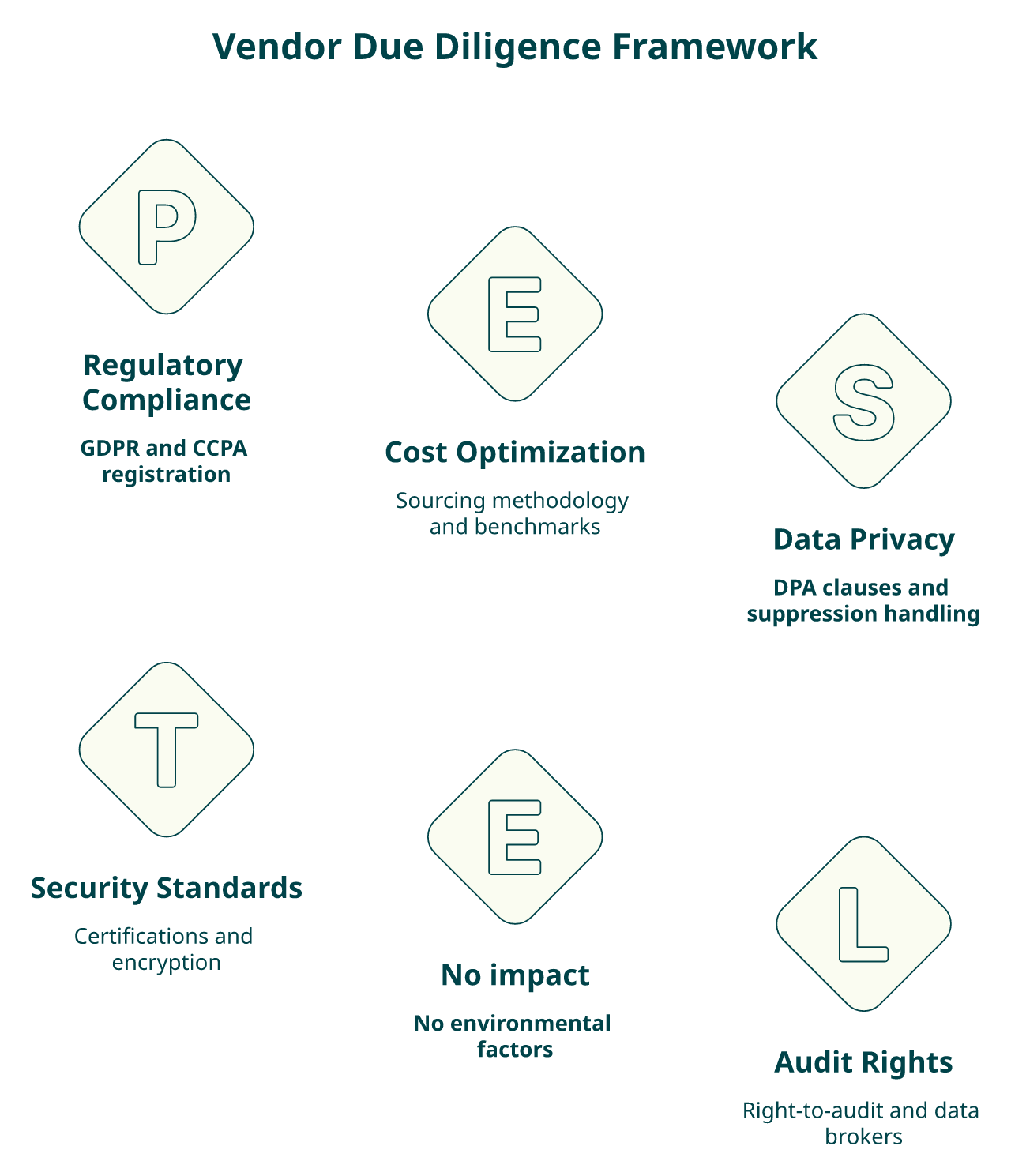
Most compliance content is written for one audience, Security or RevOps, never both. But vendor due diligence is inherently cross-functional. Security evaluates certifications, Legal reviews DPAs, and RevOps tests data quality, yet they rarely work from the same document. The result is duplicated effort, blind spots between teams, and vendor evaluations that miss critical gaps because nobody owned the question.
Why Cross-Functional Alignment Matters
Here’s what actually happens without a shared framework: Security approves the SOC 2, Legal signs the DPA, and RevOps discovers six months later that the vendor’s data sourcing methodology relies on Tier 4 web scraping that Legal never evaluated. Each team did its job in isolation. Nobody connected the dots. Use this unified template to align all three teams on a single evaluation framework, and make sure no compliance dimension falls between the cracks.
🔐 Security Team Owns
| # | Checklist Item | Reference |
|---|---|---|
| ☐ 1 | SOC 2 Type II report reviewed, current within 12 months, with Processing Integrity and Privacy TSCs in scope | Q2 criteria |
| ☐ 2 | Certification stack verified: ISO 27001, ISO 27701 where applicable | Q3 criteria |
| ☐ 3 | Third-party penetration testing evidence confirmed (within last 12 months) | Q8 criteria |
| ☐ 4 | API authentication standards documented: OAuth 2.0, API key rotation, rate limiting, and encryption at rest/in transit | Q3 criteria |
| ☐ 5 | Incident response plan reviewed, breach notification timelines specified | Q7 criteria |
⚖️ Legal Team Owns
| # | Checklist Item | Reference |
|---|---|---|
| ☐ 6 | DPA executed with enrichment-specific clauses: agent/AI use rights, resale rights, and sub-processor disclosure | Q4 criteria |
| ☐ 7 | GDPR legitimate interest basis documented for automated outreach use cases | Q5 criteria |
| ☐ 8 | CCPA data broker registration verified (California, Vermont, Oregon, and Texas) | Q4 criteria |
| ☐ 9 | Right-to-audit clause included, scope covers sub-processors, notification requirements, and frequency | Q7 criteria |
| ☐ 10 | Opt-out/suppression propagation mechanism documented and tested | Q5 criteria |
📊 RevOps / GTM Team Owns
| # | Checklist Item | Reference |
|---|---|---|
| ☐ 11 | Data sourcing methodology audited, taxonomy tier identified per data type | Q6 criteria |
| ☐ 12 | Accuracy benchmarks verified against independent datasets (not self-reported) | Q6 criteria |
| ☐ 13 | Refresh cadence documented per data type (daily/weekly/monthly/quarterly) | Q6 criteria |
🤝 Joint Review
| # | Checklist Item | Reference |
|---|---|---|
| ☐ 14 | Red flag review completed, zero disqualification signals across all 10 criteria | Q8 criteria |
| ☐ 15 | Re-audit cadence agreed and calendared (annual SOC 2, quarterly spot-checks, and trigger-based re-evaluations) | Q7 criteria |
How to Score Your Vendor
| Score | Assessment |
|---|---|
| ✅ 13–15 checked | Vendor is enterprise-ready across all three team dimensions. Proceed with confidence. |
| ⚠️ 9–12 checked | Gaps exist in at least one team’s domain. Address before signing. |
| ❌ Below 9 | Material due diligence gaps. Disqualify or require comprehensive remediation before contract execution. |
Why Explorium Scores 15/15
We designed Explorium to pass every item on this cross-functional template. One vendor means one SOC 2 to review, one DPA to execute, one sourcing methodology covering 50+ aggregated sources, and one compliance posture that satisfies Security, Legal, and RevOps simultaneously. As one Gartner reviewer noted:
“Explorium is the only platform I have seen in market that has a consistent journey to explore, experiment, and implement external data at scale.”
— Verified User Explorium Gartner – Verified Review
Eliminate the complexity of individually managing security and privacy compliance with multiple providers. Perform due diligence just once with a proven enterprise-ready partner. Create a free Explorium account and run this template against a vendor that was built for the audit from day one.
Q10. Why a Unified B2B Data Layer Reduces Compliance Risk vs. Multi-Vendor Stacks
You’re not just choosing between data providers; you’re choosing between compliance architectures. A multi-vendor stack (Apollo + Bombora + BuiltWith + PDL) means four separate SOC 2 reports to review, four DPAs to negotiate, four sourcing methodologies to audit, and four compliance postures to monitor quarterly. A unified data layer means one of each.
The Hidden Compliance Tax of Multi-Vendor Stacks
Each vendor in a fragmented stack brings its own certification scope, regulatory posture, and sourcing methodology. When one vendor updates sub-processors or changes DPA terms, your compliance team re-evaluates. When another vendor’s SOC 2 expires between audit cycles, you have a compliance gap you may not discover for months.
The operational math is straightforward. Engineering already spends 10–15 hours per week normalizing data across providers. But Legal and Security also spend hours per quarter on vendor re-audits that wouldn’t exist with consolidation. Each additional vendor integration also increases the security surface area, creating new potential entry points and new sets of vulnerabilities to monitor.
“Contact data quality varies wildly, feels like a black box.”
— Verified User, IT Services, Mid-Market Clay – G2 Verified Review
“CRM integration harvests your CRM data and sells it to other customers without clear disclosure.”
— Verified User, Insurance, Small-Business Apollo – G2 Verified Review
The Unified Architecture Advantage
The compliance case for consolidation isn’t theoretical; it’s structural. One API, one SOC 2 report, one DPA, one compliance posture across 50+ aggregated sources. Accuracy exceeds individual providers because multi-source cross-referencing catches what single-source data misses: 97.8% on employee count fields versus Apollo’s 78.15% and ZoomInfo’s 88.31%.
Multi-Vendor Stack vs. Unified Data Layer
| Compliance Dimension | Multi-Vendor Stack (3–5 providers) | Explorium Unified Layer |
|---|---|---|
| SOC 2 reviews required annually | 3–5 | 1 |
| DPAs to negotiate and maintain | 3–5 | 1 |
| Sourcing audits per year | 12–20 (quarterly × vendors) | 4 (quarterly × 1) |
| Compliance monitoring hours/quarter | 20–40 hours | 5–10 hours |
| Agent-readiness | ❌ Requires custom normalization | ✅ MCP-native delivery |
| Right-to-audit complexity | Multiple clauses, multiple scopes | One clause, one scope |
| 💰 Total compliance cost multiplier | 2–3× baseline | 1× baseline |
Who Should Choose What
Choose the multi-vendor approach if you have a dedicated compliance team with unlimited procurement bandwidth, and you prefer managing vendor relationships individually across different contract terms, billing cycles, and audit schedules.
Choose a unified data layer if you want enterprise-grade compliance from a single partner, with agent-native delivery and unified credit pricing, so your team builds GTM agents instead of auditing data vendors.
“Instead of connecting to multiple data sources and APIs, we only require one connection, Explorium!”
— Mirit H., Mid-Market Explorium G2 – Verified Review
“Explorium is a great tool for getting data from multiple subscriptions, databases but at a consolidated cost.”
— Omar G., Mid-Market Explorium G2 – Verified Review
Create a free account and run the due diligence template from Q9 against Explorium. We expect you to validate before you commit.
FAQs


