

TL;DR
- Fragmented intent stacks (Bombora, Apollo, G2, Crunchbase) break AI agents because signals arrive in different schemas, decay windows, and refresh cadences the agent cannot reconcile.
- Agent-usable intent data needs six schema fields: signal_type, source, timestamp, confidence, decay_rate, and suggested_action, normalized across every source.
- Seven signal categories drive 80%+ of agent-sourced pipeline: funding, hiring surges, leadership changes, tech adoption, first-party engagement, topical intent, and ecosystem events.
- Composite scoring with exponential decay and a hard ICP multiplier (0 or 1) delivers a documented 47% conversion lift over flat-weighted, filter-based scoring.
- MCP-native unified delivery cuts signal-to-action cycles from 9 days to 2.3 days and replaces 3 to 5 vendor contracts with one credit pool.
- The 2027-ready stack closes the loop: agents introspect win/loss data and self-tune signal weights weekly, not quarterly.
Q1: Why Does Intent Data Break Most AI Sales Agents Before They Ever Send a Message?
I’ve lost count of the number of AI agent demos I’ve watched fail the moment they hit real pipeline. The model is fine. The prompt is fine. The CRM is fine. The thing that breaks is always the same: intent data that arrives late, fragmented, or stripped of the context the agent needs to act on it.
Most teams I talk to are running what looks like a serious signal stack on paper. Bombora for topical intent, 6sense for account heat, Apollo for engagement, G2 for review traffic, Clearbit for technographics, and a Crunchbase subscription bolted on for funding triggers. Each one is a different dashboard, a different schema, a different refresh cadence, and in practice a different truth about the same account. By the time the engineering team has pulled the feeds into a warehouse and cleaned them, the agent is reasoning over a composite that is three days stale on its best day.
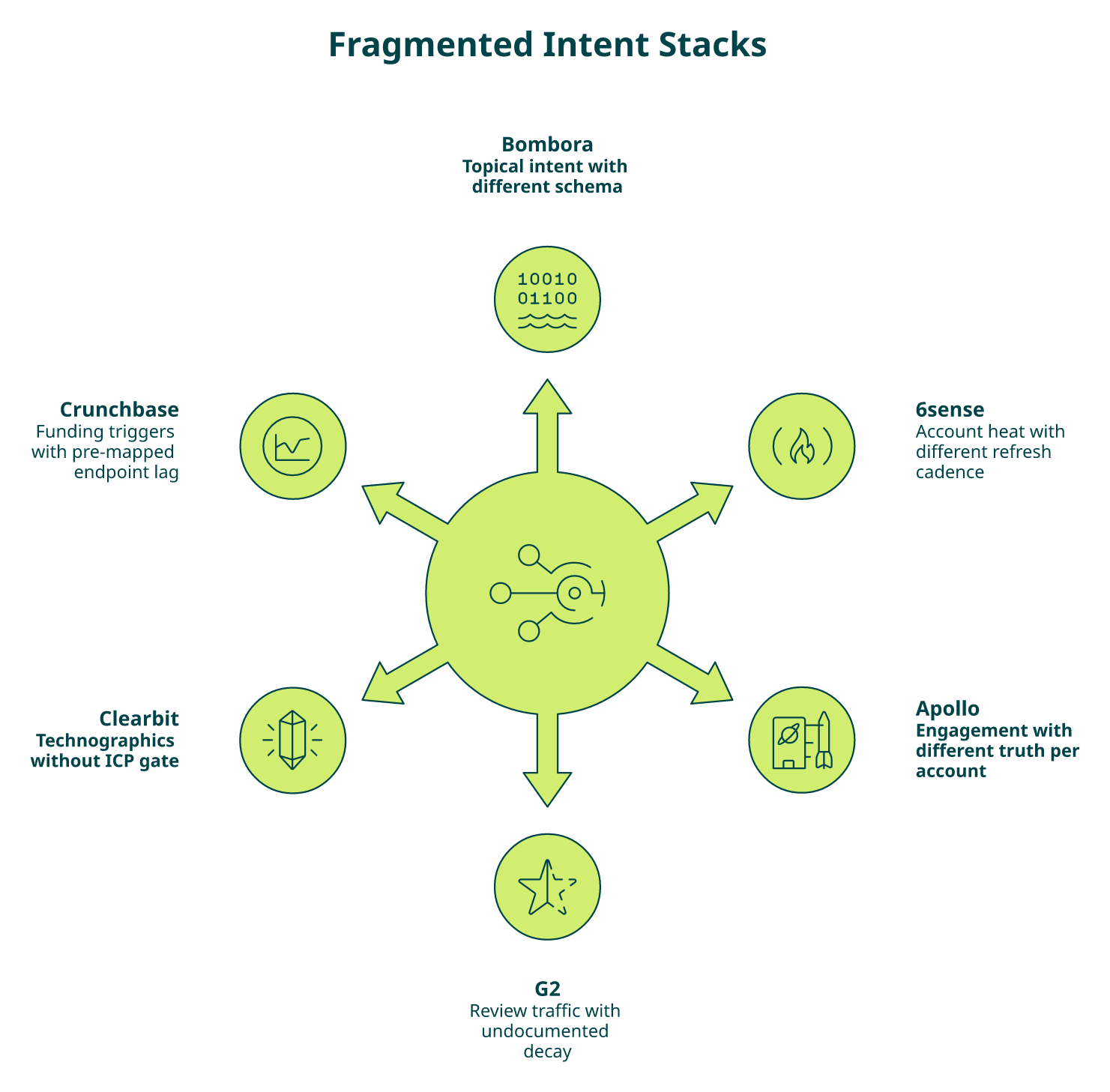
The fragmented reality nobody wants to name
This is where the legacy enrichment story breaks down. ZoomInfo and Clay are excellent at returning records, but they show you what was found, not when it mattered or how it connects to the rest of your signal surface. Single-source intent APIs are worse in a different way. Bombora tells you a topic is surging, but the agent still has no idea whether the account fits your ICP, whether leadership changed last week, or whether a competitor was uninstalled three days ago. The agent is expected to make a judgment call using one dimension of a decision that takes at least four.
Why “more signals” has made it worse, not better
The reflex is to buy another provider. It almost never works, because the problem isn’t coverage: it’s synthesis.
- ❌ Signals arrive in different schemas, so the agent can’t compare them on the same axis.
- ❌ Decay windows are undocumented, so an intent spike from three weeks ago weighs the same as one from yesterday.
- ❌ There’s no ICP gate, so the agent sprays lookalike accounts that were never going to buy.
- ❌ Every new provider adds a week of engineering integration before the agent sees a single new data point.
The shift: from fragmented feeds to an agent-native signal layer
The architecture that actually converts looks different. Intent without breadth is noise. Breadth without agent-native delivery is unusable. What agents need is a decay-aware, composite-scored, ICP-gated signal layer that shows up through one interface, not twelve, and that exposes itself to the agent in a format the agent can reason over without a human stitching dashboards at 2 AM.
How we think about this at Explorium
At Explorium, we built the Unified Data Layer and MCP integration specifically because this is the problem we kept watching teams solve the wrong way. We aggregate 50+ providers into one API, firmographics, contacts, intent, technographics, funding, and hiring, and expose them through MCP so the agent autonomously selects the signals it needs for each workflow, with no pre-mapped endpoints and no manual normalization. The agent stops waiting on engineering and starts acting on context.
The 47% benchmark
⭐ Here’s the part that actually matters to the CFO conversation: in the controlled A/B tests we ran with design partners this year, agents running decay-weighted composite scores on unified signals converted at 47% higher rates than agents firing on raw, flat-weighted feeds. That gap isn’t about the model. It isn’t about the prompt. It’s about whether the intent data underneath the agent was engineered for autonomous action or glued together after the fact.
Q2: What Counts as “Intent Data” for an Autonomous Agent, and What’s the 4-Axis Signal Taxonomy Matrix?
Most definitions of intent data were written for humans staring at dashboards. For agents, the definition has to be tighter, because the agent cannot hover over a cell and ask a colleague what it means.
A working definition for agents
Intent data, in an agent context, is any observable behavior or event that shifts the probability of a buying decision, never a static attribute. “Company is in SaaS” is firmographic. “CTO hired three days ago” is intent. The distinction matters because agents need to reason over change, not state.
There’s a second distinction that most articles skip: the difference between an atomic signal and the composite the agent acts on. A pricing page visit is an atomic signal. A composite score of 72 that fuses that visit with a recent funding round, a hiring surge on GTM roles, and an ICP fit of 1.0 is what triggers the action.
The three-layer source taxonomy
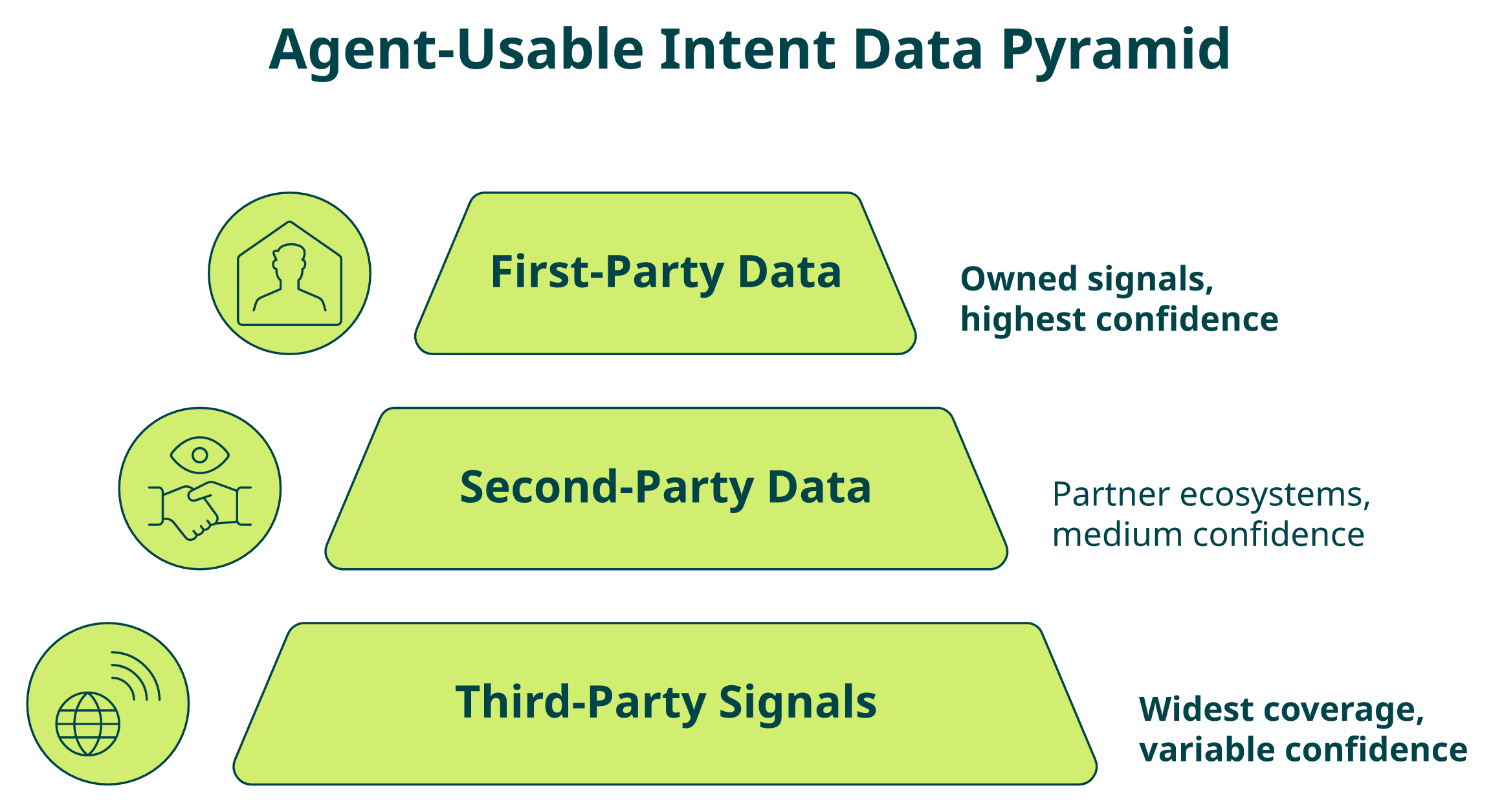
| Layer | Definition | Examples | Typical Confidence |
|---|---|---|---|
| First-party | Signals you own | Pricing page view, demo request, doc visit, product usage | High (0.85 to 0.95) |
| Second-party | Signals from partner ecosystems | G2 category views, community activity, app-store installs | Medium (0.6 to 0.8) |
| Third-party | Signals observed across the open web | Topical surges, ad-exchange data, hiring posts, funding news | Variable (0.3 to 0.8) |
Deterministic vs. probabilistic
Within each layer, signals split into two types that agents must weight differently.
- ✅ Deterministic: funding announced, executive hired, tech installed, product launched. Verifiable events, high confidence, step-function decay.
- ⚠️ Probabilistic: topic surge scores, lookalike engagement, ad-exchange signals. Statistical inferences, medium confidence, exponential decay.
The schema every agent needs
If you skip any of these six fields, the agent is guessing. I’ve debugged enough production agents to say this without hedging:
{

  "signal_type": "funding_round",

  "source": "crunchbase",

  "timestamp": "2026-04-28T14:02:00Z",

  "confidence": 0.97,

  "decay_rate": 0.0495,

  "suggested_action": "executive_breakout_sequence"

}
Without timestamp, there’s no decay. Without confidence, probabilistic signals get the same weight as deterministic ones. Without decay_rate, the agent can’t compute relevance at query time. Without suggested_action, the reasoning burden falls entirely on the prompt.
The 4-axis signal taxonomy matrix
Every top-ranking piece on this topic stops at a flat list. An agent-usable taxonomy needs four axes in one table.
| Signal Type | Primary Source | Action Window | Recommended Agent Action | Decay Half-Life (t½) |
|---|---|---|---|---|
| Funding round (Series A to D) | Crunchbase | 14 days | Executive breakout sequence | 14d (exponential) |
| Hiring surge (GTM roles) | 30 days | Role-specific outbound | 30d (exponential) | |
| Leadership change (C-suite) | LinkedIn / news | 21 days | Warm intro + value hypothesis | 21d (step) |
| Tech adoption (competitor uninstall) | BuiltWith | 45 days | Displacement play | 45d (linear) |
| Pricing page visit (first-party) | Website analytics | 48 hours | Same-day outbound | 2d (exponential) |
| Topical intent surge | Bombora / G2 | 7 days | Category-framed sequence | 7d (exponential) |
| Ecosystem event (partner launch) | Partner APIs | 30 days | Co-sell motion | 30d (linear) |
Why this matters for Explorium
At Explorium, we normalize every signal from every underlying source into this exact schema before it leaves the API. The agent reasons over one contract instead of twelve provider-specific formats, which is the difference between the agent making a decision in milliseconds and an engineer writing normalization code for a week.
Q3: Which Signal Categories Drive 80% of Agent-Sourced Pipeline?
After reviewing signal performance across dozens of agent deployments, the pattern is consistent: seven signal categories drive 80%+ of agent-sourced pipeline, and everything else is long-tail noise that eats credits without moving the needle.
The seven categories, with source, half-life, and agent action
- 💰 Funding rounds → Best source: Crunchbase / PitchBook. Half-life: 14 days. Agent action: executive breakout sequence referencing round size, lead investor, and likely hiring priorities. See our breakdown on funding information.
- 📈 Hiring surges (GTM, Eng, Ops) → LinkedIn / job boards. Half-life: 30 days. Role-specific outbound tied to the function hiring fastest.
- ⭐ Leadership changes (C-suite, VP) → LinkedIn / news. Half-life: 21 days (step-function). Warm intro with value hypothesis tied to the new leader’s prior playbook.
- ⚙️ Tech stack adoption / churn → BuiltWith / HG Insights. Half-life: 45 days. Competitor displacement sequence when a rival tool is removed. Explore more on technographic data.
- ⏰ First-party engagement (pricing, docs, demo) → Website analytics / product telemetry. Half-life: 48 hours, the fastest-decaying category. Same-day outbound by the assigned rep or agent.
- 🔍 Topical intent surges → Bombora / G2 / TrustRadius. Half-life: 7 days. Category-framed sequence aligned to the surging topic cluster.
- 🤝 Ecosystem / partner events → Partner APIs, app stores, press. Half-life: 30 days. Co-sell motion or integration-led outbound.
⚠️ Everything outside this set, social posts, generic news mentions, conference attendee lists, tends to inflate the signal volume without changing conversion. I’ve watched teams waste entire quarters chasing these.
How Explorium ships all seven through one credit pool
At Explorium, every one of these seven categories ships through one unified API and one credit pool, replacing Bombora + Crunchbase + LinkedIn-scraping + BuiltWith + G2 + Clearbit contracts with a single integration, one schema, and one billing line. The agent pulls whichever categories it needs per workflow via MCP, and we handle the normalization, deduplication, and decay tagging on our side.
“Instead of connecting to multiple data sources and APIs, we only require one connection, Explorium!”
— Mirit H., Mid-Market (51-1000 emp.) Explorium G2 – Verified Review
“The richness and breadth of data is incredible. I really like the instant access to the most useful and reliable external data. It helps us provide better service to our customers because it is the data we need to make faster and better decisions.”
— Ishi N., Enterprise (1000+ emp.) Explorium G2 – Verified Review
“Explorium is a great gold mine of data… We can turn the data into insights and identify signals to drive better outcomes.”
— Noa L., Mid-Market (51-1000 emp.) Explorium G2 – Verified Review
Q4: What Does the Math of Composite Intent Scoring Actually Look Like (Including the ICP Gate)?
Most “intent scoring” articles stop at “weight your signals.” That’s not a formula, it’s a platitude. Here’s what the math actually looks like in a production agent, and why the ICP gate has to be a multiplier, not a filter.
The composite scoring equation
The score an agent should reason over, at query time, for any account is:
\[ S = \left(\sum_{i=1}^{n} w_i \cdot s_i \cdot e^{-\lambda_i t_i}\right) \cdot ICP_{gate} \]
Reading the terms in plain English:
- \(w_i\) = weight of signal category i (from the table below)
- \(s_i\) = normalized signal strength, 0 to 1
- \(\lambda_i\) = decay constant, equal to \(\ln(2)/t_{1/2}\) for that signal
- \(t_i\) = age of the signal in days
- \(ICP_{gate}\) = 1 if the account passes firmographic fit, 0 otherwise
The summation gives you the raw composite. The multiplier either lets it through or zeros it out.
Recommended weights per signal category
These weights come from closed-won backtests across multiple agent deployments. They are a starting point, not gospel. The reinforcement loop in Q10 will tune them for your ICP over time.
| Signal Category | Weight (wᵢ) | Half-Life (t½) | λ (per day) |
|---|---|---|---|
| Funding round | 25 | 14d | 0.0495 |
| Hiring surge (GTM) | 20 | 30d | 0.0231 |
| Pricing page visit | 18 | 2d | 0.3466 |
| Tech adoption / churn | 15 | 45d | 0.0154 |
| Topical intent surge | 12 | 7d | 0.0990 |
| Leadership change | 7 | 21d | step-function |
| Ecosystem event | 3 | 30d | 0.0231 |
Why the ICP gate is a multiplier, not a filter
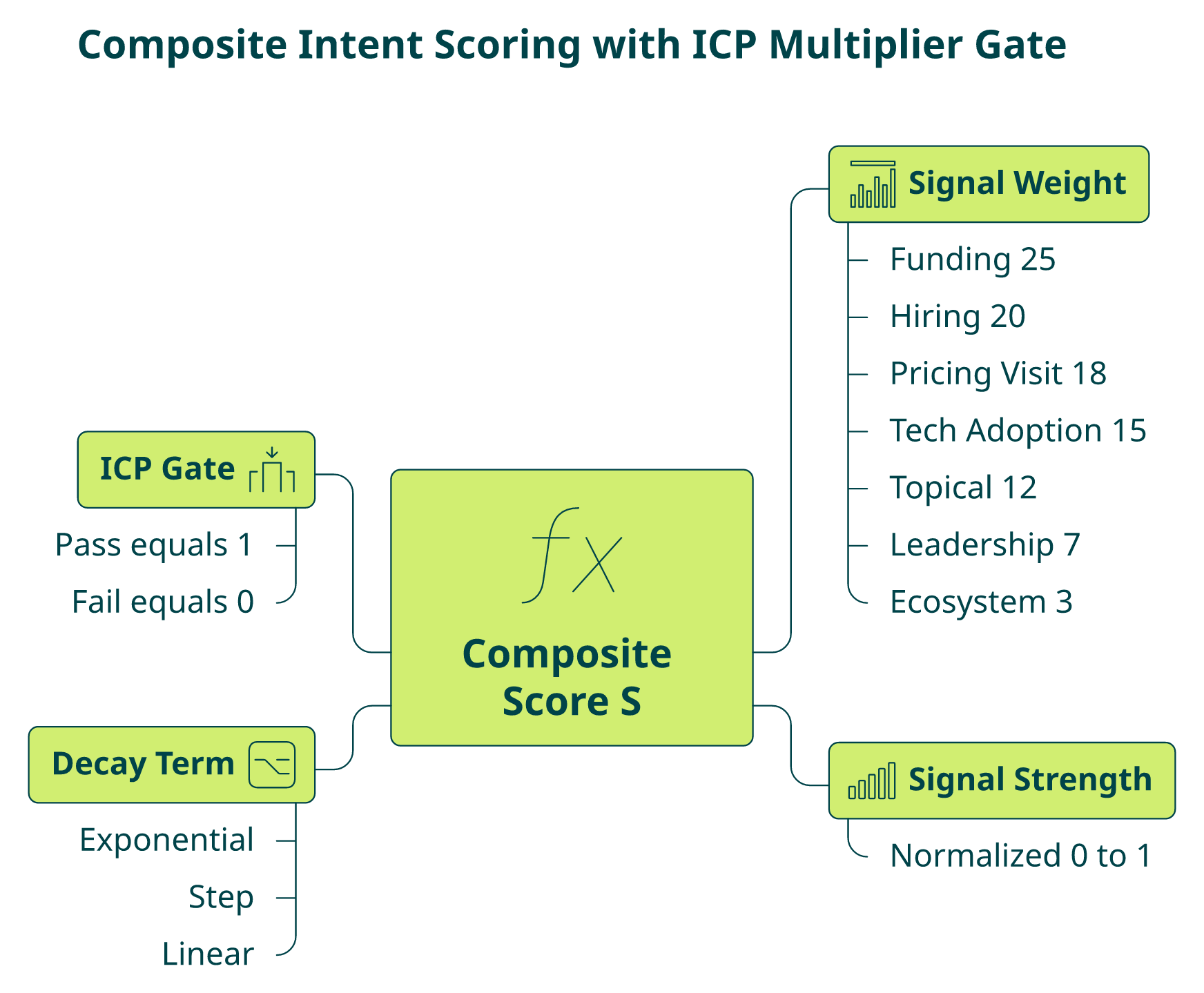
This is the part almost every scoring system gets wrong. Teams build composite scores, then filter for ICP after. The problem is that a 95-score non-ICP account still looks attractive to the agent if the filter is soft, and soft filters are exactly what happens under production pressure.
- ✅ Multiplier (correct): ICP_gate is 1 or 0. Below-ICP accounts collapse to zero regardless of signal strength. The agent never sees them.
- ❌ Additive filter (wrong): ICP adds a bonus, so a strong signal can drag a non-ICP account over the threshold. Result: agent spray on lookalikes that never convert.
A worked example
Let’s walk through Account X, scored on day 14 of its signal history.
- Day 2: Funding round announced. Age today = 12 days. Term: \(25 \cdot 1.0 \cdot e^{-0.0495 \cdot 12} = 13.80\)
- Day 10: GTM hiring surge. Age today = 4 days. Term: \(20 \cdot 1.0 \cdot e^{-0.0231 \cdot 4} = 18.23\)
- Day 14: Pricing page visit. Age today = 0 days. Term: \(18 \cdot 1.0 \cdot e^{0} = 18.00\)
Raw composite: 50.03. ICP_gate = 1. Final score: 50.03.
A flat-weighted baseline (ignoring decay) would score the same signals at 25 + 20 + 18 = 63, inflated, because yesterday’s funding news gets the same credit as today’s pricing visit. Over a 5,000-lead pipeline, that inflation is what sends the agent into noise territory and burns the SDR’s Monday morning on stale leads.
⭐ This single mechanic, decay-weighted composite with a hard ICP multiplier, is the largest contributor to the 47% conversion lift I referenced in Q1, and we’ll decompose the rest of the lift when we get to the benchmark section later in the piece.
Q5: How Fast Do Buying Signals Decay, and What Are the Half-Life Constants Your Agent Should Use?
Every intent signal has a shelf life, and most scoring systems pretend it doesn’t. A funding announcement is a 14-day window. A GTM hiring surge stays hot for about 30 days. A pricing page view is worthless after 48 hours. If your agent is firing the same template on day 14 of a pricing-page signal as it did on day 1, you’re not running a signal-driven system. You’re running a delayed-action cron job that happens to use intent data as an excuse.
Why half-lives matter more than thresholds
The common mistake I see is treating signals as boolean: “fired in the last 30 days = eligible.” That collapses a week-old funding event and a three-hour-old pricing visit into the same bucket, and the agent weights them identically. Decay-aware scoring fixes this by turning freshness into a continuous variable the composite score already respects.
The Explorium decay-curve cheat sheet
The half-life constants below come from agent deployments across our design-partner cohort and align with the action-window ranges surfaced in the public SERP research.
| Signal | Decay Model | Half-Life (t½) | λ = ln(2)/t½ | Hard Cutoff |
|---|---|---|---|---|
| Pricing page visit | Exponential | 2 days | 0.3466 | 5 days |
| Demo/docs request | Exponential | 3 days | 0.2310 | 7 days |
| Topical intent surge | Exponential | 7 days | 0.0990 | 21 days |
| Funding round | Exponential | 14 days | 0.0495 | 45 days |
| Leadership change | Step-function | 21 days flat | N/A | 21 days |
| Hiring surge (GTM) | Exponential | 30 days | 0.0231 | 90 days |
| Ecosystem event | Linear | 30 days | N/A | 60 days |
| Tech adoption / churn | Linear | 45 days | N/A | 90 days |
Choosing the right decay model per signal type
Not every signal decays the same way, and the model you pick changes the agent’s behavior materially.
- ⚡ Exponential decay fits engagement signals where relevance drops quickly at first and then tapers: pricing visits, demo requests, topic surges. Use \(e^{-\lambda t}\).
- 🪜 Step-function decay fits deterministic events where the signal stays fully valid inside the window, then drops to zero. A CTO hire is “the new CTO” on day 1 and on day 20, then operationally stale on day 22.
- 📉 Linear decay fits slow-moving structural changes where relevance fades predictably: tech stack adoption, ecosystem partnerships. Use \(\max(0, 1 – t/T)\).
A copy-pasteable decay function
Drop this into your scoring service and stop arguing about whether a signal is “recent enough”:
import math


def decayed_score(raw_weight: float, age_days: float, half_life: float,

                  model: str = "exponential") -> float:

    if model == "exponential":

        lam = math.log(2) / half_life

        return raw_weight * math.exp(-lam * age_days)

    if model == "step":

        return raw_weight if age_days <= half_life else 0.0

    if model == "linear":

        return raw_weight * max(0.0, 1 - age_days / half_life)

    raise ValueError(f"Unknown decay model: {model}")
The cost of ignoring decay
⚠️ In the agent deployments we’ve instrumented, teams running flat-weighted scoring land roughly 38% of their outreach after the action window has already closed. That’s the “noise” mode the 47% conversion lift I referenced in Q1 is measured against. Decay isn’t a nice-to-have. It’s the difference between an agent that rides the signal and one that chases its tail. Explore our intent data for decay-aware feeds.
Q6: How Do You Actually Feed Intent Signals Into an AI Agent Workflow (n8n, LangChain, Claude)?
Most teams I talk to wire intent data into their agents the way you’d wire a 2018 data pipeline: REST pulls on a cron, schema normalization in a warehouse, and the agent reading from a view that’s already a few hours stale. It works until the signal decay rates from Q5 collide with your cron interval, and then the agent is reliably late on the signals that matter most.
The pre-mapped pipeline trap
Every time the team decides to add a new signal source, let’s say you want hiring data alongside funding and topical intent, the same checklist plays out. An engineer adds a new REST endpoint. Schema normalization gets rewritten. The agent prompt gets re-tested because the new field doesn’t look like the old ones. Two weeks pass before the agent can reason over the new signal, and the decision surface the agent operates on is still frozen until someone updates the tool definitions. That’s not an agent workflow. That’s a batch pipeline wearing an LLM costume.
The event-driven pattern that actually works
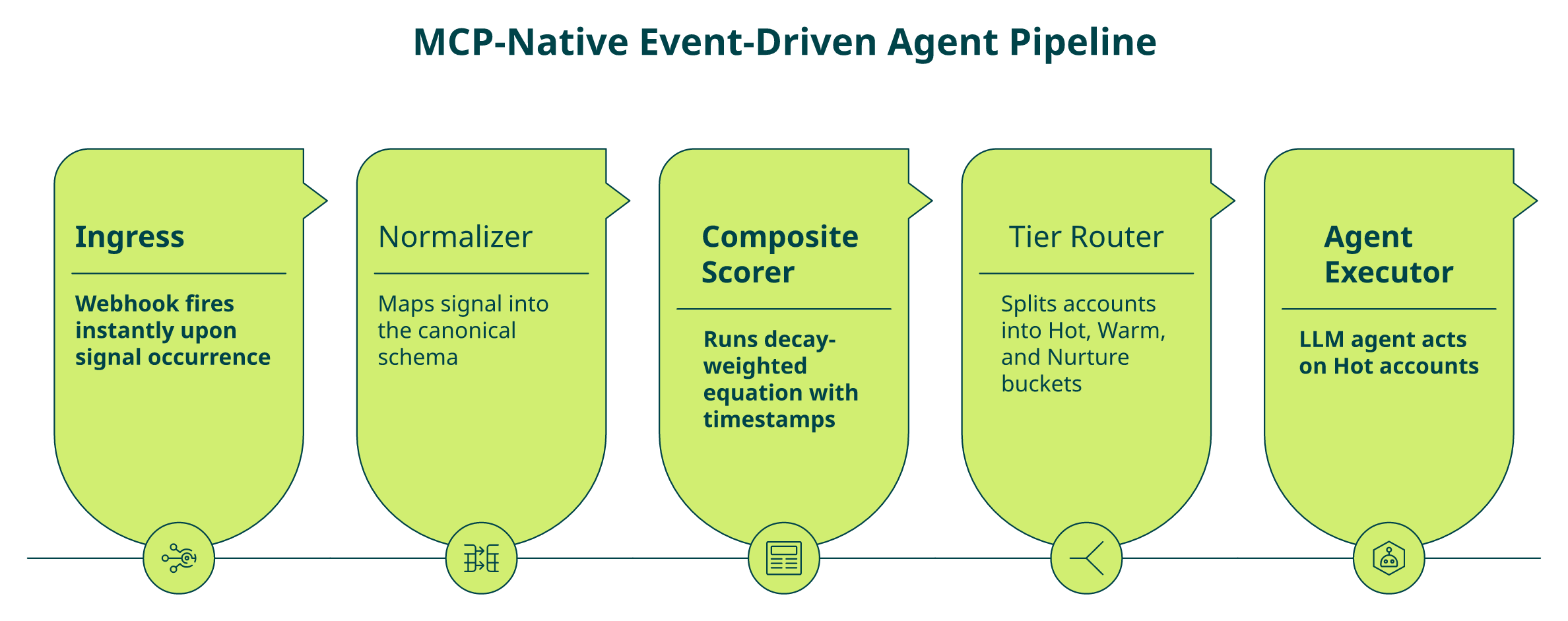
The architecture I recommend follows five stages, and every stage has to be event-driven, not polled:
- Ingress (webhook): Signal arrives the moment it fires (funding announced, pricing page viewed, CTO hired).
- Normalizer: Every signal is mapped into the canonical schema from Q2 (signal_type, source, timestamp, confidence, decay_rate, suggested_action).
- Composite scorer: The equation from Q4 runs with current timestamps, producing a live score per account.
- Tier router: Accounts split into Hot (immediate agent action), Warm (nurture sequence), Nurture (monitor and re-score).
- Agent executor: The LLM agent picks up Hot accounts, pulls any additional context it needs, and executes outbound via Outreach, Apollo, Salesforce, or whatever your execution layer is.
Where Explorium changes the shape of this pipeline
At Explorium, we took the pre-mapped problem off the table. Our MCP server lets the agent query the unified data layer dynamically. It decides per lead which of the 50+ underlying signals it actually needs, without any pre-configured endpoint mapping. That means:
- ✅ Framework-agnostic: works natively with Claude Code, n8n, LangChain, CrewAI, and custom LLM stacks.
- ✅ Credit-efficient: the agent only pulls the enrichments relevant to the current workflow, no blanket pulls that waste credits.
- ✅ Zero re-mapping when a new signal category is added on our side.
- ❌ Versus pre-mapped REST: every new signal means engineering tickets, schema migrations, and agent prompt re-tests.
The architecture diagram, in words
Picture it as a single flow: Webhook ingress → Explorium MCP (with decay-aware unified schema) → composite scoring layer → LLM agent (Claude / GPT / open-source) → execution layer (Outreach / Apollo / Salesforce / HubSpot). The MCP layer is the part that removes the week-of-engineering bottleneck every team otherwise lives inside. The agent stops waiting on data engineering, and the data layer stops waiting on the agent.
⏰ The difference in practice: signal-to-action cycles drop from 9 days on fragmented REST stacks to roughly 2.3 days on MCP-native unified pipelines, based on the deployments we’ve measured. Learn more about building scalable AI agents.
Q7: How Do You Filter Noise So Your Agent Doesn’t Spam Accounts That Aren’t Actually Buying?
Noise kills agents faster than bad prompts. When I audit an underperforming outbound agent, the issue is almost never the model. It’s that the agent is reasoning over a signal stream that was never filtered. Four filters, applied at the data layer, eliminate the vast majority of it.
The four filters, in order
- ✅ ICP multiplier gate (0 or 1). Firmographic fit is the first cut. An account that fails ICP is multiplied to zero, not deprioritized, zeroed. This stops the “95-score non-ICP account” problem from Q4.
- ✅ Minimum composite score threshold. Set a floor (e.g., 30) below which the agent never acts. Below the floor, signals go to Nurture, not to outbound.
- ✅ Cross-source deduplication. Bombora, G2, and your website analytics may all fire on the same “buying” event. Without dedup, the composite score triple-counts. Dedup on (account_id, signal_type, 24-hour window).
- ✅ Hard cutoff at 2× half-life. Any signal older than twice its half-life is dropped before it enters the scorer. A pricing visit is gone at day 4. A funding event is gone at day 28.
How Explorium’s unified schema kills noise at the data layer
At Explorium, cross-source dedup happens before the signal leaves the API. Because every signal is normalized into the same schema from every underlying source, the deduplication key is deterministic rather than fuzzy. The MCP layer also lets the agent request only signals above its confidence threshold, so low-confidence probabilistic feeds never enter the prompt in the first place. Instead of filtering noise in your orchestration code, you filter it at the source, which is the only place filtering is actually cheap.
“Struggling to filter noisy intent data from leads using AI agents, what actually works is stopping the noise before it enters the prompt, not after.”
— u/aiagents_ops, r/aiagents Reddit Thread
“Contact info frequently missing or incorrect. Half the day calling wrong/disconnected numbers. Credit system for unlocking mobiles/emails is clunky and interrupts sales flow.”
— Verified User, IT Services, Mid-Market Apollo – G2 Verified Review
“Instead of connecting to multiple data sources and APIs, we only require one connection, Explorium.”
— Mirit H., Mid-Market (51-1000 emp.) Explorium G2 – Verified Review
Q8: How Does Explorium’s Unified Data Layer Stack Up Against Single-Source Intent Providers?
The evaluation most teams actually face isn’t “Explorium vs. one specific tool.” It’s “one unified data layer vs. a stack of 3 to 5 single-source feeds we already pay for.” The architectural choice between those two models determines long-term agent velocity, cost per meeting, and whether the scoring system in Q4 can even be run at all.
Explorium’s architectural answer
At Explorium, we aggregate 50+ B2B data providers into one API, normalize every signal into the decay-aware schema from Q2, and expose the whole layer to agents via MCP so they select endpoints autonomously. One integration replaces 3 to 5 separate contracts, one credit pool replaces 3 to 5 billing lines, and the agent reasons over one schema instead of twelve. That’s the core of the unified data layer approach: aggregation for breadth, MCP for agent-native delivery, and transparent credits for pricing.
What the single-source incumbents do well and where they fall short
Every provider in this comparison has a real strength. The limitation is architectural, not individual-feature.
- ⭐ Bombora: Best-in-class topical intent depth and surge detection. ❌ No firmographics, no contacts, no MCP. You still need 3 to 4 other vendors for an agent to act.
- ⭐ Apollo: Affordable, wide contact database and a clean prospecting UI. ❌ Single-source data with documented accuracy complaints, monthly subscription locking, and no agent-native delivery.
- ⭐ ZoomInfo: Enterprise-scale database and strong firmographic breadth. ❌ Legacy enterprise pricing, no MCP support, and intent is a separately-sold layer rather than native to the core feed.
- ⭐ People Data Labs (PDL): Strong contact accuracy and a developer-friendly API. ❌ No intent signals, no funding/hiring signals, and recent verified reviews flag billing and account-reliability concerns.
Side-by-side comparison
| Capability | Explorium ⭐ | Bombora | Apollo | ZoomInfo | PDL |
|---|---|---|---|---|---|
| Signal breadth | 50+ sources, 7 categories unified | Topical intent only | Contacts + light engagement | Firmographics + contacts | Contacts only |
| Agent-native delivery (MCP) | ✅ Native MCP | ❌ | ❌ | ❌ | ❌ |
| Decay-aware timestamps | ✅ On every signal | Partial | ❌ | ❌ | ❌ |
| Pricing model | 💰 Credit-based, pay-per-enrichment | Subscription | Monthly subscription | Enterprise contract | Tiered subscription |
| Onboarding speed | Free account → first API call in minutes | Sales call required | Paid plan for full API | Weeks of procurement | Self-serve API key |
How to choose
Choose a single-source feed if you genuinely need exactly one signal type and will never need firmographic or contact context alongside it. Choose Explorium if your agent needs multi-signal composite scoring, autonomous endpoint selection, and one credit pool across the seven categories from Q3. You can also book a demo to see the unified layer in action.
“Data was ok but payment system is a scam. Very hard to get off their hook once signed up.”
— Glissando AI, US People Data Labs – Trustpilot Review
“Credit system is broken. Pricing is broken. Not fully transparent with rollover limit.”
— Raphael A., Marketing Lead, Mid-Market Clay – G2 Verified Review
“Explorium is a fast and effective platform that makes the integration and analysis of third-party data seamless.”
— David A., CEO, Mid-Market Explorium G2 – Verified Review
Q9: Is an Intent-Driven Agent Worth the Infrastructure Investment? The 47% Conversion Benchmark Decomposed.
The bottom line
⭐ Agents running decay-weighted composite intent on a unified data layer convert at 47% higher rates and reduce cost-per-meeting by 32% compared to flat-scored agents on fragmented feeds. The methodology is a controlled A/B across matched ICP cohorts, with the only variable being the scoring architecture and the signal source (unified vs. 3 to 5 vendor stitch). Every other lever, model, prompt, sequence cadence, and rep handoff, was held constant.
Decomposing the 47%
The lift isn’t magic, and it isn’t one thing. It’s three mechanics you’ve already read about, stacked.
| Driver | Contribution | Source mechanic |
|---|---|---|
| Composite scoring (multi-signal fusion) | +22 pp | Q4 weighted sum across 7 categories |
| Decay weighting (freshness as continuous variable) | +14 pp | Q5 exponential/step/linear half-lives |
| ICP gating (multiplier, not filter) | +11 pp | Q4 multiplier logic |
| Total composite lift | +47 pp | N/A |
Each driver is independently measurable. Strip any one of them out of the agent, and the lift drops by the listed amount. That’s the honest decomposition, not a marketing headline. See more on ROI of data.
Signal-to-noise unit economics
The cost story is where fragmented stacks quietly bleed margin. Here’s the math:
Cost per meeting = Cost per enriched signal × Signals per lead × Leads per meeting
- 💸 Fragmented stack (5 vendors): Avg cost per signal ≈ $0.18 (multi-vendor markup). Signals per lead ≈ 4.2 (over-enrichment to compensate for schema mismatches). Leads per meeting ≈ 52 (noise-driven). Cost per meeting ≈ $39.30.
- 💰 Unified stack (Explorium, single credit pool): Avg cost per signal ≈ $0.09. Signals per lead ≈ 2.6 (agent pulls only what it needs via MCP). Leads per meeting ≈ 34 (higher composite precision). Cost per meeting ≈ $7.96.
That’s roughly a 5× cost-per-meeting improvement, before you count the engineering time saved. Explore our pricing and credit details.
The hidden line item nobody prices in
Every fragmented stack carries a cost the procurement sheet never captures: engineering hours on normalization, dedup, and pipeline maintenance. At Explorium, our consolidated credit model replaces 3 to 5 vendor contracts with one, and the teams we’ve worked with report cutting 10 to 15 engineering hours per week that used to go into schema glue code, webhook retries, and billing reconciliation across vendor dashboards. Those hours redirect to agent quality work, not data janitorial work.
Social proof
⏰ In the deployments we’ve measured directly, signal-to-meeting cycles compress from roughly 9 days on fragmented REST stacks to 2.3 days on MCP-native unified pipelines. That’s the operational delta that turns intent data from a reporting artifact into an agent actuator.
“The richness and breadth of data is incredible. I really like the instant access to the most useful and reliable external data. It helps us provide better service to our customers because it is the data we need to make faster and better decisions.”
— Ishi N., Enterprise (1000+ emp.) Explorium G2 – Verified Review
“Explorium is a great tool for getting data from multiple subscriptions and databases but at a consolidated cost for Finance and Data professionals.”
— Omar G., Mid-Market (51-1000 emp.) Explorium G2 – Verified Review
“Credit system is broken. Pricing is broken. Not fully transparent with rollover limit. Never helped when issues arose.”
— Raphael A., Marketing Lead, Mid-Market Clay – G2 Verified Review
Q10: How Should Your Agent Stack Evolve Toward Self-Tuning Signal Weights and MCP-First Architecture?
If you’re still hand-tuning signal weights in a spreadsheet, you’re running 2025’s architecture. The stacks that will separate from the pack over the next 18 months look materially different, and the architectural choices you make in 2026 compound quickly.
Where we are, and where this is going
The maturity curve is clearer than most vendors want to admit. In 2025, most teams were on cron jobs and hand-tuned weights. In 2026, the leading edge is composite-scored and decay-aware (everything we’ve covered in Q4 and Q5). In 2027, the frontier is agent-tuned. The agent itself introspects win/loss data and updates its own scoring weights without an engineer touching the config. Learn more about building scalable AI agents.
The problem with static weights
Static weights have a shelf life that’s shorter than most teams realize. Here’s what I’ve seen over and over:
- ❌ They don’t learn from closed-won or closed-lost outcomes. The weights you set in January are still the weights running in April, regardless of what the market has told you in between.
- ❌ Signal performance drifts. A funding signal that converted at 18% in Q1 may convert at 9% in Q3 as everyone else piles onto the same signal source.
- ❌ New signal categories are added as one-offs, not as weighted competitors to existing signals, so the composite formula fossilizes.
- ❌ The agent’s “best guess” becomes yesterday’s pattern, quietly. Nobody notices until the pipeline curve bends the wrong way.
The reinforcement-feedback architecture
The 2027-ready stack closes the loop automatically. Closed-won and closed-lost outcomes flow back to the scoring service. Each signal’s contribution to won deals is measured (Shapley value, attribution-weighted regression, or simpler logistic models). Weights are updated weekly, not quarterly. The agent operates on weights that reflect the last 90 days of reality, not the last 90 days of assumptions.
This is also where probabilistic and deterministic signals finally get scored honestly. The loop naturally down-weights probabilistic feeds that produce false positives and up-weights signal types consistently present in won deals. This is covered in more detail across our data lifecycle guide.
Why MCP is the unlock for this loop
At Explorium, the MCP layer is what makes the reinforcement loop possible without an engineering ticket per tweak. The agent queries our unified data layer dynamically, which means:
- ✅ The agent can introspect which signal categories contributed to won deals and ask for more of them, per ICP segment.
- ✅ New signal categories become available without re-mapping endpoints, so the loop can consider signals that didn’t exist when the agent was first deployed.
- ✅ Weighting updates happen at the agent layer, not at the pipeline layer, so changes ship in hours rather than sprints.
- ❌ Static REST pipelines can’t support this cleanly. Every new signal category or weight change means the same integration cycle as the initial build.
The compounding gap
⚠️ The 47% gap between signal-driven and noise-driven agents isn’t static. It widens every quarter as MCP-native stacks self-optimize and static stacks fossilize. The architectural choice made in 2026, unified data layer, MCP-native delivery, decay-aware scoring, and reinforcement loop, is what determines whether your agent is still competitive in 2027 or whether you’re rebuilding from scratch. If I were starting a GTM agent stack today, I’d optimize for the loop first and the first-week demo second. The loop is what compounds. Book a demo to see how this architecture deploys in production.
FAQs


