

TL;DR
- Data enrichment adds missing or outdated context to your existing records by matching them against third-party and first-party data sources — turning sparse CRM entries into actionable intelligence.
- There are five core enrichment types: firmographic, technographic, contact, behavioral, and intent — each serving different GTM motions from ICP scoring to personalized outreach.
- Waterfall enrichment cascades through multiple providers in priority order, dramatically increasing match rates while keeping costs low by only calling the next vendor when the previous one fails.
- CRM data decays at roughly 30% per year — job changes, funding rounds, tech stack shifts, and company pivots mean that unenriched data actively degrades pipeline performance over time.
- AI agents and LLM-powered GTM workflows require structured, high-coverage enrichment as grounding context — without it, agents hallucinate company details or route leads incorrectly.
- Measuring enrichment quality means tracking three metrics: match rate (records successfully enriched), fill rate (fields populated per record), and accuracy (validated correctness of returned values).
- Explorium aggregates 50+ data sources in a single unified API, delivering 97.8%+ match accuracy, 150M+ company profiles, and 800M+ people profiles with a shared credit pool for agent-native workflows.
Every B2B go-to-market team faces the same quiet crisis: the data powering their CRM, ad targeting, and outreach sequences is incomplete, stale, or just plain wrong. A lead comes in with only a name and email. An account record is missing industry, headcount, and tech stack. A contact’s title hasn’t been updated since 2022. These gaps aren’t just cosmetic — they directly throttle revenue.
Data enrichment is the process of augmenting your existing records with accurate, up-to-date information drawn from external sources. Done well, it transforms a sparse spreadsheet of email addresses into a layered profile of buyers — complete with company size, technology usage, recent funding events, hiring signals, and behavioral intent. For modern GTM teams, enrichment is no longer a nice-to-have data hygiene task. It’s the foundation on which lead scoring, personalization, AI agents, and revenue operations are built.
This guide explains what data enrichment is, how it works at a technical level, the five types of enrichment that matter most for B2B, when to use waterfall enrichment vs. single-provider approaches, how to measure enrichment quality, and how platforms like Explorium are redefining enrichment for the age of AI-driven GTM.
What Is Data Enrichment? A Clear Definition
Data enrichment — sometimes called data appending or data augmentation — is the process of enhancing existing data records by adding, updating, or validating fields using external data sources. In a B2B context, this typically means taking a record in your CRM, data warehouse, or marketing automation platform and matching it against one or more third-party databases to fill in missing attributes.
The most common starting point is a partial identifier: a company domain, an email address, a LinkedIn URL, or a company name and country pair. Enrichment APIs take that identifier, match it against their internal graph of companies and people, and return structured data fields that didn’t previously exist in your system.
Consider a simple before-and-after example:
| Field | Before Enrichment | After Enrichment |
|---|---|---|
| Company name | Acme Corp | Acme Corp |
| Domain | acme.com | acme.com |
| Industry | (blank) | Software & Technology |
| Employee count | (blank) | 450–500 |
| Annual revenue | (blank) | $42M |
| HQ country | (blank) | United States |
| Tech stack | (blank) | Salesforce, Snowflake, Marketo |
| Recent funding | (blank) | Series B — $18M (Jan 2025) |
| Hiring signals | (blank) | +12 open engineering roles |
| Contact title | Marketing | VP of Demand Generation |
That transformation is the value proposition of enrichment in one table. Every blank field in the “before” column represents a missed opportunity: a lead that couldn’t be scored, an account that couldn’t be segmented, a sequence that had to be generic instead of personalized.
Enrichment differs from data collection (gathering raw data from scratch) and data cleansing (correcting errors or removing duplicates). It specifically means adding net-new attributes to records you already have. In practice, most mature data pipelines combine all three: cleanse first, enrich second, and validate continuously.
For a deeper dive into the mechanics of B2B data enrichment, including how matching algorithms work under the hood, see our dedicated resource guide.
The Five Types of B2B Data Enrichment
Not all enrichment is the same. Different GTM motions require different data types, and understanding the distinctions helps you prioritize where to invest and which providers to evaluate. Here are the five categories that matter most for B2B teams.
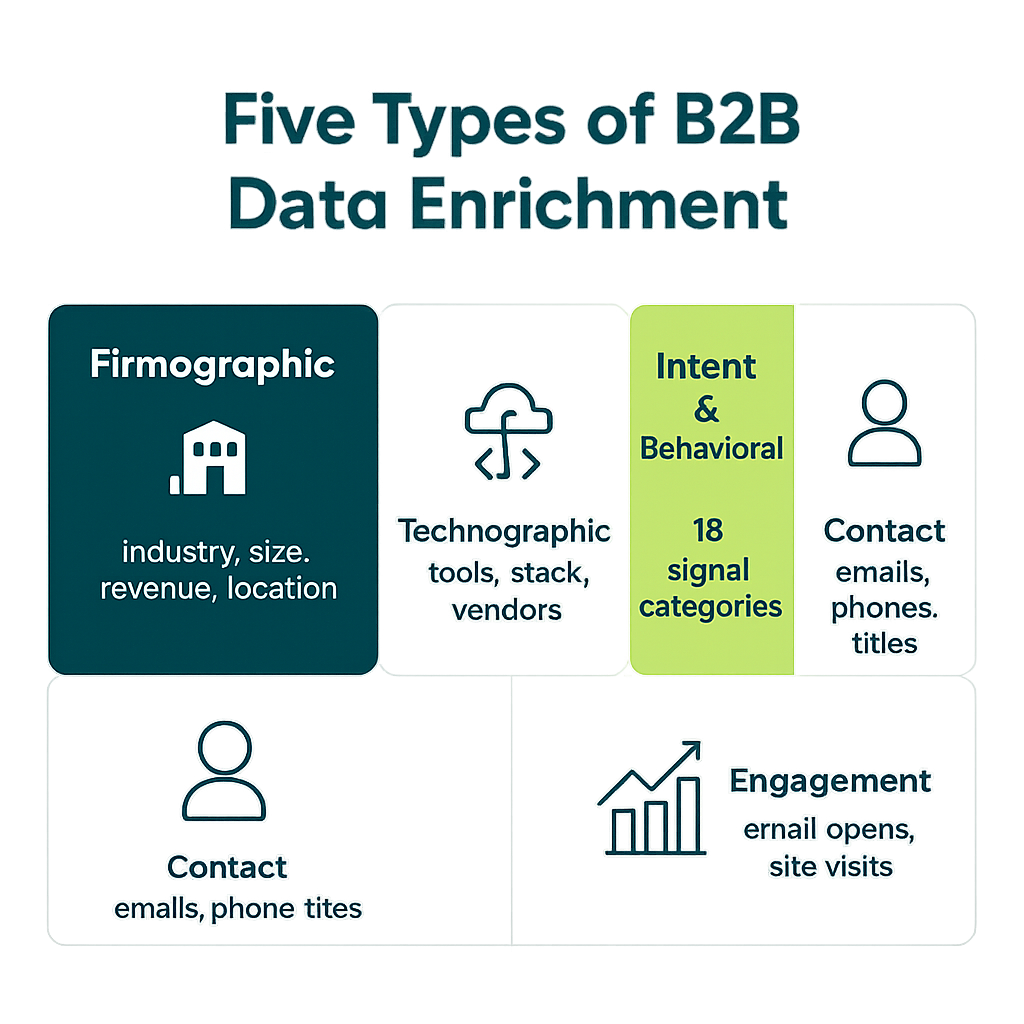
| Enrichment Type | Data Added | Primary GTM Use Case | Key Identifiers Used |
|---|---|---|---|
| Firmographic | Industry, headcount, revenue, HQ location, funding stage, ownership | ICP scoring, account segmentation, territory planning | Domain, company name, country |
| Technographic | Tech stack, installed tools, infrastructure signals, recently added/dropped tools | Competitive displacement, integration-fit scoring, upsell triggers | Domain, IP range |
| Contact | Full name, verified email, direct dial, LinkedIn URL, job title, seniority level | Outbound prospecting, contact discovery, email deliverability | Email, LinkedIn URL, name + company |
| Behavioral | Web visits, content engagement, product usage events, ad interactions | Lead scoring, sales alerts, lifecycle stage detection | Cookie ID, email, IP address |
| Intent | Keyword research activity, review site visits, competitor evaluation signals | Demand generation prioritization, timing outreach to active buyers | Domain, IP, ABM account list |
Firmographic enrichment is the baseline. It tells you what kind of company you’re dealing with — its size, industry vertical, revenue range, funding history, and geographic footprint. This data is essential for ICP filtering and territory segmentation. A record without firmographic data cannot be reliably scored, routed, or prioritized.
Technographic enrichment reveals what software and infrastructure a company uses. For technology vendors, this is enormously valuable: knowing that a target account uses Salesforce (and therefore might be a fit for a Salesforce-native product) or that they recently dropped a competing tool is a powerful trigger for sales outreach. Technographic data is typically sourced from job postings, web scraping, integration marketplace data, and proprietary crawls.
Contact enrichment fills in the human side of your records. Company-level data tells you who to target; contact enrichment tells you who specifically to reach. This includes verified email addresses, direct phone numbers, LinkedIn profiles, job titles, seniority levels, and department mappings. Contact enrichment is the lifeblood of outbound SDR sequences and ABM campaigns.
Behavioral enrichment connects known records to observed online behavior. If a target account has been visiting your pricing page repeatedly, that’s a behavioral signal worth knowing. Behavioral data is often first-party (from your own website or product), but it can also come from third-party intent co-ops that aggregate anonymous traffic across a network of B2B websites.
Intent enrichment — closely related to behavioral but broader — captures signals that a buyer is actively researching solutions in your category. This includes third-party review site visits (G2, Capterra), keyword research spikes, and competitive comparison activity. Intent data for B2B has become one of the most sought-after enrichment layers because it enables GTM teams to prioritize accounts that are actively in a buying cycle rather than spraying outreach across their entire ICP.
Most mature enrichment programs layer all five types together. A fully enriched account record contains firmographic context, technographic fit signals, contact-level reachability data, behavioral engagement history, and real-time intent scores — giving every seller and marketer a complete, current picture before they send a single message.
How Data Enrichment Works Technically
Understanding the mechanics of enrichment helps teams make better architectural decisions about their data pipelines. At its core, enrichment is a matching and retrieval problem: you have a record with partial identifiers, and you want to retrieve all known attributes associated with that record from an external database.
Step 1 — Identifier extraction. The enrichment process starts by extracting the best available identifier from your record. Company domain is the gold standard for account-level enrichment because it’s stable and globally unique. Email address is the most reliable contact-level identifier. Other common identifiers include LinkedIn profile URLs, phone numbers, and company name plus country combinations. The quality of your identifiers directly determines your match rate.
Step 2 — Entity resolution. The enrichment provider runs your identifier against its entity graph, attempting to resolve your input to a canonical entity in its database. This involves fuzzy matching, domain normalization (stripping www, subdomains, etc.), deduplication, and sometimes ML-based disambiguation when multiple entities share similar names or domains.
Step 3 — Attribute retrieval. Once a match is established, the provider retrieves the requested data fields from its database and returns them in a structured response — typically JSON. The response includes field values, confidence scores, and often a timestamp indicating when each field was last verified.
Step 4 — Merge and write-back. Your system merges the returned attributes into the existing record, handling field-level conflict resolution (e.g., should a newly enriched title overwrite an existing one?), null handling, and audit logging. This step is often underinvested but critical for data quality governance.
Here is a minimal Python example showing how to call an enrichment API, process the response, and update a CRM record:
import requests
import json

# Example: enrich a company record using domain as identifier
def enrich_company(domain: str, api_key: str) -> dict:
    """
    Enrich a company record via Explorium's enrichment API.
    Returns a dict of enriched fields or raises on error.
    """
    endpoint = "https://api.explorium.ai/v1/enrich/company"
    headers = {
        "Authorization": f"Bearer {api_key}",
        "Content-Type": "application/json"
    }
    payload = {
        "domain": domain,
        "fields": [
            "industry",
            "employee_count",
            "annual_revenue_range",
            "hq_country",
            "tech_stack",
            "funding_stage",
            "latest_funding_amount",
            "hiring_signals"
        ]
    }

    response = requests.post(endpoint, headers=headers, json=payload)
    response.raise_for_status()
    data = response.json()

    if data.get("match_status") == "matched":
        return data["attributes"]
    else:
        return {}  # No match found — trigger waterfall fallback


# Example usage: enrich a batch of CRM accounts
def enrich_crm_batch(accounts: list, api_key: str) -> list:
    enriched_accounts = []
    for account in accounts:
        domain = account.get("domain")
        if not domain:
            enriched_accounts.append(account)  # Skip — no identifier
            continue

        enrichment = enrich_company(domain, api_key)

        # Merge enrichment into account record (non-destructive)
        merged = {**account}
        for field, value in enrichment.items():
            if not merged.get(field):  # Only fill blank fields
                merged[field] = value

        enriched_accounts.append(merged)

    return enriched_accounts
And here is what a fully enriched JSON record looks like after the API response is merged back:
{
  "record_id": "acct_00842",
  "domain": "acme.com",
  "company_name": "Acme Corp",
  "enriched_at": "2026-05-01T09:14:22Z",
  "match_status": "matched",
  "match_confidence": 0.97,
  "firmographics": {
    "industry": "Software & Technology",
    "sub_industry": "B2B SaaS",
    "employee_count": 470,
    "employee_range": "201-500",
    "annual_revenue_range": "$25M-$50M",
    "hq_country": "US",
    "hq_city": "Austin",
    "founded_year": 2014,
    "ownership_type": "VC-backed"
  },
  "technographics": {
    "crm": ["Salesforce"],
    "marketing_automation": ["Marketo"],
    "data_warehouse": ["Snowflake"],
    "recently_added": ["Gong", "Clay"],
    "recently_dropped": ["HubSpot"]
  },
  "funding": {
    "stage": "Series B",
    "latest_amount": 18000000,
    "latest_date": "2025-01-14",
    "total_raised": 32000000
  },
  "signals": {
    "open_roles": 14,
    "engineering_roles": 12,
    "hiring_growth_90d": "+22%",
    "intent_score": 87,
    "intent_topics": ["data enrichment", "revenue intelligence", "sales automation"]
  },
  "contacts": [
    {
      "name": "Sarah Chen",
      "title": "VP of Demand Generation",
      "email": "[email protected]",
      "email_verified": true,
      "linkedin_url": "https://linkedin.com/in/sarahchen",
      "seniority": "VP",
      "department": "Marketing"
    }
  ]
}
This structured output is what downstream systems — CRMs, scoring models, AI agents, and sequence tools — consume to make intelligent decisions. Without enrichment, these systems operate on guesswork. With it, they can route, prioritize, and personalize at scale.
For teams building multi-step enrichment pipelines, our guide on data enrichment tools covers the technical architecture options in detail.
Why Data Enrichment Matters for B2B GTM
Data enrichment isn’t just a technical exercise — it has direct, measurable impact on pipeline velocity, conversion rates, and revenue outcomes. Here’s why GTM teams treat it as infrastructure rather than a one-time project.
CRM data decays faster than most teams realize. Industry research consistently shows that B2B contact and account data decays at roughly 30% per year. People change jobs, companies raise or spend funding, tech stacks evolve, and organizations restructure. A CRM that was fully enriched eighteen months ago is already significantly degraded. Teams that rely on static enrichment — a one-time import from a data provider — are operating on an increasingly false picture of their market. Continuous enrichment, triggered by time intervals or change events, is the only sustainable answer.
Incomplete data destroys lead scoring models. Most lead scoring frameworks depend on firmographic and technographic attributes: industry, company size, tech stack, funding stage. If 40% of your inbound leads are missing industry or headcount, your scoring model either ignores those leads (costing you pipeline) or scores them incorrectly (wasting sales time). Enrichment dramatically improves scoring coverage and model accuracy by ensuring every record has the attributes the model needs.
Personalization at scale requires structured context. Modern buyers expect outreach that reflects their specific situation — their industry, their tech stack, their recent company milestones. Achieving that personalization manually doesn’t scale. Enrichment provides the structured context that makes personalization systematic: your sequence tool can automatically insert the correct industry pain point, reference the right technology integration, or congratulate the account on its recent funding round — all because that data exists in a structured field.
AI agents and LLM workflows need grounding data. This is the newest and most urgent driver of enrichment demand. AI agents executing GTM tasks — researching accounts, drafting outreach, qualifying inbound leads, prioritizing territories — are only as good as the data they have access to. An agent without enriched account context will hallucinate company details, misclassify leads, or generate generic outreach. Enrichment functions as the factual grounding layer that keeps AI agent behavior accurate and reliable. This is why B2B buying signals and enrichment data are increasingly being architected as retrieval layers for AI systems rather than just CRM fields.
The business case is straightforward. Teams with high enrichment coverage close deals faster, generate more pipeline from the same inbound volume, spend less time on manual research, and build AI workflows that actually work. Teams without it spend more on ads, waste SDR capacity on misqualified leads, and can’t operationalize the AI tools they’ve invested in.
Waterfall Enrichment: How Cascading Multi-Source Lookups Work
No single data provider covers every company and contact in your target market. Coverage gaps are real — a provider that excels at mid-market North American companies might have thin coverage for EMEA SMBs. A provider with deep technographic data might have spotty contact-level information. This reality gave rise to waterfall enrichment, which is now considered best practice for any team that needs high match rates across a diverse ICP.
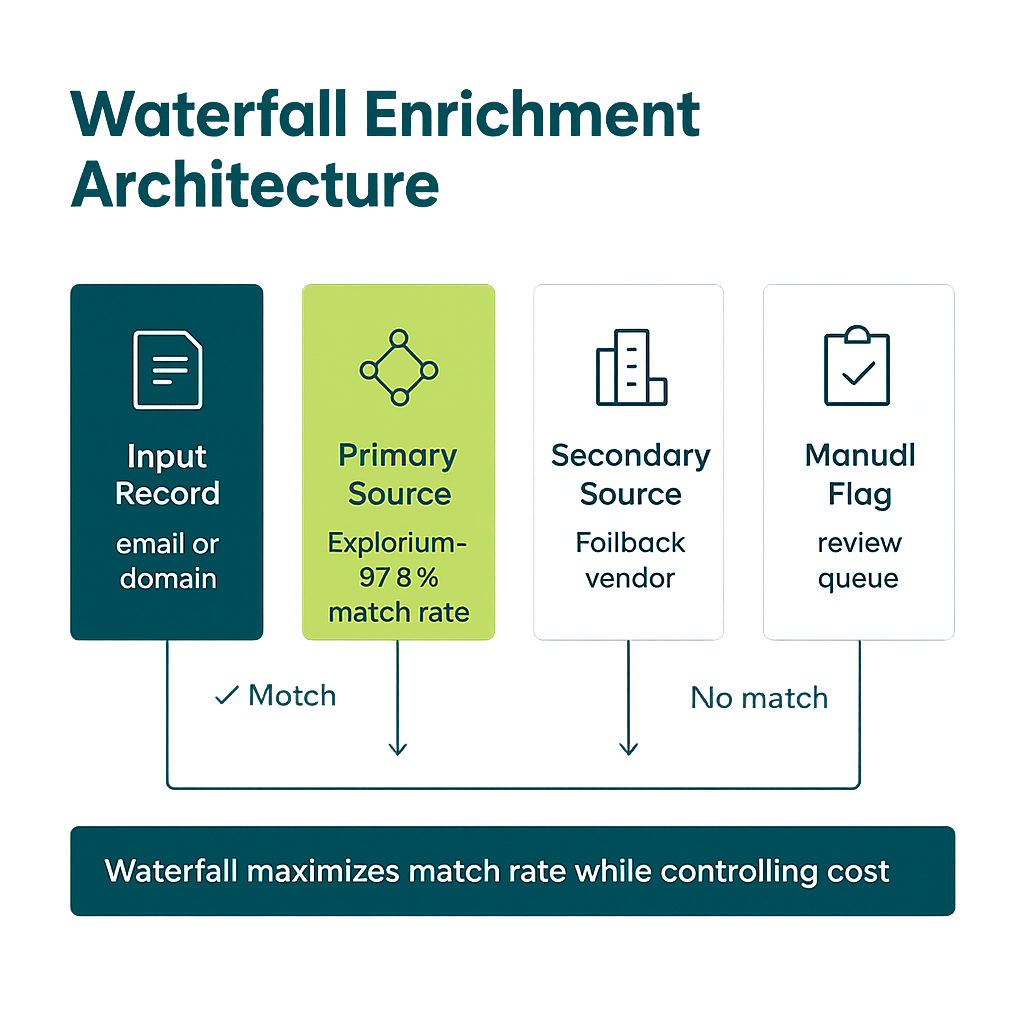
Waterfall enrichment works by defining an ordered sequence of data providers and calling them in priority order until a match is found. When Provider 1 fails to match a record, the system automatically falls through to Provider 2, then Provider 3, and so on. The process stops as soon as a match is returned. This approach yields dramatically higher aggregate match rates than any single provider while keeping costs efficient — you only call subsequent providers when earlier ones fail, so you’re not paying for redundant lookups.
Here’s how a typical waterfall configuration looks for contact enrichment:
| Waterfall Step | Provider Role | Trigger Condition | Typical Match Rate |
|---|---|---|---|
| Step 1 | Primary provider (highest coverage + accuracy) | Always called first | 65–75% |
| Step 2 | Secondary provider (strong in specific geographies) | Only if Step 1 returns no match | +10–15% of remainder |
| Step 3 | Tertiary provider (long-tail coverage) | Only if Steps 1–2 fail | +5–8% of remainder |
| Step 4 | Fallback provider (scraping or niche DB) | Only if Steps 1–3 fail | +2–4% of remainder |
The aggregate match rate after a four-step waterfall is typically 85–95%, compared to 65–75% for a single provider. That 20–30 percentage point improvement in coverage translates directly to more scored leads, more enriched accounts, and more personalized outreach.
Beyond coverage, waterfall enrichment enables field-level logic. Some teams configure waterfalls not just for “match vs. no match” but for specific fields: use Provider 1 for email addresses, Provider 2 for phone numbers, Provider 3 for technographic data. This field-level orchestration extracts the best data from each source rather than accepting whatever a single provider returns.
Managing waterfall logic manually — writing the cascade code, handling rate limits, deduplicating results across providers, normalizing field schemas — is significant engineering work. Platforms like Explorium abstract all of this complexity behind a single API call, running the waterfall internally and returning a unified enriched record regardless of which source or combination of sources contributed each field.
Build vs. Buy: Should You Build Your Own Enrichment Pipeline?
Every data team eventually faces this question. Building a custom enrichment pipeline gives you control over source selection, field mapping, and cost structure. Buying from an enrichment platform trades that control for speed, coverage, and maintenance-free operation. The right answer depends on your team’s scale, technical capacity, and data needs.
| Consideration | Build In-House | Buy from Enrichment Platform |
|---|---|---|
| Time to first enriched record | Weeks to months | Hours to days |
| Maintenance burden | High — schema changes, API versioning, rate limits | Low — provider handles all maintenance |
| Coverage (match rate) | Depends on which APIs you integrate | High — 50+ sources, waterfall built-in |
| Cost predictability | Variable — separate billing per provider | Predictable — unified credit pool |
| Agent/AI integration | Must build retrieval layer separately | API-native, ready for agent workflows |
| Compliance management | Must manage each provider separately | Single DPA, unified compliance layer |
The build case is strongest when you have a very specific niche data need (e.g., enrichment for a specialized vertical not covered by general-purpose platforms), a large engineering team that can absorb the ongoing maintenance cost, or data sensitivity requirements that prohibit sending records to third-party APIs.
For most B2B GTM teams, the buy case wins on economics and speed. The engineering cost of maintaining integrations with even three or four enrichment APIs — handling authentication, rate limiting, schema versioning, error handling, and data normalization — often exceeds the annual cost of a platform subscription. And that’s before accounting for the opportunity cost of engineering time diverted from product work.
The more nuanced answer is “buy the infrastructure, customize the logic.” Platforms like Explorium expose a flexible API that lets you define which fields to enrich, which sources to prioritize, and how to handle conflicts — giving you configurability without the maintenance burden of owning the underlying integrations. See our comparison of leading B2B data providers for a detailed breakdown of provider capabilities.
How Explorium Approaches Data Enrichment
Explorium was built for the era when enrichment isn’t just a CRM hygiene task — it’s the data layer powering AI agents, automated scoring models, and real-time personalization engines. The platform aggregates 50+ data sources into a single unified API, running waterfall enrichment internally so teams get the highest possible match rate without managing multiple provider relationships.
Ready to enrich your B2B data? Explorium aggregates 50+ data sources for CRM enrichment, lead scoring, and AI agent workflows — 150M+ companies and 800M+ people profiles. Start enriching →
Here’s what makes Explorium’s approach distinctive:
50+ data sources, one API. Rather than forcing teams to choose between providers, Explorium aggregates firmographic, technographic, contact, behavioral, and intent data from more than 50 curated sources. Every enrichment request runs against this composite graph, pulling the best-available data for each field from whichever source has the highest confidence value. Teams get the coverage of a multi-vendor stack without the complexity of managing multiple contracts, schemas, and billing relationships.
97.8%+ match accuracy. Accuracy isn’t just about whether a match is found — it’s about whether the returned data is correct. Explorium’s entity resolution layer applies cross-source validation, temporal consistency checks, and confidence scoring to every returned field. Claims that can’t be corroborated across multiple sources are flagged with lower confidence rather than silently passed through as authoritative.
150M+ companies and 800M+ people profiles. Coverage at this scale means that even niche ICPs — small regional businesses, emerging-market companies, non-English-language domains — are represented. Teams targeting diverse geographies or unusual verticals get meaningful match rates rather than the coverage gaps common with narrower providers.
Unified credit pool. Rather than paying separately for each data type or provider, Explorium customers operate from a single credit pool. Credits are consumed only when a successful match is returned, across any combination of firmographic, technographic, contact, or intent enrichment. This model removes the billing complexity of multi-provider stacks and makes cost forecasting straightforward.
Agent-native enrichment. Explorium’s API is designed for programmatic consumption by AI agents, not just human-driven workflows. Agents can call the enrichment API mid-workflow to fetch real-time context about a company or contact, use the response to ground their next action, and continue without human intervention. This design makes Explorium the enrichment layer of choice for teams building LLM-powered GTM systems — from AI SDRs to automated account scoring pipelines. For teams exploring how enrichment integrates with signal-based outreach, our resource on B2B buying signals covers the architecture in detail.
Measuring Enrichment Quality: Match Rate, Fill Rate, and Accuracy
Enrichment is only valuable if the data it returns is correct, complete, and current. Too many teams treat enrichment as a black box — they run a batch job and assume the output is good. Building a measurement framework around three core metrics changes that dynamic and gives you objective visibility into enrichment performance over time.
Match rate is the percentage of input records for which the enrichment provider returns any result. If you submit 10,000 company domains and receive enriched data back for 8,500, your match rate is 85%. Match rate is the first indicator of whether a provider covers your ICP — a provider with 95% overall match rate might drop to 60% for your specific combination of geographies and company sizes. Always measure match rate against your actual ICP, not a provider’s published aggregate statistics.
Fill rate measures how many of the specific fields you care about are actually populated in returned records. A provider might match 90% of your records but only fill the email field for 60% of them. Fill rate should be measured field by field, not in aggregate — knowing that phone numbers have a 45% fill rate while email addresses have an 82% fill rate tells you which providers to use for which fields in your waterfall stack.
Accuracy is the hardest metric to measure but the most important. It answers: when a field is populated, is it correct? Accuracy measurement requires a validation methodology — typically spot-checking against authoritative sources, running A/B tests on enriched vs. non-enriched outreach sequences, or using known-good “golden records” as a benchmark. For email addresses specifically, deliverability rates and bounce rates are objective accuracy proxies. For firmographic data, accuracy degrades over time as companies change — which is why enrichment freshness (the timestamp on each field) should also be tracked.
Teams that operationalize these three metrics — monitoring them on a recurring basis and using them to make provider selection and waterfall ordering decisions — consistently outperform teams that treat enrichment as a one-time setup task. Enrichment quality is not static; it requires ongoing measurement and adjustment.
Common Enrichment Mistakes and How to Avoid Them
Even teams that understand enrichment conceptually often make implementation mistakes that undermine the value of their investment. Here are the most common pitfalls and how to avoid them.
Enriching at ingest only, never refreshing. The most widespread mistake. Teams set up enrichment on their inbound form submission flow and assume records stay current. They don’t. As noted earlier, B2B data decays at roughly 30% per year. A contact who was a Director of Marketing when they submitted a form in 2024 may be a VP at a different company by 2026. Build refresh schedules into your enrichment pipeline — quarterly for firmographic data, monthly for contact data, weekly for intent and signal data.
Overwriting good data with bad enrichment. Enrichment data is not always more accurate than what your team has collected directly. A customer who tells you their actual headcount during a sales call has given you a first-party data point that’s more reliable than a third-party estimate. Build field-level conflict resolution rules that protect high-confidence first-party values: only overwrite blank fields, or overwrite existing values only when the enrichment confidence score exceeds a threshold.
Using a single provider for all use cases. No single provider is best at everything. Relying on one vendor means accepting their coverage gaps as your own. Waterfall enrichment solves this but requires deliberate provider selection. Map your ICP coverage requirements to each provider’s documented strengths before building your stack.
Ignoring compliance requirements. B2B contact enrichment intersects with GDPR, CCPA, and other data privacy regulations. Sending personal data to third-party enrichment APIs requires data processing agreements (DPAs) with each provider. Using enriched personal data for outreach in regulated markets requires a documented legal basis. Many teams treat enrichment as purely a technical problem and ignore the compliance dimension until it becomes a legal issue.
Measuring only match rate, not accuracy. A high match rate with low accuracy is worse than a low match rate — it fills your CRM with confidently wrong data that drives bad scoring decisions and misguided outreach. Always validate accuracy on a sample basis when onboarding a new provider.
Not enriching at the account level before the contact level. Account-level firmographic and technographic enrichment should precede contact-level enrichment in your pipeline. If an account doesn’t fit your ICP after enrichment, there’s no reason to spend credits enriching contacts at that company. Sequence your enrichment logic to filter out non-ICP accounts first, then invest contact enrichment credits only on records worth pursuing.
FAQs


