

TL;DR
- GTM skills are SKILL.md files, plugins bundle them, and MCP connects Claude to live data like a USB port.
- The labor shift moves from UI to API to Agent; research is now a cheap execution step, not a craft.
- Vibe Prospecting leads outbound with an MCP on Explorium's 150M+ companies and 800M+ profiles at 8 credits per enriched contact.
- We frame rivals by structural trade-offs: Apollo is manual, ZoomInfo is locked-in, Clay needs engineering, PDL is raw API, Cognism is data-only.
- Install takes about five minutes; prove a playbook by hand before automating, and keep a human review window.
- A 400-credit, 90-day free trial inside Claude lets you test one workflow end to end before scaling.
Q1. What Is a GTM Skill or Plugin for Claude, and Why Now? [toc=1. GTM Skills Defined]
A GTM plugin for Claude is a packaged set of skills, which means instructions, scripts, and data connections that turn Claude into a go-to-market operator across outbound, SEO, and content. Skills are composable bricks of context the model calls on the fly. Plugins bundle them. MCP, the Model Context Protocol (a shared way for AI to talk to your data), wires Claude to live systems. Together, they let you run a revenue workflow instead of babysitting a dozen browser tabs.
🧱 Skills are Lego bricks, not macros
I think of a skill as a single Lego brick of context. Each brick is one SKILL.md file (a plain text file Claude reads). It holds a name, a trigger, and the steps to follow. Claude snaps the right brick on when the moment calls for it.
A plugin is a box of those bricks shipped together. The official MCP specification defines the port that lets Claude reach live data sources, the way a USB port lets any device plug in. Anthropic’s Claude Code docs describe how skills load on demand inside that environment. This is the same shift we describe in our work on building scalable AI agents and enterprise solutions.
⏰ Why this shift is happening right now
For years, the work was prompt, copy, paste, repeat. Builders call that the tyranny of the prompt. You did one task per message and stitched the rest by hand.
That era is closing. Deep prospect research used to be a premium skill. Now an agent runs it at scale for the cost of a few tokens (the small units that meter AI usage). Research has quietly become a commodity execution step, not a craft, which reshapes the lifecycle of data in agent development.
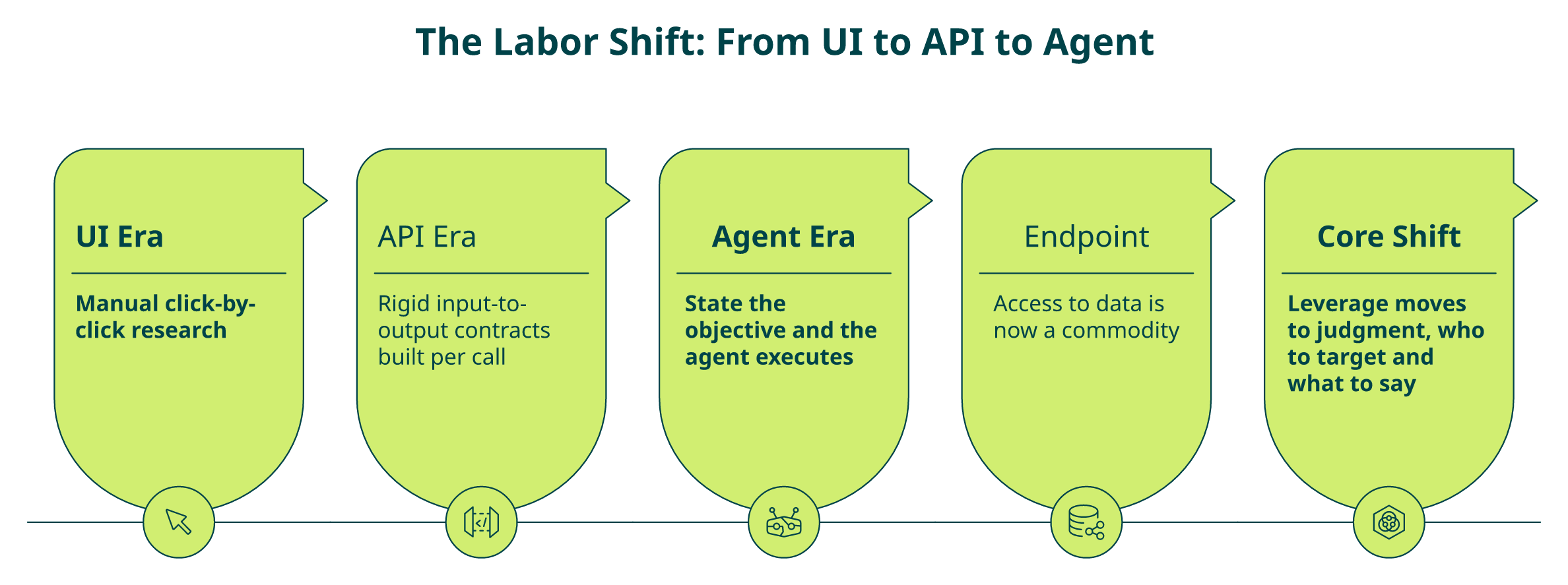
Here is the part I keep coming back to. The labor progression is moving from UI, to API, to Agent. A UI makes you click. An API makes you build. An agent does the grunt work and hands back a result. That is the frame behind how we built Vibe Prospecting, our agent-native prospecting layer inside Claude.
💡 What it means for you on Monday
You stop being the integration. The agent accesses, filters, and assembles. You keep the judgment: who to target, what to say, why now.
People in the r/ClaudeAI community describe building entire GTM packs this way:
“Built a GTM plugin with 166 marketing skills for Claude Code.”
u/thread author, r/ClaudeAI Reddit Thread
I could be early on the timing, but the direction feels settled. The teams I watch are not buying another tool. They are hiring an agent to run the playbook they already trust.
Q2. Skills vs. Plugins vs. MCP: What’s the Difference? [toc=2. Skills vs Plugins vs MCP]
A skill is a single SKILL.md file, which is one capability Claude loads on demand. A plugin bundles many skills into one installable pack. MCP, the Model Context Protocol, is the standardized port that connects Claude to live data like Salesforce, HubSpot, or a B2B database. Skills give Claude know-how. Plugins package it. MCP gives it reach into your actual systems.
🔌 The USB port analogy that finally made it click
Before USB, every device needed its own custom cable. MCP is the USB port for AI. The official MCP specification defines one open standard so any compliant data source can plug into any compliant agent.
So the three layers stack like this. A skill teaches Claude a move. A plugin hands it a toolkit. MCP plugs that toolkit into your live data, which is exactly what our MCP v2 for scaled prospecting was built to do.
<caption>Skill vs Plugin vs MCP</caption>
| Layer | What it is | What it does | Example |
|---|---|---|---|
| Skill | One SKILL.md file | Adds a single capability Claude calls on demand | A “score account fit” skill |
| Plugin | A bundle of skills | Installs many capabilities at once | A 50-skill GTM marketing pack |
| MCP | A connection protocol | Links Claude to live external data | Vibe Prospecting’s connector to Explorium data |
⚙️ API vs. MCP: a rigid contract vs. an open door
Here is the distinction I care about most, and it is structural. An API (a fixed way two systems exchange data) is a rigid input-to-output contract. You send an exact request in the exact shape, and you get an exact response back. An engineer has to build for every call.
An MCP attached to an agent works differently. It accepts input by any path and returns output by any path. You ask in plain language, and the agent figures out the route, the way we describe across our integrations.
That is why we shipped Vibe Prospecting as an MCP, not just an API. Explorium already offers a raw data bundle API for engineers who want to build against it. The MCP exists for people who want the work done, not the plumbing built.
🧩 How they compose in practice
You rarely use one layer alone. A plugin installs a set of outbound skills. One of those skills calls an MCP to pull live company data. Claude orchestrates the whole chain in a single session.
To be honest, the words get used loosely in the wild. People say "plugin" when they mean a single skill, or "MCP" when they mean a connector. The distinction matters when you decide what to install versus what to wire in, which is exactly where the next section starts.
Q3. How Did We Pick the 12 Best GTM Skills and Plugins? [toc=3. Our Selection Method]
We scored every tool on five criteria: whether it is free and open-source, which surface it runs on (Claude Code versus Claude.ai), how deep its GTM coverage goes across outbound, SEO, and content, how fast it installs, and whether it is safe to clone. We tested each install path ourselves. We also flag who each tool is wrong for, not just who it is right for.
📋 The five criteria, and why each one earns its place
I have watched too many roundups rank tools by feature count. That tells you nothing about whether the thing works on a Tuesday. So we held to five practical filters.
- Free and open-source status ✅: can you read the code and clone it without a contract? Open repos let you vet what runs.
- Surface fit 🖥️: does it run in Claude Code (the terminal-style builder) or Claude.ai (the chat app)? The two serve different people.
- GTM depth across the three pillars 📊: does it actually cover outbound, SEO, or content, or just claim to?
- Install speed ⏰: from clone to first useful output. We timed it.
- Clone safety ⚠️: can you trust the source? We checked for vetting signals before running anything.
That last one is not paranoia. Open-source security guides for Claude skills stress reading the SKILL.md before you run it, because a skill can call tools and touch data. The same discipline shapes how we evaluate official Claude connectors.
🔬 What we tested, and what we are still unsure about
We installed each tool and ran one real workflow through it. Experimentation-first is a rule for us, not a slogan. We share what worked and what did not.
Two honest gaps remain. First, we could not fully verify the live data accuracy claims of every vendor plugin from the outside. Second, a skill’s quality depends on your prompt, so your mileage will vary, which is why we stress identifying your ICP and prioritizing optimal leads first.
One principle guided the scoring more than any benchmark. A GTM skill does not need to write the best email on earth. It needs to be pretty good and 100% consistent. Consistency beats an inconsistent human, and that is the bar we measured against.
Where Vibe Prospecting appears in this list, it earns position one in outbound on the same five criteria, not by author’s privilege. The community READMEs we drew the candidate pool from, like the open claude-gtm-plugin repo with 54 skills, set the baseline for coverage.
Q4. What Are the Best GTM Plugins for Outbound Prospecting? [toc=4. Best Outbound Plugins]
For outbound, the best Claude skills do the grunt work: find accounts, enrich contacts, score fit, and draft sequences. Vibe Prospecting leads here. Its MCP connector taps Explorium’s 150M+ companies and 800M+ profiles so Claude builds and enriches lists in chat at 8 credits per fully enriched contact. Vendor plugins from Apollo and ZoomInfo expose their own databases. The winning pattern stays the same: the agent accesses and filters, the human owns targeting and messaging.
😩 The pain: a full day to build one list
An operator once told me she spent a whole Saturday building, reading, and bucketing a list of a hundred companies before sending a single email. That is the tax we set out to remove with B2B leads data.
There is a hidden cost underneath it called data lag, the delay between a buyer signal firing and a rep acting on it. For humans, that gap often runs three days. By the time you act, the moment has cooled, which is why B2B intent data matters.
⚡ The pattern that wins: parallel agents, human judgment
The strongest outbound setups launch several research agents at once. They research companies, find decision-makers, and score opportunities in about a minute. One builder wired a 14-command system that runs a full prospect audit and maps the buying committee automatically.
The grand-slam idea is simple. Access to data is now a commodity. Data quality and judgment are not. So let the agent handle access, filter, enrich, and list-build, and keep yourself on the high-leverage work: who to target, the message, the offer.
📊 Outbound tools at a glance
<caption>Outbound GTM Tools at a Glance</caption>
| Tool | Surface | Free / Open-source | Best for | Not for |
|---|---|---|---|---|
| Vibe Prospecting | MCP connector, chat UI, embeddable MCP | Free trial (400 credits) | Agent-native prospecting in Claude | Raw-API builds; tiny one-off lookups |
| Apollo | UI plugin / app | Free tier, paid plans | Manual human-run list-building | Hands-off autonomous action |
| ZoomInfo | Enterprise platform | No self-serve free trial | Large enterprise data buys | Usage-based, no-procurement starts |
| ColdIQ / outbound repos | Claude Code skills | Open-source | DIY sequence and audit skills | Non-technical chat-only users |
Vibe Prospecting: Best for agent-native B2B prospecting inside Claude
Overview
Vibe Prospecting is agent-native prospecting built on Explorium’s B2B data layer. You describe who you want in plain language, and the agent accesses, filters, and enriches the list inside Claude. We surface it three ways: an MCP connector for Claude Code and other agents, a chat UI, and an embeddable MCP for existing pipelines.
Core Services
- Natural-language account and contact search across 150M+ companies and 800M+ profiles.
- Waterfall enrichment (filling gaps by trying multiple sources in turn) for email and phone.
- Fit and hard filtering in a single pass.
- List-building and export inside Claude.
- Aggregator-of-aggregators sourcing across 50+ providers.
Metrics compared on
- Free and open-source: not open-source; offers a 400-credit free trial valid 90 days.
- Surface: MCP connector, chat UI, and embeddable MCP.
- GTM depth: deep on outbound prospecting and enrichment.
- Install speed: connect the MCP in Claude and authenticate; minutes, no code.
- Clone safety: first-party connector, not a third-party repo to vet.
Why Companies Consider Vibe Prospecting
Buyers pick it when they already work inside Claude and want prospecting to happen there, instead of switching to a separate UI. The decision logic is workflow autonomy: state the objective once, and the agent runs the access-filter-enrich loop. Data quality is the second driver, because waterfall enrichment targets the exact accuracy gap a single database leaves open.
I should be straight about the boundary. Credits apply to Claude today, not ChatGPT, and usage-based credits can burn fast on large enriched exports, so validate with samples before you export big.
Ideal Customer Profile
- Company size: solo operators through mid-market revenue teams.
- Geography: global B2B corporate contacts.
- Buyer role: founders, SDRs, AEs, RevOps, recruiters, and analysts.
- Prospecting volume: ongoing list-building, not one-off lookups.
- Decision-maker: founder or GTM/RevOps lead.
Commercial Model
Usage-based credits, from $19/mo. A free trial gives 400 credits valid 90 days. A fully enriched contact (prospect plus email plus phone) costs 8 credits. Paid credits are valid 12 months, are non-refundable, and do not roll over. Credits apply to Claude today, not ChatGPT. Full details sit on our pricing page.
Customer Reviews
“What I like best is the ability to use natural language logic instead of rigid filters… it finds the specific high-footfall venues like stadiums and universities where our operational speed is a unique selling point.”
Tristan W. Vibe Prospecting G2 Verified Review
“Vibe Prospecting solves the tunnel vision problem that usually happens with traditional, rigid search filters… it provides a massive headstart when entering new markets, allowing me to map out an entire region and identify key decision-makers in minutes rather than days.”
Verified reviewer Vibe Prospecting Trustpilot Verified Review
Apollo: Best for affordable, human-run list-building
Overview
Apollo is an all-in-one UI built for humans to search and filter prospects manually. It pairs a contact database with email and CRM features. It sits in the sales-intelligence category as a do-it-yourself workspace, not an autonomous agent.
Core Services
- Contact and company search with multiple filters.
- Email verification and outreach sequencing.
- Built-in CRM to track replies and calls.
- LinkedIn prospecting and phone data.
- Credit-based unlocking of emails and mobiles.
Metrics compared on
- Free and open-source: not open-source; free tier plus paid plans.
- Surface: web UI and app, with a Claude plugin available.
- GTM depth: broad on outbound; you run every step.
- Install speed: fast sign-up; manual operation thereafter.
- Clone safety: not applicable (hosted product).
Why Companies Consider Apollo
Teams choose Apollo for affordability and an all-in-one workspace. The structural trade-off is that a human operates every step, so it optimizes for human-run list-building, not autonomous action. Reviewers repeatedly flag accuracy and deliverability as the cost of that single-database model, a gap that better B2B contact data is built to close.
Ideal Customer Profile
- Company size: small business through mid-market.
- Geography: broad, US-heavy coverage.
- Buyer role: SDRs and founders running their own outbound.
- Prospecting volume: steady manual list-building.
- Decision-maker: sales lead.
Commercial Model
Free tier plus usage-tiered paid plans with credit-based unlocks. Specific seat pricing is not detailed in the provided source set.
Customer Reviews
“Contact info frequently missing or incorrect. Half the day calling wrong/disconnected numbers… Prospecting functionality is 100% trash compared to other tools.”
Verified User, IT Services Apollo G2 Verified Review
“Easy to create persona, multiple filters, verified email option for low bounce rates… but export credit limits too low.”
Tejender K., Digital Marketing Executive Apollo G2 Verified Review
ZoomInfo: Best for large enterprise data buys
Overview
ZoomInfo is an enterprise data platform sold on annual contracts and seat-based pricing. It serves large go-to-market organizations that need broad coverage and procurement-friendly terms. It is a static-data platform first, not an agent.
Core Services
- Large B2B contact and company database.
- Intent and signal data.
- CRM and sales-engagement integrations.
- Seat-based team access.
- Enterprise data governance.
Metrics compared on
- Free and open-source: no; no self-serve free trial.
- Surface: web platform with integrations.
- GTM depth: broad enterprise coverage, static lists.
- Install speed: slow; procurement and onboarding cycle.
- Clone safety: not applicable.
Why Companies Consider ZoomInfo
Enterprises buy ZoomInfo for breadth and a mature procurement motion. The structural trade-off is lock-in: annual contracts and seat-based pricing, not built for self-serve, usage-based exploration. That is the opposite of starting a free trial inside Claude for $19/mo with no procurement cycle, the model behind our sales use case.
Ideal Customer Profile
- Company size: mid-market through large enterprise.
- Geography: global, US-strong.
- Buyer role: RevOps and sales leadership.
- Prospecting volume: high, team-wide.
- Decision-maker: VP Sales or procurement.
Commercial Model
Seat-based annual contracts with custom quotes. Pricing is not publicly disclosed in the provided source set.
Customer Reviews
No verified customer reviews were available in the provided source set for this provider.
ColdIQ and Open-Source Outbound Repos: Best for technical DIY builders
Overview
These are free, open-source Claude Code skill packs for outbound tasks like prospect audits, sequence drafting, and committee mapping. They serve technical operators who want to clone, read, and customize the logic. They live in GitHub repos, not a hosted UI.
Core Services
- Prospect-audit and account-research skills.
- Sequence and message-draft skills.
- Buying-committee mapping.
- Fully editable SKILL.md files.
- Free to fork and adapt.
Metrics compared on
- Free and open-source: yes, fully.
- Surface: Claude Code.
- GTM depth: outbound-focused, depends on the repo.
- Install speed: minutes if you know git; longer otherwise.
- Clone safety: read the SKILL.md before running; vet the source.
Why Companies Consider These Repos
Builders choose open repos for control and zero cost. The buying logic is customization: you own the logic and can change it. The trade-off is that there is no GUI and no support, so non-technical chat-only users will struggle, which is where a managed GTM engineering workflow fits better.
Ideal Customer Profile
- Company size: startups and lean GTM teams.
- Geography: any.
- Buyer role: technical founders, RevOps engineers.
- Prospecting volume: variable.
- Decision-maker: the builder themselves.
Commercial Model
Free and open-source. No commercial pricing.
Customer Reviews
No verified customer reviews were available in the provided source set for this provider.
Q5. Which Claude Skills Are Best for SEO and AI Search (GEO/AEO)? [toc=5. Best SEO and GEO Skills]
The best SEO skills for Claude run audits, build keyword and schema markup (code that helps search engines read your page), and score how discoverable your pages are inside AI answers (GEO/AEO). Open packs like SearchFit SEO and Infrasity’s skills clone in minutes and run from Claude Code. The shift worth noting: being cited by an AI engine now matters as much as ranking on a results page.
🔍 What SEO skills actually automate
An SEO skill takes the repetitive parts off your plate. It audits a page, finds keyword gaps, drafts meta tags, and writes schema markup. You point it at a URL, and it returns a checklist instead of a blank page.
GEO and AEO are the newer jobs. GEO means Generative Engine Optimization, tuning a page so AI engines quote it. AEO means Answer Engine Optimization, the same idea for answer boxes. A good skill scores how quotable your page is, not just where it ranks, which connects to broader trends and innovations in AI-driven data products.
🧰 The named skills worth cloning
A few stand out, and they are easy to label by surface and license.
<caption>Top SEO and GEO Skills for Claude</caption>
| Skill | Surface | Free / Open-source | Does |
|---|---|---|---|
| SearchFit SEO | Claude.ai plugin | Free | Audit, strategy, markup, visibility |
| Infrasity SEO/GEO skills | Claude Code | Free, open-source | Doc audits, AI-discoverability scoring |
| Anthropic marketing pack | Claude Code | Open-source | SEO, content, and CRM skills |
SearchFit SEO ships as a free toolkit for audit, keywords, and visibility. Infrasity’s open skills score AI discoverability and run from Claude Code. The Anthropic-aligned marketing pack bundles SEO alongside content and social.
⚡ Why GEO is the real battleground now
Here is where my head is right now. The ranking page is no longer the only finish line. When a buyer asks an AI engine a question, you want your page to be the source it quotes.
That shift rewards one thing above tactics: signal intelligence, the quality of the underlying data and structure you feed the engine. The most reliable predictor of success I see is the quality of that signal layer built before any automation runs, the same principle behind scalable AI agents and data quality.
I want to be honest about scope. SEO is not Vibe Prospecting’s home turf; we built it for B2B marketing and prospecting, not content ranking. But the same principle holds across both. Get the intelligence layer right first, and the skills on top do far more useful work.
Q6. What Are the Best Claude Skills for Content and Creative Work? [toc=6. Best Content Skills]
The best content skills for Claude turn a brief into a draft, repurpose long-form into social posts, and enforce brand voice. The teams that win do not chase the perfect email. They ship a draft that is pretty good and 100% consistent, then keep a human review window of 15 seconds to 10 minutes before anything goes out. Consistency, not brilliance, is the edge.
✍️ What content skills take off your plate
A content skill is a repeatable writing job in a file. It drafts from a brief, turns one article into ten social posts, and checks every line against your brand voice. You bring the angle. It handles the volume.
I think about this with a simple split called the 10/80/10 rule. You spend 10% on the idea, Claude does 80% of the heavy lifting, and you spend the final 10% on the sniff test. The human bookends the work; the agent fills the middle, much like how marketers predict customer behavior using external data.
🧰 The named content skills worth cloning
These cluster well by surface and license.
<caption>Top Content and Creative Skills for Claude</caption>
| Skill | Surface | Free / Open-source | Does |
|---|---|---|---|
| Corey Haines marketing skills | Claude Code | Open-source | Briefs, drafts, repurposing |
| Anthropic marketing pack | Claude Code | Open-source | Content, social, CRM |
| Content packs (directories) | Claude.ai / Code | Mostly free | Templated drafts and outlines |
Curated directories list these with real install paths and build-your-own notes. The Corey Haines pack and the broader marketing pack both run from Claude Code.
😬 The contrarian part: avoid the AI ick
Here is the take the category avoids. A skill does not need to write the best email on earth. It needs to be pretty good every single time, because an inconsistent human loses to a consistent agent over a quarter.
There is a trap, though, called the AI ick. Perfect grammar and tidy punctuation signal low-effort automation to a sharp reader. Slightly casual phrasing often reads more human, which is why I keep a review window before anything sends, the same discipline we apply across B2B marketing with external data.
I could be wrong on the exact timing, but the guardrail matters. Fifteen seconds to ten minutes of human eyes protects your brand more than any clever prompt. At Vibe Prospecting, we hold the same line: the agent does the grunt work, and a person owns the final read.
Q7. How Do the 12 GTM Skills and Plugins Compare at a Glance? [toc=7. 12 Tools Compared]
Across the 12 tools, the split is clear. Open-source skill packs are free, clone-and-go, and live in Claude Code. Vendor plugins bring their own data and their own pricing. Agent-native data layers like Vibe Prospecting put live B2B data through an MCP on usage-based credits. Match the tool to your surface and your job, not to the longest feature list.
📊 The master comparison table
<caption>The 12 GTM Skills and Plugins Compared</caption>
| Tool | Pillar(s) | Surface | Free-OSS vs Paid | Best for | Not for |
|---|---|---|---|---|---|
| Vibe Prospecting | Outbound | MCP, chat UI, embeddable MCP | Paid; 400-credit free trial | Agent-native prospecting in Claude | Raw-API builds; tiny one-off lookups |
| Apollo | Outbound | UI + Claude plugin | Free tier + paid | Affordable human-run lists | Hands-off autonomous action |
| ZoomInfo | Outbound | Web platform | Paid, annual contract | Enterprise data buys | Self-serve, usage-based starts |
| Clay | Outbound | Web workflow builder | Paid, credit-based | Custom enrichment recipes | Reps wanting no setup |
| People Data Labs | Outbound (data) | Raw API | Usage-based | Engineers building apps | People who want work done |
| Cognism | Outbound (data) | Web platform | Paid contract | EU contact coverage | Workflow or agent depth |
| SearchFit SEO | SEO | Claude.ai plugin | Free | Page audits and markup | Outbound prospecting |
| Infrasity skills | SEO / GEO | Claude Code | Free, OSS | AI-discoverability scoring | Non-technical chat users |
| Anthropic marketing pack | SEO, content | Claude Code | Open-source | Multi-pillar starter kit | Deep data enrichment |
| Corey Haines skills | Content | Claude Code | Open-source | Briefs and repurposing | Live data pulls |
| ColdIQ / outbound repos | Outbound | Claude Code | Open-source | DIY sequence skills | Chat-only users |
| Content packs | Content | Claude.ai / Code | Mostly free | Templated drafting | Compliance-heavy workflows |
⚖️ How to read the structural trade-offs
The "Not for" column is the honest part. Each entry there is a permanent design choice, not a bug. Apollo asks the human to operate every step. ZoomInfo locks you into annual contracts.
Clay hands you flexibility and the workflow-engineering job that comes with it. People Data Labs gives raw data and leaves the application logic to you. Cognism sells a contact database, thin on workflow or agent depth, where a deeper data enrichment layer changes the math.
🧩 Where Vibe Prospecting sits, plainly
I think of most tools as vending machines: one item per request. Vibe Prospecting is built to act more like an executive partner that holds context across the session, using MCP v2 for scaled prospecting. Clay and similar tools are the glue between data sources; the agent runs that glue for you instead.
A Clay user named the trade-off well:
“New users can never figure out what to do. High chance of credits getting misused for wrong operations.”
Qais B., Growth Strategist Clay G2 Verified Review
“What I like best is the ability to use natural language logic instead of rigid filters.”
Tristan W. Vibe Prospecting G2 Verified Review
One caveat I will not bury: Vibe Prospecting credits apply to Claude today, not ChatGPT.
Q8. How Do You Install a GTM Skill or Plugin in Claude? [toc=8. Install Guide]
Installing a GTM skill takes about five minutes. In Claude Code, you clone the repo, drop the SKILL.md into your skills folder, and call it with a slash command. In Claude.ai, you upload the skill file directly. To add live data, you connect an MCP server. For Vibe Prospecting, you add the MCP connector and authenticate, and Claude can prospect in chat.
💻 The Claude Code path (for builders)
Claude Code is the terminal-style version of Claude. If you can run a few commands, you are set. Each step below has a clear outcome.
- Clone the repo. You now have the skill files locally.
- Move the SKILL.md into your skills folder. Claude can now see it.
- Open Claude Code and call the skill with a slash command. It runs.
Anthropic’s Claude Code docs describe this load-on-demand model in full, and our own guide to the top official Claude connectors shows where prospecting fits.
🖱️ The Claude.ai path (for non-coders)
No terminal needed here. This is the path for founders and operators who live in the chat app.
- Open the SKILL.md file in any text editor and copy it.
- In Claude.ai, upload the file to your project. Claude reads it on demand.
- Ask Claude to use the skill in plain language. It applies the steps.
🔌 Connecting an MCP for live data
A skill gives Claude know-how. An MCP gives it reach into live data. For prospecting, you connect the Vibe Prospecting MCP, authenticate, and ask in plain language, the same flow you can test in our MCP playground.
One tactic saves you grief. Keep a claude.md file in your project as the kitchen bible: your brand rules, ICP, and standards the agent reads before each session. That habit pairs well with a clear approach to identifying your ICP and prioritizing optimal leads.
I want to be straight with the non-coders reading this. You do not need API docs or a developer to start. When we first wired Vibe Prospecting into Claude as a connector, the whole point was that you state the objective and the agent handles the plumbing.
Q9. Can You Build Your Own GTM Skill and Bootstrap Your Brand Context? [toc=9. Build Your Own Skill]
Yes. A GTM skill is just a SKILL.md file: a name, a description of when to use it, and the steps Claude should follow. Use a bootstrap command to load your brand context, ICP (Ideal Customer Profile), and product briefs once, so every session starts informed. Build your own when an existing pack does not fit. But prove the playbook works by hand first, because handing an unproven process to an agent only scales the mistakes.
🧱 The anatomy of a skill
A skill is shorter than most people expect. You write a name, a trigger line, and the steps. Claude reads it and follows along.
A simple structure I like is RTO: Role, Task, Output. You tell the agent who it is, what to do, and what to return. This mirrors how we think about the lifecycle of data in agent development.
The Explorium GitHub holds working examples you can fork and adapt, and our no-code data enrichment pipelines show the same build-once, reuse-often pattern.
🚀 Bootstrapping your brand context
The bootstrap step is where most people skip and later regret it. You load your brand voice, ICP, and product briefs into the project once. Then the agent starts every session already knowing your business, much like how you would identify your ICP and prioritize optimal leads.
Keep a claude.md file as the kitchen bible. It holds your behavioral rules and standards. The agent absorbs it before each run, so you stop re-explaining yourself.
Builders in the r/ClaudeAI community share their own skill setups openly:
“I solved this by having all of my skills backend into an AI-SKILLS GitHub repo. This lets me continuously improve skills across any project.”
u/thread author, r/ClaudeAI Reddit Thread
⚠️ Prove the playbook before you automate it
Here is the guardrail I will not soften. Buying or building a skill for a process you have never run by hand does not help. It just produces bad output faster.
I think about the token budget (the metered cost of running the model) as a salary line, not a software subscription. You are hiring execution. When one founder found that off-the-shelf software was too dated, she vibe-coded a small custom agent instead, proving the workflow first, then letting the agent run it, the same discipline behind building scalable AI agents on quality data.
Where my head is right now: start by writing down the steps you already take. If you cannot describe the playbook in plain language, the agent cannot either.
Q10. Which GTM Skill Is Right for You? A Persona-Based Decision Guide [toc=10. Pick by Persona]
Pick by who you are. A solo founder or job seeker with no setup appetite should start in a chat UI. An SDR, AE, or RevOps person already living in Claude should add an MCP connector, so prospecting happens where they work. A technical or RevOps team wiring data into pipelines should embed the MCP, instead of engineering against a raw API. Match the surface to your job, then layer skills on top.
🧭 Route yourself by tier
Most roundups hand you a list and wish you luck. I would rather route you. Vibe Prospecting comes in three surfaces, and each one maps to a real person.
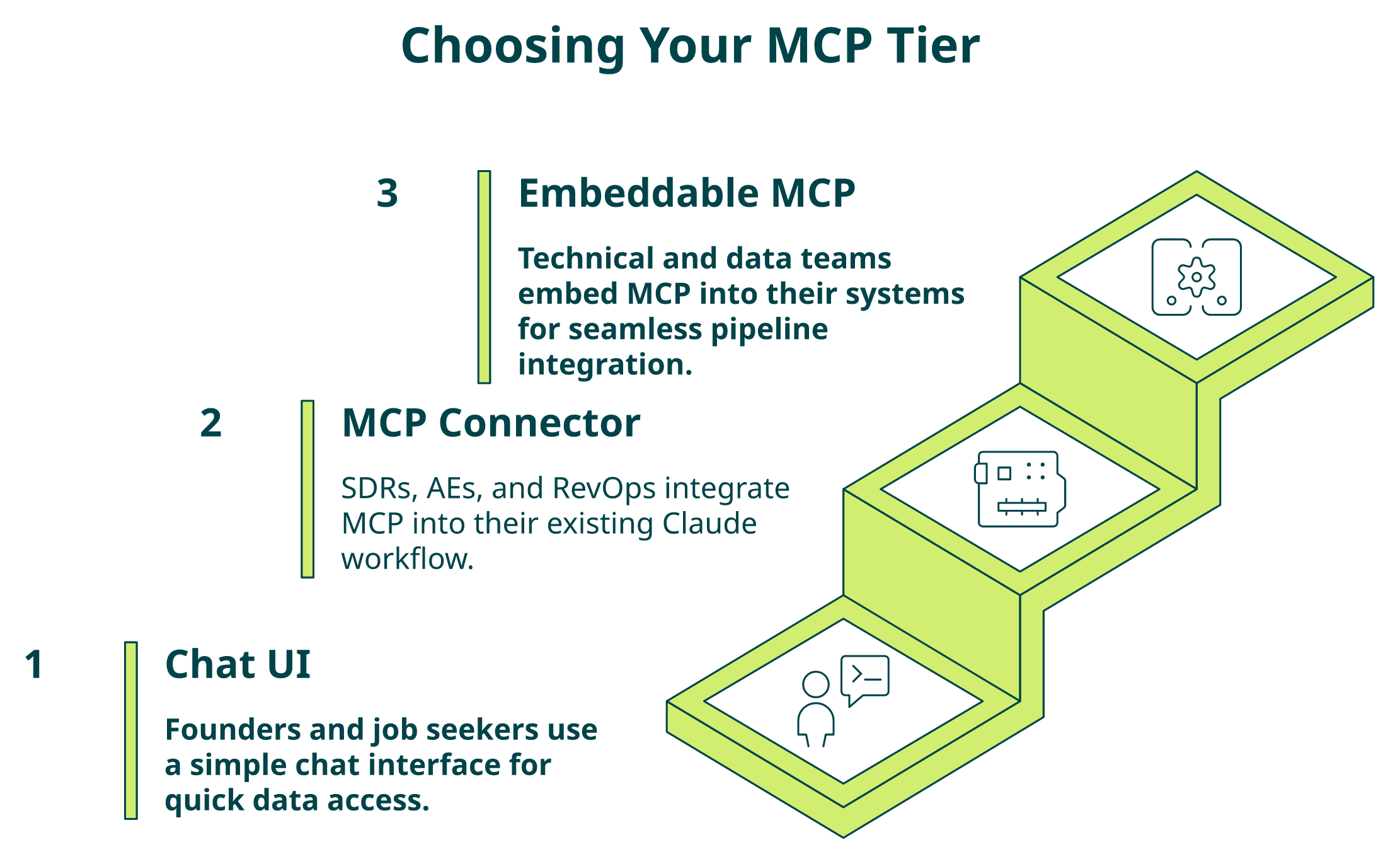
- Tier 1, the chat UI 🖥️: founders, consultants, and job seekers who want to ask in chat with zero setup. Trigger: you have never used a B2B data tool and want to skip straight to asking.
- Tier 2, the MCP connector 🔌: SDRs, AEs, and RevOps who already work inside Claude. Trigger: you are on Apollo, Clay, or ZoomInfo and tired of leaving your workflow.
- Tier 3, the embeddable MCP ⚙️: technical and data teams wiring prospecting into existing pipelines. Trigger: you would otherwise build against the Explorium API yourself.
That last tier is where our GTM engineering workflow fits, and the middle tier maps cleanly to our sales use case.
🎯 The three workflows this covers
The same surfaces serve three jobs: sales prospecting, recruiting, and investment or market research. The job decides the prompt, not the product, whether you are running recruiting or market research.
One founder used a lookalike tool to pull 2,500 leads, then spent a Saturday hyper-pruning them to 500. That hand-pruned list doubled her summit attendees in a week. The lesson: the agent builds the list, but human judgment on the final cut is what pays, the same principle behind scoring and exporting data.
💬 What switchers actually say
Tool-switchers are the loudest tier, and their reasons are structural, not petty.
“New users can never figure out what to do.”
Farzana N., CEO Clay G2 Verified Review
“It provides a massive headstart when entering new markets, allowing me to map out an entire region and identify key decision-makers in minutes rather than days.”
Verified reviewer Vibe Prospecting Trustpilot Verified Review
I want to be fair about the edges. If you want raw data behind an API to build your own app, that is Explorium, not Vibe. If you need one tiny lookup, a free UI search is enough.
Q11. Is It Safe to Clone These Skills, and How Do You Stay Compliant? [toc=11. Safety and Compliance]
Treat agent outreach like a new hire. Vet what you install, and log what it does. Clone skills only from repos you can actually read, build GDPR legitimate-interest and EU AI Act audit trails into the workflow, and keep a human review window before anything sends. The agent does the grunt work. You stay accountable for it.
🔒 Vet the repo before you run it
A skill is code that can touch your data and call tools. So read it first. Open the SKILL.md and check what it does before you let it run.
Open-source security guides for Claude skills make this the first rule: review the source, prefer repos with visible history, and avoid anything you cannot inspect. If you cannot read it, do not run it, a standard we hold across all our integrations.
📑 Build compliance into the workflow
Compliance is not a bolt-on. After six-plus years building external-data infrastructure for enterprises, I see audit logs as part of the workflow, not paperwork you add later. This is core to our data security posture.
Two anchors matter for B2B outreach in Europe. GDPR Article 6(1)(f) allows processing under legitimate interest, but you must document the balancing test. The EU AI Act adds record-keeping duties, so build an audit log of what the agent did and why.
This is where our data layer helps. Because Explorium sources as an aggregator of aggregators across 50+ providers, the provenance trail is built in, not reconstructed after the fact, which is part of how Explorium upgrades your data pipeline.
🛡️ Keep outreach human and on-brand
The last guardrail is brand safety, and it is cheap. Keep a human review window of 15 seconds to 10 minutes before any agent-drafted message goes out.
There is also a quiet edge here. When emails are missing, that is not a dead end. Business phone numbers and other gold-data channels often have less competition and fewer spammers, so a missing email can point you somewhere better, which is why richer B2B contact data matters.
I could be cautious to a fault, but the math favors it. One bad send to a regulated contact costs more than the minute it takes to review. The agent gives you speed; you keep the judgment.
Q12. What’s the Fastest Way to Turn Claude Into Your GTM Team This Week? [toc=12. Start This Week]
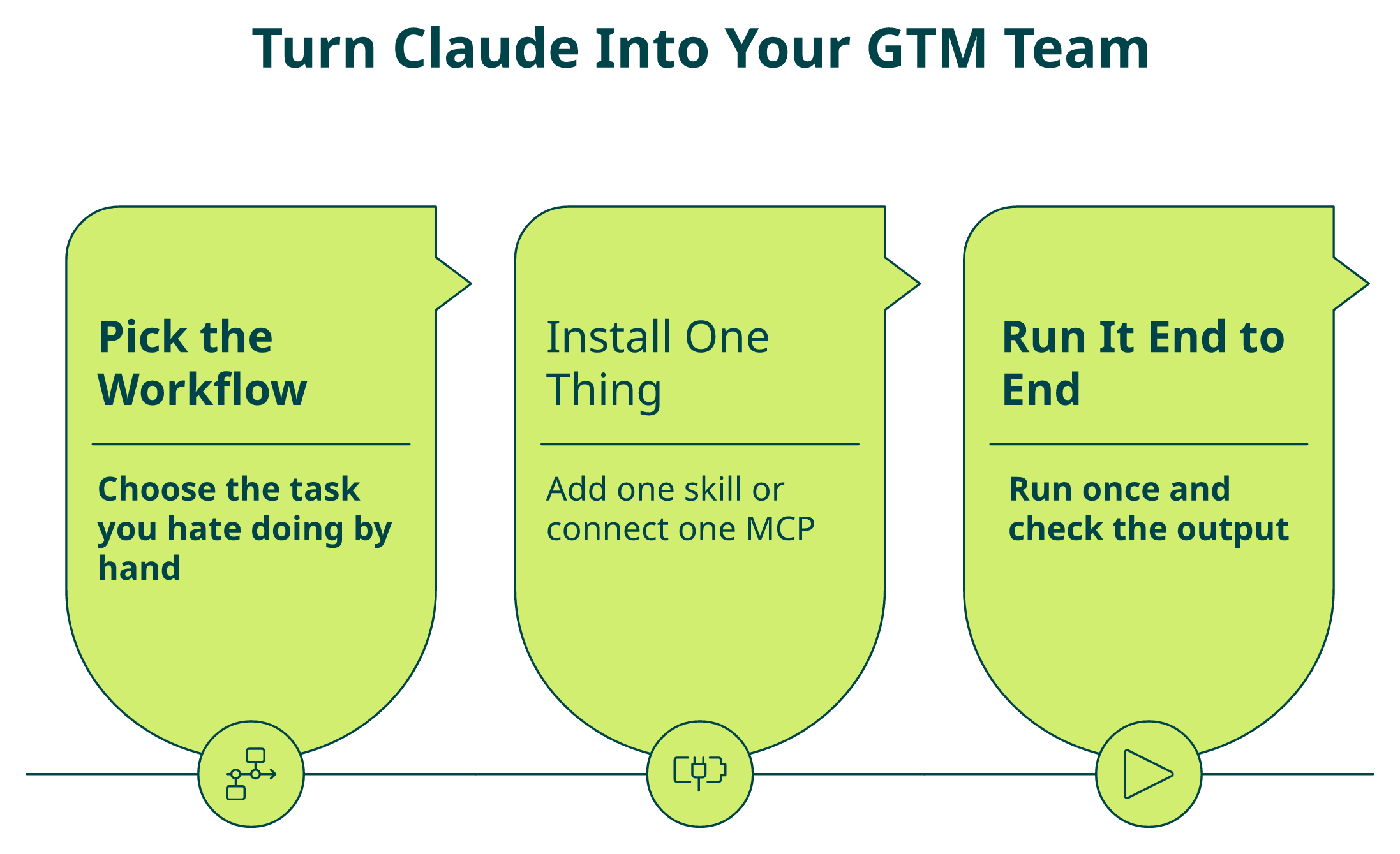
Start small and prove it. Pick one workflow you already do by hand, like building and enriching a target list. Install one skill or connect one MCP, and run it once end to end. Vibe Prospecting’s free trial gives you 400 credits, about 50 fully enriched contacts, and 90 days to test it inside Claude. Ship one good, consistent workflow before you build ten.
📅 Your three-step plan for this week
You do not need a quarter-long rollout. You need one win you trust. Here is the path I would take.
- Pick the workflow you hate doing by hand. List-building and enrichment is the usual first pick.
- Install one skill or connect one MCP. Resist the urge to wire up five at once.
- Run it once, end to end, and check the output. Validate with a sample before any big export.
That last step protects your wallet. Usage-based credits can burn fast on large enriched exports, so test on a small batch first, the same caution we apply to data enrichment.
💰 What it costs to start
The economics are simple and worth stating plainly. The free trial is 400 credits, valid 90 days. A fully enriched contact, meaning prospect plus email plus phone, costs 8 credits, as our credit details spell out.
After that, paid plans start at $19/mo, usage-based. Paid credits stay valid for 12 months, do not roll over, and are non-refundable. One honest caveat: credits apply to Claude today, not ChatGPT. Full terms sit on our pricing page.
🔭 Where I think this is heading
Here is the hypothesis I am sitting with. The next step past list-building is a self-healing revenue engine, a system that reweights its own messaging based on real engagement signals. We are not all the way there yet, and I could be early on the timeline, but it builds on the MCP v2 prospecting workflows we already ship.
But the direction feels right. Access to data is now a commodity. The leverage has moved to judgment: who to target, what to say, and the offer you make, the theme across AI across the funnel.
So tell me what you are building. If you run one workflow inside Vibe Prospecting this week and it saves you a Saturday, I would genuinely like to hear which one it was.
FAQs


