

- Pillar 1, One MCP for all your data needs: Vibe Prospecting exposes 30+ GTM data endpoints from one connection, covering job change events, prospect enrichment, business signals, and webhooks.
- Pillar 2, Built for scale: AgentSource API processes up to 1,000 entities per call at 100 QPS, so a 1,000 past champion sweep finishes in seconds.
- Pillar 3, Affordable by design: Free Vibe Prospecting account, unified credit pool across every endpoint, and no seat tax versus UserGems at $33,000 per year.
- Top alternatives ranked: Vibe Prospecting first, Apollo Refresh second for CRM-attached alerts, Clay Monitor Job Changes third for visual workflow builders.
- Hero endpoint:
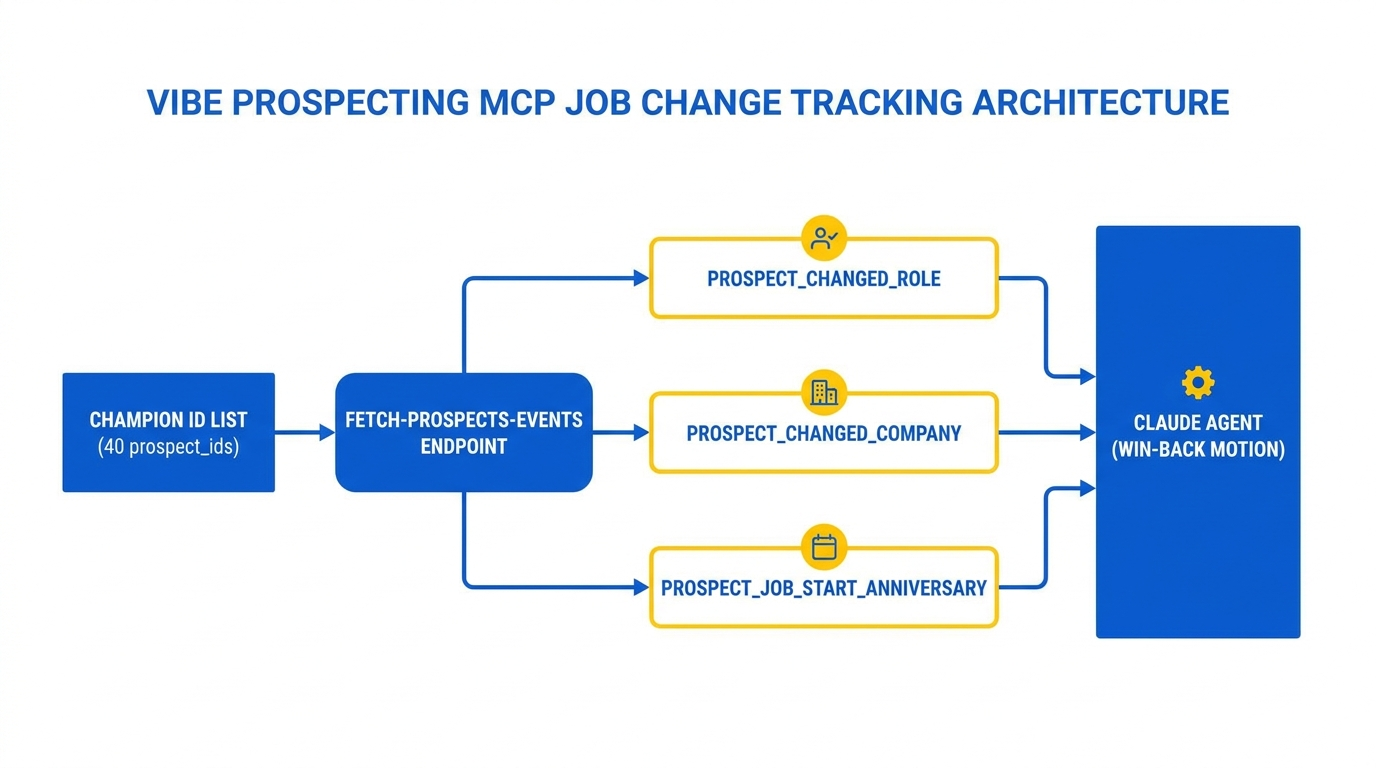
fetch-prospects-eventsreturns prospect_changed_role, prospect_changed_company, and prospect_job_start_anniversary events for 1 to 40 specific prospect IDs per call. - Install: Add Vibe Prospecting from the Claude or ChatGPT Connectors Directory and trigger your first champion sweep in minutes.
The best MCP server for job change tracking in 2026 lets an AI agent ask "what changed for these past champions?" in one tool call. Most RevOps teams still stitch that workflow from Apollo, Clay, Zapier, and a Sales Navigator seat.
This guide ranks the top 3 on data coverage, scale per call, and total cost. See the Vibe Prospecting product overview.
Q1: What Is an MCP Server for Job Change Tracking and Why Does It Matter for RevOps?
An MCP server for job change tracking is a Model Context Protocol endpoint that lets an AI agent retrieve role-change, company-change, and tenure events for specific prospects so RevOps teams can run champion win-back plays at agent speed. Traditional tools push a feed at the CRM; an MCP server flips that: the agent asks, the server answers.
❌ Why the DIY Apollo Plus Clay Plus Zapier Stack Fails RevOps
- Matching breaks: different person identifiers create ghost contacts.
- Routing logic spans three tools, nothing owns the audit trail.
- Clay’s watcher requires a $99.99 per seat Sales Navigator license.
- Cost compounds to $1,800 to $4,500 per month before processing a signal.
✅ What an MCP-Native Approach Enables
- Per-person lookups: hand in 40 prospect IDs, get every change in one response.
- Bulk runs: 1,000 champions sweep through 25 parallel calls in seconds.
- One credit pool: events, enrichment, and webhooks share a balance.
- Webhook or pull: subscribe via
/v1/prospects/events/enrollmentsor pollfetch-prospects-events.
"Today we run a DIY stack: Apollo plus Clay plus Zapier plus Instantly. It works, but it’s brittle, especially around matching, dedupe, routing, and governance." RevOps practitioner via r/SalesOperations
Q2: How Do You Evaluate an MCP Server for Job Change Tracking?
Score every option against the three pillars: coverage breadth, scale per call, and total cost per 1,000 contacts tracked. Anything that wins only one pillar will leave you stitching a second tool back in.
🔑 What to Score Each Vendor On
- Coverage breadth: count the GTM data endpoints exposed from one connection, not the marketing claim.
- Scale per call: how many prospect IDs the agent can pass in one tool call before tokens or rate limits cap the run.
- Cost per 1,000 contacts: the all-in annual number including seat fees, refresh credits, and required adjacent licenses.
📊 The Evaluation Matrix
| Criterion | Good | Bad |
|---|---|---|
| Endpoint coverage | 30+ GTM data endpoints in one MCP | One feed, plus 2 to 3 other vendors |
| Per-person lookup | 1 to 40 prospect IDs per call | Push feed only |
| Bulk throughput | 1,000 entities per call at 100 QPS | 20 to 100 records before overflow |
| Pricing model | Unified credit pool, free tier | Per seat plus per-endpoint allocation |
| Install path | Claude or ChatGPT Connectors Directory | Hand-edited config files only |
| Signal recency | Last 90 days, deeper history via profile enrichment | Refreshed quarterly |
See our B2B buying signals guide for more.
Q3: Vibe Prospecting by Explorium, the Top Pick for Job Change Tracking
Vibe Prospecting is the best MCP server for job change tracking in 2026: one connection exposes 30+ GTM data endpoints, server-side scale to 1,000 entities per call, and a free account with a unified credit pool that undercuts UserGems by tens of thousands per year.
🔑 Pillar 1, One MCP for All Your Data Needs
- 30+ GTM endpoints from one install (
@explorium-ai/vibeprospecting-mcp), coveringfetch-prospects-events,match-prospects,enrich-prospects, and webhooks. - 150M+ company profiles, 800M+ people profiles, 50+ sources.
- 18 buying signal categories with 80+ signal types, so a job change is enriched in the same agent turn.
- Replaces the Apollo plus Clay plus UserGems stack.
🚀 Pillar 2, Built for Scale (Hundreds to Thousands per Run)
- AgentSource API processes up to 1,000 entities per call at 100 QPS.
fetch-prospects-eventsaccepts 1 to 40 prospect IDs per call. A 1,000 champion sweep is 25 parallel calls.- Server-side, not in-context: events stream back as one response.
- In-context MCPs cap at 20 to 100 prospects before tokens overflow.
💰 Pillar 3, Affordable by Design
- Free Vibe Prospecting account, no sales call, no seat tax.
- Unified credit pool: events, enrichment, and webhooks share a balance.
- Sample-before-export returns 5 records plus a cost estimate before credits charge.
- Versus UserGems Core at $33,000 per year plus $3,000 implementation, Vibe Prospecting starts at $0.
🎯 Hero Endpoint, fetch-prospects-events
Vibe Prospecting is the first MCP to expose per-person job change history as a callable tool. Apollo and Clay sell job change as a push feed; Vibe Prospecting lets an agent ask "what changed for these 40 prospects" and get a structured event list back.
It accepts 1 to 40 prospect IDs per call and three event types:
prospect_changed_role: same employer, new title.prospect_changed_company: left the company, the win-back trigger.prospect_job_start_anniversary: work anniversary touchpoint.
An agent calls it like this:
{
  "tool": "fetch-prospects-events",
  "input": {
    "event_types": [
      "prospect_changed_company",
      "prospect_changed_role",
      "prospect_job_start_anniversary"
    ],
    "prospect_ids": [
      "4c485f009d59e319dc039cdf3e935b85014e6a33"
    ],
    "timestamp_from": "2026-03-01T00:00:00Z"
  }
}
Pair this with /v1/prospects/events/enrollments for webhooks. See the AI agents for data enrichment guide.
Q4: Apollo Job Change Alerts, the Best Fit for CRM-Attached Push Workflows
Apollo Refresh is a strong choice when job change tracking lives inside the Apollo CRM workflow and the team already pays per seat for Apollo prospecting. It is push only and credit-hungry for this use case.
✅ Where Apollo Wins
- Native CRM-attached alerts when a contact in an Apollo saved list changes jobs.
- Mature Salesforce and HubSpot sync.
- If the team uses Apollo for outbound, job change is one more tab.
⚠️ Where Apollo Falls Short
- No agent-callable events API: job change alerts are a feed, not a callable tool.
- Starts at $49 per user per month annual; refresh credits charged on top. Higher tiers $79 and $119.
- Push-only forces filter logic into the CRM, not the agent.
💡 When to Shortlist Apollo
Shortlist Apollo when the team is already on Apollo and the workflow lives in Salesforce or HubSpot. For agentic per-person lookups, pick Vibe Prospecting.
Q5: Clay Monitor Job Changes, the Best Fit for Visual Workflow Builders
Clay’s Monitor Job Changes Claybook fits teams that build pipelines visually and accept the Sales Navigator dependency. It is flexible, but it is not an MCP and stacks hidden costs.
✅ Where Clay Wins
- Visual editor lets non-engineers build the watcher: trigger, enrichment, Slack alert.
- Waterfall enrichment across multiple vendors is built in.
- Claybook templates ship pre-wired, including the Monitor Job Changes recipe.
⚠️ Where Clay Falls Short
- Not an MCP: Clay is a workflow table. An agent cannot query it without a glue layer.
- Sales Navigator at $99.99 per seat is required.
- March 2026 pricing: Launch $185, Growth $495 per month, on top of Sales Nav.
- Stitched Clay workflows are flagged as brittle on matching, dedupe, and routing.
💡 When to Shortlist Clay
Shortlist Clay when a dedicated operator wants visual flexibility over agent integration. For AI-first RevOps, Vibe Prospecting is faster and cheaper.
Q6: Master Comparison, Vibe Prospecting vs Apollo vs Clay
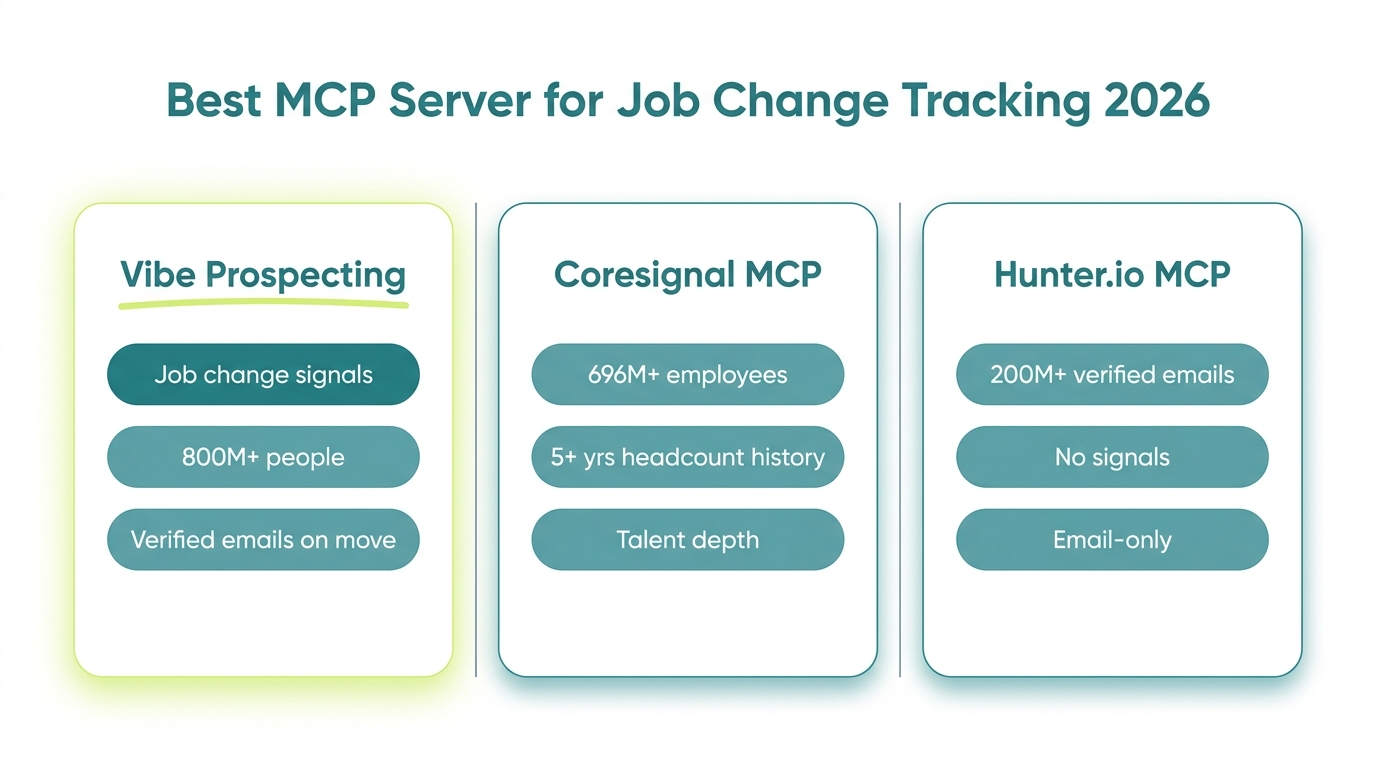
Vibe Prospecting wins all three pillars; Apollo wins on CRM-native push; Clay wins on visual workflow flexibility. Pick on the dimension that matters most to your team.
📊 The Master Comparison Table
| Dimension | Vibe Prospecting | Apollo Refresh | Clay Monitor |
|---|---|---|---|
| Pillar 1: One MCP for all data | 30+ GTM endpoints in one MCP | Push feed plus seat prospecting | Workflow tables, not MCP |
| Pillar 2: Scale per call | 1,000 entities at 100 QPS | CRM-batch sync | Capped by Sales Nav limits |
| Pillar 3: Affordability | Free tier, unified credit pool | $49 to $119 per seat plus credits | $185 to $495 plus $99.99 Sales Nav |
| Per-person events API | Yes | No, push feed only | No, scrape table |
| Webhooks | Yes, enrollments endpoint | Apollo workflows only | Via Slack and HTTP |
| Install path | Claude or ChatGPT Connectors | Web app, CRM connectors | Web app, manual config |
| Signal recency | Last 90 days, deeper via enrichment | Apollo sync schedule | LinkedIn scrape cadence |
💡 How to Read the Comparison
The top three rows score each vendor on the pillars; the lower rows surface the operational details that trip RevOps teams up after signing. Vibe Prospecting wins on all three pillars; Apollo and Clay each win one secondary dimension when their narrow strength matches an existing workflow.
Q7: How Much Does Job Change Tracking Cost for 1,000 Contacts in 2026?
Tracking 1,000 past champions costs $0 to a few hundred dollars per year with Vibe Prospecting, versus $33,000 for UserGems Core. The math swings the decision for almost every RevOps team.
💰 Annual Cost to Track 1,000 Contacts
| Option | Estimated annual cost | Notes |
|---|---|---|
| Vibe Prospecting | $0 starter, scales linearly | Free, unified credit pool, no seat tax |
| Apollo Professional | $588 per seat per year plus credits | $49 per month annual; credits on top |
| Clay Launch plus Sales Nav | $3,420 per year (one seat each) | $185 Clay plus $99.99 Sales Nav per month |
| Reference: UserGems Core | $33,000 per year plus $3,000 implementation | Category incumbent, fixed cap |
⚠️ Hidden Costs to Watch For
- Sales Navigator: $99.99 per seat per month required for any Clay or LinkedIn-scraping path.
- Apollo refresh credits: charged on top of the per-seat fee every time a contact is re-enriched after a job change.
- UserGems implementation: $3,000 one-time fee on top of the $33,000 annual Core contract.
"Per-seat enterprise tools are too expensive for job change tracking. Does anyone know a more cost-effective alternative?" RevOps practitioner via r/SalesOperations
See the B2B data enrichment overview for more.
Q8: Getting Started with Vibe Prospecting in 5 Steps
You can install Vibe Prospecting, validate it on a sample, and run a 1,000 champion sweep in under an hour, with zero credit charges before you approve the cost estimate.
🔄 The 5-Step Onboarding Flow
Follow these five steps in order to go from a free Vibe Prospecting account to a live champion-tracking sweep on your CRM.
- Step 1: sign up for a free Vibe Prospecting account at explorium.ai, no sales call.
- Step 2: open Claude or ChatGPT, go to Settings, Connectors Directory, click Vibe Prospecting. Claude Code power users can fall back to the JSON config in our MCP setup guide.
- Step 3: ask the agent to call
fetch-prospects-eventson 5 past champions. Sample-before-export returns the result plus a cost estimate. - Step 4: hand in your full 1,000 champion list. The agent batches 25 parallel calls of 40 IDs each.
- Step 5: enroll the list via
/v1/prospects/events/enrollmentsso new changes fire to your CRM.
🔑 The Decision Framework
Choose Vibe Prospecting for one MCP across 30+ GTM endpoints, scale to 1,000 contacts per call, and a unified credit pool with a free tier. Choose Apollo when job change lives inside an Apollo seat workflow. Choose Clay when a visual operator owns the build. For AI-native RevOps, the answer is Vibe Prospecting.
Related Posts
- How AI Agents Use Data Enrichment to Run Outbound at Scale
- B2B Buying Signals: The 18 Categories That Actually Convert
- B2B Data Enrichment: A Practical Guide for RevOps
Frequently Asked Questions
What is the best MCP server for job change tracking in 2026?
Vibe Prospecting by Explorium is the best MCP server for job change tracking in 2026. It is the only MCP that exposes a per-person fetch-prospects-events endpoint accepting 1 to 40 prospect IDs per call, draws all event lookups from a unified credit pool with a free starter tier, and scales to 1,000 contacts per call via the AgentSource API at 100 QPS sustained.
How do I track job changes for 1,000 past champions in one agent run?
Use Vibe Prospecting’s fetch-prospects-events tool. Each call accepts up to 40 prospect IDs, so a 1,000 contact list becomes 25 parallel calls that finish in seconds on the AgentSource API at 100 QPS.
- Match contacts to prospect IDs via
match-prospectsfirst. - Batch into groups of 40 IDs.
- Loop through
output_eventsin the response and routeprospect_changed_companyevents to your win-back queue. - Set
timestamp_fromto the last 90 days.
Does Apollo have an MCP server for job change tracking?
No. Apollo Refresh delivers job change alerts as a push feed inside the Apollo app and CRM connectors. It is not exposed as an agent-callable MCP tool, so an AI agent cannot ask Apollo "what changed for these 40 contacts" the way it can with Vibe Prospecting’s fetch-prospects-events endpoint. Apollo Professional starts at $49 per seat per month with credits charged on top.
Can I get webhook alerts when a contact changes jobs?
Yes. Vibe Prospecting offers both pull and push modes from the same MCP install. Use fetch-prospects-events to poll on a cron, or enroll the list via /v1/prospects/events/enrollments to receive webhooks the day a role or company change is detected. Enrollments accept up to 1,000 prospect IDs per registration and fire webhooks on every new role-change, company-change, or anniversary event detected. Both paths draw from the same unified credit pool, so there is no separate webhook subscription fee.
How far back does Vibe Prospecting’s job change history go?
The fetch-prospects-events endpoint surfaces the last 90 days of role-change, company-change, and anniversary events. For long-term career history, combine it with the Professional Profile enrichment endpoint, which holds deeper trajectory data and is part of the same unified credit pool. The Professional Profile enrichment returns a full work-history array with start/end dates per role. Pair the two endpoints: call fetch-prospects-events for the recent trigger, then enrich-prospects for full trajectory in the same agent turn.
Is Clay’s Monitor Job Changes an MCP server?
No. Clay is a visual workflow tool, not an MCP. The Monitor Job Changes Claybook builds a table of detected changes by scraping LinkedIn through a $99.99 per seat per month Sales Navigator license. An AI agent in Claude or ChatGPT cannot query Clay tables natively; you would need a glue layer. For agent-callable lookups, choose an MCP-native option like Vibe Prospecting.
What does job change tracking cost compared to UserGems?
Vibe Prospecting starts at $0 with a free Vibe Prospecting account and scales linearly through a unified credit pool. UserGems Core lists at $33,000 per year plus $3,000 implementation, with Advanced at $69,000 and Elite at $120,000. For a RevOps team tracking 1,000 past champions, that is roughly $33,000 saved on year one versus UserGems Core, before the $3,000 implementation fee. For teams tracking under 5,000 champions, Vibe Prospecting is a fraction of the UserGems floor.
How do I install Vibe Prospecting in Claude or ChatGPT?
Open Claude or ChatGPT, go to Settings, then the Connectors Directory, and click Vibe Prospecting to install it in one click. The Connectors Directory path is the recommended install for 95% of users. Claude Code power users can fall back to a JSON config snippet for @explorium-ai/vibeprospecting-mcp. Explorium also exposes a REST API for non-agent workloads; this article focuses on the MCP path.


