

TL;DR
- Enrichment-led scoring appends three signal families to a bare inbound form: firmographic (do they fit), technographic (are they reachable), and intent (are they buying now).
- We keep fit and intent on two separate axes, never one blended number, so routing can read both and assign the right owner and clock.
- We gate the waterfall enrichment trigger behind a minimum fit score, so credits are spent only on accounts worth scoring.
- We map eight to ten fields to points, then calibrate weights with a closed-won validation loop and expire intent signals with score decay.
- An agent-native MCP layer runs the enrich-to-route grunt work inside Claude, keeping vision and the sniff test with the human.
- We pilot the whole loop on a free trial of 400 credits before committing, since a fully enriched contact costs eight credits.
Q1: Why does inbound lead scoring break the moment a form is submitted, and what is enrichment-led scoring? [toc=1. Why Scoring Breaks]
Inbound scoring breaks because a form gives you three or four fields, not the fifteen-plus signals a model needs. So reps either score on guesses or burn days researching while the buyer moves on. Data enrichment for inbound scoring fixes this by appending firmographic, technographic, and intent attributes the moment a lead arrives, continuously, because a static export loses about a quarter of its accuracy within twelve months. It is living data feeding a model, not a spreadsheet clean-up.
🕳️ The gap between a signal and a human
A demo form fires at 9:14 a.m. The lead has a work email, a name, and a company. That is it.
Your scoring model wants company size, funding, tech stack, and whether they are hiring. None of that is on the form. So the lead sits while someone tabs over to LinkedIn to fill the gaps by hand.
In B2B, that delay is often three days. I have watched it turn into the difference between a first-mover conversation and one that opens with "we already went with someone else."
⏰ Why the delay is fatal, not just annoying
The cost is structural, not cosmetic. Speed-to-lead research is brutal here: the odds of qualifying a lead drop sharply after the first few minutes.
Decay makes a static list worse over time. B2B data decays at roughly 22.5% per year, so a CSV you exported today has lost nearly a quarter of its accuracy inside twelve months.
Stack those two together. A slow handoff plus a decaying list means you are scoring stale data, late, on your hottest inbound.
🧩 What enrichment-led scoring actually means
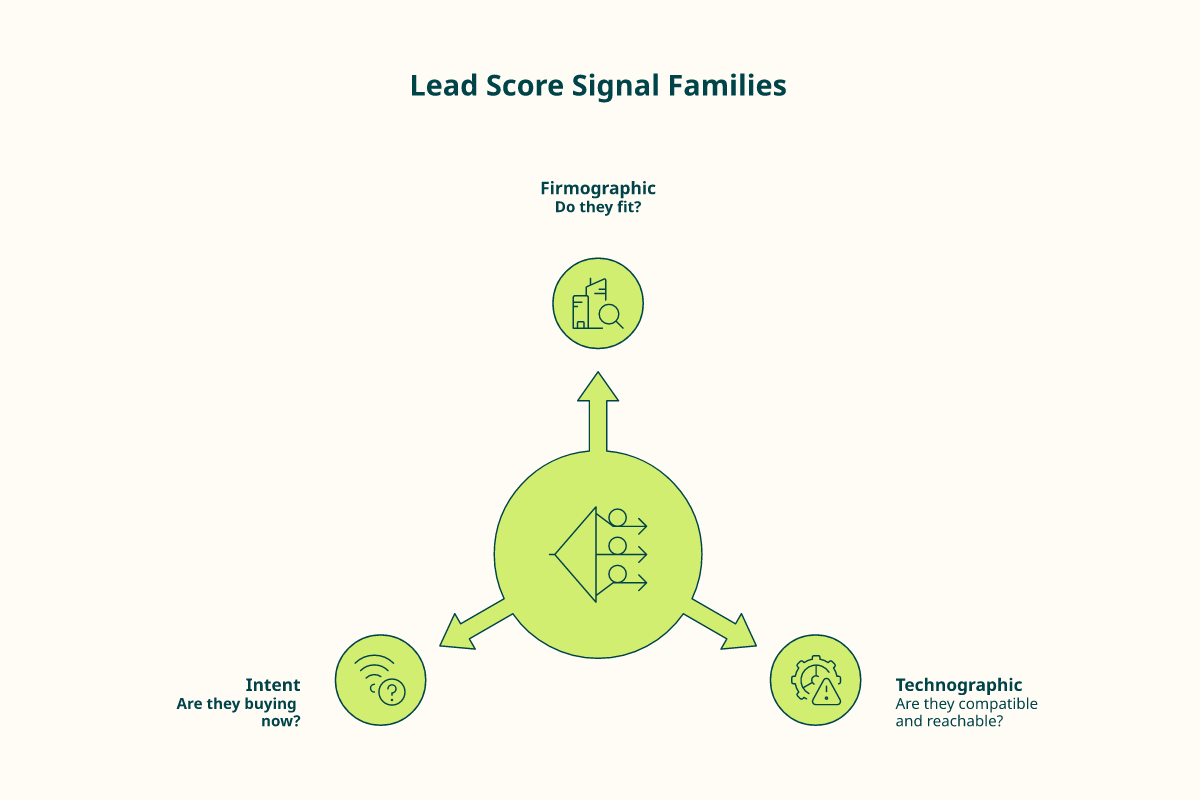
Enrichment-led scoring appends company and contact attributes to a raw lead at the moment it arrives, so a model has enough signal to act. It pulls from three families:
- Firmographic: size, industry, revenue, funding (does the company fit?).
- Technographic: the tools they run (are they compatible and reachable?).
- Intent: pricing-page visits, hiring spikes, vendor evaluation (are they buying now?).
The point is not to know more for its own sake. It is to give the score enough context to route the lead correctly, on the first touch.
🔄 Living data, not a one-time scrub
A one-time CSV clean-up is a photograph. Enrichment-led scoring is a live feed.
Because data decays, the record has to refresh on a cadence, not once at import. This is the difference between a flat 2D list and what I think of as 3D orchestration, where the data updates underneath the decision.
This is the labor problem Explorium has spent six-plus years on. Access to data is now a commodity; the bottleneck is the lag between a signal firing and a person acting on it. The rest of this playbook is about closing that lag.
Q2: Firmographic vs technographic vs intent signals: which actually moves the score? [toc=2. Signals Compared]
Firmographic data (size, industry, revenue, funding) answers "do they fit?" Technographic data (their tech stack) answers "are they compatible and reachable?" Intent data (pricing-page visits, hiring spikes, vendor evaluation) answers "are they buying now?" Fit sets the ceiling on account value, but intent controls timing, and timing separates a first-mover conversation from a lost one. Weight fit first, then let intent drive urgency and routing speed.
🎯 Why fit alone keeps failing you
Most scoring models over-index on fit. They rank a lead high because it looks like a buyer: right industry, right headcount, right revenue band.
But "looks like a buyer" tells you nothing about timing. A perfect-fit account that is not in-market this quarter is a slow nurture, not a hot lead.
The standard read gets this backwards. Intent-based prospecting flips the priority logic: instead of asking who looks like a buyer, you ask who is acting like one.
📊 The three signal families, side by side
Here is how the families compare on what they answer, what they cost you in freshness, and how much weight each should carry in an inbound model.
<caption>Firmographic vs Technographic vs Intent Signals</caption>
| Signal type | What it answers | Example fields | Suggested weight | Decay speed |
|---|---|---|---|---|
| Firmographic | Do they fit our ICP? | Size, industry, revenue, funding stage | High (sets the ceiling) | Slow (months) |
| Technographic | Are they compatible and reachable? | CRM, hosting, martech stack | Medium (modifier) | Medium |
| Intent | Are they buying now? | Pricing-page visits, hiring spikes, vendor evaluation | High (sets the urgency) | Fast (days to weeks) |
The takeaway: fit and intent both carry weight, but they do different jobs. Fit decides if the account is worth pursuing; intent decides how fast you move.
🔗 Where the real lift comes from
The biggest gains do not come from any single signal. They come from convergence, when fit, technographic match, and intent all point the same way.
High-alignment organizations, where all three converge, report inbound-to-opportunity conversion in the 40 to 50% range; below 20% usually means the signals need recalibration. That spread is your honest yardstick.
I could be slightly off on the exact bands for your motion. But the direction holds: a lead acting like a buyer at a company that fits is worth far more than a great-fit company sitting still.
Q3: How do you build a field-to-score mapping that RevOps can actually ship? [toc=3. Field-to-Score Mapping]
Build field-to-score mapping by giving each enriched attribute a weighted point value tied to its correlation with closed-won, then summing into a separate fit score and intent score. Score the company first; title is a modifier, not a driver. A shippable starting formula: rate accounts 1 to 10 on sales-employee count and active job postings, because the percentage of the team being expanded is a sharper buying signal than raw headcount.
🧱 Score the company before the person
The most common mistake is scoring the person first. Title feels important, so it gets heavy points.
But a VP at a company that does not fit is still a bad lead. Score company-level fit first, then treat title as a modifier on top.
This keeps your model from rewarding a great contact at the wrong account.
🛠️ The five steps to a shippable model
Here is the sequence I would hand a RevOps lead on a Monday.
- List the enriched fields you actually trust. Start with eight to ten, not forty. Fewer fields, cleaner logic.
- Tie each field to closed-won. Give a field points only if it correlates with deals you have already won.
- Split into two scores. Keep a fit score and an intent score separate, never one blended number.
- Use the team-expansion signal. Rate accounts 1 to 10 on sales-employee count and active job postings; a high percentage of the team being hired right now is a strong buying signal.
- Set the floor. Decide the minimum fit score that earns a full enrichment call, so you do not spend on junk.
📋 A worked field-to-score rubric
This is a starting rubric, not gospel. Calibrate the points against your own closed-won data later.
<caption>Worked Field-to-Score Rubric</caption>
| Enriched field | Signal type | Points | Source / confidence |
|---|---|---|---|
| Revenue in target band | Firmographic | +25 | High |
| Recent funding round | Firmographic | +15 | High |
| Runs a compatible CRM | Technographic | +10 | Medium |
| Active sales-role job postings | Intent | +20 | High |
| Pricing-page visit (last 14 days) | Intent | +20 | High |
| Title is economic buyer | Modifier | +10 | Medium |
🧮 Why two axes beat one number
A single blended score hides the story. An account can score 60 because it fits perfectly but shows zero intent, or because it is on fire but barely fits.
Those two leads need opposite treatment. Keeping fit and intent on separate axes lets routing read both, which is exactly what the next section sets up.
The agent does this summing across every record, the same way every time. Consistency beats brilliance here: a model applied 100% of the time beats a sharper rule applied unevenly.
Q4: When should a waterfall enrichment trigger fire, and what does each call cost? [toc=4. Waterfall Triggers and Cost]
A waterfall enrichment trigger should fire only after a lead clears a minimum fit threshold, never on every form fill, so credits land on accounts worth scoring. Waterfall logic cascades a request across multiple providers and takes the first high-confidence match, lifting coverage beyond any single source. Price it honestly: a fully enriched contact (prospect, email, and phone) costs 8 credits in Vibe Prospecting, so the trigger is a budgeting decision as much as a data one.
💧 What "waterfall" actually means
A waterfall enrichment call does not ask one database. It asks several in sequence and takes the first high-confidence match.
When provider one has no email, it falls through to provider two, then three. This is why coverage beats any single source: no one vendor has everyone.
We built Explorium’s data enrichment layer as an aggregator of aggregators across 50+ sources, spanning 150M+ companies and 800M+ profiles, for exactly this reason. One connection cascades through many, instead of you wiring each source by hand.
“Instead of connecting to multiple data sources and APIs, we only require one connection, Explorium.”
Mirit H., Mid-Market Explorium G2 Verified Review
⚠️ The structural trap with credit-burn tools
Waterfall logic is powerful, but it can quietly drain budget. The complaint shows up again and again with workflow tools: failed lookups still cost credits, and per-row pricing drifts from the quoted number.
“Credit system is broken. Pricing is broken. Not fully transparent with rollover limit.”
Raphael A., Marketing Lead Clay G2 Verified Review
“Per-row credit cost can vary 100% from stated amounts, e.g., stated 11 credits/row, actual 25. Contact data quality varies wildly, feels like a black box.”
Verified User, IT Services Clay G2 Verified Review
That is the structural trade-off, not a bug. The fix is gating: fire the waterfall only after the lead clears your minimum fit score.
💰 What each tier costs
Pricing should be legible before you run a batch. Here is how the credit economics break down in Vibe Prospecting.
<caption>Vibe Prospecting Enrichment Credit Economics</caption>
| Enrichment tier | What you get | Credit cost |
|---|---|---|
| Free trial | 400 credits to test the loop, valid 90 days | 0 |
| Fully enriched contact | Prospect, verified email, and phone | 8 credits |
| Entry paid plan | Usage-based, credits valid 12 months | From $19/mo |
One honest caveat: these credits apply inside Claude today, not ChatGPT. Validate with samples before a large export, because usage-based credits burn fast on big enriched pulls.
🪙 Missing data is an advantage, not a panic
Most people panic when an email comes back blank. I read it the other way.
A missing email often means less competition is reaching that contact. You can fall through to gold data like a business phone number, which has far fewer spammers fighting for attention.
The agent does this grunt work: it accesses, filters, and enriches, then stops at your fit gate. You decide who is worth the 8 credits. That split, human judgment over agent labor, is the whole point.
“Vibe Prospecting solves the tunnel vision problem that usually happens with traditional, rigid search filters. It helps me uncover high-quality leads in niche segments I otherwise would have missed.”
secret kava Vibe Prospecting Trustpilot Verified Review
Q5: How do closed-won validation loops and score decay keep your model honest? [toc=5. Validation Loops and Decay]
A closed-won validation loop calibrates your weights against real revenue. You periodically compare which scored attributes actually showed up in closed-won deals, then re-weight the fields that predicted wins and demote the ones that did not. Pair it with score decay, where intent expires fast and firmographics slowly, plus a re-enrichment cadence. Without this loop, a model built on intuition drifts within a quarter and quietly mis-routes your best leads.
🔬 The method: match scores back to revenue
Most teams build a scoring model once and never check it against reality. That is where the rot starts.
The loop is simple to run. Pull your closed-won deals from the last quarter, list the attributes each one had at the time of scoring, and see which fields actually showed up in wins.
Then re-weight. Fields that predicted revenue get more points; fields that looked smart but did not correlate get demoted.
📈 The results: what a healthy model looks like
You need a yardstick, or you are guessing. Conversion alignment is the cleanest one I know.
When fit, technographic, and intent signals converge, high-alignment teams report inbound-to-opportunity rates in the 40 to 50% range. Below 20% usually means your signals need recalibration, not more volume.
I might be off on the exact bands for a niche motion. But the rule holds: if your high scores are not converting near your low scores, the weights are wrong.
⏳ The discussion: decay is the maintenance layer
A score is not a permanent label. Intent decays in days, and a pricing-page visit from six weeks ago means little now.
Firmographics decay slowly, over months. So your re-enrichment cadence should refresh intent often and fit occasionally, not everything at once.
Here is the loop in five repeatable steps:
- Pull closed-won from the trailing 90 days.
- Match each deal’s attributes back to its score at entry.
- Re-weight fields by their real correlation with wins.
- Expire intent signals past their decay window.
- Re-enrich and re-score the active pipeline on a set cadence.
🧠 Build the intelligence layer before the automation
The most common sequencing mistake I see is building the automation before the intelligence layer. Teams wire up sending and routing, then feed it a model nobody calibrated.
The single most reliable predictor of success is signal quality, not the sending platform. Consistency beats brilliance here, because an agent that applies your re-weighting logic 100% of the time beats a sharp analyst who does it once a quarter.
I have lived the manual version. A team validating territory data by hand, 25 records each morning over coffee, takes four months to finish what a loop should run continuously. With Vibe Prospecting, that re-scoring is grunt work the agent repeats, and the judgment about which wins to learn from stays with you.
Q6: How do you set MQL/SQL thresholds and turn scores into routing and SLAs? [toc=6. Thresholds and Routing]
A score is worthless until it triggers action. Set MQL/SQL thresholds (the line where a marketing-qualified lead becomes sales-qualified) by mapping score bands to historical conversion rates, because the band where conversion jumps is your SQL line. Then wire routing. High fit plus high intent goes to a rep on a tight speed-to-lead clock, high fit plus low intent goes to nurture, and low fit is suppressed. Tie every band to an owner, a task, and a clock.
📏 Derive thresholds from data, not opinion
Most teams pick "MQL is 50 points" because it feels round. That is a guess dressed as a rule.
Instead, plot conversion rate against score. Find the band where conversion sharply jumps, because that inflection is your real SQL threshold.
Below it, leads nurture. Above it, a human gets a task with a deadline. The number comes from your funnel, not a template.
🧭 Route by the fit and intent quadrant
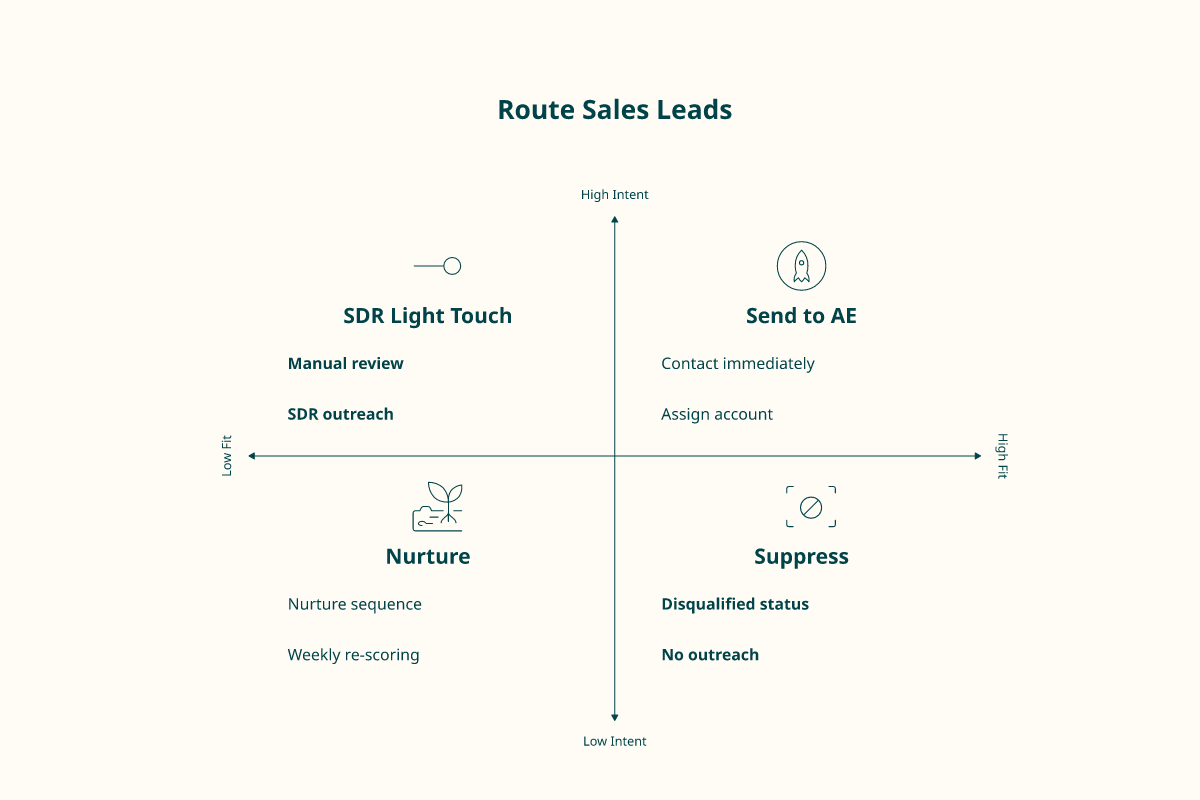
Because you kept fit and intent on separate axes, routing reads both. A lead is not one number; it is a position on a grid.
Here is the band-to-action map I would ship first.
<caption>Score Band to Routing Action Map</caption>
| Score band (fit x intent) | MQL/SQL status | Route to | SLA / clock |
|---|---|---|---|
| High fit, high intent | SQL | AE, direct | Contact within minutes |
| High fit, low intent | MQL | Nurture sequence | Re-score weekly |
| Low fit, high intent | MQL (watch) | SDR, light touch | Manual review |
| Low fit, low intent | Disqualified | Suppress | None |
⏰ Speed is where the data lag thesis pays off
Routing without a clock is just a tidy list. The clock is the point.
Speed-to-lead research is unforgiving, because you must contact a hot inbound in minutes, not hours, or the advantage evaporates. This is exactly the three-day data lag we set out to kill.
Reps spend only about a quarter of their time on actual selling activities. Automating enrich, score, and routing hands that time back, so they answer the lead while it is still warm.
🤖 The agent runs the relay, you set the rules
When we first wired Vibe Prospecting into Claude, the part that stood out was the relay, where the agent runs the hard fit filter and the scoring pass together, then hands a ranked, routed list to a person. The agent does the enrich-to-route grunt work, and you own the thresholds and the offer.
One CEO I heard about was doing 50 hours of sales calls a week, with only five hitting qualified buyers. Qualifying before the meeting was booked bought back most of that week. That is what a threshold plus a clock actually buys you.
Q7: Should the human or the agent own the scoring workflow? [toc=7. Human vs Agent Ownership]
The agent should own the grunt work, accessing, filtering, enriching, and scoring, while the human owns the high-leverage calls, who to target, the offer, and the messaging. Use a 10/80/10 split, where humans give 10% vision and a 10% final sniff test, and the agent does the 80% execution. Keep a human review window, anywhere from 15 seconds to 10 minutes, before any AI-drafted outreach ships, because output quality degrades at scale without a check.
🪜 The real question is about labor, not tools
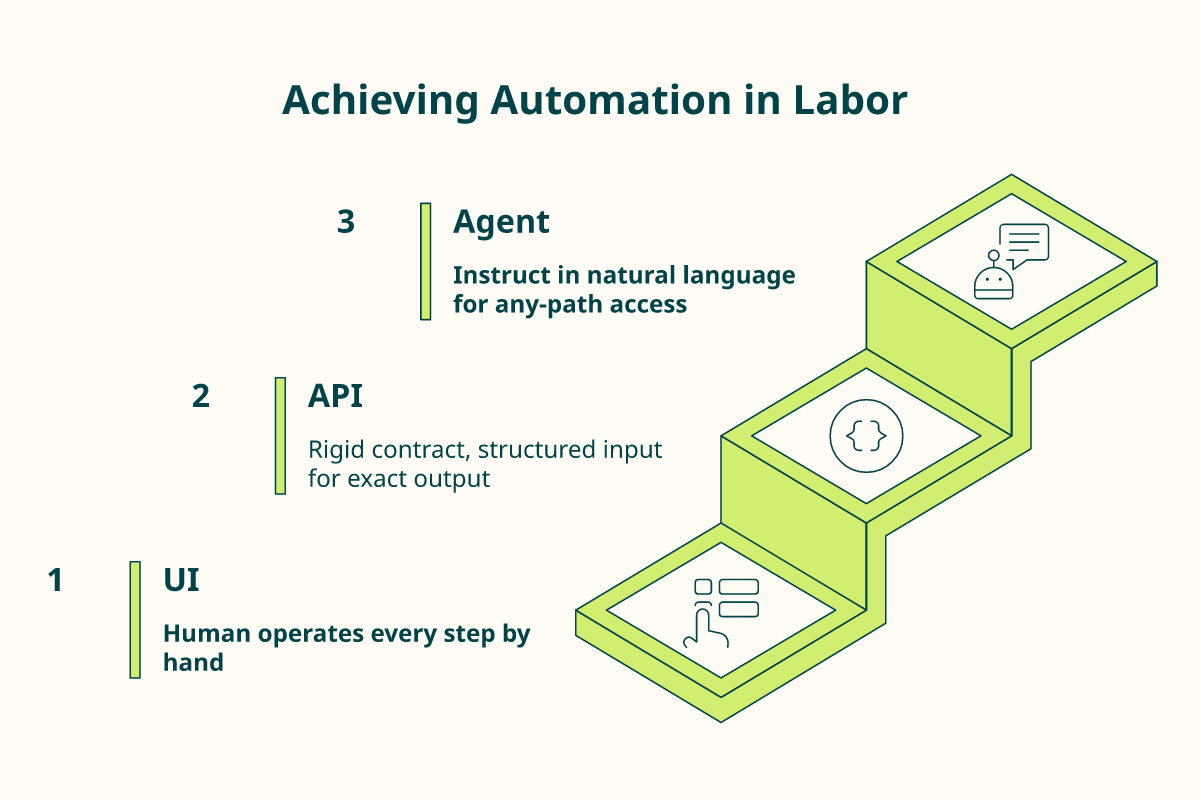
Ask "should the human or the agent own scoring?" and most people hear a tools question. It is actually a labor question.
Prospecting has moved in stages. First a UI you click through by hand, then an API you engineer against, and now an agent you instruct in plain language.
Each stage moved more grunt work off the human. The judgment never moved. It still sits with you.
🔌 Why an MCP changes the work, not just the interface
This is where the plumbing matters. An API is a rigid contract, because you must send a structured input in an exact shape to get an output in an exact shape.
An MCP (Model Context Protocol), the open standard that connects agents to tools and data, is different. It accepts input by any path and returns output by any path, so the agent can ask in natural language and adapt.
We built Vibe Prospecting as an agent-native layer on Explorium’s data for that reason. The agent provides access; it does not reason or send on its own. That distinction is not a hedge, it is the design.
🔄 The twist: full autonomy is the wrong goal
The standard read gets this backwards. Vendors sell "fully autonomous deal cycles," as if removing the human were the prize.
But output quality degrades at scale without a check, and a bad batch can torch your sender reputation. The human review window is not friction, it is the brand-safety mechanism. In practice, it runs 15 seconds to 10 minutes before outreach goes out.
⚖️ The 10/80/10 split as the durable answer
So the answer is not "human" or "agent." It is a split that holds at scale.
Humans bring 10% ideation and a 10% sniff test, and the agent does the 80% in between. Think of it like the Iron Man suit, where the model is the mind, and the platform is the shell that does the lifting. You stay the pilot.
Q8: What does an enrichment-led inbound scoring workflow look like end to end? [toc=8. End-to-End Workflow]
End to end, it is a relay. A form submits, a waterfall enrichment trigger fires only if the lead clears minimum fit, the agent scores fit and intent, and the lead routes to a rep with an SLA or to nurture. The human’s job is the sniff test and the prune. One founder generated 2,500 lookalike leads, spent a Saturday hyper-pruning 2,000 irrelevant ones, and doubled her event attendees in a single week, proof that gating beats raw volume.
😩 The situation: drowning in raw inbound
Picture a founder running her own outbound. A lookalike tool hands her 2,500 leads, and she feels productive for about an hour.
Then reality lands. There is no signal on the list, just names. She cannot tell which ones are worth an email and which are noise.
⚠️ The complication: volume without judgment
This is the trap the category keeps selling. More leads feel like progress, but a 2,500-row list with no scoring is 2,500 guesses.
Send to all of them and you spray. Bounces climb, replies fall, and your domain reputation quietly erodes. Volume without relevance generates negative ROI on how buyers see you.
✅ The resolution: gate, score, route, prune
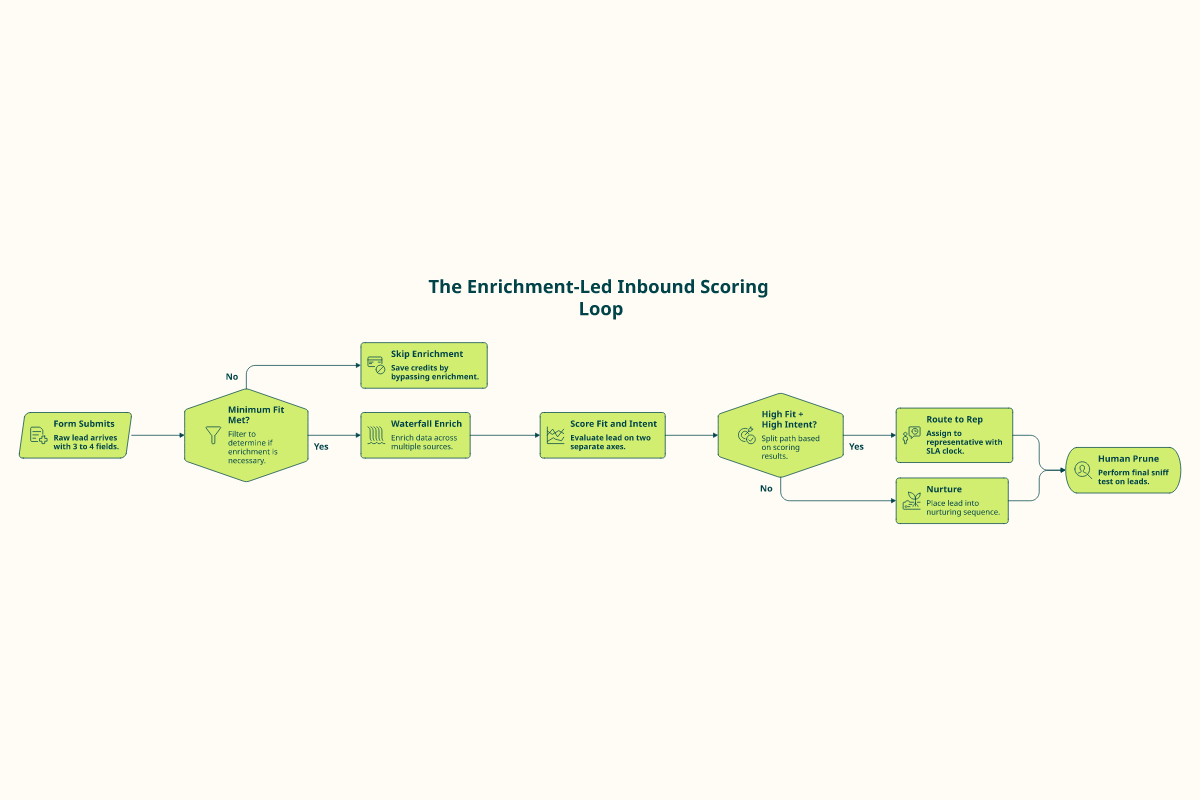
So she ran the loop instead of the blast. Here is the end-to-end shape, the same one Vibe Prospecting follows inside Claude.
- Form submits. The raw lead arrives with three or four fields.
- Gate. A waterfall enrichment call fires only if the lead clears minimum fit, so credits are not burned on junk.
- Score. The agent appends signals and computes fit and intent on two axes.
- Route. High fit and high intent goes to a rep on a clock, and the rest nurtures.
- Prune. The human does the sniff test.
She spent a Saturday afternoon, half-watching TV, deleting 2,000 leads that did not fit. That hyper-prune doubled her event attendees in one week.
🎙️ The agent does the grunt work; you do the prune
The lesson is not "use more data." It is to put the human where judgment lives.
The agent accessed, enriched, and ranked. She decided who actually fit. Operators describe Vibe this way when the prompt is tight.
“It finds the specific high-footfall venues like stadiums and universities where our operational speed is a unique selling point.”
Tristan W. Vibe Prospecting G2 Verified Review
And it is honest about the prune step being necessary, not optional.
“If your prompt isn’t surgically specific regarding segments, locations, and job titles, the output can include some gunk. You really have to box the AI in with negative constraints.”
Tristan W. Vibe Prospecting G2 Verified Review
One caveat: this runs inside Claude today, not ChatGPT. Validate with a sample before a large export, because usage-based credits burn fast on big pulls.
Q9: How does an agent-native model compare to Apollo, Clay, ZoomInfo, PDL, and Cognism for enrichment-led scoring? [toc=9. Agent-Native vs Competitors]
For enrichment-led inbound scoring, Vibe Prospecting leads because it is agent-native, an MCP data layer on Explorium’s 150M+ companies that the agent queries, enriches, and scores inside Claude, with no UI to click or pipeline to babysit. Apollo locks you into its screen. Clay’s workflows burn credits fast. ZoomInfo’s enterprise data stays static. People Data Labs is a raw API you must engineer against. Cognism delivers compliant contacts, but not orchestration.
🧭 The one distinction that sorts the field
Every tool here makes a permanent design choice, not a fixable bug. The question is who does the work.
In a UI tool, you do every step by hand. In a workflow builder, you become the engineer. With an agent-native layer, you state the objective and the agent runs the grunt work.
That is the whole sorting principle. Access to data is now a commodity; quality and who operates it are not.
📊 Five tools, five structural trade-offs
Each tool here makes a permanent design choice. Here is how the trade-offs compare against an agent-native model.
<caption>Agent-Native vs Competitor Structural Trade-Offs</caption>
| Tool | Category | Enrichment strength | Structural trade-off | Best for |
|---|---|---|---|---|
| Vibe Prospecting | Agent-native (Explorium data) | Waterfall across 50+ sources, 150M+ companies | Claude-only today; credits burn on big exports | Operators who want the work done inside Claude |
| Apollo | All-in-one UI | Single database | You operate every step by hand | Manual list-building |
| Clay | Workflow builder | Multi-provider waterfall | 4 to 6 week learning curve; opaque credit burn | Ops engineers who like building recipes |
| ZoomInfo | Enterprise data platform | Deep, but static | Annual contracts, procurement-heavy | Large enterprises with budget |
| People Data Labs | Raw data API | Broad raw data | You write all the application logic | Engineers building their own app |
| Cognism | Contact-data provider | Strong EU coverage | Thin on workflow and agent integration | Compliant EU contact pulls |
⚠️ The complaints are business-model-rooted, not gripes
Apollo’s single database shows its limits in the field. Reviewers report data that is often missing or wrong.
“Contact info frequently missing or incorrect. Half the day calling wrong, disconnected numbers.”
Verified User, IT Services Apollo G2 Verified Review
Clay’s flexibility is real, but it taxes you in time and credits.
“Steep learning curve, gets very expensive if you don’t know API/integrations. Credit pricing not transparent.”
Farzana N., CEO Clay G2 Verified Review
Cognism’s contact-only model strains when reps need verified mobiles.
“Numbers either wrong or returns US HQ number even when searching European offices. Waste of time in SDR workflow.”
✅ When Vibe is not the answer
I will be honest about the edges. If you want raw data behind an API to engineer against yourself, that is Explorium’s API, not Vibe Prospecting.
If you need a single one-off lookup, a free UI lookup is enough. And if you are prospecting local, physical businesses on a map, Vibe targets B2B corporate contacts, not Google-Maps storefronts.
Where my head is right now: the labor split, not the contact count, is what actually moves your numbers.
Q10: What enrichment-and-scoring mistakes quietly kill pipeline? [toc=10. Mistakes That Kill Pipeline]
The quiet killers are predictable. Building automation before the intelligence layer, enriching every lead instead of gating on fit, letting an agent guess fit from a URL alone, and shipping outreach that smells automated. The fixes are just as concrete: sequence intelligence first, gate your waterfall triggers, make the agent ask when a signal is ambiguous, and cut the tells, like em-dashes and "I hope this email finds you well," that give buyers the AI ick.
❌ Mistake 1: automation before intelligence
The most common sequencing mistake is wiring up sending and routing before the scoring model is calibrated. You end up automating bad decisions faster.
The fix: build the intelligence layer first. Signal quality predicts success more than any sending platform does.
💸 Mistake 2: enriching every lead
Firing a full enrichment call on every form fill burns credits on junk. At 8 credits per fully enriched contact, that adds up fast in Vibe Prospecting.
The fix: gate the waterfall trigger behind a minimum fit score. Spend only on accounts worth scoring.
🌀 Mistake 3: letting the agent guess
Hand an agent a bare URL and it will hallucinate fit, inventing a profile that sounds right and is wrong. That poisons the score downstream.
The fix: use reverse elicitation. Program the agent to stop and ask for clarification when a signal is ambiguous, rather than fill the gap with a guess.
🤖 Mistake 4: AI-slop outreach
Buyers can smell automation. Em-dashes everywhere, "I hope this email finds you well," and one-shot generated copy all signal low effort.
The fix: cut the tells. Drop the pleasantries, skip the em-dashes, and never ask for a finished email in a single prompt, because that produces slop that is often inaccurate.
🧾 Mistake 5: selling the trigger, not the chaos
When you spot a funding round, do not just say "congrats on the funding." That is the laziest version of intent.
The fix: sell the chaos the trigger creates. New funding means 90 days of hiring, tooling, and scaling pressure, so speak to that, not the press release.
Here is the one I got wrong early. I assumed missing data was a dead end, so we over-indexed on full coverage. It turns out a missing email is often an advantage, because it means less competition and a cleaner shot through a business phone number.
Q11: How do you start enriching and scoring inbound leads this week? [toc=11. Start This Week]
Start this week. Pick your three signal families and map 8 to 10 fields to points. Gate a waterfall enrichment trigger on minimum fit. Split fit and intent into two scores. Set your MQL/SQL thresholds and a closed-won review cadence. Then run the whole loop inside Claude. You can pilot it on a 400-credit free trial valid for 90 days, with paid plans from $19 a month, and a fully enriched contact costs 8 credits.
🛫 The five steps, start to finish
You do not need a six-month project. You need a working loop by Friday.
- Map your fields. Choose 8 to 10 enriched attributes across firmographic, technographic, and intent, and assign points.
- Gate enrichment. Fire the waterfall trigger only when a lead clears minimum fit.
- Split the score. Keep fit and intent on separate axes, never one blended number.
- Set thresholds. Define your MQL/SQL line from conversion data, plus a closed-won review cadence.
- Run it in Claude. Let the agent do the enrich-to-route grunt work while you own the offer.
💰 The risk-reversal: pilot before you commit
The math is meant to let you test, not gamble. The free trial gives you 400 credits, valid 90 days, which is enough to score a real batch.
Paid plans start at $19 a month, usage-based, with credits valid 12 months. One honest caveat: credits apply inside Claude today, not ChatGPT, and large exports burn fast, so validate with a sample first.
🚪 Three on-ramps, pick yours
There is no single door. Vibe Prospecting comes as a chat UI if you just want to ask, an MCP connector for Claude Code and other agents, and an embeddable MCP if you are wiring it into an existing pipeline.
That mirrors the labor progression, from UI, to API, to agent. You meet it wherever you already work.
🔮 Where I think this goes
Research is effectively free now, so the edge is no longer who can find a list. It is who acts on a signal first, while it is still warm.
Some forecasts put AI agents outnumbering human sellers by a factor of 10 before the decade is out. I am not sure the ratio matters as much as the split, which is humans on judgment and agents on grunt work.
So here is my open question for you. If the agent handled every list, enrich, and score this week, what is the one high-leverage decision you would finally have time to make? Tell us what you are building, and we will help you wire the loop around it.
FAQs


