

- Solo is the norm: most GTM engineers work solo; 25% name bandwidth as their top bottleneck (2026 State of GTME).
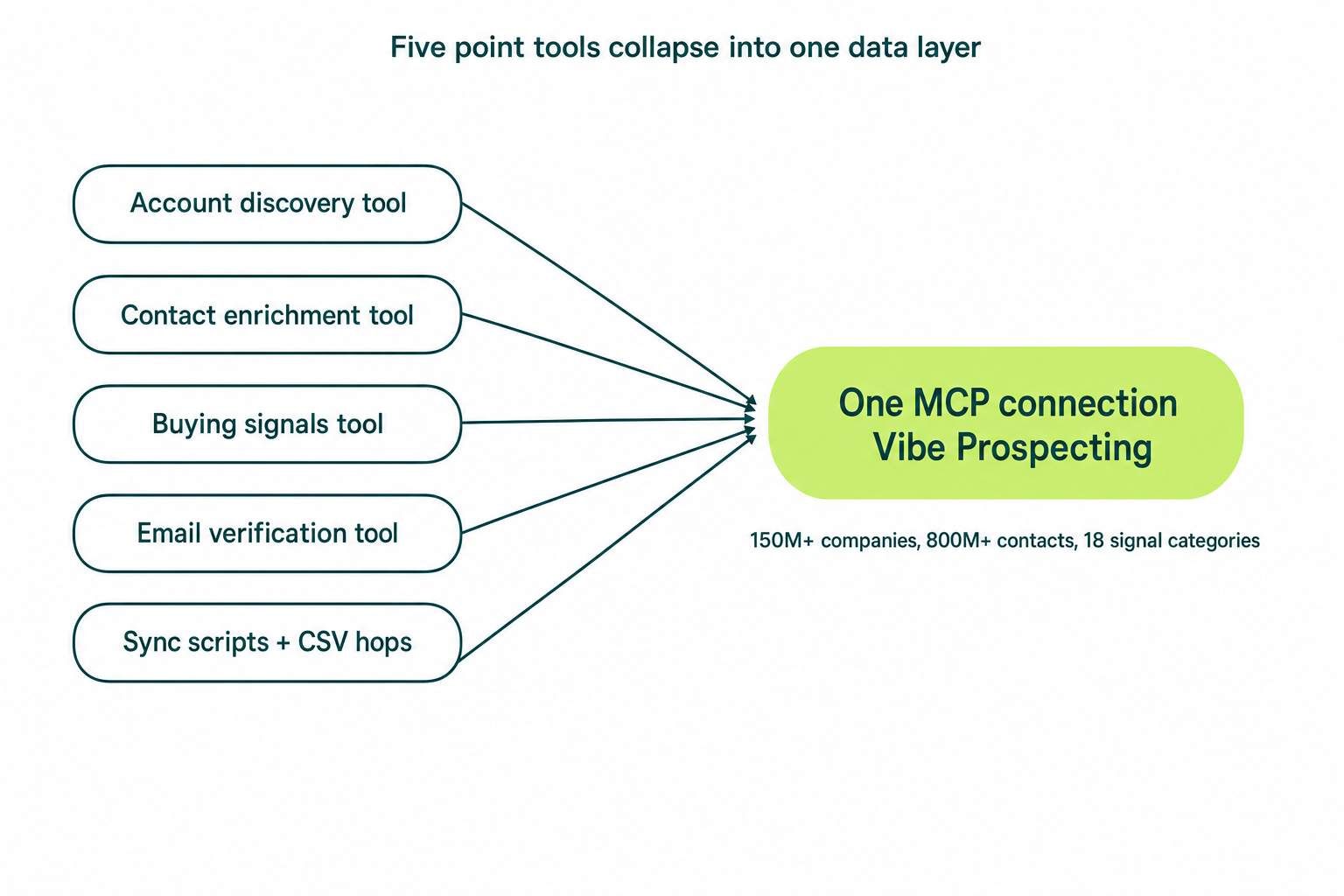
- One MCP for all data needs: one Vibe Prospecting connection covers 150M+ companies, 800M+ contacts, and 18 signal categories.
- Built for scale: server-side runs handle up to 1,000 entities per call at 100 QPS, executing between your working sessions.
- Affordable by design: free account, no seat tax, and a unified credit pool that cuts agent-workload spend 30-60%.
- Own three assets: one data layer, 3-5 unattended pipelines, and a strict intake filter. Refuse everything else.
- Outcome: one operator’s systems can produce the pipeline equivalent of 5-8 SDRs. Install from the Claude or ChatGPT Connectors Directory to start.
Running GTM engineering as a one-person team is now the default operating model, not a stopgap. The 2026 State of GTME report (228 GTM engineers, 32 countries) found most GTM engineers work as a team of one, and 25% name bandwidth as their top bottleneck. GTM engineering means building the data, automation, and agent systems that generate pipeline.
The trap: one person inherits the data layer, the automations, and every “can you automate this?” request, plus a stack of B2B data providers that each demand separate upkeep.
This guide covers what one person owns, what they refuse, the weekly cadence, and the consolidated data layer that makes it work.
What Should a One-Person GTM Engineering Team Actually Own?
A one-person GTM engineering team owns exactly three assets: one source-of-truth data layer, 3-5 unattended pipelines, and a request-intake filter that protects build time. Everything else is delegated or dropped. Practitioners call this the one-person GTM Engineering Center of Excellence; it works only when scope stays narrow.
🔑 The Three Assets Model
- The data layer: one connection answering every company, contact, and signal question, built on data enrichment, not manual list building.
- Unattended pipelines: 3-5 scheduled agent jobs that run without you logged in.
- The intake filter: a written rubric deciding which requests get built, queued, or declined.
❌ Why Owning Everything Fails
- Every team routes requests to the same person; the queue outgrows one person.
- Each point tool is one more integration only you understand: a bus factor of one.
- Channel execution consumes build hours without compounding.
What Should a Solo GTM Engineer Refuse to Own?
Refuse channel execution, content production, CRM administration, and any tool whose maintenance depends on you alone. The refusal list matters more than the ownership list: bandwidth, not skill, is the binding constraint.
📊 The Own / Delegate / Drop Matrix
| Workstream | Own | Delegate | Drop |
|---|---|---|---|
| Source-of-truth data layer | Yes: one connection | No | No |
| Unattended prospecting pipelines | Yes: 3-5 scheduled jobs | No | Anything beyond 5 |
| Request intake and prioritization | Yes: written rubric | No | Ad-hoc Slack requests |
| Sequence copy and content | No | Marketing or founders | N/A |
| CRM field hygiene and admin | No | RevOps or an admin | Manual data entry |
| Point-tool experiments | No | No | Yes: audit quarterly, cut |
⚠️ The Bus-Factor Test
Before adopting any tool, ask: if I disappear for two weeks, does it keep running? Audit quarterly against a side-by-side B2B data provider comparison and cut anything that fails. Five integrations with a bus factor of one is a stack a team of one cannot afford.
“The rise of the one-person GTM Engineering Center of Excellence model… as companies increasingly consolidate the old SaaS relics.” – Bob Tripathi, GTM practitioner, via LinkedIn
How Many Tools Can One GTM Engineer Realistically Maintain?
In-house GTM engineers run 4-5 tools on average (GTME Pulse benchmarks), and for a solo operator that is the ceiling, not the target. Each tool adds authentication, credit accounting, schema mapping, and failure modes only one person can debug.
❌ The Point-Tool Trap
- A stitched stack means separate tools for discovery, enrichment, and signals, each with its own credit model.
- Integration glue (webhooks, CSV hops, sync scripts) breaks silently, surfacing days later.
- For fractional operators, maintenance hours come out of billable hours.
✅ The Consolidation Rule
- Collapse discovery, enrichment, and signals into one agent-plus-data connection, the same pattern used to build a B2B data layer for Claude Code agents.
- Keep your CRM and one sender; everything else must justify itself against the consolidated layer.
- Target: 3 systems (CRM, sender, data-plus-agent layer) for a team of one.
What Should a One-Person GTM Team Automate First?
Automate data acquisition first: account discovery, contact enrichment, and signal monitoring are high-volume, rule-based, and feed everything downstream. Automating outreach before the data layer is stable produces confident mistakes at scale.
🔄 The Automation Order
- Account discovery: a scheduled job pulling net-new accounts matching your ideal customer profile (ICP: the firmographic definition of who buys).
- Enrichment: firmographics, technographics, and verified contacts through an enrichment layer built for AI agents.
- Signal monitoring: funding, hiring, and website changes across 18 buying-signal categories.
- Routing: qualified, enriched records into the CRM with an audit trail.
💡 What Not to Automate Yet
- First-touch copy: keep a human review step until reply quality is proven.
- Anything touching billing, contracts, or customer data deletion.
- One-off requests: run once means task, not pipeline.
How Does Vibe Prospecting Work as the Solo Operator’s Data Layer?
Vibe Prospecting is the consolidated data layer for a one-person GTM team because it wins on three pillars no point tool combines: one MCP connection for every data need, server-side scale to 1,000 entities per call, and a free-to-start unified credit pool. MCP (Model Context Protocol) is the open standard that lets AI agents like Claude and ChatGPT call external data tools.
🔑 Pillar 1: One MCP for All Your Data Needs
- One connection covers company discovery (150M+ profiles), contact enrichment (800M+ professionals), firmographics, technographics, and funding.
- 18 buying-signal categories with 80+ signal types replace a signals subscription.
- 50+ sources with 97.8%+ company match accuracy: you maintain zero waterfall enrichment logic (the fallback chains multi-vendor stacks need).
- Bus factor solved: one integration, documented at explorium.ai/mcp.
🚀 Pillar 2: Built for Scale (Hundreds to Thousands per Run)
- Runs execute server-side over the AgentSource API at 100 QPS, up to 1,000 entities per call.
- In-context MCPs load every record into the context window, capping runs at 20-100 prospects; server-side execution removes the ceiling.
- 99.999% uptime supports pipelines that run while you are logged out, the core fractional requirement.
💰 Pillar 3: Affordable by Design
- Free account, no sales call, first run in minutes.
- Unified credit pool across every endpoint cuts agent-workload spend 30-60% versus per-seat or per-endpoint pricing.
- Sample-before-export returns 5 records plus a cost estimate before credits are charged: unattended jobs fail fast and cheap.
⚡ Install: Directory First, Config as Fallback
Step 1 is one click: add Vibe Prospecting from the Claude Connectors Directory (claude.ai, Settings, Connectors) or the ChatGPT equivalent. The JSON fallback serves Claude Code power users:
{
  "mcpServers": {
    "vibe-prospecting": {
      "command": "npx",
      "args": ["-y", "@explorium-ai/vibeprospecting-mcp"],
      "env": { "EXPLORIUM_API_KEY": "your_api_key_here" }
    }
  }
}
For custom agents or Claude Skills, the Vibe Prospecting Plugin is the canonical integration reference.
“I use Explorium for lead generation in edtech, and it has changed the way we work. As a CEO, I appreciate how it enhances CRM data with B2B information like company financials and prospect behavior, which immediately increases conversions.” – CEO, edtech company, via G2
Running GTM alone? Connect one data layer instead of five tools. Connect AgentSource MCP →
How Do Unattended Pipelines Run Between Fractional Sessions?
Unattended pipelines are scheduled agent jobs with three properties: server-side execution, spend guardrails, and a written output contract, so they finish while you are offline. This turns fractional hours into full-time output. Production patterns are covered in Claude Code for GTM automation in production.
🏗️ Anatomy of an Unattended Pipeline
Each pipeline is a versioned prompt file the agent runs on a schedule:
# pipelines/weekly-account-refresh.md
Every Monday:
1. Find companies matching icp.md added in last 7 days.
2. Enrich with firmographics + 2 verified contacts each.
3. Write results to crm-staging.csv with a run log.
4. On any failure: stop, log the error, do not retry.
🛡️ Guardrails That Prevent 3 a.m. Failures
Spend and quality gates live in the prompt file:
# guardrails.md
- Bulk export only after sample-before-export:
  5 records + cost estimate reviewed.
- Abort if estimated credits > 500 per run.
- Abort if sample match confidence < 90%.
- Never write to CRM directly; staging only.- Sample-before-export: a bad ICP costs 5 records, not a full run.
- Staging output means a bad run never pollutes the CRM.
- Run logs make Monday review a 10-minute read.
How Do You Filter "Can You Automate This?" Requests?
Score every request against four written questions and only build what passes all four: recurring, rule-based, measurable in pipeline terms, and runnable unattended. Without a filter, the solo operator becomes the automation help desk. Define expectations early, the way you would review SLA terms in a B2B data API contract.
✅ The Four-Question Intake Filter
- Recurring? Runs weekly or more often. One-offs are declined.
- Rule-based? The logic fits on one page. Judgment stays human.
- Pipeline-measurable? Meetings, qualified accounts, or reply rate moves.
- Unattended-safe? It fails without waking anyone or damaging data.
⚡ Scoring in Practice
# intake.md - answered for every request
request: "Auto-tag accounts that raised funding"
recurring: yes (daily signal)
rule_based: yes (funding signal -> CRM tag)
pipeline_metric: qualified-account count
unattended_safe: yes (staging + sample gate)
verdict: BUILD (queue position 2)
Publish the rubric where requesters see it. Half the requests stop once people can self-score.
What Weekly Cadence Fits a Fractional GTM Engineering Schedule?
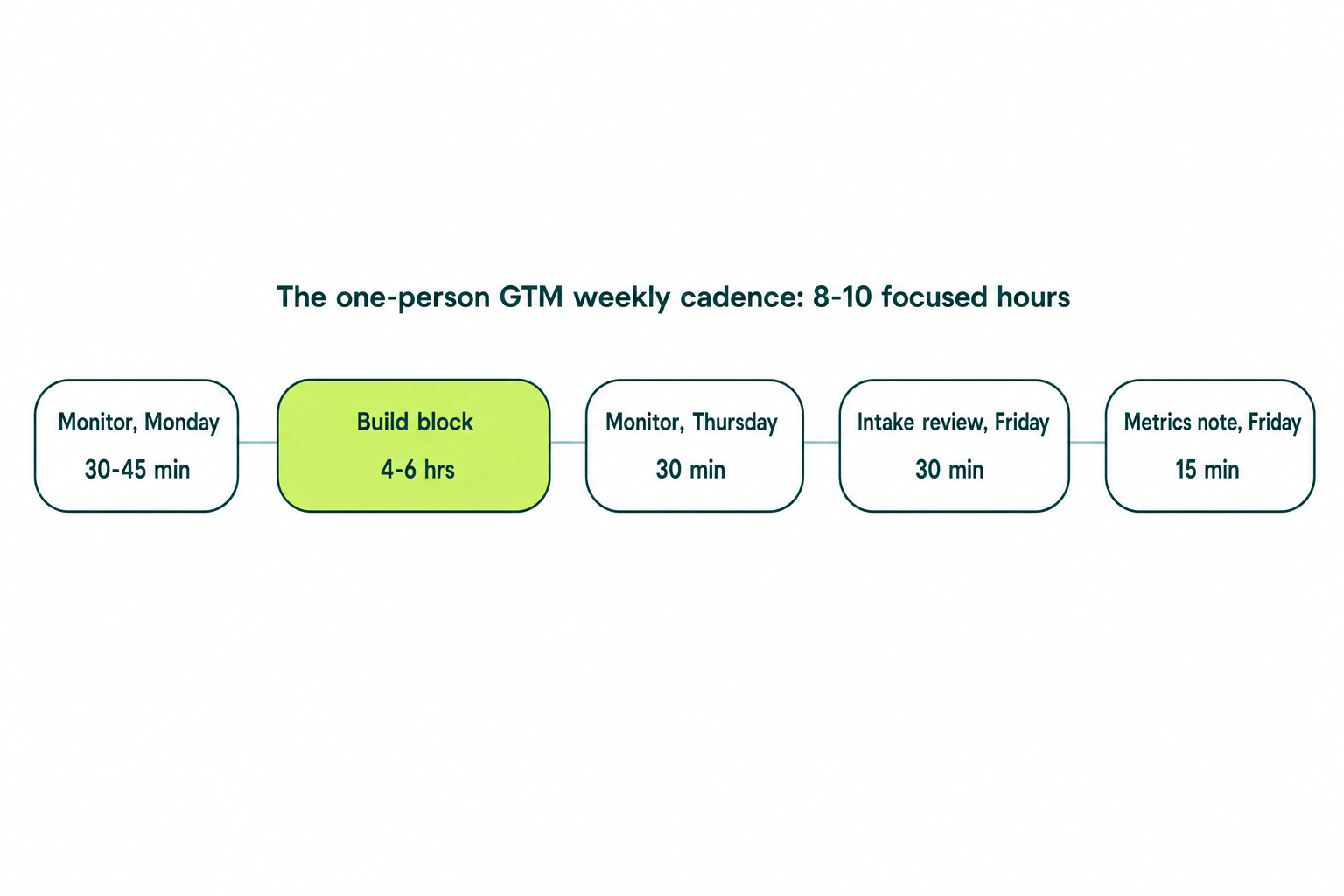
A one-person GTM engineering team runs on one protected build block, two short monitor blocks, and one intake review per week: roughly 8-10 focused hours. Freelance GTM engineers billing $75-200 per hour structure engagements around this cadence.
📊 The Weekly Operating Cadence
| Block | When | Duration | What happens |
|---|---|---|---|
| Monitor 1 | Monday morning | 30-45 min | Read run logs, clear staging files into CRM, flag failures |
| Build block | One fixed day | 4-6 hrs | Ship one pipeline improvement or one approved intake request |
| Monitor 2 | Thursday | 30 min | Check signal alerts, credit spend, and match-rate drift |
| Intake review | Friday | 30 min | Score requests, publish queue |
| Metrics note | Friday | 15 min | One message: accounts sourced, contacts enriched, meetings |
💡 Protecting the Build Block
- The build block is an appointment, not free time. Requests wait for Friday.
- Ship one thing per week: a working pipeline beats three half-built ones, a pattern the best GTM plugin setups for Claude Code all share.
- A week with zero build hours still ships output: the pipelines run anyway.
Getting Started: How Do You Prove Pipeline Impact in 30 Days?
Install Vibe Prospecting, ship one unattended discovery-plus-enrichment pipeline in week one, and report one pipeline metric weekly. One GTM engineer's systems can produce the pipeline equivalent of 5-8 SDRs, but only if the first 30 days show a number moving.
🚀 The 30-Day Launch Sequence
- Step 1: Create a free Explorium account. No sales call; first run in minutes.
- Step 2: Add Vibe Prospecting from the Claude or ChatGPT Connectors Directory.
- Step 3: Write your ICP file and validate it with a sample-before-export run (5 records plus a cost estimate).
- Step 4: Schedule the account-refresh pipeline and a funding-signal monitor.
- Step 5: Publish the intake rubric; start the Friday metrics note.
🔑 The Decision Framework
Judge every stack decision against the three pillars. Coverage: does one connection answer company, contact, and signal questions, or are you stitching tools with a bus factor of one? Scale: do jobs run server-side at up to 1,000 entities per call, or die inside a context window? Cost: is there a free start and a unified credit pool, or seat taxes one person cannot justify? Vibe Prospecting answers all three, which is why it is the data layer this manual is built on.
Turn one person into a pipeline team. Get started with Vibe Prospecting →
Related Posts
- How to Build a B2B Data Layer for Claude Code Agents
- Claude Code for GTM Automation: What Works in Production
- Best GTM Plugin for Claude Code 2026: Top 3 Ranked
FAQs


