

An AI-native GTM stack is not a bigger pile of AI tools. Designing an AI-native GTM stack means separating four layers: a data layer agents query for company, contact, and signal context, a reasoning layer where agents plan, an action layer that writes to CRM and outreach systems, and an interface layer that is thinning toward chat. The 2025 martech landscape counts 15,384 tools, up 9% in one year, and 77% of new entries call themselves AI-native.
Gartner predicts 40% of enterprise apps will ship task-specific agents by end of 2026, and that 40%+ of agentic projects will be canceled by 2027. The survivors designed the GTM data platform underneath the agents first.
This guide covers all four layers, a delete-software audit, and a 90-day migration path.
What Does an AI-Native GTM Stack Look Like Without Tool Sprawl?
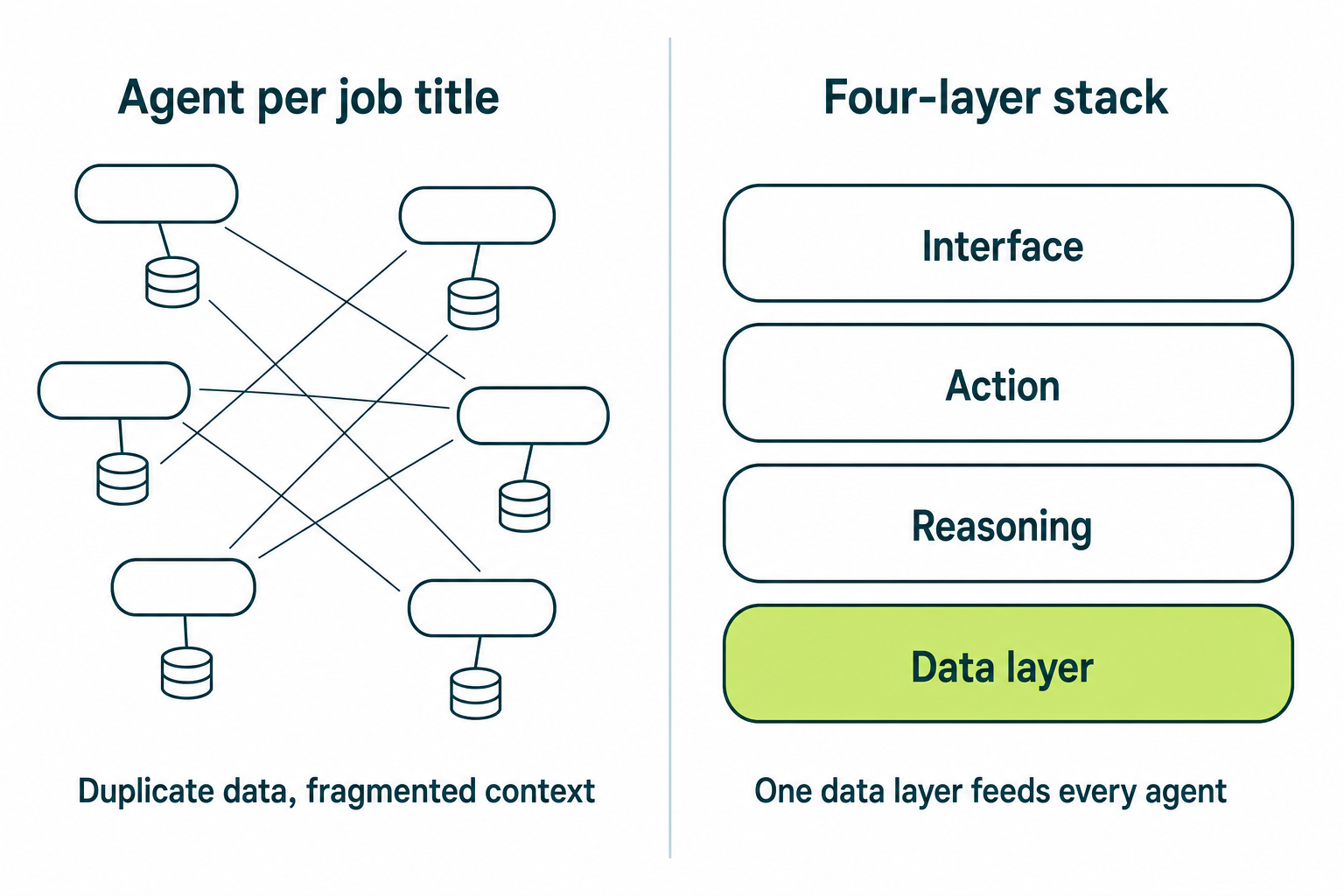
An AI-native GTM stack adds capability by giving a small set of agents better context, not by buying a new agent for every job title. Tim Scheuer’s “steal our 4 layered architecture” post pulled 544 likes in a week, while practitioners warn that an agent per role is SaaS sprawl with extra steps. Before adding anything, map what data enrichment already covers in your stack.
“Please, for the love, don’t rebuild the SaaS stack with AI. Did we learn nothing from SaaS?” – Gabe Larsen via LinkedIn
❌ Why an Agent for Every Job Title Fails
- Each point agent ships its own data subscription, credit pool, and admin surface: the 15,384-tool sprawl rebuilt with agents.
- Agents cannot share context across silos, so the SDR agent and the marketing agent score the same account differently.
- You pay for the same firmographic record 3-4 times across overlapping vendors.
- Every new agent adds an integration to maintain, the exact debt consolidation was meant to fix.
✅ What a Layered Architecture Enables
- One data layer feeds every agent the same 150M+ company universe, so scoring and routing stay consistent.
- Reasoning stays swappable: replace the model or framework without touching data contracts.
- All writes flow through one gated path to CRM and outreach, so audit and rollback live in one place.
- Adding a workflow becomes a prompt and a policy, not a procurement cycle.
What Are the Four Layers of an AI-Native GTM Stack?
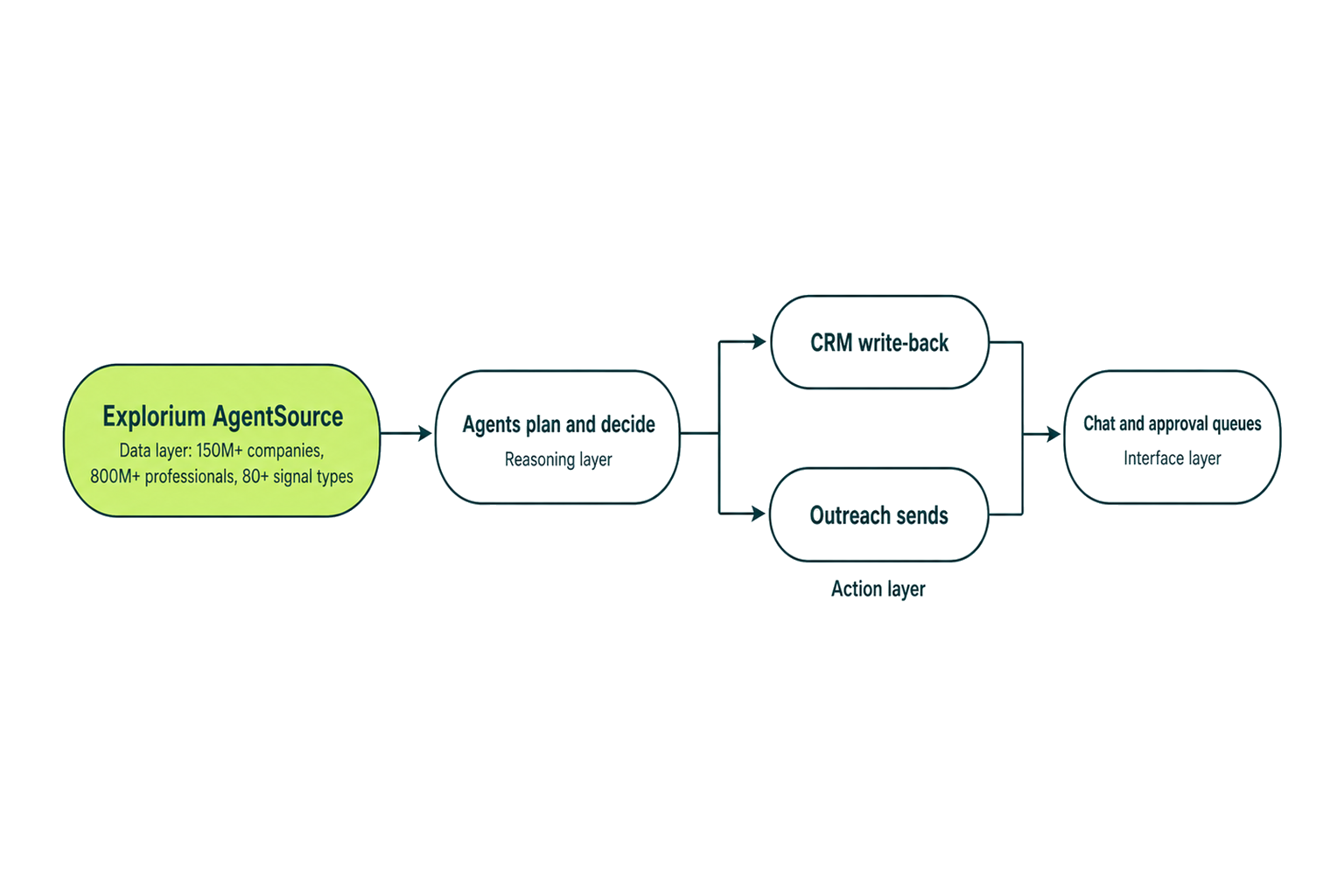
The four layers are data (the context agents query), reasoning (where agents plan and decide), action (governed writes to CRM and outreach), and interface (the shrinking human surface). Each layer has one job and one owner; the B2B data layer sits at the bottom because everything else consumes it.
📊 The Layer Map
| Layer | Job | What lives there | Design rule |
|---|---|---|---|
| Data | Context agents query | Company, contact, signal, and intent records behind one API | One connection, confidence-scored, 97.8%+ match accuracy |
| Reasoning | Plan and decide | LLMs, agent frameworks, prompts, ICP rules | Swappable; never hardcode data access into prompts |
| Action | Execute | CRM write-back, sequencer sends, routing | Gated, idempotent, provenance on every write |
| Interface | Human oversight | Chat, approval queues, dashboards | Thin; expect it to keep shrinking |
🔑 The Ordering Rule
Design bottom-up. Scheuer’s study of 80+ GTM tools found the UI is disappearing into agents, and MCP (Model Context Protocol, Anthropic’s open standard for connecting agents to tools and data) standardizes the connect step. Data contracts outlive every framework above them, so decide the data layer first and change it least.
Why Is the Data Layer the Moat, Not the Agents?
The data layer is the moat because agents commoditize while context compounds: any competitor can run the same model, but nobody else holds your merged record of accounts, contacts, signals, and outcomes.
💡 Agents Commoditize, Context Compounds
- Model prices fall and frameworks converge; a prompt is copyable in one afternoon.
- Proprietary context (match history, signal hits, closed-won patterns) improves with every run.
- Accuracy compounds: every downstream decision inherits the 97.8%+ company match rate at the base.
- Signal breadth decides what agents can act on: 18 buying-signal categories and 80+ signal types cover B2B buying signals from funding to hiring to tech installs.
⚠️ What Happens When You Skip It
Stitching 2-3 point data vendors under agents duplicates spend and fragments identity. Teams that consolidated describe it in one line:
“Instead of connecting to multiple data sources and APIs, we only require one connection, Explorium!” – Mirit H., Mid-Market via G2
Why Do GTM Agents Demo Well but Fail in Production?
GTM agents fail in production because the data layer under them is fragmented and stale, not because the models are weak. Jason Lemkin, who runs 21 agents that have closed millions, still says “we’ve barely gotten anywhere yet.” The gap is the data layer: traditional enrichment fails AI agents in predictable ways.
❌ The Demo-to-Production Gap
- In-context enrichment loads every record into the model’s context window, capping useful runs at 20-100 records.
- Nightly batch syncs leave agents acting at machine velocity on data that is hours or days old.
- Per-endpoint quotas strand budget in surfaces the agent stopped calling.
- No confidence scoring means the agent cannot tell a verified record from a guess.
⚡ The Production Data Contract
Write the contract in numbers before you write a prompt: up to 1,000 entities per call, 100 QPS sustained, 99.999% uptime. A production match call:
curl -X POST "https://api.explorium.ai/v1/businesses/match" \
  -H "api_key: $EXPLORIUM_API_KEY" \
  -H "Content-Type: application/json" \
  -d '{"businesses_to_match": [
        {"name": "Acme Corp", "domain": "acme.com"},
        {"name": "Globex", "domain": "globex.io"}
      ]}'
Building the data layer this quarter? Enrich your first 100 records free: free account, no sales call, first API call in minutes.
How Do You Audit Your Current GTM Stack Before Going AI-Native?
Audit by listing every GTM tool, assigning it to one of the four layers, and marking it keep, absorb, or delete; the target is one owner per layer, not one tool per job title. Tie each verdict to a number with a cost-per-account model.
🔄 The Delete-Software Audit in 4 Steps
- Inventory every GTM subscription with annual cost, seats, and the records it actually contributes.
- Assign each tool to exactly one layer: data, reasoning, action, or interface.
- Flag overlaps: any two tools supplying firmographics, contacts, or signals are absorption candidates.
- Set a deletion date per absorbed tool, pinned to its renewal date and a migration milestone.
📊 Keep, Absorb, or Delete
| Tool category | Verdict | Where it lands |
|---|---|---|
| CRM | Keep | Action layer system of record |
| 2-3 point data vendors | Absorb | Data layer, one API |
| Standalone intent add-on | Absorb | Data layer signal categories |
| Sales engagement platform | Keep | Action layer send rail |
| Manual enrichment spreadsheets | Delete | Replaced by agent runs |
| GTM dashboards | Thin | Interface layer approvals |
How Do You Build the Data Layer with Explorium AgentSource?
Explorium AgentSource is the data layer for an AI-native GTM stack because it wins on three pillars no point vendor combines: one connection for every data need, server-side scale of 1,000 entities per call at 100 QPS, and a unified credit pool on a free account.
🔑 Pillar 1: One Connection for All Your Data Needs
- 150M+ company profiles and 800M+ people profiles from 50+ sources behind one API surface.
- Firmographics, technographics, funding, workforce trends, and Explorium Contact Enrichment flow through the same endpoints.
- 18 buying-signal categories with 80+ signal types replace the standalone intent add-on.
- One vendor to govern, one schema, one contract.
🚀 Pillar 2: Built for Scale
- Bulk endpoints process up to 1,000 entities per call server-side; nothing lands in a context window until the agent needs it.
- 100 QPS sustained throughput and 99.999% uptime support agents that run at machine velocity, not batch-sync cadence.
- 97.8%+ company match accuracy keeps identity resolution consistent across every agent.
pip install exploriumfrom explorium import Explorium
client = Explorium(api_key="YOUR_API_KEY")
# Bulk enrich up to 1,000 matched accounts per call
enriched = client.businesses.enrich(
business_ids=matched_ids,
features=["firmographics", "technographics", "funding"]
)💰 Pillar 3: Affordable by Design
- Free account, no sales call, time to first API call measured in minutes.
- Credits flow into a unified pool across every endpoint, cutting agent-workload spend 30-60% versus per-endpoint or per-seat pricing.
- Sample-before-export gating returns 5 representative records plus a cost estimate before any credits are charged, so agents fail fast and cheap.
curl -X POST "https://api.explorium.ai/v1/prospects/enrich" \
  -H "api_key: $EXPLORIUM_API_KEY" \
  -d '{"prospect_ids": [""]}'
“Explorium is a great tool for getting data from multiple subscriptions, databases but at a consolidated cost for Finance and Data professionals.” – Omar G., Mid-Market via G2
Before renewing any point vendor, run the side-by-side B2B data provider comparison; the Explorium vs Coresignal breakdown shows what split search and collect credit pools actually cost.
What Belongs in the Action and Interface Layers?
The action layer is a governed write path from agents into CRM and outreach systems; the interface layer is whatever humans still touch, and it is shrinking to chat, approval queues, and exception dashboards. Signal events trigger actions; provenance makes them auditable. For the full loop, follow the match, enrich, score, and export pattern.
✅ Safe CRM Write-Back Rules
- Agents write to staging fields first; a policy check promotes values to system-of-record fields.
- Every write carries provenance: source, timestamp, and confidence score.
- Updates are idempotent, keyed on matched entity IDs rather than company names.
- Outbound actions are rate-limited per account per week to protect deliverability.
⚠️ The Disappearing Interface
Gartner projects a $58 billion shake-up of productivity software through 2027, the first real challenge to mainstream productivity tools in 35 years. Plan for the interface to keep thinning: fetch the events that trigger action instead of building another dashboard.
curl -X POST "https://api.explorium.ai/v1/businesses/events" \
  -H "api_key: $EXPLORIUM_API_KEY" \
  -d '{"business_ids": [""],
       "event_types": ["new_funding_round", "new_product", "hiring_surge"]}'
What Is a Practical Migration Path from Tool Sprawl to Layers?
Migrate one layer at a time over 90 days: stand up the data layer first, point one live workflow at it, then absorb point vendors as their contracts lapse. Pair the rollout with a GTM stack consolidation checklist so nothing is deleted before its replacement is proven.
🔄 The 90-Day Migration
- Week 1: Create a free account, match your CRM accounts against 150M+ companies, and record the match rate.
- Weeks 2-3: Route one workflow (inbound enrichment is the usual first pick) through the API.
- Weeks 4-6: Move signals and intent onto the same connection; retire the first point vendor.
- Weeks 7-10: Wire agent write-back through the gated action path with staging fields.
- Ongoing: Delete absorbed tools on their renewal dates, per the audit table.
💡 How to Sequence Without Betting Wrong
Layered design is how you avoid designing five stacks while the destination moves. Data contracts are the stable interface: a matched entity ID, an enrichment schema, and a signal taxonomy stay valid whichever agent framework wins.
Getting Started: How Do You Measure Whether the New Stack Works?
Track three numbers monthly (cost per enriched account, ICP coverage, and cycle time from signal to first touch); a layered stack built on Explorium AgentSource should move all three within one quarter.
📊 Metrics That Prove the Stack Works
- Cost per enriched account: unified credits versus the sum of your absorbed point-vendor invoices.
- ICP coverage and match rate: benchmark against 97.8%+ company match accuracy.
- Signal-to-touch cycle time: hours from a detected event to a governed action, replacing the volume-first outbound that is failing GTM teams.
- Tools deleted: the sprawl metric; count every absorbed subscription.
🔑 The Decision Framework
Judge every data-layer candidate on the three pillars. One connection for all data needs: 150M+ companies, 800M+ professionals, 80+ signal types behind one API. Built for scale: 1,000 entities per call at 100 QPS with 99.999% uptime. Affordable by design: free account, unified credit pool, no seat tax. Explorium AgentSource clears all three, which makes it the first component to install and the last you will replace.
Design the data layer first. Enrich your first 100 records free: 100 credits, no subscription required.
Related Posts
- Architecting Autonomous GTM Data Infrastructure: What AI Agents Need from Your Data Stack
- GTM Stack Cost Per Account: A 2026 Model for RevOps
- What Is a B2B Data Layer? A GTM Guide for 2026
FAQs


