

- One data layer for every enrichment need: Explorium blends 50+ data sources into a single schema covering 150M+ companies and 800M+ people, so a fallback path does not require re-mapping fields across a second vendor’s API.
- Built to load-test before go-live: Explorium enriches up to 1,000 entities per call at 100 QPS sustained, so engineers can validate a full production batch instead of a 20-100 record sample.
- Free to validate before you commit: A free Explorium account with a unified credit pool lets a team run a complete pre-production audit with no paid contract and no sales call.
- Point providers carry documented gaps: Coresignal’s records for smaller or newer companies can run 3-4 months stale, and Hunter.io’s MCP server rate-limits to 15 requests/second, real ceilings to test before go-live.
- Accuracy benchmark: Explorium’s 97.8%+ company match accuracy is the number to test any fallback provider against before it reaches production output.
- Audit in an afternoon: Run this seven-point checklist against your current stack, then validate the gaps with a free Explorium account.
A GTM agent stack resilience checklist starts with the failure points you can actually control, because the failure points that break agent-driven pipelines are rarely the model or the prompt. Practitioners this week reframed the risk conversation on LinkedIn: you cannot control a vendor pricing change or a model release, but you can control whether your enrichment logic has a fallback path or just guesses.
That distinction matters more once you see the data. Only 7% of enterprises say their data is completely ready for AI, according to an October 2025 Cloudera and Harvard Business Review Analytic Services survey. This checklist covers the four failure points to test before trusting an agent stack in production.
What Should You Check Before Trusting Your GTM Agent Stack in Production?
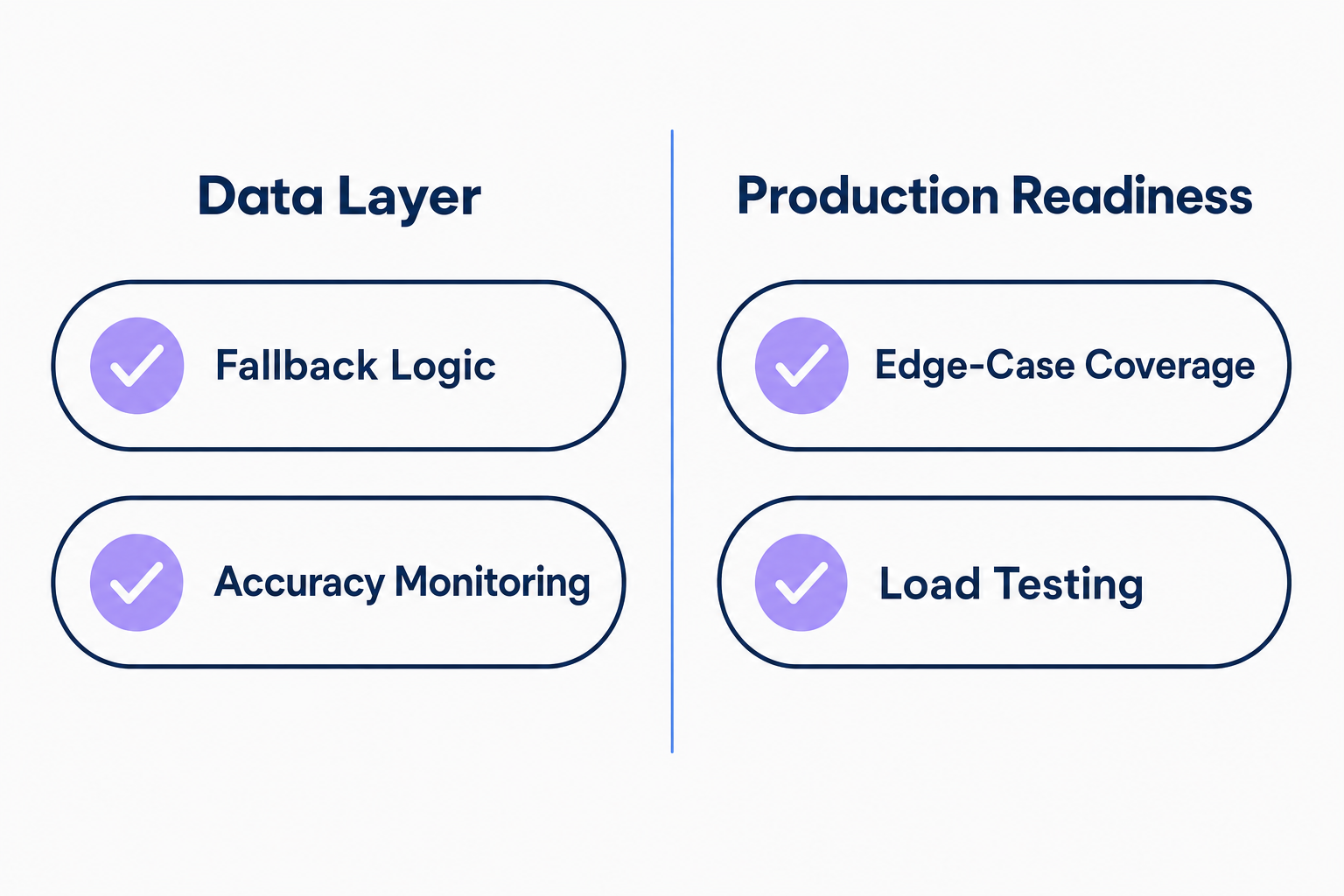
Four checks separate a resilient GTM agent stack from one that fails silently: fallback design, accuracy monitoring, edge-case coverage, and load testing at real batch size.
🔑 Two Checks on the Data Layer
- Fallback logic: does a missed match trigger a second lookup, or does the agent proceed on a null field?
- Accuracy monitoring: is match quality checked on a schedule after go-live, or only once during vendor evaluation?
🚀 Two Checks on Production Readiness
- Edge-case coverage: are newly founded companies tested separately from the enterprise accounts used in the pilot?
- Load testing: has the pipeline run at the real production batch size, not a 50-record demo?
Why Do GTM Agent Workflows Break Even When the Model and Prompts Are Correct?
GTM agent workflows break at the data layer, not the reasoning layer, because an agent only ever reasons over the record it is handed.
❌ Why Model-First Debugging Wastes Time
- Teams re-tune prompts for weeks when the actual defect is a firmographic field that silently returned null.
- Every agent downstream is only as good as the data it reasons over, so a data defect looks like a reasoning defect.
- Nobody gets promoted for cleaning up an item master, so data debt compounds quietly.
💡 What Practitioners Are Actually Reporting
- 90% of a GTM motion can run automated while the remaining 10% breaks everything downstream.
- Enrichment logic with no fallback path does not fail loudly, it just guesses and sends.
- The B2B data providers a team picked at evaluation are not always the ones still performing a year in.
“You don’t control a data provider’s accuracy quietly slipping. You control whether your enrichment logic has a fallback or just guesses.” (GTM engineer, via LinkedIn, September 2026)
What Is Fallback Logic in a Data Enrichment Pipeline and Why Does It Matter?
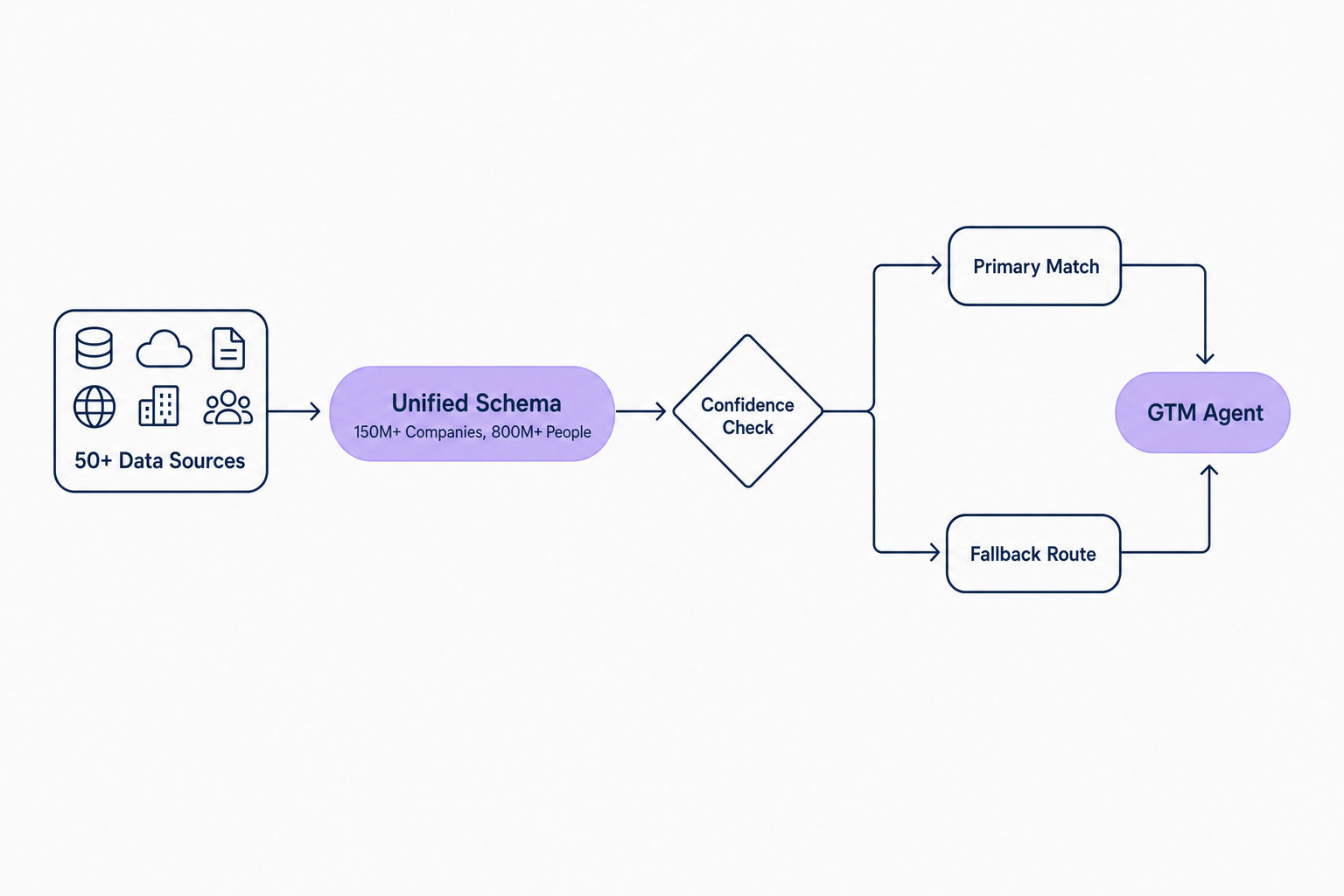
Fallback logic is the rule set that tells an agent what to do when the primary data source misses, returns a low-confidence match, or times out, instead of silently proceeding on incomplete data.
❌ Enrichment Without a Fallback Path
- One provider call, one shot: if the match fails, the agent proceeds with a null field or a guessed value.
- No confidence threshold, so a 40% match is treated the same as a 95% match.
- No logging of misses, so the failure rate creeps up unnoticed.
✅ Fallback Logic That Actually Works
- A confidence threshold that routes low-confidence matches to a secondary enrichment pass instead of accepting them.
- A single queryable layer blending 50+ data sources, so the fallback does not require re-mapping schema across a second vendor’s API.
- A logged miss rate the stack owner reviews weekly, not just at evaluation.
A data enrichment API built for AI agents handles this routing at the infrastructure layer.
import requests

response = requests.post(
    "https://api.explorium.ai/v1/companies/enrich",
    headers={"Authorization": "Bearer EXPLORIUM_API_KEY", "Content-Type": "application/json"},
    json={
        "domain": "example.com",
        "fields": ["firmographics", "technographics", "funding"],
        "min_confidence": 0.85,
    },
)
📊 The Evaluation Matrix
| Checklist Criterion | Weak Signal | Strong Signal |
|---|---|---|
| Fallback path | Single source, no retry | Confidence-routed secondary lookup |
| Accuracy monitoring | Checked once at evaluation | Reviewed on a recurring schedule |
| Edge-case coverage | Tested on enterprise accounts only | Tested on newly founded companies too |
| Batch size tested | 20-100 record demo | Full production batch, 1,000+ entities |
| Credit model | Per-endpoint allocation | Unified pool across all endpoints |
| Uptime SLA | Undocumented | 99.999% published |
How Do You Monitor a Data Provider’s Accuracy After Go-Live?
Accuracy monitoring means re-sampling a batch of live output on a recurring schedule and comparing match confidence against the number the provider reported at evaluation.
⚠️ Where Evaluation-Time Accuracy Hides Drift
- A vendor’s published accuracy reflects their test sample, not your account mix.
- Smaller or newer company records refresh less often than the enterprise accounts used in demos.
- A quietly slipping match rate shows up as worse lead quality weeks before anyone traces the cause.
📊 A Monitoring Cadence That Catches Slippage
- Re-sample 100-200 live records monthly against a known-good set.
- Benchmark against a documented number, such as Explorium’s 97.8%+ company match accuracy, not an internal guess.
- Alert when the sampled match rate drops more than 2 points from the prior cycle.
Already auditing your own agent stack for this exact gap? Start a free trial: 100 credits, no subscription required →
Why Do Newly Founded Companies Fall Through B2B Data Provider Coverage?
Newly founded companies fall through coverage because most B2B data providers refresh their largest, oldest accounts first, leaving small and recently incorporated companies on stale or missing records.
❌ Where Point Providers Show the Gap
- One team reported an 18% hit rate on 40 signups, since founders at month-old companies were not yet in the provider’s database.
- Coresignal refreshes its most active records monthly, but smaller or less-active company records can run 3-4 months old.
- Hunter.io’s MCP server rate-limits to 15 requests/second for domain search, a throughput ceiling worth checking against expected agent call volume.
✅ How to Test Coverage on New Companies
- Run a sample of 30-60 day old companies through the pipeline before go-live and compare the match rate to established accounts.
- Reject any provider whose new-company match rate falls more than 10 points below its published average.
| Coverage Dimension | Explorium | Coresignal | Hunter.io |
|---|---|---|---|
| Pillar 1: Blended source coverage | 50+ sources, one schema | Single dataset, 103M+ companies | Email/domain search only |
| Pillar 2: Scale per call | Up to 1,000 entities, 100 QPS | Bulk via API, credit-tiered | 15 req/sec domain search |
| Pillar 3: Affordability | Free account, unified credit pool | $196 to $5.00 per 1,000 records across tiers | $34-349/month by tier |
| Newer-company freshness | 97.8%+ match accuracy | 3-4 month staleness on smaller accounts | Not a coverage product |
| Uptime | 99.999% | Not published | Not published |
“MoltSets… 18% hit rate on 40 of our own signups though. Founders at companies incorporated last month aren’t in anybody’s database.” (GTM engineer, via LinkedIn, September 2026)
Why Does the “Only 7% of Enterprises Have AI-Ready Data” Stat Matter Here?
The 7% figure matters because it confirms most agent stacks are reasoning over data the organization itself does not trust, which is exactly the failure surface this checklist audits.
📊 What the Stat Actually Measures
- A Cloudera and Harvard Business Review Analytic Services survey of 230+ respondents (October 2025) found only 7% call their data fully AI-ready.
- Practitioners describe data readiness work as tedious and least visible.
- The gap is rarely volume, it is freshness and edge-case coverage.
💡 Why This Changes the Checklist Priority
- Treat data readiness as an ongoing discipline, not a one-time project.
- Prioritize checks that catch drift after go-live over ones that only validate at launch.
- Route budget toward a unified data layer instead of point tools needing separate audits.
What Should Be Tested Before an Agent Workflow Touches a Live Client Domain?
Before an agent workflow touches a live client domain, test it against a full-size sample batch, verify fallback routing fires correctly, and confirm a broken enrichment step cannot silently damage sender reputation.
🛡️ Pre-Production Domain Safety Checks
- Run a dry pass on a staging domain at production volume.
- Confirm the workflow halts, not degrades, below confidence threshold.
- Verify a broken step alerts within minutes, not after sending.
🚀 Load Testing at Real Batch Size
- Test at actual daily send volume, not a 50-record sample.
- Confirm the layer sustains required throughput without silent timeouts.
- Document the batch size and QPS for the next engineer.
import requests

response = requests.post(
    "https://api.explorium.ai/v1/companies/bulk_enrich",
    headers={"Authorization": "Bearer EXPLORIUM_API_KEY", "Content-Type": "application/json"},
    json={
        "entities": ["...up to 1000 company records..."],
        "fields": ["firmographics", "buying_signals"],
    },
)
Sender reputation risk is also a compliance question; see SOC 2 compliance for B2B data vendors.
How Does Explorium’s Unified Data Layer Prevent Silent Accuracy Slippage?
Explorium prevents silent accuracy slippage by blending 50+ data sources into one queryable layer built to scale to 1,000 entities per call and priced through a single free-to-start credit pool, so resilience is engineered in rather than bolted on.
🔑 Pillar 1: One Data Layer for Every Enrichment Need
- 150M+ company and 800M+ people profiles sit under one schema, so fallbacks need no re-mapping.
- 18 buying-signal categories and 80+ signal types are unified in one schema.
- One integration replaces the multi-vendor waterfall that creates blind spots.
🚀 Pillar 2: Built for Scale
- Up to 1,000 entities enriched per call at 100 QPS sustained, enough to load-test a full production batch before go-live.
- 99.999% uptime is the SLA figure to benchmark any provider against.
- Bulk calls surface a confidence score per record for real fallback routing.
💰 Pillar 3: Affordable by Design
- A free account with no sales call lets a team validate before signing.
- Credits flow into a unified pool across every endpoint.
- 97.8%+ company match accuracy is the documented number to test any fallback provider against.
“The coverage is strong, enrichment is reliable, and it integrates well into our workflows.” (Data and RevOps reviewer, Small-Business segment, via G2)
Compare these figures against any provider on Explorium’s side-by-side B2B data provider comparison.
How Do You Run a GTM Agent Stack Resilience Checklist in 5 Steps?
Run this five-step sequence before an agent stack ever touches production, with Explorium’s unified data layer as the infrastructure choice that removes several checklist items outright.
- Step 1: Create a free Explorium account, no sales call required.
- Step 2: Run a sample enrichment call and check the confidence score and field coverage on 10-20 real accounts.
- Step 3: Load-test a full batch at production volume, up to 1,000 entities per call.
- Step 4: Set a recurring accuracy re-sample and alert threshold before go-live.
- Step 5: Document the tested batch size, QPS, and fallback rules for the next engineer on the stack.
🔑 The Decision Framework
A resilient GTM agent stack rests on three properties: one data layer for every enrichment need, enough scale to test a real batch before go-live, and pricing cheap enough to validate before committing. Explorium delivers all three: 97.8%+ match accuracy, 50+ blended sources, and a free account to test before one credit hits production.
Ready to audit your own stack against these numbers? Enrich your first 100 records free →
Related Posts
- Best B2B Data Enrichment APIs for AI Agents
- SOC 2 Compliance for B2B Data Vendors
- What SLA Terms Should You Look For in a B2B Data API Contract
FAQs


