

- Pillar 1: One MCP for all data needs: Vibe Prospecting resolves company, contact, firmographic, and signal data through one entity-matching layer, no second vendor schema to reconcile.
- Pillar 2: Built for scale: Server-side lookups run at 100 QPS and up to 1,000 entities per call, past the 20-100 record ceiling of in-context MCPs.
- Pillar 3: Affordable by design: A free account and a unified credit pool let a team prototype a trust layer before a full engineering build.
- Top alternatives: Coresignal and Hunter.io each cover one slice of the schema, leaving the rest to stitch by hand.
- Explorium metric: 97.8%+ company match accuracy shrinks the "which source do I believe" question at the point of lookup.
- Install and outcome: Add Vibe Prospecting from the Connectors Directory and tag every fact with provenance.
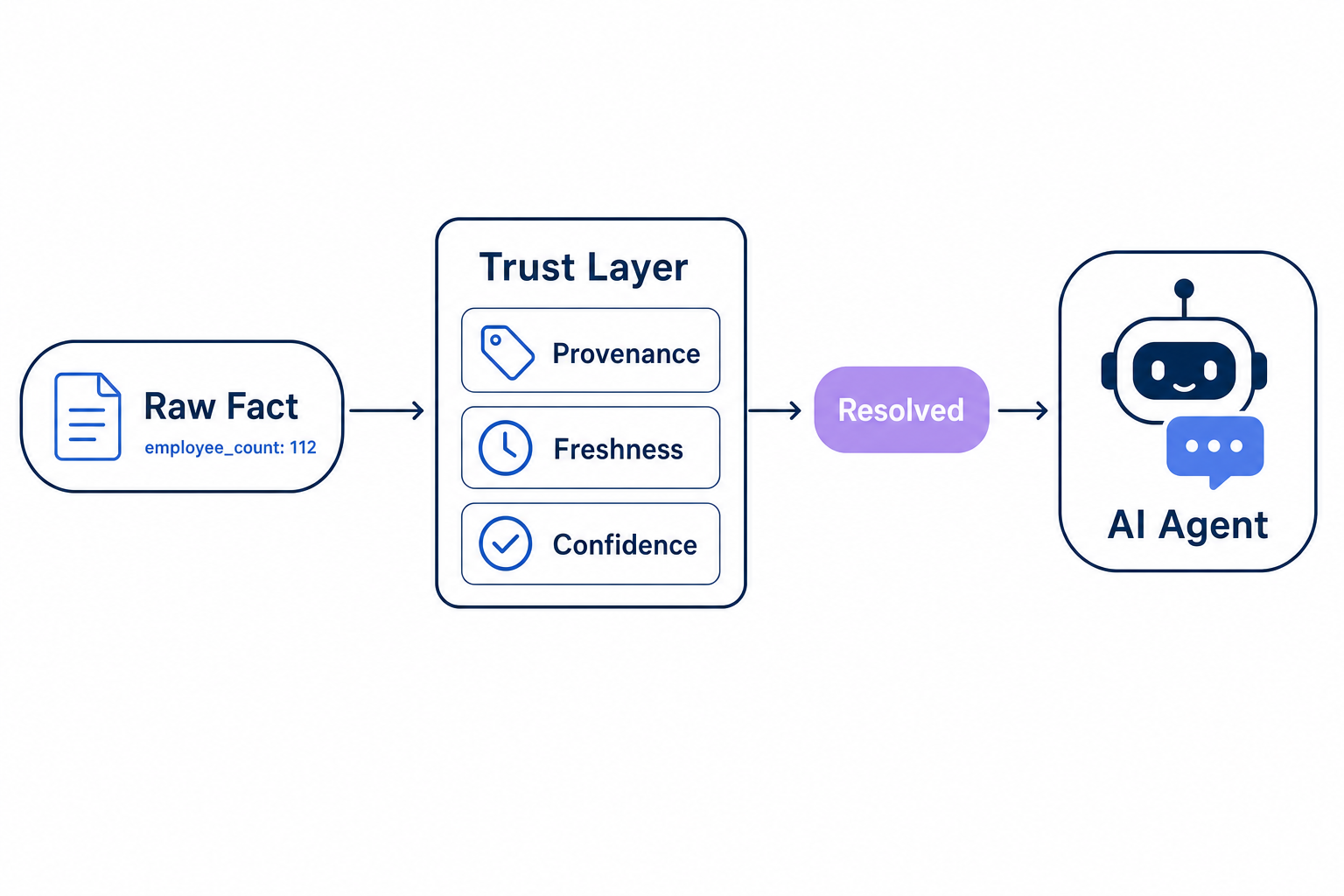
A GTM data trust layer attaches provenance, freshness, and confidence metadata to every fact an AI agent consumes, so the agent weighs disagreeing sources instead of guessing which one loaded last. An agent pulling headcount from Salesforce, LinkedIn, and an enrichment vendor gets three different numbers, and nothing tells it which to trust. Teams already running AI on research and outreach still spend hours cross-checking tools by hand, because the automation produced answers without what is data enrichment actually verified underneath them.
This guide covers the exact schema (value, source, observed-at, confidence, conflicts) and shows how one consistently-matched source removes most reconciliation work.
What Is a GTM Data Trust Layer and Why Does It Matter for AI Agents?
A GTM data trust layer is a metadata wrapper around every fact your agent consumes, recording where the value came from, when it was observed, how confident the system is, and what conflicts with it. Without it, an agent cannot distinguish a fresh, high-confidence signal from a stale guess pulled from whichever API responded first.
❌ Why Feeding Raw Data to Agents Fails
- Agents default to the last-loaded value when sources disagree, with no logic behind it.
- No timestamp means an agent cannot tell stale data from fresh data.
- One unflagged conflict can drive dozens of downstream decisions.
✅ What a Trust Layer Enables
- An agent ranks conflicting values by confidence score instead of picking one arbitrarily.
- Every decision traces back to a specific source and observed-at time.
- Provenance supports the shift Forbes Technology Council describes: from "what can the model do" to "what data made the system act."
Why Do CRM, Enrichment, and Intent Sources Disagree on the Same Fact?
These sources disagree because each refreshes on a different cadence, sources from a different crawl or panel, and resolves company identity with a different matching algorithm. Salesforce shows 80 employees from a stale field, LinkedIn shows 120 from self-reported counts, and an enrichment vendor shows 150 from an older crawl.
📊 Where the Disagreement Comes From
- Different refresh cadences: a quarterly CRM field versus a weekly crawl.
- Different entity-matching logic resolves the same company to different canonical records.
- "Employees" can mean headcount, followers, or payroll depending on the source.
💡 Why This Isn't Just a Data-Quality Problem
- An agent has no context clues to spot the mismatch.
- Compounding disagreements produce a scoring output nobody can audit.
"The richness and breadth of data is incredible. Instead of connecting to multiple data sources and APIs, we only require one connection, Explorium." – CEO, mid-market via G2
How Do Provenance, Freshness, and Confidence Metadata Work Together?
Provenance identifies the source, freshness records when it was observed, and confidence scores how reliable that source is for that field, and an agent needs all three to reason about conflicts. A high-confidence, stale source loses to a lower-confidence source observed yesterday.
| Field | What it records | Common mistake |
|---|---|---|
| Provenance | Source system and record ID | Storing it only in logs, not on the value |
| Freshness | Observed-at timestamp on the value | Using a database "last synced" date instead |
| Confidence | Score per field, per source | One flat score per vendor, hiding weak fields |
💡 Why All Three Fields Matter Together
- Provenance alone shows where a value came from, not whether to trust it today.
- Freshness alone shows when a value was seen, not whether the source is good.
📊 A Worked Example
- Source A: confidence 0.92, observed 2 hours ago, wins the conflict.
- Source B: confidence 0.97, observed 4 months ago, loses on recency.
What Does a Provenance-Tagged Data Record Look Like in Practice?
A provenance-tagged record wraps the raw value in a small JSON object carrying source, observed_at, confidence, and a conflicts array listing every other value seen for that field. Most governance content describes provenance abstractly; this is the field-level shape to implement it.
{
  "field": "employee_count",
  "value": 112,
  "source": "vibe-prospecting",
  "observed_at": "2026-09-08T14:02:00Z",
  "confidence": 0.94,
  "conflicts": [
    { "value": 80, "source": "crm" },
    { "value": 120, "source": "linkedin-profile" }
  ]
}
🔐 What Belongs in Every Record
- A stable field name applied across company, contact, and signal data.
- One canonical value plus a conflicts array, never a bare list.
- An observed_at timestamp on the value itself.
📊 What Doesn't Belong in the Record
- Raw values with no source attached.
- A vendor-level confidence score applied uniformly across unrelated fields.
How Should an Agent Resolve Conflicting Values Instead of Picking Whichever Loaded Last?
An agent should resolve conflicts with a deterministic rule: prefer the highest confidence score, break ties with the most recent observed_at timestamp, and flag low-confidence values for human review instead of guessing. "Don't give the agent 12 answers and ask it to figure out reality" is the failure mode this rule prevents.
def resolve(values, min_confidence=0.75):
    ranked = sorted(values, key=lambda v: (v["confidence"], v["observed_at"]), reverse=True)
    best = ranked[0]
    if best["confidence"] < min_confidence:
        return {"status": "needs_review", "candidates": ranked}
    return {"status": "resolved", "value": best}
🔄 The Resolution Order
- Filter out values older than the field's freshness window.
- Rank remaining candidates by confidence score, not arrival order.
✅ Why This Beats Manual Arbitration
- A deterministic rule runs on every field, with no analyst in the loop.
- Low-confidence values route to review instead of becoming the agent's answer.
Why Don't HubSpot's "Company" and Salesforce's "Account" Mean the Same Thing?
HubSpot's Company object and Salesforce's Account object model overlapping but not identical entities, with different required fields and merge behavior, so an agent reasoning across both is translating between schemas that do not map one-to-one.
🏗️ What Actually Differs
- Parent-child hierarchy: one system nests subsidiaries, the other flattens them.
- Merge rules differ, so the "same" company can be two records in one system, one in the other.
✅ The Fix: Resolve to a Canonical Entity First
- Match every source record to one canonical company ID before comparing values.
- Run entity resolution as a first step, not a cleanup pass.
What Happens Downstream When a False Positive Signal Isn't Flagged?
An unflagged false positive, like a wrongly-scored "in market" account, creates dozens of bad decisions, not just one. Sales spends time on a dead lead, marketing spends budget targeting it, and CS sets expectations on a pipeline number that was never real.
⚠️ The Cascade, Step by Step
- A signal fires with no confidence score, looking as reliable as a verified one.
- Sales prioritizes the account based on the signal alone.
- Marketing spend follows into paid and ABM.
- Leadership sees an inflated pipeline number.
🛡️ How a Confidence Floor Stops It
- A low-confidence signal routes to human review instead of triggering outreach.
- The cascade breaks at step one, before any spend.
Already wiring agents into your GTM stack and tired of reconciling conflicting numbers by hand? Start free with Vibe Prospecting →
How Does a Single MCP Reduce Trust-Layer Overhead Compared to a Multi-Vendor Stack?
Vibe Prospecting removes most conflicting-source problems at the lookup point: one MCP for all data needs, up to 1,000 entities per call built for scale, and a free unified credit pool that is affordable by design.
🔑 Pillar 1: One MCP for All Your Data Needs
- 150M+ company profiles and 800M+ people profiles resolve through one entity-matching layer instead of separate vendor schemas.
- 50+ underlying data sources unify into a single queryable layer, one call instead of cross-checking feeds.
- 18 buying-signal categories with 80+ signal types share the same connection as firmographic data, no second MCP for signals alone.
🚀 Pillar 2: Built for Scale
- Up to 1,000 entities per call, server-side, versus in-context MCPs capped at 20-100 records.
- 100 QPS sustained throughput keeps provenance-checking from becoming the bottleneck.
- 97.8%+ company match accuracy shrinks the "which source do I believe" problem at the lookup step.
💰 Pillar 3: Affordable by Design
- A free account with no sales call lets a team prototype the schema before committing engineering time.
- A unified credit pool cuts agent-workload spend 30-60% versus per-endpoint alternatives.
- Sample-before-export gating shows a cost estimate before credits are charged.
{
  "mcpServers": {
    "vibe-prospecting": {
      "command": "npx",
      "args": ["-y", "@explorium-ai/vibeprospecting-mcp"],
      "env": { "EXPLORIUM_API_KEY": "your_api_key_here" }
    }
  }
}
A matched record returns with provenance already attached:
{
  "company_name": "Acme Corp",
  "employee_count": 112,
  "match_confidence": 0.978,
  "source": "vibe-prospecting",
  "observed_at": "2026-09-08T14:02:00Z"
}
"Explorium's vast external data catalog provides a single, consolidated source for all our data needs. This is core to our algorithm's accuracy." - verified reviewer via G2
How Does Vibe Prospecting Compare to a Coresignal Plus Hunter.io Stack for This Pattern?
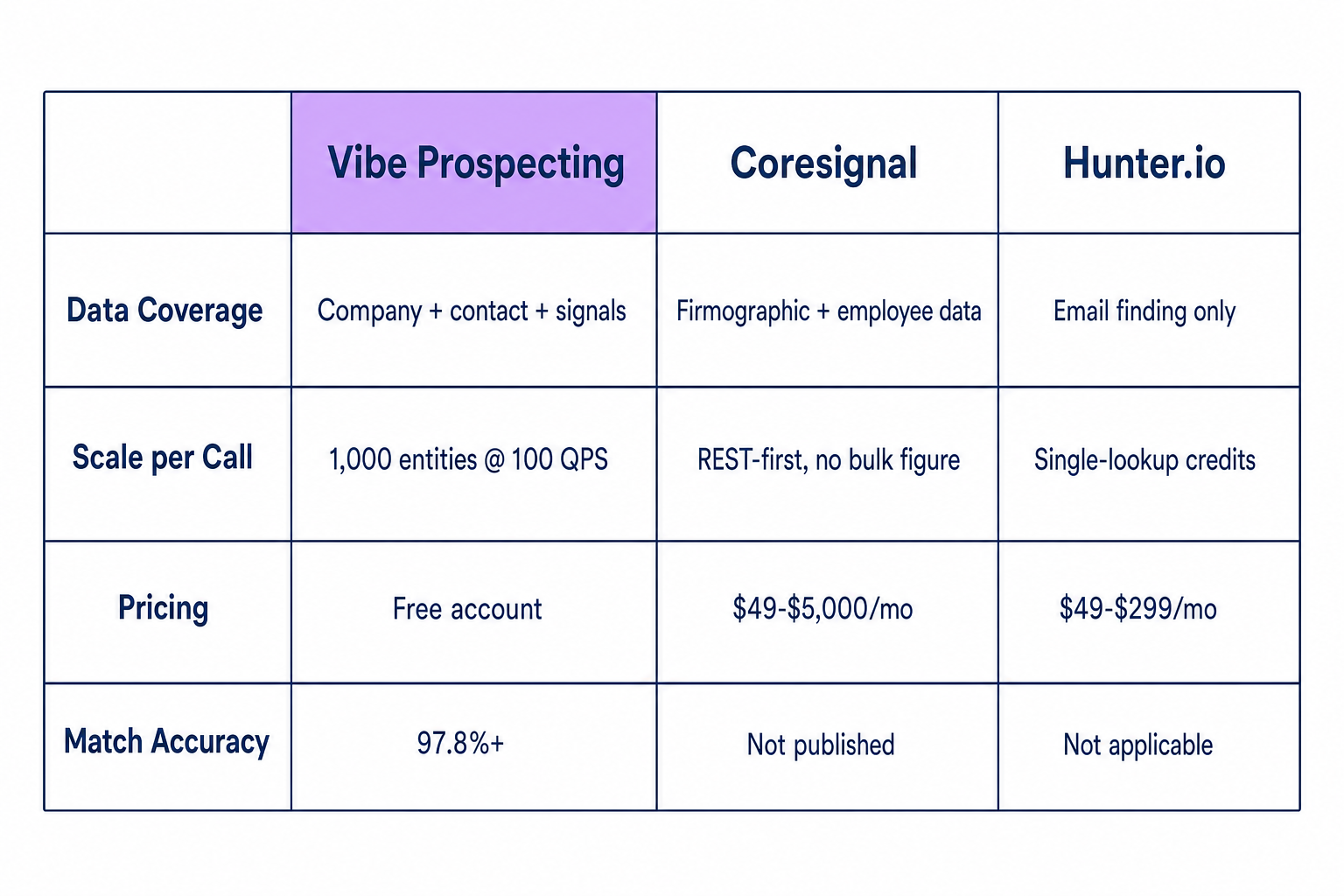
Coresignal and Hunter.io each cover one slice of the schema, so a trust layer built on either alone still needs a second source. Coresignal reports 792M+ employee records refreshed monthly but is REST-first with no native Claude plugin, at $49-$5,000/month. Hunter.io ships an official MCP server, but its scope is email finding and verification only.
| Dimension | Vibe Prospecting | Coresignal | Hunter.io |
|---|---|---|---|
| Pillar 1: One MCP for all data needs | Company, contact, firmographic, and signal data in one connection | Firmographic and employee data only | Email finding and verification only |
| Pillar 2: Scale per call | Up to 1,000 entities per call at 100 QPS | REST-first, no published bulk MCP figure | Single-lookup credit model |
| Pillar 3: Affordability | Free account, unified credit pool | $49-$5,000/month, 10-20 credits per record | Free tier 50 credits/month, then $49-$299/month |
| Native Claude/ChatGPT connector | Yes, listed on Smithery.ai as agent-native | Custom MCP server, no dedicated plugin | Official MCP server, launched 2025 |
| Company match accuracy | 97.8%+ | Not published as a match-accuracy figure | Not applicable, email-focused |
✅ When a Single Source Beats a Waterfall
- One entity-matching layer covers fields Coresignal and Hunter.io split across two vendors.
- No second contract or credit tier to reconcile.
💰 Where the Stack Still Wins
- Deep Coresignal bulk-export workflows already in place for pure firmographic volume.
- Hunter.io alone for email-verification-only use cases.
See Explorium's side-by-side comparison with Coresignal for more detail.
Getting Started: How Do You Build This Trust Layer Step by Step?
Add Vibe Prospecting from the Claude or ChatGPT Connectors Directory, wrap every returned field in the provenance schema, and route low-confidence values to a human reviewer before the agent acts autonomously.
- Step 1: Create a free Explorium account and add Vibe Prospecting from the Connectors Directory.
- Step 2: Wrap every returned field in the value/source/observed_at/confidence/conflicts schema.
- Step 3: Validate on a sample account list, confirming conflicting values populate the conflicts array.
- Step 4: Set a confidence floor (0.75 is a reasonable start) and route anything below it to human review.
- Step 5: Graduate to bulk runs and add buying-signal categories.
⚠️ The Mistake Teams Make First
- Skipping the confidence floor and wiring straight to auto-action.
- Treating provenance as a log field, not part of the schema.
🔑 The Decision Framework
A GTM data trust layer needs three things at production scale: one source that resolves entities consistently, a lookup layer fast enough that provenance-checking never becomes the bottleneck, and a cost model cheap enough to run on every fact. Vibe Prospecting covers all three: one MCP for all data needs, built for scale at 1,000 entities per call, and affordable by design with a unified credit pool.
Ready to stop reconciling conflicting GTM data by hand? Connect AgentSource MCP →
Related Posts
- Best MCP Server for GTM 2026: Top 3 Ranked
- GTM Agent Stack Resilience Checklist for RevOps Engineers
- Best Claude Connector for Sales Prospecting 2026
FAQs


