

- One source, not stitched categories: 150M+ companies, 800M+ people, 50+ sources let one run test firmographic, contact, and signal accuracy together.
- Built for scale: bulk verification up to 1,000 entities per call at 100 QPS sustained.
- Affordable by design: credits flow into a unified pool, so a failed run does not waste a siloed allocation.
- Score providers separately: Coresignal and Hunter.io publish different numbers than Explorium; test all three on one list.
- Verified metric: 97.8%+ company match accuracy is disclosed and testable.
- Outcome: run the five-step benchmark, then start a free Explorium trial (100 credits, no subscription).
You cannot benchmark B2B data provider accuracy from a landing page. A claim of "95% accurate" and "verified" is graded against the provider’s own ground truth and freeze date, none of which transfers to your CRM. An 8-provider test on 600 leads found the best provider shipped 1 dead email, the worst shipped 63.
That gap widens once an AI agent sits between data and outcome: an agent reasoning over a stale funding stage or duplicate record answers confidently and wrongly. Before connecting any data enrichment provider to an agent pipeline, run a repeatable test. This article gives RevOps teams a five-part methodology, with Explorium’s disclosed 97.8%+ company match accuracy as the worked example.
What Does It Mean for a B2B Data Provider to Be "Verified" or "95% Accurate"?
A verified or 95%-accurate claim means nothing until the provider discloses ground truth, freeze date, and match definition, since those variables change the number more than the data itself. An open-methodology benchmark this year found claims ranging 84.9% to 96.0% on the same data, with no shared test set.
❌ Why a Bare Percentage Fails RevOps Teams
- No disclosed ground truth means 95% could be measured against the vendor’s own database.
- No freeze date means the claim could be months stale.
- No third-party confirmation means the number is self-graded.
✅ What a Substantiated Claim Looks Like
- Explorium discloses 97.8%+ company match accuracy against an independently testable sample.
- 150M+ companies and 800M+ people come from 50+ named sources.
- 99.999% uptime means the number holds under a real run.
How Do You Build a Ground-Truth Test Set Before Benchmarking a Provider?
Freeze an independent list of 300-1,000 records before contacting any provider, so no vendor can tune its response to your sample. Pull the list from your own CRM, timestamp it, and never share the raw list with a vendor’s sales team.
📊 Sizing the Sample and Provider Count
- 300 records is the floor for a directional signal; 1,000 is enough for a defensible ranking.
- Test every provider on the exact same list, never a resampled subset.
- Mix company sizes and industries so the sample reflects your pipeline.
- Cap the run at 3-5 providers, including one stored-record and one research-agent option if deciding between categories; more adds overhead, not signal.
🔑 Ground-Truth Rules
- Freeze the list and timestamp before the first API call, keep a hash for comparison.
- Mix easy records (large public companies) with hard ones (small, recent name changes).
- Exclude any record already known to be wrong; it invalidates the score.
⚠️ Common Freeze-List Mistakes
- Sharing the raw list with a vendor’s sales team lets them quietly clean the sample.
- Testing only easy, well-known companies hides the real gap.
- Skipping the timestamp and hash blocks a later re-test comparison.
Why Must Coverage, Freshness, and Enrichment Accuracy Be Scored as Separate Axes?
Coverage, freshness, and enrichment accuracy measure different failure modes; a provider can score well on one while failing another. A provider can have deep coverage and still return a stale funding round.
📊 The Evaluation Matrix
| Axis | How to Test It | Fails Silently When |
|---|---|---|
| Coverage | Count matched vs. unmatched against your frozen list | Coverage measured against the vendor’s own catalog |
| Freshness | Compare timestamp to a known recent event | Last-crawled date shown, not last-verified |
| Enrichment accuracy | Field-by-field diff against ground truth | Only company name is checked, not fields you use |
| Deliverability | Third-party send test, not the vendor’s own check | "Verified" treated as "deliverable" |
| Bulk stability | Run the full sample in one batch, not 10 records | Vendor only demos hand-picked easy records |
💡 Why One Blended Score Hides the Failure
- A single average can mask a provider failing on freshness while scoring high on coverage.
- One blended number hides which axis to re-test.
- Separate axis scores show which failure mode an agent hits first.
Explorium’s 150M+ company and 800M+ people profiles cover all four axes against one ground-truth list.
Why Doesn’t "Verified" in a Database Guarantee Inbox Deliverability?
"Verified" usually means a record passed a syntax or mailbox-ping check at ingestion, not that it lands in an inbox today. That gap shows up weeks later as damaged sender score.
⚠️ Where the Gap Shows Up
- A record verified six months ago may point to a contact who already left.
- Catch-all mail servers accept anything at the SMTP level.
- Small companies have thin public footprints, softening accuracy.
Practitioner insight: dead emails don’t just cost credits, they cost sender score, since every bounce drags down the sending domain’s future reputation, and a domain flagged by mailbox providers sees legitimate future sends routed to spam for weeks afterward.
✅ How to Test Deliverability Directly
- Run a real send test through a third-party checker, not the provider’s own endpoint.
- Track bounce rate by domain type instead of one blended number.
- Re-test the same sample at 30 and 90 days.
❌ How Bad Enrichment Makes an Agent Reason Confidently on Wrong Facts
An AI agent does not know when its input data is wrong, so it reasons over duplicate customers, stale funding stages, and broken hierarchies with the same confidence it applies to correct data. A widely discussed case study this year showed the same question tripping up an agent on inconsistent enrichment.
- Duplicate records cause an agent to double-count deal size.
- Stale funding stage causes a mis-qualified lead.
- Broken parent-child hierarchy attributes a signal to the wrong entity.
🛡️ Why Benchmarking First Prevents This
- Teams shift from "is this AI relevant" to "is this data relevant" before an agent touches it.
- A benchmarked provider with disclosed accuracy limits the blast radius of any wrong fact.
- Explorium’s 18 buying-signal categories and 80+ signal types stay inside one tested source.
How Do You Score Stored-Record Lookups vs. Real-Time Research Agents Separately?
Stored-record providers and real-time research agents solve different problems and should never share one accuracy axis. A stored-record provider returns a record from a maintained database: fast, cheap, only as current as its ingestion cycle. A research agent re-derives an answer live: fresher, slower, costlier.
💡 When Each Category Wins
- Stored-record lookups win on cost and latency for high-volume enrichment.
- Real-time research agents win on freshness for low-volume, high-stakes lookups.
- A two-minute agent call and a 280ms lookup are not the same purchase.
⚡ Cost-Per-Lookup Comparison
- A bulk stored-record lookup at 100 QPS sustained costs a fraction of a research agent’s spend.
- Research-agent pricing scales with live searches and reasoning steps, not a flat credit.
- Score cost-per-lookup alongside accuracy so a cheaper provider isn’t penalized unfairly.
Explorium’s bulk endpoint runs the stored-record model at scale, up to 1,000 entities per call at 100 QPS. See the full B2B data providers comparison for how vendors split across categories.
What Role Does an Independent Third Party Play in Confirming Provider Claims?
An independent third party removes the incentive problem: no vendor grading its own homework produces a trustworthy number. The open-methodology benchmark works because no vendor pays for inclusion.
🔑 What to Require From a Third Party
- A published methodology document, not just a results table.
- A ground-truth source independent of every provider tested.
- A freeze date so results cannot be selectively re-run.
⚠️ Red Flags That Signal a Paid-for Result
- A sponsor also appears as the top-ranked provider in its own results.
- No methodology document is published, only a summary chart.
- The test set is never disclosed, so no outsider can challenge it.
Already scoring providers by their own numbers? Test Explorium’s disclosed 97.8%+ company match accuracy against your own frozen sample. Start a free trial: 100 credits, no subscription required →
Explorium API: The Worked Example of a Substantiated Provider Accuracy Claim
Explorium wins the benchmark on three pillars a self-reported vendor number never covers: one unified source, bulk verification built for scale, and a credit model that does not punish a failed run.
🔑 Pillar 1: One Source Instead of Stitched Categories
- 150M+ companies and 800M+ people unified under one API, one source, not three.
- 50+ data sources feed one accuracy number, not averaged vendor sources.
- 18 buying-signal categories and 80+ signal types sit inside one scope.
🚀 Pillar 2: Built for Benchmark-Scale Volume
- Up to 1,000 entities per call at 100 QPS sustained tests a real sample in one pass.
- 97.8%+ company match accuracy is disclosed, versus the 84.9%-96.0% range in a recent benchmark.
- 99.999% uptime means a run does not fail mid-test.
💰 Pillar 3: Affordable by Design
- Credits flow into a unified pool; a benchmark run does not burn separate allocations.
- A free account with minutes-to-first-API-call access starts the benchmark before any sales call.
- Coresignal’s own pricing shows the risk: spend often runs 30-80% above plan pricing.
⚡ Bulk Verification Call
curl -X POST https://api.explorium.ai/v1/companies/match \
  -H "Authorization: Bearer $EXPLORIUM_API_KEY" \
  -H "Content-Type: application/json" \
  -d '{
    "records": [ ... up to 1000 frozen ground-truth entities ... ],
    "match_fields": ["domain", "company_name"]
  }'
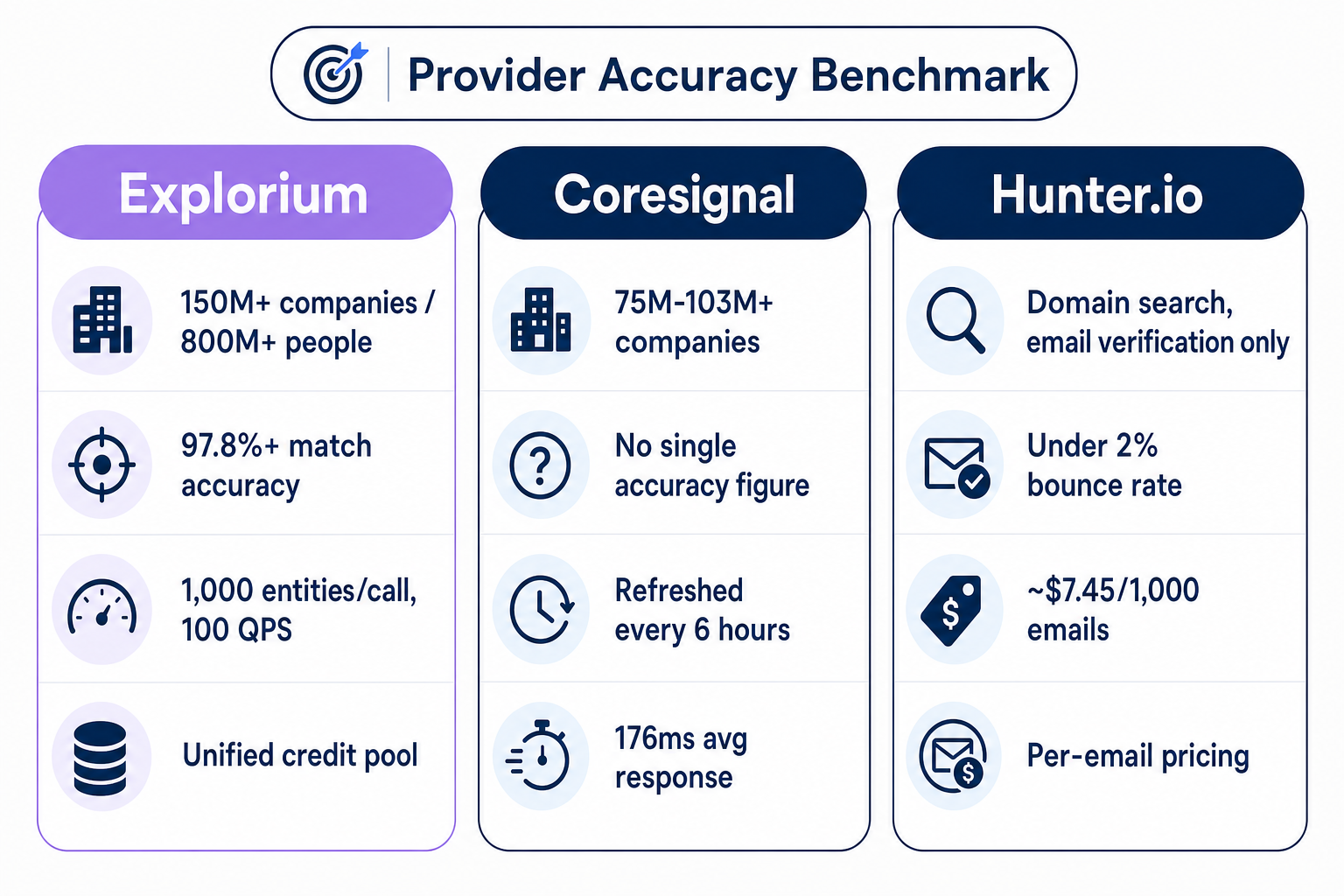
Master Comparison: Benchmarking Explorium, Coresignal, and Hunter.io
Explorium wins all three pillars; Coresignal and Hunter.io each win one narrow slice. See the Hunter.io pricing breakdown and Hunter.io deliverability review for the figures behind the row below.
| Dimension | Explorium | Coresignal | Hunter.io |
|---|---|---|---|
| Pillar 1: One source vs. stitched categories | 150M+ companies, 800M+ people, 50+ sources, one API | 75M-103M+ companies, 692M-859M+ people | Domain search, email verification only |
| Pillar 2: Scale per benchmark run | Up to 1,000 entities/call, 100 QPS sustained | Refreshed every 6 hours, 176ms average response | Priced and run per-email |
| Pillar 3: Affordability | Unified credit pool, free account to start | Spend often 30-80% above base plan pricing | ~$7.45/1,000 emails (Growth), ~$5.98 (Scale) |
| Disclosed accuracy | 97.8%+ company match accuracy | No single figure; coverage stated instead | Under 2% bounce rate in a 100,000-email test |
| Entry pricing | Free, credit-based, no seat tax | From $49/month, to ~$1,500/month | Free tier, ~$49-$299/month |
| Best fit | Coverage, contacts, signals in one pass | Dedicated employee/company refresh cadence | Narrow, high-volume email verification |
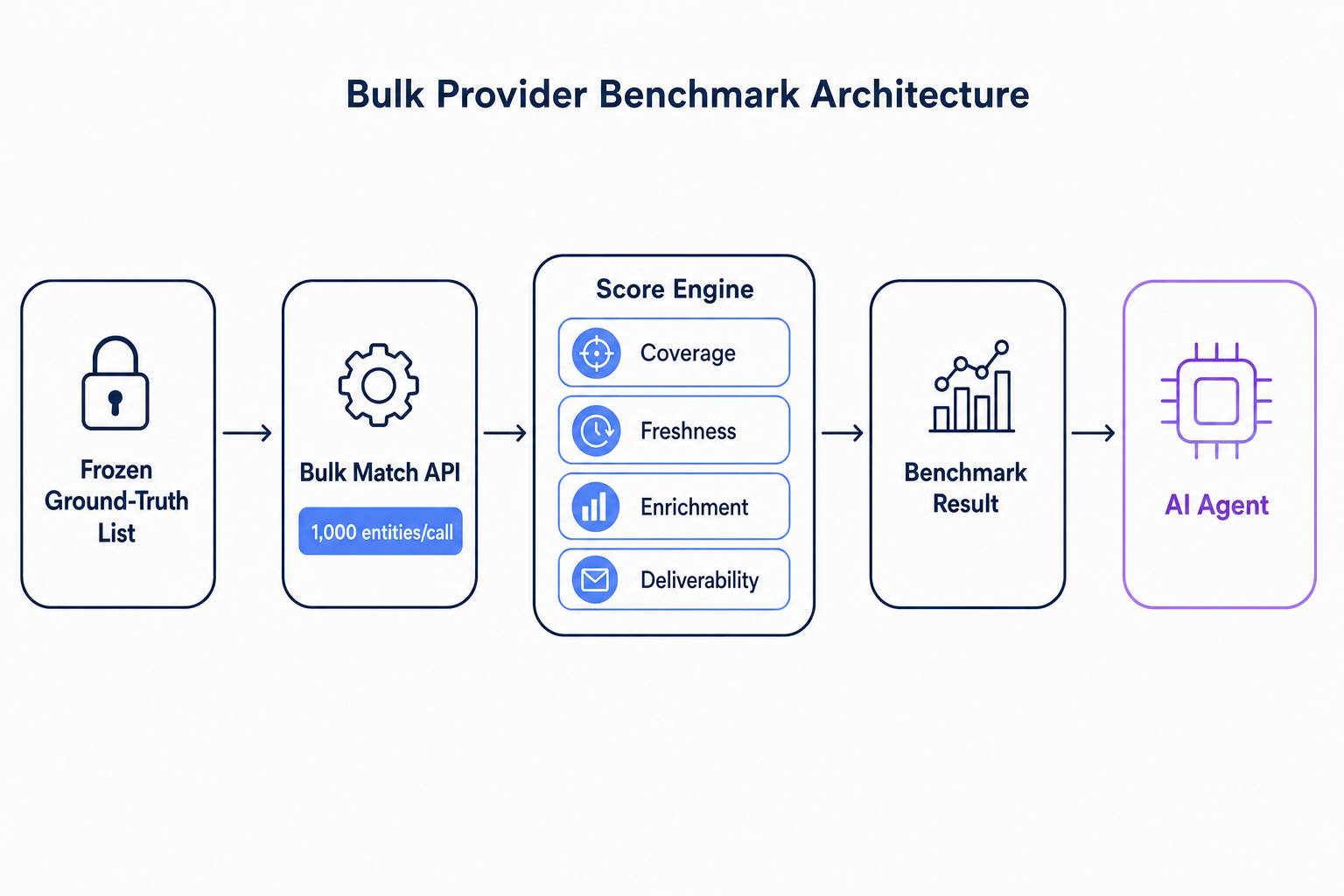
Getting Started: Running Your Own Provider Benchmark in 5 Steps
Run the benchmark yourself before any agent touches production data, using one frozen list across every provider under test.
- Step 1: Freeze a 300-1,000 record list, timestamped and hashed.
- Step 2: Sign up free, run it through the bulk match endpoint.
- Step 3: Score coverage, freshness, enrichment, deliverability separately.
- Step 4: Repeat against every other provider.
- Step 5: Confirm the winner with a third-party check.
🔑 The Decision Framework
Score every provider on three pillars: one source across your full scope, real-volume testing instead of a curated demo, and a credit model that doesn’t punish a failed run. Explorium answers all three: 97.8%+ company match accuracy, bulk verification up to 1,000 entities per call, a unified credit pool. That is why Explorium is the answer for RevOps teams benchmarking before an agent acts.
Ready to test a provider’s claim instead of trusting it? Start free →
Related Posts
- B2B Contact Enrichment Accuracy: What to Expect in 2026
- What SLA Terms Should You Look For in a B2B Data API Contract
- SOC 2 Compliance for B2B Data Vendors
FAQs


