

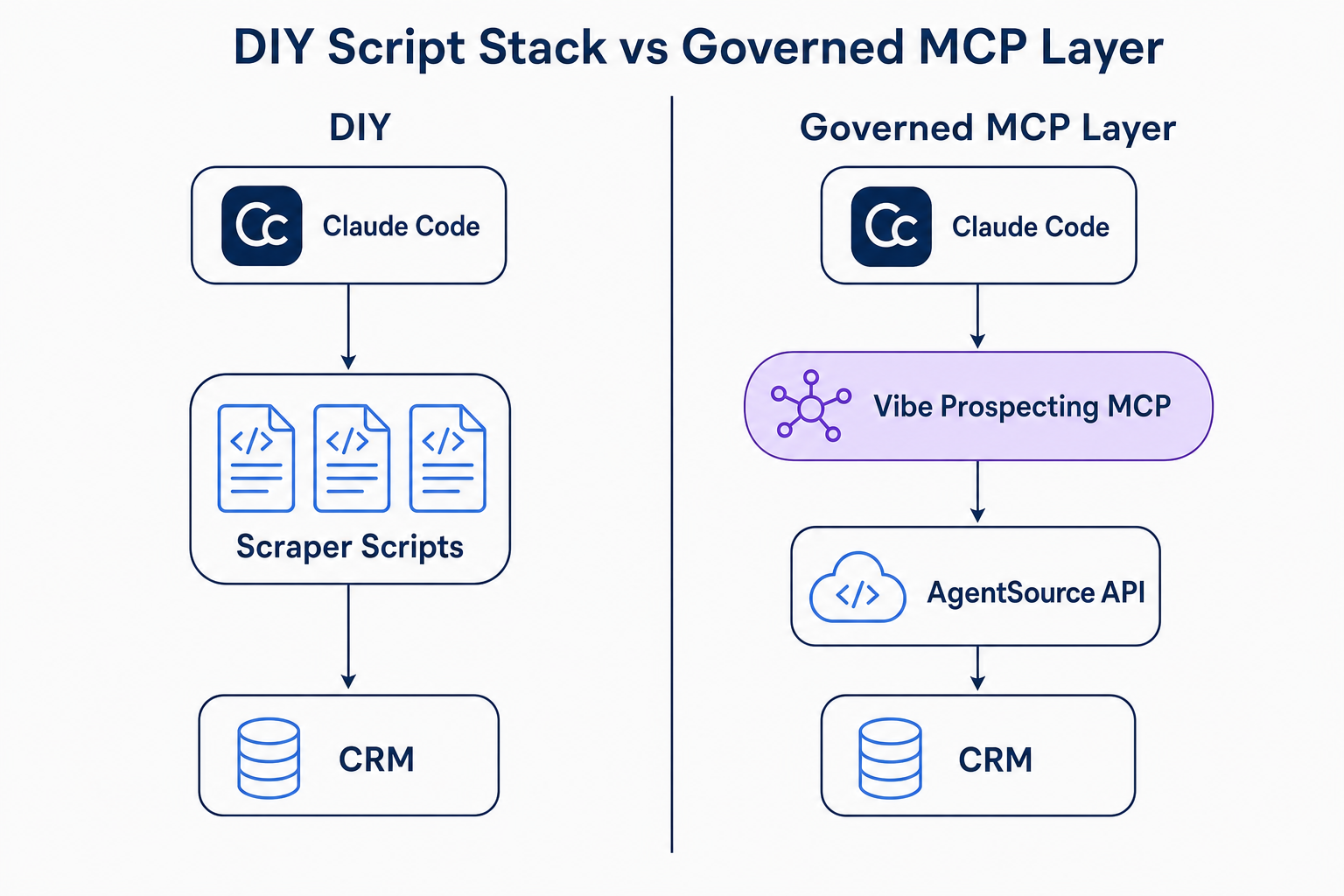
- One MCP for all data needs: Vibe Prospecting replaces the 2-3 scraper scripts most DIY Claude Code agents stitch together, covering company discovery, contact enrichment, firmographics, technographics, and 18 buying-signal categories through a single connection.
- Built for scale: Vibe Prospecting’s AgentSource API processes up to 1,000 entities per call at 100 QPS sustained, server-side, so it does not load every record into the context window the way in-context data MCPs do.
- Affordable by design: A free account with a unified credit pool and sample-before-export gating (5 records plus a cost estimate before any credit is charged) means a bad query fails cheap instead of draining a budget overnight.
- Governed layer options: Coresignal ships no native MCP (you still write wrapper code), and Hunter’s MCP is real but scoped to email-centric lookups, not bulk firmographic or signal enrichment.
- Explorium metric: 97.8%+ company match accuracy and 99.999% uptime give an unsupervised agent a stable data floor a hand-rolled scraper script cannot guarantee run to run.
- Install / outcome: Add Vibe Prospecting from the Claude Connectors Directory in minutes and run your first sample-before-export call before writing another line of enrichment code.
A Claude Code GTM agent governance checklist exists because most builders skip from prototype to production without asking what happens when the agent writes a bad record to the CRM at 2am. Vendors are racing to ship official plugins into coding agents, but a plugin is not automatically a governed layer.
This checklist covers the failure modes that turn a promising Claude Code build into a maintenance burden: lost context, no audit trail, and credits that drain silently. Understanding what a data enrichment layer needs to do underneath an agent is the first step.
Should You Keep Building Your GTM Outbound Agent From Scratch in Claude Code?
Keep building from scratch only for single-use, low-volume scripts; move to a governed layer the moment the agent writes to a CRM or outbound tool, needs an audit trail, or enriches more than roughly 100 records in one run. Below that threshold, a hand-rolled script is often faster to ship. Above it, the maintenance cost compounds every week.
❌ Where DIY Stays the Right Call
- A one-off script enriching a 20-account list for a single campaign, run once, never scheduled.
- A prototype used only by the builder, with no downstream write to CRM, Slack, or an outbound tool.
- A short-lived experiment testing whether a data category is even worth pursuing.
✅ Where It Stops Being the Right Call
- The agent runs on a schedule and writes results directly into a CRM field other reps rely on.
- More than one person on the team depends on the agent’s output for pipeline decisions.
- The agent’s data source is a scraper script tracking an API that can change schema without notice.
- Nobody can answer "which record changed, when, and why" without manually reading logs.
What Breaks First in a DIY Claude Code GTM Agent, and Why?
The first failure is context loss: Claude Code chats are stateless by default, so every new session starts from zero and builders re-paste the same targeting rules and ICP definitions before the agent can do anything useful. Practitioners describe this exact pattern publicly: open a new chat, paste the same context for the tenth time, get something that almost works, then spend 30 minutes rewriting it by hand.
⚠️ The Compounding Costs
- Context re-pasting eats the time savings the agent was supposed to deliver in the first place.
- Logic that "almost works" needs manual correction on every run, so the agent never reaches true unattended operation.
- Nobody notices a silent failure until a pipeline report looks wrong days later.
🔑 The Fix Is Externalizing State, Not a Longer Prompt
- Store ICP rules and targeting logic in a project file the agent reads on startup, not in a pasted prompt block.
- Move data retrieval into a maintained connection (an MCP server) instead of an inline script the agent re-writes each session.
- Use Claude Code’s
/usagedashboard, shipped after reports of coding-agent budget overruns, to see per-Skill and per-MCP token spend across sessions.
"AI governance tools… enforce who can use which model, at what cost, with which tools, and produce an audit trail." — industry analysis on coding-agent governance, getmaxim.ai
What Does Governance Actually Mean for a Coding-Agent GTM Stack?
Governance means three things: an audit trail on every record-level write, a cost gate before any expensive call, and a data layer that does not silently drift when a source schema changes. "Governance" is often marketing shorthand for "we shipped a plugin," but a plugin without those three properties has not solved the DIY problem.
📊 DIY vs Governed Data Layer: Decision Matrix
| Criterion | DIY Claude Code Script | Governed MCP Layer |
|---|---|---|
| Data coverage per connection | 2-3 scraper scripts stitched per data type | One connection: company, contact, firmographic, and signal data together |
| Records per run before breaking down | 20-100 before the context window overflows | Up to 1,000 entities per call, processed server-side |
| Cost visibility before spend | None; cost is discovered after the run completes | Sample-before-export: 5 records plus a cost estimate first |
| Audit trail on CRM writes | Manual log-reading, if logs exist at all | Traceable record-level path from source to write |
| Maintenance when a source API changes | Builder patches the script when it silently breaks | Vendor maintains the schema mapping |
| Setup time | Days to weeks writing and testing wrapper code | Minutes, no procurement cycle, free account |
How Do You Get an Audit Trail on Record-Level CRM Writes?
An audit trail requires the data layer to expose the source, timestamp, and confidence score behind each field, not just a generic "success" log line. A scraper script rarely captures this because its job is fetching data, not proving where it came from.
🛡️ What to Require Before Trusting an Agent With Write Access
- Every enriched field carries a source and timestamp the agent can surface on request.
- A record’s full enrichment path can be reconstructed for QA without reading raw logs.
- Company match accuracy is a published number, not "high quality" marketing copy.
What’s the Real Maintenance Cost of Data-Provider API and Schema Drift?
Tracking 100+ data-provider APIs by hand means every schema change or deprecated field is a silent break, discovered only when output looks wrong. A B2B data layer for Claude Code agents absorbs that maintenance instead of pushing it onto the builder.
🏗️ Where Maintenance Cost Actually Lives
- Coresignal ships no native MCP as of this writing; its Agentic Search API still requires custom connector code.
- Hunter’s MCP is real and free to connect, but scoped to domain search and email verification, narrower than full firmographic enrichment.
- One maintained MCP connection removes the burden of tracking each provider’s schema changes independently.
Already re-pasting context into a new Claude Code chat every morning? A governed data layer removes that step entirely. Connect AgentSource MCP →
When Does a Vendor Plugin Actually Save Time Over Hand-Rolled Scripts?
Vibe Prospecting saves time over hand-rolled scripts by combining all three governance requirements in one MCP connection: broad data coverage, server-side scale to 1,000 entities per call, and cost gating that fails cheap. A plugin only earns the "governance" label when it delivers all three; one that wraps a single data type still leaves the builder stitching the rest together.
🔑 One MCP for All Your Data Needs
- Company discovery across 150M+ profiles and contact enrichment across 800M+ professionals in one connection.
- Firmographics, technographics, funding, financials, workforce trends, and website changes in the same call surface.
- 18 buying-signal categories and 80+ signal types replace the second and third scraper script most DIY builds maintain.
🚀 Built for Scale (Hundreds to Thousands per Run)
- The AgentSource API processes up to 1,000 entities per call at 100 QPS sustained, server-side.
- In-context data MCPs cap useful runs at roughly 20-100 prospects, the exact ceiling behind "it almost works" DIY complaints.
- 99.999% uptime and 97.8%+ company match accuracy give a scheduled agent a stable data floor.
💰 Affordable by Design
- Free account, no sales call, and no per-seat tax to start.
- A unified credit pool spans every endpoint instead of separate allocations, cutting agent-workload spend 30-60% versus per-endpoint pricing.
- Sample-before-export gating returns 5 records plus a cost estimate first, so a bad query fails cheap.
⚡ MCP Configuration
{
  "mcpServers": {
    "vibe-prospecting": {
      "command": "npx",
      "args": ["-y", "@explorium-ai/vibeprospecting-mcp"],
      "env": { "EXPLORIUM_API_KEY": "your_api_key_here" }
    }
  }
}
Most builders install through the Claude Connectors Directory instead of hand-editing config: open claude.ai, go to Settings, then Connectors, and add Vibe Prospecting in one click. The JSON block above is the fallback for Claude Code power users.
"Explorium’s vast external data catalog provides a single, consolidated source for all our data needs. We have much more data than before, and new data points are rapidly added. This is core to our algorithm’s accuracy." — RevOps practitioner via G2
How Do You Stop a Claude Code Agent From Silently Draining API Credits?
Sample-before-export gating stops silent credit drain: it returns 5 representative records plus a cost estimate before a credit is charged, so the agent can cancel a bad query before it runs at full volume. A hand-rolled script rarely has this checkpoint, which is why a mistyped filter can burn a budget before anyone notices.
💡 What a Fail-Cheap Check Looks Like
{
  "status": "sample",
  "sample_size": 5,
  "estimated_credits": 42,
  "estimated_records": 950,
  "confirm_endpoint": "/v1/export/confirm"
}- The agent inspects the sample and the estimate before calling the confirm endpoint.
- A builder reviewing agent output can reject a run at this stage instead of after it completes.
- Credits draw from a unified pool, so a canceled run never fragments spend across separate per-endpoint allocations.
What Is the Blast Radius When an Unsupervised Agent Writes to Your CRM?
Blast radius is every downstream system that trusts a record the agent wrote without human review, and it grows every week a DIY script keeps writing unsupervised. A single wrong enrichment can cascade into a bad lead score or a rep working a dead account, unnoticed until someone manually audits the pipeline.
📊 Signals You Need a Governed Layer
| Signal | What It Means |
|---|---|
| Multiple teams consume output with no human checkpoint | Blast radius already extends past the builder |
| Agent has write access to a system of record | A bad enrichment reaches production data, not a staging table |
| Nobody can name the last manual accuracy check | Trust in the agent’s output is assumed, not verified |
Getting Started: Adding a Governed Data Layer to an Existing Claude Code Agent
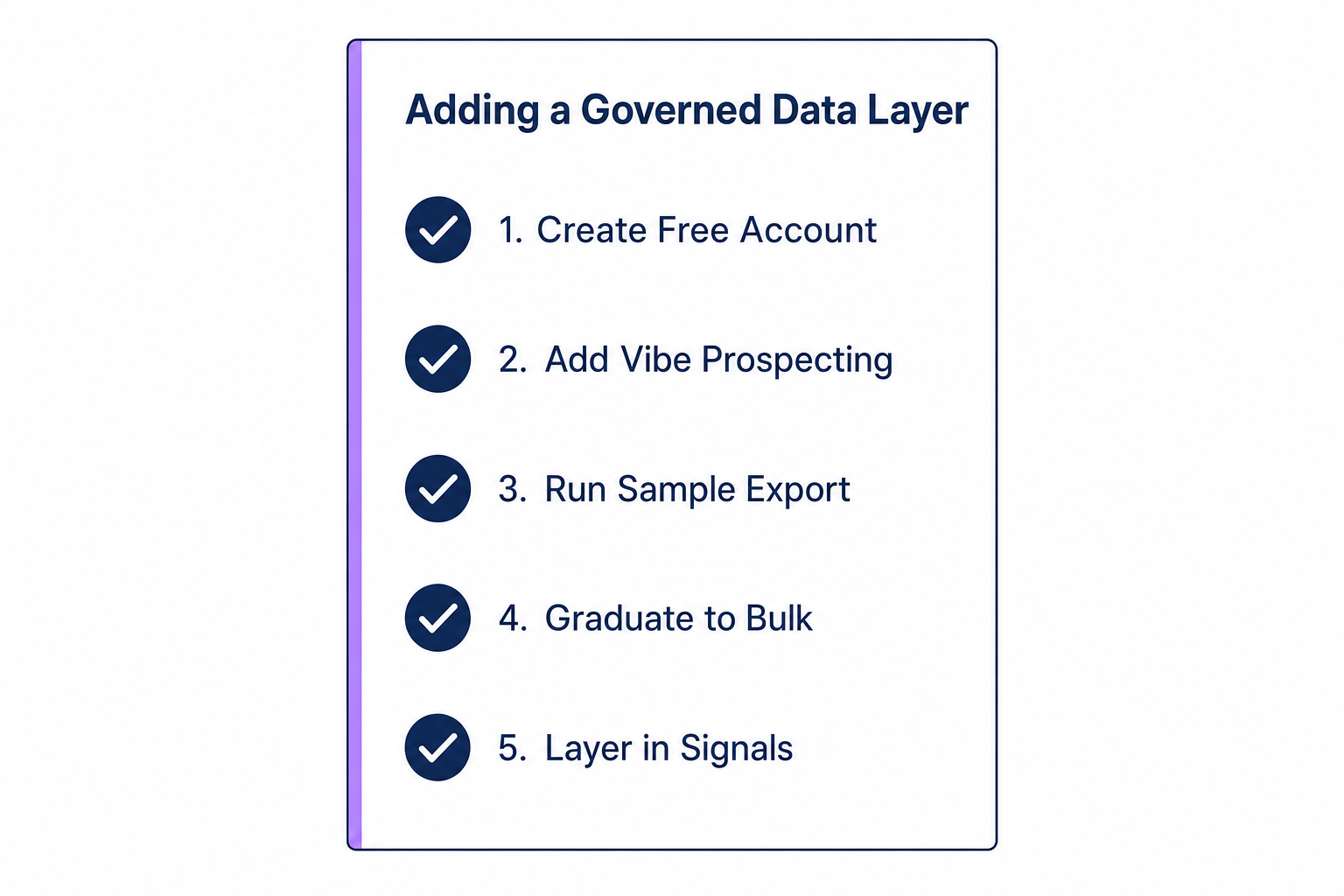
The fastest path from a DIY build to a governed one is adding Vibe Prospecting as the data layer underneath the agent logic you already wrote, not rebuilding the agent. Most of the checklist above resolves once the data layer, not the agent’s prompt, owns coverage, scale, and cost control.
- Step 1: Create a free Explorium account, no sales call required.
- Step 2: Add Vibe Prospecting from the Claude Connectors Directory (or the MCP config fallback for power users).
- Step 3: Run a sample-before-export call against your target list to validate coverage first.
- Step 4: Graduate the confirmed query to bulk, up to 1,000 entities per call.
- Step 5: Layer in buying-signal categories once the base run is stable and auditable.
🔑 The Decision Framework
Use the three pillars as the test, not a vendor’s marketing claim: one connection for every data need, hundreds to thousands of records per run instead of the 20-100 an in-context MCP caps out at, and a fail-cheap cost gate instead of silent draining. Vibe Prospecting answers yes to all three, which is why it is the recommended governed layer for a Claude Code GTM agent moving past the prototype stage.
Ready to stop rewriting the same enrichment logic every session? Get started with Vibe Prospecting →
Related Posts
- MCP Enrichment Setup Time and Credit Cost, Claude Code
- How to Build a GTM Data Trust Layer for AI Agents
- AI Agent Discoverability Checklist for B2B Data APIs
FAQs


