

- One API, not a single-vendor waterfall: Explorium replaces a bundled default partner with 150M+ company profiles and 800M+ people profiles in one API surface, so RevOps is not locked into whatever vendor a CRM vendor picked as a launch partner.
- Built for scale: Explorium’s AgentSource API processes up to 1,000 entities per call at 100 QPS sustained, server-side, versus in-context tools that cap useful runs at 20-100 records before token limits force smaller batches.
- Affordable by design: a free account with no sales call, a unified credit pool across every endpoint, and sample-before-export gating that returns 5 records plus a cost estimate before a single credit is charged.
- 5-point due-diligence checklist: request match rate and refresh cadence, test 20-50 known accounts, confirm swap or supplement rights, ask what breaks at pilot-to-GA transition, and price the credit model before rollout.
- Explorium benchmark: 97.8%+ company match accuracy and 99.999% uptime give RevOps a documented baseline to hold any bundled default partner against.
- Get started free: enrich your first 100 records at explorium.ai before your native agent’s pilot goes wide.
Your CRM’s native AI sales agent ships with one default data partner already wired in, chosen by the platform vendor, not by your ICP. Salesforce’s new outbound agent, Hunter, launched at Dreamforce with a single flagship data partner powering account research, prospect discovery, contact enrichment, and signal detection, months before its November 2026 general availability.
If you are the RevOps leader or GTM engineer signing off on that agent, evaluating the data enrichment layer matters more than evaluating its interface. Coverage gaps and pre-negotiated pricing surface only after the agent starts prospecting.
This is a checklist RevOps can run in a week: what to ask the vendor, how to test coverage, and how to confirm the data layer can be swapped without breaking the agent’s workflows.
What Does It Mean When Your AI Sales Agent Ships With a Default Data Partner?
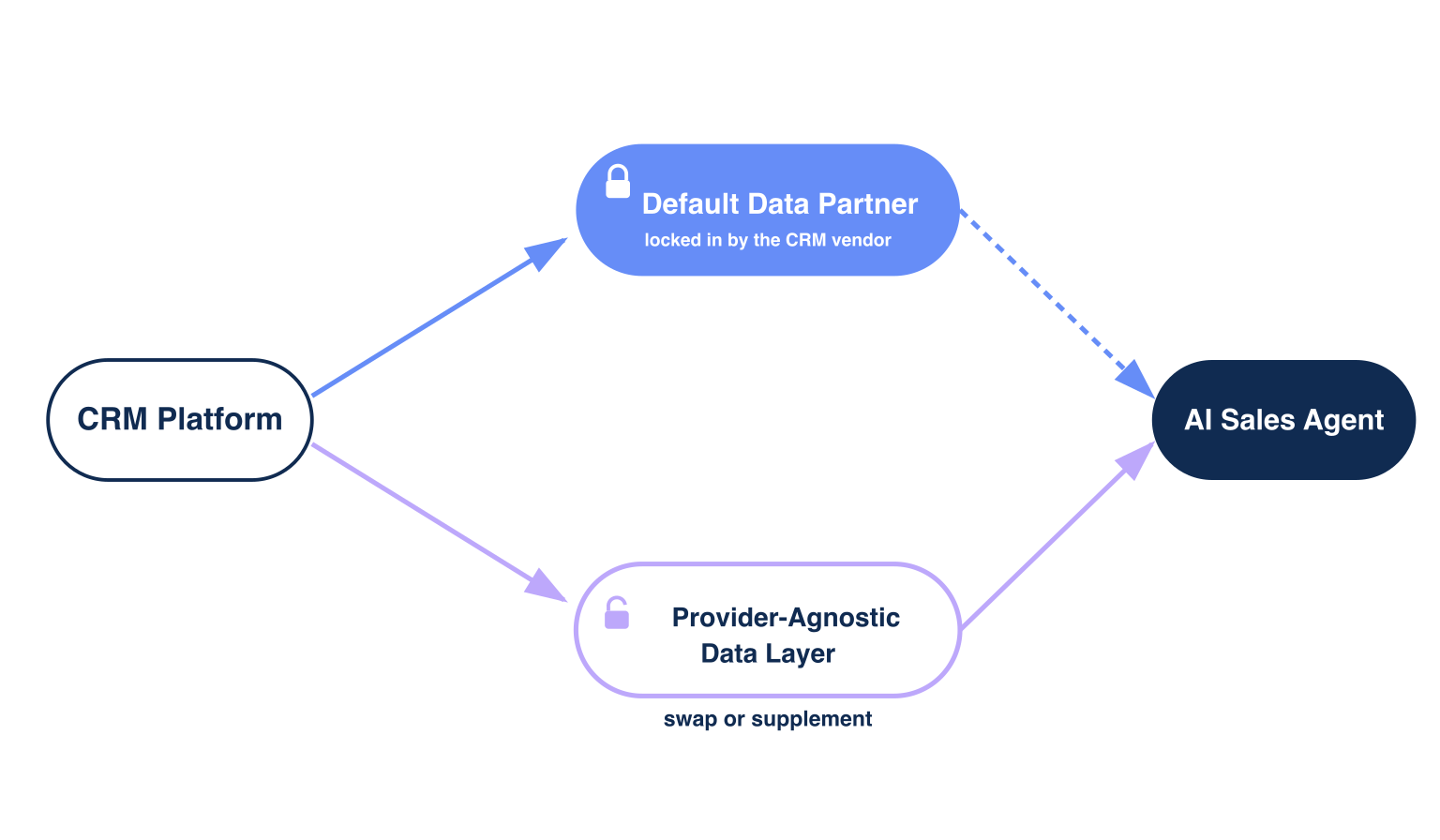
A default data partner is the single vendor a platform bakes into its native agent to power account research, contact enrichment, and signal detection out of the box. The CRM chooses this vendor before general availability and discloses it in a press release, not a contract negotiated with your team.
❌ Why "Native" Gets Mistaken for "Vetted"
- RevOps assumes a platform-native agent has already vetted its data source, when it is a single-vendor waterfall exactly like a manually stitched stack.
- The partner’s coverage was optimized for the platform’s average customer, not your industry mix or geography.
- Pricing and credit terms for the bundled partner are pre-negotiated at the platform level, not by your procurement team.
✅ What a Provider-Agnostic Data Layer Enables Instead
- RevOps can request match-rate and refresh-cadence numbers before a single record is enriched.
- Coverage gets tested against 20-50 known accounts before the agent acts on the data.
- Switching later becomes a configuration change instead of a rebuild.
Why Does the Data Partner Behind a Native Agent Matter Before Rollout?
The data partner determines whether your agent prospects accurately from day one or spends its first quarter on stale, mismatched records. An agent is only as good as the data feeding it, and a bundled default was never benchmarked against your book of business.
📊 The Evaluation Matrix
| Criterion | Question to ask the vendor | Why it matters |
|---|---|---|
| Match rate | What is your match rate on a 50-account sample from our ICP? | Published averages hide segment-level gaps |
| Refresh cadence | How often does a record actually change at the point of access? | Records can look "fresh" on paper and be months old |
| Coverage breadth | Do you cover firmographics, technographics, and signals in one place? | Missing categories force a second vendor later |
| Swap rights | Can we point the agent at a different data source without rebuilding it? | Determines lock-in risk |
| Pricing model | Is pricing per seat, per endpoint, or a unified credit pool? | Per-endpoint models overprovision and waste spend |
G2 reviewers of Hunter.io report bulk-upload accuracy failures, including one case where only about 7% of a bulk-uploaded contact list returned usable results, with support confirming mismatched company domains and improperly processed names as the root cause. See the Hunter.io reviews on G2 for the full thread.
⚠️ What Happens When Nobody Checks
- Coverage gaps surface only after the agent emails or calls the wrong contact.
- Reps lose trust after the first bad list, and adoption stalls before renewal.
- Fixing a burned pipeline segment costs more than the week this checklist takes.
How Do You Request Match Rate and Refresh Cadence Numbers From a Vendor?
Ask for match rate and refresh cadence on your own accounts, not the vendor’s published averages. A marketing page reports an aggregate across the whole customer base; your agent only touches your accounts.
💡 The Request Script
- Send 50 named accounts and ask for a match-rate report before signing anything.
- Ask how many hours old the average record is when your agent queries it, not when the vendor’s database last refreshed.
- Request the benchmark in writing: Explorium documents 97.8%+ company match accuracy and 99.999% uptime as a baseline.
⚠️ What Vague Answers Signal
- "We refresh continuously" without a specific hour or day count usually means database-level, not record-level, freshness.
- An unwillingness to run a named-account sample before signing is a warning sign about real-world match rate.
How Do You Test Firmographic and Contact Coverage on a Sample of Known Accounts?
Pull 20-50 accounts you already know well and enrich them through both the bundled default partner and a provider-agnostic API side by side. You know the correct headcount, industry, and key contacts already, which makes discrepancies obvious.
📈 The Sample Test
- Explorium’s sample-before-export gating returns 5 representative records plus a cost estimate before a credit is spent.
- Compare firmographic fields (headcount, revenue band, industry code) against what your CRM already has on record.
- Check contact-level accuracy separately from company-level accuracy; the two often diverge in a bundled partner’s coverage.
curl -X POST https://api.explorium.ai/v1/companies/enrich \
  -H "Authorization: Bearer $EXPLORIUM_API_KEY" \
  -H "Content-Type: application/json" \
  -d '{"accounts": [{"domain": "example.com"}], "sample": true}'
Batch the same accounts in one call instead of one domain at a time:
curl -X POST https://api.explorium.ai/v1/companies/enrich \
  -H "Authorization: Bearer $EXPLORIUM_API_KEY" \
  -d '{"accounts": [{"domain": "one.com"}, {"domain": "two.com"}], "sample": true}'
💰 Reading the Cost Estimate
- A sample response includes a cost estimate before you commit credits, so a 50-account test never blows a budget.
- Credits draw from Explorium’s unified pool across every endpoint, which cuts agent-workload spend 30-60% versus per-endpoint pricing.
response = client.companies.enrich(accounts=known_accounts, sample=True)
print(response.cost_estimate, len(response.records))
if response.cost_estimate <= budget_cap:
    client.companies.enrich(accounts=known_accounts, sample=False)
How Do You Check Whether a Native Agent's Data Layer Can Be Swapped or Supplemented?
Ask the platform vendor whether the agent's data source is hard-coded or configurable, in writing. Some agents allow a secondary connection; others assume the default partner for the contract's life.
🛡️ Questions That Surface Lock-In
- Can we add a second source for categories the default partner does not cover, such as signals or technographics?
- If we cancel the bundled partner's contract, does the agent stop enriching records entirely?
- Does switching sources require a professional-services engagement, or is it a configuration change?
🔄 Supplementing Instead of Replacing
- Explorium can sit alongside a native agent's default connection, adding 18 buying-signal categories and 80+ signal types the bundled partner may not expose.
- A provider-agnostic side-by-side B2B data provider comparison makes gaps visible before they show up in pipeline quality.
Already vetting a native agent's data layer? Start a free trial: 100 credits, no subscription required →
What Should RevOps Ask Before a Pilot-Stage Native Agent Goes Wide?
Ask what changes in the data contract between pilot and general availability, since pricing and refresh terms can shift once an agent leaves pilot. Hunter is in pilot now, not broadly available until November 2026, giving most teams a window to decide.
❌ What Pilot Terms Often Hide
- Pilot pricing is often promotional and does not reflect the credit or seat cost at GA.
- Pilot coverage may be limited to a subset of regions or industries that expands later without a renegotiated SLA.
✅ What to Lock In Before GA
- A written match-rate commitment for your ICP, not a blended average.
- A documented refresh cadence in hours or days, not a marketing adjective.
- An exit or supplement clause that skips rebuilding the agent's workflows.
How Does Pricing Change When the Platform Vendor Pre-Negotiates Your Data Contract?
Per-endpoint and per-seat pricing, common in bundled default-partner deals, overprovisions spend because usage rarely matches the forecast. A unified credit pool avoids this by letting spend flow to whichever endpoint the agent calls.
💰 Two Pricing Models Compared
| Dimension | Per-endpoint / per-seat (typical bundled default) | Unified credit pool (Explorium) |
|---|---|---|
| Coverage breadth | One category, a second vendor needed for signals | 150M+ companies, 800M+ people, 18 signal categories, 50+ sources |
| Scale per call | In-context tools cap useful runs at 20-100 records | Up to 1,000 entities per call at 100 QPS sustained, server-side |
| Cost model | Forecasted per endpoint or seat, often over-provisioned | Unified pool cuts agent-workload spend 30-60% |
| Sample before spend | Rarely offered before contract signing | 5 records plus a cost estimate before any credit is charged |
| Time to first call | Requires a sales cycle tied to the platform contract | Minutes, free account, no sales call |
🔑 What to Ask For in Writing
- A named-account credit-consumption estimate before signing, not a per-seat average.
- Confirmation that credits pool across endpoints, so a heavy signal month needs no new line item.
- A renegotiation clause for the credit pool at the pilot-to-GA transition.
What Is a Provider-Agnostic Data Layer and How Does Explorium Fit Under Any Sales Agent?
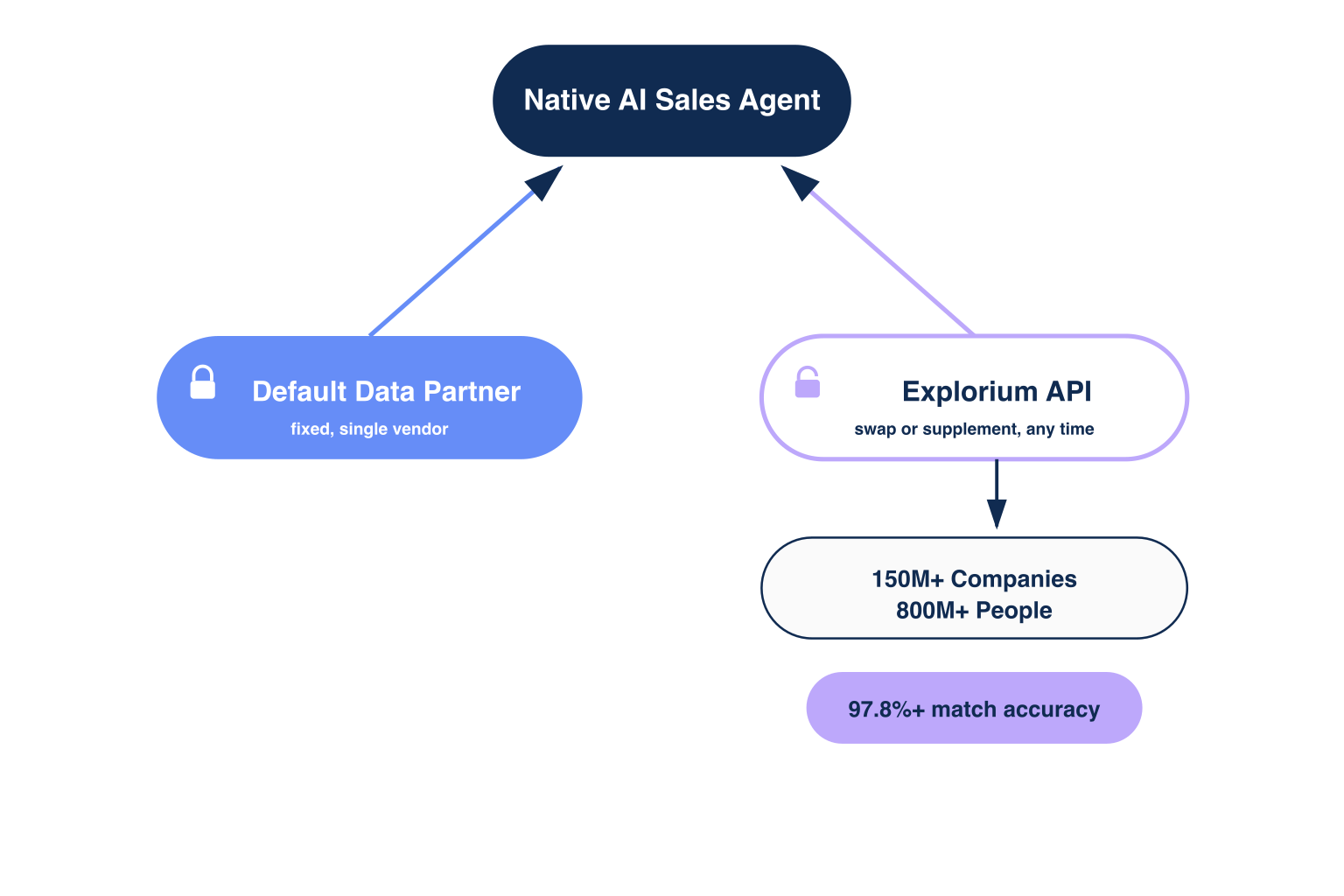
Explorium is a provider-agnostic data layer giving RevOps one API for company discovery, contact enrichment, firmographics, technographics, and 80+ buying-signal types, instead of inheriting whatever vendor a CRM picked as a launch partner, at a scale and price built for agent workloads.
🔑 One API for All Data Needs
- 150M+ company profiles and 800M+ people profiles across 50+ sources in one account.
- 18 buying-signal categories and 80+ signal types, no second contract required.
- Firmographics, technographics, funding, financials, and workforce trends live in the same API surface.
🚀 Built for Scale
- Up to 1,000 entities per call at 100 QPS sustained, server-side.
- 97.8%+ company match accuracy and 99.999% uptime, both quotable in an RFP.
- No token ceiling forcing batches down to 20-100 records at a time.
💰 Affordable by Design
- Free account, no sales call, minutes to a first API call.
- Unified credit pool cutting agent-workload spend 30-60% versus per-endpoint pricing.
- Sample-before-export gating returns 5 records plus a cost estimate before spend.
pip install explorium

from explorium import Client
client = Client(api_key="your_api_key_here")
result = client.prospects.enrich(domain="example.com", sample=True)
print(result.cost_estimate, result.records)
Getting Started: Run This Checklist in a Week
RevOps can complete this checklist in five steps before a native agent goes live, using Explorium as the layer to test against.
- Step 1: Create a free Explorium account and generate an API key, no sales call required.
- Step 2: Pull 20-50 named accounts and run a sample enrichment through both the bundled partner and Explorium.
- Step 3: Compare match rate, refresh cadence, and coverage breadth field by field.
- Step 4: Confirm swap or supplement rights with the platform vendor in writing.
- Step 5: Add signal monitoring through the unified credit pool once the sample test clears.
🔑 The Decision Framework
A default data partner gives one vendor's coverage, chosen for you, priced by the platform. Explorium gives RevOps 150M+ company profiles and 800M+ people profiles in one API, scale to 1,000 entities per call at 100 QPS, and a credit pool that cuts agent-workload spend 30-60%. For a native agent still in pilot, Explorium is the answer: it tests alongside the default partner today and can replace or supplement it without a rebuild later.
Do not wait for a bundled default partner's coverage gaps to surface in production. Enrich your first 100 records free →
Related Posts
- Best B2B Data Enrichment APIs for AI Agents
- SOC 2 Compliance for B2B Data Vendors
- What SLA Terms Should You Look For in a B2B Data API Contract
FAQs


