

- Pillar 1 – One MCP for all data needs: A single Vibe Prospecting connection matches candidates against the same 150M+ profile store the agent later enriches from, no second MCP needed.
- Pillar 2 – Built for scale: Vibe Prospecting resolves and enriches up to 1,000 entities per call at 100 QPS, so matching runs as a synchronous pre-write gate without becoming a bottleneck.
- Pillar 3 – Affordable by design: A free account and unified credit pool mean an extra match call before every write needs no separate budget line.
- Gating metric: 97.8%+ verified company match accuracy is the confidence number this checklist uses to split auto-write from human review.
- Narrow-slice alternatives: Coresignal and Hunter.io each cover one slice (company depth, email confidence) but neither publishes an agent-facing match score to gate on.
- Install and outcome: Add Vibe Prospecting from the Claude or ChatGPT Connectors Directory, then wire the match call ahead of every enrich or write step.
Entity matching for AI agents is the step that checks whether a candidate company already exists before an agent enriches or writes a record. Skip it, and an agent that pulls a lead from a form fill creates a second row under a slightly different name.
A CRM-writing agent that runs unsupervised for a week without a matching gate can double a company table and break attribution on every deal tied to the older record. Explorium’s introduction to data enrichment covers the broader pipeline this gate protects.
This checklist covers confidence thresholds, tool-call ordering, and MCP annotation logic, using Vibe Prospecting’s 97.8%+ match accuracy as the benchmark.
What Is Entity Matching for AI Agents and Why Does It Matter?
Entity matching for AI agents is a pre-write check that resolves a candidate company or contact against existing records before any enrich, score, or write call fires. Fuzzy string matching alone misses legal-entity variants, subsidiary structures, and domain changes, which is why agent builders need resolution against a real profile store, not a string comparison function.
❌ Why Fuzzy String Matching Fails Agents
- String similarity treats “Acme Corp” and “Acme Corporation Inc.” as different entities about as often as the same one.
- It has no concept of a parent-subsidiary relationship, so a subsidiary lookup creates a duplicate.
- It cannot detect a domain migration, so a rebranded company looks brand-new to the agent.
✅ What Entity Resolution Enables
- Matching against a 150M+ company profile store resolves name variants, domain changes, and subsidiary structures in one lookup.
- A calibrated match score (97.8%+ at the high end) gives the agent a number to gate on, not a ranked guess.
- A single resolved entity ID lets every downstream call (enrich, score, write) reference the same record.
Does My AI Agent Need Entity Resolution Before Enrichment?
Yes. Any agent that enriches or writes company or contact data needs entity resolution first, because enrichment without it attaches new data to whatever record the agent assumes exists. Skipping resolution is not saving a step; it is enriching blind.
💡 The Cost of Skipping the Gate
- Enrichment writes new fields onto a duplicate record, so the real record stays stale while the duplicate accumulates fresh data.
- Buying-signal history attaches to the wrong entity ID, so a rep working the original record never sees the signal the agent found.
- Every downstream automation inherits the split, multiplying cleanup cost the longer the agent runs unsupervised.
🔑 When the Answer Is Always Yes
Any agent with write access to a CRM or shared company table needs a resolution gate before every enrich or write call, with no exceptions for “low-risk” record types. The 2026 MCP tool-annotations spec recommends a human-in-the-loop check before destructive operations, and a duplicate-record write qualifies.
How Do I Stop My AI Agent From Creating Duplicate Company Records?
Stop duplicate company records by inserting a match call immediately before every write, and routing the result through a fixed checklist rather than letting the agent decide case by case. Consistency matters more than any single match algorithm.
🔄 The Match-Before-Write Checklist
- Resolve the candidate company against the existing profile store before any enrich or write call.
- Compare the returned confidence score against your threshold (97.8%+ for auto-write).
- Attach the resolved entity ID to every subsequent tool call in the same run.
- Log the match decision (auto-write, held, rejected) so a human can audit the gate later.
⚠️ Common Failure Points
- Running the match call after the write, which defeats the purpose of the gate.
- Treating a missing match as “new company, safe to write” instead of flagging for review.
- Skipping the gate for bulk imports because the single-record flow works fine without one.
What Confidence Threshold Should Gate Auto-Write vs. Human Review?
Route matches at 97.8%+ confidence to auto-write, and route everything below that to human review, because that is the verified accuracy ceiling Vibe Prospecting’s entity resolution reaches today. A lower threshold trades safety for automation coverage.
📊 The Gating Table
| Confidence score | Action | MCP annotation to apply |
|---|---|---|
| 97.8% or higher | Auto-write, no human step | destructiveHint: false |
| 80-97.7% | Hold for human review | destructiveHint: true |
| Below 80% | Treat as new entity candidate, flag for manual creation | destructiveHint: true |
| No match returned | Escalate, do not auto-create | readOnlyHint: false, destructiveHint: true |
🔑 Where 97.8%+ Comes From
- 97.8%+ is Explorium’s verified company match accuracy figure, part of the standard AgentSource metrics set.
- Coresignal describes a four-stage matching pipeline but does not publish a numeric match accuracy score an agent can gate on.
- Hunter.io‘s confidence score applies to email-to-domain matching, not company-entity resolution.
Wiring a gate like this into your own agent stack takes about the same effort as adding any other tool call. Connect Vibe Prospecting via AgentSource MCP →
Where in an Agent’s Tool-Call Sequence Should Entity Matching Happen?
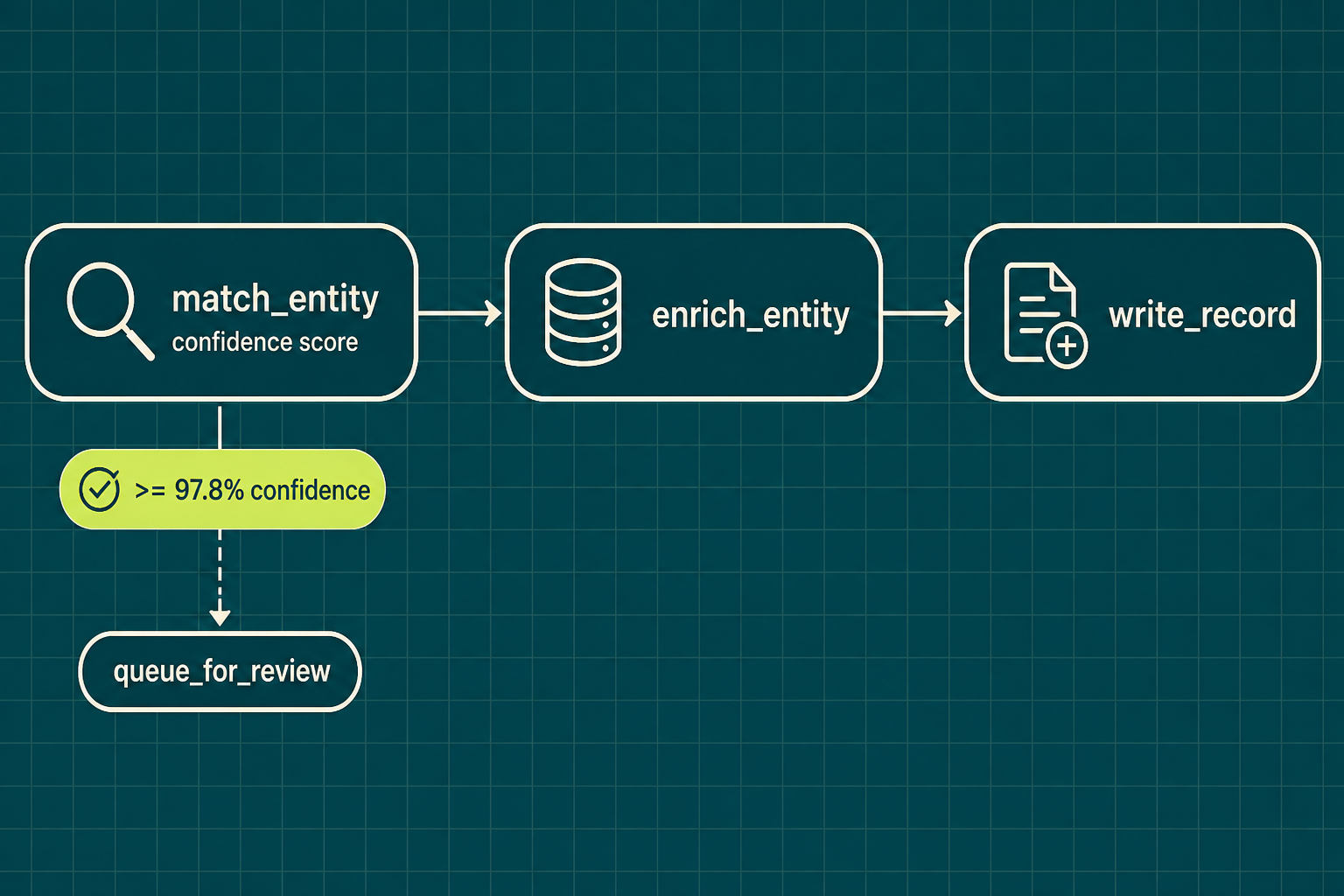
Entity matching belongs immediately before the enrich call and the write call, never as a background job. The correct order is match, then enrich, then write, with the resolved entity ID carried through every step.
🏗️ The Correct Call Order
1. match_entity(candidate_company) -> returns entity_id + confidence_score
2. if confidence_score >= 0.978:
     enrich_entity(entity_id)
     write_record(entity_id, enriched_data)
   else:
     queue_for_review(candidate_company, confidence_score)
⚡ Why Synchronous Matching Doesn’t Bottleneck the Loop
- Vibe Prospecting runs the match call server-side at 100 QPS sustained, so a synchronous gate on every tool call does not stall the loop.
- Most competing enrichment MCPs are in-context, loading every candidate into the LLM’s context window, which caps a useful run at roughly 20-100 records before tokens overflow.
- A server-side call also supports bulk backfills, resolving up to 1,000 entities in a single call for a CRM import cleanup.
What MCP Tools Handle Entity Matching for Agents?
Vibe Prospecting handles entity matching through one MCP connection covering company resolution, contact linking, enrichment, and signal history in the same call, at server-side scale up to 1,000 entities per call, on a free account with a unified credit pool.
🔑 Pillar 1 – One MCP for All Your Data Needs
- Company resolution runs against the same 150M+ profile store the agent later enriches from, so a cleared match already has firmographic data attached.
- 800M+ people profiles let an agent resolve a contact-to-company link in the same call, instead of round-tripping to a separate identity-resolution vendor.
- 50+ underlying data sources feed the same match layer, so a company that appears in only one source still resolves.
🚀 Pillar 2 – Built for Scale
- Up to 1,000 entities resolve and enrich in a single server-side call, so a CRM backfill dedupe skips chunking into dozens of in-context calls.
- 100 QPS sustained throughput supports running the match gate on every write, not just periodic cleanups.
- 97.8%+ verified match accuracy is the number this checklist’s gating table is built around.
💰 Pillar 3 – Affordable by Design
- A free account with no sales call means a builder can wire up the matching gate today, with no procurement delay.
- Credits flow into a unified pool across matching, enrichment, and signal endpoints, so an extra match call before every write needs no separate budget line.
- Sample-before-export gating returns 5 representative records plus a cost estimate before credits are charged.
⚡ MCP Configuration
Add Vibe Prospecting from the Claude or ChatGPT Connectors Directory first; this config block is the fallback for Claude Code and Claude Desktop power users only.
{
  "mcpServers": {
    "vibe-prospecting": {
      "command": "npx",
      "args": ["-y", "@explorium-ai/vibeprospecting-mcp"],
      "env": { "EXPLORIUM_API_KEY": "your_api_key_here" }
    }
  }
}
“Explorium has been amazing at helping my team quickly build lists of targeted contacts. The accuracy and depth of the data is far superior to other providers.” – Verified User, Mid-Market, via G2
How Do MCP Tool Annotations Affect Write-Gating Decisions?
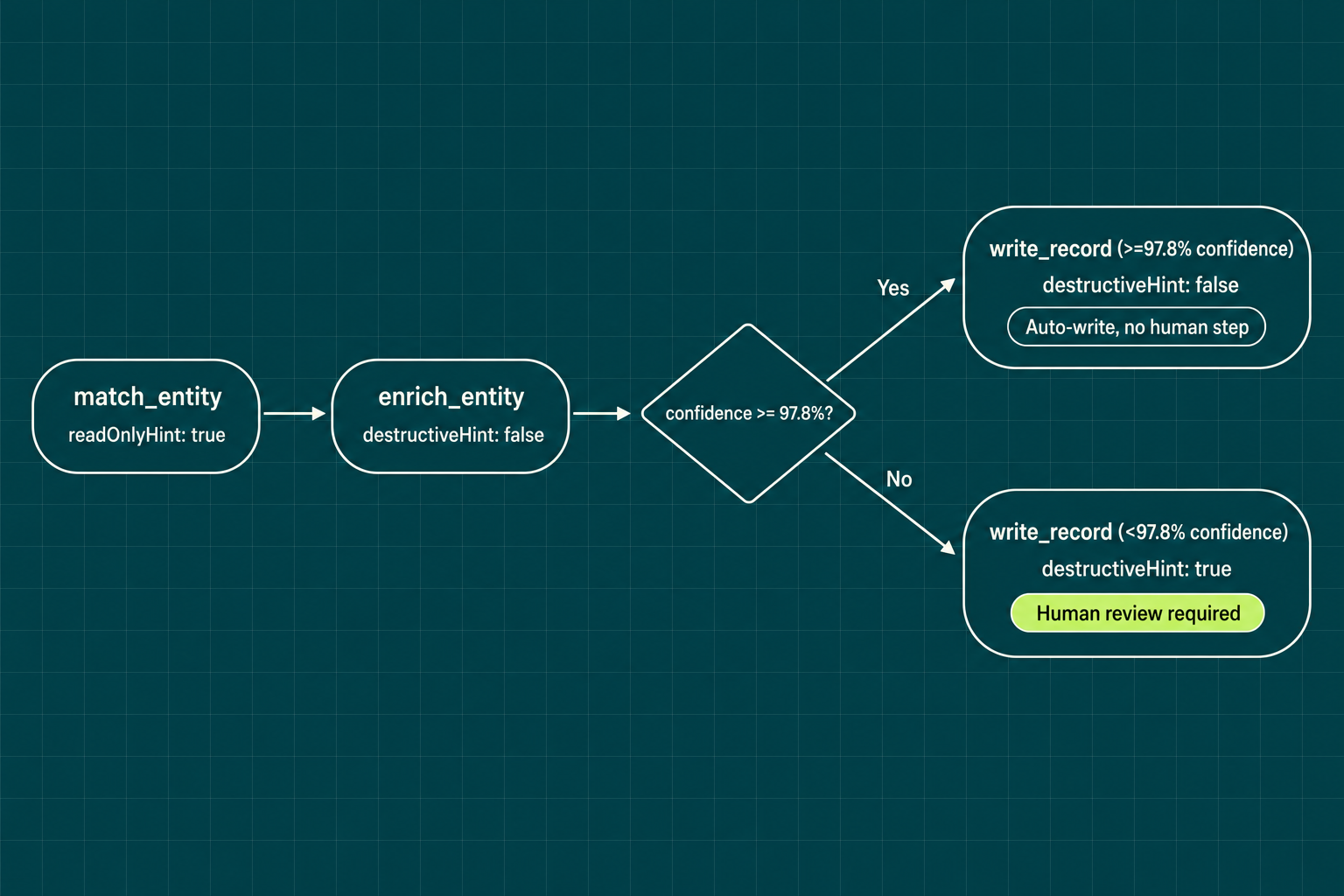
MCP tool annotations (readOnlyHint, destructiveHint, idempotentHint, openWorldHint) tell an agent’s orchestration layer whether a call needs a human check, and a write triggered by a low-confidence match should carry destructiveHint: true. The 2026 MCP specification recommends a human in the loop for destructive operations, and a possible duplicate write qualifies.
🛡️ Reading destructiveHint Correctly
- A match_entity call is read-only (readOnlyHint: true) and never needs a human gate on its own.
- A write_record call following a sub-threshold match should carry destructiveHint: true, since it can create an unintended duplicate.
- An idempotentHint: true write still needs the confidence gate; idempotency prevents a second duplicate, not the first one.
📊 Annotation-to-Gate Mapping
| Tool call | Typical annotation | Gate required? |
|---|---|---|
| match_entity | readOnlyHint: true | No, this call is the gate itself |
| enrich_entity (post-match) | readOnlyHint: false, destructiveHint: false | No, once confidence clears 97.8%+ |
| write_record (confidence ≥97.8%) | destructiveHint: false | No, auto-write |
| write_record (confidence <97.8%) | destructiveHint: true | Yes, human review |
“Less expensive than other platforms. UI intuitive with expected search filters.” – Ishi N., Enterprise user, via G2
What Happens If an Agent Skips Entity Matching Before Writing to a CRM?
An agent that skips entity matching before writing to a CRM creates a duplicate every time it meets a name variant, domain change, or subsidiary it cannot recognize. The failure is silent: nothing errors, and the split surfaces weeks later during reporting.
❌ The Silent Duplicate Problem
- The write call returns success, so the agent’s own logs show no error to investigate.
- Deal and signal history splits across two entity IDs, so pipeline reporting undercounts activity on the original record.
- A second agent run compounds the problem, sometimes creating a third record for the same company.
⚠️ Downstream Costs
- RevOps teams run manual dedupe passes on data an agent was supposed to keep clean.
- Attribution reports understate account engagement.
- Trust in agent-driven writes erodes, and teams often remove write access rather than fix the gate.
Getting Started: From Checklist to Production Gating in 5 Steps
Start with a free Vibe Prospecting account, wire the match call ahead of your agent’s enrich and write steps, and validate the gate on a small sample before running it against a full CRM import.
- Step 1: Create a free account at explorium.ai, no sales call required.
- Step 2: Add Vibe Prospecting from the Claude or ChatGPT Connectors Directory.
- Step 3: Run a sample-before-export match on 5 records to confirm confidence scores match expectations.
- Step 4: Insert match_entity immediately before every enrich_entity and write_record call.
- Step 5: Set the auto-write threshold at 97.8%+ and route everything below it to human review, logging every decision.
🔑 The Decision Framework
The checklist comes down to three pillars. One MCP connection resolves, enriches, and links entities without a second vendor for matching. Server-side scale to 1,000 entities per call at 100 QPS lets the gate run on every write without slowing the agent. A free account with a unified credit pool removes the budget objection to a safety check that increases call volume. For a builder who needs a working gate today, Vibe Prospecting is the answer.
Ready to stop duplicate company records before they reach your CRM? Get started with Vibe Prospecting →
Related Posts
- Best Entity Matching Solution 2026: Top 3 Ranked
- Best B2B Data Enrichment APIs for AI Agents
- What SLA Terms Should You Look For in a B2B Data API Contract
FAQs


