

TL;DR
- GTM skills, plugins, and MCP connectors turn a generic Hermes-Agent into a context-aware outbound, pipeline, and launch worker you install without touching core code.
- Vibe Prospecting ranks first as the data layer, searching 150M+ companies and 800M+ profiles, enriching a full contact for 8 credits.
- Skills are markdown files, plugins add tools and hooks, and MCP connectors expose live data with any-path-in, any-path-out access versus a rigid API contract.
- Orchestration, not 12 separate tools, is the point: chain context, data, memory, cron, and sequencing into one self-improving operator on a 10/80/10 human-agent split.
- Hosting runs on a $5 VPS, Vibe starts free with 400 credits valid 90 days, then from $19/mo usage-based, with credits applying to Claude today, not ChatGPT.
- The structural win is a labor progression closer to 3x than 10%, since data access is commoditized and judgment plus channel choice is the real edge.
Q1. What Are GTM Skills and Plugins for Hermes-Agent (and Why Do They Matter)? [toc=1. GTM Skills and Plugins]
GTM (go-to-market) skills and plugins for Hermes-Agent are installable instruction files and code packages that give the open-source agent specific go-to-market jobs: prospecting, enrichment, sequencing, scheduling, and CRM sync. You add them without touching the agent’s core code. Skills are reusable capability files. Plugins add tools, hooks, and commands. MCP connectors expose live data. Together they turn a generic agent into a context-aware GTM worker.
🧰 The vending machine versus the operator
Most of us still use AI like a vending machine. You put in one prompt, you get one item out, and the context dies the second the tab closes.
Hermes-Agent is built to work the other way. It holds context, runs on its own, and gets more capable the longer it runs. That single difference is what makes GTM automation on it worth your attention.
I have spent six-plus years building external-data infrastructure at Explorium. The pattern I keep seeing is people stuck in "the tyranny of the prompt," asking an AI for one thing at a time when the real work is a chain of steps.
🔌 Skill, plugin, or MCP: the plain-English split
These three words get used loosely, so here is how Hermes itself defines them.
- Skill: a reusable capability file. It teaches the agent how to do one thing well, with no code changes required.
- Plugin: adds tools, hooks, and slash commands. It extends what the agent can physically do.
- MCP connector: MCP (Model Context Protocol, an open standard for connecting agents to live data) acts like a USB port for AI, wiring the agent into sources like Salesforce or HubSpot.
Here is the distinction I care about most. An API is a rigid input-to-output contract; you engineer every call. An MCP attached to an agent takes input by any path and returns output by any path. At Vibe Prospecting, that is the whole reason we surface our data through an MCP layer rather than asking you to code against an endpoint.
⚙️ What this buys you on Monday morning
Think of the shift the way search moved from manual library lookups to Google. The data was always there; the labor of finding it collapsed.
A GTM-equipped Hermes agent does the grunt work: access, filter, enrich, and list-build. You keep the high-leverage work: who to target, the message, and the offer. That is a labor progression, not a feature upgrade, and I think it is closer to 3x than 10%.
I could be wrong on the exact ceiling. But from what surfaces when you actually run these prospecting workflows, the bottleneck stops being data access and starts being your own judgment.
Q2. How Did We Rank the 12 Best GTM Skills and Plugins? [toc=2. How We Ranked Them]
We scored every pick on five criteria: install friction, GTM job coverage (outbound, pipeline, and launch), data and capability depth, orchestration fit, and cost-to-run for a solo founder. Each extension is tagged as a skill, plugin, or MCP connector, so you know exactly what you install and where it lives. The quick-reference table below ranks all 12, with Vibe Prospecting at position 1 as the data layer.
🧪 Why most "best plugins" lists fail you
Open the average roundup and you get a vibes-based list with no criteria. Nobody tells you what they tested or where each tool breaks.
My rule, after years of build-versus-buy calls, is simple. Buy off the shelf for about 90% of GTM needs, and only vibe-code a custom micro-agent for the niche 10% where existing tools are too dated. So we scored for the buyer who has real, finite money on the line.
📊 The five scoring criteria
<caption>The Five Scoring Criteria</caption>
| Criterion | What we checked | Why it matters |
|---|---|---|
| Install friction | One-command install versus manual config | A founder should be live in minutes, not days |
| GTM job coverage | Outbound, pipeline, or launch fit | Each pick must own a real job |
| Data and capability depth | Source breadth, enrichment, action | Thin tools stall fast |
| Orchestration fit | Chains with memory and cron | A toolbox is not an operator |
| Cost-to-run | Credits, tokens, hosting | Usage-based spend can burn quickly |
🗺️ The 12 picks at a glance
<caption>The 12 Picks at a Glance</caption>
| Rank | Tool | Type | Best GTM job |
|---|---|---|---|
| 1 | Vibe Prospecting | MCP connector | Find and enrich prospects |
| 2 | Email sequencing skill | Skill | Send and follow up |
| 3 | Signal-monitoring trigger | Skill | Catch buying signals |
| 4 | Prospect-audit skill | Skill | Score fit fast |
| 5 | Contact verification | Plugin | Cut bounce |
| 6 | Persistent memory (Honcho, Hindsight) | Skill | Recall every account |
| 7 | Cron scheduler | Skill | Run recurring touches |
| 8 | CRM sync (HubSpot, Salesforce) | Plugin | Keep records clean |
| 9 | Kanban dashboard | Plugin | Watch deals move |
| 10 | Touch orchestration (7-11-4) | Skill | Coordinate launches |
| 11 | Lead resurrection | Skill | Re-engage cold leads |
| 12 | Composio connectivity hub | Plugin | Wire the stack together |
We tested these as a working stack, not in isolation. Vibe Prospecting earns position 1 because it is the GTM data layer everything else feeds on, and I will defend that ranking honestly through the trade-offs in the next sections.
Q3. Which GTM Skills and Plugins Power Outbound (Picks 1 to 5)? [toc=3. Outbound Picks 1 to 5]
For outbound, install five extensions: Vibe Prospecting as the data layer, an email-sequencing skill, a signal-monitoring trigger, a parallelized prospect-audit skill, and a verification step. Vibe Prospecting leads at position 1. One command, and the agent searches 150M+ companies and 800M+ profiles, enriching a full contact (prospect, email, and phone) for 8 credits.
🥇 1. Vibe Prospecting (MCP connector)
An operator once told me she spent a full day building, reading, and bucketing a list of a hundred companies before sending a single email. That tax is exactly what we built to remove.
- Best for: founders and SDRs who want the agent to find and enrich, not 20 open tabs.
- Type: MCP connector for Claude Code, also a chat UI and embeddable MCP.
- Why install: Explorium’s data layer is an aggregator-of-aggregators across 50+ sources, with waterfall enrichment (querying providers in sequence until verified data is found).
This is the structural gap single-database tools cannot close. Apollo reviewers say it plainly.
“Contact info frequently missing or incorrect. Half the day calling wrong, disconnected numbers. Prospecting functionality is trash compared to other tools.”
Verified User, IT Services Apollo G2 Verified Review
Honest caveat: credits apply to Claude today, not ChatGPT, and large enriched exports can burn credits fast. Validate with samples before you export.
📧 2. Email-sequencing skill
- Best for: turning a vetted list into sent, followed-up outreach.
- Type: skill. Vibe provides agent-ready access; it does not send for you.
- Why install: it closes the loop from list to inbox without a separate sending platform.
📡 3. Signal-monitoring trigger (skill)
Stack triggers to predict the chaos of the next 90 days: new funding, a new head of sales, and open roles. The smart move is not "congrats on the funding," which feels creepy. Sell the consequence the trigger implies instead, and use B2B intent data to time it well.
🔍 4. Parallelized prospect-audit skill
This one launches five sub-agents at once: a researcher, a decision-maker mapper, an opportunity scorer, and more. A full prospect audit that took an afternoon now runs in under a minute.
✅ 5. Contact verification (plugin)
Verification trims bounce before you damage your domain. Clay users feel the cost of skipping this step.
“Credit system is broken. Pricing is broken. Not fully transparent with rollover limit.”
Raphael A., Marketing Lead Clay G2 Verified Review
Where Clay makes you the workflow engineer, the agent here states the objective in plain language and runs the chain, then helps you filter and enrich the results.
Q4. Which Skills and Plugins Keep Your Pipeline Moving (Picks 6 to 9)? [toc=4. Pipeline Picks 6 to 9]
Pipeline work needs the agent to remember context and act on a schedule. Add a persistent-memory skill (Honcho or Hindsight) so it recalls every account, a cron skill for recurring touches, a CRM-sync plugin for HubSpot or Salesforce, and a Kanban dashboard to watch deals move. Together these four turn one-off prompts into a standing pipeline.
🧠 6. Persistent-memory skill (Honcho or Hindsight)
A buyer signal that takes three days to reach a human often costs the deal. Memory is what closes that lag.
- Best for: keeping account context alive across sessions.
- Type: skill that recalls context before each call.
- Why install: the agent stops asking you to re-brief it every morning.
I keep a structured context file, a claude.md, as the kitchen bible. It holds brand guidelines and the north-star goal so the agent does not drift, much like a clear ICP definition keeps targeting tight.
⏰ 7. Cron scheduler (skill)
Cron (a time-based scheduler) is what makes touches recurring instead of manual.
- Best for: standing tasks that should run without you.
- Why install: it converts a one-time prompt into a daily or weekly motion.
- Tip: have the agent save to CSV every 5 to 10 rows, so a force-quit does not erase the run.
🔗 8. CRM sync (HubSpot or Salesforce)
- Best for: keeping enriched records flowing into the system of record.
- Type: plugin with tools and hooks.
- Why install: clean sync, through a tool like the HubSpot connector, is where SalesIntel users get burned.
“HubSpot integration broken, phone numbers don’t push over despite team insisting it’s resolved.”
Lorri F., Business Development SalesIntel G2 Verified Review
📋 9. Kanban dashboard (plugin)
Here is the distinction that matters. Legacy tools schedule static 2D lists; an orchestrated agent makes context-based decisions in 3D.
A Kanban board lets you watch the agent move deals across stages and reweight messaging on live engagement, not a backward-looking report. But a scheduled list still is not a true orchestrator. That gap is what the orchestration recipe in a later section resolves, and it is where strong data enrichment earns its keep.
One operator I trust on the data-quality point uses Vibe precisely to escape rigid filters.
“Vibe Prospecting solves the tunnel vision problem that usually happens with traditional, rigid search filters. It maps out an entire region and identifies key decision-makers in minutes rather than days.”
Verified User Vibe Prospecting Trustpilot Verified Review
Q5. Which Skills and Plugins Automate Product and Campaign Launches (Picks 10 to 12)? [toc=5. Launch Picks 10 to 12]
Launch automation is coordinated, multi-channel motion. Add a touch-orchestration skill built on a 7-11-4 cadence (7 touchpoints, 4 channels, 11 days), a lead-resurrection skill that re-engages timed-out CRM contacts when a feature ships, and a connectivity hub like Composio to wire Slack, calendars, and analytics. These three turn a launch from a frantic week into a repeatable, agent-run sequence.
📣 10. Touch-orchestration skill (7-11-4 cadence)
A launch week usually feels like juggling. You are posting, emailing, and messaging across channels, and you lose track of who heard what.
The 7-11-4 framework fixes that. It coordinates 7 touchpoints across 4 channels within 11 days to build subconscious familiarity before you ask for anything.
- Best for: founders running a product or campaign launch solo.
- Type: skill that sequences cross-channel touches.
- Why install: the agent holds the cadence so you stop dropping touches by hand.
♻️ 11. Lead-resurrection skill
Most CRMs are graveyards. Deals time out, leads go cold, and nobody circles back.
A resurrection skill re-engages those contacts the moment a new feature ships or a trigger fires. You stop paying to acquire B2B leads you already had.
- Best for: re-opening “closed-lost” deals tied to a missing feature.
- Why install: it mines the pipeline you already own before you buy fresh data.
This is also where stacking signals matters. Pair a launch with new funding, a new head of sales, and open roles, then sell the chaos those signals create over the next 90 days, using funding information to time the move.
🔗 12. Composio connectivity hub (plugin)
A launch touches a dozen tools: Slack, the calendar, analytics, and the docs. Wiring them by hand is the old API tax.
Composio acts as a connectivity hub so the agent reaches all of them through one surface, much like Explorium’s own integrations. One builder I read about skipped even that, vibe-coding a micro-agent to watch a sponsor portal and email partners who had not logged in.
“Most people still use AI as a prompt tool, but Hermes Agent automation workflows let you build pipelines that research, plan, execute, and publish.”
u/AISEOInsider, r/AISEOInsider Reddit Thread
🤖 What this unlocks for agencies
Here is the part the category undersells. This stack is service-as-software.
An agency can charge high-value fees while agentic efficiency serves a volume of clients that used to demand a big back office. At Vibe Prospecting, the data layer feeds that launch motion so the agent acts on fresh accounts, not a stale export.
I could be early on this, but from what surfaces when you actually run a launch this way, the win is repeatability. A launch stops being a one-week scramble and becomes a sequence you press play on.
Q6. How Do You Install a GTM Plugin or Skill on Hermes-Agent? [toc=6. Installing a Plugin or Skill]
Installing is one command. For a plugin, run hermes plugins install <repo> –enable, then verify with hermes mcp test <name>. Skills are markdown files dropped into ~/.hermes/skills/, with no code changes and no restart. MCP connectors register a live data source the agent queries any-path-in, any-path-out.
⌨️ The commands you actually run
Skills install by file. You drop a markdown capability file into ~/.hermes/skills/, and the agent picks it up on its own.
Plugins install by command. Run the install with –enable, then confirm the connection with a test call before you trust it in a live run.
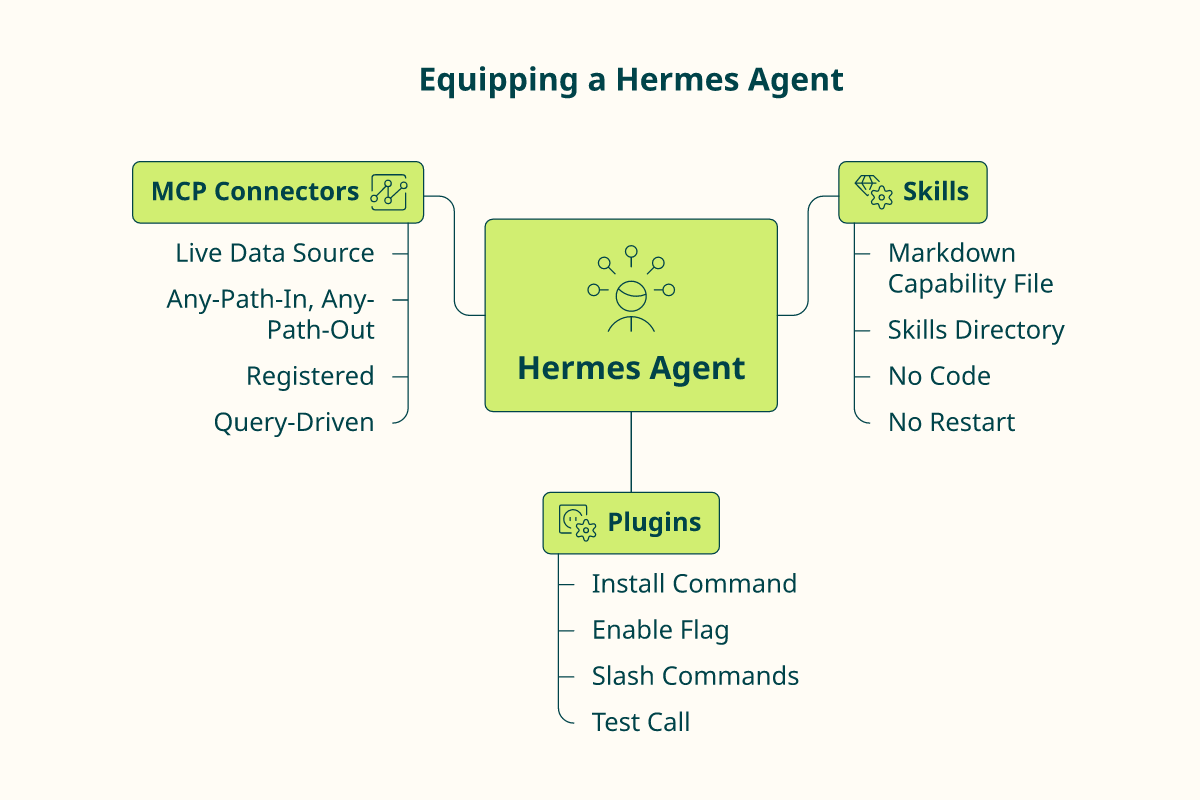
For Vibe Prospecting specifically, you install it as an MCP connector for Claude Code, then verify the connection the same way.
🧭 Which one do you choose?
The decision is not about preference. It is about what the job needs.
<caption>Skill, Plugin, or MCP Connector</caption>
| You need | Install a | Where it lives |
|---|---|---|
| Reusable logic, no code | Skill | ~/.hermes/skills/ |
| New tools, hooks, commands | Plugin | Plugin registry, enabled by flag |
| Live external data | MCP connector | Registered data source |
Here is the distinction I keep coming back to. An API is a rigid input-to-output contract; you engineer every call to a fixed shape. An MCP attached to an agent takes input by any path and returns output by any path.
That is why technical teams who would otherwise build against the Explorium API can instead embed our MCP into an existing data pipeline. If raw data behind an API is genuinely what you want, that is Explorium, not Vibe.
⚠️ Two small habits that save you
Program your skills to ask for clarification when a signal is ambiguous, rather than letting the agent guess a fit. That one rule prevents a lot of confident nonsense.
Second, put variables at the bottom of your prompts. It is a small caching habit that can trim 10% to 15% off monthly model costs.
Q7. How Do You Orchestrate These Into One Self-Improving GTM Operator? [toc=7. Orchestrating One Operator]
Orchestration is what separates a toolbox from an operator. Chain a context file (claude.md) for north-star goals, Vibe Prospecting for data, a memory skill for recall, a cron skill for cadence, and a sequencing skill for delivery. The agent then prospects, enriches, sequences, and adjusts on its own, getting more capable the longer it runs.
🧩 Twelve plugins is not an operator
You can install all 12 picks and still have a drawer of tools. A drawer does not run your pipeline.
Orchestration is the wiring that makes them act as one. The way I think about it, Claude Code is Tony Stark, and the chained stack is the Iron Man suit he puts on for execution.
🔧 The chained recipe, step by step
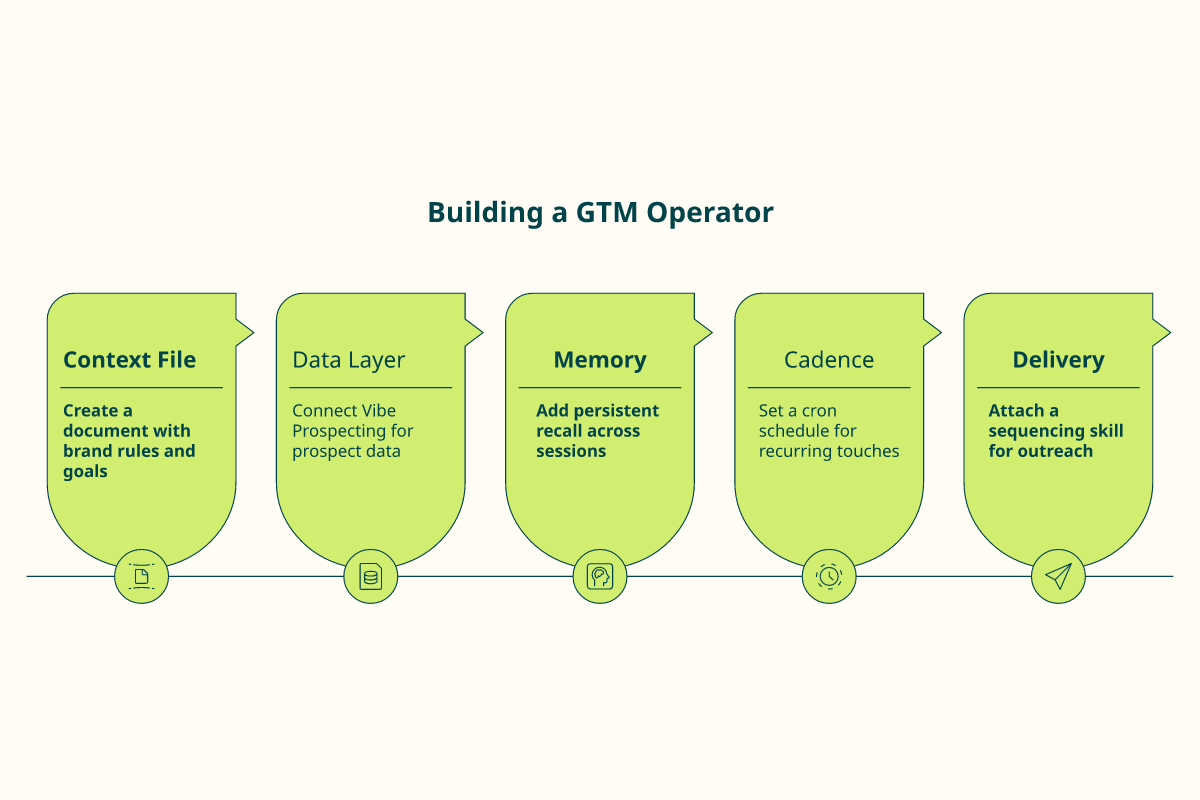
Here is the order that works. Build it once, then let it run.
- Context file: write a claude.md “kitchen bible” holding brand rules and the north-star goal, so the agent does not drift.
- Data layer: connect Vibe Prospecting for prospect and account data, the fuel for everything downstream.
- Memory: add a persistent-memory skill so the agent recalls every account across sessions.
- Cadence: set a cron schedule so touches recur without you.
- Delivery: attach a sequencing skill so vetted contacts move to outreach.
Once the plan is good, the run is good. Hermes is built so the agent writes and refines its own skills, getting more capable each time it runs, which is the heart of building scalable AI agents.
⚖️ Where humans still belong
I want to be clear about labor, because the category gets this backwards. The agent is not in charge of judgment.
I run a 10/80/10 split. Humans spend 10% on ideation, defining the perfect customer, and 10% on the final quality "sniff test," while the agent handles the 80% execution in between. A clear ICP definition makes that first 10% pay off.
And you cannot automate a broken process. Prove a human playbook works first, then feed it to the agent.
🔁 The compounding payoff
The loop is the point. Each run leaves the agent a little sharper, with more memory and tighter skills.
Leadership feels this shift too. Some leaders now spend close to 30% of their time training and calibrating agents instead of managing people.
I could be off on the exact ratio. But from what surfaces when you actually run this for a few weeks, the operator gets better while your hours go down. Check it weekly, correct the drift, and let it compound.
Q8. What Does It Actually Cost to Run This GTM Stack on Hermes-Agent? [toc=8. Cost to Run the Stack]
Running the stack is cheap by design. Hermes is open-source (MIT license) and self-hosts on a $5 VPS (virtual private server, a rented cloud machine). LLM tokens are pay-as-you-go. Vibe Prospecting starts free with 400 credits valid 90 days, then runs from $19/mo, usage-based.
💰 The three cost lines
Your spend breaks into three buckets, and none of them require a procurement cycle.
<caption>The Three Cost Lines</caption>
| Cost line | What you pay | Notes |
|---|---|---|
| Hosting | From ~$5/mo VPS | Hermes is MIT-licensed, open-source |
| LLM tokens | Pay-as-you-go | Trim 10% to 15% with prompt caching |
| Vibe Prospecting | Free 400 credits, then from $19/mo | 8 credits per fully enriched contact |
A fully enriched contact (prospect, email, and phone) costs 8 credits. The credits sit in one pool, and paid credits are valid 12 months, as the credit details spell out.
💸 A worked 1,000-contact run
Say you want 1,000 fully enriched contacts. At 8 credits each, that is roughly 8,000 credits.
The free 400 credits cover about 50 enriched contacts, enough to test fit before you spend a dollar. ⏰ That is the point of the trial: prove the data is right for your niche, then scale, then score and export the data.
A few honest trade-offs, because your money is real and finite.
- ⚠️ Credits apply to Claude today, not ChatGPT.
- ⚠️ Large enriched exports burn credits fast, so validate with samples and statistics first.
- ⚠️ Paid credits do not roll over, so size your plan to actual usage.
🆚 Why usage-based matters
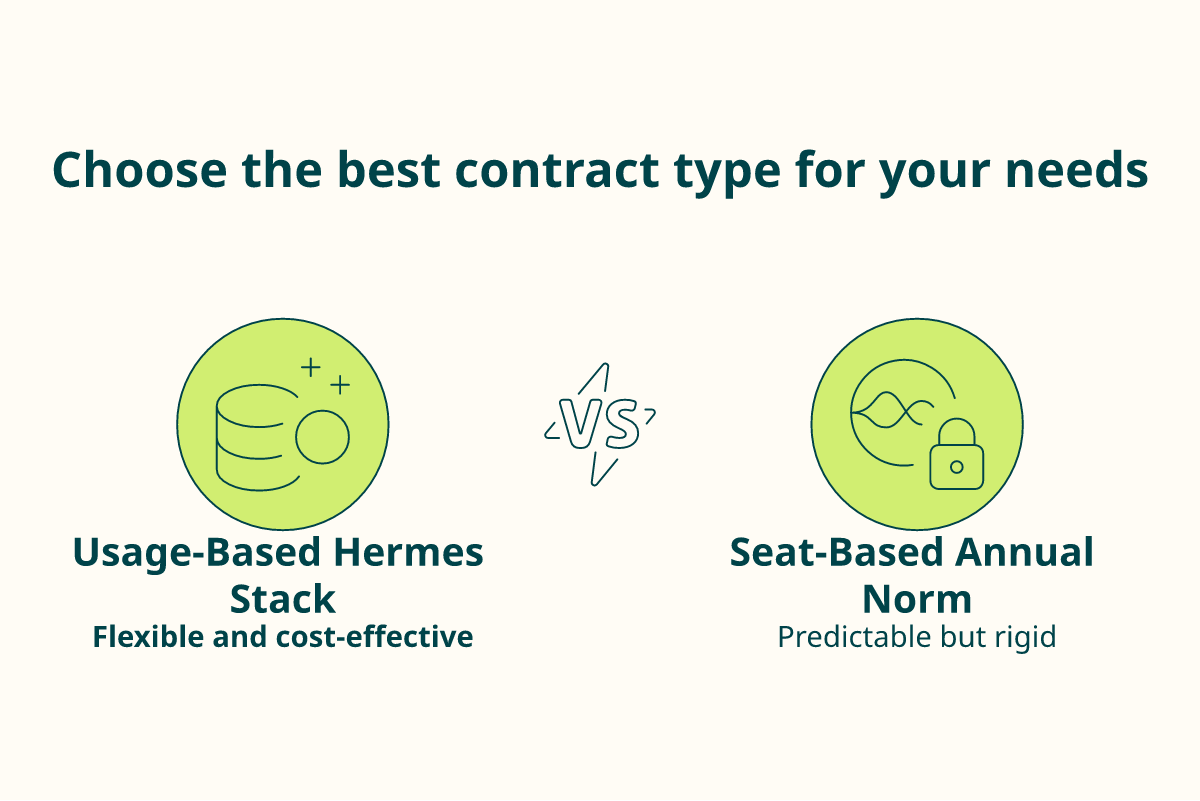
Compare this to the enterprise norm. ZoomInfo and Cognism lean on annual contracts and seat-based pricing, and reviewers report being signed into long terms they did not expect.
“Shady sales tactics. They reference quarterly terms but sign you up to a 12-month arrangement.”
Steven Musico Cognism Trustpilot Verified Review
Usage-based pricing flips that. You start free inside Claude, pay for what you enrich, and AI made the research itself nearly free, so the cost frontier moved to execution. Where my head is right now: budget the credits, not the contract.
Q9. What Are the Contrarian Rules for GTM Automation That Actually Work? [toc=9. Contrarian Automation Rules]
The counterintuitive rules: missing email data is an edge, because it scares off most competitors and leaves phone and LinkedIn channels open; perfect grammar signals automation, so slightly casual copy lifts replies; consistency beats brilliance, since a "pretty good" email sent every time outperforms a brilliant inconsistent one; and never sell the trigger, sell the consequence it implies.
📵 Missing emails are an edge, not a gap
The standard read gets this backwards. Everyone treats a missing email as a dead end and moves on.
Here is what I have learned building a data layer for years. A missing email scares off most of your competitors, which leaves the reliable gold (business phone numbers for SMS, LinkedIn voice notes) wide open. Strong B2B contact data is what surfaces those channels.
So the gap is the moat. The contact channel nobody else will work is the one that converts.
🤖 The "AI ick" is real
This is the rule I got wrong early. We assumed cleaner copy meant better copy.
Perfect grammar and tidy formatting now read as low-effort automation to a sharp buyer. Slightly casual phrasing, even a small grammar slip, can make outreach feel human and lift replies.
The category keeps polishing. I think the polish is the tell.
⏰ Consistency beats brilliance
A founder once spent a Saturday afternoon, watching TV, deleting 2,000 of 2,500 leads by hand to hit 100% list quality. That pruning doubled her attendees in a single week, a payoff that good data enrichment makes repeatable.
The lesson is not "work harder." It is that a steady, "pretty good" motion run with 100% consistency beats a brilliant human who sends in bursts.
“Most people still use AI as a prompt tool, but Hermes Agent automation workflows let you build pipelines that research, plan, execute, and publish.”
u/AISEOInsider, r/AISEOInsider Reddit Thread
🎯 Don’t sell the trigger
A signal is a reason to reach out, not the message itself. "Congrats on the funding" is creepy, and the buyer knows you set an alert.
Sell the consequence the trigger implies instead. New funding means a hiring sprint and 90 days of operational chaos, so speak to that cost, not the headline. At Vibe Prospecting, the data layer surfaces those intent signals, but your judgment is what turns a trigger into a message worth a reply.
I could be off on where the line sits. But from what surfaces when you actually run outbound this way, the team that sells the consequence wins the reply.
Q10. Real Workflows: How Founders Use Hermes GTM Skills [toc=10. Real Founder Workflows]
The same GTM stack serves three jobs. In sales, a CEO cut 50 hours of calls down to 5 high-intent meetings by having the agent call and qualify leads first. In recruiting and research, the agent runs the same prospect-audit and enrichment loop against talent pools or target markets. One operator, one agent, three workflows.
📞 Sales: the 95% week reclaim
Picture a founder-CEO buried in 50 hours of sales calls a week. Most of those calls were unqualified, and the calendar owned him.
He put an agent in front of the calendar. It called and qualified leads before anyone could book, so only real intent got through.
The result was 5 high-intent meetings instead of 50 scattered calls. He reclaimed the week, and the pipeline got cleaner, not thinner. This is exactly the kind of sales workflow the call-and-qualify pattern unlocks.
🧑💼 Recruiting: the same loop, new target
A recruiter has the identical problem as an SDR. The "prospect" is just a candidate now.
The agent runs the same audit and enrichment loop against a talent pool. It maps roles, finds contacts, and scores fit, then hands back a short, vetted list, which is the heart of an agent-run recruiting motion.
“Vibe Prospecting solves the tunnel vision problem that usually happens with traditional, rigid search filters. It maps out an entire region and identifies key decision-makers in minutes rather than days.”
Verified User Vibe Prospecting Trustpilot Verified Review
🔎 Research: mapping a market fast
An analyst or investor needs to size a market, not send an email. The same job underneath: access, filter, and enrich.
I watched the value of this firsthand. An operator described spending a full day building and bucketing a hundred-company list before any real work began, and that tax is exactly what we set out to remove, much like tapping the untapped businesses in your TAM.
“Vibe Prospecting provides a massive headstart when entering new markets. It has turned our market expansion from a slow crawl into a sprint.”
Verified User Vibe Prospecting Trustpilot Verified Review
⚖️ One honest boundary
This stack is for B2B corporate prospecting. If you need local, Google-Maps-style business leads, this is the wrong tool.
And if you want raw data behind an API to engineer against yourself, that is Explorium, not Vibe. The line I hold: Vibe is for when you want the work done, not the raw feed.
Q11. Which GTM Stack Should You Install First? [toc=11. Which Stack First]
Start small, then chain. Solo founders should install Vibe Prospecting, a memory skill, and a cron scheduler, which is enough to run compounding outbound on the free 400 credits. SDR and RevOps users in Claude add CRM sync and sequencing. Technical teams embed the MCP into an existing pipeline. In every case, install the data layer first.
🧱 Install the data layer first, always
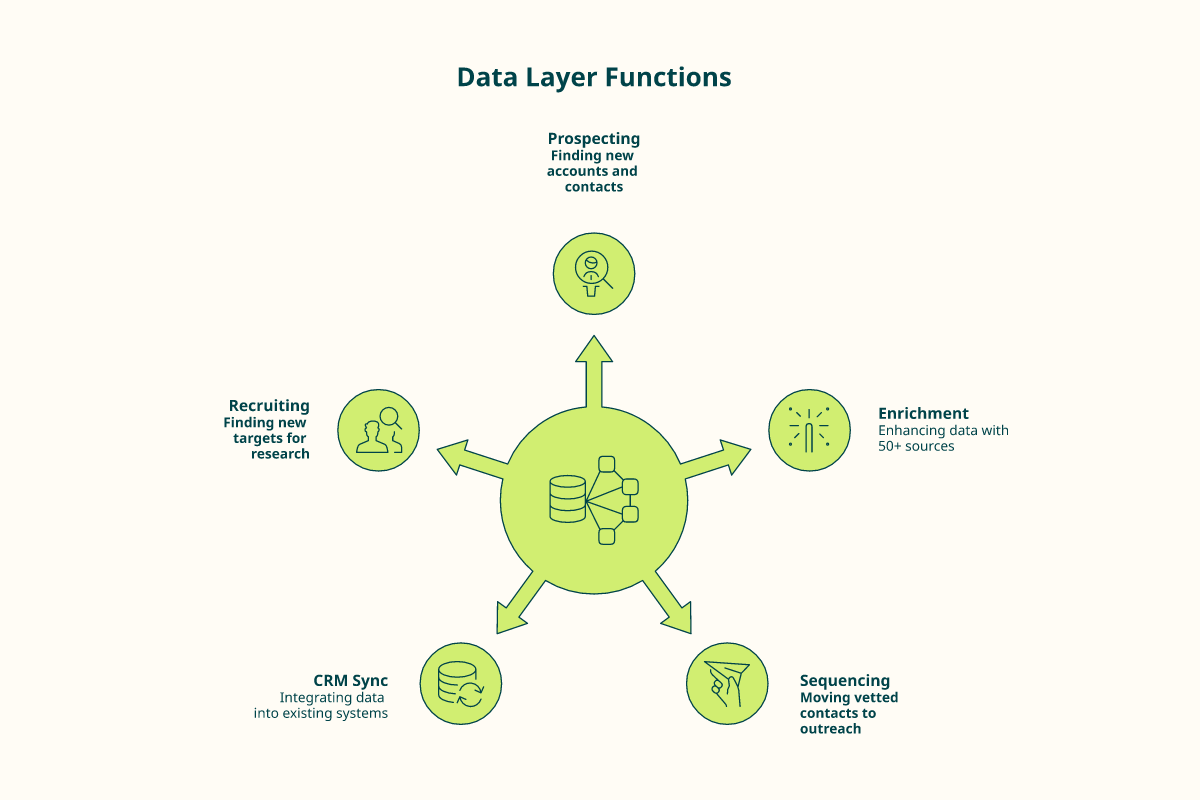
The order is not arbitrary. Everything downstream feeds on data, so the data layer goes in before anything else.
And do not automate a broken process. Prove one human playbook works, then hand that proven motion to the agent, the same way you would identify your ICP and prioritize optimal leads before scaling.
🗂️ Your starter stack by operator type
<caption>Starter Stack by Operator Type</caption>
| Operator type | First stack | Why start here |
|---|---|---|
| Solo founder (UI or chat) | Vibe Prospecting, memory, cron | Compounding outbound on the free 400 credits, valid 90 days |
| SDR / RevOps (in Claude) | Add CRM sync, sequencing | Prospecting happens where you already work |
| Technical team | Embed the MCP in your pipeline | Skip building against a raw API |
One honest reminder on cash: credits apply to Claude today, not ChatGPT, and a fully enriched contact is 8 credits. Start free, prove fit, then scale the spend to real usage, guided by the credit details.
🔭 What I am sitting with
Where my head is right now is the labor question, not the feature question. Access to data is a commodity now, and I think that is settled.
The open question is how far the agent should go before a human steps in. I run a 10/80/10 split today, but I suspect that ratio keeps shifting as the agent gets more capable each run, a theme I keep returning to when building scalable AI agents.
So here is my invitation, not a pitch. Install the data layer, prove one playbook, and tell us what you are building, because the workflows you invent are the ones teaching us where this category goes next. If you want a guided start, book a demo and we will walk it with you.
FAQs


