

TL;DR
- Apollo's API caps at 200 RPM fixed, charges per seat from $49 to $119/user/mo, and ships zero native MCP support, a stack built for SDR clicks, not production agents.
- We scored 6 alternatives on a 100-point Agent-Readiness rubric covering MCP, bulk throughput, pricing transparency, signal breadth, and compliance.
- Explorium scored 94/100 with native SSE MCP, bulk 50 records/call (10K records/min effective), credit packages from $200, and 97.8% firmographic accuracy.
- Persona-fit: solo builders and RevOps favor Explorium or People Data Labs; enterprises needing US phone depth may still accept ZoomInfo's annual contract.
- Our seven-step migration checklist moves teams from Apollo to a unified data layer in under a week, swap auth, map endpoints, install MCP, diff, and cut over.
Q1. What Are the 6 Best Apollo API Alternatives for AI Agent Builders in 2026?
Choosing a B2B data API for production AI agents is a decision you either get right once or pay for every sprint. Apollo’s API ships a $49 to $119/user/month subscription, a fixed 200 RPM ceiling on Basic and Professional plans, and zero native MCP support, a combination that stops scaling the moment your agent fleet starts calling it like a real consumer rather than a human SDR clicking “enrich” in a UI. For this guide I analysed every serious Apollo alternative I’ve seen shortlisted by GTM engineers and narrowed it to six, each scored on the same Agent-Readiness criteria we use internally at Explorium.
Our Evaluation Criteria
- Time to Value ⏰, self-serve signup, free credits, time to first successful enrichment call, and documentation clarity.
- Data Coverage and Accuracy 📊, company/contact database breadth, segment strengths, email/phone deliverability, and disclosed gaps.
- Field Depth and Signal Quality ⭐, firmographics, technographics, intent, events, and social signals per entity.
- Agent and API Readiness 🤖, published rate limits, bulk endpoints, native MCP support, and usability inside Claude Code, n8n, LangChain, and LangGraph.
- Scalability and Infrastructure ⚙️, production throughput, bulk multipliers, uptime, and sliding vs fixed rate windows.
- Compliance and Governance ✅, SOC 2, ISO 27001, GDPR, CCPA, and enterprise DPAs.
- Commercial Model Transparency 💰, published pricing, cost-per-enrichment visibility, free tier, and hidden seat or export caps.
Who This Guide Is For
- GTM Engineers shipping agent-native enrichment on n8n, LangChain, LangGraph, or Claude Code.
- RevOps leaders rebuilding outbound and inbound scoring around programmatic data calls instead of CRM list pulls.
- AI Product Managers embedding real-time B2B data inside LLM applications and agent frameworks.
- Data and Engineering teams benchmarking third-party enrichment APIs against in-house pipelines and legacy contracts.
Ranked Comparison at a Glance
| Provider (Stars) | Best For | Data Strength | API/Agent Readiness | Pricing Model |
|---|---|---|---|---|
| Explorium ⭐⭐⭐⭐⭐ | Agent-native GTM workflows needing multi-signal enrichment via one API + MCP | 150M companies, 800M contacts, 30 enrichment categories, and 50-source aggregation | Native MCP at mcp.explorium.ai/mcp, 200 QPM + bulk 50/call ≈ 10K records/min effective | Credit packages: $0 free (100 credits), $200 Starter, $1,500 Growth, $7,500 Scale, Custom |
| People Data Labs ⭐⭐⭐⭐ | Deep person/company identity resolution for data partnerships and apps | Millions of person/company profiles, ~100 fields/person, depth-focused | REST-only, no native MCP (Zapier/Composio wrappers), Bulk up to 100/request | Pay-as-you-go, Free 100 lookups/mo, Pro from $98/mo, Enterprise $2,500/mo+ |
| ZoomInfo ⭐⭐⭐ | US enterprise phone prospecting and large ABM programs | 265M contacts, 100M companies, best US direct-dial phone | No native MCP, opaque published rate limits, API gated to enterprise tier | Professional ~$14,995/yr, Advanced $24,995/yr, Elite $39,995/yr, full API ~$50K/yr |
| Clay ⭐⭐⭐ | No-code waterfall orchestration of multiple providers in a spreadsheet UI | Multi-provider waterfall, ~86 to 90% blended accuracy via aggregation | Async table API, no native MCP, 400 records/hr throttle on Explorer plan | Starter $134 to $149/mo, Explorer $279 to $349/mo, Pro $720 to $800/mo, Enterprise $30K/yr |
| Crustdata ⭐⭐ | Real-time startup, funding, and early-stage company signals for lean API-first teams | 12M companies, 250M people, startup-focused signals | API-first, no native MCP, 60 RPM noted in third-party analysis | Permanent free tier (quota unspecified), tier-dependent paid plans, enterprise custom |
| Cognism ⭐⭐ | EMEA-focused outbound where GDPR-compliant phone-verified mobiles matter most | EMEA-strong, Diamond-verified mobiles but <10% of database is Diamond-tier | No native MCP, platform-first, quote-based API access | No public pricing, annual contract, per-user licensing, onboarding fee ~$500 to $1,500 |
Apollo itself is deliberately excluded from the ranking, it’s the benchmark these six are replacing, not a candidate for the shortlist.
1. Explorium, Best for Agent-Native GTM Workflows Needing Unified Multi-Signal Enrichment via One API and MCP
Overview
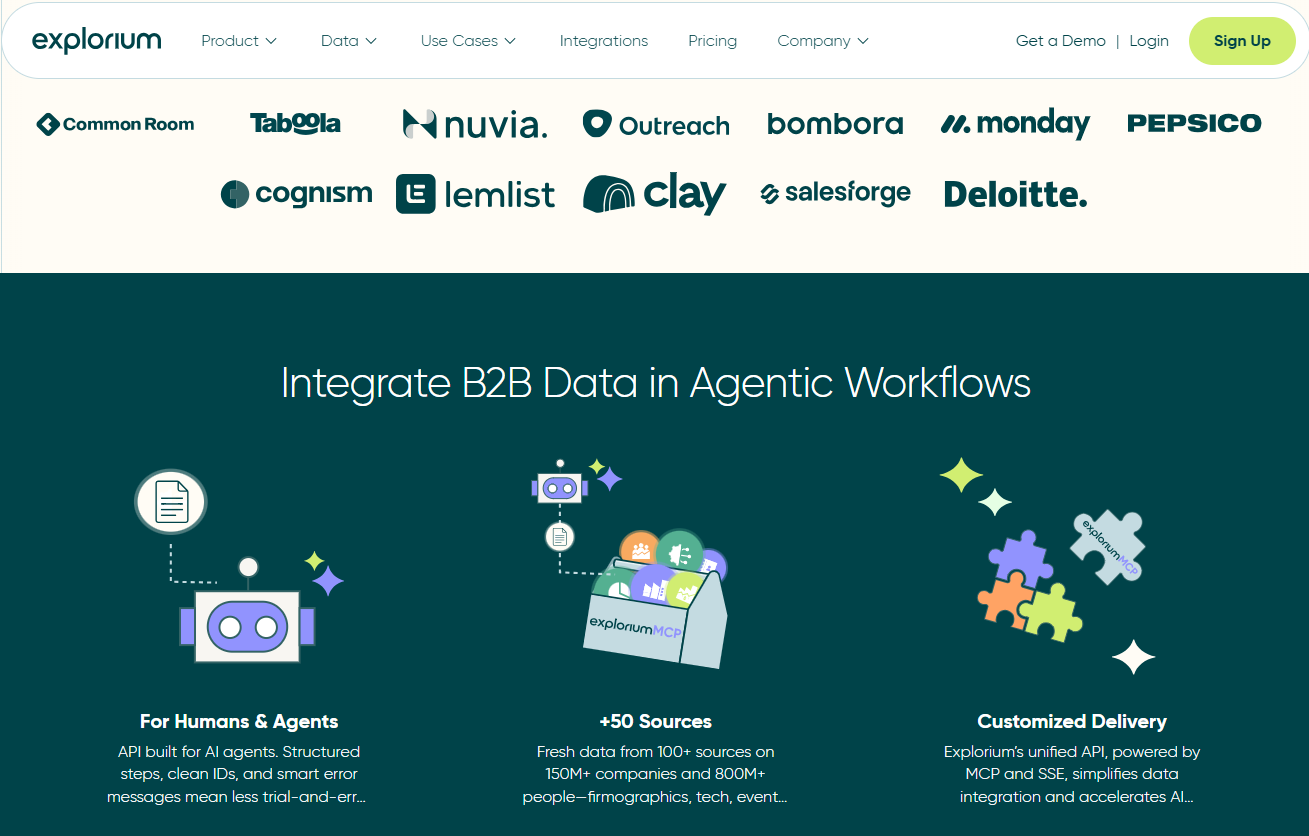
Explorium is a B2B data layer purpose-built for AI agents, not a retrofitted prospecting UI with an API tacked on. We aggregate 50+ data providers into a single normalised schema and expose it through both a REST API and a native Model Context Protocol server at mcp.explorium.ai/mcp, listed on AWS Marketplace and Product Hunt. Instead of forcing a GTM engineer to stitch firmographics from one vendor, intent from another, and technographics from a third, we return all of it from one call and let the agent, via MCP, decide which enrichments to pull per lead.
⏰ Time to first API call: UI: Instant, API call: ~5 to 15 minutes with 100 free credits on self-serve signup.
⚙️ Setup complexity: Low (self-serve signup, no sales call, n8n community node + Claude Code + LangChain native integrations).
🧱 Core Services
- Unified REST API across four endpoint types: match, enrich, fetch, and events, with consistent schema and autocomplete for discovery.
- Native MCP server (SSE) exposing match, enrich, fetch, and events as agent tools, supported natively in Claude Code, n8n, LangChain, LangGraph, CrewAI, and Zapier.
- 50-source aggregation across firmographics, contacts, technographics, intent, funding events, hiring signals, and social signals, one credit pool, one integration.
- 80+ real-time event triggers (funding rounds, executive changes, hiring surges, and tech-stack changes) routed straight into agent workflows.
- Enterprise features: dedicated CSM, DPA, and resale rights on custom plans for ISVs embedding data in customer-facing products.
📊 Data Coverage and Field Depth (Reality Check)
Strong in:
- Global firmographics with documented 97.8% accuracy on employee-count fields (vendor claim, methodology in developer blog).
- Multi-signal coverage: firmographics, contacts, technographics, intent, and 80 event types in one response.
- 150M company profiles and 800M contact records across US, EMEA, and APAC (vendor claim).
Weak in:
- Independent third-party benchmarking of accuracy figures (vendor-published only).
- Public SLA page, enterprise plan implies dedicated support, but SLA specifics are not publicly documented.
Field depth: ~4,000 data points across 30 enrichment categories per entity, accessible through one credit system.
Confidence Level: ✅ High for product architecture and MCP, Medium for accuracy benchmarks (vendor-claim, requires third-party validation).
🤖 API and Agent Readiness
- API availability: ✅ Yes, REST with four unified endpoint types.
- API depth: ✅ High, match, enrich, fetch, events, with bulk 50 records/call.
- MCP compatibility: ✅ Native SSE server, listed on AWS Marketplace.
- Agent usability: ✅ High, native n8n community node, LangChain, LangGraph, CrewAI, Claude Code, and Zapier.
Effective throughput math: 200 QPM × bulk 50 = 10,000 records/minute at the Scale tier, comfortably above the 50K-record/month wall that breaks Apollo’s Organization plan on day one.
💰 Pricing and Cost Structure
Pricing Model: Credit-based, one-time packages, no per-seat subscription lock-in.
Published Pricing:
- Free: $0, 100 credits, 90-day validity
- Starter: $200 for 5,000 credits
- Growth: $1,500 for 50,000 credits
- Scale: $7,500 for 500,000 credits
- Enterprise: Custom (resale rights, dedicated CSM, additional QPM)
💸 Cost Interpretation (What You Actually Pay):
- Estimated cost per 1,000 records: ~$15 to $40 depending on tier and enrichment type.
- Free credits: ✅ Yes, 100 credits, 90-day validity, self-serve.
- Billing driver: Credits per enrichment (match/enrich/fetch/events), no seats.
⚠️ Hidden Costs and Constraints
- Some enrichment categories consume more credits than others (e.g., deep event data vs. a simple match).
- Resale rights and published SLA are gated to custom Enterprise plans.
✅ When to Shortlist
Shortlist this if:
- You are building agent-native enrichment on Claude Code, n8n, LangChain, LangGraph, or CrewAI.
- You want firmographics, contacts, technographics, intent, and events in one API and one credit pool.
- You need resale rights for a product that ships enriched data to your own customers.
Avoid this if:
- You need a UI-first prospecting workflow with built-in outbound sequencing and dialer.
- Your use case is a single-field enrichment (one contact’s email) and you don’t need breadth.
- You require independently audited accuracy benchmarks before signing any contract.
💬 Customer Reviews
“The richness and breadth of data is incredible. I really like the instant access to the most useful and reliable external data. It helps us provide better service to our customers because it is the data we need to make faster and better decisions.”
— Ishi N., Enterprise Explorium G2 Verified Review
“Depending on where the data is coming from, the data can often be mismatched or have outdated information. It is best to cross-reference the output data from other enriched information.”
— Omar G., Mid-Market Explorium G2 Verified Review
2. People Data Labs, Best for Developer-Friendly Person and Company Identity Resolution
Overview
PDL is the canonical “data-as-an-API” vendor for developers who want clean REST, pay-as-you-go billing, and deep person/company profiles for identity-resolution use cases. It is not an all-in-one agent layer, there is no native MCP, no intent, and no event triggers, but for applications whose core job is resolving a person or a company to a rich profile, PDL remains one of the cleanest APIs on the market.
⏰ Time to first API call: UI: Not the primary surface, API call: ~15 to 30 minutes with free 100 lookups/month.
⚙️ Setup complexity: Low (self-serve signup, good docs).
🧱 Core Services
- REST endpoints: Person Enrichment, Company Enrichment, Person Search, Person Identify, IP Enrichment, and Bulk APIs.
- ~100 fields per person profile, including employment history, education, and skills.
- Bulk API up to 100 records per request, with enterprise-custom rate limits.
- Third-party MCP access via Zapier and Composio wrappers, not native.
- Pay-as-you-go credits on Pro plan, with monthly/annual billing options.
📊 Data Coverage and Field Depth
Strong in: person-level depth, employment history, and identity resolution across fragmented inputs.
Weak in: intent data, technographics, event triggers, and contactability-optimised email deliverability.
Field depth: ~100 fields/person, depth-focused rather than signal-breadth-focused.
Confidence Level: Medium, strong developer reputation, but no independent accuracy benchmarks found.
🤖 API and Agent Readiness
- API availability: ✅ Yes, REST.
- API depth: ✅ High for identity, ❌ no intent/events.
- MCP compatibility: ❌ No native MCP, Zapier + Composio wrappers only.
- Agent usability: Medium, great for programmatic enrichment, awkward for autonomous tool selection.
💰 Pricing and Cost Structure
Pricing Model: Pay-as-you-go credits with Pro monthly/annual and Enterprise custom.
Published Pricing:
- Free: 100 person/company lookups per month
- Pro: from $98/month (350 person credits, 1,000 company credits)
- Enterprise: $2,500/month+ with custom limits
💸 Cost Interpretation:
- Estimated cost per 1,000 person enrichments: ~$280 to $350 on Pro.
- Free credits: ✅ Yes, 100/month.
- Billing driver: Credits per lookup, tier upgrades for bulk and higher volumes.
⚠️ Hidden Costs and Constraints
- Reports of accounts being disabled without warning after free-to-paid conversion.
- Support responsiveness complaints on G2 and Trustpilot post-paid conversion.
✅ When to Shortlist
Shortlist this if:
- You are building identity resolution, data partnerships, or apps requiring deep person/company profiles.
- You want clean REST and pay-as-you-go without per-seat subscriptions.
Avoid this if:
- You need native MCP for agent-native workflows.
- You need intent data, event triggers, or technographics in the same integration.
- You need reliable enterprise support at lower tiers.
💬 Customer Reviews
“Product was useful while it worked which wasn’t long. Switched from free trial to paid plan $100/month. After a few days, account disabled with no warning or explanation. Support unresponsive after multiple contact attempts, even after waiting 1 week.”
— Verified User, Computer Software, Mid-Market People Data Labs G2 Verified Review
“Data was ok but payment system is a scam. Very hard to get off their hook once signed up.”
— Glissando AI, US People Data Labs Trustpilot Review
3. ZoomInfo, Best for US Enterprise Phone Prospecting and Large ABM Programs
Overview
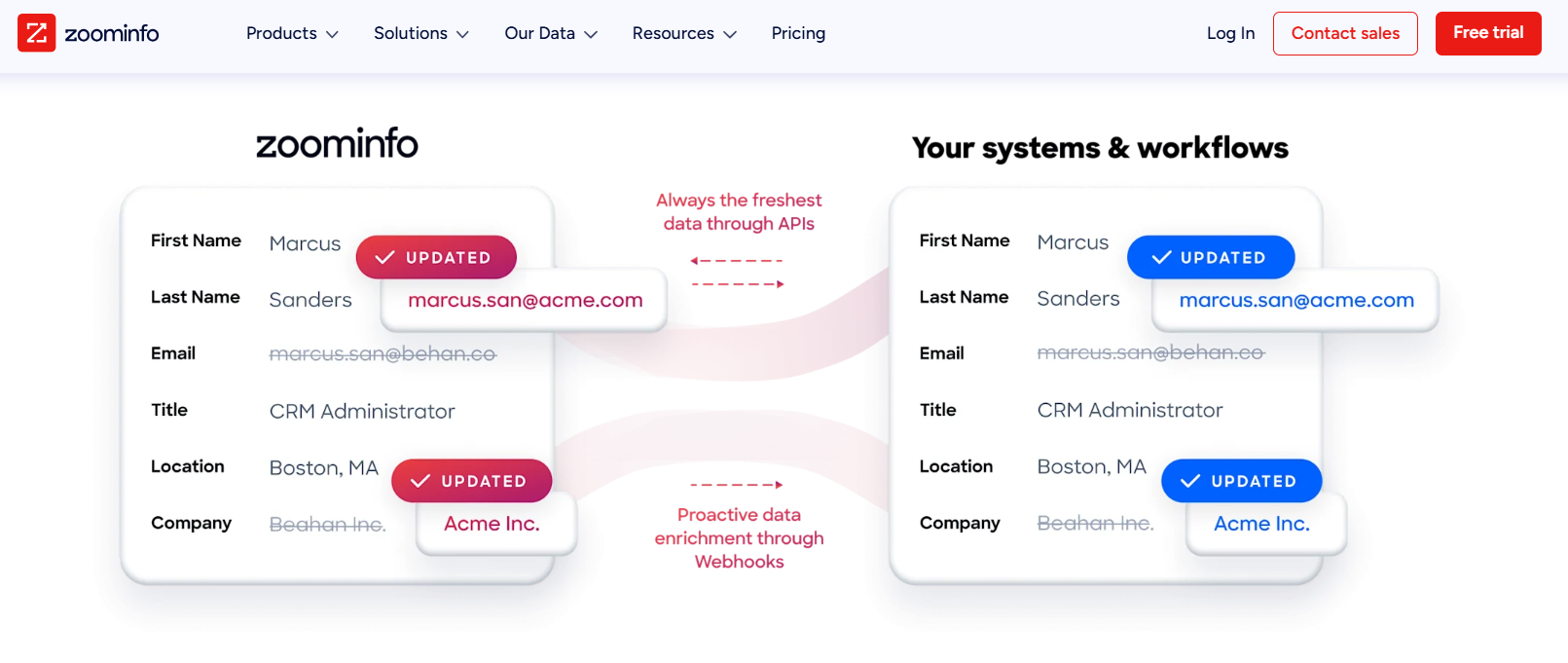
ZoomInfo is the incumbent enterprise sales-intelligence platform, deepest US direct-dial phone coverage, Salesforce/HubSpot native integrations, and a procurement motion built for seven-figure GTM budgets. The tradeoff is opaque pricing, no native MCP, and API access gated behind the Elite or custom enterprise tier that most builder-grade teams never reach.
⏰ Time to first API call: UI: ~1 week after demo/procurement, API call: sales-gated, typically weeks.
⚙️ Setup complexity: High (sales-led onboarding, enterprise contracting).
🧱 Core Services
- 265M contact and 100M company database with best-in-class US direct-dial coverage.
- Intent signals via the Elite/Intent add-on, integrated compliance API in Professional plan and above.
- Native Salesforce and HubSpot integrations for enterprise ABM motions.
- API access reportedly requires ~$50K/year enterprise tier for meaningful usage.
- No native MCP, no published agent-framework integrations.
📊 Data Coverage and Field Depth
Strong in: US direct-dial phones (~80 to 85% third-party estimate), enterprise contact depth, and ABM firmographics.
Weak in: international coverage (especially APAC), agent-native delivery, and transparent pricing.
Confidence Level: High for US enterprise, Low for agent builders.
🤖 API and Agent Readiness
- API availability: ✅ Yes, enterprise-gated.
- API depth: Moderate, contacts, firmographics, and intent (add-on).
- MCP compatibility: ❌ None found.
- Agent usability: Low, designed for Salesforce workflows, not autonomous agent orchestration.
💰 Pricing and Cost Structure
Pricing Model: Annual contract, per-user licensing plus platform fee.
Published Pricing:
- Professional: ~$14,995/year
- Advanced: $24,995/year
- Elite: $39,995/year
- Full API access: ~$50,000/year enterprise tier
💸 Cost Interpretation:
- Estimated cost per 1,000 contacts: highly variable, typically bundled into annual spend.
- Free tier: Lite plan, 10 exports/month, API requires paid tier, demo heavily pushed.
- Billing driver: Seats + platform fee + optional intent add-on.
⚠️ Hidden Costs and Constraints
- No public rate-limit documentation, throughput negotiated in enterprise contracts.
- Data-freshness complaints around stale company data.
- Data-sharing terms in Lite plan raise privacy questions.
✅ When to Shortlist
Shortlist this if:
- You run US enterprise outbound and need the deepest direct-dial phone coverage available.
- You have a seven-figure GTM budget and an existing Salesforce/ABM stack.
Avoid this if:
- You are a startup or developer building agent-native workflows with self-serve expectations.
- You need MCP or published rate limits for production engineering.
- International (especially APAC) coverage is central to your ICP.
💬 Customer Reviews
Note: no reviews for ZoomInfo are included in the explorium-competitor-reviews source file, so per the sourcing rule no reviews are pasted here. Reviewers on G2 and Trustpilot should be added only when verified quotes with direct review URLs are available.
4. Clay, Best for No-Code Waterfall Orchestration of Multiple Providers
Overview
Clay is less a data vendor and more a GTM workflow platform, a spreadsheet-style UI that orchestrates waterfall enrichment across many underlying providers (including, in some customer stacks, Explorium itself). For teams that want a visual, no-code way to stack providers and apply AI transformations, Clay is best-in-class. For agent-native programmatic workflows at scale, it hits the same ceilings every platform-style product hits: a 400 records/hour throttle on the Explorer plan, a credit system that reviewers describe as opaque, and no native MCP.
⏰ Time to first API call: UI: ~30 minutes, API call: platform-native, async.
⚙️ Setup complexity: Medium-to-High (steep learning curve, credit logic non-obvious).
🧱 Core Services
- Spreadsheet-style tables for waterfall enrichment across 100+ providers.
- Claygent AI enrichment for logic-based, LLM-assisted transformations.
- Deep integration ecosystem with CRMs, outbound tools, and scraping providers.
- Async table API, platform-native, not a pure API product.
- No native MCP, Clay is a consumer of providers, not an MCP supplier.
📊 Data Coverage and Field Depth
Strong in: waterfall accuracy when stacked correctly (86 to 90% third-party estimate), and native AI transforms.
Weak in: predictable per-row cost, beginner usability, and high-throughput programmatic workflows.
Confidence Level: Medium, quality depends entirely on which providers you configure.
🤖 API and Agent Readiness
- API availability: Platform-first, async API.
- API depth: Limited for pure programmatic agent use.
- MCP compatibility: ❌ None.
- Agent usability: Low-to-Medium for agent-native patterns.
💰 Pricing and Cost Structure
Pricing Model: Platform fee + credits-based per-action charges (overhauled March 2026).
Published Pricing:
- Free: 100 credits
- Starter: $134 to $149/month
- Explorer: $279 to $349/month
- Pro: $720 to $800/month
- Enterprise: ~$30,000/year
💸 Cost Interpretation:
- Estimated cost per 1,000 enrichments: highly variable, reviewers report stated 11 credits/row landing at 25 credits/row in practice.
- Free credits: ✅ Yes, 100 on Free.
- Billing driver: Data Credits + Actions + platform fee.
⚠️ Hidden Costs and Constraints
- 400 records/hour throttle on Explorer plan materially constrains agent workloads.
- Credit-per-row cost can diverge ~100% from stated numbers.
✅ When to Shortlist
Shortlist this if:
- You want no-code waterfall enrichment with a visual table UI.
- Your team prefers Claygent AI transforms over writing code.
Avoid this if:
- You need native agent frameworks and MCP delivery.
- You require resale rights for a customer-facing product.
- You need predictable per-enrichment cost at scale.
💬 Customer Reviews
“Credit system is broken. Pricing is broken. Not fully transparent with rollover limit. Never helped when issues arose.”
— Raphael A., Marketing Lead, Mid-Market Clay G2 Verified Review
“Transformative for GTM operations and data enrichment. Deeply flexible and integrated with modern GTM toolstack. Tradeoff between flexibility and complexity falls on the complex but flexible side. Per-row credit cost can vary 100% from stated amounts, e.g., stated 11 credits/row, actual 25.”
— Verified User, IT Services, Mid-Market Clay G2 Verified Review
5. Crustdata, Best for Real-Time Startup and Early-Stage Company Signals
Overview
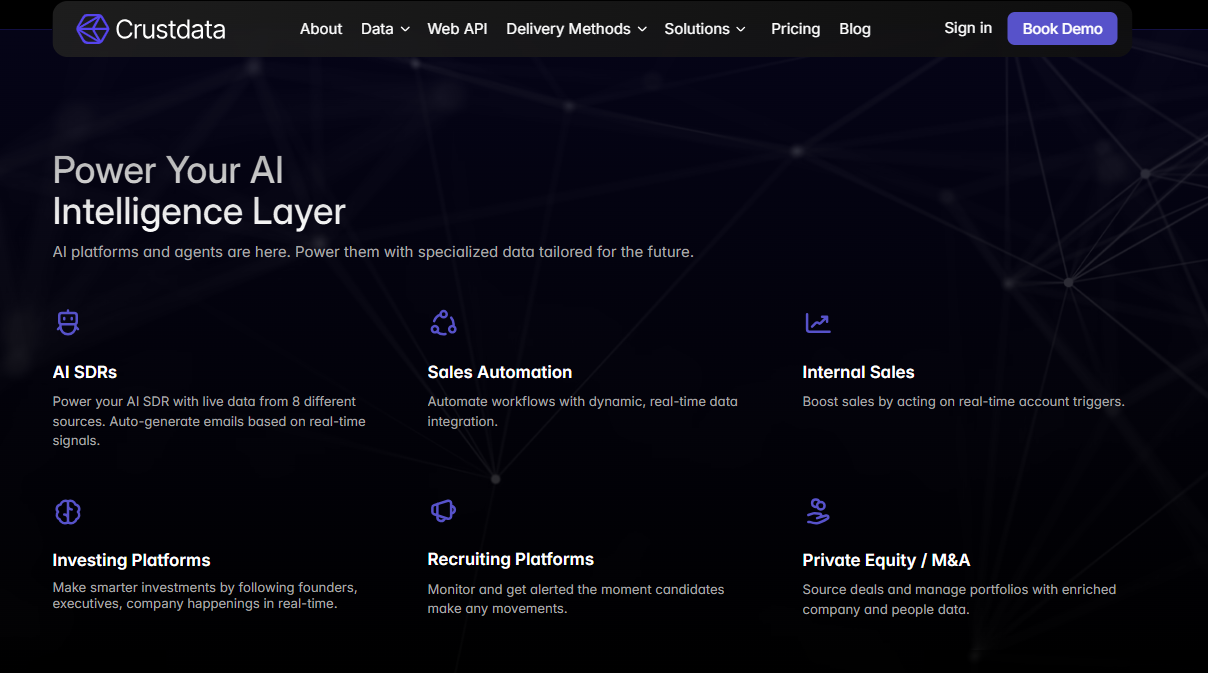
Crustdata is an API-first provider focused on startup and funding signals, headcount growth, funding rounds, job postings, and early-stage company discovery. For a lean team building an “interesting startup detector” or a lightweight sourcing agent, Crustdata ships a clean developer experience. For production enrichment at volume, the 60 RPM ceiling and tier-gated rate limits are a real constraint.
⏰ Time to first API call: UI: Dashboard-based, API call: ~30 minutes via permanent free tier.
⚙️ Setup complexity: Low-to-Medium (API-first, Slack-based engineer support).
🧱 Core Services
- 12M company and 250M people records, startup-weighted.
- Real-time signals: funding rounds, headcount changes, and job postings.
- Flat files available for bulk use cases.
- Slack support channel for engineering users.
- No native MCP, no published agent-framework integrations.
📊 Data Coverage and Field Depth
Strong in: US startup ecosystem signals, early-stage discovery, and real-time change events.
Weak in: enterprise contact depth, intent data, and international phone coverage.
Confidence Level: Medium, no third-party accuracy benchmarks published.
🤖 API and Agent Readiness
- API availability: ✅ Yes.
- API depth: Moderate, signals-focused.
- MCP compatibility: ❌ None found.
- Agent usability: Medium, works programmatically but 60 RPM caps agent fleets.
💰 Pricing and Cost Structure
Pricing Model: Tier-based with permanent free tier, enterprise custom.
Published Pricing:
- Free: Permanent free tier (quota unspecified)
- Paid tiers: Tier-dependent, specifics via dashboard
- Enterprise: Custom, requires sales
💸 Cost Interpretation:
- Estimated cost per 1,000 records: not publicly documented.
- Free credits: ✅ Yes, permanent free tier.
- Billing driver: Tier + volume.
⚠️ Hidden Costs and Constraints
- 60 RPM ceiling noted in third-party analysis, insufficient for high-volume production agents.
- Enterprise plans require custom sales process despite API-first positioning.
✅ When to Shortlist
Shortlist this if:
- Your workflow is startup discovery, funding-triggered outbound, or early-stage sourcing.
- You want API-first simplicity and a permanent free tier.
Avoid this if:
- You need high-throughput agent workloads (60 RPM is a hard ceiling).
- You need intent data, deep contact data, or enterprise phone coverage.
- You need native MCP for autonomous agent tool selection.
💬 Customer Reviews
Note: no Crustdata reviews are included in the explorium-competitor-reviews source file, so per the sourcing rule no review quotes are inserted here.
6. Cognism, Best for EMEA-Focused Outbound Where GDPR-Compliant Phone Data Matters Most
Overview
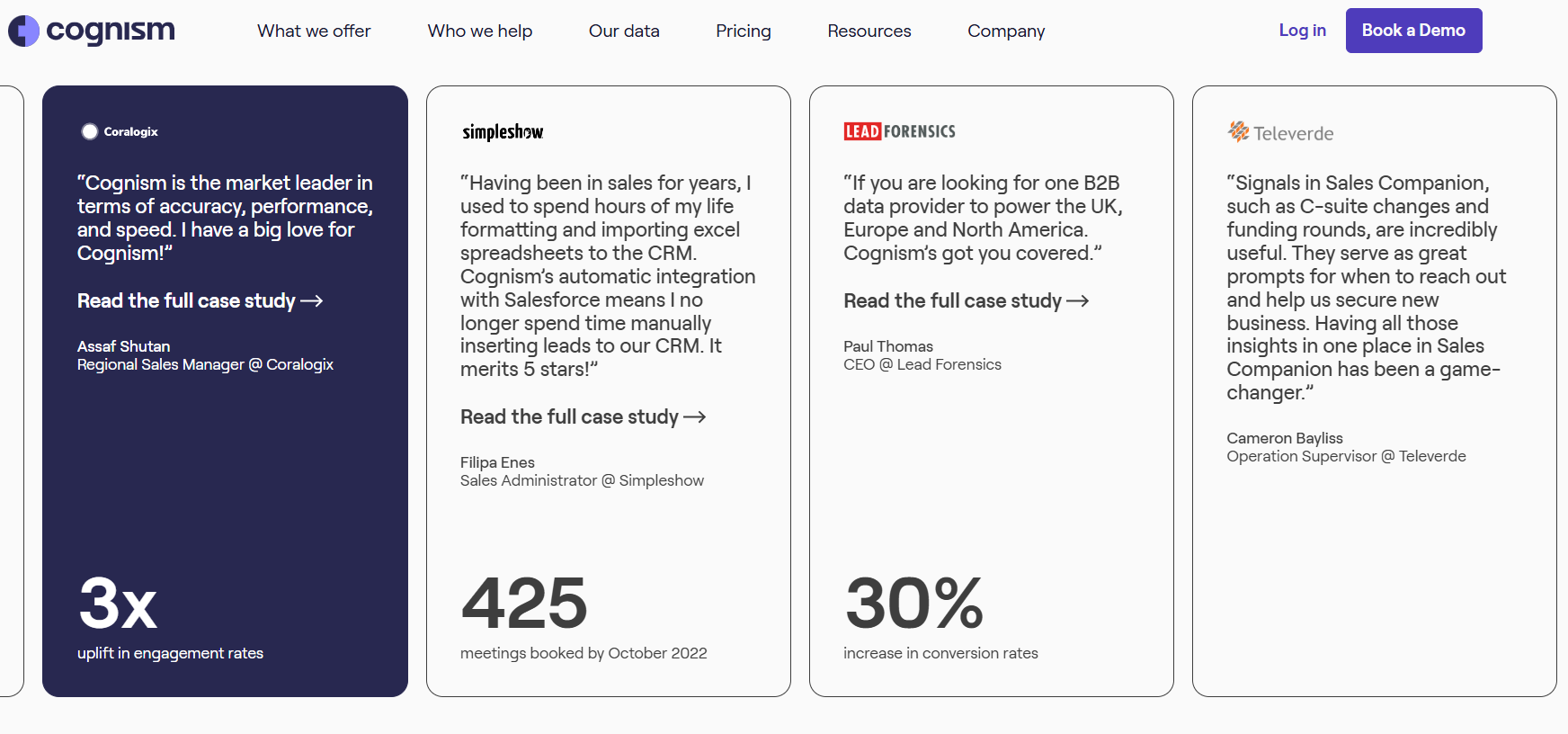
Cognism’s strongest pitch is GDPR-grade, phone-verified mobile data across EMEA, the only major vendor that leads with European compliance as a product feature, not a legal afterthought. It is a platform-first tool with quote-based pricing, no public API rate limits, and no native MCP, so its fit for agent builders is narrow: if your ICP is European and your outbound motion depends on mobile dials, it belongs on the shortlist. If you’re building programmatic global workflows, it probably doesn’t.
⏰ Time to first API call: UI: ~3 to 7 days via demo, API call: sales-gated.
⚙️ Setup complexity: High (demo required, quarterly terms can land as 12-month commitments).
🧱 Core Services
- EMEA-focused contact and company database with phone-verified Diamond tier.
- Intent signals on Cognism Elevate add-on.
- GDPR-first brand positioning and compliance workflow integrations.
- CRM integrations including Salesforce and HubSpot.
- No native MCP, platform-first with quote-based API access.
📊 Data Coverage and Field Depth
Strong in: EMEA firmographics, phone-verified mobiles (Diamond tier), and GDPR posture.
Weak in: Diamond coverage is reportedly <10% of total database, non-EMEA markets, and API transparency.
Confidence Level: Medium, strong brand, mixed reviewer signals on data freshness.
🤖 API and Agent Readiness
- API availability: ✅ Yes, quote-based.
- API depth: Moderate.
- MCP compatibility: ❌ None found.
- Agent usability: Low, designed for SDR workflows, not agent orchestration.
💰 Pricing and Cost Structure
Pricing Model: Quote-based platform fee + per-user annual licenses.
Published Pricing: No public pricing, annual contract, onboarding fee ~$500 to $1,500.
💸 Cost Interpretation:
- Estimated cost per 1,000 records: not publicly disclosed.
- Free tier: ❌ None, demo required.
- Billing driver: Seats + annual platform fee + add-ons.
⚠️ Hidden Costs and Constraints
- Reviewers report quarterly terms presented as 12-month arrangements.
- 90% mobile coverage marketing claim disputed by reviewers citing real-world delivery.
✅ When to Shortlist
Shortlist this if:
- EMEA outbound is your primary motion and GDPR compliance is a board-level concern.
- Your SDRs live on phone dials and you need mobile-verified numbers.
Avoid this if:
- You need API-first, agent-native workflows with native MCP.
- Your ICP is primarily non-EMEA or you need self-serve pricing.
- You want transparent published rate limits and usage-based billing.
💬 Customer Reviews
“Poor data quality, no direct mobile numbers. Numbers either wrong or returns US HQ number even when searching European offices. Not worth the money. Waste of time in SDR workflow.”
— Jackie, DE Cognism Trustpilot Review
“Data nowhere near as good as other vendors. Has used two others with far greater access to valid data. Shady sales tactics, reference quarterly terms but sign you up to 12-month arrangement.”
— Steven Musico, AU Cognism Trustpilot Review
Here’s the exact Agent-Readiness scorecard that ranked all six, and showed why Explorium earns 5★ while Apollo, the benchmark we’re replacing, lands at 3★, coming up in Q2.
Q2. How Did We Score These Tools, The Agent-Readiness Scorecard (Selection Criteria)?
Most Apollo-alternative listicles lean on vibes: “great UI,” “affordable,” “scales well.” That’s useless when you’re the engineer who has to ship an agent that calls data 10,000 times a minute at 2 AM without paging anyone. So we built the Agent-Readiness Scorecard, a 100-point rubric that scores every vendor on the five things that actually decide whether an API survives production.
The Five Weighted Criteria
| Criterion | Weight | What It Measures |
|---|---|---|
| 🤖 Agent-Readiness | 30% | Native MCP (not Zapier/StackOne wrappers), sliding vs fixed rate windows, and bulk-endpoint multiplier |
| 📊 Data Breadth & Accuracy | 25% | Firmographics, contacts, technographics, intent, and events; verified vs vendor-claim accuracy |
| 💰 Pricing Transparency & Model Fit | 20% | Published tiers, credit-based vs per-seat, and published cost per 1,000 records |
| ⏰ Self-Serve Testability & DX | 15% | Free credits, self-serve signup, docs quality, and n8n/LangChain/Claude integrations |
| ✅ Compliance & Resale Rights | 10% | SOC 2, ISO, GDPR, CCPA, DPA, and resale rights for ISVs |
Why These Weights, Not Others
Agent-Readiness sits at 30% because MCP availability is the single biggest 2026 differentiator. A native SSE server lets the agent discover and call tools autonomously, while wrappers like StackOne (45 pre-baked Apollo actions) or Zapier middleware add latency and hide schema. Sliding rate-limit windows matter more than the headline RPM. A fixed 200 RPM resets at minute boundaries and murders bursty agent traffic; bulk endpoints act as throughput multipliers (bulk 50 records × 200 RPM = 10,000 records/minute effective).
Per-Vendor Score Table
Star mapping: 0 to 20 = 1★, 21 to 40 = 2★, 41 to 60 = 3★, 61 to 80 = 4★, and 81 to 100 = 5★.
| Vendor | Agent-Readiness /30 | Breadth & Accuracy /25 | Pricing /20 | DX /15 | Compliance /10 | Total /100 | Stars |
|---|---|---|---|---|---|---|---|
| Explorium | 28 | 22 | 19 | 15 | 10 | 94 | ⭐⭐⭐⭐⭐ |
| People Data Labs | 12 | 18 | 17 | 13 | 8 | 68 | ⭐⭐⭐⭐ |
| ZoomInfo | 8 | 22 | 6 | 4 | 10 | 50 | ⭐⭐⭐ |
| Clay | 10 | 17 | 10 | 11 | 5 | 53 | ⭐⭐⭐ |
| Apollo (benchmark) | 9 | 14 | 11 | 11 | 3 | 48 | ⭐⭐⭐ |
| Crustdata | 8 | 12 | 11 | 9 | 4 | 44 | ⭐⭐⭐ |
| Cognism | 6 | 15 | 5 | 3 | 8 | 37 | ⭐⭐ |
Credibility Rules Applied to Every Score
We scored conservatively and labelled every claim honestly. Apollo’s widely cited 91% accuracy figure, for example, only applies to contacts Apollo itself marks as “verified”. Blended real-world accuracy tested by Prospeo lands at 65 to 80%. Coverage numbers (275M, 150M, and 265M contacts) are vendor-claimed until independently audited and are scored as such. MCP support counts only when it’s a native server with dedicated GTM tools. StackOne and Zapier wrappers score zero because they can’t expose full schema discovery. Cost was modelled at both prototype (under $200, one engineer) and production (50,000 records/month, bulk) scales, so vendors that look cheap at signup but wall off the API behind a $50K/year tier (ZoomInfo) lose pricing points.
Q3. Why Are GTM Engineers Switching From Apollo’s API, the 200 RPM / Per-Seat / No-MCP Thesis
Engineers leave Apollo because its API was architected for human SDRs clicking “enrich” in a UI, not for autonomous agents calling data 10,000 times a minute. Three failures surface only at production scale, and once you hit them, there’s no workaround that doesn’t involve more engineering hours than the platform is worth.
The Three Walls That Break Production Agents
- ⚠️ Rate limits, 200/min, fixed windows. Apollo Basic and Professional cap at 200 requests/minute, 400/hour, and 2,000/day. Organization lifts the daily ceiling to 6,000 but keeps the same 200/min wall. Fixed windows (not sliding) mean bursty agent traffic gets throttled even when average usage is well under the limit.
- 💰 Per-seat pricing, agents aren’t seats. Pricing runs $49, then $79, then $119 per user/month with annual billing and a 3-user minimum on Organization. Full API access is gated to Organization tier only, which means a 5-seat team pays $17,000 to $20,700/year before they run the first agent call.
- 🤖 No native MCP. Apollo has zero native MCP server. The only paths are StackOne’s third-party wrapper (45 pre-baked actions) or Zapier middleware. Neither lets an agent discover the full schema or call non-wrapped endpoints. You’re shipping an agent that can only do what the wrapper author anticipated.
- 📉 Accuracy/deliverability reality. The headline 91% accuracy applies only to contacts Apollo marks “verified”. Blended real-world accuracy is 65 to 80% per Prospeo third-party testing. Pre-update bounce rates sat at 32 to 38%. Apollo’s December 2025 waterfall update claims a 45% bounce reduction, still unverified independently as of April 2026.
The Explorium Resolution
We rebuilt the stack around production agents, not prospecting UIs. Explorium documents 200 QPM with bulk 50 records/call, 10,000 records/minute effective throughput, on credit packages that start at $200 for 5,000 credits with no per-seat minimum and scale to $7,500 for 500,000 credits. Native SSE MCP at mcp.explorium.ai/mcp is listed on AWS Marketplace and supported natively in Claude Code, n8n, LangChain, LangGraph, and CrewAI. G2 and Gartner reviewers consistently rate Explorium 5/5 on data breadth and CS responsiveness.
Operator Voices
“Affordable pricing. Data relatively accurate for the price. Half of exported data was on spam lists. Phone/email get flagged as spam if you use Apollo regularly. CRM integration harvests your CRM data and sells it to other customers without clear disclosure.”
— Verified User, Insurance, Small-Business Apollo G2 Verified Review
“Contact info frequently missing or incorrect. Half the day calling wrong/disconnected numbers. Mobiles frequently wrong. Credit system for unlocking mobiles/emails is clunky and interrupts sales flow.”
— Verified User, IT Services, Mid-Market Apollo G2 Verified Review
“Instead of connecting to multiple data sources and APIs, we only require one connection, Explorium!”
— Mirit H., Mid-Market Explorium G2 Verified Review
Q4. What Are Apollo’s Exact Rate Limits, Pricing Tiers, and MCP Gaps, and When Do They Break Production?
If you’re evaluating Apollo’s API for anything beyond a solo side project, you need the exact numbers, not marketing language. Here’s the documented teardown of rate limits, pricing, and MCP support, with the throughput math that shows precisely when production agents hit the wall.
Apollo Rate Limits and Pricing, Tier by Tier
| Plan | Price (annual) | Requests/min | Requests/hr | Requests/day | API Access |
|---|---|---|---|---|---|
| Free | $0 | 50 | , | , | Limited |
| Basic | $49/user/mo | 200 | 400 | 2,000 | Included |
| Professional | $79/user/mo | 200 | 400 | 2,000 | Included |
| Organization | $119/user/mo (3-user min) | 200 | 600 | 6,000 | Full API, Organization only |
All rate windows are fixed, not sliding. A burst at minute 59:59 reuses quota at 00:00 with no smoothing. A 5-seat Organization team pays $17,000 to $20,700/year before writing a single line of agent code.
Throughput Math, When Apollo Breaks
Single-record enrichment × 200 RPM = 12,000 records/hour ceiling on any paid tier. Apollo’s bulk endpoint supports up to 10 records per call but is rate-limited as single-record for pricing purposes, so the effective multiplier is minimal. An agent enriching 50,000 records/month clears Apollo’s daily ceiling on day one without engineering-heavy queue management, retries, and exponential backoff. That’s work that shouldn’t exist on a production data layer. On top of that, agents aren’t seats. Paying a 3-user minimum just to unlock the API is per-seat economics applied to a non-seat consumer.
MCP, The 2026 Differentiator Apollo Skipped
Apollo has no native MCP server. The only paths for agent integration are:
❌ StackOne third-party wrapper, 45 pre-baked actions, cannot expose full Apollo schema.
❌ Zapier middleware, adds latency, credit overhead, and a second vendor dependency.
Agent-native infrastructure in 2026 needs three things simultaneously: native MCP so agents discover tools autonomously, bulk endpoints that act as true rate-limit multipliers, and sliding rate windows that don’t punish burst traffic. Apollo provides none.
The Explorium Solution, One API, Built for Agents
We designed Explorium from the opposite direction. Documented 200 QPM with bulk 50 records/call = 10,000 records/min effective throughput, on a credit package you can start for $200 (5,000 credits) and scale to $7,500 (500,000 credits), with no per-seat minimum, and no annual contract to unlock the API. Native SSE MCP at mcp.explorium.ai/mcp exposes match, enrich, fetch, and events tools with autocomplete for discovery, and is supported natively in Claude Code, n8n, LangChain, LangGraph, CrewAI, and Zapier. One API call returns firmographics, contacts, technographics, intent, and 80 event types from 50 aggregated sources, not four separate vendor contracts your engineers normalise by hand.
The punchline: while Apollo caps you at 200 RPM single-record on a $119/seat Organization plan, Explorium’s bulk endpoint delivers 10,000 records/minute effective on a credit package that starts at $200, with MCP letting your agent, not your engineer, decide which of the 30 enrichment categories to pull for each lead.
Q5. How Do the Top Alternatives Compare Head-to-Head With Apollo, the Agent-Readiness Comparison Table?
When builders ask me “Apollo vs X,” they’re really asking five questions at once. Does it have native MCP? What’s the real throughput once I factor in bulk multipliers? How does the pricing actually model against agent workloads? How deep is the signal stack? And how accurate is the data when I diff it against my own ground truth? Here’s the head-to-head that answers all five.
The Master Comparison Table
| Vendor | Native MCP | Rate Limit + Bulk | Pricing Model | Signal Breadth | Verified Accuracy |
|---|---|---|---|---|---|
| Apollo (benchmark) | ❌ No, StackOne/Zapier only | 200 RPM fixed, bulk up to 10 single-rate | Per-seat $49 to $119/user/mo, 3-user min on Organization | Contacts + firmographics + limited intent | 91% verified subset, 65 to 80% blended (Prospeo) |
| Explorium | ✅ Native SSE at mcp.explorium.ai/mcp | 200 QPM + bulk 50 = 10K records/min | Credit packages $200 to $7,500, no seats | 30 categories (firmo + contact + techno + intent + 80 events) | 97.8% firmographic (vendor claim) |
| People Data Labs | ❌ No, Zapier/Composio wrappers | Bulk up to 100/request | PAYG, Free 100/mo, Pro from $98/mo, Enterprise $2,500/mo+ | Person + company identity depth | Not independently benchmarked |
| ZoomInfo | ❌ No, none found | Opaque, API gated ~$50K/yr | $14,995 to $39,995/yr + API tier, annual | Contacts + intent (add-on) | 75 to 85% email, 80 to 85% US phone |
| Clay | ❌ No, platform, not provider | 400 records/hr throttle on Explorer | Platform + credits $134 to $800+/mo | Multi-provider waterfall | 86 to 90% (waterfall result) |
| Crustdata | ❌ No | 60 RPM | Free tier + tier-gated paid | Startup & funding signals | Not benchmarked |
| Cognism | ❌ No | Quote-based | Annual contract, per-user licensing | EMEA phone-verified (Diamond) | 80 to 90% EMEA (Diamond <10% of DB) |
Deliverability and Accuracy Context
Headline rates and bounce figures rarely match reality. Apollo’s pre-update bounce rates sat at 32 to 38%, and the December 2025 waterfall update claims a 45% reduction, still unverified independently as of April 2026. Cognism markets 90% mobile coverage, but reviewers confirm only ~10% of the database is Diamond-verified. ZoomInfo remains the benchmark for US direct-dial phone but doesn’t publish rate limits. Explorium’s published firmographic benchmark on employee-count accuracy lands at 97.8%, versus ZoomInfo 88.3%, Apollo 78.2%, and Clearbit 32.9%, vendor-published with methodology in our developer blog, not yet independently audited.
Prescriptive Read of the Table
✅ Need native MCP + unified signals across firmographics, contacts, intent, and events, Explorium.
✅ Need deep person/company identity resolution with clean PAYG, People Data Labs.
✅ Need US enterprise direct-dial phone and ABM depth, ZoomInfo (accept no MCP and annual contract).
✅ Need no-code waterfall orchestration across many providers, Clay (accept 400 records/hr ceiling).
✅ Need GDPR-grade EMEA phone-verified mobiles, Cognism (accept quote-based pricing).
As of April 2026, Explorium is the only vendor in this shortlist that scores 5★ across every Agent-Readiness dimension, native MCP, bulk-multiplier throughput, credit-based pricing, multi-signal breadth, and documented accuracy benchmarks.
Operator Voices on the Comparison
“Explorium is a fast and effective platform that makes the integration and analysis of third-party data seamless.”
— David A., CEO, Mid-Market Explorium G2 Verified Review
“Removed a user from the plan but a task by that user kept running and consumed all credits. Happened twice. Bug cost $1000. Support refused responsibility. No refund.”
— Amulya P., Small-Business Apollo G2 Verified Review
Q6. Which Alternative Is Right for Your Stage, Solo Builder, Production RevOps, or Enterprise Evaluator?
The right Apollo alternative depends on stage, not features. A solo n8n builder with 100 leads to enrich this weekend should not shortlist the same tool as a 500-seat ABM team running procurement on a 12-month contract. Here’s the prescriptive read by persona.
Persona 1, Solo Builder / Vibe-Coder
⏰ Readiness bar: API key in minutes, free credits, native n8n/LangChain/Claude support, and no sales call.
✅ Shortlist: Explorium (100 free credits, 90-day validity, native MCP, and n8n community node) or People Data Labs (100 lookups/month free, clean REST).
❌ Avoid: ZoomInfo and Cognism, both demo-gated with multi-week procurement, wrong motion for a weekend prototype.
Persona 2, RevOps / Production Engineer
⚙️ Readiness bar: Bulk APIs, credit-based pricing, GDPR/CCPA proof, verified accuracy, and handles variable usage.
✅ Shortlist: Explorium (bulk 50/call, SOC 2 Type II + ISO 27001 + ISO 27701, and 97.8% firmographic vendor claim) or People Data Labs (Bulk up to 100/request, ISO + SOC 2 Type 2).
❌ Avoid: Crustdata (60 RPM is a hard production ceiling) and Clay (400 records/hr throttle on Explorer makes agent fleets queue for hours).
Persona 3, Enterprise Evaluator / Procurement
✅ Readiness bar: Documented SLA, resale rights, DPA, dedicated CSM, compliance questionnaire responses, and legal review of terms.
✅ Shortlist: Explorium (resale rights on custom plans, dedicated CSM, SOC 2 + ISO 27001 + ISO 27701 + GDPR + CCPA, AES-256 at rest, and TLS 1.2 in transit) or ZoomInfo (enterprise-grade phone, compliance API included from Professional).
❌ Non-fit for agent-native products: every vendor without native MCP, you’d be building a customer-facing product on a stack that can’t support agent tool discovery.
Bottom-Line Table
| Persona | Shortlist | Avoid | Readiness Bar |
|---|---|---|---|
| Solo Builder | Explorium, PDL | ZoomInfo, Cognism | Free credits + self-serve API key |
| Production RevOps | Explorium, PDL | Crustdata, Clay | Bulk APIs + verified accuracy + GDPR |
| Enterprise Evaluator | Explorium, ZoomInfo | Single-source, no-MCP vendors | SLA + resale + DPA + CSM |
Explorium is the only vendor that clears every readiness bar across all three stages, free-tier testability for prototypes, bulk + MCP throughput for production, and resale rights + full compliance portfolio for enterprise. That’s not a coincidence. It’s what happens when you design a data layer for agents instead of retrofitting a prospecting UI.
Q7. How Do You Migrate From Apollo to a Unified Data Layer in One Week, the Switching Checklist?
Switching data providers mid-production scares people more than it should. The risk isn’t technical, it’s planning. Authentication, schema mapping, and credit accounting are boring problems, but if you skip them you’ll ship a pipeline that enriches zero records at 9 AM Monday. Here’s the seven-step migration we’ve walked customers through in under a week.
The Seven-Step Switching Checklist
- Create a free Explorium account, 100 credits, 90-day validity, no sales call, and API key issued immediately.
- Swap auth, replace the Apollo API key with Explorium Header Auth in your n8n, LangChain, or custom client.
- Map endpoints, Apollo /people/match to Explorium match, /people/enrich to Explorium enrich. Four endpoint types total: match, enrich, fetch, and events.
- Install MCP, drop the Explorium MCP server into Claude Code or the n8n community node. Agents discover tools via autocomplete instead of pre-mapped endpoints.
- Diff accuracy, replay your last 1,000 Apollo enrichments through Explorium and compare fields side-by-side (third-party Prospeo benchmark: Apollo 65 to 80% blended vs Explorium 97.8% firmographic claim).
- Shift traffic gradually, 10% to 50% to 100% over one week, with rate-limit retries configured for both providers during the overlap.
- Cancel Apollo Organization seats, only after 100% cutover, and only after you’ve exported contact histories you need to retain.
Risks to Plan Before You Cut Over
- ⚠️ Credit-system surprises, model production volume at 50K records/month on both providers before committing to a tier.
- ⚠️ Rate-limit retries, Apollo’s fixed windows need different backoff than Explorium’s sliding QPM. Don’t copy-paste retry logic.
- ⚠️ GDPR DPA signature, if you route any EU contacts, have the DPA countersigned before the first production call.
- ⚠️ Resale rights review, if your product embeds enriched data for your own customers, confirm resale terms in writing. Explorium offers resale rights on custom plans. Apollo, ZoomInfo, Cognism, and Clay do not in standard terms.
Bottom Line
Teams using Explorium’s n8n community node and native MCP typically go from signup to first production call in minutes, not the multi-week cycle typical of ZoomInfo or Cognism sales motions. The friction that kills most migrations is procurement, not code. Credit-based pricing, self-serve signup, and a native MCP server mean procurement isn’t on the critical path.
Social Proof
“Explorium gives us the data I need when I need it. This saves us a lot of time and money instead of managing each data source separately. Explorium’s models are able to extract multiple sources of data and create an easy output for the user to consume.”
— Ishi N., Enterprise Explorium G2 Verified Review
“Explorium is a great gold mine of data, together with a quick and easy auto ML pipeline, we are able to turn plans into results really fast.”
— Noa L., Mid-Market Explorium G2 Verified Review
Explorium already powers enrichment for leading GTM platforms, including Clay and Cognism, which tells you the unified data layer is where the rest of the category is already quietly consolidating.
FAQs


