

TL;DR
- Apollo excels for SMB sales teams that want affordable prospecting, email sequences, and a built-in CRM — but its API rate limits (200 records/day on most plans) make it a poor fit for data-intensive workflows.
- API rate limits are the most common reason engineering and RevOps teams start evaluating Apollo alternatives — synchronous, high-throughput enrichment simply isn’t what Apollo was built for.
- ZoomInfo offers the deepest firmographic data and intent signals, but comes with enterprise pricing that prices out most growth-stage companies and lacks a developer-friendly API layer.
- Explorium’s AgentSource API delivers 100 QPS synchronous enrichment across 150M+ company profiles and 50+ data sources — purpose-built for AI agents and high-volume GTM pipelines.
- Clay is best for no-code enrichment waterfalls, letting teams pull from multiple providers in sequence — but it abstracts away the raw API access that engineering teams actually need.
- Cognism and Lusha both shine for EMEA-focused or compliance-sensitive teams, offering GDPR-compliant contact data, though neither offers the API throughput required for agent-scale workloads.
- Choosing the right alternative depends primarily on three factors: your required API throughput, whether you need contact data, firmographics, or both, and whether your stack is human-operated or AI-agent-driven.
Apollo.io has become one of the most recognizable names in B2B sales tooling. For a self-serve sales team that wants a single platform for prospecting, email sequencing, and light CRM functionality, it genuinely delivers. The pricing is accessible, the UI is friendly, and the contact database covers enough ground for most SMB or early-stage outbound workflows. That’s a real strength, and it’s worth acknowledging upfront.
But there’s a version of growth where Apollo starts to become the ceiling rather than the foundation. If your team is running high-volume enrichment against inbound pipelines, building AI agents that need to enrich thousands of records per hour, or architecting a GTM data layer that feeds multiple downstream systems in real time, you’ll hit Apollo’s API rate limits fast. The 200 records/day ceiling on standard plans isn’t a minor inconvenience — it’s a structural constraint that forces engineering workarounds, batching delays, and ultimately, a second vendor anyway.
This guide is for teams that have already gotten value from Apollo but are now asking: what comes next? We’ll compare the best Apollo alternatives across the dimensions that actually matter for data-intensive GTM stacks — API rate limits and architecture, data depth and coverage, pricing at scale, and compatibility with AI agent workflows. If you’re still evaluating whether Apollo is right for your current stage, this comparison will help you understand exactly where those limits are and how to plan ahead.
Why Teams Look for Apollo Alternatives
Apollo’s core product is built around a workflow: a sales rep logs in, searches a database, exports contacts, builds a sequence, and sends outbound email. That workflow is well-served by Apollo’s UI, and the platform has invested heavily in making it smooth. The problems emerge when you need to move data programmatically at volume, or when your data consumers aren’t humans sitting in a browser.
The API rate limit issue is the most cited reason engineering and RevOps teams begin searching for alternatives. Apollo’s basic and professional plans cap API enrichment at 200 records per day. Even the organization tier, which is priced at a significant premium, doesn’t offer the kind of throughput that a mid-size company running real-time enrichment on inbound form submissions, CRM updates, or ad audience syncs actually needs. If your website generates 500 qualified demo requests in a single day — not unusual for a company running paid acquisition at scale — you cannot enrich all of them in real time with Apollo’s API. You’ll be queuing, batching, and dealing with latency that degrades the downstream experience.
The second common trigger is data depth. Apollo’s database is contact-first: it’s strong on email and phone coverage for individual buyers, but comparatively thin on the firmographic and technographic signals that matter for AI-driven scoring, segmentation, and agent orchestration. Teams building sophisticated ICP models or training lead scoring systems often find that Apollo’s data isn’t structured or rich enough for what they need. For more context on how B2B data providers compare on depth, see our guide to B2B data providers.
Third, as AI agents become a real part of GTM infrastructure — not just a talking point — the requirements for data APIs shift fundamentally. An AI agent enriching a prospect in real time needs a synchronous response in milliseconds, not an async job that resolves in minutes. It may need to fire dozens of enrichment requests simultaneously. It may need structured, normalized data that maps cleanly to a schema. Apollo’s API was not designed with any of these requirements in mind, because it was designed for humans, not machines.
Finally, there’s the cost structure. Apollo’s per-seat pricing works well when you have a defined number of sales reps. It breaks down when you’re consuming data programmatically — because you’re not paying for seats, you’re paying for data volume, and per-seat pricing is the wrong model for that use case. Teams often find themselves paying for Apollo seats they don’t really use just to unlock higher API limits, which is economically wasteful.
| Pain Point | Who It Affects | Apollo’s Limitation |
|---|---|---|
| API rate limits | Engineering, RevOps | 200 records/day on standard plans |
| Async-only enrichment | AI/ML teams, platform engineers | No synchronous bulk API |
| Thin firmographic data | Data science, growth teams | Contact-first, limited company signals |
| Per-seat pricing at volume | Finance, platform teams | Expensive for programmatic usage |
| Limited EMEA coverage | International GTM teams | US-centric database |
| AI agent incompatibility | AI GTM teams | Not designed for machine consumers |
The Best Apollo Alternatives at a Glance
Before diving into each tool individually, it’s useful to see the competitive landscape in a single view. The alternatives we’re covering span a wide range of use cases — from enterprise data platforms to no-code enrichment tools to pure API providers. The right choice depends heavily on what you’re trying to solve.
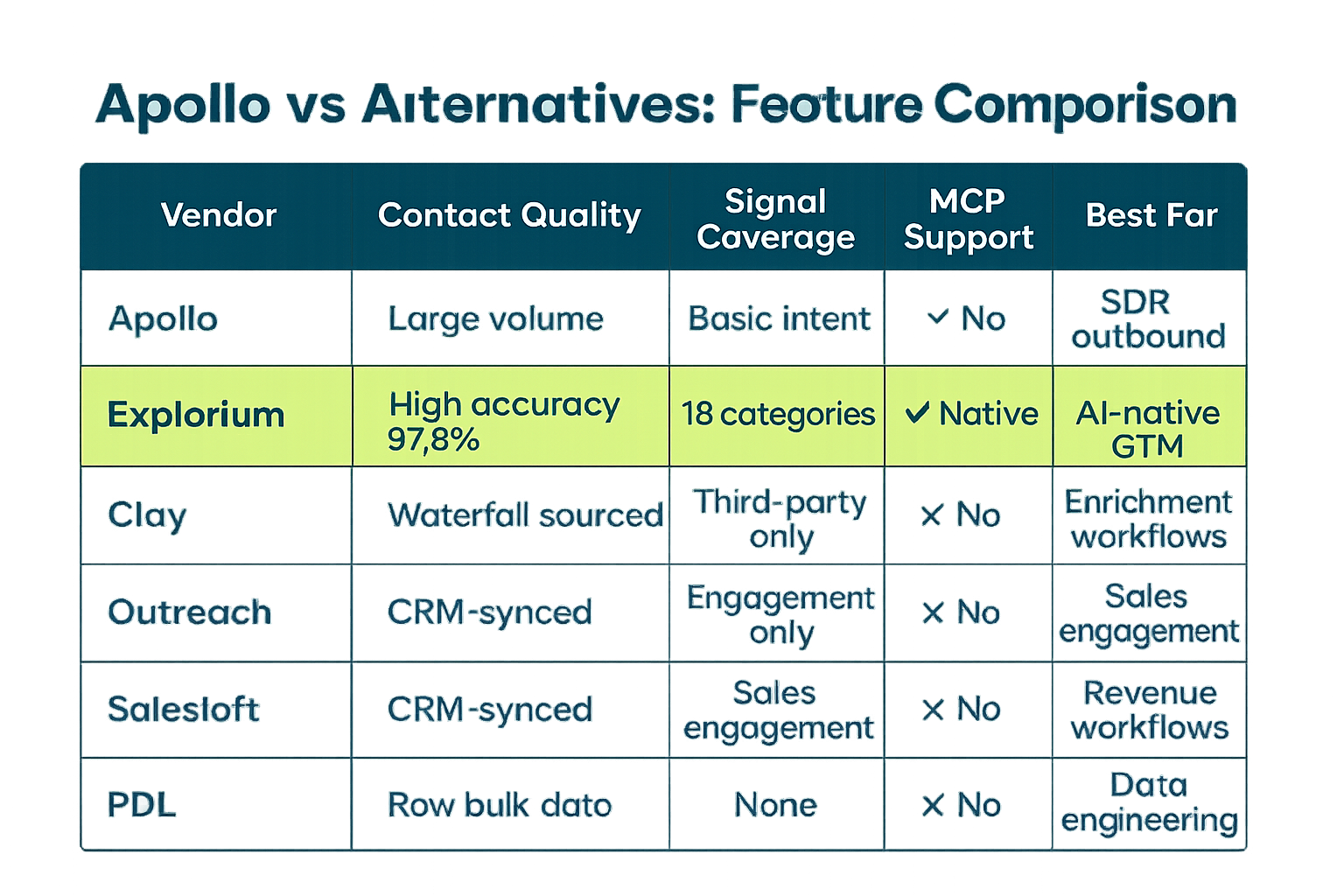
| Tool | Best For | API-First | Data Type | Pricing Model | EMEA Coverage |
|---|---|---|---|---|---|
| Explorium | AI agents, high-volume enrichment | Yes (100 QPS sync) | Company + contact + signals | Usage-based | Strong |
| ZoomInfo | Enterprise sales, intent data | Partial | Company + contact + intent | Per-seat (enterprise) | Good |
| Clearbit | Product-led growth, real-time enrichment | Yes | Company + contact | Usage-based | Moderate |
| Lusha | SMB outbound, GDPR compliance | Limited | Contact-first | Per-seat + credits | Strong |
| Cognism | EMEA outbound, compliance | Limited | Contact + basic firmographics | Per-seat | Very strong |
| Clay | No-code enrichment waterfalls | No (abstraction layer) | Aggregated multi-source | Credit-based | Depends on sources |
| People Data Labs (PDL) | Developer-first data API | Yes | Person + company | Usage-based | Good |
| Apollo.io | SMB outbound + sequences | Limited | Contact-first | Per-seat + credits | Moderate |
Let’s go deeper on each alternative — what it does well, where it falls short, and which teams it’s genuinely the right fit for.
ZoomInfo: The Enterprise Incumbent
ZoomInfo is the incumbent in the enterprise data space. If you’re evaluating Apollo alternatives and you work in sales operations at a company with a significant budget and a complex ICP, ZoomInfo is almost certainly on your shortlist. Its database is the most comprehensive in the market for US-based B2B contacts — particularly at the director level and above — and its intent data layer (powered by its acquisition of Bombora data partnerships) is genuinely useful for identifying in-market accounts before they raise their hand.
The firmographic depth is a real differentiator. ZoomInfo’s company profiles include funding history, technology stack (through BuiltWith-class integrations), headcount by department, revenue estimates, and organizational hierarchy data that Apollo simply doesn’t have. If your sales team sells to enterprises and needs to understand org structure, budget ownership, and buying signals before an SDR dials, ZoomInfo’s data layer is hard to match.
That said, ZoomInfo has significant drawbacks that make it a poor fit for a large portion of the market. The pricing is opaque and high — most mid-market and growth-stage companies report paying $15,000–$50,000+ per year, and the contract structure makes it difficult to do apples-to-apples comparisons. The API, while technically available, is not a first-class product: it’s primarily designed to support CRM integrations and sync workflows, not high-throughput programmatic enrichment. Rate limits exist, and the documentation for developers is significantly worse than purpose-built API providers.
ZoomInfo also has a data accuracy problem in certain segments, particularly for fast-moving companies, startups, and non-US markets. If your ICP skews toward EMEA, APAC, or SMB, you’ll frequently encounter outdated or missing records. And the platform is built around a sales-team-in-a-browser experience — it’s not designed for the kind of data infrastructure work that engineering and data teams need. For teams evaluating ZoomInfo and other data platforms, our guide to ZoomInfo alternatives provides additional context.
Best fit: Enterprise sales teams (200+ employees) with significant outbound motion targeting large US-based companies, director+ personas, and complex buying committees. Poor fit: Engineering-led data pipelines, AI agent workflows, EMEA-first GTM, startups, or any team that needs cost-effective usage-based pricing.
Clearbit: The Developer-Friendly Enrichment Layer
Clearbit (now part of HubSpot) built its reputation on one thing: real-time, API-first B2B enrichment. Before the HubSpot acquisition, Clearbit was the go-to tool for product-led growth companies that wanted to enrich signups, personalize onboarding, and route leads — all programmatically, all in real time. The API is genuinely well-designed, the documentation is developer-friendly, and the response times are fast enough to use synchronously in a web application.
Clearbit’s data quality for company-level enrichment is strong. Feed it a domain or email, and it returns company size, industry, funding, technology stack, and a variety of other signals reliably. For product teams building in-app personalization or ops teams enriching HubSpot records on the fly, it works well. The acquisition by HubSpot has deepened the native integration for HubSpot customers, making it essentially the default enrichment layer for that ecosystem.
The limitations are meaningful, though. Since the HubSpot acquisition, Clearbit’s independent roadmap has effectively been subsumed into HubSpot’s product strategy. If you’re not a HubSpot customer, the value proposition has weakened — pricing has become less transparent, and the standalone product is less actively developed. Contact-level data (emails, direct dials) is not Clearbit’s strength; it’s primarily a company enrichment tool, which means it doesn’t fully replace Apollo for teams that need contact discovery.
Rate limits on Clearbit are better than Apollo but still not designed for agent-scale workloads. The API caps out at around 100 requests per minute on standard plans, which is workable for moderate enrichment tasks but insufficient for high-throughput pipelines. For teams building B2B data enrichment pipelines that need to process thousands of records per hour, Clearbit will still require batching and queuing logic. The per-call pricing model can also become expensive at high volumes — it’s worth modeling your expected usage carefully before committing.
Best fit: HubSpot-native teams, PLG companies enriching signups, mid-volume enrichment workflows, and teams that need strong company-level data. Poor fit: Contact discovery at scale, non-HubSpot stacks, AI agent workloads requiring very high QPS, or teams that need deep EMEA coverage.
Lusha and Cognism: GDPR-Compliant Contact Data
Lusha and Cognism are often evaluated together because they occupy a similar space: GDPR-compliant contact data platforms with strong EMEA coverage. Both are positioned as the compliance-conscious alternatives to Apollo for teams selling into European markets, where data privacy regulations create genuine legal exposure for platforms that collect and store personal data without proper consent frameworks.
Lusha’s core strength is simplicity. The browser extension works well for individual SDRs doing ad-hoc prospecting, and the platform’s data quality for direct dials — particularly in European markets — is consistently rated highly by users. The pricing is more accessible than ZoomInfo and competitive with Apollo at similar usage levels. For a small outbound team that prioritizes GDPR compliance and needs reliable phone numbers for cold calling in the UK, Germany, or Nordics, Lusha is a strong option.
Cognism goes deeper on compliance, with a dedicated focus on phone-verified contacts and a more explicit GDPR consent framework. Cognism’s Diamond Data tier — phone-verified mobile numbers — is genuinely differentiated for teams where connect rates on cold calls are a critical metric. The platform also has stronger intent data integration than Lusha, with Bombora partnerships that surface in-market signals. For EMEA-focused enterprise sales teams, Cognism is frequently the first choice.
Neither Lusha nor Cognism, however, is designed for programmatic or high-volume use. Their APIs are limited in scope — primarily designed to support CRM enrichment for human-operated workflows, not machine-scale data pipelines. If you’re evaluating either platform for an AI agent workflow or a high-throughput enrichment pipeline, you’ll find the API documentation sparse and the rate limits restrictive. Both platforms are also predominantly contact-first: they’re good at finding the right person’s email and phone number, but they’re not the right tool for deep company-level firmographic enrichment or building a comprehensive GTM data platform.
Lusha best fit: SMB sales teams, GDPR-conscious organizations, teams that prioritize phone data quality in EMEA. Cognism best fit: Mid-market to enterprise EMEA outbound teams, high-volume cold calling, compliance-first organizations. Both poor fit: API-first architectures, AI agent workflows, US-focused GTM, or data science applications requiring structured company signals.
Clay: The No-Code Enrichment Waterfall
Clay has emerged as one of the most talked-about tools in the GTM stack over the past two years, and for good reason. It solves a real problem: sales and marketing teams want to pull enrichment data from multiple providers — without having to integrate each API individually or pay a full contract with each vendor. Clay acts as a meta-enrichment layer, letting you build waterfall workflows that try Provider A, fall back to Provider B if the record isn’t found, and so on. The no-code interface makes this accessible to ops teams who don’t want to write Python.
For the right use case, Clay is genuinely excellent. If you’re a growth marketer or sales ops professional who wants to enrich a list of 5,000 accounts with a combination of company data, contact emails, LinkedIn signals, and AI-generated research — all without writing code — Clay is probably the best tool on the market for that workflow. The credit system is flexible, the waterfall logic is powerful, and the integrations with underlying data providers (including PDL, Clearbit, Hunter, and others) are well-maintained.
The limitations become visible when you look under the abstraction layer. Clay is not an API provider — it’s an API consumer and workflow tool. If your team needs programmatic access to raw data at scale, Clay doesn’t give you that. You’re working within Clay’s UI and Clay’s credit system, not calling an enrichment endpoint directly from your application. This is fine for a human-operated enrichment workflow, but it’s a blocker for engineering teams that need to embed enrichment into a real-time application, an AI agent, or a data pipeline. For understanding how waterfall enrichment works across providers, the mechanics Clay implements are worth studying regardless of whether you use the platform.
Clay also has a cost ceiling issue at high volumes. The credit model is opaque at scale — the per-row cost depends on which providers you use in your waterfall, and modeling the true cost of enriching a large dataset requires careful planning. Teams that have tried to use Clay for ongoing, high-volume enrichment often find that the economics shift significantly once they move past their initial use case.
Best fit: Sales ops, growth marketers, SDR teams building outbound lists, no-code enrichment workflows, teams that want to aggregate multiple data sources without writing code. Poor fit: Engineering teams needing a direct API, AI agent workflows, real-time application enrichment, or cost-sensitive high-volume pipelines.
People Data Labs: The Developer-First Raw Data API
People Data Labs (PDL) occupies a unique position in the market: it’s one of the few data providers that is explicitly and unapologetically designed for developers. There’s no UI to log into, no sequence builder, no CRM integration. PDL is a data API, full stop. You call it, it returns structured JSON, and you do what you want with it. For engineering teams that have been frustrated by the developer experience of Apollo, ZoomInfo, or Clearbit, PDL is often a revelation.
The data coverage is broad — PDL’s person API covers over 1.5 billion professional profiles, and its company API covers 100 million+ organizations globally. The schema is well-documented and consistent, which matters enormously when you’re building data pipelines that need to parse and normalize responses reliably. Rate limits are more generous than most alternatives at comparable price points, and the pricing model is straightforwardly usage-based — you pay per API call, with volume discounts at scale.
The tradeoff with PDL is data freshness and signal richness. PDL aggregates data from public sources — LinkedIn profiles, web crawls, social media, company websites — but it doesn’t have the real-time verification layer that some providers offer. Email accuracy rates are lower than dedicated contact data providers like Cognism or Lusha for direct dials. And PDL doesn’t offer intent signals, technographic data, or the kind of enriched company intelligence that ZoomInfo or Explorium provide. It’s a very strong foundation, but teams that need actionable GTM signals layered on top of the raw contact data will likely need to supplement PDL with additional sources.
PDL also has a rate limit ceiling that can be a constraint for the highest-throughput use cases. Standard API plans support up to 1,000 requests per minute, which is significantly better than Apollo but still not sufficient for agent-scale workloads that may need to fire hundreds of simultaneous requests. For teams building on B2B data APIs for lead scoring, PDL’s schema consistency and broad coverage make it a strong candidate for the person and company data layer, even if you need to layer additional signal providers on top.
# PDL Python API enrichment example — company lookup by domain
import requests

PDL_API_KEY = "your_pdl_api_key"

def enrich_company_by_domain(domain: str) -> dict:
    url = "https://api.peopledatalabs.com/v5/company/enrich"
    params = {
        "website": domain,
        "pretty": True
    }
    headers = {
        "X-Api-Key": PDL_API_KEY,
        "Content-Type": "application/json"
    }
    response = requests.get(url, params=params, headers=headers)
    if response.status_code == 200:
        return response.json()
    elif response.status_code == 404:
        return {"error": "Company not found", "domain": domain}
    else:
        response.raise_for_status()

# Example usage
result = enrich_company_by_domain("stripe.com")
print(f"Company: {result.get('name')}")
print(f"Industry: {result.get('industry')}")
print(f"Size: {result.get('size')}")
print(f"Location: {result.get('location', {}).get('country')}")
Best fit: Developer-first teams, data engineers building enrichment pipelines, researchers needing broad person/company coverage, teams comfortable working without a UI. Poor fit: Non-technical teams, use cases requiring verified mobile phone numbers, intent data, or agent-scale synchronous enrichment.
Explorium: Purpose-Built for Agent-Scale Enrichment
Explorium’s AgentSource API represents a fundamentally different architecture from any of the tools discussed above. While Apollo, ZoomInfo, and most other B2B data platforms were built for human-operated sales workflows and later added APIs as a secondary feature, Explorium was built API-first from the ground up — with the explicit design goal of serving AI agents, autonomous GTM systems, and high-throughput data pipelines that no legacy provider can handle at scale.
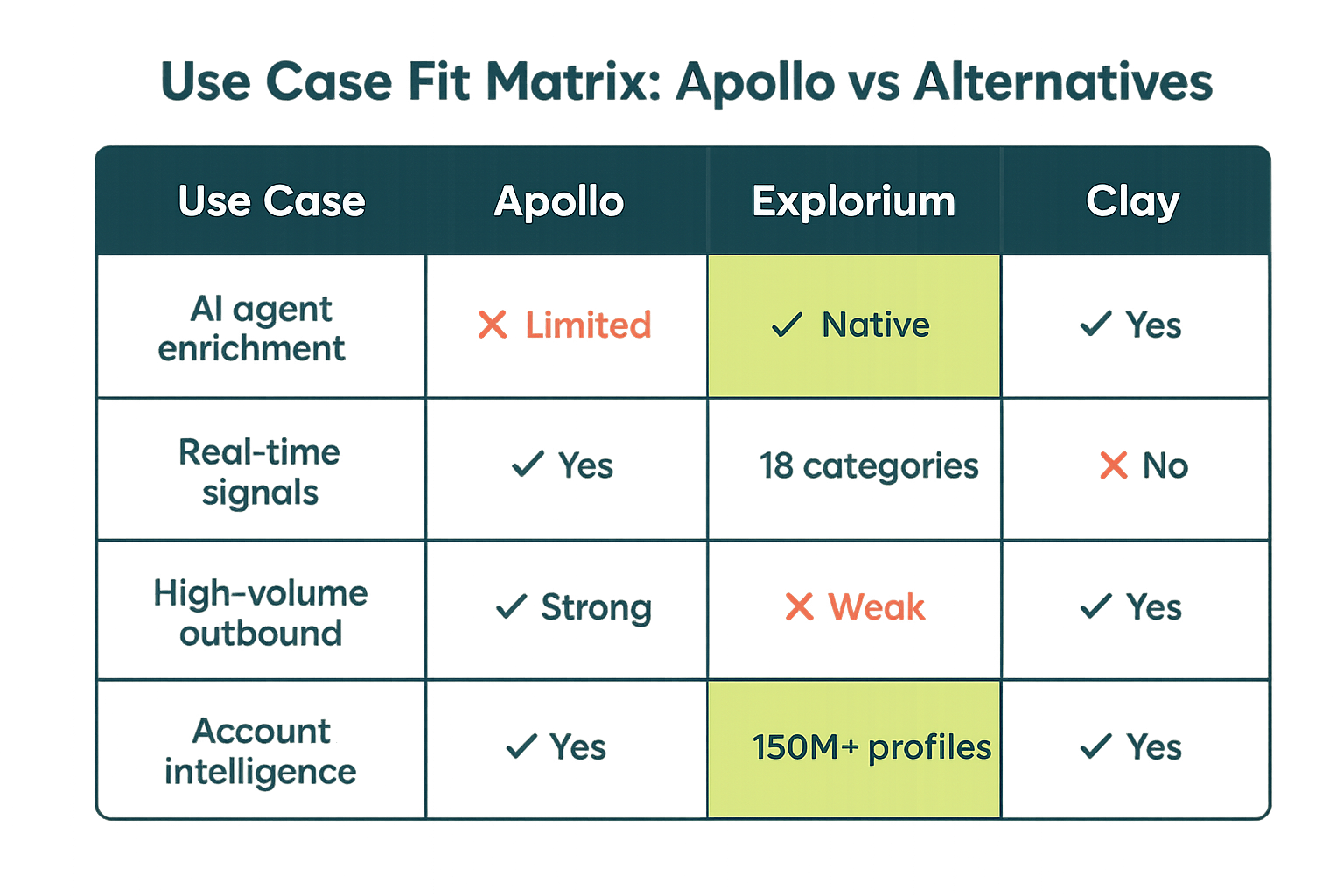
The headline differentiator is throughput. Explorium supports 100 queries per second (QPS) synchronously — meaning you get a response in real time, not a job ID to poll later. This isn’t a marketing claim; it’s an architectural requirement for the use cases Explorium was built to serve. An AI agent enriching an inbound lead in the middle of a conversation cannot wait for a batch job. A real-time scoring system firing on every CRM update needs a sub-second response. Explorium’s API is designed to meet those requirements by default, not as a special enterprise tier.
The data coverage underpinning that API is also differentiated. Explorium aggregates 50+ data sources — combining traditional company databases, web signals, technographic crawls, financial data, firmographic registries, and proprietary signal layers — into a unified company profile. With 150M+ company profiles globally, the coverage extends well beyond the US-centric datasets that make ZoomInfo and Apollo unreliable for international GTM. Match accuracy is 97.8%+ across primary enrichment fields, which is meaningful when you’re running enrichment at a scale where even a 1% miss rate translates to thousands of bad records.
For teams building AI-native GTM stacks, the agent compatibility is worth calling out specifically. Explorium’s API returns structured, schema-consistent JSON that maps cleanly to the data contracts AI agents expect. The response includes not just raw fields but confidence scores, source attribution, and signal freshness metadata — the kind of structured enrichment context that allows an AI agent to reason about data quality, not just consume it blindly. This is a qualitative difference from providers that return unstructured or inconsistently formatted responses.
Pricing at Explorium is usage-based, which aligns the cost model with how the API is actually consumed. Engineering teams aren’t paying for sales seats they don’t use; they’re paying for the data they actually enrich. At moderate volumes, Explorium is competitive with Apollo’s enterprise tier. At high volumes, the economics improve significantly because there are no per-seat multipliers inflating the cost. For teams that have been paying for Apollo seats primarily to unlock higher API limits — a common and wasteful pattern — the shift to usage-based pricing alone often justifies the evaluation.
Outgrown Apollo’s API rate limits? Explorium’s AgentSource API handles 100 QPS synchronously with 150M+ company profiles — no rate-limit queuing, no data export caps. See the API →
It’s worth being clear about what Explorium is and isn’t. It is not a sequence builder. It does not have an SDR-facing UI with a contact search browser. It is not trying to replace Apollo for teams that primarily need email sequencing and individual rep workflows. Explorium is a data infrastructure layer — the right tool for teams that have separated their data sourcing from their execution layer, or are building that separation now. If you need both sequences and enrichment in a single tool, evaluate accordingly. If you need a reliable, high-throughput enrichment API that can serve both human operators and AI agents, Explorium is the strongest option on the market.
# Explorium AgentSource API — high-throughput enrichment with rate-limit handling
import asyncio
import aiohttp
from typing import List, Dict

EXPLORIUM_API_KEY = "your_explorium_api_key"
EXPLORIUM_BASE_URL = "https://api.explorium.ai/v1"

async def enrich_company(session: aiohttp.ClientSession, domain: str) -> Dict:
    """Enrich a single company domain synchronously via Explorium API."""
    url = f"{EXPLORIUM_BASE_URL}/companies/enrich"
    headers = {
        "Authorization": f"Bearer {EXPLORIUM_API_KEY}",
        "Content-Type": "application/json"
    }
    payload = {"domain": domain, "fields": ["name", "industry", "employee_count", "revenue", "technologies", "signals"]}
    async with session.post(url, json=payload, headers=headers) as response:
        if response.status == 200:
            return await response.json()
        elif response.status == 429:
            # Explorium supports 100 QPS — 429s are rare but handle gracefully
            retry_after = int(response.headers.get("Retry-After", 1))
            await asyncio.sleep(retry_after)
            return await enrich_company(session, domain)
        else:
            return {"error": f"HTTP {response.status}", "domain": domain}

async def bulk_enrich(domains: List[str], concurrency: int = 50) -> List[Dict]:
    """Enrich a list of domains concurrently — up to 100 QPS supported."""
    semaphore = asyncio.Semaphore(concurrency)
    async def bounded_enrich(domain):
        async with semaphore:
            return await enrich_company(session, domain)
    async with aiohttp.ClientSession() as session:
        tasks = [bounded_enrich(domain) for domain in domains]
        results = await asyncio.gather(*tasks, return_exceptions=True)
    return results

# Enrich 1,000 domains concurrently — completes in seconds at 100 QPS
domains = ["stripe.com", "hubspot.com", "salesforce.com"]  # extend to thousands
results = asyncio.run(bulk_enrich(domains, concurrency=50))
print(f"Enriched {len(results)} companies")
Best fit: Engineering and data teams building enrichment pipelines, AI agent frameworks, real-time GTM data layers, companies enriching at scale (thousands of records/day), teams that need deep firmographic + signal data globally. Poor fit: Teams that need a built-in sequence builder or individual rep prospecting UI as part of the same platform.
API Rate Limits: A Detailed Comparison
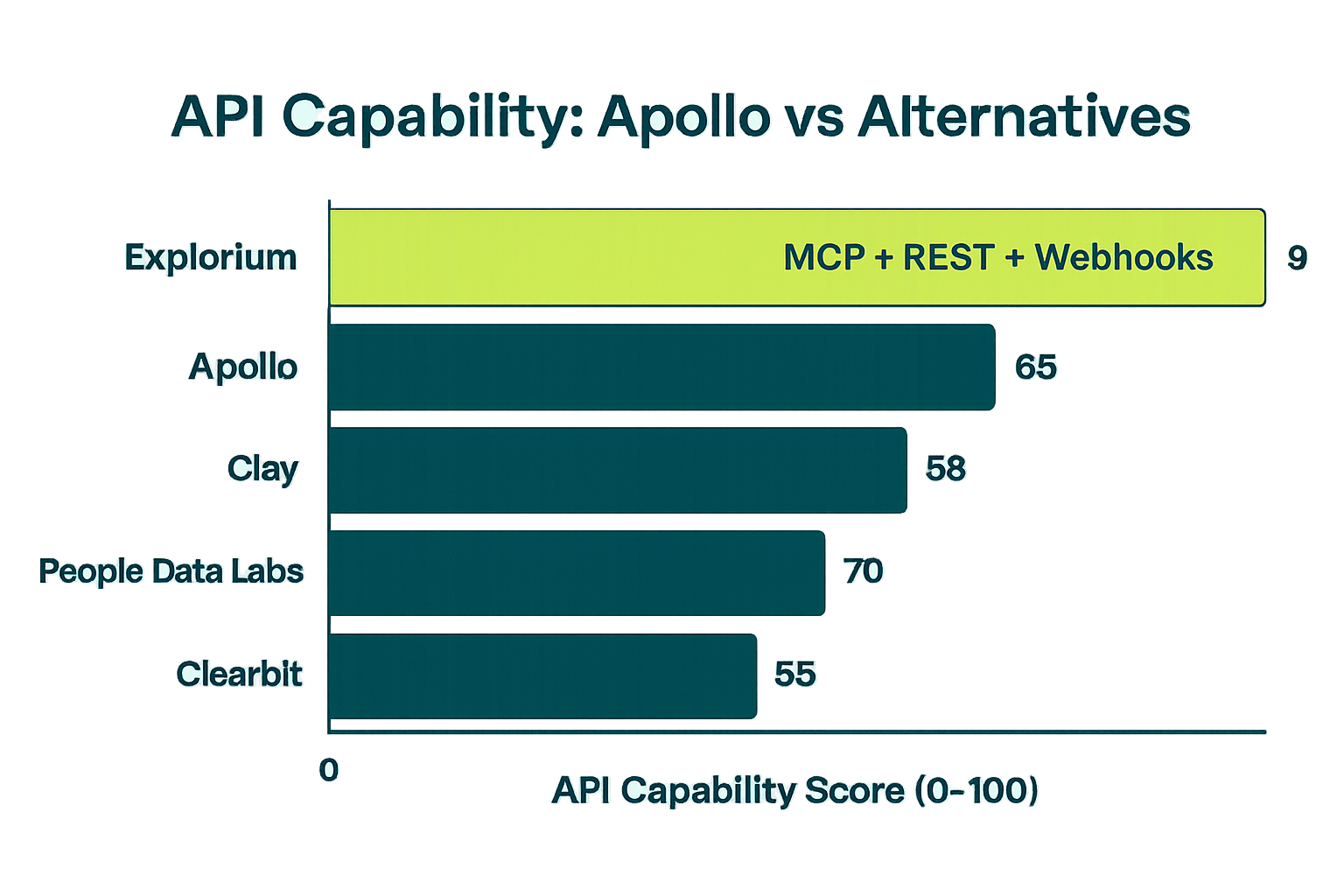
For engineering teams, the API rate limit table is often the first thing that determines which providers are even worth evaluating. There’s a significant range across the market — from Apollo’s 200 records/day on standard plans to Explorium’s 100 QPS synchronous throughput. The architecture matters as much as the numbers: a synchronous API that responds in real time is categorically different from an asynchronous API that returns a job ID and requires polling.
| Provider | Rate Limit (Standard) | Rate Limit (Enterprise) | Architecture | Sync / Async |
|---|---|---|---|---|
| Apollo.io | 200 records/day | ~1,000 records/day | REST | Sync (limited) |
| ZoomInfo | Not publicly documented | Custom (low by default) | REST + webhooks | Async primarily |
| Clearbit | 100 req/min | Custom | REST | Sync |
| Lusha | ~50 req/min | Custom | REST | Sync |
| Cognism | Not API-first | Custom (low) | REST (limited) | Sync (limited) |
| Clay | N/A (workflow tool) | N/A | No direct API | N/A |
| PDL | 1,000 req/min | Custom | REST | Sync |
| Explorium | 100 QPS (6,000/min) | 100+ QPS custom | REST, agent-optimized | Sync |
The practical implication of these numbers is significant. A team enriching 10,000 records per day needs a provider that can handle that volume without queuing. At Apollo’s standard rate limit, that same task takes 50 days. At Explorium’s 100 QPS, it takes under two minutes. The difference between synchronous and asynchronous architecture is similarly material: async enrichment requires your application to manage job IDs, polling intervals, and result storage — adding complexity and latency that synchronous providers eliminate entirely.
For teams building on B2B data APIs, understanding these architectural differences before committing to a provider is critical. Retrofitting an async-first provider into a synchronous application architecture is genuinely painful — it’s much easier to start with a provider whose architecture matches your requirements.
Pricing at Scale: Which Model Works for Your Team?
The pricing comparison across Apollo alternatives is not straightforward, because the models are fundamentally different. Per-seat pricing, credit-based pricing, and usage-based pricing each have different cost curves as your data consumption grows. What’s affordable at 1,000 records/month can become very expensive at 500,000 records/month — or vice versa.
| Provider | Model | Entry Price | Cost at 100K Records/mo | Cost at 1M Records/mo | Export Caps? |
|---|---|---|---|---|---|
| Apollo.io | Per-seat + credits | $49/seat/mo | ~$500–1,200/mo | Prohibitive / not designed for this | Yes |
| ZoomInfo | Per-seat (custom) | ~$10,000+/yr | Included (if contracted) | Custom contract required | Yes |
| Clearbit | Usage-based | ~$99/mo | ~$1,500–3,000/mo | Custom | No |
| Lusha | Per-seat + credits | $29/seat/mo | ~$800–2,000/mo | Not designed for this | Yes |
| Cognism | Per-seat (custom) | ~$1,000+/mo | Included (if contracted) | Custom | Yes |
| Clay | Credit-based | $149/mo | ~$2,000–5,000/mo | Variable by source mix | No |
| PDL | Usage-based | ~$0.002/call | ~$200/mo | ~$2,000/mo | No |
| Explorium | Usage-based | Custom | Competitive with PDL | Volume discounts apply | No |
The key insight from this pricing comparison: usage-based models (PDL, Clearbit, Explorium) have the most predictable cost curves for engineering-led teams, because you’re paying for what you use. Per-seat models (Apollo, ZoomInfo, Cognism, Lusha) are cost-effective when usage is relatively flat across a defined number of human users, but they become economically distorted when you’re consuming data programmatically — you end up paying for seats just to unlock API access, which wastes budget.
How to Choose the Right Apollo Alternative
The right Apollo alternative depends on three questions that your team should answer before evaluating vendors. First: what is your required API throughput, both today and in 12 months? If you’re enriching fewer than 1,000 records per day, almost any provider will work. If you’re enriching 100,000+ records per day, your options narrow to PDL and Explorium for pure API solutions. Second: do you need contact data, company data, or both? If you primarily need email and phone for outreach, Lusha or Cognism may be sufficient. If you need deep company profiles with signals, you need ZoomInfo or Explorium. If you need both at scale, Explorium or a Clay-mediated waterfall is the most viable path.
Third: is your data consumer a human or a machine? This question is increasingly important as AI agents become a core part of GTM infrastructure. Human-operated tools (Apollo, ZoomInfo, Cognism’s UI) are designed for sales reps who log in, search, and export. Machine consumers — AI agents, enrichment pipelines, real-time scoring systems — need APIs that are synchronous, reliable, schema-consistent, and throughput-capable. Only PDL and Explorium are genuinely designed for machine consumers at scale.
If you’re still in an earlier stage and need a single platform that handles both sequences and data, Apollo may still be the right answer for now — with a plan to move enrichment to a dedicated provider as your volume grows. If you’re already past that stage and are hitting the limits described in this article, the right move is to separate your execution layer (sequences, CRM) from your data layer (enrichment API), and choose the best tool for each job independently. Our guide to building a GTM data platform covers this architectural decision in more detail.
FAQs


