

TL;DR
- We ranked 8 B2B data APIs on coverage, MCP support, agent-readiness, pricing, and compliance for GTM agent builders in 2026.
- Only Explorium and Crustdata qualify as agent-native with native MCP servers; Apollo, ZoomInfo, Cognism, and PDL require middleware.
- Explorium leads firmographic accuracy benchmarks at 97.80% vs. ZoomInfo 88.31%, Apollo 78.15%, and Clearbit 32.93%.
- Credit economics vary drastically: Explorium at $0.015/credit vs. Clay at $0.10–$0.50 per find vs. PDL at $0.20/profile vs. ZoomInfo at $3.00–$3.60/credit.
- Real GTM agent workflows like meeting prep, lead scoring, and outbound prospecting were built in hours using n8n plus Explorium MCP.
- Clay, Cognism, Outreach, and Bombora all use Explorium data to power their own platforms, the strongest trust signal in the market.
Q1. What Are the 8 Best B2B Data Enrichment APIs for GTM AI Agent Builders in 2026?
Choosing a B2B data enrichment API is one of the highest-stakes infrastructure decisions a GTM engineering team makes in 2026. The wrong pick locks you into single-source coverage gaps, forces manual normalization across fragmented vendors, and stalls the agent workflows your entire pipeline depends on. For this guide, we evaluated 8 leading B2B data API providers across operational, technical, and commercial criteria relevant to teams building agent-native GTM systems, not just teams doing manual prospecting.
Our Evaluation Criteria
Each provider was scored across seven decision-grade metrics:
- Time to Value ⏰ Ease of integration, API onboarding speed, documentation clarity, and time to first successful enrichment call
- Data Coverage & Accuracy 📊 Breadth of company/contact database, segment-level strengths, email/phone accuracy, and known coverage gaps
- Field Depth & Signal Quality ⭐ Availability of firmographic, technographic, intent, and behavioral signals; richness of attributes per entity
- Agent & API Readiness 🤖 API reliability, rate limits, MCP compatibility, and usability within LLM-driven workflows
- Scalability & Infrastructure ⚙️ Ability to handle high-volume enrichment workloads, uptime guarantees, and pipeline stability
- Compliance & Governance ✅ Support for GDPR, CCPA, SOC 2, and enterprise-grade data governance requirements
- Commercial Model Transparency 💰 Pricing clarity, cost per enrichment, free tier availability, and hidden constraints
Who This Guide Is For
- GTM Engineers building agent-native enrichment workflows
- RevOps teams optimizing outbound targeting and data quality
- AI Product Managers integrating real-time data into LLM applications
- Data & Engineering teams evaluating third-party enrichment APIs vs. in-house pipelines
- CTOs and Data Partnership Leaders at scaling SaaS companies, sales tech startups, and AI-native product teams
📊 Master Comparison Table
| Provider | Best For | Data Strength | API/Agent Readiness | Pricing Model |
|---|---|---|---|---|
| Explorium ★★★★★ | AI agent builders, GTM engineers building agentic workflows | 150M+ companies, 800M+ contacts, 4,000+ data points across 30 enrichment categories | ✅ Native MCP server, sync API, NL queries, autonomous endpoint selection | Credit-based: Free 100 credits → Scale at $0.015/credit |
| Crustdata ★★★★ | Event-driven agent workflows, real-time trigger monitoring | Real-time indexed, 250+ data points per record | ✅ MCP at mcp.crustdata.com, sync API, Watcher webhooks | Credit-based: Free trial → custom pricing |
| Clay ★★★★ | No-code RevOps teams wanting multi-provider waterfall enrichment | 150+ provider waterfall, ~78% email match rate | ⚠️ MCP launch partner, but async API limits agent use | Subscription: $446+/mo for Growth plan |
| Apollo.io ★★★★ | Solo founders, early-stage SDRs, US SaaS prospecting | 275M+ contacts, 65M+ companies | ⚠️ REST API, no confirmed MCP, human-first platform | Subscription + credits: Free → $149/mo Organization |
| ZoomInfo ★★★ | Enterprise US sales teams with $15K+/yr budgets | 260M+ contacts, 100M+ companies, deepest org charts | ⚠️ Enterprise API, ZI Copilot (internal only) | Annual contract: $14,995+/yr, API ~$50K/yr |
| Cognism ★★★ | UK/EMEA phone-first outbound teams | 25M+ phone-verified contacts (Diamond Data) | ❌ No MCP, human SDR platform | Annual contract: ~$22,500+/yr for 5 seats |
| People Data Labs ★★★ | Engineering teams building AI/ML products, recruiting platforms | 1.5B+ individual profiles, resume-level data | ⚠️ REST + SQL-style API, listed in agent directories | Usage-based: ~$0.20/profile at scale |
| Clearbit/Breeze ★★★ | HubSpot-native teams only | ~44M companies, buyer intent, form shortening | ⚠️ HubSpot MCP only, no standalone API | HubSpot subscription + credits: ~$45 to $5,500/mo |
1. Explorium: Best Unified B2B Data API for AI Agent Builders ★★★★★
Overview
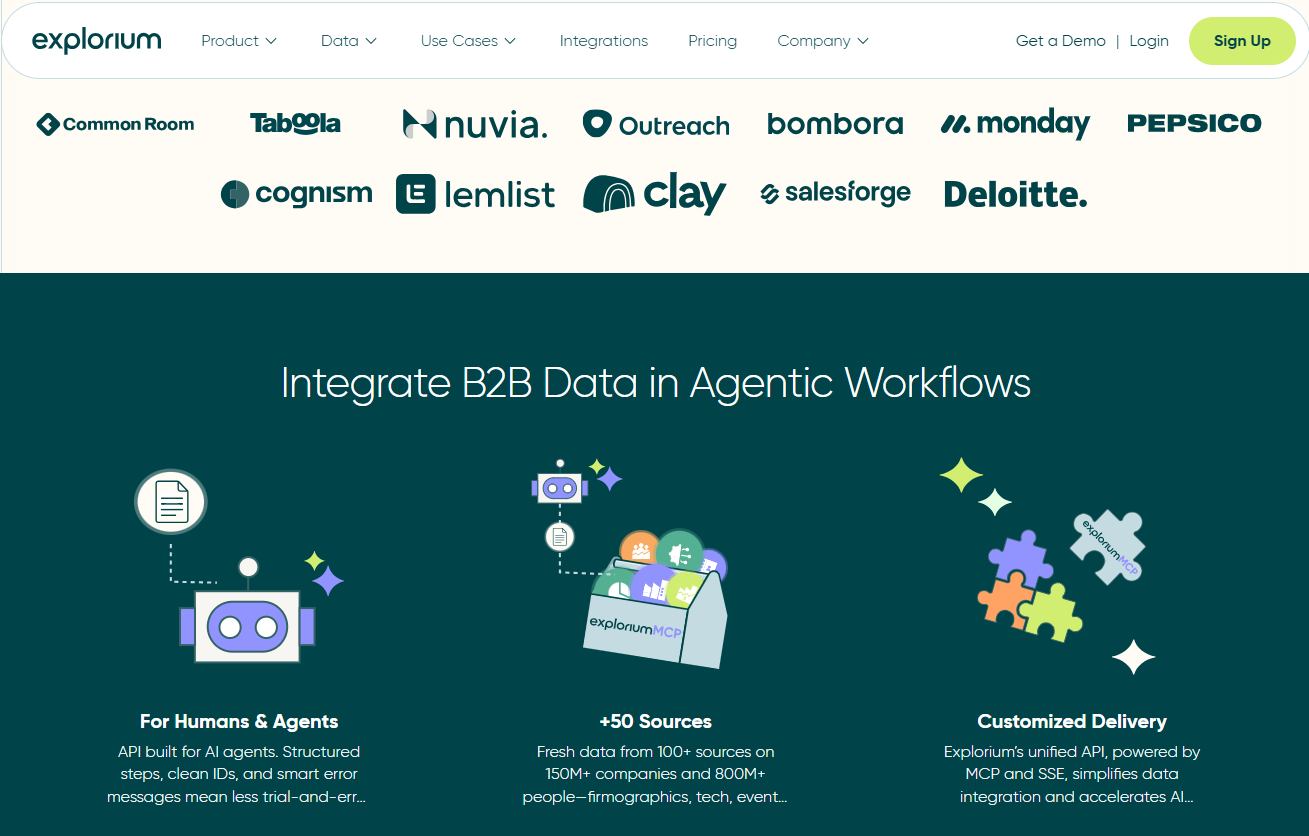
Explorium operates as a source-agnostic data aggregation layer that unifies 50+ B2B data providers into a single API and MCP infrastructure. Instead of acting as another single-source contact database, we built Explorium to be the data foundation layer that AI agents query autonomously, pulling firmographics, technographics, intent signals, contact data, funding events, and hiring velocity through one integration, without the developer pre-mapping every endpoint.
The practical difference is architectural. When your agent encounters a lead and needs context, such as “What’s this company’s tech stack, latest funding round, and hiring velocity?”, Explorium’s MCP lets the agent autonomously decide which enrichments to retrieve from 30+ categories across 50+ underlying sources. You don’t configure each endpoint manually; the agent selects what’s relevant to the workflow.
⏰ Time to First API Call
- UI: N/A (API/MCP-first product; no prospecting UI)
- API Call: ~5 to 10 minutes
- ⚙️ Setup complexity: Low. 4-step process: sign up, grab API key, connect to Claude Desktop or n8n, start enriching. No sales call required, no credit card needed for the free tier.
Core Services
- Unified API with 50+ source aggregation: firmographics, contacts, technographics, intent, funding, events, and workforce signals through a single integration
- Native MCP server (available on AWS Marketplace): agents autonomously select and retrieve relevant enrichments per workflow without pre-mapped API calls
- Event data engine: 18 event categories × 80 unique event types covering executive changes, funding rounds, partnerships, and product launches
- Custom signal creation: agents can define and generate novel proprietary signals, not just retrieve pre-existing fields
- Entity matching: Match, Enrich, Fetch/Discover, and Event Data endpoints form a complete agent workflow architecture
📊 Data Coverage & Field Depth
Strong in:
- SaaS, FinTech, SalesTech, and all US verticals with global coverage
- Company-level matching: 97.80% accuracy on employee count, 97.80% on website URL, 97.31% on NAICS codes, the highest benchmarked in head-to-head comparisons against Apollo (78.15%), ZoomInfo (88.31%), and Clearbit (32.93%)
- Technographics, intent data (Bombora-equivalent signals), 10K filing data, and hiring velocity, signals most single-source providers don’t offer
Weak in:
- No click-and-export UI for non-technical users who want manual prospecting
- Brand recognition lags behind Apollo and Clay in the broader GTM community. Most builders encounter those tools first through community content.
- PDL may have broader raw individual contact coverage at the 1B+ profile scale
Field depth: 4,000+ data points, 30 enrichment categories, 18 event categories × 80 unique event types.
Confidence Level: High. Firmographic accuracy independently benchmarked; data powers platforms including Clay, Cognism, Outreach, Bombora, CommonRoom, Salesforge, and Monday.com.
🤖 API & Agent Readiness
- API availability: ✅ REST API with sync responses
- API depth: Deep. 4 endpoint types (Match, Enrich, Fetch/Discover, Event Data) covering 30+ enrichment categories.
- MCP compatibility: ✅ Native MCP server on AWS Marketplace. The agent autonomously decides which additional endpoints to call beyond what’s explicitly configured.
- Agent usability: ✅ Purpose-built for agents: NL queries, autocomplete, autonomous endpoint selection. Works natively with Claude Desktop, n8n, LangChain, and CrewAI.
💰 Pricing & Cost Structure
Pricing Model: Credit-based (usage-only, no subscriptions).
Published Pricing:
- Free: 100 credits ($0, no credit card)
- Starter: $200 for 5,000 credits ($0.04/credit)
- Growth: $1,500 for 50,000 credits ($0.03/credit)
- Scale: $7,500 for 500,000 credits ($0.015/credit)
- Enterprise: Custom, includes resale rights and search preview
💸 Cost Interpretation (What You Actually Pay)
- Estimated cost per 1,000 basic enrichments: $15 to $75 at Scale tier, depending on enrichment type
- Free credits/trial: Yes. 100 credits, no credit card required.
- Billing driver: Credits consumed per enrichment type (Generate = 1 credit, Enrichments = 1 to 5 credits, Events = 1 credit, Custom Data = 5 credits)
⚠️ Hidden Costs & Constraints
- Credits valid for 12 months; no rolling over
- No hidden platform fees, no mandatory sales call, no auto-renewal clauses
- Credit costs vary by enrichment type (1 to 5 credits per call), so blended cost depends on your signal mix
- Small-deal CSV mode is available but isn’t the product’s core strength
✅ When to Shortlist
Shortlist this if:
- You’re building GTM agents that need multi-source enrichment through one API without managing 3 to 5 separate vendor contracts
- You need agent-native MCP delivery where the agent autonomously selects relevant data per workflow
- You’re a SaaS builder who needs resale rights to embed B2B data in your own product
Avoid this if:
- You need a click-and-export prospecting UI for non-technical SDRs
- You only need a single enrichment type at low volume. The platform’s strength is multi-signal depth.
- You’re optimizing purely for individual-level resume data at 1B+ scale (PDL may have broader raw coverage there)
💬 Customer Reviews
“Explorium is a fast and effective platform that makes the integration and analysis of third-party data seamless. If you are looking to enrich your lead generation efforts, I would strongly recommend trying out Explorium, as it was a revelation for us.”
— David A., CEO, Mid-Market Explorium G2 – Verified Review
“The richness and breadth of data is incredible. I really like the instant access to the most useful and reliable external data. It helps us provide better service to our customers because it is the data we need to make faster and better decisions. Given the large amount of data, the platform can be a bit confusing for the first few times you use it. However, their CS team is very helpful and responsive.”
— Ishi N., Enterprise Explorium G2 – Verified Review
2. Crustdata: Best for Real-Time Event-Driven Agent Workflows ★★★★
Overview
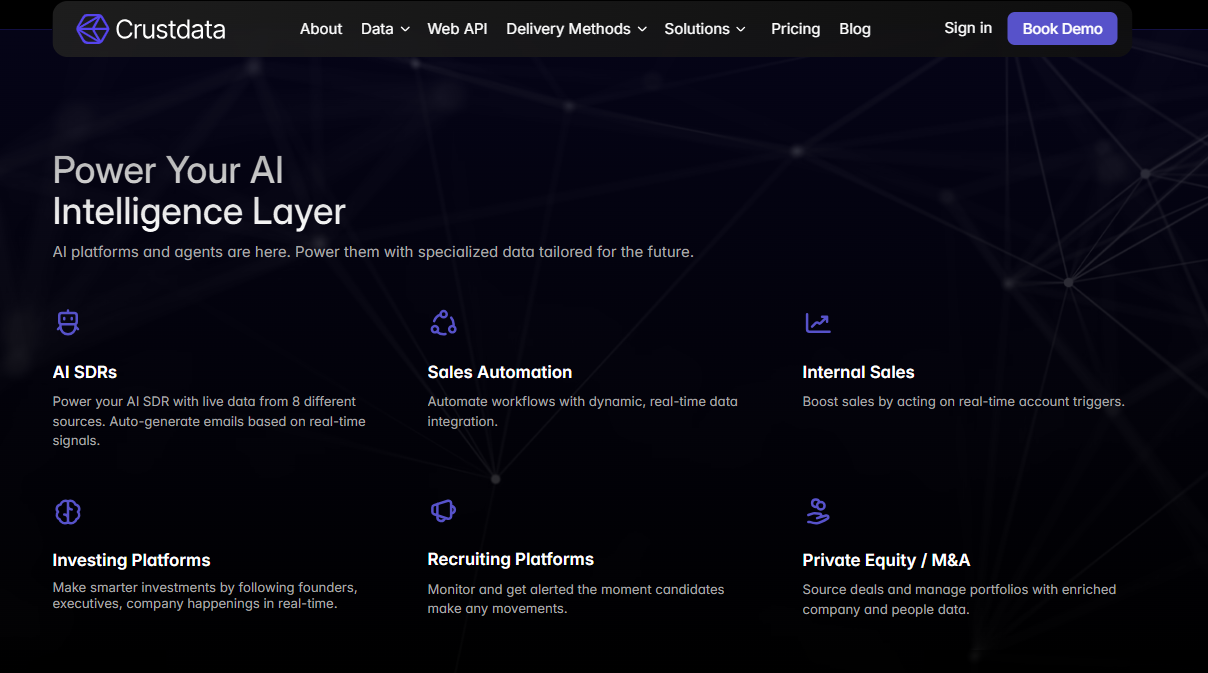
Crustdata positions itself as a real-time data infrastructure layer for AI agent builders and VC-backed ecosystem analysis. Unlike batch providers that refresh databases monthly, Crustdata indexes the web on-demand when you submit filters, meaning the data your agent retrieves reflects the current state, not a snapshot from 30 days ago. The Watcher API delivers webhooks when a target company experiences a job change, funding announcement, or executive departure, so your agents react to triggers without polling.
⏰ Time to First API Call
- UI: Basic search interface available
- API Call: ~15 minutes
- ⚙️ Setup complexity: Low. Free trial, no credit card required. Dedicated Slack channel with 4 to 5 Crustdata team members assigned to every customer.
Core Services
- Real-time on-demand data indexing, not monthly batch refreshes
- Watcher API: webhook-delivered alerts for job changes, funding events, and executive departures
- Websearch API: structured real-time web research results
- Enrichment and Discovery APIs: 250+ data points per record across company and people
- MCP server at mcp.crustdata.com for agent integration
📊 Data Coverage & Field Depth
Strong in: Real-time data on funded startups, LinkedIn-derived signals, app store reviews, product ratings, and VC-backed ecosystem coverage.
Weak in: Less proven for large-enterprise data depth, no phone-verified mobile numbers, and pricing less transparent than Apollo.
Field depth: 250+ data points per record; Enrichment, Discovery, Watcher, and Websearch APIs.
Confidence Level: Medium-High. Strong for funded startup coverage, less validated in enterprise-scale firmographics.
🤖 API & Agent Readiness
- API availability: ✅ REST API
- API depth: Good. Purpose-built for programmatic access.
- MCP compatibility: ✅ mcp.crustdata.com
- Agent usability: ✅ API-first, real-time indexed, sync responses
💰 Pricing & Cost Structure
Pricing Model: Credit-based (custom pricing).
Published Pricing: Free trial, then custom credit-based plans (monthly or annual). No hidden platform fees, no mandatory enterprise contract.
💸 Cost Interpretation
- Estimated cost per 1,000 records: Not publicly disclosed. Requires conversation.
- Free credits/trial: Yes. Free trial available.
- Billing driver: Credits per API call
⚠️ Hidden Costs & Constraints
- Pricing requires a conversation. No public per-credit rate.
- Smaller community footprint means less third-party validation.
- If periodic monthly enrichment is sufficient for your use case, cheaper batch providers may serve.
✅ When to Shortlist
Shortlist this if: You’re building real-time agent-triggered workflows, monitoring target accounts for trigger events, or need an AI SDR platform with live data.
Avoid this if: You need phone-first outbound, deep EMEA contact data, or a UI for manual prospecting.
3. Clay: Best for No-Code Multi-Provider Waterfall Enrichment ★★★★
Overview
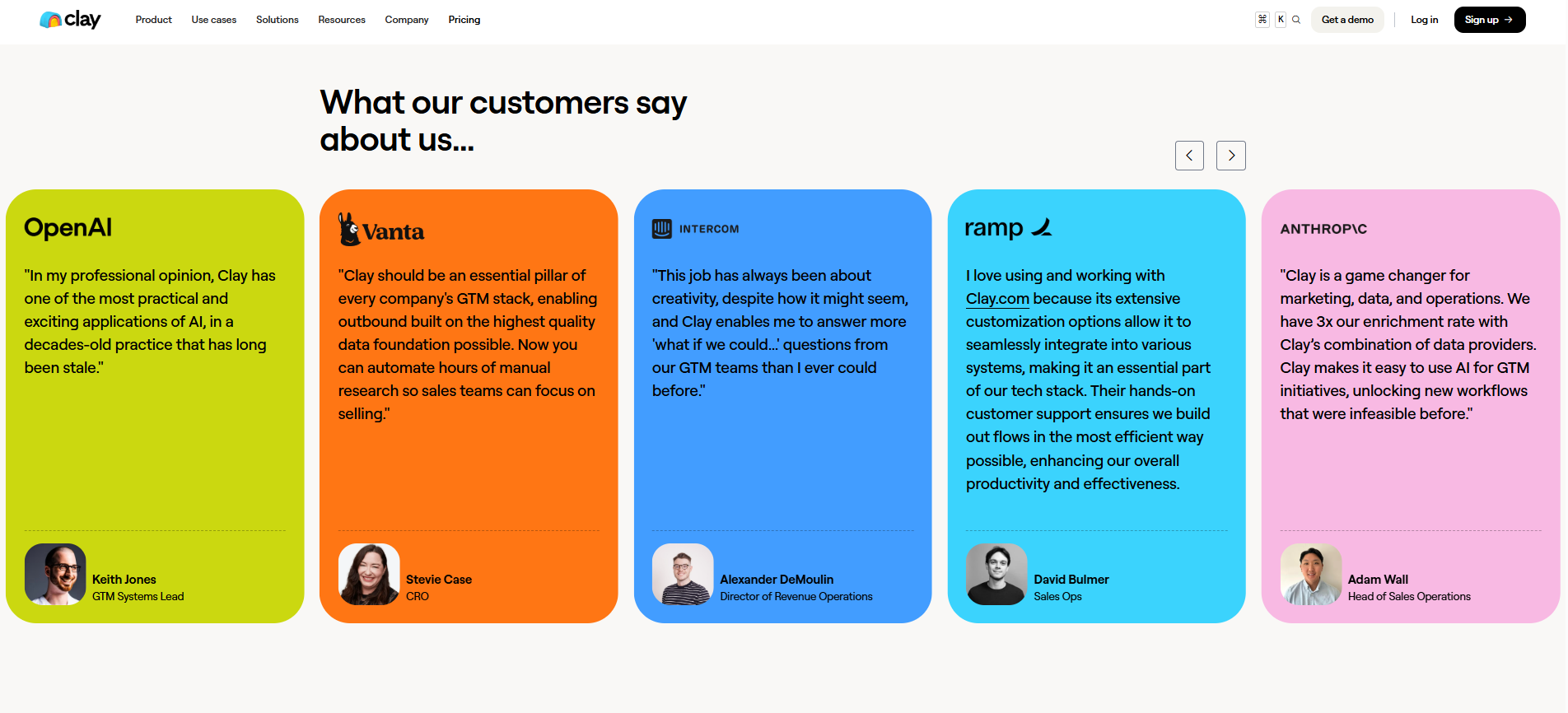
Clay operates as an enrichment orchestration layer, not a data provider. It cascades enrichment requests across 150+ underlying data providers in a single workflow, boosting email match rates from roughly 40% (single provider) to approximately 78% via its waterfall system. Claygent, Clay’s embedded AI agent, can autonomously browse the web, extract unstructured data, and answer research questions about prospects.
The critical distinction for agent builders: Clay is primarily a human-operated platform with an AI layer added on top. Its async API is described as “not easy to use with agents” for real-time workflows, and the credit system has produced unexpected cost explosions, a recurring complaint across G2 and Reddit.
⏰ Time to First API Call
- UI: 30 to 60 minutes for basic setup
- API Call: Moderate. API is secondary to the UI workflow.
- ⚙️ Setup complexity: Medium-High. Credit card required for meaningful use; 4 to 6 weeks to become proficient with the full platform.
Core Services
- Waterfall enrichment across 150+ data providers in a single workflow
- Claygent AI: browses the web and extracts semi-structured research autonomously
- No-code workflow builder: visual pipeline builder for RevOps teams
- CRM integrations: Salesforce and HubSpot sync (Growth plan, $446+/mo)
📊 Data Coverage & Field Depth
Strong in: US SaaS and funded startups; email match rate via waterfall is the highest available when cascading across multiple providers.
Weak in: Clay itself owns no data. Quality depends entirely on the 150+ underlying providers; non-tech industries and non-US markets are weaker.
Field depth: No guaranteed schema. Returns what the waterfall finds. Claygent can add web-researched fields on top.
Confidence Level: Variable. Depends on which providers in the waterfall return data for your specific query.
🤖 API & Agent Readiness
- API availability: ✅ REST API
- API depth: Moderate. Async architecture.
- MCP compatibility: ✅ MCP launch partner
- Agent usability: ⚠️ Async API creates coordination overhead in multi-step agent pipelines. “Not easy to use with agents.”
💰 Pricing & Cost Structure
Pricing Model: Subscription plus credit usage.
Published Pricing:
- Free: Limited credits
- Growth: $446 to $495/mo for 6,000 to 50,000 data credits plus 40,000 actions
💸 Cost Interpretation
- Estimated cost per successful email find: $0.10 to $0.50 depending on waterfall depth
- Free credits/trial: Yes. Limited.
- Billing driver: Credits per data lookup; waterfall may burn 5 to 10 credits before finding a match
⚠️ Hidden Costs & Constraints
- ❌ Failed lookups still consume credits. This is the single most-cited complaint across reviews.
- CRM sync is locked behind the $446+/mo Growth plan.
- Per-row credit cost can vary 100%+ from stated amounts.
- Contact data quality varies. “Feels like a black box.”
✅ When to Shortlist
Shortlist this if: You’re a RevOps team wanting no-code multi-provider enrichment with a visual workflow builder, or you have complex waterfall requirements.
Avoid this if: You need deterministic synchronous API responses for real-time agent workflows, or you’re on a tight budget without predictable enrichment volumes.
💬 Customer Reviews
“Credit system is broken. Pricing is broken. Not fully transparent with rollover limit. Never helped when issues arose.”
— Raphael A., Marketing Lead, Mid-Market Clay – G2 Verified Review
“Transformative for GTM operations and data enrichment. Deeply flexible and integrated with modern GTM toolstack. Per-row credit cost can vary 100%+ from stated amounts (e.g., stated 11 credits/row, actual 25+). Contact data quality varies wildly, feels like a black box.”
— Verified User, IT Services, Mid-Market Clay – G2 Verified Review
4. Apollo.io: Best for Early-Stage Teams Needing All-in-One Prospecting ★★★★
Overview
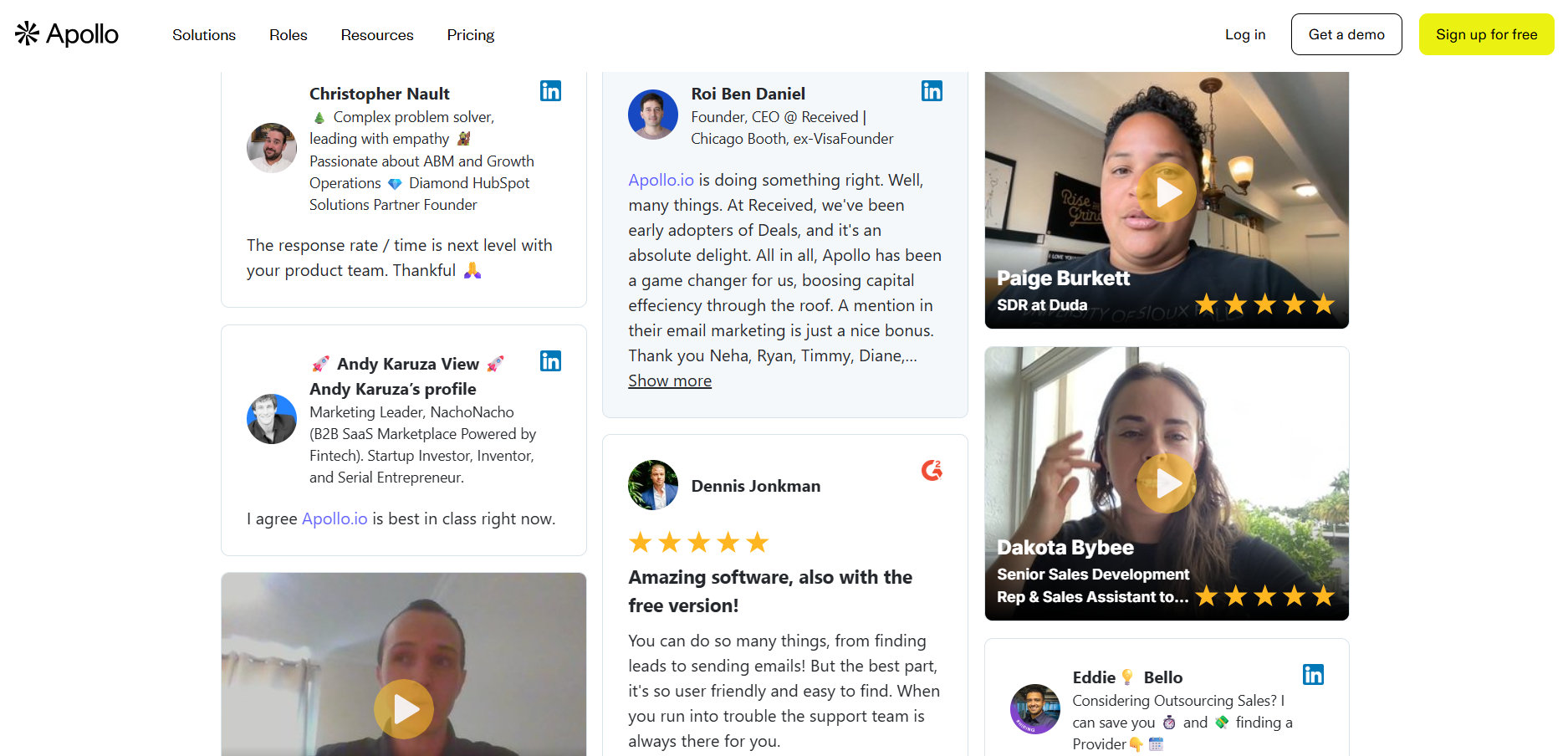
Apollo.io operates as a bundled GTM platform combining contact discovery, enrichment, and outreach sequencing into a single system. With 9,015 G2 reviews (4.7/5) and 500,000+ company customers, it’s the default starting point for solo builders and early-stage SDR teams who want to move from prospecting to engagement without stitching multiple tools together.
From an agent-builder’s perspective, though, Apollo was designed for human SDRs first. MCP support is unconfirmed, the monthly billing model becomes cost-prohibitive for large-scale batch enrichments, and the API requires middleware to structure data for autonomous agent workflows.
⏰ Time to First API Call
- UI: Instant. Prospecting available within minutes.
- API Call: ~20 minutes
- ⚙️ Setup complexity: Medium. UI-first, API-second. 2 to 4 weeks to become comfortable with the full feature set.
Core Services
- Contact and company database: 275M+ contacts, 65M+ companies with advanced filtering
- Built-in outbound sequencing and email automation
- AI Assistant: builds prospect lists from plain-language descriptions
- CRM integrations: Salesforce, HubSpot
- Chrome extension: LinkedIn-based prospecting
📊 Data Coverage & Field Depth
Strong in: US SaaS professionals, funded tech companies, mid-level contacts; intent signals on Organization plan (12 topics).
Weak in: Non-tech SMB contacts, founder-level email availability, and international data quality outside the US.
Field depth: Email, phone, LinkedIn URL, job title, seniority, company firmographics, basic tech stack, intent topics (Organization+ plan only).
Confidence Level: Medium. Strong in SaaS, weaker in SMB and traditional sectors.
🤖 API & Agent Readiness
- API availability: ✅ REST API
- API depth: Moderate. Primarily contact/company endpoints.
- MCP compatibility: ❌ No confirmed MCP support
- Agent usability: ⚠️ Human-first platform; middleware required for agent orchestration
💰 Pricing & Cost Structure
Pricing Model: Subscription-based with credit usage layered on top.
Published Pricing:
- Free: 50 exports/month, 10 mobile credits
- Basic: $59/mo for 1,000 exports ($0.059/contact)
- Professional: $99/mo for unlimited exports (fair-use throttled)
- Organization: $149/mo (3-user min) for 4,000 credits/mo ($0.037/credit)
💸 Cost Interpretation
- Estimated cost per 1,000 contacts: $37 to $59, depending on plan and usage
- Free tier: Yes. 50 exports/month.
- Billing driver: Per user (seat-based) plus per credit (data access and exports)
⚠️ Hidden Costs & Constraints
- “Unlimited” exports on Professional plan are subject to “fair use” throttling
- Mobile numbers remain credit-gated even on Professional
- API access included in paid plans but rate-limited for batch use
- Domain blacklisting reported after first email campaigns. Warm-up system insufficient.
✅ When to Shortlist
Shortlist this if: You need an all-in-one prospecting platform with minimal setup, your focus is US SaaS outbound, or you need a free tier with real utility for manual prospecting.
Avoid this if: You’re building agent-native enrichment systems, need accurate data across non-tech industries, or require synchronous real-time API responses for high-volume batch workflows.
💬 Customer Reviews
“Contact info frequently missing or incorrect. Half the day calling wrong/disconnected numbers. Mobiles frequently wrong. Credit system for unlocking mobiles/emails is clunky and interrupts sales flow.”
— Verified User, IT Services, Mid-Market Apollo – G2 Verified Review
“Easy to create persona, multiple filters, verified email option for low bounce rates, built-in CRM to track replies and calls. Lack of integrations, only Zapier and some API. Support not helpful, no phone calls, chat only.”
— Tejender K., Digital Marketing Executive, Consulting, Mid-Market Apollo – G2 Verified Review
5. ZoomInfo: Best for Enterprise US Sales Teams With Large Budgets ★★★
Overview
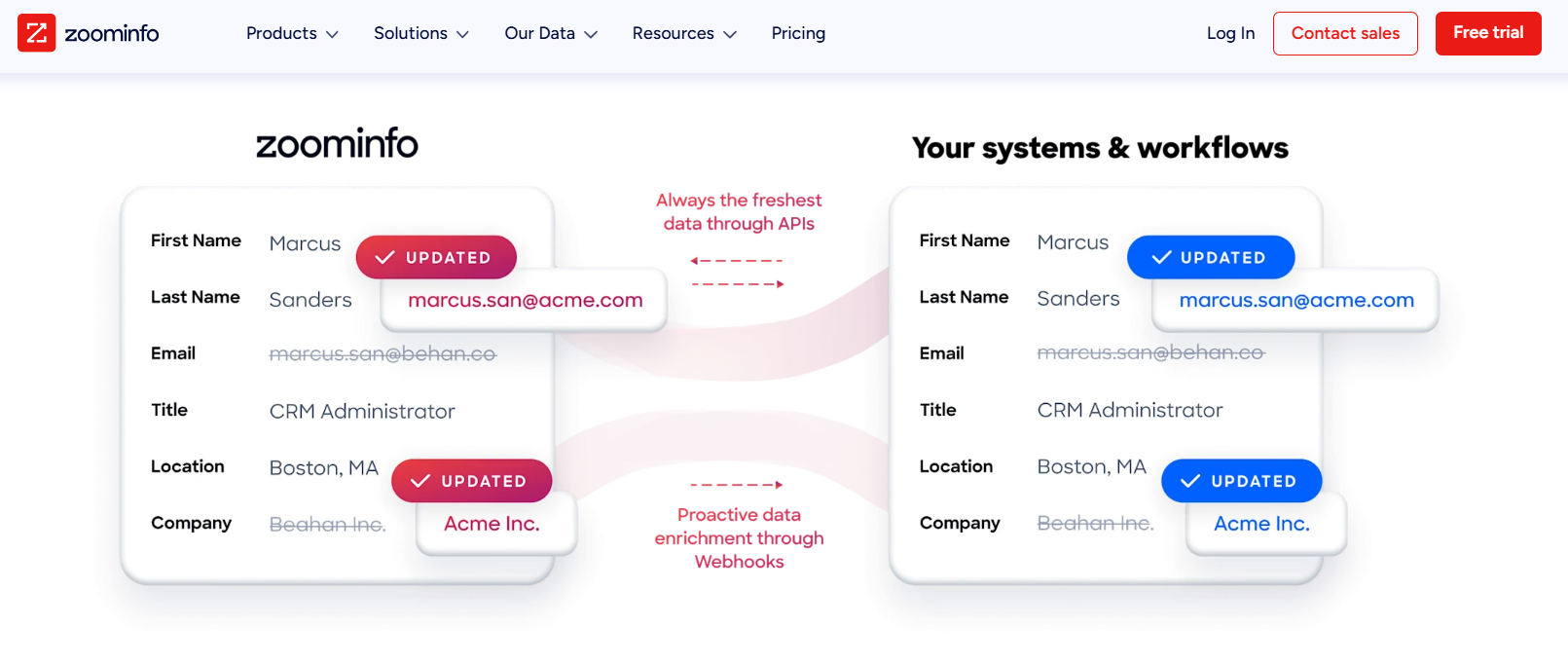
ZoomInfo operates the largest proprietary B2B database with daily refresh cycles: 260M+ contacts, 100M+ companies, and the deepest org chart data in the market. Bombora intent integration identifies accounts actively researching relevant topics. ZoomInfo Copilot surfaces pipeline insights and buying signals for enterprise revenue teams.
The constraint for agent builders is straightforward: no self-serve signup, API access estimated at ~$50,000/year, and aggressive auto-renewal clauses with 10% to 20% annual price increases. ZoomInfo was built for enterprise sales teams, not developers building agent workflows.
⏰ Time to First API Call
- UI: After sales call plus signed contract
- API Call: Weeks to months (sales call, demo, annual contract required)
- ⚙️ Setup complexity: High. No self-serve option.
Core Services
- Largest proprietary B2B database with daily refreshes
- Org chart hierarchy data: decision-making hierarchy within accounts (deepest in market)
- Intent data via Bombora integration
- ZoomInfo Copilot: AI layer for pipeline insights and buying signals
📊 Data Coverage & Field Depth
Strong in: US enterprise contacts, org chart hierarchy, intent data, SIC/NAICS codes, and daily data refreshes.
Weak in: Data quality drops in non-US markets, no real-time event triggers, and no custom signal creation.
Field depth: Firmographics, technographics, intent topics (Bombora), org chart hierarchy, and buying signals (Copilot).
Confidence Level: High for US enterprise; lower for international and SMB.
🤖 API & Agent Readiness
- API availability: ✅ Enterprise-tier API
- API depth: Moderate. CRM enrichment focused.
- MCP compatibility: ⚠️ ZI Copilot is internal AI only, not an open MCP server
- Agent usability: ⚠️ API has “limited scale” for millions of calls/month; enterprise contracts required
💰 Pricing & Cost Structure
Pricing Model: Annual contract (quote-only).
Published Pricing:
- Professional: $14,995 to $18,000/year (3 seats) for ~$3.00 to $3.60/credit
- Advanced: $25,000 to $30,000/year
- Elite: $40,000 to $45,000+/year
- API access: ~$50,000/year (estimated)
💸 Cost Interpretation
- Estimated cost per 1,000 enrichments: $3,000 to $3,600 at Professional tier
- Free tier: ❌ None
- Billing driver: Annual contract plus per-seat plus per-credit
⚠️ Hidden Costs & Constraints
- Auto-renewal at 10% to 20% annual price increase, the most-cited complaint across reviews
- Each additional seat: $2,000 to $5,000/year
- No path for startups or builders in early stages. Enterprise-only.
- Detailed cost mechanics are not fully transparent pre-contract.
✅ When to Shortlist
Shortlist this if: You’re an enterprise US sales team with $15K+/year budgets, need org chart hierarchy, and want Bombora intent data integrated natively.
Avoid this if: You’re a startup, small team, international team, or developer-first agent builder. The pricing model and sales-call-required onboarding make it inaccessible for modern builder workflows.
6. Cognism: Best for UK/EMEA Phone-First Outbound Teams ★★★
Overview
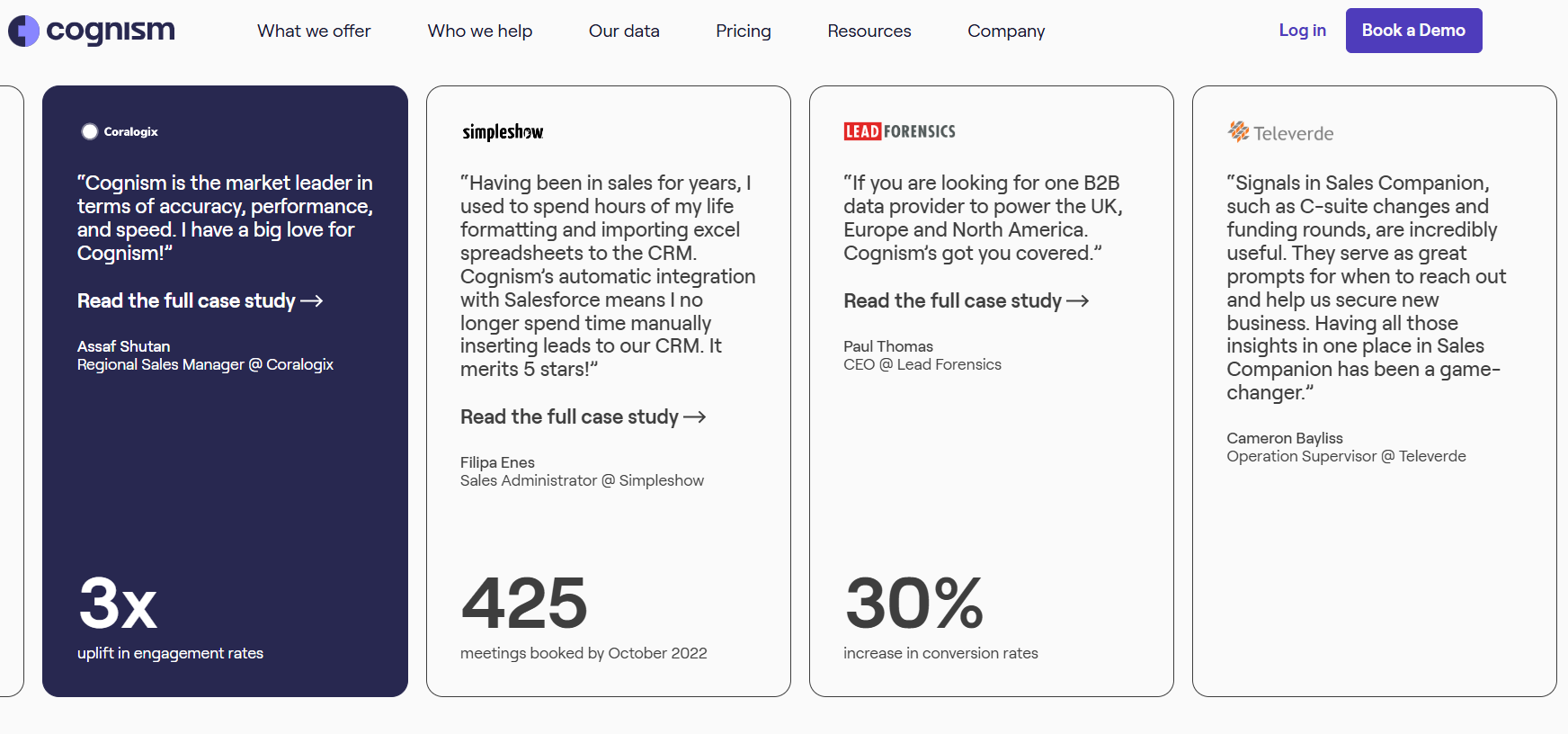
Cognism’s core differentiator is Diamond Data: phone-verified mobile numbers with 48-hour manual verification, the only product in the market with this level of phone number validation. Clients report 34% higher connect rates and 15% more meetings booked after switching. It’s the strongest provider for GDPR-compliant UK/EU contact data.
For agent builders, though, the story is different: no MCP, no agent-friendly architecture, weaker North American data, and a $15K to $25K platform fee before any per-seat access.
⏰ Time to First API Call
- UI: After sales call, demo, and annual contract
- API Call: Weeks to months. Annual prepayment required before any API access.
- ⚙️ Setup complexity: High. Onboarding costs $500 to $1,500 extra.
Core Services
- Diamond Data: phone-verified mobile numbers with 48-hour manual verification
- GDPR-compliant EMEA contact data: deepest UK/EU coverage
- Bombora intent data add-on
- Prospector and browser extension for sales teams
📊 Data Coverage & Field Depth
Strong in: EMEA phone-verified contacts, compliance-first, mid-level and VP-level contacts in UK/EU.
Weak in: North American coverage significantly weaker, founder-level data thin, and no real-time event triggers.
Field depth: Contact (email, phone, LinkedIn), company firmographics, and Bombora intent topics (add-on).
Confidence Level: High for UK/EMEA phone outbound; low for US and agent-driven use cases.
🤖 API & Agent Readiness
- API availability: ✅ REST API
- API depth: Narrow. Contact-focused.
- MCP compatibility: ❌ No MCP support
- Agent usability: ❌ Human SDR platform primarily
💰 Pricing & Cost Structure
Pricing Model: Annual contract, seat-based.
Published Pricing:
- Grow: ~$22,500/year for 5 users ($4,500/user/year, platform fee $15K plus $1,500/user)
- Elevate (Diamond Data): ~$37,500/year for 5 users ($7,500/user/year)
- Add-ons: Intent topics $200 to $400 each; onboarding $500 to $1,500
💸 Cost Interpretation
- Estimated cost per 1,000 records: Not calculable. Seat-based, no per-record pricing.
- Free tier: ❌ None
- Billing driver: Annual platform fee plus per-seat plus add-on charges
⚠️ Hidden Costs & Constraints
- Platform fee ($15K to $25K) required before any per-seat access
- Annual renewal increases 10% to 15%
- No free tier, no monthly option. Annual prepayment only.
- Onboarding is an additional paid service.
✅ When to Shortlist
Shortlist this if: You’re a UK/EMEA-focused enterprise sales team doing phone-first outbound and need the highest-quality mobile numbers available.
Avoid this if: You’re US-focused, building agents, budget-conscious, or need non-contact enrichment signals like technographics, intent, or event triggers.
💬 Customer Reviews
“Poor data quality, no direct mobile numbers. Numbers either wrong or returns US HQ number even when searching European offices. Not worth the money. Waste of time in SDR workflow.”
— Jackie, DE Cognism – Trustpilot Review
“Data is really limited and generally poor quality. Claims 90%+ mobile coverage in sales process but doesn’t deliver. ‘Diamond Verified’ mobiles are less than 10%. Rest is a cobbled-together database of untrustworthy data.”
— Alex, AU Cognism – Trustpilot Review
7. People Data Labs (PDL): Best for AI Product Builders Needing Raw Individual Data ★★★
Overview
People Data Labs maintains the largest raw individual dataset in the market: 1.5B+ profiles with resume-level employment history, education, skills, and social handles. The developer experience is clean: SQL-style queries, Python/Go/Ruby SDKs, and a REST API that makes exploration intuitive. PDL’s data co-op model aggregates from thousands of contributing businesses, creating breadth no single-source provider can match at the individual level.
The limitation is that PDL is a raw data engine, not an enrichment orchestrator. No real-time event triggers, no tech stack data, no intent signals, and at ~$0.20/profile at scale, it’s roughly 10x more expensive per profile than alternatives.
⏰ Time to First API Call
- UI: Basic dashboard
- API Call: ~10 minutes
- ⚙️ Setup complexity: Low. Free API key, no credit card required. SQL-style queries make exploration intuitive.
Core Services
- 1.5B+ individual profiles with resume-level depth
- SQL-style query interface for developer-native exploration
- Multi-language SDKs: Python, Go, and Ruby
- Data co-op model: aggregates from thousands of contributing businesses
- Successful-match-only billing: credits charged only on successful returns
📊 Data Coverage & Field Depth
Strong in: Individual/person profiles, employment history, education, skills, and social profiles (LinkedIn, Twitter, GitHub).
Weak in: Freshness issues flagged by reviewers, no real-time event triggers, no tech stack data, no intent signals, and phone availability inconsistent.
Field depth: Employment history (resume-level), education, skills, social profiles, phone numbers, emails, and basic company firmographics.
Confidence Level: Medium. Largest individual dataset but freshness concerns; only 17 G2 reviews (thin social proof).
🤖 API & Agent Readiness
- API availability: ✅ REST plus SQL-style API
- API depth: Good for individual data queries
- MCP compatibility: ⚠️ Listed in agent integration directories, but no native MCP server
- Agent usability: ⚠️ Developer-first but lacks agent-native features like NL queries or autonomous endpoint selection
💰 Pricing & Cost Structure
Pricing Model: Usage-based.
Published Pricing:
- Free: Limited API calls, no credit card
- Pro: ~$98/month
- Enterprise: Custom pricing
💸 Cost Interpretation
- Estimated cost per 1,000 profiles: ~$200 at scale
- Free tier: Yes. Limited calls.
- Billing driver: Per successful match (credits only on returns)
⚠️ Hidden Costs & Constraints
- Per-profile cost ~10x higher than alternatives at scale ($0.20 vs $0.02)
- Trustpilot rating 2.8/5 from only 4 reviews. Thin social proof.
- Account suspension issues reported on new paid plans.
✅ When to Shortlist
Shortlist this if: You’re an engineering team building AI products, recruiting platforms, or fraud detection tools that need the largest possible individual-level dataset.
Avoid this if: You need GTM prospecting workflows with real-time signals, EMEA outreach, or phone-first outbound.
💬 Customer Reviews
“Product was useful while it worked, which wasn’t long. Switched from free trial to paid plan ($100/month). After a few days, account disabled with no warning or explanation. Support unresponsive after multiple contact attempts.”
— Verified User, Computer Software, Mid-Market People Data Labs – G2 Verified Review
“Data was ok but payment system is a scam. Very hard to get off their hook once signed up.”
— Glissando AI, US People Data Labs – Trustpilot Review
8. Clearbit / Breeze Intelligence (HubSpot): Best for HubSpot-Native Teams Only ★★★
Overview
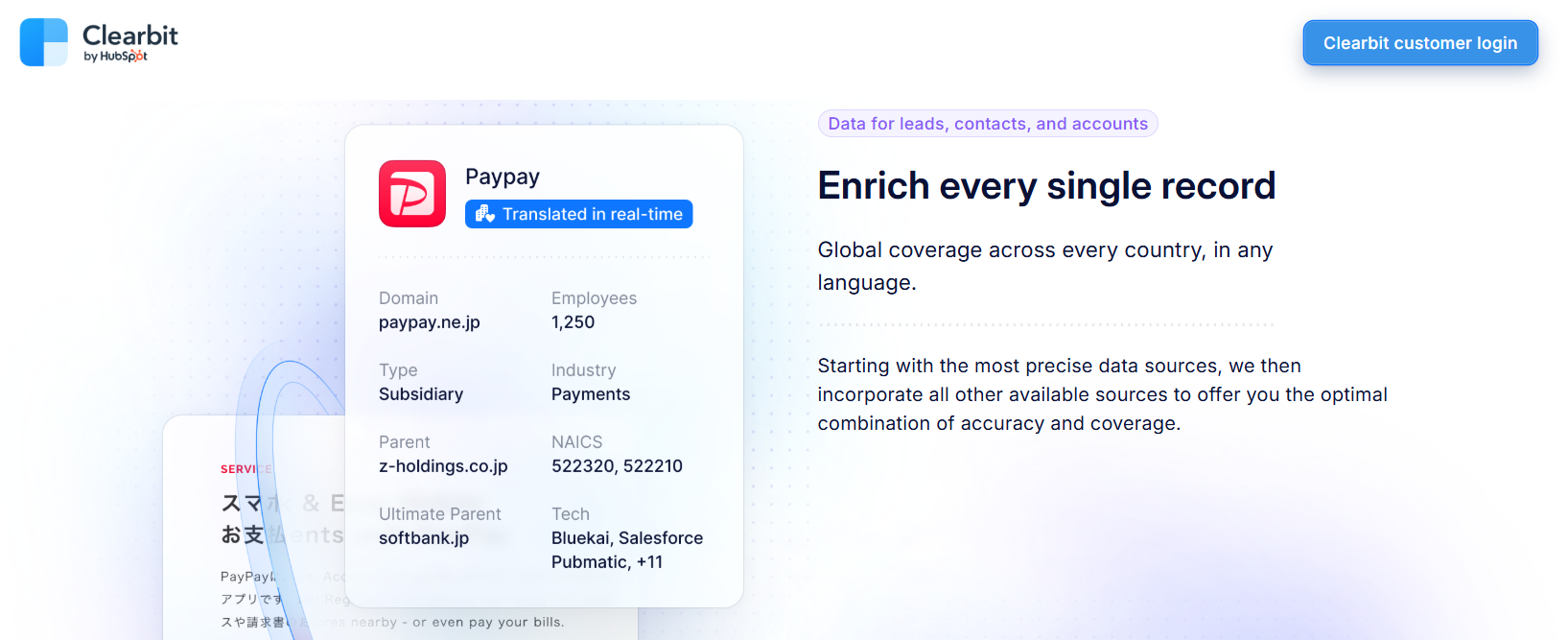
Post-acquisition by HubSpot, Clearbit has been repackaged as Breeze Intelligence, a feature inside HubSpot, not a standalone product. It provides the deepest HubSpot CRM integration in the market: enrichment triggers natively within HubSpot sequences, forms, and workflows. Form shortening pre-fills known fields on lead capture forms, and buyer intent signals identify anonymous website visitors mapped to company records inside HubSpot.
The tradeoff is absolute: zero utility outside HubSpot. No standalone API, no agent-native delivery, and all legacy free Clearbit tiers were sunset in 2025.
⏰ Time to First API Call
- UI: Tied to HubSpot onboarding
- API Call: N/A. No standalone API; requires active HubSpot subscription.
- ⚙️ Setup complexity: Medium. Depends on your HubSpot tier and existing configuration.
Core Services
- Native HubSpot CRM enrichment: triggers within sequences, forms, and workflows
- Form shortening: pre-fills known fields on lead capture forms
- Buyer intent signals: anonymous website visitor identification mapped to company records
- AI Audit Cards (2026): timestamped records of every AI action for regulated industries
📊 Data Coverage & Field Depth
Strong in: Firmographics, technographics, buyer intent (website visitor enrichment), and HubSpot-native field mapping.
Weak in: 100% HubSpot-dependent, no standalone API, no phone-verified mobile numbers, and EMEA depth weak.
Field depth: Company firmographics, tech stack, buyer intent signals, and form fill enrichment.
Confidence Level: Medium. Solid within HubSpot; irrelevant outside it.
🤖 API & Agent Readiness
- API availability: ⚠️ HubSpot ecosystem only
- API depth: Limited to HubSpot workflow triggers
- MCP compatibility: ⚠️ HubSpot MCP only, not for custom agent stacks
- Agent usability: ⚠️ HubSpot-dependent only
💰 Pricing & Cost Structure
Pricing Model: HubSpot subscription plus Breeze credits.
Published Pricing:
- Starter (100 credits): ~$45 to $60/month on top of HubSpot Starter subscription
- Mid-market: ~$950 to $1,040/month total HubSpot spend
- Enterprise: ~$4,000 to $5,500/month
💸 Cost Interpretation
- Estimated cost per 1,000 records: $450 to $600+ (including HubSpot base cost)
- Free tier: ❌ All free Clearbit tiers sunset in 2025
- Billing driver: HubSpot subscription tier plus Breeze credits per enrichment
⚠️ Hidden Costs & Constraints
- Credits reset monthly. No rollover.
- Requires HubSpot subscription base cost on top of Breeze credits.
- Cannot be plugged into custom agent stacks or used outside HubSpot.
- The removal of free Clearbit tiers was the top-cited negative sentiment across community discussions.
✅ When to Shortlist
Shortlist this if: Your team already runs on HubSpot and you want seamless, native enrichment inside your existing CRM workflows without leaving the platform.
Avoid this if: You’re not on HubSpot, building agent pipelines outside the HubSpot ecosystem, or need a standalone enrichment API for custom workflows.
💬 Customer Reviews
“APIs enrich new lead notifications with job title data for qualification. Reveal product shows which accounts visit your website. Not always accurate. Needs more frequent refresh. Lacks robust integrations to easily action on data.”
— Brian Y., Head of Marketing, Small-Business Clearbit – G2 Verified Review
“Company data doesn’t refresh often enough. Only 20% of known contacts could be found, including people at companies for 1+ year.”
— Verified User, Internet, Mid-Market Clearbit – G2 Verified Review
Q2. How We Scored: Selection Criteria and Star Rating Methodology
Every listicle has a methodology problem. Most don’t disclose one. They rank tools based on affiliate payouts or whichever vendor responded to a demo request. That’s not useful if you’re a GTM engineer evaluating data infrastructure you’ll depend on for the next 12 to 18 months.
⭐ The Five Weighted Criteria
Here’s exactly how each provider was scored, totaling 100%. These weights reflect the operational reality of building agent-native GTM systems, not generic feature comparisons:
| Criterion | Weight | What It Measures |
|---|---|---|
| Data Coverage & Accuracy | 25% | Database breadth (companies plus contacts), update cadence (daily vs. quarterly), and benchmarked accuracy on firmographic fields, not self-reported “we have X million records” claims |
| Agent-Readiness & MCP Support | 25% | Native MCP server, sync API, NL query support, autonomous endpoint selection, event triggers, and whether agents can retrieve data without pre-mapped endpoints |
| API Architecture & Developer Experience | 20% | Time-to-first-call, docs quality, SDK availability, sync vs. async responses, and whether the product is API-first or UI-first with API bolted on |
| Pricing Transparency & Scale Economics | 15% | Cost per 1,000 enrichments at scale, hidden fees (failed-lookup billing, auto-renewal traps), credit mechanics, and free tier utility |
| Compliance & Enterprise Readiness | 15% | GDPR/CCPA certification, SOC 2 posture, resale rights for SaaS builders embedding data, and volume handling at millions of calls/month |
📊 Star Rating Scale and Provider Scores
Scores map to stars on a 0 to 100 scale: 0 to 20 = ★, 21 to 40 = ★★, 41 to 60 = ★★★, 61 to 80 = ★★★★, 81 to 100 = ★★★★★.
| Provider | Score | Stars |
|---|---|---|
| Explorium | 96 | ★★★★★ |
| Crustdata | 76 | ★★★★ |
| Clay | 64 | ★★★★ |
| Apollo.io | 61 | ★★★★ |
| ZoomInfo | 57 | ★★★ |
| People Data Labs | 56 | ★★★ |
| Cognism | 45 | ★★★ |
| Clearbit/Breeze | 44 | ★★★ |
⚠️ A Note on Weights and Disclosure
Agent-Readiness & MCP Support carries equal weight to Data Coverage for a specific reason: in 2026, the value of B2B data is determined by how autonomously agents can access and act on it, not just how much data exists in a static database. A provider with 1.5B profiles that requires manual endpoint mapping for every enrichment type is less useful to an agent builder than a provider with 800M profiles that agents can query autonomously via MCP.
Full disclosure: I’m a co-founder of Explorium. All data in this guide is sourced from public vendor pricing pages, G2 reviews, verified benchmarks, and official documentation. Readers are invited to apply the same framework using their own weights. The scoring criteria are deliberately reproducible.
Q3. Why Is Agent-Readiness, Not Record Count, the Defining Criterion in 2026?
Here’s what the typical GTM data stack looks like right now: Apollo for contacts, Bombora for intent, Clearbit for firmographics, BuiltWith for technographics. Four vendors, four contracts, four API integrations, and an engineer spending 10 to 15 hours a week writing normalization scripts to stitch it all together.
As our CEO Omar put it at the True Builders Panel: “Traditional GTM data flows through three stops: data provider, CRM, and sequencer. Agentic AI will change this dramatically. Agents will sit at the point of activation, sending an email, pre-meeting research, and LinkedIn outreach, and pull data on-the-fly.”
🤖 Agent-Native vs. Agent-Adapted: The Classification That Matters
Not every tool with an API qualifies as “agent-ready.” There’s a critical distinction between platforms designed for agents from the ground up and platforms that bolted an API onto a human-first product:
| Classification | Definition | Providers |
|---|---|---|
| Agent-Native | Built for autonomous workflows. Sync API, MCP support, NL queries, agents select enrichments dynamically | Explorium, Crustdata |
| Agent-Adapted | Human-first platform with API added. Requires middleware or pre-mapped endpoints for agent use | Apollo, ZoomInfo, Cognism |
| Hybrid | MCP launch partner but architectural limitations (async API) create agent coordination overhead | Clay |
| Ecosystem-Locked | Tied to a specific platform; only works within that ecosystem’s agent framework | Clearbit/Breeze (HubSpot only) |
| Developer-First, Not Agent-First | Clean API and SDKs, but no MCP, no NL queries, no autonomous endpoint selection | People Data Labs |
⚙️ MCP vs. API: Why the Architecture Matters
The difference between an API and MCP isn’t just a protocol upgrade. It changes what’s possible for your agent:
API approach: You explicitly define which endpoints to call in your workflow. If you need technographics, you configure the technographics endpoint. Miss it, and the agent doesn’t pull it.
MCP approach: The AI agent autonomously decides which endpoints to call based on what’s relevant to the task. In a meeting prep workflow, technographics wasn’t explicitly configured, but Explorium’s MCP pulled it automatically because the agent determined it was relevant.
| Provider | MCP Support | Sync/Async | Notes |
|---|---|---|---|
| Explorium | ✅ Native MCP (AWS Marketplace) | Sync | 4 endpoint types: Match, Enrich, Fetch/Discover, and Event Data. Framework-agnostic: Claude, n8n, LangChain, and CrewAI |
| Crustdata | ✅ mcp.crustdata.com | Sync | Watcher API webhooks for event-driven triggers |
| Clay | ✅ MCP launch partner | Async | Async architecture creates coordination overhead in multi-step agent pipelines |
| Clearbit/Breeze | ⚠️ HubSpot MCP only | Sync | Useless outside HubSpot ecosystem |
| Apollo, ZoomInfo, Cognism, PDL | ❌ No confirmed native MCP | Sync | Require middleware for agent workflows |
✅ The Trust Signal That Closes the Argument
The most powerful evidence that Explorium’s agent-native architecture works at production scale isn’t a benchmark. It’s the customer list. Clay, Cognism, Outreach, Bombora, CommonRoom, Salesforge, and Monday.com all use Explorium’s data to power their own platforms. These are data resellers who chose to build on Explorium’s infrastructure rather than their own.
“Explorium has built very useful and intuitive data tools, and the team is very receptive to feedback and understanding the domain knowledge needed to solve problems.”
— Gartner Reviewer, 5/5 Explorium Gartner – Verified Review
“Instead of connecting to multiple data sources and APIs, we only require one connection, Explorium!”
— Mirit H., Mid-Market Explorium G2 – Verified Review
Q4. How Do All 8 APIs Compare on Coverage, Pricing, Accuracy, and Architecture?
Six comparison dimensions determine whether a data API powers your agents or just adds another vendor to manage. Below are the tables that let you compare every provider on the metrics that actually matter at procurement time, not marketing pages.
📊 Master Coverage & Architecture Comparison
| Provider | Companies | Contacts | Update Cadence | MCP | Sync/Async | Time to First Call | Starting Price | Best For |
|---|---|---|---|---|---|---|---|---|
| Explorium | 150M+ | 800M+ | Daily to Quarterly (varies by set) | ✅ Native | Sync | ~5 to 10 min | $0 (100 credits) | Agent builders, GTM engineers |
| Crustdata | Broad | 250+ data pts/record | Real-time on-demand | ✅ Native | Sync | ~15 min | Free trial | Event-driven agents |
| Clay | Via 150+ providers | Via 150+ providers | Provider-dependent | ✅ Launch partner | Async | 30 to 60 min | $446/mo | No-code RevOps |
| Apollo | 65M+ | 275M+ | Not disclosed | ❌ | Sync | ~20 min | $0 (50 exports) | Solo founders, SDRs |
| ZoomInfo | 100M+ | 260M+ | Daily | ⚠️ Internal only | Sync | Sales call required | ~$14,995/yr | Enterprise US sales |
| Cognism | Global | 25M+ phone-verified | Frequent | ❌ | Sync | Sales call required | ~$22,500/yr | UK/EMEA phone outbound |
| PDL | Broad | 1.5B+ | Not disclosed | ❌ | Sync | ~10 min | $0 (free API key) | AI/ML product builders |
| Clearbit/Breeze | ~44M | Contact enrichment | Not disclosed | ⚠️ HubSpot only | Sync | HubSpot-dependent | ~$45/mo + HubSpot | HubSpot-native teams |
💰 Unit Economics: Cost per 1,000 Enrichments at Scale
This is the table that most listicles don’t publish, because the numbers expose dramatic pricing gaps:
| Provider | Cost per 1,000 Enrichments | Hidden Costs |
|---|---|---|
| Explorium | $15 to $75 (Scale tier) | Credits valid 12 months; no auto-renewal; no platform fees (see pricing) |
| Crustdata | Not publicly disclosed | Requires pricing conversation |
| Clay | $100 to $500 (waterfall-dependent) | ❌ Failed lookups consume credits; per-row cost can vary 100%+ from stated amounts |
| Apollo | $37 to $59 (Organization tier) | “Unlimited” exports subject to fair-use throttling; mobile numbers credit-gated |
| ZoomInfo | $3,000 to $3,600 (Professional tier) | Auto-renewal at 10% to 20% annual increase; each additional seat $2K to $5K/yr |
| Cognism | N/A (seat-based only) | Platform fee $15K to $25K before any per-seat access |
| PDL | ~$200 ($0.20/profile) | ~10× more expensive per profile than alternatives |
| Clearbit/Breeze | $450 to $600+ (incl. HubSpot base) | Credits reset monthly; no rollover; requires HubSpot subscription on top |
⭐ Accuracy Benchmarks: Firmographic Fields
Benchmarked from Explorium’s internal head-to-head comparison, the only published side-by-side accuracy test across these providers:
| Field | Explorium | ZoomInfo | Apollo | Clearbit |
|---|---|---|---|---|
| Employee Count | 97.80% | 88.31% | 78.15% | 32.93% |
| Website URL | 97.80% | 89.62% | 78.04% | 54.03% |
| NAICS Code | 97.31% | 89.62% | 69.30% | 45.62% |
✅ Compliance & Enterprise Readiness
| Provider | GDPR | CCPA | SOC 2 | Resale Rights |
|---|---|---|---|---|
| Explorium | ✅ | ✅ | ✅ Enterprise-grade | ✅ Custom plans |
| Crustdata | ✅ | ✅ | Not confirmed | Not confirmed |
| Clay | ✅ | ✅ | ✅ | ❌ |
| Apollo | ✅ | ✅ | ✅ | ❌ |
| ZoomInfo | ✅ | ✅ | ✅ | ❌ |
| Cognism | ✅✅ (EMEA leader) | ✅ | ✅ | ❌ |
| PDL | ✅ | ✅ | ✅ | Not confirmed |
| Clearbit/Breeze | ✅ | ✅ | ✅ (via HubSpot) | ❌ |
Explorium is the only provider scoring ✅ across all six dimensions: coverage breadth, firmographic accuracy, MCP-native delivery, sync API architecture, transparent scale pricing, and compliance with resale rights. For CRM and tool integrations, it connects natively to HubSpot, Salesforce, n8n, Claude Desktop, LangChain, and CrewAI.
Q5. Explorium vs Apollo vs Clay vs PDL: Which API Wins for Agent Builders?
These four tools show up on every shortlist for a reason. Apollo has the largest community and the most accessible free tier. Clay built the waterfall orchestration category. PDL owns the largest raw individual dataset. And we built Explorium to be the agent-native data layer that unifies signals from 50+ sources through a single API and MCP. Same goal, fundamentally different architectures.
⚡ Explorium vs Apollo: Agent Infrastructure vs. Sales Engagement UI
| Dimension | Explorium | Apollo |
|---|---|---|
| Architecture | Agent-native MCP + NL queries | Human-first UI; no confirmed MCP |
| Data sources | 50+ aggregated providers | Single proprietary source |
| Employee count accuracy | 97.80% | 78.15% |
| Event triggers | ✅ 80 event types | ❌ Not available |
| Cost at scale (per credit) | $0.015 | $0.037 |
| Resale rights | ✅ Custom plans | ❌ |
Apollo excels at what it was built for: a human SDR sitting in a browser tab, building lists, and launching sequences. For that use case, the 275M+ contact database and the all-in-one UI are genuine strengths.
But agent builders hit walls fast. No confirmed MCP support means every enrichment call requires explicit endpoint mapping. Monthly billing becomes expensive at batch scale. And the data gaps are real:
“Contact info frequently missing or incorrect. Half the day calling wrong/disconnected numbers. Mobiles frequently wrong.”
— Verified User, IT Services Apollo – G2 Verified Review
✅ Choose Apollo if: You’re a solo SDR doing manual prospecting with a tight budget.
✅ Choose Explorium if: You’re building agent-powered GTM workflows that need sync API, multi-signal enrichment, and MCP.
🔄 Explorium vs Clay: Data Source vs. Orchestration Layer
| Dimension | Explorium | Clay |
|---|---|---|
| Type | Data source + API | Orchestration layer (not a data source) |
| API architecture | Sync, agent-native | Async, “not easy to use with agents” |
| Cost per enrichment | $0.015/credit at scale | $0.10 to $0.50 per successful find |
| Failed lookup billing | No charge | ❌ Credits consumed on failed lookups |
| Resale rights | ✅ | ❌ |
Clay’s waterfall across 150+ providers genuinely boosts email match rates from ~40% to ~78%. The no-code builder is powerful for RevOps teams. But the credit economics create real friction:
“Credit system is broken. Pricing is broken. Not fully transparent with rollover limit.”
— Raphael A., Marketing Lead Clay – G2 Verified Review
“Per-row credit cost can vary 100% from stated amounts e.g., stated 11 credits/row, actual 25. Contact data quality varies wildly, feels like a black box.”
— Verified User, IT Services Clay – G2 Verified Review
One fact worth noting: Clay itself is an Explorium customer. They use our data to power their own enrichments.
✅ Choose Clay if: You want no-code waterfall enrichment through a visual UI.
✅ Choose Explorium if: You need agent-ready infrastructure with predictable costs and sync API responses.
📊 Explorium vs PDL: GTM Signals vs. Raw Individual Data
| Dimension | Explorium | PDL |
|---|---|---|
| Contacts/People | 800M+ | 1.5B+ |
| Intent data | ✅ | ❌ |
| Tech stack data | ✅ | ❌ |
| Event triggers | ✅ 80 types | ❌ |
| Cost per profile at scale | $0.015 to $0.04/credit | ~$0.20/profile |
| MCP support | ✅ Native | ❌ REST only |
PDL wins on raw individual volume: 1.5B+ profiles with resume-level depth. For recruiting platforms, fraud detection, or ML pipelines needing demographic data at scale, PDL is the right pick.
But for GTM agent builders who need signals alongside contacts, including intent, technographics, event triggers, and 10K filing data, PDL leaves critical gaps. And the cost difference is significant: $0.20/profile vs. $0.015/credit at Explorium’s scale tier.
“Product was useful while it worked, which wasn’t long. Switched from free trial to paid plan ($100/month). After a few days, account disabled with no warning or explanation. Support unresponsive.”
— Verified User, Computer Software People Data Labs – G2 Verified Review
✅ Choose PDL if: You’re building a recruiting or fraud detection product needing 1B+ raw individual profiles.
✅ Choose Explorium if: You’re building GTM agents needing multi-signal enrichment, including contacts, intent, tech stack, and events, in one integration.
Q6. What Do Real GTM Agent Workflows Look Like with a Data Enrichment API?
It’s 11:30 PM on a Thursday. Your outbound agent just enriched 5,000 leads, but half came back with missing phone numbers from Apollo, outdated titles from PDL, and zero intent signals because your Bombora contract lapsed last quarter. Now you’re writing normalization scripts at midnight because the pipeline launch was supposed to go live tomorrow morning.
That scenario isn’t hypothetical. GTM engineers spend 10 to 15 hours per week normalizing data across fragmented providers. The fix isn’t another provider. It’s an architecture where agents pull the right data on-the-fly without you pre-mapping every endpoint. See how Explorium upgrades your data pipeline.
🗓️ Workflow 1: Meeting Prep Agent (n8n + Explorium)
This workflow runs daily, pulling your Google Calendar events and filtering for external meetings only. It forks into two parallel enrichment paths:
Company path: Extracts attendee domains, matches to Explorium business ID, enriches with demographics, technographics, competitive landscape, workforce trends, and LinkedIn posts, and feeds into a Claude research agent via Explorium MCP.
Prospect path: Matches attendee email to Explorium prospect ID, enriches with contact info, professional profile, and LinkedIn activity, and Claude agent extracts career progress, pain points, and fit reasoning.
Both paths merge into a Slack brief delivered before your meeting, complete with conversation starters, tech stack insights, and tailored talking points.
📊 Workflow 2: Inbound Lead Scoring Agent (n8n + Explorium)
Unqualified leads hit Salesforce. The workflow forks again: one path queries your product usage data from Databricks or Mixpanel; the other matches the company to Explorium’s business ID and pulls firmographics, recent events, and tech stack.
The Claude agent with Explorium MCP determines lead priority by combining ICP fit, decision-maker status, recent trigger events (promotions, funding rounds, and product launches), and product usage signals. Output goes back to Salesforce as a task assigned to the account executive, with a priority score, company profile, and recommended talking points.
The critical question this workflow answers: “Are they relevant now?”, not just “Do they match our ICP generally?”
✉️ Workflow 3: Outbound Prospecting Agent (n8n + Explorium)
Type a natural language query: “Find me 2 marketing leaders at fintech startups who joined within the past year and have valid contact information.” The Claude agent translates this into valid Explorium API calls via MCP, mapping “decision maker” to job title taxonomy and “fintech” to Explorium industry categories.
After fetching matching prospects, the workflow splits into two specialized agents: a research agent compiling all prospect intelligence, and an email writer crafting tailored outreach. Splitting these tasks, rather than asking one agent to handle both, produces measurably better output. Drafts land in Gmail for manual review before sending.
🤖 The Autonomous Data Selection Difference
Here’s the detail that separates these workflows from what you’d build with a static API. In the meeting prep workflow, technographics wasn’t explicitly configured as an enrichment endpoint. But the MCP pulled it automatically because the agent determined it was relevant to the meeting context.
As Omar put it at the Rev Genius webinar: “Your agent is only as good as your data. Web data alone isn’t enough for technographics, intent signals, or department-level people searches. The most successful agents use a mix of web data AND external B2B data.”
Each of these three workflows was built in hours with n8n + Explorium, not weeks of custom engineering. Templates are available on both n8n and Explorium’s website.
Q7. FAQ, B2B Data Enrichment APIs for GTM AI Agent Builders
⭐ What is the best free B2B data enrichment API?
Three providers offer meaningful free access. Apollo gives 50 exports/month and 10 mobile credits, functional but capped. People Data Labs provides a free API key with no credit card required, but per-profile costs at scale (~$0.20) are steep. Explorium offers 100 credits with no credit card and no sales call, enough to test all four endpoint types (Match, Enrich, Fetch/Discover, and Event Data) and connect to Claude Desktop or n8n in under 10 minutes. See pricing.
🤖 What is MCP and why does it matter for data APIs?
MCP (Model Context Protocol) lets AI agents autonomously decide which data endpoints to call based on task context, instead of requiring developers to pre-map every API call in the workflow. With a traditional API, you explicitly configure which enrichment types to retrieve. With MCP, the agent expands its data pull dynamically. Explorium and Crustdata offer native MCP servers; Clay is an MCP launch partner but runs async; Apollo, ZoomInfo, Cognism, and PDL have no confirmed native MCP support.
💰 Is ZoomInfo worth $50K/year for API access?
ZoomInfo’s database is deep: 260M+ contacts, daily refreshes, and the strongest org chart data in the market. But API access starts at an estimated ~$50,000/year with auto-renewal clauses that increase 10% to 20% annually. For enterprise teams already in ZoomInfo’s ecosystem with large budgets, the investment can make sense. For startups, agent builders, or teams needing scale economics, alternatives like Explorium deliver comparable coverage at $7,500/year for 500,000 credits.
📊 Which API has the best data accuracy for firmographic fields?
Benchmarked in head-to-head comparisons: Employee Count accuracy, Explorium 97.80% vs. ZoomInfo 88.31% vs. Apollo 78.15% vs. Clearbit 32.93%. Website URL accuracy, Explorium 97.80% vs. ZoomInfo 89.62% vs. Apollo 78.04% vs. Clearbit 54.03%. NAICS Code accuracy, Explorium 97.31% vs. ZoomInfo 89.62% vs. Apollo 69.30% vs. Clearbit 45.62%.
⚙️ Can I use these APIs with n8n, Claude, or LangChain?
Explorium connects natively via MCP to Claude Desktop, n8n (community node), LangChain, LangGraph, CrewAI, and Zapier. See all integrations. Crustdata offers MCP at mcp.crustdata.com. Apollo and PDL provide REST APIs that work with these frameworks but require middleware for agent-native integration, with no MCP, no NL queries, and no autonomous endpoint selection.
🔐 Which API offers data resale rights for SaaS builders?
Explorium includes resale rights in custom enterprise plans, critical for SaaS builders embedding B2B data directly into their own products. Most other providers (Apollo, Clay, ZoomInfo, Cognism, and Clearbit) explicitly restrict resale. This is why Clay, Cognism, Outreach, and Bombora, all data companies themselves, are Explorium customers.
✅ How do I choose between Apollo and Explorium?
Apollo is the better choice for solo SDRs who want an all-in-one UI for manual prospecting: list building, email sequences, and a dialer in one subscription. Explorium is the better choice for GTM engineers building automated agent workflows: sync API, MCP for autonomous data selection, 50+ aggregated sources, and transparent credit-based pricing without monthly subscription constraints.
⚠️ What compliance certifications should I look for?
At minimum: GDPR, CCPA, and SOC 2. If you’re building a SaaS product that embeds third-party data, resale rights are non-negotiable. Without them, you risk legal exposure when serving enriched data to your own customers. Explorium, Apollo, ZoomInfo, Cognism, and PDL all confirm GDPR/CCPA compliance. Only Explorium confirms resale rights on custom plans. See data security.
FAQs


