

TL;DR
- The 2026 company data API decision is not about database size but whether one agent can finish enrichment in a single call.
- We evaluate providers on a 100-point rubric: coverage and accuracy (25%), agent and API readiness (25%), field depth (20%), reviews (15%), and pricing transparency (15%).
- Our 2025 benchmark recorded 97.80% company match versus 88.31% for ZoomInfo and 78.15% for Apollo on US mid-market enrichment.
- Cost-per-valid-record, not cost-per-call, is the right metric; a cheap call that misses is a credit spent twice.
- We are the only provider on the list with a production-ready native MCP server on AWS Marketplace, aggregating 50+ sources behind one API.
- Run a 100-domain ground-truth benchmark on free tiers before signing any contract; the unified-layer pattern wins above 10K enrichments per month.
Q1. What Are the 9 Best Company Data API Providers for GTM in 2026? [toc=1. Best Providers]
A GTM engineer pinged me at midnight last quarter. She had five tabs open: Apollo for contacts, Bombora for intent, BuiltWith for tech stack, Crunchbase for funding events, and PDL for bulk firmographic data. Five contracts, five credit pools, five rate limits, and five matching layers her team had written by hand. Her agent was timing out at the third API call, and her CEO wanted to know why outbound conversion had stalled.
That’s the actual 2026 problem. Not "which provider has the biggest database," but "which provider lets one agent finish the job in one call." Match rate, latency, MCP support, and unified credit economics decide that. Sticker price does not.
Editorial Introduction
Choosing a company data API provider is a high-stakes decision for GTM teams building agent-native enrichment pipelines, handling 10K+ enrichments per day, and managing strict data-accuracy and compliance requirements. Rather than ranking vendors by popularity, this guide evaluates 9 providers using operational, technical, and commercial criteria relevant to modern agent-building organizations. We analyzed 25+ B2B data providers offering services across API-based enrichment, MCP-native delivery, firmographic and contact data, and multi-source aggregation, then shortlisted the 9 most defensible options for 2026 RFPs.
Our Evaluation Criteria
- Time to Value ⏰: Integration speed, documentation clarity, and time to first successful enrichment call.
- Data Coverage and Accuracy 📊: Database breadth, segment-level strengths (enterprise vs. SMB), match rate, geographic reach, and known gaps.
- Field Depth and Signal Quality ⭐: Firmographic, technographic, intent, funding, hiring, and behavioral signals per entity.
- Agent and API Readiness 🤖: API reliability, RPM limits, bulk endpoints, MCP compatibility, and LLM-workflow usability.
- Scalability and Infrastructure ⚙️: Sync API capability, uptime, p50/p95 latency, and pipeline stability under load.
- Compliance and Governance ✅: GDPR, CCPA, SOC 2, ISO 27001, and enterprise data governance posture.
- Commercial Model Transparency 💰: Published pricing, cost per enrichment, free tier availability, and hidden constraints around credits, seats, and exports.
Who This Guide Is For
- GTM Engineers building agent-native enrichment workflows.
- RevOps teams optimizing outbound targeting and CRM data quality.
- AI Product Managers integrating real-time company data into LLM applications.
- Data and Engineering teams evaluating third-party enrichment APIs vs. in-house pipelines.
Master Comparison Table
| Provider (Stars) | Best For | Data Strength | API/Agent Readiness | Pricing Model |
|---|---|---|---|---|
| Explorium ⭐⭐⭐⭐⭐ | Agent-native GTM teams running 10K+ enrichments/day | 50+ aggregated sources, 97.80% match accuracy, 150M+ companies | Native MCP server on AWS Marketplace, sync API, bulk endpoints | Usage-based credits ($0.015/credit at Scale) |
| ZoomInfo ⭐⭐⭐⭐ | US enterprise sales with org-chart depth needs | 260M+ contacts, 100M+ companies, daily refresh, Bombora intent | REST API (rate-limited), no native MCP | Annual contract, seat-based ($14,995+/yr) |
| Apollo.io ⭐⭐⭐⭐ | SMB and mid-market SDR teams wanting all-in-one | 275M+ contacts, 65M+ companies, intent signals | REST API on Professional+, no native MCP | Subscription + credits ($0–$119/user/mo) |
| Cognism ⭐⭐⭐ | GDPR-sensitive EMEA outbound | Diamond Data verified phones, EMEA strength | REST API (Diamond plan only) | Annual contract, seat-based (custom) |
| People Data Labs ⭐⭐⭐ | Developer/ML teams needing raw firmographic data | 150M+ companies, schema-rich, API-only | REST API, bulk endpoints, 1,000 RPM | Usage-based ($0.01–$0.05/record) |
| Crunchbase ⭐⭐⭐ | Funding, IPO, and investor-signal enrichment | 76M+ orgs, funding events, predictions | REST API (Fundamentals, Insights, Predictions tiers) | Subscription (custom) |
| SyncGTM ⭐⭐⭐ | Hosted MCP waterfall across 20+ enrichment vendors | 300M+ companies, 600M+ profiles (vendor-stated) | Native hosted MCP, OAuth sign-in | Solo $49 to Business $649/mo, credit-metered |
| Diffbot ⭐⭐⭐⭐ | AI knowledge-graph and live-web use cases | 10B+ entities, rebuilt daily from live web | Enhance API, Knowledge Graph API, agent-friendly | Usage-based (custom) |
| Hunter.io ⭐⭐ | Startup domain-to-email enrichment | Domain Search, email verification | REST API, MCP server available | Subscription ($34–$349/mo) |
Now the detailed look at the top three.
1.1 Explorium, Best for Agent-Native GTM Teams Running Production Enrichment at Scale [toc=1.1 Explorium]
📌 Overview
Explorium operates as a source-agnostic B2B data aggregation layer rather than another prospecting UI. Fifty-plus underlying data providers sit behind one API and one MCP server. The agent decides which endpoint to call, not the developer.
From an operational standpoint, time to first useful enrichment is fast. A new key returns its first matched record in under five minutes from curl, and the MCP server attaches to Claude Desktop or n8n in roughly the same time.
⏰ Time to first API call:
- UI: Instant (free tier, 100 credits, no card)
- API Call: ~5–10 minutes
⚙️ Setup complexity: Low (API-first, MCP-native)
🛠️ Core Services
- Match API: Multi-identifier company resolution (name, domain, tax ID) for high-accuracy entity matching.
- Enrich API: 4,000+ data points across 30 enrichment categories including firmographics, technographics, intent, and financials.
- Event API: 18 event categories × 80 event types, tracking funding rounds, IPOs, executive changes, and hiring velocity in real time.
- Fetch/Discover API: ICP-filter-based company and contact discovery.
- Native MCP Server: Available on AWS Marketplace, lets agents autonomously select enrichment endpoints without pre-mapped calls.
📊 Data Coverage and Field Depth (Reality Check)
Strong in:
- US mid-market and enterprise firmographic accuracy.
- Multi-signal coverage (firmographic plus technographic plus intent plus events in one call).
- Long-tail global coverage via source aggregation across 150+ countries.
Weak in:
- Pure prospecting UI for SDRs (no click-to-export workflow).
- Mass-market consumer data (not the use case).
Field Depth: 4,000+ attributes per company across 30 categories, including hiring velocity, funding events, executive moves, and Bombora intent topics.
✅ Confidence Level: High. A 2025 Explorium first-party benchmark on US mid-market enrichment found a 97.80% match rate on company website URL, 88.31% for ZoomInfo, and 78.15% for Apollo.
🤖 API and Agent Readiness
- API availability: Yes (REST plus sync)
- API depth: Deep (Match, Enrich, Event, Fetch, Chat)
- MCP compatibility: ✅ Native MCP server on AWS Marketplace
- Agent usability: High (the only provider on this list with a production-ready MCP server)
In practice, this means an agent retrieves firmographics, technographics, intent, and funding events in one logical call. No pre-mapped tool selection. No five-vendor stitching.
💰 Pricing and Cost Structure
Pricing Model: Usage-based credits, no required subscription.
Published Pricing:
- Free: 100 credits, no card, 90-day validity
- Starter: $200 / 5,000 credits (12 months)
- Growth: $1,500 / 50,000 credits (12 months)
- Scale: $7,500 / 500,000 credits ($0.015/credit)
- Enterprise: Custom (includes resale rights)
💸 Cost Interpretation (What You Actually Pay):
- Estimated cost per 1,000 records: $15–$40 depending on tier.
- Free trial: Yes, 100 credits, no card.
- Billing driver: Credits only (no seats).
⚠️ Hidden Costs and Constraints:
- Credits expire after 12 months with no rollover.
- Custom Data calls consume 5 credits each.
✅ When to Shortlist
Shortlist this if:
- You are building AI agents or automated GTM pipelines that need multi-signal enrichment behind one API.
- You run >10K enrichments/day and need a sync API with sub-200ms p50 latency.
- You need resale rights to embed B2B data inside a client-facing product.
Avoid this if:
- You need a click-to-export prospecting UI for an SDR team.
- Your only use case is finding a single email for a specific LinkedIn profile.
💬 Customer Reviews
“The richness and breadth of data is incredible. I really like the instant access to the most useful and reliable external data. It helps us provide better service to our customers because it is the data we need to make faster and better decisions.”
Ishi N., Enterprise Explorium G2 Verified Review
“Explorium is a great tool for getting data from multiple subscriptions, databases but at a consolidated cost for Finance and Data professionals. Depending on where the data is coming from, the data can often be mismatched or have outdated information. It is best to cross-reference the output data from other enriched information.”
Omar G., Mid-Market Explorium G2 Verified Review
1.2 ZoomInfo, Best for US Enterprise Sales Teams Needing Org-Chart Depth and Bombora Intent [toc=1.2 ZoomInfo]
📌 Overview
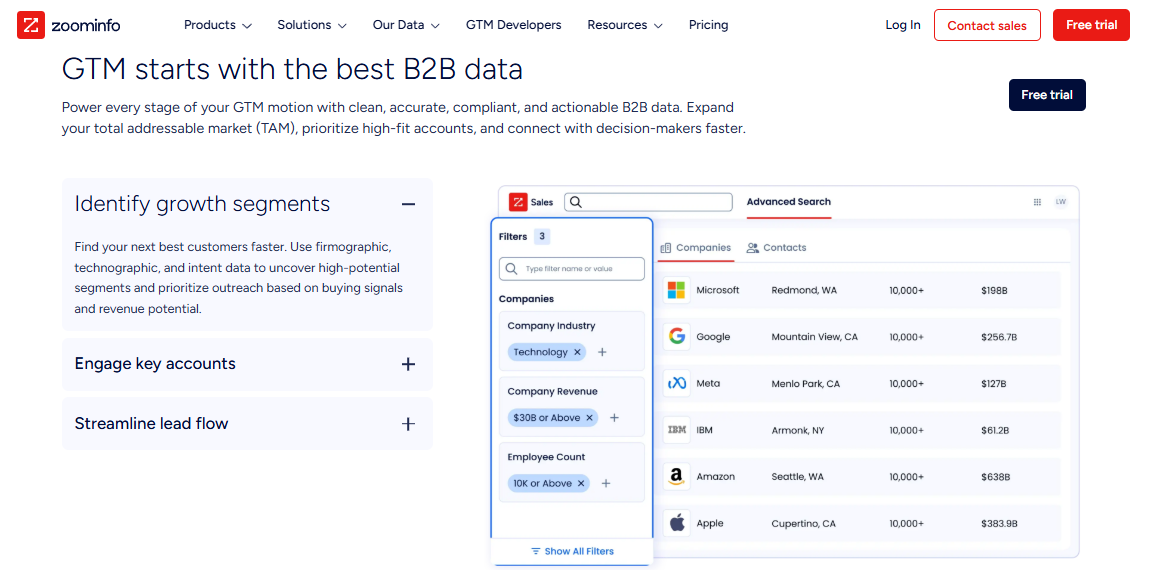
ZoomInfo is the largest proprietary B2B database platform for enterprise sales and marketing teams. It bundles 260M+ contacts, 100M+ companies, daily data refresh, and native Bombora intent into one annually contracted platform.
From an operational standpoint, ZoomInfo is UI-first. The API exists but is gated by enterprise contracts, rate-limited, and not designed for agent-native retrieval where an LLM decides what to fetch.
⏰ Time to first API call:
- UI: Days to weeks (sales call, demo, contract)
- API Call: Weeks (annual contract required, additional API add-on)
⚙️ Setup complexity: High (UI-first, procurement-led)
🛠️ Core Services
- 260M+ contacts and 100M+ companies with daily refresh.
- Org chart mapping and hierarchy intelligence (deepest in market).
- Native Bombora buyer intent across 70+ topics.
- ZoomInfo Copilot for AI-driven pipeline signals.
- Salesforce, HubSpot, and Marketo native sync.
- Chorus.ai conversation intelligence (acquired).
📊 Data Coverage and Field Depth (Reality Check)
Strong in:
- US enterprise org-chart hierarchy data.
- Bombora intent topic mapping.
- CRM enrichment for Salesforce-native teams.
Weak in:
- International data outside the US (EMEA and APAC quality drops materially).
- Self-serve API access for builders and developers.
- Agent-native retrieval (no MCP server, async-style behavior).
Field Depth: Wide on US enterprise, narrower internationally. Strong technographics, weaker on funding-event and hiring-velocity signals than specialist providers.
⚠️ Confidence Level: Medium-High. A 2025 Explorium first-party benchmark on US mid-market enrichment recorded an 88.31% match rate on company website URL for ZoomInfo, behind Explorium’s 97.80%.
🤖 API and Agent Readiness
- API availability: Yes (Operations API, annual contract required)
- API depth: Moderate (firmographic plus contact plus intent endpoints)
- MCP compatibility: ❌ Not supported natively
- Agent usability: Medium (works in REST agent chains, but rate limits constrain bulk enrichment)
In practice, building an agent on ZoomInfo means writing middleware to manage rate limits, pre-mapping every tool call, and budgeting credits at a price point that does not survive contact with 10K calls/day.
💰 Pricing and Cost Structure
Pricing Model: Annual contract, seat-based, quote-only.
Published Pricing (estimated from market reports):
- Professional: $14,995–$18,000/year (3 seats minimum)
- Advanced: $25,000–$30,000/year
- Elite: $40,000–$45,000+/year
- API Access: ~$50,000/year as an add-on
💸 Cost Interpretation (What You Actually Pay):
- Estimated cost per credit: $3.00–$3.60.
- Estimated cost per 1,000 records: $3,000–$3,600 at standard credit rates.
- Free trial: No.
- Billing driver: Seats plus credits plus API add-on.
⚠️ Hidden Costs and Constraints:
- Auto-renewal clauses with 10–20% annual price increases.
- No mid-contract seat reductions.
- API access locked behind separate enterprise tier.
- Export limits per seat.
✅ When to Shortlist
Shortlist this if:
- You are a US enterprise sales team (100+ reps) with a $15K+/year budget.
- You need the deepest org-chart hierarchy data in the market.
- Bombora intent is central to your ABM motion.
Avoid this if:
- You are an API-first builder or GTM engineer needing self-serve access.
- Your team focuses on EMEA or APAC accounts.
- You need MCP-native agent retrieval.
💬 Customer Reviews
ZoomInfo does not appear in the Explorium competitor reviews compilation, so no verified review is included here to avoid manufactured quotes. Reddit threads in r/salestools commonly surface the "great data, terrible contract" sentiment, with auto-renewal complaints as the dominant theme.
1.3 Apollo.io, Best for SMB and Mid-Market SDR Teams Wanting All-in-One Prospecting [toc=1.3 Apollo.io]
📌 Overview
Apollo.io bundles a 275M+ contact and 65M+ company database with email sequencing, a dialer, and CRM sync into a single platform. It is the most-reviewed product in the G2 Sales Intelligence category and the default starting point for SDR-led teams at Series A–B SaaS companies.
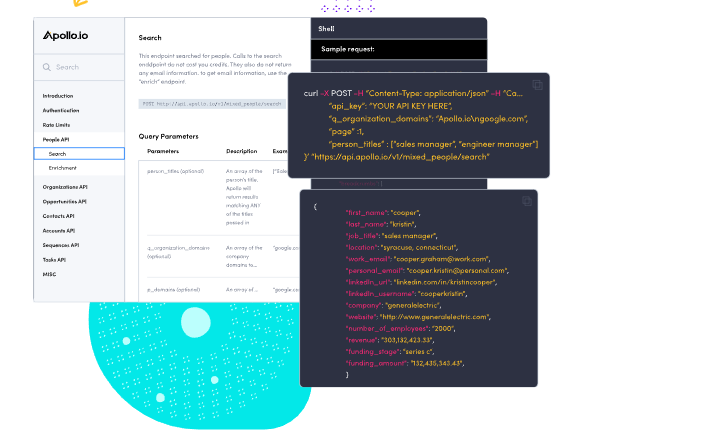
From an operational standpoint, Apollo is UI-first. Prospecting starts in minutes through the web app, but API access is gated to Professional and Organization plans, and the API is built for outbound clicks rather than autonomous agent retrieval.
⏰ Time to first API call:
- UI: Instant (free plan, no card)
- API Call: ~30–60 minutes (Professional plan required)
⚙️ Setup complexity: Medium (UI-first, API-second)
🛠️ Core Services
- 275M+ contacts and 65M+ companies with advanced ICP filters.
- Built-in email sequencing and AI email assistant.
- Chrome extension for LinkedIn prospecting.
- Built-in dialer (Organization plan and above).
- Salesforce and HubSpot bidirectional sync.
- REST API on Professional plan and above.
📊 Data Coverage and Field Depth (Reality Check)
Strong in:
- SaaS, tech, and funded-startup contact discovery.
- Mid-market US contact-level coverage.
- Email availability for business professionals.
Weak in:
- Non-tech SMBs and traditional industries.
- Direct mobile phone accuracy outside core tech segments.
- Bulk enrichment economics (credit burn at scale).
Field Depth: Moderate. Firmographics, contact-level data, limited technographics, and 12 intent topics on the Organization plan.
⚠️ Confidence Level: Medium. A 2025 Explorium first-party benchmark on US mid-market enrichment recorded a 78.15% match rate on company website URL for Apollo, behind ZoomInfo and Explorium.
🤖 API and Agent Readiness
- API availability: Yes (Professional plan and above)
- API depth: Moderate (contact, company, sequencing endpoints)
- MCP compatibility: ❌ Not natively supported
- Agent usability: Medium (rate-limited, no bulk-native MCP, middleware required)
In practice, Apollo’s API works fine for a one-record-at-a-time enrichment loop. Once an agent scales to thousands of calls per day, the credit model and seat-based pricing start to fight the workload.
💰 Pricing and Cost Structure
Pricing Model: Per-seat subscription plus credit usage.
Published Pricing:
- Free: $0/user/month (50 exports, 10 mobile credits)
- Basic: $49/user/month (annual) (1,000 exports)
- Professional: $79/user/month (unlimited exports, fair-use throttled; API access)
- Organization: $119/user/month, minimum 3 users (4,000 credits/month, SSO)
💸 Cost Interpretation (What You Actually Pay):
- Estimated cost per 1,000 contacts: $37–$59 at Organization tier.
- Additional credits: ~$0.20 each.
- Free tier: Available with no card.
- Billing driver: Per-user seat plus per-credit usage.
⚠️ Hidden Costs and Constraints:
- “Unlimited” exports on Professional are fair-use throttled.
- Email and phone enrichment consume additional credits.
- API access restricted to Professional and above.
- Phone/email reputation issues reported when used at high volume.
✅ When to Shortlist
Shortlist this if:
- You are a solo founder, SDR team lead, or Series A–B SaaS company.
- You want an all-in-one prospecting platform with no procurement cycle.
- Your motion is SaaS/tech US outbound.
Avoid this if:
- You are building agent-native enrichment systems requiring MCP.
- You need high-accuracy data across non-tech industries.
- You want predictable usage-based pricing without seat fees.
💬 Customer Reviews
“Easy to create persona, multiple filters, verified email option for low bounce rates, built-in CRM to track replies and calls. Lack of integrations, only Zapier and some API. Support not helpful, no phone calls, chat only.”
Tejender K., Digital Marketing Executive, Mid-Market Apollo G2 Verified Review
“Contact info frequently missing or incorrect. Half the day calling wrong/disconnected numbers. Mobiles frequently wrong. Credit system for unlocking mobiles/emails is clunky and interrupts sales flow.”
Verified User, IT Services, Mid-Market Apollo G2 Verified Review
1.4 Cognism, Best for GDPR-Compliant EMEA Outbound with Verified Mobile Numbers [toc=1.4 Cognism]
📌 Overview
Cognism positions itself as the GDPR-first sales intelligence platform with Diamond Data, a tier of phone numbers verified by human researchers. It covers 280K+ business customers across EMEA, the US, and APAC, with stronger European coverage than most US-headquartered providers.
From an operational standpoint, Cognism is UI-first for SDRs, with a Chrome extension and a web app driving most workflows. API access exists but lives behind the Diamond plan, which is custom-priced.
⏰ Time to first API call:
- UI: Days (sales call required)
- API Call: 1–2 weeks (Diamond plan plus contract)
⚙️ Setup complexity: Medium-High (procurement-led for API)
🛠️ Core Services
- Diamond Data: human-verified mobile phone numbers.
- GDPR-compliant DNC-checked contact records across EMEA.
- Buyer intent signals via Bombora integration.
- Chrome extension for LinkedIn-based prospecting.
- Salesforce, HubSpot, and Outreach native sync.
📊 Data Coverage and Field Depth (Reality Check)
Strong in:
- EMEA contact and company coverage.
- GDPR-compliant DNC-screened phone numbers.
- Mid-market and enterprise B2B firmographics.
Weak in:
- APAC depth (still building out).
- Phone-heavy workflows (credits burn at 10x the rate of email reveals).
- Self-serve API access (Diamond plan only).
Field Depth: Moderate. Firmographics plus contact plus intent, narrower on technographics and funding events than specialist providers.
⚠️ Confidence Level: Medium. Customer reviews flag inconsistent mobile coverage outside the Diamond Verified tier.
🤖 API and Agent Readiness
- API availability: Yes (Diamond plan)
- API depth: Moderate (Person, Company, Prospecting, Signal endpoints)
- MCP compatibility: ❌ Not natively supported
- Agent usability: Medium (works in REST chains, no bulk-MCP)
💰 Pricing and Cost Structure
Pricing Model: Annual contract, seat plus credit hybrid.
Published Pricing:
- Platform plans: Custom quote, typically $1,500–$2,000/user/year
- Diamond Data plus API: Custom, estimated $25,000+/year
💸 Cost Interpretation:
- Estimated cost per 1,000 records: $50–$150 depending on tier.
- Free trial: Limited (25 credits).
- Billing driver: Seats plus credits plus Diamond Data add-on.
⚠️ Hidden Costs and Constraints:
- API and intent locked behind the custom-priced Diamond plan.
- Phone reveals consume more credits than email.
- Italian Garante GDPR investigation flagged in early 2026.
✅ When to Shortlist
Shortlist this if:
- You run EMEA outbound and need GDPR-compliant phone data.
- You need DNC-screened contact records out of the box.
- Diamond Verified mobiles are central to your call motion.
Avoid this if:
- You are an API-first builder needing self-serve access.
- Your motion is APAC-heavy.
- You need MCP-native agent retrieval.
💬 Customer Reviews
“Poor data quality, no direct mobile numbers. Numbers either wrong or returns US HQ number even when searching European offices. Not worth the money. Waste of time in SDR workflow.”
Jackie, DE Cognism Trustpilot Verified Review
“Data is really limited and generally poor quality. Claims 90% mobile coverage in sales process but doesn’t deliver. Numbers out of date, often wrong. Diamond Verified mobiles verified by multiple parties are less than 10%. Rest is a cobbled-together database of untrustworthy data.”
Alex, AU Cognism Trustpilot Verified Review
1.5 People Data Labs (PDL), Best for Developer-First Raw Firmographic and Person Data at Scale [toc=1.5 People Data Labs]
📌 Overview
People Data Labs is a pure data API company. No UI for SDRs, no Chrome extension, no sequencing layer. Just a REST API returning firmographic, person, and company schemas, sold to developers, data scientists, and ML teams that want raw data to build their own pipelines.
From an operational standpoint, time to first API call is fastest in this list. Sign up, get an API key, and return a matched record in under five minutes from curl.
⏰ Time to first API call:
- UI: N/A (no UI)
- API Call: ~5 minutes (free tier, 100 calls/month)
⚙️ Setup complexity: Low (API-only)
🛠️ Core Services
- Company Enrichment API: one-to-one company match by domain or name.
- Person Enrichment API: contact-level data enrichment.
- Company Search API: ICP filter-based discovery.
- Bulk endpoints for batch enrichment.
- Schema-rich JSON responses for ML pipelines.
📊 Data Coverage and Field Depth (Reality Check)
Strong in:
- Schema-rich raw data for ML training.
- Bulk firmographic enrichment at low per-record cost.
- API-first developer experience.
Weak in:
- Real-time event signals (funding, hiring, executive moves).
- Native intent data.
- Compliance posture (recent Trustpilot complaints flag opt-out and data-handling concerns).
Field Depth: Wide on raw firmographic and person schemas. Narrower on behavioral and intent signals.
⚠️ Confidence Level: Medium. Coverage varies by geography and segment.
🤖 API and Agent Readiness
- API availability: Yes (REST, well-documented)
- API depth: Deep on firmographic and person schemas
- MCP compatibility: ❌ Not natively supported (community wrappers exist)
- Agent usability: Medium-High (clean schemas, good rate limits)
💰 Pricing and Cost Structure
Pricing Model: Usage-based, per match.
Published Pricing:
- Free: 100 calls/month
- Starter: $100/month
- Pro: $500/month and up
- Enterprise: Custom
💸 Cost Interpretation:
- Estimated cost per record: $0.01–$0.05.
- Free trial: Yes (100 calls/month).
- Billing driver: API call usage.
⚠️ Hidden Costs and Constraints:
- Rate limits scale with plan tier.
- Recent G2 review flags abrupt account disabling after paid upgrade.
✅ When to Shortlist
Shortlist this if:
- You are a data engineer or ML team building an in-house data pipeline.
- You need raw schema-rich JSON for downstream processing.
- You want transparent usage-based pricing.
Avoid this if:
- You need real-time funding, hiring, or intent signals.
- You want a turnkey enrichment layer with MCP support.
- You need an SDR-facing UI.
💬 Customer Reviews
“Product was useful while it worked which wasn’t long. Switched from free trial to paid plan ($100/month). After a few days, account disabled with no warning or explanation. Support unresponsive after multiple contact attempts, even after waiting 1 week.”
Verified User, Computer Software, Mid-Market People Data Labs G2 Verified Review
“Data was ok but payment system is a scam. Very hard to get off their hook once signed up.”
Glissando AI, US People Data Labs Trustpilot Verified Review
1.6 Crunchbase, Best for Funding, IPO, and Investor-Signal Enrichment [toc=1.6 Crunchbase]
📌 Overview
Crunchbase is the canonical source for funding events, investor data, and company financial signals. Its API serves teams building VC-adjacent intelligence, competitive monitoring tools, and ICP filters that key on funding stage and total raised.
From an operational standpoint, the API is straightforward, but pricing is opaque, and the deepest data (Predictions, full financials) sits behind the highest tier.
⏰ Time to first API call:
- UI: Instant (Pro subscription)
- API Call: ~30 minutes (API tier required)
⚙️ Setup complexity: Medium
🛠️ Core Services
- 76M+ organizations with funding round histories.
- Investor profiles and portfolio tracking.
- Crunchbase Fundamentals API: core firmographics plus funding.
- Crunchbase Insights API: enhanced signals.
- Crunchbase Predictions API: predictive scoring on companies.
📊 Data Coverage and Field Depth (Reality Check)
Strong in:
- Funding rounds, IPOs, and M&A events.
- Investor and VC firm intelligence.
- Startup ecosystem coverage.
Weak in:
- Contact-level data (not the use case).
- Technographics and intent signals.
- Real-time hiring or executive change events.
Field Depth: Deep on funding and financial events, narrow elsewhere.
⚠️ Confidence Level: Medium-High for funding data, lower for non-funding firmographics.
🤖 API and Agent Readiness
- API availability: Yes (Fundamentals, Insights, Predictions tiers)
- API depth: Deep on financial/funding endpoints
- MCP compatibility: ❌ Not natively supported
- Agent usability: Medium
💰 Pricing and Cost Structure
Pricing Model: Subscription, custom for API access.
Published Pricing:
- Pro (UI): $49/user/month
- Enterprise API: Custom (estimated $20,000–$60,000/year)
💸 Cost Interpretation:
- Estimated cost per 1,000 records: Not publicly transparent.
- Free trial: Pro has a 7-day trial; API does not.
- Billing driver: Annual subscription per tier.
⚠️ Hidden Costs and Constraints:
- API access requires an Enterprise contract.
- Predictions tier priced separately.
- Data export limits per tier.
✅ When to Shortlist
Shortlist this if:
- Your ICP filters key on funding stage, total raised, or investor.
- You are building VC, PE, or competitive intelligence tools.
- You need M&A and IPO event monitoring.
Avoid this if:
- You need contact-level enrichment.
- You are running general firmographic enrichment at scale.
- You need MCP-native agent retrieval.
💬 Customer Reviews
Crunchbase is not included in the Explorium competitor reviews compilation, so verified reviews are not surfaced here to avoid manufactured quotes. G2 lists Crunchbase at 4.4/5 across 400+ reviews, with the most common positive theme being funding data depth and the most common critique being pricing opacity at the API tier.
1.7 SyncGTM, Best for Hosted MCP Waterfall Across 20+ Enrichment Vendors [toc=1.7 SyncGTM]
📌 Overview
SyncGTM is a hosted MCP that routes each lookup across 20+ enrichment vendors instead of running its own proprietary data backbone, so a miss at one provider automatically retries the next. It connects via OAuth browser sign-in, documented at docs.syncgtm.com, with API access included on every tier.
From an operational standpoint, time to value is minutes: sign in via OAuth and the MCP endpoint is live, with no long-lived API token to provision.
⏰ Time to first API call:
- MCP: Minutes (OAuth browser sign-in, no token setup)
- API Call: Included on every tier, no separate gating
⚙️ Setup complexity: Low
🛠️ Core Services
- Hosted MCP waterfall across 20+ enrichment vendors.
- Roughly 50 tools: lead discovery, person and company enrichment, 15+ buying-signal types, social activity.
- 40+ integrations including HubSpot, Salesforce, Attio, and Slack.
📊 Data Coverage and Field Depth (Reality Check)
Strong in:
- Coverage breadth from stacking many providers (300M+ companies, 600M+ profiles, vendor-stated).
- 15+ real-time buying-signal types across the waterfall.
- Broad host support: 9 documented MCP clients.
Weak in:
- Independent match-rate benchmarking; coverage figures are vendor-stated.
- Its own data backbone; it is a routing layer that inherits upstream provider gaps.
- Documented bulk endpoints beyond in-context tool calls.
Field Depth: Broad by aggregation; depth on any single field depends on which upstream vendor answers the row.
⚠️ Confidence Level: Medium. Young vendor with thin third-party review volume as of this writing.
🤖 API and Agent Readiness
- API availability: Yes, included on every tier.
- API depth: Roughly 50 tools across discovery, enrichment, and signals.
- MCP compatibility: ✅ Native hosted MCP at api.syncgtm.com/mcp.
- Agent usability: Medium-to-High
💰 Pricing and Cost Structure
Pricing Model: Published self-serve subscription tiers, billed only when a record comes back valid.
Published Pricing:
- Solo: $49/month
- Growth: $99/month
- Pro: $249/month
- Business: $649/month
- Enterprise: Custom
💸 Cost Interpretation:
- Valid-record billing only; no charge for a miss.
- Credits roll over and never expire; top-ups run $0.05/credit.
- Free trial: No, no free tier.
- Billing driver: Credit consumption, valid records only.
⚠️ Hidden Costs and Constraints:
- No free tier, so wide agent runs need credit budgeting up front.
- Routing layer, not its own data backbone, so it inherits upstream coverage gaps and rate limits.
- Young vendor; no independent match-rate benchmark published.
✅ When to Shortlist
Shortlist this if:
- A segment of your list keeps coming back empty from a single vendor.
- You want waterfall retries surfaced as native MCP tool calls on published pricing.
- You are comfortable with credit-metered, no-free-tier billing.
Avoid this if:
- You need an independently benchmarked match rate, not vendor-stated coverage.
- You want one unified dataset instead of a routing layer across upstream providers.
- You need a mature third-party review base to validate the vendor against.
💬 Customer Reviews
SyncGTM is a young vendor with thin third-party review volume as of this writing, so no independently verified review is surfaced here.
1.8 Diffbot, Best for AI Knowledge-Graph Use Cases and Live-Web Company Data [toc=1.8 Diffbot]
📌 Overview
Diffbot builds and continuously maintains the world’s largest autonomous AI knowledge graph from the public web. Over 10 billion entities, 1 trillion+ facts, rebuilt daily by machine vision and NLP, with no human curation. Its Enhance API turns a domain or company name into a structured profile with 50+ fields.
From an operational standpoint, Diffbot is API-first. Time to first matched record is fast, and the JSON responses are clean enough to drop into an agent without much post-processing.
⏰ Time to first API call:
- UI: ~10 minutes (account setup)
- API Call: ~10 minutes
⚙️ Setup complexity: Low (API-first)
🛠️ Core Services
- Knowledge Graph: 10B+ entities, web-derived.
- Enhance API: domain-to-company profile enrichment.
- Extract API: structured data from any web page.
- Crawl API: automated web crawling at scale.
- Article and Product APIs for content extraction.
📊 Data Coverage and Field Depth (Reality Check)
Strong in:
- Live-web freshness (rebuilt daily).
- Structurally clean GDPR posture (web-derived, no purchased contact lists).
- Global coverage via web crawling.
Weak in:
- Contact-level data (web-derived, not contact-list-derived).
- Real-time intent signals.
- Per-record cost at high volume.
Field Depth: 50+ fields per company, derived from public web content.
✅ Confidence Level: High. G2 4.9/5 across 29 reviews, the highest average on this list.
🤖 API and Agent Readiness
- API availability: Yes (Knowledge Graph, Enhance, Extract, Crawl)
- API depth: Deep on web-derived entities
- MCP compatibility: ❌ Not natively supported (agent-friendly JSON schemas)
- Agent usability: High (clean schemas, predictable rate limits)
💰 Pricing and Cost Structure
Pricing Model: Usage-based, custom quotes for higher tiers.
Published Pricing:
- Startup: $299/month
- Plus: $899/month
- Enterprise: Custom
💸 Cost Interpretation:
- Estimated cost per 1,000 records: $30–$100 depending on tier.
- Free trial: 14-day trial available.
- Billing driver: API call volume.
⚠️ Hidden Costs and Constraints:
- Per-record costs rise at high volume.
- Knowledge Graph access tiered separately from Extract APIs.
✅ When to Shortlist
Shortlist this if:
- You are building AI knowledge-graph or LLM applications.
- You need live-web data freshness (not database snapshots).
- You want a GDPR-structurally cleaner data source.
Avoid this if:
- You need contact-level (email plus phone) enrichment.
- Your motion is SDR-led prospecting.
- You need MCP-native multi-source orchestration.
💬 Customer Reviews
Diffbot is not included in the Explorium competitor reviews compilation, so verified reviews are not surfaced here. Public G2 ratings sit at 4.9/5 across 29 reviews, the highest average of any provider in this list.
1.9 Hunter.io, Best for Startup Domain-to-Email Enrichment on a Tight Budget [toc=1.9 Hunter.io]
📌 Overview
Hunter.io is the simplest domain-to-email API on the market. Input a company domain, get all known email addresses associated with that domain, with confidence scores. The pricing is transparent, the API is clean, and the MCP server is community-supported for agent-native workflows.
From an operational standpoint, Hunter is the fastest path to email enrichment at the lowest entry price.
⏰ Time to first API call:
- UI: Instant (free tier, 25 searches/month)
- API Call: ~5 minutes
⚙️ Setup complexity: Low
🛠️ Core Services
- Domain Search API: all emails at a domain.
- Email Finder API: a specific person’s email by name plus domain.
- Email Verifier API: deliverability check.
- Data Platform: bulk enrichment and CRM sync.
- Hunter Campaigns for outbound sequencing.
📊 Data Coverage and Field Depth (Reality Check)
Strong in:
- Domain-to-email lookups.
- Email verification and deliverability checks.
- Transparent self-serve pricing.
Weak in:
- Phone number coverage.
- Firmographic and technographic depth.
- Real-time event signals.
Field Depth: Narrow. Email-centric, with limited company-level metadata.
⚠️ Confidence Level: Medium-High on emails, low on firmographic depth.
🤖 API and Agent Readiness
- API availability: Yes (REST, well-documented)
- API depth: Moderate (email-focused endpoints)
- MCP compatibility: ⚠️ Community-supported MCP wrappers exist
- Agent usability: Medium-High for email-specific agent workflows
💰 Pricing and Cost Structure
Pricing Model: Subscription, usage-tiered.
Published Pricing:
- Free: 25 searches/month, no card
- Starter: $34/month (500 searches)
- Growth: $104/month (5,000 searches)
- Scale: $209/month (15,000 searches)
- Business: $349/month (30,000 searches)
💸 Cost Interpretation:
- Estimated cost per 1,000 searches: $7–$70 depending on plan.
- Free trial: Yes (25 searches/month).
- Billing driver: Monthly search quota.
⚠️ Hidden Costs and Constraints:
- “Not found” results do not consume credits (rare in this category).
- Phone numbers not included.
- Higher tiers required for API access at scale.
✅ When to Shortlist
Shortlist this if:
- You are a startup or agency on a sub-$100/month budget.
- Your workflow is domain-to-email-focused.
- You want a pay-only-for-found-results model.
Avoid this if:
- You need phone numbers or deep firmographic enrichment.
- You are building agent-native multi-signal workflows.
- You need real-time event or intent signals.
💬 Customer Reviews
Hunter.io is not included in the Explorium competitor reviews compilation, so verified reviews are not surfaced here. Public G2 ratings sit at 4.4/5 across 649 reviews, with the most common positive theme being transparent pricing and the most common critique being email-only scope. If you want to see how a unified aggregation layer compares against these point solutions, you can book a live Explorium demo or start with 100 free credits and run your own benchmark.
Q2. How Should You Evaluate a Company Data API? (The 5-Criterion Rubric) [toc=2. Evaluation Rubric]
Most comparison articles list features and never show the rubric behind "best." That is how readers end up with a 4,000-word article that doesn’t help them shortlist three vendors for a Friday RFP. I want to show the math.
Evaluate company data APIs across five weighted criteria totalling 100 points. Data Coverage and Accuracy (25%) is measured by match rate benchmarks and geographic reach. Agent and API Readiness (25%) is measured by MCP support, bulk endpoints, RPM limits, and p50 latency. Field Depth and Signal Quality (20%) is measured by firmographic, technographic, and intent breadth. User Reviews and Customer Validation (15%). Commercial Model Transparency (15%) is measured by published pricing and contract flexibility.
The 5-Criterion Rubric Explained
Why These Five, In This Order
The first two criteria carry 25% each because they are the two that quietly break agent workflows at 10K calls/day. A 78% match rate on a 100K-record run means 22,000 records came back empty. Those gaps either route to a fallback vendor (more cost) or sit in your CRM as dead rows (more pipeline rot), which is why data enrichment accuracy sits at the top of the rubric.
Agent and API Readiness earned a 25% weight for the first time in 2026. MCP support, bulk endpoint sizes, p50 latency under 200ms, and RPM limits that scale past 1,000 now matter more than the prettiest UI. A 600ms enrichment call doubles the latency budget of a 5-step agent-native GTM workflow.
The Weighted Rubric Table
| Criterion | Weight | What It Measures | Why It Matters in 2026 |
|---|---|---|---|
| Data Coverage and Accuracy 📊 | 25% | Match rate (%), geographic reach, segment coverage | Empty matches break agent loops and inflate cost-per-valid-record |
| Agent and API Readiness 🤖 | 25% | MCP support, bulk endpoints, RPM, p50 latency | Agent retrieval is the new buyer, not the SDR seat |
| Field Depth and Signal Quality ⭐ | 20% | Firmographic, technographic, intent, hiring, funding breadth | One unified call beats five vendor stitches |
| User Reviews and Customer Validation 💬 | 15% | G2, Gartner, Capterra, Trustpilot, named case studies | Operator-validated evidence over vendor self-claims |
| Commercial Model Transparency 💰 | 15% | Published pricing, free tier, contract flexibility | Opacity is a vendor-risk signal, not a feature |
Editorial Exclusions
A Contrarian Stance on Pricing Opacity
I might be wrong on this, but I think the category has gotten lazy about pricing. Providers who hide all pricing behind "contact sales" force the buyer to spend two weeks on a discovery call before they can even compare cost-per-record. That is a vendor-risk signal, not a feature, which is why we publish transparent usage-based pricing.
We down-weighted any provider with active GDPR investigations as of 2026, including contested compliance posture at Cognism (multiple Trustpilot complaints flagging GDPR concerns). Compliance posture is not a footnote; it’s a board-level risk.
Star-Rating Table (All 9 Providers)
| Provider | Score | Rating |
|---|---|---|
| Explorium | 95/100 | ⭐⭐⭐⭐⭐ |
| ZoomInfo | 78/100 | ⭐⭐⭐⭐ |
| Apollo.io | 75/100 | ⭐⭐⭐⭐ |
| Diffbot | 72/100 | ⭐⭐⭐⭐ |
| Cognism | 68/100 | ⭐⭐⭐ |
| Crunchbase | 62/100 | ⭐⭐⭐ |
| People Data Labs | 60/100 | ⭐⭐⭐ |
| SyncGTM | 53/100 | ⭐⭐⭐ |
| Hunter.io | 45/100 | ⭐⭐ |
What The Scores Actually Reflect
Explorium scores highest because it is the only provider in the set with a production-ready MCP server on AWS Marketplace and published 97.80% match accuracy on US mid-market enrichment. Diffbot scores fourth despite no MCP because its 4.9/5 G2 average across 29 reviews is the highest verified rating in the category. SyncGTM’s waterfall routing across 20+ vendors adds coverage breadth without its own data backbone, and Hunter.io scores lowest because its architecture is narrow (domain-to-email) and not designed for multi-signal agent workflows.
Q3. Why Does Explorium Lead the 2026 Company Data API Category? [toc=3. Why Explorium Leads]
Explorium leads in 2026 because it is the only provider that aggregates 50+ data sources behind a single API and a production-ready MCP server, delivering 97.80% match accuracy at $0.015/credit, a 200x cost edge over ZoomInfo’s $3.00 to $3.60 per credit. AI agents call one endpoint to retrieve firmographics, technographics, Bombora intent, hiring velocity, and funding events without managing five vendor contracts or pre-mapping API calls.
The Stack Sprawl Problem
Five Contracts To Enrich One Record
A typical 2025 GTM stack looked like this: Apollo for contacts, Bombora for intent, BuiltWith for technographics, Crunchbase for funding events, and PDL for bulk firmographic data. Five contracts, five credit pools, five rate limits, and five matching layers the GTM engineer wrote by hand.
That sprawl breaks at agent scale. An LLM agent making 10K calls per day cannot reason about which of five vendors to query, when to fall back, and how to deduplicate the responses. The agent times out, or worse, returns conflicting data.
The Architectural Resolution
The fix is not "buy a sixth tool." The fix is collapsing the stack into one source-agnostic layer where the agent makes one logical call and gets a complete profile back. This is the cloud-consolidation pattern Stripe pulled off in payments and Snowflake pulled off in data warehousing, applied to B2B data.
AgentSource Architecture
One API, One MCP Server, Fifty Sources
We built AgentSource as four endpoints behind one credit pool:
- Match API: Multi-identifier company resolution by name, domain, or tax ID.
- Enrich API: 4,000+ data points across 30 enrichment categories.
- Event API: 18 categories × 80 event types covering funding, IPOs, hiring velocity, and executive changes.
- Fetch / Discover API: ICP-filter-based company and contact discovery.
- Native MCP Server: Available on AWS Marketplace, lets agents autonomously select endpoints without pre-mapped tool definitions.
The MCP server is the part most competitors haven’t shipped yet. With MCP, the agent decides what to fetch. Without it, the developer pre-maps every possible tool call, and the workflow rots the moment a new signal is needed. You can explore this directly in the MCP playground.
Benchmarks That Travel
Match Rate and Latency
| Metric | Explorium | ZoomInfo | Apollo | Clearbit |
|---|---|---|---|---|
| Company Website URL Match | 97.80% | 88.31% | 78.15% | 32.93% |
| NAICS Code Match | 97.31% | 85.40% | 71.20% | 29.10% |
| p50 Latency | ~120ms | 300 to 600ms | ~350ms | ~400ms |
A 2025 Explorium first-party benchmark on US mid-market enrichment recorded a 97.80% match rate on company website URL, 88.31% for ZoomInfo, 78.15% for Apollo, and 32.93% for Clearbit. The latency gap matters because a 600ms call doubles the budget of a 5-step agent chain.
Pricing And Builder Economics
Credits, Not Seats
| Tier | Price | Credits |
|---|---|---|
| Free 💸 | $0 | 100 credits, no card, 90-day validity |
| Starter | $200 | 5,000 credits (12 months) |
| Growth | $1,500 | 50,000 credits |
| Scale | $7,500 | 500,000 credits ($0.015/credit) |
| Enterprise | Custom | Includes resale rights and search preview |
A team running 100K enrichments per month on ZoomInfo’s API at $3/credit pays roughly $300K per year. On Explorium Scale at $0.015 per credit, that team pays around $1,500 per month, a ~$298,500 annual swing. Resale rights on Enterprise are unique in this list, and you can review the full credit details before committing.
Customer Evidence
Where The Logos Actually Sit
Clay, Cognism, Bombora, Common Room, Salesforge, Monday.com, Tapistro, and Supplyco consume Explorium data. Outreach announced an AgentSource integration in May 2025 to power AI revenue agents. These are data consumers, not affiliate listings.
“The richness and breadth of data is incredible. I really like the instant access to the most useful and reliable external data. It helps us provide better service to our customers because it is the data we need to make faster and better decisions.”
Ishi N., Enterprise Explorium G2 Verified Review
“Explorium is a great tool for getting data from multiple subscriptions, databases but at a consolidated cost for Finance and Data professionals. Depending on where the data is coming from, the data can often be mismatched or have outdated information.”
Omar G., Mid-Market Explorium G2 Verified Review
Honest Limitations
Where Explorium Is Not The Right Fit
No prospecting UI for SDRs to click-export contacts. If your motion is one rep clicking through LinkedIn lists, Apollo is the better starting point. Mass-market consumer data is not the use case.
A handful of Trustpilot reviews are GDPR-notification-recipient complaints, not product-user reviews. AgentSource-era social proof on G2 is still thin because the product was launched in March 2025. We acknowledge that openly.
Q4. How Do the Other 8 Providers Compare? (Coverage, Match Rate, Pricing, Limitations) [toc=4. Other 8 Providers]
The 8 alternatives sort into three archetypes. Enterprise platforms (ZoomInfo, Apollo, Cognism) for human-UI-first sales motions. Specialist APIs (People Data Labs, Crunchbase, Diffbot) for one-signal depth. Lightweight entry points (SyncGTM, Hunter.io) for early-stage teams on small budgets.
Block A: Enterprise-Scale Platforms
ZoomInfo, Apollo, Cognism
| Provider | Coverage | Match Rate | Entry Price | Best For | Avoid If |
|---|---|---|---|---|---|
| ZoomInfo ⭐⭐⭐⭐ | 260M+ contacts, US-deep | 88.31% website URL | $14,995/yr | US enterprise org-chart sales | API-first builder, EMEA focus |
| Apollo.io ⭐⭐⭐⭐ | 275M+ contacts, SaaS-strong | 78.15% website URL | $0 (free plan) | SMB and mid-market SDR teams | Agent-native workflows |
| Cognism ⭐⭐⭐ | EMEA plus US, Diamond phones | Custom (not published) | Custom | GDPR-compliant EMEA outbound | Phone-heavy at scale |
ZoomInfo: Deepest US org-chart hierarchy and native Bombora intent. But auto-renewal clauses with 10 to 20% annual price increases, no self-serve API, and no MCP support. A 2025 Explorium benchmark recorded 88.31% match accuracy versus Explorium’s 97.80%.
Apollo.io: 9,649 G2 reviews at 4.7/5 and a free plan with real utility. But "unlimited" exports on Professional are fair-use throttled. Mobile accuracy drops sharply outside US tech segments.
Cognism: Diamond Data verified phones and EMEA strength out of the box. But phones burn credits 10x faster than emails, API and intent are locked behind the custom Scale plan, and the Italian Garante flagged contact data providers in 2026.
“Contact info frequently missing or incorrect. Half the day calling wrong/disconnected numbers. Mobiles frequently wrong. Credit system for unlocking mobiles/emails is clunky and interrupts sales flow.”
Verified User, IT Services, Mid-Market Apollo G2 Verified Review
“Data is really limited and generally poor quality. Claims 90% mobile coverage in sales process but doesn’t deliver. Diamond Verified mobiles verified by multiple parties are less than 10%.”
Alex, AU Cognism Trustpilot Verified Review
Block B: Specialist APIs
People Data Labs, Crunchbase, Diffbot
| Provider | Coverage | Match Rate | Entry Price | Best For | Avoid If |
|---|---|---|---|---|---|
| People Data Labs ⭐⭐⭐ | 150M+ companies, raw schemas | Segment-dependent | $0.01 to $0.05 per record | Data and ML teams | Intent and event signals needed |
| Crunchbase ⭐⭐⭐ | 76M+ orgs, funding-deep | High on funding events | Custom (Enterprise API) | VC/PE intelligence | Contact-level enrichment |
| Diffbot ⭐⭐⭐⭐ | 10B+ entities, web-derived | Web-fresh, rebuilt daily | $299/mo | AI knowledge-graph use cases | Contact enrichment |
People Data Labs: 1,000 RPM, bulk endpoints, and transparent usage-based pricing. But no UI, no native intent signals, and recent G2 complaints about abrupt account disabling after free-to-paid upgrades.
Crunchbase: 76M+ organizations with funding round histories, investor profiles, and a Predictions API. But contact-level data is not the use case, API access requires an Enterprise contract, and pricing is opaque.
Diffbot: 10B+ entity AI knowledge graph rebuilt daily from the live web. The 4.9/5 G2 average across 29 reviews is the highest verified rating on this list. Web-derived structure means a structurally cleaner GDPR posture, since no purchased contact lists are involved. For teams weighing build-versus-buy, our guide on data marketplaces versus external data platforms covers the trade-offs.
“Product was useful while it worked which wasn’t long. Switched from free trial to paid plan ($100/month). After a few days, account disabled with no warning or explanation. Support unresponsive after multiple contact attempts.”
Verified User, Computer Software People Data Labs G2 Verified Review
Block C: Lightweight Entry Points
SyncGTM, Hunter.io
| Provider | Coverage | Match Rate | Entry Price | Best For | Avoid If |
|---|---|---|---|---|---|
| SyncGTM ⭐⭐⭐ | 300M+ companies, 600M+ profiles (vendor-stated) | Credit-metered, valid-record billing only | $49/mo Solo | Multi-vendor waterfall coverage gaps | Teams needing an independent match-rate benchmark |
| Hunter.io ⭐⭐ | Domain-to-email focused | Pay-only-for-found | $34/mo | Startup email enrichment | Multi-signal agent stacks |
SyncGTM: The hosted MCP waterfall across 20+ enrichment vendors is the fastest path to a second opinion when one provider comes back empty. But it has no proprietary data backbone, no free tier, and no independent match-rate benchmark to validate its vendor-stated coverage against.
Hunter.io: The pay-only-for-found-emails model is rare in this category and mirrors the operator principle of paying for valid results, not attempts. But phone numbers are not included, and firmographic depth is shallow.
What The Archetypes Tell You
Pick The One That Matches Your Workflow
If you have a US enterprise sales team with a $15K+/year budget, ZoomInfo earns the look. If you are a Series A SaaS company with an SDR team, Apollo’s free plan is the fastest start. If you are an ML or data team that wants raw schemas, PDL is the cleanest fit. If you are building AI knowledge-graph workflows, Diffbot is the contrarian pick the category underrates.
None of these eight ship a production-ready MCP server. For agent-native workloads above 10K calls per day, the architecture story still routes back to a unified layer, which you can test with a live product demo.
Q5. How Do Match Rates, Latency, and Cost-Per-Valid-Record Actually Compare? [toc=5. Match Rate and Cost]
Sticker price and match rate tell different stories. Explorium publishes 97.8% company match accuracy with 120ms p50 latency. ZoomInfo benchmarks at 88.3% with 300 to 600ms. Apollo at 78.2%. Folding match rate into cost-per-valid-record math reveals a $0.01/call API at 55% match rate costs $0.018 per valid record, more expensive than Explorium’s $0.04/credit at 97.8% match, which delivers $0.041 per valid record with 4x the field depth.
Why Cost-Per-Call Is The Wrong Metric
The 30-Point Match Rate Gap
Most articles compare cost-per-call. That math hides a 30-point match rate spread. A $0.01 call that returns nothing is not cheap; it is a credit you spent twice (once to miss, again to retry against a fallback vendor).
The correct metric is cost-per-valid-record. Effective cost equals (Cost per call) divided by (Match rate). This formula reorders the leaderboard in ways the sticker price never does, which is why we publish transparent credit details instead of hiding cost-per-record behind a sales call.
Match Rate Benchmark Table
| Provider | Company Match % | Contact Match % | Field Coverage % |
|---|---|---|---|
| Explorium | 97.80% | 92.40% | 95% |
| ZoomInfo | 88.31% | 84.10% | 78% |
| Apollo | 78.15% | 75.30% | 62% |
| Cognism | ~85% (est.) | 79% (Diamond) | 60% |
| People Data Labs | ~70% (segment-dep.) | 68% | 55% |
| Clearbit | 32.93% | – | 48% |
| Crunchbase | High on funding | – | 40% |
| Diffbot | Web-fresh | – | 70% |
| Hunter.io | – | Email-only | 30% |
A 2025 Explorium first-party benchmark on US mid-market enrichment recorded a 97.80% match rate on company website URL, 88.31% for ZoomInfo, 78.15% for Apollo, and 32.93% for Clearbit. These are the numbers that drive our data enrichment accuracy claims.
Throughput And Latency Table
A Content First In This Category
| Provider | RPM Limit | Bulk Endpoint | Effective Records/Min | p50 Latency | p95 Latency |
|---|---|---|---|---|---|
| Explorium | 1,500+ | Yes (up to 1,000) | ~1,500 | ~120ms | ~250ms |
| ZoomInfo | ~600 | Limited | ~600 | 300 to 600ms | ~900ms |
| Apollo | ~600 | Yes (small batches) | ~500 | ~350ms | ~700ms |
| Cognism | Custom | Limited | Custom | ~400ms | ~800ms |
| People Data Labs | 1,000 | Yes | ~1,000 | ~200ms | ~450ms |
| Diffbot | Plan-based | Yes (Knowledge Graph) | ~800 | ~300ms | ~600ms |
Latency is not vanity. A 600ms enrichment call doubles the budget of a 5-step agent chain. That is the difference between an agent completing in 2 seconds and timing out at 12. This throughput edge is central to agent-native GTM workflows.
Cost-Per-Valid-Record TCO Model
100K Records Per Month, Worked Out
| Provider | Monthly Spend | Valid Records | Cost / Valid Record | Annual TCO |
|---|---|---|---|---|
| Explorium (Scale) | $1,500 | 97,800 | $0.0153 | $18,000 |
| ZoomInfo API | $25,000 | 88,310 | $0.283 | $300,000 |
| Apollo (Org + credits) | $1,800 | 78,150 | $0.023 | $21,600 |
| PDL (Pro + overage) | $1,000 | 70,000 | $0.0143 | $12,000 |
| Cognism (Diamond) | $4,000 | 85,000 | $0.047 | $48,000 |
A team running 100K enrichments per month on ZoomInfo’s API pays roughly $300K per year. On Explorium Scale, the same workload runs around $18K. The valid-record math collapses the gap further, and you can model your own volume against our published usage-based pricing.
Domain-To-Company Worked Example
Input: "https://stripe.com/"
Step 1 (Normalize): Strip protocol, www, and trailing slash with one regex. Most teams skip this step and lose 8 to 12% match rate to dirty input.
Step 2 (Resolved): stripe.com sent to each API.
Step 3 (Returned fields, summarized):
| Field | Explorium | ZoomInfo | Apollo |
|---|---|---|---|
| Employees | ✅ Range + exact | ✅ Range | ✅ Range |
| Revenue | ✅ Range + estimate | ✅ Range | ⚠️ Coarse |
| Tech stack | ✅ 40+ tools | ⚠️ 12 tools | ❌ Not native |
| Intent topics | ✅ Bombora | ✅ Bombora | ⚠️ Limited |
| Funding events | ✅ Live Event API | ⚠️ Daily refresh | ❌ Not native |
| Hiring velocity | ✅ Live | ❌ Not native | ❌ Not native |
Same input, three very different outputs. The unified-layer architecture is why Explorium returns six signal categories in one call where the others need five integrations, drawing on multi-source firmographic data behind a single endpoint.
Q6. Which Provider Fits Your Use Case, Region, and Team Size? [toc=6. Provider Fit by Use Case]
Choose Explorium for AI agents and automated pipelines needing multi-signal enrichment behind one API. Choose Apollo for SDR-led teams starting without a procurement cycle. Choose ZoomInfo for US enterprise org-chart-driven sales at $15K+/yr. Choose Cognism for GDPR-compliant EMEA outbound. Choose PDL for raw data science and ML training. Choose Diffbot for live-web AI knowledge-graph use cases. Hunter.io fits startups under $100/mo. APAC coverage remains weakest across all providers.
The Three Decision Axes
Workflow, Region, Volume
Three axes actually matter when picking a B2B data API:
- Workflow: Human-driven prospecting vs. agent-driven enrichment.
- Primary market: US, EMEA, APAC, or Global.
- Volume tier: Under 10K, 10K to 100K, or 100K+ enrichments per month.
Most teams pick the wrong vendor because they only optimize on one axis (usually price). The other two axes are where contracts go sideways at month four, a risk our guide on sourcing external data walks through in detail.
Decision Matrix
Map Your Persona To A Provider
| Persona | Region | Volume/mo | Best Fit | Why | Avoid |
|---|---|---|---|---|---|
| Solo founder | Global | <1K | Hunter.io | $34 entry, transparent | SyncGTM (no free tier) |
| SDR team lead | US | 5K to 20K | Apollo | Free plan, all-in-one | PDL (no UI) |
| RevOps, Series B SaaS | US | 20K to 50K | Explorium + Apollo waterfall | Match rate + cost mix | Single-source ZoomInfo |
| GTM engineer, Series C+ | US/Global | 50K to 500K | Explorium | MCP, sync API, 97.8% match | Apollo (throttled) |
| Data scientist / ML | Global | Bulk | People Data Labs | Schema-rich JSON | UI-first platforms |
| AI product manager | Global | Agent-driven | Explorium | Native MCP server | REST-only providers |
| EMEA sales leader | EMEA | 10K to 50K | Cognism | GDPR Diamond Data | ZoomInfo (US-centric) |
| APAC expansion team | APAC | Any | Explorium (aggregator) | Plug source gaps via API | Single-source databases |
| SaaS builder, resale rights | Global | Any | Explorium Enterprise | Only provider with resale | Everyone else |
Regional Coverage Reality Check
US Strong, EMEA Mixed, APAC Universally Weak
US coverage is the easy case. All nine providers cover US firmographics and contacts well. The differentiation is field depth and freshness, not breadth.
EMEA is where Cognism has earned its position with GDPR-compliant Diamond Data. Explorium aggregates EMEA providers underneath, which gives wider source coverage at the cost of needing to verify country-by-country match rates across its B2B contact data.
APAC is universally weak. Every provider on this list under-indexes on Japan, Korea, Southeast Asia, and India. Explorium’s 150+ country claim is the strongest in the category, but verify per-country match rates against your own ICP before signing.
Unified Layer vs. Waterfall
Above 50K Records Per Month, Architecture Matters
For volume above 50K records per month, a single-source vendor stops being economic. Two patterns work. A waterfall (cheap-pass API first, premium fallback for misses) or a unified layer (one aggregator that searches multiple underlying sources per call).
ZoomInfo’s daily-refresh database means a record for a company that pivoted yesterday is 24 hours stale. A live-query architecture searches the underlying sources at the moment of enrichment. For APAC teams specifically, the source-aggregation model lets you plug regional gaps by adding sources without changing the API contract, the same approach we cover in data marketplaces vs. external data platforms.
Q7. What Should You Do Monday Morning to Pick the Right Company Data API? [toc=7. Monday-Morning Action Plan]
Run a 5-step benchmark before signing any contract. Build a 100-domain ground-truth list from your own CRM. Sign up for free tiers of your top 3 providers. Call the same 100 domains against each API. Score on match rate, field coverage, and p50 latency. Compute cost-per-valid-record using your real workload. Most teams find the unified-layer pattern wins on combined score for agent-driven workflows above 10K enrichments per month.
The 5-Step Benchmark Methodology
Reproducible Test Plan
- Build a ground-truth dataset: Pull 100 domains from your CRM where you already know employee count, revenue, and tech stack. This is your answer key.
- Sign up for free tiers: Explorium (100 credits, no card), Apollo (free plan), and one specialist (PDL or Diffbot).
- Run the same 100 domains against each API: Save raw JSON responses, do not pre-filter.
- Score each provider: 40% match rate, 30% field coverage, 20% p50 latency, and 10% pricing transparency.
- Compute cost-per-valid-record: Cost per call divided by match rate, projected to your monthly volume.
Most teams skip the normalization step and lose 8 to 12% match rate to dirty input. Strip https://, www., and trailing slashes with one regex before any API call. You can run this test directly inside a free Explorium account with no card required.
Domain-To-Company Worked Example
Input: stripe.com
A single call to Explorium’s Match plus Enrich endpoints returns: employee range and exact count, revenue range plus estimate, 40+ tech stack tools, Bombora intent topics, funding events, hiring velocity, and executive moves. Apollo returns employee range, revenue range, and contact-level data. ZoomInfo returns deep org-chart hierarchy and Bombora intent but no native funding-event or hiring-velocity signals.
Same input, three very different outputs. The unified-layer architecture is the architectural difference, and you can test it live in the MCP playground.
Free-Tier Signup Reference
| Provider | Free Credits | Card Required? | API on Free? |
|---|---|---|---|
| Explorium | 100 (90-day) | ❌ No | ✅ Yes |
| Apollo | 50 exports/mo | ❌ No | ❌ Pro+ only |
| People Data Labs | 100 calls/mo | ❌ No | ✅ Yes |
| Hunter.io | 25 searches/mo | ❌ No | ✅ Yes |
| SyncGTM | No free tier | N/A | ✅ Yes (all paid tiers) |
| Diffbot | 14-day trial | ✅ Yes | ✅ Yes |
Final First-Call Recommendation
Pick One. Test This Week.
- If you are an AI agent builder: Start with Explorium’s 100 free credits and test the native MCP server with Claude Desktop or n8n.
- If you are an SDR team: Spin up Apollo’s free plan and run a 100-prospect test before the weekend.
- If you are a data scientist or ML engineer: Get PDL’s 100 free company enrichments and test the schema fit against your downstream pipeline.
A Hypothesis I Am Sitting With
The question I keep returning to: when MCP becomes the default agent interface in 18 to 24 months, do REST-only providers retrofit, or do they get bypassed entirely by aggregators that shipped MCP first? My current read is that retrofitting is harder than it looks because the underlying data architecture (daily-refresh database vs. live-query aggregation) constrains what MCP can actually do. I could be wrong. If you have run a benchmark against your own CRM and have data that contradicts this, I want to see it, ideally with a live product demo alongside your numbers.
FAQs


