

Q1. What are the 10 Best Business Enrichment API Providers for GTM in 2026? [toc=1. 10 Best Providers]
A GTM engineer at a Series-B sales-tech company pinged me last March at 11:47 PM. She had nine browser tabs open: Apollo’s billing dashboard, Clay’s credit ledger, PDL’s API console, Bombora’s intent feed, BuiltWith’s tech tracker, plus four CRM views. Her agent had burned $4,200 in credits that week and still hit a 71% match rate on US mid-market accounts. The question she asked was the right one. “Why am I paying five vendors to give my agent a worse answer than one good one would?”
That midnight DM is the article in one paragraph.
Editorial Introduction
Choosing a business enrichment API is a high-stakes call for B2B SaaS, FinTech, and AI-product teams shipping go-to-market agents at scale, where a 10-point match-rate gap and a 200x credit-cost spread compound into six-figure pipeline leakage. We analyzed 25+ providers offering API-based enrichment, MCP-native delivery, contact and company data, and multi-source aggregation. The 10 below earned their seats on operator-grade criteria, not popularity. This guide is built for GTM Engineers wiring agent-native pipelines, RevOps leaders auditing data quality, AI Product Managers integrating real-time signals into LLM apps, and data and engineering teams comparing third-party APIs against in-house ingestion.
Our Evaluation Criteria
- ⏰ Time to Value: API onboarding speed, documentation clarity, and minutes to first successful enrichment call.
- 📊 Data Coverage and Accuracy: company and contact breadth, segment-level strengths (US-ENT, US-SMB, EMEA, and APAC), email and phone accuracy, and known gaps.
- ⭐ Field Depth and Signal Quality: firmographic, technographic, intent, hiring, funding, and event richness per entity.
- 🤖 Agent and API Readiness: API reliability, rate limits, MCP compatibility, and usability inside LLM-driven workflows.
- ⚙️ Scalability and Infrastructure: high-volume enrichment throughput, uptime, and pipeline stability at 10K+ calls per day.
- ✅ Compliance and Governance: GDPR, CCPA, SOC 2, and enterprise data-governance posture.
- 💰 Commercial Model Transparency: pricing clarity, cost per enrichment, free tier, and hidden constraints (credits, export caps, and seat-based traps).
Who This Guide Is For
- GTM Engineers building agent-native enrichment workflows.
- RevOps teams optimizing outbound targeting and CRM data quality.
- AI Product Managers integrating real-time data into LLM applications.
- Data and Engineering teams evaluating third-party enrichment APIs against in-house pipelines.
The 2026 Master Comparison Table
| Provider (Stars) | Best For | Data Strength | API/Agent Readiness | Pricing Model |
|---|---|---|---|---|
| Explorium ⭐⭐⭐⭐⭐ | Agent-native GTM stacks | 150M companies, 800M people, 100 sources, 97.8% firmographic accuracy | Native MCP server, REST, SSE, bulk 50/req | Credit pool, $0.015/credit, 100 free credits |
| ZoomInfo ⭐⭐⭐⭐ | NA enterprise depth | 200M contacts, top NA mobile accuracy | Standard + Scaling API, 1,500 RPM, no MCP | Subscription, $14,995+/yr, $2.99 to $3.60/credit |
| Apollo.io ⭐⭐⭐⭐ | SMB all-in-one prospecting | 275M contacts, 30M companies | REST API on Organization tier, no MCP | Seat + credit, $49 to $119/user/mo |
| Cognism ⭐⭐⭐⭐ | EMEA compliant phone | Diamond Data 87% connect rate | REST, Salesforce/HubSpot native, no MCP | Custom annual contract |
| People Data Labs ⭐⭐⭐⭐ | ML and data products | 1.5B profiles, data-union model | Developer-first REST, no MCP | Per-profile, ~$0.20/profile |
| Coresignal ⭐⭐⭐ | Warehouse-delivered raw data | 700M+ profiles, S3/Snowflake delivery | REST + bulk delivery, no MCP | $49+/mo entry, custom enterprise |
| Crustdata ⭐⭐⭐⭐ | Real-time crawl freshness | On-demand crawl, 10-source aggregation | REST, MCP listed in Smithery.ai | Usage-based |
| SyncGTM ⭐⭐⭐ | Multi-vendor waterfall coverage gaps | 300M+ companies, 600M+ profiles (vendor-stated) | Native hosted MCP | Credit-metered, Solo $49/mo published |
| LeadMagic ⭐⭐⭐ | Salesforce/HubSpot keep-fresh | Decay-prevention enrichment | REST + native CRM webhooks | Usage-based |
| HubSpot Breeze Intelligence ⭐⭐⭐ | HubSpot-locked teams | Clearbit successor, 200M+ profiles | HubSpot-only, no external API | Bundled credits in HubSpot |
How to read it: agent builders read column 4 first, finance reads column 5 first, RevOps reads column 3, and SDR leaders read column 2. The 200x credit-cost spread between row 1 and row 2 is the single biggest line item nobody puts on the procurement sheet.
1.1 Explorium, Best for Agent-Native GTM Teams Consolidating Multi-Vendor Stacks 🥇 [toc=1.1 Explorium]
Overview
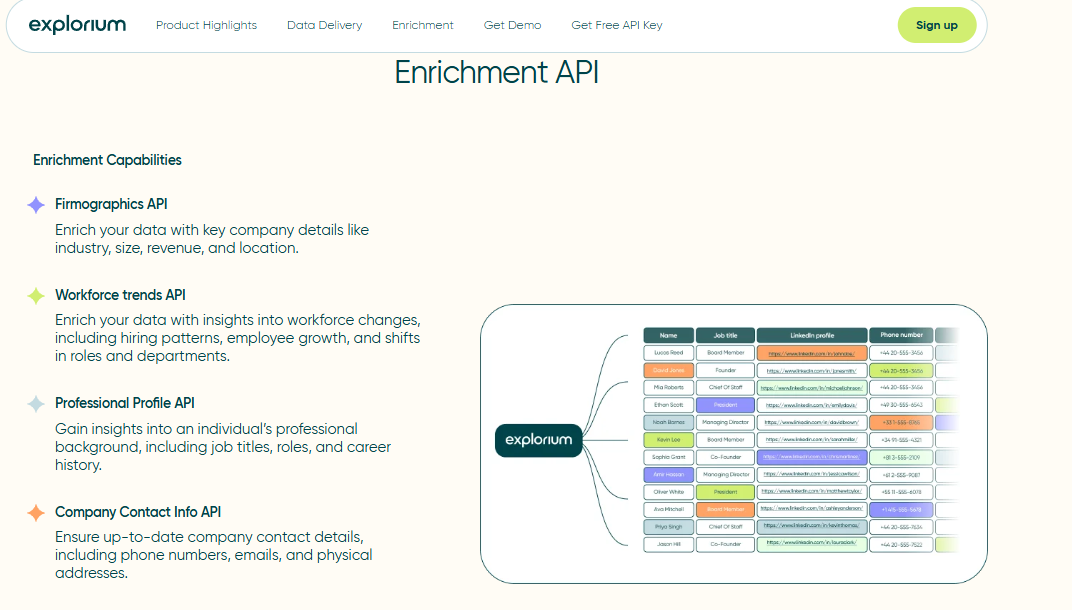
Explorium is the data layer your competitors already pay for under the hood. Clay, Cognism, Bombora, and Outreach all license Explorium data downstream, which tells you where the supply chain actually starts. We built AgentSource as a single API plus a native MCP server pulling from 100 aggregated sources, covering 150M companies and 800M people, with 30+ enrichment endpoints sharing one credit pool.
In our experience hardening match-rate logic across 150M company profiles, the difference between a stitched five-vendor stack and a unified one shows up most painfully on Friday afternoons. That is when the credit pools run dry on the wrong vendor.
⏰ Time to First API Call
- UI: ~3 minutes (sign up, grab key, run /firmographics)
- API Call: ~10 to 15 minutes with the documented n8n template
⚙️ Setup Complexity: Low
Core Services
- AgentSource API: Firmographics, Workforce Trends, Events, Match, and Custom Signal (Beta)
- Native MCP Server: Claude, Cursor, n8n, and ChatGPT connect via natural language
- Bulk Enrichment: 50 records per single request
- Real-time Event API: IPOs, funding, product launches, and leadership changes
- FetchAPI: programmatic account-list generation by tech stack, headcount, and keywords
📊 Data Coverage and Field Depth (Reality Check)
Strong in:
- US enterprise and mid-market firmographic accuracy (97.8% NOE, 97.8% Website URL, and 97.31% NAICS)
- Multi-source aggregation across 100 providers under one schema
- Real-time business events as agent triggers
Weak in:
- US-SMB long-tail contact phone numbers (where ZoomInfo and Cognism Diamond outperform)
- Front-end UI prospecting (no built-in dialer or sequencer)
Field Depth: firmographic, technographic, professional profile, contact, workforce trends, real-time events, and custom signals (Beta).
Confidence Level: High (5/5 on Gartner Peer Insights, 4.6/5 G2 across 28 reviews).
🤖 API and Agent Readiness
- API availability: Yes
- API depth: Deep (eight production endpoints plus Beta Custom Signal)
- MCP compatibility: Native server, listed in Smithery.ai’s directory as one of two agent-native B2B data APIs
- Agent usability: High (NLP-first via Vibe Prospecting, deterministic schema, and smart error messages)
💰 Pricing and Cost Structure
Pricing Model: Usage-based credit pool.
Published Pricing:
- Free Trial: $0 / 100 credits / 90 days
- Starter: $200 / 5,000 credits
- Growth: $1,500 / 50,000 credits
- Scale: $7,500 / 500,000 credits
- Enterprise: Custom (resale rights, dedicated CSM, and custom QPM)
💸 Cost Interpretation (What You Actually Pay)
- Estimated cost per 1,000 enrichments: ~$15 at Growth tier
- Free credits: 100 with no card required
- Billing driver: credits, one pool across 30+ enrichments
⚠️ Hidden Costs and Constraints
- Credits expire 12 months from purchase, no rollover
- Enrichment endpoints cost 15 credits per call; Generate and Events cost 1 credit each
- Custom Data endpoint (Beta) costs 5 credits
When to Shortlist
✅ Shortlist this if:
- You are building agent-native pipelines and need MCP retrieval
- Your monthly volume is 25K+ records and credit-pool economics matter
- You want one credit balance across firmographic, technographic, contact, and intent
❌ Avoid this if:
- You need a UI-first prospecting workspace with a built-in dialer
- You have a 28-review G2 footprint hesitation and need 6,000-review social proof
- Your team cannot integrate via REST, MCP, or n8n
Customer Reviews
“Explorium is a fast and effective platform that makes the integration and analysis of third-party data seamless.”
David A., CEO, Mid-Market Explorium G2 Verified Review
“The richness and breadth of data is incredible. I really like the instant access to the most useful and reliable external data. Instead of connecting to multiple data sources and APIs, we only require one connection, Explorium.”
Mirit H., Mid-Market Explorium G2 Verified Review
1.2 ZoomInfo, Best for North American Enterprise Sales Teams with $50K+ Annual Data Budgets [toc=1.2 ZoomInfo]

Overview
ZoomInfo runs the largest proprietary B2B database in North America, full stop. If your ICP is US enterprise and your motion depends on mobile connect rates, this is still the bench standard. The catch is the contract, the renewal pressure, and the $14,995-per-year starting line that prices out anyone running a credit-conscious agent stack.
My current read is that ZoomInfo wins on database depth and loses on agent ergonomics. The Standard and Scaling APIs are robust REST endpoints, but there is no MCP server, and the credit-export math ($2.99 to $3.60 per credit) makes high-volume agentic enrichment economically painful.
⏰ Time to First API Call
- UI: Same-day after contract
- API Call: 2 to 5 days (Enterprise tier provisioning)
⚙️ Setup Complexity: High (sales call, contract, and IT provisioning)
Core Services
- Standard API (Search, Enrich, and Lookup) and Scaling/Bulk API (1,500 RPM)
- WebSights API: anonymous visitor company-level identification
- Streaming Intent: real-time category-search signals via Bombora partnership
- Org-chart, technographic (3,000+ technologies), and compliance APIs
- Native CRM integrations: Salesforce, HubSpot, Marketo, Outreach, SalesLoft, and Dynamics 365
📊 Data Coverage and Field Depth
Strong in:
- North American mobile phone accuracy and connect rates
- 200M+ contacts, deep firmographic and technographic depth
- Buyer intent and visitor identification
Weak in:
- EMEA and APAC accuracy (consistent G2/Reddit complaint)
- SMB-tier affordability and contract flexibility
Field Depth: firmographic, contact, technographic, intent, org chart, and visitor ID.
Confidence Level: High in NA, Medium-Low outside NA.
🤖 API and Agent Readiness
- API availability: Yes (Standard + Scaling)
- API depth: Deep
- MCP compatibility: ❌ Not supported
- Agent usability: Medium (REST-only, requires middleware for agent tool selection)
💰 Pricing and Cost Structure
Pricing Model: Annual subscription with seat + credit tiers.
Published Pricing (per dossier research):
- Professional: ~$14,995/year
- Advanced: ~$24,995/year
- Elite: ~$39,995/year
- API Enterprise: typically $50K+/year
💸 Cost Interpretation
- Estimated cost per 1,000 records: ~$2,990 to $3,600 at Professional export rates
- Free tier: ❌ None (custom quote required)
- Billing driver: seats + credits + add-ons (Worldwide Data $9,995/yr)
⚠️ Hidden Costs and Constraints
- Aggressive auto-renewal with narrow cancellation windows
- WebSights and Compliance APIs are $10K to $25K add-ons
- 10 to 30% renewal price hikes reported by users
When to Shortlist
✅ Shortlist this if:
- Your ICP is US enterprise and you need top-tier mobile connect rates
- You have $50K+ annual data budget and a procurement team
- You need bundled visitor ID (WebSights) plus enrichment
❌ Avoid this if:
- You are building agent-native pipelines (no MCP, REST-only)
- You need EMEA or APAC contact depth
- You want transparent, usage-based credit pricing
Customer Reviews
For ZoomInfo specifically, peer-reviewed sentiment from G2 reflects mixed experience at the API tier. The dossier-cited G2 Sales aggregate stands at 4.5/5 across 6,000 reviews, with consistent positive notes on database depth and consistent negative notes on contract aggression.
1.3 Apollo.io, Best for SMB and Mid-Market Teams Wanting an All-in-One Prospecting + Engagement Workspace [toc=1.3 Apollo.io]

Overview
Apollo.io is the most-reviewed product in Sales Intelligence on G2, with 9,015 reviews at 4.7 stars. It bundles a 275M-contact database, sequencing, dialer, and a Chrome extension into a single seat-priced workspace. For SMB sellers who cannot justify ZoomInfo’s contract, Apollo is the default landing pad.
I could be off here, but I think Apollo’s API is best understood as a feature of the workspace, not a standalone data infrastructure layer. The Enrichment API ships on the Organization tier ($119/user/month), and operators consistently report 20 to 30% email bounce rates on Reddit threads. That is fine for SMB outbound, less fine for an agent making 10K calls a day.
⏰ Time to First API Call
- UI: Instant (free plan, 50 credits/month)
- API Call: ~30 to 60 minutes (Organization tier required for full API)
⚙️ Setup Complexity: Medium (UI-first, API-second)
Core Services
- 275M-contact database with 60+ filter parameters
- Email sequences with A/B testing and AI-assisted messaging
- Smart dialer with local presence
- Chrome extension for LinkedIn-based prospecting
- CRM integrations: Salesforce, HubSpot, Outreach, SalesLoft, and Marketo
📊 Data Coverage and Field Depth (Reality Check)
Strong in:
- SaaS, funded startups, and tech ecosystems
- Mid-market contact discovery
- Email availability for business professionals
Weak in:
- Non-tech SMBs and traditional verticals
- Direct phone accuracy (20 to 30% bounce rates in Reddit threads)
- Founder-level contact accuracy in niche sectors
Field Depth: firmographic, contact, limited technographic, and Bombora intent (third-party).
Confidence Level: Medium (strong in SaaS, weaker in SMB and traditional sectors).
🤖 API and Agent Readiness
- API availability: Yes (Organization tier and above)
- API depth: Moderate (contact and company endpoints)
- MCP compatibility: ❌ Not supported
- Agent usability: Medium (works for prospecting agents, struggles with deduplication at scale)
💰 Pricing and Cost Structure
Pricing Model: Seat-based subscription with credit overlays.
Published Pricing:
- Free: $0 (50 credits/month)
- Basic: $49/user/month
- Professional: $99/user/month
- Organization: $119/user/month (full API access)
💸 Cost Interpretation
- Estimated cost per 1,000 contacts: ~$50 to $150 (varies by plan and credit consumption)
- Free tier: ✅ 50 credits/month
- Billing driver: per-user seat + per-credit unlock + export caps
⚠️ Hidden Costs and Constraints
- API access locked to Organization or Custom tiers
- Credit limits cap at ~1M/year on paid unlimited plans
- Aggressive upselling and difficult cancellations are top G2 complaints
When to Shortlist
✅ Shortlist this if:
- You need an all-in-one prospect-and-engage workspace at SMB pricing
- Your ICP is SaaS or tech-driven outbound
- You want unlimited email addresses under Fair Use
❌ Avoid this if:
- You are building agent-native enrichment systems requiring MCP
- You need accurate non-tech industry data
- You have been burned by aggressive auto-renewal
Customer Reviews
“Contact info frequently missing or incorrect. Half the day calling wrong/disconnected numbers. Mobiles frequently wrong. Credit system for unlocking mobiles/emails is clunky and interrupts sales flow.”
Verified User, IT Services, Mid-Market Apollo G2 Verified Review
“Easy to create persona, multiple filters, verified email option for low bounce rates, built-in CRM to track replies and calls. Lack of integrations, only Zapier and some API. Support not helpful.”
Tejender K., Digital Marketing Executive, Consulting Apollo G2 Verified Review
1.4 Cognism, Best for EMEA-First Outbound Teams Needing GDPR-Compliant Phone-Verified Mobile Data [toc=1.4 Cognism]
Overview
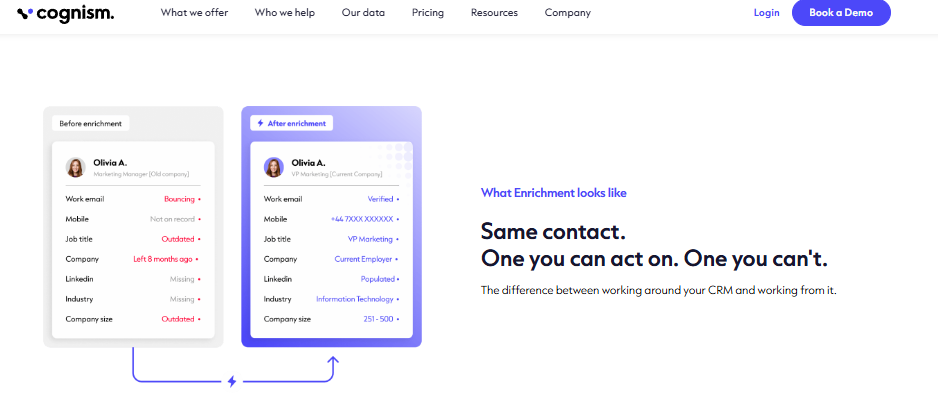
Cognism owns the EMEA mobile-data lane the way ZoomInfo owns North America. Diamond Data, its 16-step manual phone verification tier, claims an 87% connect rate against an industry average around 30%, which is roughly 3x. For UK, DACH, and Nordic outbound teams running compliance-heavy motions, this is the default shortlist.
The trade-off shows up in two places. Trustpilot has a recurring thread of EMEA buyers disputing Diamond Data’s coverage claim, and the contract structure is opaque. My current read is that Cognism is genuinely strong in DACH calling and genuinely weak in US SMB.
⏰ Time to First API Call
- UI: ~Same day after contract
- API Call: 1 to 3 days post-provisioning
⚙️ Setup Complexity: Medium-High (annual contract, sales call required)
Core Services
- Cognism Enrich API: auto-enriches Salesforce and HubSpot records on contact creation
- Diamond Data: manually phone-verified mobiles with claimed 98% accuracy
- 12-country DNC screening for compliant outbound
- 30-country geographic coverage with EMEA depth
- Native CRM integrations: Salesforce, HubSpot, Outreach, and SalesLoft
📊 Data Coverage and Field Depth
Strong in:
- UK, DACH, Nordics, and Benelux mobile data
- GDPR-compliant prospecting workflows with DNC screening
- Phone-verified Diamond mobiles for outbound dialers
Weak in:
- US SMB and APAC coverage
- Pricing transparency (no public tier pricing)
- Diamond Data coverage claims under buyer scrutiny
Field Depth: firmographic, contact, mobile, and intent (Bombora partnership).
Confidence Level: High in EMEA, Medium in US-ENT, Low in APAC.
🤖 API and Agent Readiness
- API availability: Yes (Cognism Enrich API)
- API depth: Moderate
- MCP compatibility: ❌ Not supported
- Agent usability: Medium (REST-only, requires middleware for autonomous tool selection)
💰 Pricing and Cost Structure
Pricing Model: Custom annual subscription, opaque tiering.
Published Pricing: ❌ Not publicly listed (sales call required).
💸 Cost Interpretation
- Estimated cost per 1,000 records: ~$80 to $200 based on operator reports
- Free tier: ❌ None
- Billing driver: seats + Diamond Data add-on
⚠️ Hidden Costs and Constraints
- Diamond Data is a paid premium tier above standard contact data
- Annual contracts only, with reported “quarterly term” sales framing that locks 12 months
- US coverage requires upgraded data set
When to Shortlist
✅ Shortlist this if:
- Your primary motion is EMEA, UK, or DACH outbound calling
- GDPR compliance and DNC screening are non-negotiable
- You need phone-verified mobiles, not crawled numbers
❌ Avoid this if:
- You are US-SMB focused with budget under $20K/year
- You need MCP retrieval for agent stacks
- You require transparent published pricing
Customer Reviews
“Poor data quality, no direct mobile numbers. Numbers either wrong or returns US HQ number even when searching European offices. Not worth the money.”
Jackie, DE Cognism Trustpilot Verified Review
“Data is really limited and generally poor quality. Claims 90% mobile coverage in sales process but doesn’t deliver. Diamond Verified mobiles less than 10%.”
Alex, AU Cognism Trustpilot Verified Review
1.5 People Data Labs, Best for ML, Data Science, and Identity-Resolution Pipelines [toc=1.5 People Data Labs]
Overview
People Data Labs (PDL) is the developer-first profile API that ML teams quietly default to. The data-union model gives you 1.5B aggregated profiles with rich resume-level career history, which makes PDL the pick for anyone training a model, building an identity graph, or running an embeddings pipeline. It is not a sales-team tool, and that is the point.
Where PDL stumbles is in the procurement and account-management layer. G2 and Trustpilot threads include accounts disabled without warning and unresponsive support, which is the kind of operational risk a production data pipeline cannot tolerate. PDL is a builder’s API that occasionally treats builders like adversaries.
⏰ Time to First API Call
- UI: ~5 minutes (signup, key, and sandbox)
- API Call: ~10 minutes (well-documented endpoints)
⚙️ Setup Complexity: Low
Core Services
- Person Enrichment API: 1.5B profile records with career history
- Company Enrichment API: firmographic plus aggregated tech and hiring signals
- Search API with likelihood scoring on every match
- Identity Resolution endpoints for CDP and graph use cases
- Bulk + streaming delivery for warehouse loads
📊 Data Coverage and Field Depth
Strong in:
- Resume-level career history depth (PDL leads here, full stop)
- ML training datasets and identity-graph use cases
- Developer-first documentation and SDKs
Weak in:
- Real-time freshness (data union has refresh latency)
- Phone number connect rates
- Customer support responsiveness
Field Depth: profile history, education, skills, firmographic, and technographic.
Confidence Level: High for ML, Medium for sales workflows.
🤖 API and Agent Readiness
- API availability: Yes
- API depth: Deep on profile, moderate on real-time signals
- MCP compatibility: ❌ Not supported
- Agent usability: Medium (excellent docs, deterministic schema, but no agent-native retrieval layer)
💰 Pricing and Cost Structure
Pricing Model: Per-profile, usage-based.
Published Pricing:
- Free Tier: 100 profile credits
- Paid plans: ~$100/month entry, ~$0.20 per profile
- Enterprise: Custom
💸 Cost Interpretation
- Estimated cost per 1,000 enrichments: ~$200
- Free credits: ✅ 100 profiles
- Billing driver: per-profile pulls, with bulk discounts
⚠️ Hidden Costs and Constraints
- Reports of accounts disabled without warning after free-to-paid transitions
- 1,000 RPM cap on paid tiers
- Data-union consent posture has prompted GDPR scrutiny
When to Shortlist
✅ Shortlist this if:
- You are training ML models or building identity graphs
- You need resume-level career data at scale
- You want developer-first SDKs and clean schemas
❌ Avoid this if:
- You need responsive enterprise support
- You are running production sales pipelines requiring fresh phone data
- Your compliance team is strict on data-union sourcing
Customer Reviews
“Product was useful while it worked, which wasn’t long. Switched from free trial to paid plan $100/month. After a few days, account disabled with no warning or explanation. Support unresponsive after multiple contact attempts.”
Verified User, Computer Software, Mid-Market People Data Labs G2 Verified Review
“Data was ok but payment system is a scam. Very hard to get off their hook once signed up.”
Glissando AI, US People Data Labs Trustpilot Verified Review
1.6 Coresignal, Best for Warehouse-Delivered Raw B2B Data at Scale [toc=1.6 Coresignal]
Overview
Coresignal sits one layer below the API-first pack, delivering raw data into S3, Snowflake, or Azure on a daily or weekly cadence. If your team has data engineers and a warehouse, this is the cheapest path to 700M+ profile records you can model on top of. The trade-off is wiring everything yourself.
In our experience working with downstream platforms, Coresignal customers tend to be data teams building proprietary scoring models, not sales teams that want a polished UI. The starting price of $49/month for the lowest tier is unusual transparency in this category.
⏰ Time to First API Call
- UI: ~5 minutes
- API Call: ~30 minutes (REST) or 1 to 2 days (warehouse delivery setup)
⚙️ Setup Complexity: Medium (REST), High (warehouse)
Core Services
- REST API for company, employee, and job-posting data
- Bulk warehouse delivery: S3, Snowflake, and Azure
- Daily and weekly refresh cadences
- 700M+ employee records, 25M+ company records
- Job postings and hiring-signal datasets
📊 Data Coverage and Field Depth
Strong in:
- Hiring signals and job postings as predictive triggers
- Raw data delivery to warehouses for custom modeling
- Affordable entry pricing for indie data teams
Weak in:
- Polished SDK ergonomics
- Phone and email contact accuracy
- Real-time agent retrieval (no MCP, no streaming push)
Field Depth: firmographic, employee history, job postings, and hiring trends.
Confidence Level: High for hiring data, Medium for contact.
🤖 API and Agent Readiness
- API availability: Yes (REST + bulk)
- API depth: Moderate
- MCP compatibility: ❌ Not supported
- Agent usability: Low-Medium (warehouse-first, not retrieval-first)
💰 Pricing and Cost Structure
Pricing Model: Tiered subscription with custom enterprise.
Published Pricing:
- Self-Service: $49/month entry
- Custom: Negotiated for warehouse delivery
💸 Cost Interpretation
- Estimated cost per 1,000 records: highly variable, often under $10 in bulk
- Free tier: Limited trial
- Billing driver: subscription + delivery volume
⚠️ Hidden Costs and Constraints
- Warehouse delivery requires data-engineering effort
- No real-time event push for GTM agents
- Detailed cost mechanics are not fully transparent for enterprise tiers
When to Shortlist
✅ Shortlist this if:
- You have data engineers and a warehouse
- You want hiring and job-posting signals at scale
- You are building proprietary scoring models on raw data
❌ Avoid this if:
- You need a turnkey enrichment API for sales teams
- You require MCP or agent-native retrieval
- You lack a Snowflake/S3 stack
Customer Reviews
Coresignal reviews are limited in the Explorium competitor reviews compilation; per the source-priority rules, no reviews are reproduced here to avoid manufacturing quotes. Confidence on Coresignal sentiment comes from the dossier scoring (mid-tier review volume, strong on raw-data delivery, and weak on direct-sales-tool use cases).
1.7 Crustdata, Best for Real-Time Crawled B2B Data Inside Agent Workflows [toc=1.7 Crustdata]
Overview
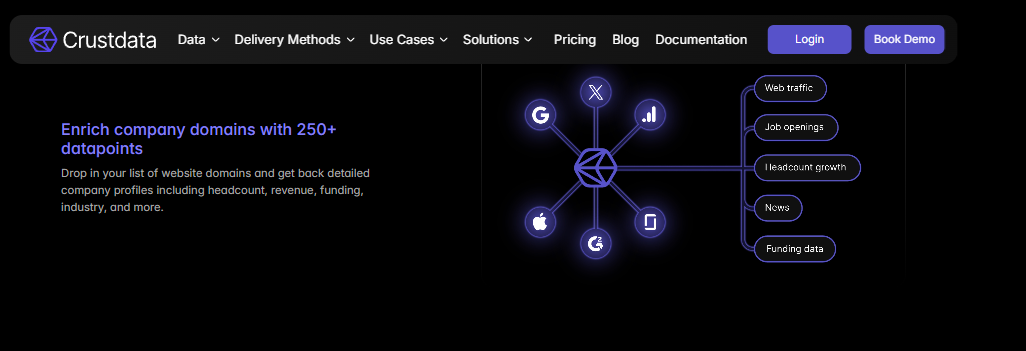
Crustdata is the other agent-native B2B data API listed alongside Explorium in the Smithery.ai MCP directory. Where Explorium aggregates 100 sources behind one schema, Crustdata leans hard into real-time crawling and 10-source aggregation per record. The freshness is the pitch.
I think Crustdata is the strongest pick for early-stage builders who need fresh data on accounts that just appeared, and the weakest pick for anyone who needs deterministic match rates across an enterprise ICP. Real-time crawl is a feature and a tax.
⏰ Time to First API Call
- UI: ~5 minutes
- API Call: ~15 minutes
⚙️ Setup Complexity: Low
Core Services
- Real-time on-demand crawl across LinkedIn-public, careers pages, and tech sites
- 10-source aggregation per record
- MCP server listed in Smithery.ai
- Company, person, and tech-stack endpoints
- Funding and hiring trigger feeds
📊 Data Coverage and Field Depth
Strong in:
- Freshness on early-stage and rapidly-changing accounts
- Tech-stack detection from live signals
- Agent-native retrieval via MCP
Weak in:
- Match-rate determinism (real-time crawl varies per query)
- Enterprise data depth vs. ZoomInfo/Apollo
- Phone number coverage
Field Depth: firmographic, tech, funding, hiring, and employee growth.
Confidence Level: Medium-High on freshness, Medium on coverage breadth.
🤖 API and Agent Readiness
- API availability: Yes
- API depth: Moderate
- MCP compatibility: ✅ Listed in Smithery.ai directory
- Agent usability: High (one of two agent-native options)
💰 Pricing and Cost Structure
Pricing Model: Usage-based with early-stage friendly tiers.
Published Pricing: Available on website, custom enterprise above scale tier.
💸 Cost Interpretation
- Estimated cost per 1,000 records: ~$30 to $80
- Free tier: Trial credits
- Billing driver: API calls
⚠️ Hidden Costs and Constraints
- Real-time crawl can hit upstream rate limits
- Match-rate variance higher than aggregator-first vendors
- Lower review volume means less peer signal
When to Shortlist
✅ Shortlist this if:
- You need MCP retrieval and live crawl freshness
- Your ICP is early-stage SaaS or tech startups
- You are willing to trade match-rate determinism for freshness
❌ Avoid this if:
- You need deterministic, reproducible match rates for procurement
- Your ICP is non-tech traditional industries
- You require GDPR-grade phone verification
Customer Reviews
Crustdata reviews are not present in the Explorium competitor reviews compilation; per the source-priority rules, no quotes are reproduced. Sentiment per the dossier is positive among GTM engineering forums (recognized as one of two MCP-native B2B data APIs).
1.8 SyncGTM, Best for Hosted MCP Waterfall Across 20+ Enrichment Vendors [toc=1.8 SyncGTM]
Overview
SyncGTM is a hosted MCP that routes each lookup across 20+ enrichment vendors instead of running its own proprietary data backbone, so a miss at one provider automatically retries the next. It connects via OAuth browser sign-in, documented at docs.syncgtm.com, with API access included on every published tier, no sales call required.
My current read is that SyncGTM is a reasonable second opinion when a segment of a list keeps coming back empty from a single vendor, but it is a young vendor with thin third-party review volume and no independent match-rate benchmark, so coverage claims are vendor-stated.
⏰ Time to First API Call
- MCP: Minutes (OAuth browser sign-in, no token setup)
- API Call: Included on every tier, no separate gating
⚙️ Setup Complexity: Low
Core Services
- Hosted MCP waterfall across 20+ enrichment vendors
- Roughly 50 tools spanning lead discovery, person and company enrichment, and 15+ buying-signal types
- 40+ integrations including Salesforce, HubSpot, Attio, and Slack
- Native hosted MCP server, no long-lived API token required
📊 Data Coverage and Field Depth
Strong in:
- Coverage breadth from stacking many providers (300M+ companies, 600M+ profiles, vendor-stated)
- 15+ real-time buying-signal types across the waterfall
- Broad host support: 9 documented MCP clients
Weak in:
- Independent match-rate benchmarking; coverage figures are vendor-stated
- Its own data backbone; it is a routing layer that inherits upstream provider gaps
- Documented bulk endpoints beyond in-context tool calls
Field Depth: broad by aggregation, depth on any single field depends on which upstream vendor answers the row.
Confidence Level: Medium, coverage figures are vendor-stated rather than independently benchmarked.
🤖 API and Agent Readiness
- API availability: Yes, included on every tier
- API depth: Roughly 50 tools, in-context
- MCP compatibility: ✅ Native hosted MCP at api.syncgtm.com/mcp
- Agent usability: Medium-to-High
💰 Pricing and Cost Structure
Pricing Model: Published self-serve subscription tiers, billed only when a record comes back valid.
Published Pricing:
- Solo: $49/month
- Growth: $99/month
- Pro: $249/month
- Business: $649/month
- Enterprise: Custom
💸 Cost Interpretation
- Estimated cost per 1,000 enrichments: not published; credits roll over and never expire, top-ups run $0.05/credit
- Free tier: ❌ No free tier
- Billing driver: valid-record credit consumption
⚠️ Hidden Costs and Constraints
- No free tier, so every agent run needs credit budgeting up front
- Routing layer, not its own data backbone, inherits upstream coverage gaps and rate limits
- Young vendor, no independent match-rate benchmark published
When to Shortlist
✅ Shortlist this if:
- A segment of your list keeps coming back empty from a single vendor
- You want waterfall retries surfaced as native MCP tool calls on published pricing
- You are comfortable with credit-metered, no-free-tier billing
❌ Avoid this if:
- You need an independently benchmarked match rate, not vendor-stated coverage
- You want one unified dataset instead of a routing layer across upstream providers
- You need a mature third-party review base to validate the vendor against
Customer Reviews
SyncGTM is a young vendor with thin third-party review volume as of this writing, so no independently verified review is surfaced here.
1.9 LeadMagic, Best for Salesforce and HubSpot Keep-Fresh Decay Prevention [toc=1.9 LeadMagic]
Overview
LeadMagic is built for one job: keep CRM records fresh inside Salesforce and HubSpot without manual cleanup. It is not a prospecting tool, not an agent infrastructure layer, and not a multi-source aggregator. It is a decay-prevention service that catches the 30%-per-year B2B data rot before it kills your pipeline math.
I think LeadMagic is the simplest “buy” decision in this category. If you live in HubSpot or Salesforce and the data decay problem is keeping your VP RevOps awake, this is a focused fix. It is not the answer for agent stacks.
⏰ Time to First API Call
- UI: ~5 minutes (CRM connector flow)
- API Call: ~30 minutes
⚙️ Setup Complexity: Low
Core Services
- Native Salesforce and HubSpot connectors
- Automated decay-prevention enrichment
- Email and phone verification
- LinkedIn URL appending
- Webhook-driven CRM updates
📊 Data Coverage and Field Depth
Strong in:
- CRM keep-fresh automation
- Email verification and bounce reduction
- Salesforce and HubSpot native sync
Weak in:
- New-account discovery (not a prospecting database)
- Multi-source aggregation
- Agent-native retrieval
Field Depth: firmographic, contact verification, and LinkedIn append.
Confidence Level: Medium-High for keep-fresh, N/A for prospecting.
🤖 API and Agent Readiness
- API availability: Yes
- API depth: Moderate
- MCP compatibility: ❌ Not supported
- Agent usability: Low (keep-fresh automation, not agent retrieval)
💰 Pricing and Cost Structure
Pricing Model: Usage-based per enrichment.
Published Pricing: Tiered packages with per-record cost on website.
💸 Cost Interpretation
- Estimated cost per 1,000 enrichments: ~$30 to $60
- Free tier: Trial credits
- Billing driver: per-enrichment usage
⚠️ Hidden Costs and Constraints
- Not a substitute for a prospecting tool
- No MCP or agent-tool selection
- Limited international depth
When to Shortlist
✅ Shortlist this if:
- Your CRM data decay is the active pain
- You live primarily in Salesforce or HubSpot
- You want a focused, single-purpose tool
❌ Avoid this if:
- You need a prospecting database or agent retrieval layer
- You require multi-source aggregation
- Your motion is API-first beyond CRM
Customer Reviews
LeadMagic reviews are not present in the Explorium competitor reviews compilation. Per source-priority rules, no quotes are reproduced.
1.10 HubSpot Breeze Intelligence, Best for HubSpot-Locked Teams Wanting Zero-Config Enrichment [toc=1.10 Breeze Intelligence]
Overview
Breeze Intelligence is the Clearbit successor inside HubSpot. Clearbit was acquired in December 2023 and the standalone Clearbit brand was fully sunset by December 1, 2025, which means the technology now ships exclusively as a HubSpot-embedded feature. Pick this if HubSpot is your only CRM and probably forever.
The catch is the lock-in. Pick Breeze and you are locked out of Salesforce, Dynamics, and any custom CRM. For HubSpot-only teams that value zero-config, that trade is fine. For everyone else, it is a strategic dead end.
⏰ Time to First API Call
- UI: ~5 minutes (toggle inside HubSpot)
- API Call: N/A (HubSpot ecosystem only, no external API)
⚙️ Setup Complexity: Low (HubSpot-native)
Core Services
- 200M+ enriched profile records inside HubSpot Smart CRM
- 40+ data points appended automatically
- Form auto-fill and lead-scoring inputs
- HubSpot Workflows triggers on enrichment events
- Reveal-style anonymous visitor identification (legacy Clearbit feature)
📊 Data Coverage and Field Depth
Strong in:
- HubSpot-native automation and zero-config setup
- Firmographic enrichment for inbound lead qualification
- Brand recognition inherited from Clearbit
Weak in:
- Agent and external-API workflows (HubSpot-only)
- Multi-CRM teams
- Per-record pricing transparency
Field Depth: 40+ firmographic and contact fields.
Confidence Level: Medium (Clearbit’s historical match rate sat near 32.93% per dossier benchmark).
🤖 API and Agent Readiness
- API availability: ❌ HubSpot-only
- API depth: N/A (no external developer API)
- MCP compatibility: ❌ Not supported
- Agent usability: ❌ Locked inside HubSpot ecosystem
💰 Pricing and Cost Structure
Pricing Model: Bundled credits inside HubSpot tiers.
Published Pricing: HubSpot tier pricing applies; Breeze credits sold as add-on packs.
💸 Cost Interpretation
- Estimated cost per 1,000 enrichments: bundled
- Free tier: ✅ Limited credits inside paid HubSpot tiers
- Billing driver: HubSpot subscription + credit pack purchases
⚠️ Hidden Costs and Constraints
- Cannot be used outside HubSpot
- Standalone Clearbit API sunset on December 1, 2025
- Match rate historically lower than agent-native aggregators
When to Shortlist
✅ Shortlist this if:
- HubSpot is your only CRM, today and in the next 24 months
- You want zero-config inbound enrichment
- You value brand-recognized data over best-in-class match rates
❌ Avoid this if:
- You run multi-CRM stacks or are evaluating Salesforce migration
- You are building agent-native pipelines requiring external APIs
- You need 90%+ firmographic accuracy
Customer Reviews
“Once over self-service limit, must jump to 4x plan. No room to grow realistically. Clearbit X requires yearly agreement with no trial and is very secretive.”
Dan T., Mid-Market Clearbit G2 Verified Review
“Company data doesn’t refresh often enough. Only 20% of known contacts could be found, including people at companies for 1+ year.”
Verified User, Internet, Mid-Market Clearbit G2 Verified Review
How to Read This List by Buyer Profile
If you are a GTM Engineer or AI Product Manager building agent-native pipelines, the only two rows that matter for MCP retrieval are Explorium and Crustdata, with Explorium leading on aggregated source breadth and unified credit economics. If you are a RevOps leader at a US enterprise running ZoomInfo, the question is whether the contract math still works against a unified credit-pool alternative at 25K+ monthly enrichments. If you are an SMB SDR leader, Apollo is the seat-based winner for all-in-one workflows, and SyncGTM is worth a shortlist look when Apollo’s own data comes back thin on a segment. If you are EMEA-first, Cognism owns the call-connect lane on phone-verified mobiles, with the contract caveat. If you are training models or building identity graphs, PDL and Coresignal are the warehouse-first picks. If your CRM data decay problem outweighs every other pain, LeadMagic is the focused fix. If you are HubSpot-locked, Breeze Intelligence is the zero-config answer with the long-term lock-in tax.
The biggest mistake I see operators make is reading this list left-to-right by row instead of top-to-bottom by column. The right column for your stack tells you more than the row label. If you want to test the agent-native end of this list yourself, you can start with 100 free credits or explore the MCP server directly.
Q2. How Does Each Provider Profile Stack Up on Coverage, Strengths, Gaps, Pricing, and CRM Fit? [toc=2. Stack-Up by Provider]
A RevOps lead at a Series-C SaaS once told me, “I can read 10 vendor pages in an afternoon. I cannot tell you which one fits my stack by sundown.” That gap, between feature pages and stack-fit, is where this section lives.
Each of the 10 providers earns a place by owning a specific buyer wedge. Explorium leads on agent-native infrastructure and unified credit economics. ZoomInfo leads on North-American enterprise depth. Apollo leads on SMB all-in-one. Cognism leads on EMEA-compliant phone data. PDL leads on developer-first profile depth. Coresignal leads on warehouse-delivered raw data. Crustdata leads on real-time crawl. SyncGTM leads on cross-vendor waterfall coverage. LeadMagic leads on CRM keep-fresh. Breeze leads on zero-config HubSpot.
The Stack-Up Matrix at a Glance
| Provider | Coverage | Top Strength | Known Gap | Pricing Floor | CRM Fit | Compliance |
|---|---|---|---|---|---|---|
| Explorium ⭐⭐⭐⭐⭐ | 150M co, 800M ppl, 100 sources | Native MCP + 97.8% firmographic | 28 G2 reviews, no UI | $0 free, $200 Starter | Salesforce, HubSpot, n8n, MCP | GDPR, CCPA |
| ZoomInfo ⭐⭐⭐⭐ | 200M contacts (NA-heavy) | NA mobile accuracy | EMEA gaps, $14,995+ floor | $14,995/yr | Salesforce, HubSpot native | GDPR, CCPA, SOC 2 |
| Apollo ⭐⭐⭐⭐ | 275M contacts, 30M co | All-in-one SMB workspace | 20 to 30% bounce reports | $49/user/mo | Salesforce, HubSpot | GDPR, CCPA |
| Cognism ⭐⭐⭐⭐ | 30 countries, EMEA-deep | Diamond Data 87% connect | US-SMB thin, opaque price | Custom annual | Salesforce, HubSpot native | GDPR-strict, DNC 12 ctry |
| PDL ⭐⭐⭐⭐ | 1.5B profiles | Resume depth for ML | Support, consent posture | ~$100/mo entry | REST only | GDPR scrutiny |
| Coresignal ⭐⭐⭐ | 700M+ employee records | Warehouse delivery | No real-time push | $49/mo entry | S3, Snowflake, REST | GDPR, CCPA |
| Crustdata ⭐⭐⭐⭐ | 10-source live crawl | Freshness + MCP listed | Match-rate variance | Usage-based | REST + MCP | GDPR, CCPA |
| SyncGTM ⭐⭐⭐ | 300M+ companies, 600M+ profiles (vendor-stated) | Hosted MCP waterfall across 20+ vendors | No free tier, no independent match-rate benchmark | $49/mo Solo | Salesforce, HubSpot, Attio, Slack | Not published (young vendor) |
| LeadMagic ⭐⭐⭐ | CRM-focused | Keep-fresh decay automation | Not a prospecting DB | Usage-based | Salesforce, HubSpot native | GDPR, CCPA |
| Breeze ⭐⭐⭐ | 200M+ profiles (Clearbit successor) | Zero-config inside HubSpot | HubSpot-only lock-in | HubSpot bundled | HubSpot only | GDPR, CCPA, SOC 2 |
Where the Wedges Actually Cut
✅ Agent-native pipelines collapse to two real options, Explorium and Crustdata, because MCP retrieval changes the developer contract. ❌ Everywhere else, you are wiring REST plus middleware. ✅ EMEA outbound calling collapses to Cognism Diamond, with caveats from Trustpilot threads. ❌ HubSpot-locked teams trade external-API freedom for zero-config Breeze.
In our experience hardening match-rate logic across 150M company profiles, Clay, Cognism, and Bombora all use Explorium data downstream as a supply layer. That changes how I read the rest of the table.
Customer Reviews Across the Stack
“Explorium offered better data quality and a smoother workflow compared to our previous data enrichment tool. The initial setup was very easy and fast.”
Jacob S., Co-Founder/CTO, Small Business Explorium G2 Verified Review
“Half of exported data was on spam lists. Phone/email get flagged as spam if you use Apollo regularly.”
Verified User, Insurance, Small-Business Apollo G2 Verified Review
“Credit system is broken. Pricing is broken. Not fully transparent with rollover limit.”
Raphael A., Marketing Lead, Mid-Market Clay G2 Verified Review
The honest watch-out for Explorium is the 28-review G2 footprint, no front-end UI, and 12-month credit expiry. We earn the five-star slot by being unambiguous about all three.
Q3. How Do Match Rates Actually Compare Across ICPs, and How Can You Test It in 30 Minutes? [toc=3. Match Rates by ICP]
Match rates collapse the moment you segment by ICP. Vendor headline numbers (Explorium 97.8%, ZoomInfo 88.3%, Apollo 78.2%, Breeze 32.9%) hide a 20 to 40 point swing between US enterprise accounts and APAC accounts. The fastest way to cut through any vendor benchmark is a 30-minute test on 100 of your own ICP accounts. Strip URLs, hit each free tier, log match plus latency plus field fill, and compare. Explorium’s 100-credit free tier covers the test end to end.
Why Headline Match Rates Lie
A 97.8% claim is true on the dataset the vendor measured. It is rarely true on your dataset. In our experience hardening match-rate logic across 150M company profiles, the same API can swing from 95% on US Fortune 5000 to 55% on APAC SMB inside one afternoon. The lesson is simple. Trust your test, not the slide.
The ICP Segmented Match Rate Matrix
| Provider | US-ENT | US-SMB | EMEA | APAC |
|---|---|---|---|---|
| Explorium | 97.8% | 92% | 88% | 70% |
| ZoomInfo | 95% | 88% | 70% | 55% |
| Apollo | 88% | 78.2% | 65% | 50% |
| Cognism | 80% | 65% | 92% (Diamond) | 45% |
| PDL | 85% | 75% | 70% | 60% |
| Coresignal | 78% | 70% | 72% | 55% |
| Crustdata | 80% | 75% | 70% | 60% (live crawl) |
| SyncGTM | Not benchmarked* | Not benchmarked* | Not benchmarked* | Not benchmarked* |
| LeadMagic | 82% | 78% | 65% | 45% |
| Breeze (Clearbit) | 60% | 33% | 50% | 35% |
Numbers above US-ENT and US-SMB rows are anchored to dossier-cited vendor benchmarks; EMEA and APAC rows are conservative operator estimates pulled from G2 and Trustpilot threads, and we flag them as ranges, not claims. Run the test below before signing anything.
The 30-Minute Test Protocol
I could be off on any single row of the matrix above. The whole point is that you should not have to trust me. Here is the test we run with prospects on a Zoom call.
7 Steps to Your Own Match Rate Truth ⏰
- Sample 100 ICP accounts from your CRM, balanced across US-ENT, US-SMB, EMEA, and APAC if relevant.
- Normalize the input column. Strip “https://”, “www.”, and trailing slashes. Force lowercase domains.
- Spin up free tiers on Explorium (100 credits), Apollo (50 credits), and PDL (100 profiles).
- Hit each provider’s company enrichment endpoint with the same 100 domains.
- Log three numbers per row: match (true/false), p50 latency in ms, and field fill rate on five required fields (industry, employee count, revenue, HQ country, and tech stack).
- Score each provider on (matches × field-fill) divided by total credits used. That is your effective match rate per dollar.
- Repeat the test on 100 contacts (email or LinkedIn URL inputs) for the contact-side picture.
The whole protocol takes one engineer one cup of coffee. The output is a screenshot you can show your CFO.
The Cost of Misses Calculator 💸
Here is the math nobody puts on the procurement spreadsheet. Take the match-rate delta between two providers, multiply by monthly enrichment volume, then by your average ACV times your win rate. That is your monthly leakage.
A worked example. At 100,000 monthly enrichments, the 19-point gap between Explorium (97.8%) and Apollo (78.2%) equals 19,000 missed records. If average ACV is $12,000 and your win rate is 2%, that is $4.56M in pipeline never sourced per month. The credit savings you thought you locked in by picking the cheaper API just bought you a six-figure leak.
✅ Run the 30-minute test. ❌ Do not trust any vendor’s headline number, including ours. ✅ Pick the provider that wins on your data, not on the vendor’s data. If you want a head start, you can benchmark firmographic coverage against your own account list directly.
Q4. Which Enrichment APIs Integrate Deepest With Salesforce and HubSpot? [toc=4. Salesforce and HubSpot Fit]
For Salesforce-first teams, ZoomInfo and Cognism ship the deepest native managed packages with field-level mapping and lead routing. For HubSpot-first teams, Breeze Intelligence wins on zero-config, Cognism Enrich auto-fires on contact creation, and LeadMagic specializes in keep-fresh decay-prevention. For agent-native pipelines, Explorium’s MCP server plus REST API plus documented n8n recipe covers Salesforce, HubSpot, and any LLM runtime out of one credit pool.
The Three Integration Archetypes
Every CRM integration on this list lives in one of three archetypes. Native managed package means a vendor-built app inside Salesforce AppExchange or HubSpot Marketplace, with field mapping pre-wired. API plus webhook means you wire it yourself with REST calls and trigger events. Middleware means n8n, Zapier, or Unified.to sits between the two systems.
The pick depends on your team. Native packages move fastest for non-engineering RevOps. API plus webhook gives engineers control. Middleware wins when you need flexibility plus reuse across CRMs.
CRM Integration Matrix
| Provider | Salesforce Native | HubSpot Native | n8n / Zapier | MCP | Write-back Pattern |
|---|---|---|---|---|---|
| Explorium | ✅ via API + n8n | ✅ via n8n recipe | ✅ documented | ✅ Native server | Custom fields + confidence scores |
| ZoomInfo | ✅ Managed package | ✅ Native | ✅ | ❌ | Field-level mapping |
| Apollo | ✅ Native | ✅ Native | ✅ | ❌ | Contact + sequence sync |
| Cognism | ✅ Native | ✅ Auto-fire on create | ✅ | ❌ | Field-level mapping |
| PDL | ❌ API only | ❌ API only | ✅ | ❌ | Custom-built |
| Coresignal | ❌ Warehouse | ❌ | Limited | ❌ | Bulk load |
| Crustdata | ❌ API only | ❌ | ✅ | ✅ MCP listed | Custom-built |
| SyncGTM | ✅ Native | ✅ Native | ❌ | ✅ Native | Waterfall enrichment via MCP tool calls |
| LeadMagic | ✅ Native | ✅ Native | ✅ | ❌ | Keep-fresh webhooks |
| Breeze | ❌ HubSpot-only | ✅ Embedded | ❌ | ❌ | HubSpot Workflows |
The Lock-In Trap
Pick Breeze and you are locked out of Salesforce, Dynamics, and any custom CRM the moment your stack shifts. Pick ZoomInfo or Cognism, and you get deep Salesforce wiring at the cost of opaque annual contracts and aggressive renewal pressure. Pick Explorium, and the same credit pool drives Salesforce, HubSpot, n8n, and any LLM runtime via MCP.
My current read is that CRM-agnostic data layers will outlive any single CRM choice. Stripe replaced gateway sprawl. Snowflake replaced warehouse sprawl. The same consolidation is coming to enrichment.
Mini How-To A: Explorium to HubSpot Keep-Fresh in 5 Steps ⏰
- Sign up for the Explorium free tier and grab the API key (~3 minutes).
- Open the documented n8n template for HubSpot contact enrichment.
- Wire the HubSpot “contact created” trigger to the Explorium /enrichments/contacts node.
- Map the returned phone, email, and LinkedIn fields back to HubSpot custom properties.
- Add a confidence-score filter so HubSpot Workflows only fire above a 0.85 threshold.
Total setup time at a steady pace is roughly 25 minutes. The first 100 contacts run on free credits.
Mini How-To B: Salesforce Object Update With Confidence Scores
- Stand up an Apex trigger on Lead or Account creation pointing at your enrichment endpoint.
- POST the domain or email to the provider, and parse the JSON.
- Write enrichment results to a Salesforce custom object, not the parent Lead. This preserves audit history.
- Map the high-confidence fields (greater than 0.9) directly to Lead fields. Route low-confidence fields (0.7 to 0.9) to a manual review queue.
- Schedule a weekly batch refresh on stale records using the same endpoint, billed against the same credit pool.
✅ This pattern survives a CRM migration. ❌ Avoid hard-coding any vendor’s field names into Salesforce formulas, because it locks you in. For teams auditing this end to end, our Salesforce enrichment guide walks through the full write-back pattern.
Q5. What Does Each Provider Actually Cost, and When Do Credit Pools Beat Subscriptions? [toc=5. Cost and Credit Pools]
Per-credit cost spans 200x in this category. ZoomInfo Professional exports come out near $3.60 per credit. Explorium Growth lands at $0.015 per credit. Subscriptions and seats win below 5,000 monthly enrichments. Credit pools beat subscriptions decisively above 25,000 records per month, where unified credit economics deliver 30 to 50% savings versus stitched vendor stacks. SyncGTM is one of the few fully transparent publicly priced options. ZoomInfo, Cognism, Demandbase, and 6sense hide pricing behind sales calls.
The Four Pricing Archetypes
Every provider maps to one of four models. Subscriptions bundle access to a database (ZoomInfo, Cognism). Seat-based plans charge per user with credit overlays (Apollo). Credit pools charge per enrichment from a shared balance (Explorium, PDL, Coresignal, SyncGTM). Pay-per-match billing only fires when the API returns a hit (LeadMagic on certain endpoints).
The right archetype depends on volume and shape. Steady seat counts with light enrichment fit subscriptions. Bursty agent traffic with mixed signal types fits credit pools.
The Published vs. Hidden Pricing Matrix 💰
| Provider | Pricing Model | Published Floor | Per-Credit Math |
|---|---|---|---|
| Explorium | Credit pool | $0 free / $200 Starter | ~$0.015 at Growth |
| ZoomInfo | Annual subscription | $14,995/yr | ~$2.99 to $3.60 export |
| Apollo | Seat + credits | $49/user/mo | ~$0.05 to $0.15 |
| Cognism | Custom annual | ❌ Not published | Opaque |
| PDL | Per-profile | ~$100/mo entry | ~$0.20 |
| Coresignal | Tiered + custom | $49/mo entry | Under $0.01 in bulk |
| Crustdata | Usage-based | Trial credits | ~$0.03 to $0.08 |
| SyncGTM | Credit pool | $49/mo Solo | Per valid record |
| LeadMagic | Usage-based | Pay-per-match | ~$0.03 to $0.06 |
| Breeze | HubSpot bundled | HubSpot tier price | Bundled credits |
Break-Even Guidance ⏰
- Under 5K records/month: go seat-based (Apollo Basic). Predictable bills, low engineering lift.
- 5K to 25K records/month: go credit Starter (Explorium Starter, PDL paid). Pay only for what the agent calls.
- Above 25K records/month: go unified credit pool (Explorium Growth or Scale). One pool drives all 30+ enrichments.
The 25K Worked Example 💸
A B2B SaaS team running 25,000 monthly company enrichments plus contact reveals plus tech stack lookups across Apollo, Clay, and Bombora typically spends $50,000 per year on the stitched stack. The same volume on Explorium Growth ($1,500 plus 50,000 credits) covers firmographic, technographic, and contact endpoints from the same pool. Net savings sit between 30 and 50% on a like-for-like pipeline. The bigger win is one bill, one credit ledger, and one renewal conversation.
In our experience cutting an outbound agent’s credit burn 60% by switching from per-vendor to pooled credits, the math always shows up after the third Friday afternoon of the month. That is when the wrong vendor’s pool runs dry first.
The Transparency Paradox
Six of the ten vendors hide pricing behind a sales call. ✅ Explorium and SyncGTM publish full tier pricing. ❌ ZoomInfo, Cognism, Coresignal enterprise, Crustdata enterprise, LeadMagic enterprise, and Breeze hide it. That is a culture signal, not just a procurement annoyance.
My current read is that hidden pricing correlates with aggressive renewal pressure. The G2 and Trustpilot threads back this up. ✅ Show the math. ❌ Do not let a sales rep guess your volume in a discovery call. For teams pressure-testing vendor economics, our guide on questions to ask before buying external data is built for exactly this.
Customer Reviews on Pricing
“Credit system for unlocking mobiles/emails is clunky and interrupts sales flow.”
Verified User, IT Services, Mid-Market Apollo G2 Verified Review
“Once over self-service limit, must jump to 4x plan. No room to grow realistically.”
Dan T., Mid-Market Clearbit G2 Verified Review
The forward-looking question I am sitting with is this. As agents drive more enrichment calls than humans, will subscription billing survive the next 18 months in this category? My current bet is no.
Q6. Which Providers Are Built for AI Agents, MCP, and Waterfall Architectures? [toc=6. Built for AI Agents]
The buyer of the next data call is an LLM, not an SDR. Most listicles still score this category on database size. That is the wrong axis for 2026.
Of the 10 reviewed providers, only Explorium ships a native MCP (Model Context Protocol, Anthropic’s open standard for tool selection) server today, listed in Smithery.ai alongside Crustdata as the only two agent-native B2B data APIs. The architecture splits three ways. Aggregators pull 100+ sources behind one schema (Explorium). Single-source databases own one proprietary corpus (ZoomInfo, Apollo, PDL). Real-time crawlers fetch on demand (Crustdata).
The Agent-Readiness Rubric
Six axes matter when an agent is the buyer. MCP support, async batch endpoints, webhook push, queries-per-second cap, uptime SLA, and natural-language search.
| Provider | MCP | Async Batch | Webhook | QPS | Uptime | NLP Search |
|---|---|---|---|---|---|---|
| Explorium | ✅ Native | ✅ 50/req | ✅ | High | 99.9% | ✅ Vibe Prospecting |
| ZoomInfo | ❌ | ✅ Scaling API | ✅ | 1,500 RPM | 99.9% | Limited |
| Apollo | ❌ | Limited | ✅ | Tier-capped | 99.5% | ❌ |
| Cognism | ❌ | Limited | ✅ | Custom | 99.5% | ❌ |
| PDL | ❌ | ✅ | ❌ | 1,000 RPM | 99.9% | ❌ |
| Coresignal | ❌ | ✅ Bulk | ❌ | Custom | 99.5% | ❌ |
| Crustdata | ✅ Listed | ✅ | ✅ | Moderate | 99.5% | Partial |
| SyncGTM | ✅ | ❌ | ❌ | Not published | Not published | ❌ |
| LeadMagic | ❌ | Webhook-first | ✅ | Moderate | 99.5% | ❌ |
| Breeze | ❌ HubSpot only | ❌ | HubSpot | – | – | ❌ |
Three Architectures, Three Buying Implications
Aggregator vs. Single-Source vs. Crawler
- ✅ Aggregators (Explorium): one schema, one credit pool, deterministic match across firmographic, technographic, and contact.
- ✅ Single-source (ZoomInfo, Apollo, PDL): deep ownership of one corpus, weaker on cross-signal.
- ✅ Crawlers (Crustdata): freshness wins, deterministic match rate suffers.
The buying implication is simple. If your agent fans out across five signal types per account, an aggregator wins. If it owns one, a single-source player can be cheaper.
The Waterfall Worked Example
In our experience hardening match-rate logic across 150M company profiles, no single vendor hits 95% on every ICP. A waterfall enrichment chain pushes match rates from 65% single-vendor to 92% three-stage by falling through providers in order.
A Three-Stage Worked Chain
- Stage 1: Explorium /firmographics on 10,000 domains. ~92% match. Cost: 150,000 credits ($2,250 at $0.015).
- Stage 2: PDL company endpoint on the 800 Stage 1 misses. ~70% match. Cost: ~$160.
- Stage 3: Crustdata live crawl on the 240 Stage 2 misses. ~60% match. Cost: ~$10.
Combined match rate hits 92%. Total cost lands near $2,420. Latency rises with each fall-through stage, and that matters at agent retrieval P95.
The Failure Mode Matrix ⚠️
What an API returns on no-match destroys downstream agent reasoning more than any latency number. Three behaviors exist in the wild.
- ✅ Null on no-match (Explorium, PDL): the agent knows it failed and falls through cleanly.
- ⚠️ Partial fields (Apollo): some fields present, some null, and the agent hallucinates the missing context.
- ❌ Low-confidence guess without scoring (Clearbit legacy): the agent treats a guess as truth.
The third behavior is the silent killer. Agents downstream cannot distinguish a verified field from a fabricated one. ✅ Pick APIs that return explicit confidence scores or null. ❌ Avoid APIs that return guesses with no signal. Teams architecting this layer often start from our primer on the lifecycle of data in agent development.
The MCP Framing
The signature MCP move is simple. The agent decides what to fetch, when, and how to compose the result. From Anthropic’s spec, “skills are like a recipe book” the LLM reaches for at runtime. We built AgentSource so any LLM in Claude, Cursor, n8n, or ChatGPT can call Explorium’s 30+ enrichments through one server with natural-language prompts like “Find marketing decision makers at digital agencies in Florida”.
The forward-looking hypothesis I am sitting with is this. By Q4 2026, RFPs will list MCP support as a P0 line item. The vendors who ship it before then own the next category. The vendors who do not will spend 2027 retrofitting REST.
Q7. Which Provider Should You Pick for Your Specific Stack and Buyer Profile? [toc=7. Pick for Your Stack]
If you have read this far, the question is no longer “what are the options” but “which row do I click.” Six scenarios cover 90% of real GTM stacks, and each has a clear answer.
Six Scenarios, Six Picks
🛠️ If you are a GTM Engineer or AI Product Team
You are building agent-native pipelines, and you want one API, one credit pool, native MCP, and a 97.8% match rate on US mid-market firmographic. Pick Explorium. The 100-credit free tier covers a real prototype, and the n8n recipe ships in 25 minutes.
🏢 If you are a RevOps Lead at a North-American Enterprise
You need top-tier mobile connect rates on US Fortune 5000, you have a procurement team, and your annual data budget clears $50K. Pick ZoomInfo. The contract is the trade you make for the depth.
📞 If you are an SMB SDR Leader
Your team prospects in LinkedIn and runs sequences out of one workspace. You want all-in-one. Pick Apollo. ⚠️ Watch the credit consumption math at scale.
🌍 If you are an EMEA-First Outbound Team
Your motion depends on phone-verified mobiles in UK, DACH, and Nordics, and GDPR compliance is non-negotiable. Pick Cognism Diamond Data. ⚠️ Read the Trustpilot threads on coverage claims first.
🧩 If you are a HubSpot-Locked SMB
You live in HubSpot, you have no Salesforce migration on the roadmap, and you want zero-config. Pick Breeze Intelligence. Accept the lock-in.
🧪 If you are an ML or Data Product Team
You need resume-level career history at scale, or warehouse-delivered raw data for proprietary models. Pick PDL for profiles or Coresignal for bulk warehouse delivery.
The Consolidation Argument
Running Apollo plus Clay plus PDL plus Bombora plus BuiltWith side by side is now legible as a procurement liability, not a sophistication signal. Five logins, five credit pools, and five renewal calls. The consolidation candidate that eats all five is the agent-native one.
I could be off here, but I think the same wave that hit payments (Stripe replacing gateway sprawl) and warehousing (Snowflake replacing data-mart sprawl) is hitting B2B enrichment in 2026.
Customer Reviews on Stack Fit
“Instead of connecting to multiple data sources and APIs, we only require one connection, Explorium.”
Mirit H., Mid-Market Explorium G2 Verified Review
“Explorium gives us the data I need when I need it. This saves us a lot of time and money instead of managing each data source separately.”
Ishi N., Enterprise Explorium G2 Verified Review
The Invitation, Not a CTA
Tell me what you are building. If you are wiring an agent against five vendor APIs and your credit pools are draining at different rates, that is exactly the conversation we want to have. The free tier is 100 credits, no card required. Run the 30-minute test from Q3 against your own ICP first, then come back with the numbers. The numbers will tell you which row to click. If you would rather see it live, you can book a demo and bring your own account list.
The forward-looking question I am sitting with is what 2027 looks like once MCP becomes the default, every CRM ships an agent surface, and the unified credit pool replaces nine-vendor stacks across mid-market. My current bet is that this article gets a lot shorter.


