

TL;DR
- Choose enrichment by the work you want the agent to do, not by raw database size; coverage is a vanity metric while deliverability protects your domain.
- Waterfall enrichment pushes match rates past 85 percent and bounce rates under 3 percent, versus 55 to 70 percent and 8 to 15 percent for single-source data.
- An API is a rigid contract you orchestrate; an MCP lets the agent decide which tools to chain, turning hours of plumbing into one plain-language instruction.
- Verified email and mobile are table stakes; firmographic fit, technographic shifts, and intent signals drive conversion, but sell the cost of inaction, not the trigger.
- Vibe Prospecting is agent-native on Explorium's 50-plus-source data layer, from $19/mo with a 400-credit, 90-day trial inside Claude.
- Autonomy does not suspend compliance; document GDPR legitimate interest and keep audit logs of what the agent accessed and acted on.
Q1: What are the 9 best B2B data enrichment MCPs and APIs for AI coding agents in 2026, and how do API and MCP access actually differ? [toc=1. Best Enrichment MCPs]
The nine worth your evaluation are Vibe Prospecting, People Data Labs, Clearbit, SyncGTM, ZoomInfo, Cognism, Apollo, Enrich.so, and FullEnrich. An API is a rigid input-to-output contract that you or your code must orchestrate call by call. An MCP is any-path-in, any-path-out access where the agent itself decides which tools to chain. Think of MCP as a USB port for AI applications connecting models to live business data.
🎯 The shortlist, in one line each
Here is the fast version, so you can scan before you read.
- Vibe Prospecting: Best for SDRs, RevOps, and founders who want the agent to access, filter, and enrich inside Claude.
- People Data Labs: Best for engineers who want raw person and company data behind an API to build on.
- Clearbit (now Breeze Intelligence): Best for HubSpot-centric teams enriching inbound leads.
- SyncGTM: Best for a fallback MCP waterfall when a segment keeps coming back empty.
- ZoomInfo: Best for enterprise teams with budget for annual contracts.
- Cognism: Best for EU-coverage-first outbound teams.
- Apollo: Best for solo reps who want an all-in-one search-and-send UI.
- Enrich.so: Best for teams wanting one MCP across Claude, ChatGPT, and Cursor.
- FullEnrich: Best for waterfall email and phone enrichment with a preview-before-charge model.
⏰ The real problem is not vendor choice. It is data lag.
I have watched this play out hundreds of times. A buyer signal fires, a funding round, a key hire, a tech switch, and nobody acts for days.
By the time a human notices, builds a list, and writes the email, the prospect says, "We already went with someone else." That gap between signal and action is the tax. It is rarely about which database you bought.
💸 The 20-tab tax nobody puts on the invoice
The second problem is the stack itself. SDRs lose an estimated 75 to 80 percent of their time jumping between disconnected tools.
One operator described spending a full day building, reading, and bucketing a hundred companies before sending a single email. That full day is the exact tax we built Vibe Prospecting to remove. The work is real; the tab-switching is waste.
🔌 What actually separates an API from an MCP?
An API is a contract. You send a precisely structured request, and you get a precisely structured response.
Someone, a human or a script, has to decide what to call, in what order, and what to do with each result. That orchestration is your job. It is rigid by design, which is great for engineers and painful for everyone else.
An MCP (Model Context Protocol) flips that. It is an open standard that lets an AI agent connect to a data source and decide for itself which tools to call.
🩺 The doctor-versus-pharmacist difference
Here is the analogy I keep coming back to. A rigid API is like a pharmacist; it gives you exactly what you ask for, nothing more.
An agent with an MCP is more like a doctor. It diagnoses the underlying problem, then chains the right lookups to solve it. Ask "find me 50 fast-growing logistics firms hiring SDRs," and the agent can interpret intent, filter, enrich, and return a list.
🛠️ Same task, two very different amounts of work
Say you want a verified contact at every Series B fintech in Texas. With a raw API, you write code: query companies, loop results, call the person endpoint, then call an email-verification endpoint, then handle the failures.
With an MCP attached to an agent, you describe the outcome in plain language. The agent runs the steps. I could be slightly off on the exact token math, but from what surfaces when you actually run this, the human effort drops from hours of plumbing to one clear instruction.
🧭 The three structural categories this guide uses
Every provider here falls into one of three buckets. The category, not the brand, usually decides your fit.
<caption>The Three Structural Categories</caption>
| Category | What it is | Who it suits | The trade-off |
|---|---|---|---|
| Raw data API | Data behind an endpoint you build on | Engineers, data teams | You write all the application logic |
| UI tool with an MCP bolted on | A dashboard product exposing some agent access | Existing UI users | The MCP is often read-only, not action |
| Agent-native layer | Data and workflow built for the agent first | SDRs, RevOps, founders | Credits apply to Claude today, not ChatGPT |
📐 From 2D lists to 3D orchestration
The standard read of this market gets one thing backwards. It treats data access as the prize. Access to data is now a commodity.
Traditional tools hand you a 2D list: static rows that start decaying the moment you export them. An agent-native layer like Vibe Prospecting aims for something closer to 3D orchestration, where data is accessed, filtered, and enriched in one flow. We built it on Explorium’s data layer, an aggregator-of-aggregators pulling from 50-plus sources, with 150M+ companies and 800M+ profiles.
🪜 Why I frame this as a labor progression, not a feature list
The shift from UI to API to Agent is really a shift in who does the work. The UI made a human do every click; the API made an engineer write every call; the agent does the grunt work.
That leaves humans on the high-leverage part: who to target, the message, the positioning, and the offer. The claim here is 3x, not 10 percent. When the grunt work disappears, the math on a prospecting day changes completely.
💬 What real users say
A balanced read matters here, so here are verified reviews, including a critical one.
“What I like best is the ability to use natural language logic instead of rigid filters. It doesn’t just look for ‘Sustainability,’ it finds the specific high-footfall venues like stadiums and universities where our operational speed is a unique selling point.”
Tristan W. Vibe Prospecting G2 Verified Review
“The tool’s biggest strength, its broad AI-driven search, is also where you can run into trouble. If your prompt isn’t surgically specific regarding segments, locations, and job titles, the output can include some gunk. It’s not exactly set it and forget it if you want a clean, high-intent list.”
Tristan W. Vibe Prospecting G2 Verified Review
“Vibe Prospecting solves the tunnel vision problem that usually happens with traditional, rigid search filters. It provides a massive headstart when entering new markets, allowing me to map out an entire region and identify key decision-makers in minutes rather than days.”
Verified Reviewer Vibe Prospecting Trustpilot Verified Review
That second review is the honest caveat. The agent rewards specificity, so you still have to box it in with a sharp ICP. ⚠️ That is a real limit, not a bug.
Our Evaluation Criteria
Because this is a data-enrichment-and-API title, I selected the criteria that actually move the purchase decision.
- Data coverage: How many companies and profiles, and in which regions, because reach sets your ceiling.
- Source aggregation model: Single database, aggregator, or waterfall, because this drives accuracy.
- Enrichment depth: Email, phone, firmographics, technographics, and signals, because thin records stall outbound.
- Accuracy and validation: Verification method and reported bounce rates, because deliverability protects your domain.
- API or MCP fit: Whether an agent can consume it, because that decides how much you build.
- Surface availability: Claude, ChatGPT, embeddable, because the surface must match your team.
- Pricing per enriched record: Real cost per usable contact, because credits burn fast at volume.
Who This Guide Is For
- Solo founders and operators running their own outbound who want a list without a full day of manual work.
- SDRs, AEs, and RevOps teams on Apollo, Clay, or ZoomInfo who are frustrated and weighing a switch.
- GTM engineers wiring data into agent workflows inside Claude.
- Technical and data teams that would otherwise build directly against a B2B data API.
- Recruiters, investors, and analysts who work with business data at volume.
Simple Provider List
- Vibe Prospecting: Best for SDRs, RevOps, and founders who want an agent to build the list inside Claude.
- People Data Labs: Best for engineers building their own enrichment application on raw data.
- Clearbit (Breeze Intelligence): Best for HubSpot teams enriching inbound leads in-platform.
- SyncGTM: Best for a fallback MCP waterfall across 20+ vendors.
- ZoomInfo: Best for enterprise teams with procurement budget and broad coverage needs.
- Cognism: Best for EU-first outbound where regional coverage is the priority.
- Apollo: Best for individual reps wanting an all-in-one search-and-send UI.
- Enrich.so: Best for teams wanting one MCP across multiple agents.
- FullEnrich: Best for waterfall email and phone with preview-before-charge billing.
Master Comparison Table
<caption>Master Comparison of B2B Data Enrichment Providers</caption>
| Provider Name | Best For | Key Strength | Pricing Model |
|---|---|---|---|
| Vibe Prospecting | SDRs, RevOps, founders building lists inside Claude | Agent-native access on a waterfall-enriched data layer | Usage-based credits, from $19/mo, 400-credit free trial |
| People Data Labs | Engineers building enrichment apps | Massive raw person and company dataset via API | Usage-based API, per-record pricing |
| Clearbit (Breeze) | HubSpot teams enriching inbound | Native HubSpot enrichment and reveal | Bundled into HubSpot / tiered |
| SyncGTM | Fallback waterfall across 20+ vendors | Hosted MCP, OAuth sign-in | Credit-metered, no free tier |
| ZoomInfo | Enterprise teams | Broad coverage and intent data | Seat-based annual contract |
| Cognism | EU-first outbound | European mobile coverage | Annual contract |
| Apollo | Solo reps, all-in-one | Search, enrich, and send in one UI | Freemium, seat-based tiers |
| Enrich.so | Multi-agent teams | One MCP across Claude, ChatGPT, Cursor | Usage-based |
| FullEnrich | Waterfall email and phone | Preview before charging credits | Credit-based, preview model |
1.1 Vibe Prospecting: Best for SDRs, RevOps, and founders building lists inside Claude [toc=1.1 Vibe Prospecting]
Overview
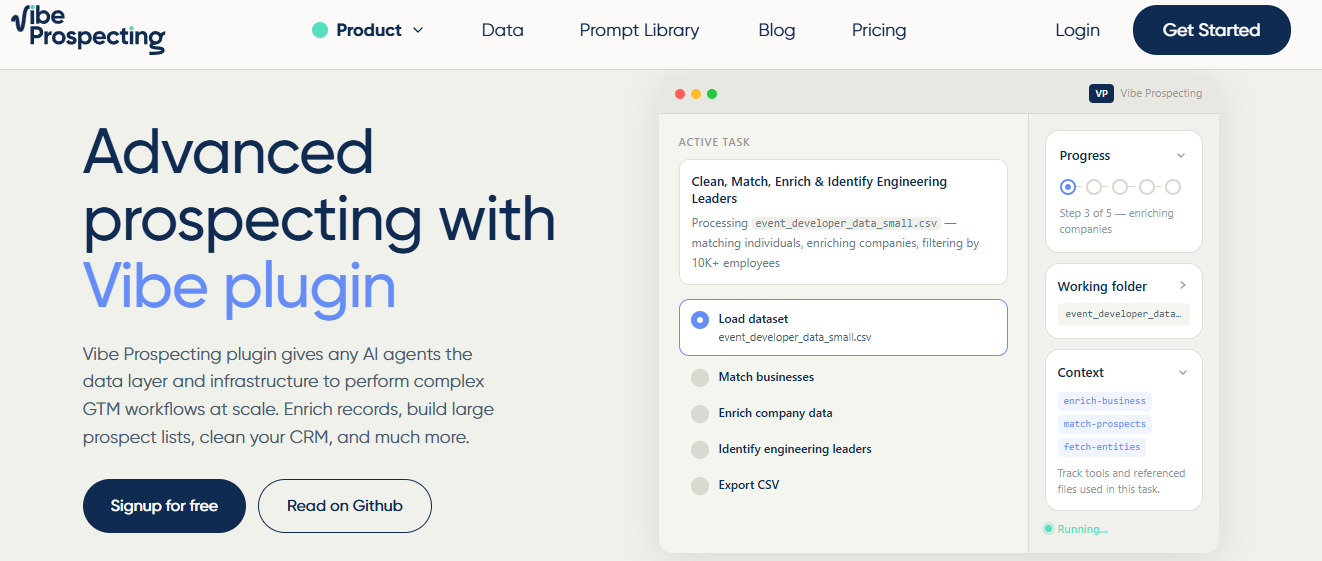
Vibe Prospecting is an agent-native prospecting product built on Explorium’s B2B data layer. You describe your target in natural language, and the agent accesses, filters, and enriches contacts for you. It sits in the agent-native category, not the UI or raw-API category. We surface it three ways: an MCP connector for Claude Code and other agents, a chat UI, and an embeddable MCP for existing pipelines.
Core Services
- Natural-language prospecting where the agent runs the filter and fit logic.
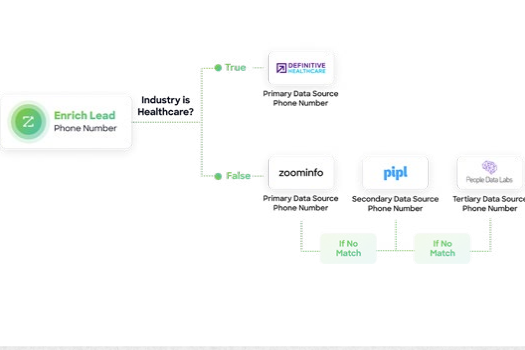
- Waterfall enrichment for verified email, phone, and firmographic fields.
- Account and prospect signals drawn from Explorium’s data layer.
- Three surfaces: Claude connector, chat UI, and embeddable MCP.
- List-building and export from a single agent flow.
Metrics compared on
- Data coverage: 150M+ companies and 800M+ profiles via Explorium.
- Source aggregation model: Aggregator-of-aggregators across 50+ sources, with waterfall enrichment.
- Enrichment depth: Email, phone, firmographics, and signals in one pass.
- Accuracy and validation: Waterfall fills gaps a single database cannot close.
- API or MCP fit: Agent-native by design; MCP consumption out of the box.
- Surface availability: Claude today via MCP and chat UI; not ChatGPT yet.
- Pricing per enriched record: 8 credits per fully enriched contact (prospect, email, and phone).
Why Companies Consider Vibe Prospecting
The buying logic is leverage. Teams choose it when they want the agent to do the access, filter, and enrich work rather than a human doing it across 20 tabs.
The second reason is data quality without engineering. You get aggregator-of-aggregators sourcing and waterfall enrichment without building a pipeline yourself.
Ideal Customer Profile
- Company size: Solo operators through mid-market GTM teams.
- Geography: B2B corporate contacts, global, not local SMB.
- Buyer role: SDRs, AEs, RevOps, and founders running outbound.
- Prospecting volume: Regular list-building, not one-off lookups.
- Decision maker: RevOps lead, GTM owner, or the founder.
Commercial Model
Pricing is usage-based, from $19/mo, with a 400-credit free trial valid 90 days. A fully enriched contact costs 8 credits. Paid credits are valid 12 months, are non-refundable, and do not roll over.
When to Shortlist
- You work inside Claude and want prospecting to happen there.
- You want a verified list built by an agent, not by hand.
- You want to start on a free trial with no procurement cycle.
- You need waterfall-enriched data without building the pipeline.
When Not to Shortlist
- ❌ You want raw data behind an API to engineer against yourself; Explorium’s API fits better.
- ❌ You need a single one-off or tiny-volume lookup; a free UI lookup is enough.
- ❌ You prospect local or SMB physical businesses; Vibe targets B2B corporate contacts.
- ⚠️ You require ChatGPT today; credits apply to Claude only for now.
Customer Reviews
“I can describe exactly what [my company] does, and the AI actually understands the vibe of the companies I’m looking for.”
Tristan W. Vibe Prospecting G2 Verified Review
“I am using [it] from [the] previous few months. The starter plan is $200, [which] is huge for [a] new startup, but I purchase[d] it. After getting a loyal customer using the data provided by [the] company, [the] result is fantastic.”
Verified Reviewer Vibe Prospecting Trustpilot Verified Review
1.2 People Data Labs: Best for engineers building their own enrichment application [toc=1.2 People Data Labs]
Overview
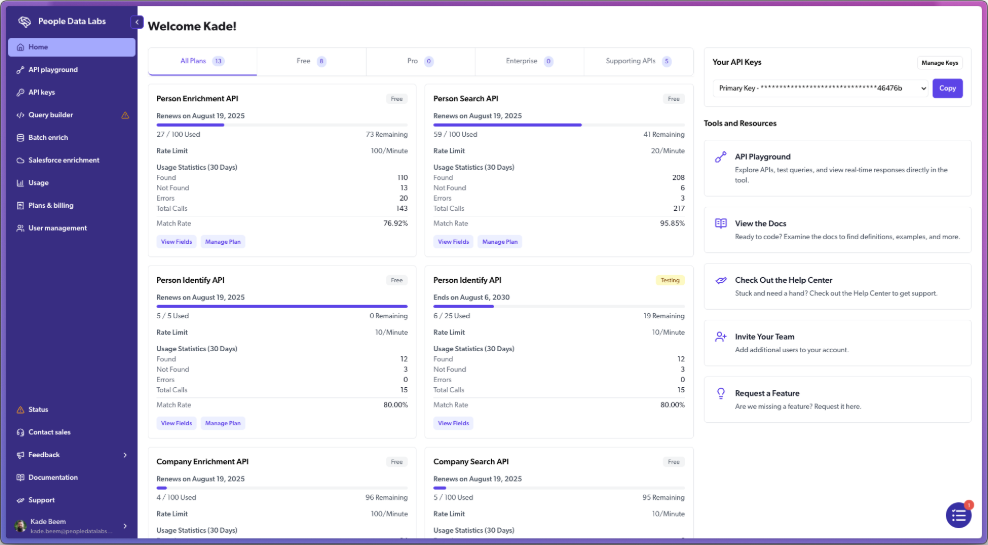
People Data Labs (PDL) is a raw data API for engineers. It hands you person and company records through endpoints, and you build the application logic around them. It belongs firmly in the raw-data-API category. It is the right tool when you want data, not a finished workflow.
Core Services
- Person enrichment API for profile data.
- Company enrichment API for firmographics.
- Search APIs to query the dataset by attributes.
- Bulk and identify endpoints for matching records.
- Data licensing for teams building products on top.
Metrics compared on
- Data coverage: Large person and company dataset positioned for scale.
- Source aggregation model: Compiled dataset served via API, not an agent-run waterfall.
- Enrichment depth: Strong firmographic and profile fields; you assemble the rest.
- Accuracy and validation: You own validation logic in your own code.
- API or MCP fit: API-first; agent consumption is something you build.
- Surface availability: API endpoints; no native agent UI.
- Pricing per enriched record: Usage-based, per-record API pricing.
Why Companies Consider People Data Labs
The decision logic is control. Engineering teams pick PDL when they want raw data to power their own product, model, or internal tool.
The trade-off is that you build everything around it. PDL hands you data; the application logic, the workflow, and the agent layer are all yours to write.
Ideal Customer Profile
- Company size: Startups through enterprises with engineering resources.
- Geography: Global, with a US-centric data strength.
- Buyer role: Engineers, data scientists, and product teams.
- Prospecting volume: High-volume, programmatic use.
- Decision maker: Engineering or data lead.
Commercial Model
Pricing is usage-based and per-record through the API. Exact published rates depend on plan and volume; check current PDL documentation for the latest tiers.
When to Shortlist
- You are building a product or internal app on raw data.
- You have engineers who want endpoints, not a UI.
- You need programmatic access at high volume.
When Not to Shortlist
- ❌ You want the work done for you; an agent-native layer fits better.
- ❌ You are an SDR or founder without engineering support.
- ⚠️ You expect built-in workflow or verification; you build that yourself.
Customer Reviews
“Product was useful while it worked, which wasn’t long. Switched from free trial to paid plan ($100/month). After a few days, [the] account [was] disabled with no warning or explanation. Support [was] unresponsive after multiple contact attempts.”
Verified User, Computer Software People Data Labs G2 Verified Review
“Data was ok, but [the] payment system is a scam. Very hard to get off their hook once signed up.”
Glissando AI People Data Labs Trustpilot Verified Review
1.3 Clearbit (Breeze Intelligence): Best for HubSpot teams enriching inbound leads [toc=1.3 Clearbit Breeze]
Overview
Clearbit, now part of HubSpot as Breeze Intelligence, enriches inbound leads and reveals company data on web visitors. It serves marketing and sales teams that live inside HubSpot. It sits between the raw-API and UI categories, with its strongest fit as a HubSpot-native enrichment layer.
Core Services
- Lead enrichment that appends job title and firmographic data.
- Reveal, which identifies companies visiting your website.
- Enrichment APIs for new-lead notifications.
- Salesforce and HubSpot integrations.
- Form-shortening using known visitor data.
Metrics compared on
- Data coverage: Good database size, strongest on company-level data.
- Source aggregation model: Compiled database, not an agent-run waterfall.
- Enrichment depth: Solid firmographics; contact depth varies by account.
- Accuracy and validation: Reviewers report refresh and accuracy gaps.
- API or MCP fit: API and native HubSpot, no agent-native MCP.
- Surface availability: In-HubSpot and via API; no agent surface.
- Pricing per enriched record: Tiered, increasingly bundled into HubSpot.
Why Companies Consider Clearbit
The decision logic is HubSpot gravity. If your team already runs HubSpot, native enrichment inside the CRM removes a step.
The second reason is inbound. Reveal and form enrichment help teams qualify website visitors and shorten forms without extra tooling.
Ideal Customer Profile
- Company size: Small-business through mid-market.
- Geography: Global, US-centric strength.
- Buyer role: Marketing operations and demand generation.
- Prospecting volume: Inbound-led enrichment, not heavy outbound list-building.
- Decision maker: Marketing ops or RevOps owner inside HubSpot.
Commercial Model
Clearbit’s standalone pricing has moved into HubSpot’s Breeze Intelligence tiers. Exact pricing is increasingly bundled; confirm current rates in HubSpot’s documentation. Historically, self-service plans had limited room before a steep jump.
When to Shortlist
- You run HubSpot and want enrichment inside it.
- You need website visitor reveal for inbound.
- You want job-title enrichment on new-lead notifications.
When Not to Shortlist
- ❌ You need an agent to build outbound lists autonomously.
- ❌ You want frequent contact-level refresh for heavy outbound.
- ⚠️ You are not on HubSpot; the native value drops sharply.
Customer Reviews
“APIs enrich new lead notifications with job title data for qualification. Reveal product shows which accounts visit your website. [But it is] not always accurate. Needs more frequent refresh. Lacks robust integrations to easily action on data.”
Brian Y., Head of Marketing Clearbit G2 Verified Review
“Company data doesn’t refresh often enough. Only 20% of known contacts could be found, including people at companies for [over] 1 year.”
Verified User, Internet Clearbit G2 Verified Review
1.4 SyncGTM: Best for a fallback MCP waterfall when a segment keeps coming back empty [toc=1.4 SyncGTM]
Overview
SyncGTM is a hosted MCP that routes each lookup across 20+ enrichment vendors instead of running its own data backbone, so a miss at one provider automatically retries the next. It connects via OAuth browser sign-in, documented at docs.syncgtm.com. The appeal is coverage breadth by aggregation, not a proprietary dataset.
Core Services
- Hosted MCP waterfall across 20+ enrichment vendors.
- Roughly 50 tools for lead discovery, person and company enrichment.
- 15+ real-time buying-signal types across the waterfall.
- 40+ integrations including Salesforce, HubSpot, Attio, and Slack.
Metrics compared on
- Data coverage: 300M+ companies, 600M+ profiles (vendor-stated), aggregated across upstream vendors.
- Source aggregation model: Hosted MCP waterfall across 20+ enrichment vendors.
- Enrichment depth: Broad by aggregation; depth on any single field depends on which upstream vendor answers.
- Accuracy and validation: Not independently benchmarked; coverage figures are vendor-stated.
- API or MCP fit: Native hosted MCP at api.syncgtm.com/mcp, OAuth sign-in.
- Surface availability: 9 documented MCP clients.
- Pricing per enriched record: Credit-metered, billed only on a valid record, no free tier.
Why Companies Consider SyncGTM
The decision logic is coverage breadth. Teams pick SyncGTM when a specific ICP segment keeps coming back empty from a single vendor and they want an automatic second opinion instead of stitching a waterfall by hand.
The trade-off is that it has no proprietary data backbone, so it inherits whatever gaps its upstream vendors have, it has no free tier, and it is a young vendor with thin third-party review volume and no independent match-rate benchmark.
Ideal Customer Profile
- Company size: Teams already running a primary enrichment source that want a fallback for empty rows.
- Geography: Global, aggregated across upstream vendors.
- Buyer role: RevOps and agent builders comfortable with credit-metered billing.
- Prospecting volume: Light to moderate, gap-filling use.
- Decision maker: Whoever owns the enrichment stack and its fallback logic.
Commercial Model
Published self-serve subscription tiers: Solo $49/month, Growth $99/month, Pro $249/month, Business $649/month, Enterprise custom. No free tier. Credits roll over and never expire; top-ups run $0.05/credit.
When to Shortlist
- A segment of your list keeps coming back empty from your primary vendor.
- You want waterfall retries surfaced as native MCP tool calls.
- You are comfortable with credit-metered, no-free-tier billing.
When Not to Shortlist
- ❌ You need an independently benchmarked match rate, not vendor-stated coverage.
- ❌ You want one unified dataset instead of a routing layer across upstream providers.
- ⚠️ You need a mature third-party review base to validate the vendor against; there is little yet.
1.5 ZoomInfo: Best for enterprise teams with procurement budget [toc=1.5 ZoomInfo]
Overview
ZoomInfo is an enterprise data platform with broad coverage, intent data, and a procurement-heavy sales motion. It serves larger teams that can commit to annual contracts and seat-based pricing. It sits in the UI-platform category, with an API and some agent access layered on. The strength is breadth; the structural cost is the contract.
Core Services
- Large company and contact database with firmographics.
- Buyer intent data and scoops on hiring and initiatives.
- Workflow and engagement tools layered on the data.
- CRM and sequencing integrations.
- An API for programmatic access.
Metrics compared on
- Data coverage: Among the broadest, with 300M+ profiles cited.
- Source aggregation model: Large compiled database, not an agent-run waterfall.
- Enrichment depth: Deep firmographics, intent, and signals.
- Accuracy and validation: Strong at the enterprise tier; verify direct dials.
- API or MCP fit: API available; agent-native consumption is limited.
- Surface availability: Platform UI and API; no usage-based agent entry.
- Pricing per enriched record: Bundled into annual contracts, not per-record.
Why Companies Consider ZoomInfo
The decision logic is coverage and enterprise readiness. Large teams pick ZoomInfo for breadth, intent data, and integrations they can standardize across the org.
The structural trade-off is the buying motion. Locked-in annual contracts and a procurement cycle are the norm, so it is not built for self-serve or usage-based exploration.
Ideal Customer Profile
- Company size: Mid-market through enterprise.
- Geography: Global, US-centric strength.
- Buyer role: RevOps and sales leadership with budget authority.
- Prospecting volume: High, org-wide.
- Decision maker: VP of Sales, RevOps, or procurement.
Commercial Model
ZoomInfo uses seat-based annual contracts, typically starting near $15,000 per year, with custom quotes above that. Pricing is not self-serve, and there is no usage-based entry point. Confirm current figures during an RFP.
When to Shortlist
- You are an enterprise needing broad coverage and intent data.
- You can commit to an annual contract.
- You want org-wide integrations and standardization.
When Not to Shortlist
- ❌ You want usage-based pricing and a free trial to explore.
- ❌ You are a founder or small team avoiding procurement.
- ⚠️ You want an agent to run the workflow, not a human in a UI.
1.6 Cognism: Best for EU-first outbound where regional coverage is the priority [toc=1.6 Cognism]
Overview
Cognism is a data-only contact provider known for European coverage and a focus on compliant mobile data. It serves outbound teams that prioritize EU reach. It sits in the data-vendor category, thinner on workflow, agent integration, or enrichment depth. The pitch is regional coverage; the reviews suggest you should verify it.
Core Services
- Company and contact data with a European focus.
- Mobile-number coverage marketed as a core strength.
- Intent data through partner signals.
- CRM integrations for syncing contacts.
- Compliance-oriented data sourcing for the EU.
Metrics compared on
- Data coverage: EU-focused, with mobile coverage as the headline.
- Source aggregation model: Single-vendor contact database, not a waterfall.
- Enrichment depth: Contact-centric; thin on workflow and signals.
- Accuracy and validation: Reviewers report gaps versus claimed mobile coverage.
- API or MCP fit: API and integrations; no agent-native MCP.
- Surface availability: Platform UI and API; no Claude or ChatGPT surface.
- Pricing per enriched record: Bundled into annual contracts.
Why Companies Consider Cognism
The decision logic is geography. EU-first teams choose Cognism for European contact reach and compliance-oriented sourcing.
The structural trade-off is scope. It is positioned as a contact-database vendor, so it is thin on agent workflow and enrichment depth beyond a single contact set.
Ideal Customer Profile
- Company size: Mid-market through enterprise.
- Geography: Europe-first, with some global reach.
- Buyer role: SDR leaders and RevOps focused on EU outbound.
- Prospecting volume: Moderate to high, region-specific.
- Decision maker: Sales or RevOps leadership.
Commercial Model
Cognism uses annual contracts, and several reviewers note multi-month commitments. Pricing is not publicly disclosed and is quote-based. Confirm contract length carefully before signing.
When to Shortlist
- You run EU-first outbound and need European coverage.
- Compliance-oriented sourcing is a priority.
- You want mobile data as a core field.
When Not to Shortlist
- ❌ You want an agent to build and enrich lists, not a static database.
- ❌ You need waterfall enrichment beyond a single contact set.
- ⚠️ You expect the claimed mobile coverage to hold; verify with a sample first.
Customer Reviews
“Poor data quality, no direct mobile numbers. Numbers [are] either wrong or return[] US HQ number even when searching European offices. Not worth the money.”
Jackie, DE Cognism Trustpilot Verified Review
“Data is really limited and generally poor quality. Claims 90% mobile coverage in [the] sales process but doesn’t deliver. Diamond Verified mobiles… are less than 10%.”
Alex, AU Cognism Trustpilot Verified Review
1.7 Apollo: Best for individual reps wanting an all-in-one search-and-send UI [toc=1.7 Apollo]
Overview
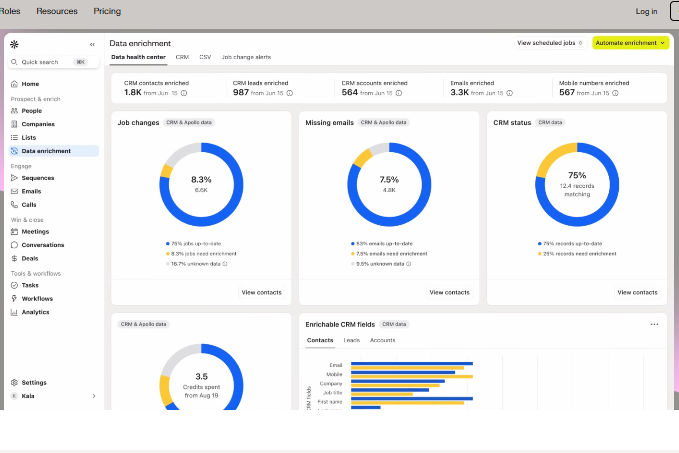
Apollo is an all-in-one prospecting UI built for humans to search, filter, and send by hand. It serves individual reps and small teams that want data and outreach in one dashboard. It sits firmly in the UI category. The operator runs every step, which is the appeal and the structural cost.
Core Services
- Contact and company search with many filters.
- Email and phone enrichment with credit-based unlocks.
- Built-in email sequencing and outreach.
- A Chrome extension for LinkedIn prospecting.
- CRM sync and basic reporting.
Metrics compared on
- Data coverage: Large database, 275M+ contacts cited.
- Source aggregation model: Single compiled database, not an agent-run waterfall.
- Enrichment depth: Email, phone, and firmographics; accuracy varies by record.
- Accuracy and validation: Reviewers report bounce and wrong-number issues.
- API or MCP fit: API available; the workflow is human-run, not agent-native.
- Surface availability: UI and extension; no native Claude or ChatGPT agent.
- Pricing per enriched record: Credit-based unlocks within seat tiers.
Why Companies Consider Apollo
The decision logic is all-in-one and affordable. Reps pick Apollo to search, enrich, and send from one place without stitching tools together.
The structural trade-off is that the human operates every step. The platform optimizes for human-run list-building, not autonomous action. ⚠️ Reviewers widely advise using Apollo as a data source, not a sending engine.
Ideal Customer Profile
- Company size: Solo operators through small and mid-market teams.
- Geography: Global, US-centric strength.
- Buyer role: Individual SDRs and AEs running their own outbound.
- Prospecting volume: Moderate, hands-on.
- Decision maker: The rep or a small-team sales lead.
Commercial Model
Apollo uses a freemium model with seat-based paid tiers, from roughly $49 per seat per month, plus credit limits on exports. Confirm current rates and export caps on Apollo’s pricing page. Several reviewers flag low export-credit ceilings.
When to Shortlist
- You want search, enrich, and send in one affordable UI.
- You are an individual rep or small team.
- You want a low-cost entry to test outbound.
When Not to Shortlist
- ❌ You want an agent to do the filtering and vetting for you.
- ❌ You need waterfall enrichment to close a single-database accuracy gap.
- ⚠️ You plan to send directly from it at scale; reviewers warn against it.
Customer Reviews
“Contact info [is] frequently missing or incorrect. Half the day [is spent] calling wrong/disconnected numbers. Mobiles [are] frequently wrong. [The] credit system for unlocking mobiles/emails is clunky and interrupts sales flow.”
Verified User, IT Services Apollo G2 Verified Review
“Easy to create [a] persona, multiple filters, verified email option for low bounce rates, built-in CRM to track replies and calls. [But] export credit limits [are] too low.”
Tejender K., Digital Marketing Executive Apollo G2 Verified Review
1.8 Enrich.so: Best for teams wanting one MCP across multiple agents [toc=1.8 Enrich.so]
Overview
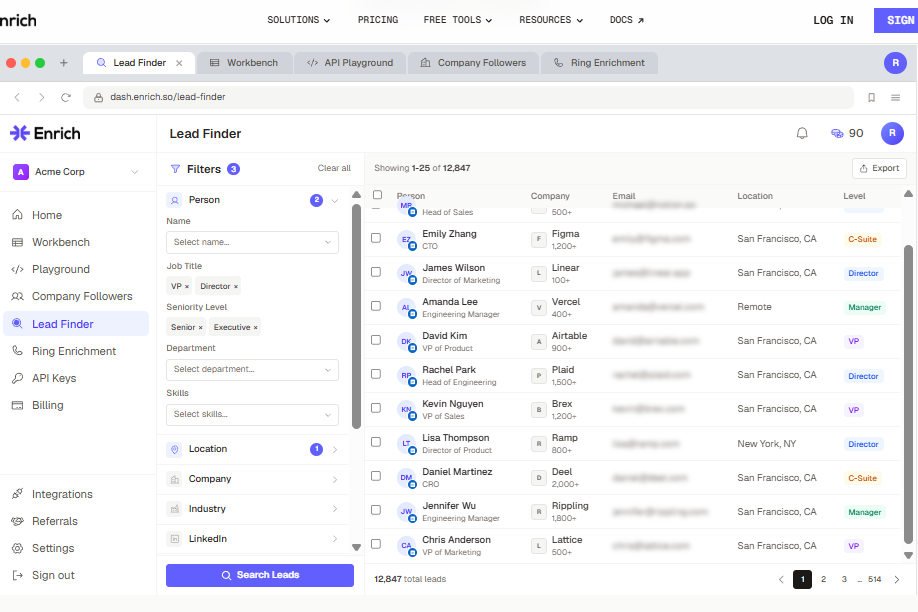
Enrich.so offers a single MCP server that gives several agents access to enrichment tools. It serves teams that want one connector across Claude, ChatGPT, Cursor, and VS Code. It sits in the agent-native category, with a multi-surface stance. The strength is breadth of agent support; the open question is data depth versus a dedicated waterfall layer.
Core Services
- An MCP server exposing 40+ enrichment tools.
- Email finding and verification through the agent.
- Lead and contact enrichment in plain language.
- Support across Claude, ChatGPT, Gemini, Cursor, and VS Code.
- Batch enrichment on lists.
Metrics compared on
- Data coverage: 150M+ leads cited, with 135+ filters.
- Source aggregation model: Aggregates multiple tools behind one MCP.
- Enrichment depth: Email, verification, and contact fields across 40+ tools.
- Accuracy and validation: Includes verification tools; validate at volume.
- API or MCP fit: MCP-native by design, plus API access.
- Surface availability: Broad: Claude, ChatGPT, Gemini, Cursor, VS Code.
- Pricing per enriched record: Usage-based; confirm current per-tool rates.
Why Companies Consider Enrich.so
The decision logic is multi-agent flexibility. Teams pick it when they want one MCP that works across several agents, not just Claude.
The second reason is breadth of tools. With 40+ enrichment tools behind one connector, it suits teams that want many functions in plain language.
Ideal Customer Profile
- Company size: Startups through mid-market.
- Geography: Global.
- Buyer role: GTM engineers and technical RevOps.
- Prospecting volume: Moderate to high, agent-driven.
- Decision maker: Technical or RevOps lead.
Commercial Model
Enrich.so uses usage-based pricing across its MCP tools. Specific per-tool rates depend on plan; confirm on the Enrich.so site. There is no enterprise-only lock noted in the source set.
When to Shortlist
- You want one MCP across Claude, ChatGPT, and Cursor.
- You need many enrichment tools in plain language.
- You value multi-agent flexibility over a single surface.
When Not to Shortlist
- ❌ You want a single dedicated waterfall data layer with deep signals.
- ❌ You need an enterprise data platform with intent and procurement support.
- ⚠️ You want the deepest contact accuracy; validate against a waterfall provider.
1.9 FullEnrich: Best for waterfall email and phone with preview-before-charge billing [toc=1.9 FullEnrich]
Overview
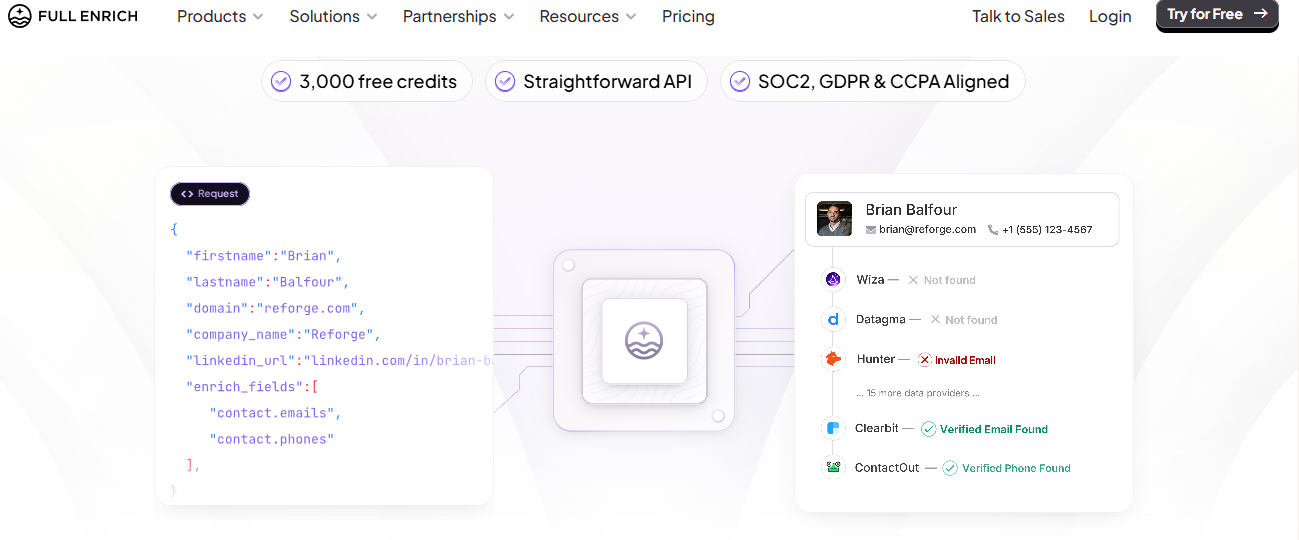
FullEnrich focuses on waterfall email and phone enrichment, with a model that previews results before charging credits. It serves teams that want deliverable contacts without paying for misses. It sits in the enrichment-utility category, available as an MCP. The standout is its preview-before-charge billing, which directly attacks credit waste.
Core Services
- Waterfall enrichment for work email and phone.
- An MCP server for one-at-a-time or batch enrichment.
- A preview of results before credits are spent.
- List-based batch enrichment.
- CRM and tool integrations for export.
Metrics compared on
- Data coverage: Aggregates multiple providers via waterfall.
- Source aggregation model: Waterfall across several data sources.
- Enrichment depth: Strong on email and phone; lighter on signals.
- Accuracy and validation: Waterfall plus preview improves deliverability.
- API or MCP fit: MCP-native, with batch support.
- Surface availability: MCP, including inside Claude.
- Pricing per enriched record: Roughly 0.25 credits per exported contact, preview free.
Why Companies Consider FullEnrich
The decision logic is cost control. The preview-before-charge model means you do not pay credits for results you do not use.
The second reason is deliverability. Waterfall across multiple providers fills gaps a single database leaves open, which lowers bounce.
Ideal Customer Profile
- Company size: Startups through mid-market.
- Geography: Global.
- Buyer role: SDRs, RevOps, and growth teams.
- Prospecting volume: Moderate to high, list-based.
- Decision maker: RevOps or growth lead.
Commercial Model
FullEnrich uses credit-based pricing, with a free 10-result preview and roughly 0.25 credits per exported contact. It confirms before charging. Confirm current credit-pack rates on FullEnrich’s site.
When to Shortlist
- You want waterfall email and phone without paying for misses.
- You want to preview results before spending credits.
- You need batch enrichment inside an agent.
When Not to Shortlist
- ❌ You want a full prospecting workflow, not just enrichment.
- ❌ You need deep firmographic and intent signals.
- ⚠️ You want a single platform for search, enrich, and send.
How We Evaluated These Providers
- Primary sources consulted: Explorium documentation (developers.explorium.ai), the Vibe Prospecting site, the MCP specification (modelcontextprotocol.io), Anthropic’s Claude and Claude Code docs, provider documentation, and first-party reviews from G2, Capterra, and Trustpilot.
- Criteria selected for this title: Data coverage, source-aggregation model, enrichment depth, accuracy validation, API or MCP fit, surface availability, and pricing per enriched record, because this is a data-enrichment-and-API comparison.
- Criteria de-prioritized: Outreach and sequencing depth, since the title is about enrichment access for agents, not sending.
- Data gaps: ZoomInfo, Enrich.so, and FullEnrich had no verified reviews in the provided source set, and several providers do not publicly disclose full pricing, which I flagged rather than estimating. SyncGTM is a young vendor with thin third-party review volume, so its review block is blank for the same reason.
Which Provider Should You Shortlist?
- You live in Claude and want the agent to build the list: Shortlist Vibe Prospecting, because it accesses, filters, and enriches in one flow on a waterfall-enriched data layer.
- You are an engineer building your own enrichment app: Shortlist People Data Labs, because it hands you raw data to build on.
- You run HubSpot and enrich inbound: Shortlist Clearbit (Breeze), because enrichment lives inside the CRM.
- A segment keeps coming back empty: Shortlist SyncGTM, because its hosted MCP waterfall automatically retries across 20+ other vendors.
- You are an enterprise with procurement budget: Shortlist ZoomInfo, because coverage and intent data are broad.
- You run EU-first outbound: Shortlist Cognism, but validate mobile coverage with a sample first.
- You want one MCP across several agents: Shortlist Enrich.so, because it spans Claude, ChatGPT, and Cursor.
- You want waterfall enrichment without paying for misses: Shortlist FullEnrich, because it previews before charging.
Q2: Why does waterfall enrichment beat single-source data, and what match-rate and bounce-rate benchmarks should you trust? [toc=2. Waterfall vs Single-Source]
Waterfall enrichment moves through multiple data providers in sequence until a contact is verified, instead of trusting one database. Single-source match rates run 55 to 70 percent; waterfall pushes past 85 percent. Verified waterfall keeps bounce rates under 3 percent, versus 8 to 15 percent for non-validated lists. With B2B data decaying about 22.5 percent a year, the verification layer protects your sender reputation.
💧 What waterfall enrichment actually does
Think of waterfall enrichment as a relay race for one contact. You ask the first provider for an email. If it misses or returns something stale, the request falls to the next provider, then the next.
It keeps going until a source returns a verified result. The logic is simple: Apollo, then ZoomInfo, then Hunter, until the contact is confirmed. One database guesses once; a waterfall asks until it knows.
🏗️ Why one database can never close the gap
A single source only knows what it has collected. Coverage gaps and stale records are baked in, no matter how big the database claims to be.
After building Explorium’s data layer as an aggregator of aggregators rather than one source, I am convinced this is structural. We pull from 50-plus providers, so a gap in one is covered by another. That is the same mechanism, run automatically inside the agent. You can see how we approach this in our no-code data enrichment pipelines.
📊 The benchmarks worth trusting
Here is the distinction the category keeps blurring. Match rate is how often you find a contact. Bounce rate is how often that contact fails when you send.
A 90 percent match with a 15 percent bounce is worse than an 80 percent match with a 2 percent bounce. High coverage means nothing if half the emails bounce and your domain gets flagged.
📈 The numbers side by side
<caption>Single-Source vs Verified Waterfall Benchmarks</caption>
| Metric | Single-source | Verified waterfall |
|---|---|---|
| Match rate | 55 to 70% | 85%+ |
| Bounce rate | 8 to 15% | Under 3% |
| Annual data decay | ~22.5% | ~22.5% (same, but refreshed) |
Coverage is a vanity number. ✅ Deliverability is the one that protects your reputation.
⏰ What 22.5 percent decay means for your list
A list you export today is not a fixed asset. It is a melting one. At roughly 22.5 percent decay a year, nearly a quarter of it is wrong within twelve months.
People change jobs, companies move, and direct dials go dead. ⚠️ A "verified" CSV from January is already leaking accuracy by spring.
💸 The 27 percent bounce that proves the point
One practitioner trusted a single "verified" database and watched 27 percent of emails bounce. Switching to real-time verification across sources lifted accuracy to 98 percent. That is the difference between a burned domain and a healthy one.
“Half of [the] exported data was on spam lists. Phone/email get flagged as spam if you use Apollo regularly.”
Verified User, Insurance Apollo G2 Verified Review
🎯 The contrarian move on missing data
Here is where the standard read gets it backwards. Most teams give up when an email is missing, which leaves the field wide open.
A missing email is an opportunity, not a dead end. The reliable gold is often the business phone or a LinkedIn touch that competitors ignored. With Vibe Prospecting, the waterfall runs inside the agent, so a gap in email simply routes the request toward the field that does exist.
Q3: How do the 9 providers compare on enrichment model, surfaces, integrations, data fields, and our scoring methodology? [toc=3. Provider Scoring Comparison]
I scored every provider on seven criteria: coverage, source-aggregation model, data-quality mechanism, surface availability, autonomous workflow depth, pricing per fully enriched contact, and compliance posture. Coverage ranges widely, from Apollo’s 275M contacts to PDL’s huge raw dataset. But size is not the story. Some "MCPs" are read-only lookups, not agents that act.
🧪 How I scored these, and why it matters
I did not rank by database size, because size is a vanity metric. A bigger database with a 15 percent bounce rate loses to a smaller, verified one.
Instead, each provider gets read against seven purchase-relevant criteria. ✅ The goal is to help you sort tools into a trial bucket, a pilot bucket, or an "avoid for us" bucket, not to crown a winner. If you need help defining fit, our guide on how to identify your ICP and prioritize optimal leads is a good start.
🔌 The classification that actually separates them: agent-native vs read-only
Here is the line the category avoids drawing. An agent-native tool lets the agent take action: filter, enrich, and build a list in one pass. A read-only MCP just lets the agent look something up.
This matters more than it sounds. Clay, for example, cannot trigger its own waterfall through its MCP, so the agent reads but does not run the workflow. You still operate the spreadsheet engine yourself.
📋 The master comparison
| Provider | Enrichment Model | Surfaces | Key Data Fields | Agent Action |
|---|---|---|---|---|
| Vibe Prospecting | Aggregator + waterfall (50+ sources) | Claude MCP, chat UI, embeddable | Email, phone, firmographics, signals | Agent-native ✅ |
| People Data Labs | Compiled dataset via API | API only | Profiles, firmographics | Build-your-own ❌ |
| Clearbit (Breeze) | Compiled database | HubSpot, API | Firmographics, reveal | Read-mostly ⚠️ |
| SyncGTM | Multi-vendor waterfall | Hosted MCP | Company and person data, buying signals | Read-only ❌ |
| ZoomInfo | Large compiled database | Platform UI, API | Firmographics, intent | Read-mostly ⚠️ |
| Cognism | Single-vendor database | Platform UI, API | EU contacts, mobile | Read-only ❌ |
| Apollo | Single compiled database | UI, extension | Email, phone, sequences | Human-run ❌ |
| Enrich.so | Aggregates tools via MCP | Claude, ChatGPT, Cursor | Email, verification | Agent-native ✅ |
| FullEnrich | Waterfall (multi-source) | MCP, including Claude | Email, phone | Agent-native ✅ |
🧭 Reading the table: who wins on which axis
On raw coverage, ZoomInfo and PDL lead, but both make you pay in contracts or code. On agent action inside Claude, the agent-native group separates from the pack.
On data-quality mechanism, the waterfall providers (Vibe Prospecting, FullEnrich) target the accuracy gap a single database cannot close. The strongest predictor of success is the signal quality feeding your targeting, not the sending platform.
💬 What real users say across the categories
Balance matters, so here is praise and a clear complaint.
“[It is] transformative for GTM operations and data enrichment. [But the] per-row credit cost can vary 100% from stated amounts. Contact data quality varies wildly, [it] feels like a black box.”
Verified User, IT Services Clay G2 Verified Review
“I can describe exactly what [my company] does, and the AI actually understands the vibe of the companies I’m looking for.”
Tristan W. Vibe Prospecting G2 Verified Review
That Clay quote is the structural cost of a builder tool. ⚠️ Flexibility is real, but so is the credit opacity and the work it pushes onto you.
Q4: What does each option cost per fully enriched contact, and how do credits, free trials, and contracts compare? [toc=4. Cost per Contact]
On a normalized cost per fully enriched contact (prospect, email, and phone), the spread is wide. Vibe Prospecting is 8 credits, SyncGTM is credit-metered and billed only on a valid record with no published per-contact figure, and FullEnrich is about 0.25 credits per exported contact. Pricing splits three ways: per-record APIs, per-credit tools, and usage-based agent layers. Vibe starts at $19/mo with a 400-credit, 90-day trial; ZoomInfo typically starts near $15,000 a year. You can review our own credit details for the full breakdown.
💰 Why "cost per fully enriched contact" is the only fair number
Most pricing pages hide the real cost. They quote per-email or per-seat, then phone unlocks cost extra.
So I normalized everything to one unit: a contact with a prospect, a verified email, and a phone. ✅ That is the number that actually hits your budget when you build a real list.
🧾 The pricing side by side
<caption>Pricing Comparison per Fully Enriched Contact</caption>
| Provider | Entry Price | Free Trial | Cost per Complete Contact | Contract |
|---|---|---|---|---|
| Vibe Prospecting | $19/mo | 400 credits, 90 days | 8 credits | Usage-based, no rollover |
| SyncGTM | No free tier | Solo $49/mo | Not published | Monthly subscription |
| FullEnrich | Credit packs | 10-result preview | ~0.25 credit/export | Usage-based |
| Apollo | ~$49/seat | Freemium | Credit unlocks | Seat-based |
| ZoomInfo | ~$15,000/yr | None self-serve | Bundled | Annual contract |
Figures not in the source set are left out rather than estimated. ⚠️ Always confirm current rates on each provider’s site.
⚖️ The hidden costs nobody quotes
The sticker price is rarely the real price. Failed lookups can still burn credits on some tools, and per-row costs can vary far from the stated rate. Our take on demonstrating the value of data walks through how to model this.
💸 What this means for a real list
Say you want 500 fully enriched contacts. At 8 credits each, that is 4,000 credits on Vibe Prospecting, which you can model before you spend a dollar.
I want to be straight about our own trade-offs. Vibe’s credits apply to Claude today, not ChatGPT. Paid credits are valid 12 months, do not roll over, and are non-refundable. ⏰ So validate with a sample before a large export.
🧪 Why the trial economics matter most
Here is where my head is on pricing. AI made deep research a commodity, so the cost of finding a contact is now a few tokens, not a premium skill.
That is why a real trial beats a sales call. A 400-credit, 90-day trial inside Claude lets you benchmark Vibe Prospecting against your own list before committing, with no procurement cycle to start. You can compare current pricing against a five-figure annual contract you would otherwise sign before testing the data.
Q5: How do you wire an enrichment MCP into your agent and build your first list, and which surface fits a founder, SDR, or RevOps team? [toc=5. Wiring Your First List]
Connect the MCP (Model Context Protocol, an open standard that lets an agent use a tool) to your agent. Point it at a clean CSV with name, site, and address only. Then let parallel sub-agents run research, decision-maker finding, and scoring at once. A full prospect audit can finish in under a minute. Solo founders want a chat UI; SDRs want an in-Claude connector; RevOps teams want an embeddable MCP.
🛠️ The six steps to your first list
Here is the workflow I have watched run dozens of times. None of it requires you to write code.
- Connect the MCP to your agent, so it can call the enrichment tools.
- Feed it a clean CSV with only name, site, and address.
- Launch parallel sub-agents for research, decision-maker finding, and scoring.
- Run waterfall enrichment to fill email and phone gaps.
- Score for fit against your ICP (ideal customer profile).
- Export only the contacts that pass.
🧹 Two hacks that save real money
Keep the CSV hyper-clean. ✅ Extra columns make agents hallucinate fit or misread an existing description, so name, site, and address are enough.
Put your variables at the bottom of the prompt. The agent caches the static top part, which can cut token cost by up to half. ⏰ Small habit, real savings on a big run. For more on this approach, see how we build no-code data enrichment pipelines.
🧑💻 Which surface fits you
Vibe Prospecting comes in three surfaces, and the right one depends on how you work. We built it that way on purpose.
🙋 Founders and solo operators: the chat UI
If you have never used a B2B data tool, start in the chat UI. You ask in plain language, and the agent does the grunt work of access, filter, and enrich.
AI made deep research a commodity, so you skip the learning curve entirely. ❌ Not for you if you only need one contact; a free UI lookup is enough. If you want the full picture first, our overview of Vibe Prospecting walks through the experience.
💼 SDRs, AEs, and RevOps: the Claude connector
If you live in Claude and are tired of 20 open tabs, use the MCP connector for Claude Code. SDRs lose 75 to 80 percent of their time tab-switching, and that is the exact tax we built to remove.
You state the objective, and the agent runs the workflow. ⚠️ Note honestly: credits apply to Claude today, not ChatGPT. This fits squarely into a modern sales workflow.
🔧 Technical and data teams: the embeddable MCP
If you would otherwise engineer against the Explorium API, the embeddable MCP drops agent-ready access into your existing pipeline. You get the data layer without building the application logic, which suits GTM engineering teams.
❌ Not for you if you genuinely want raw data to engineer against yourself; that is Explorium’s API, not Vibe.
Q6: Which signals and data fields actually drive outbound conversion, and how do you stay compliant when an agent acts autonomously? [toc=6. Signals and Compliance]
Verified email and direct mobile are the floor, not the edge. The lift comes from firmographic fit, technographic shifts, and intent signals from earnings calls and job patterns. Do not sell the trigger itself; "I saw you’re hiring" reads as stalking. Sell the cost of inaction it implies. Autonomy does not suspend compliance: document GDPR legitimate interest and keep audit logs.
🎯 The field hierarchy that actually matters
Most teams stop at email and phone. Those are table stakes; they get you in the door, nothing more.
The real signal is fit and timing. Firmographics tell you who matches; technographics and intent tell you who is ready now.
🔍 The technographic switch nobody watches
Here is a concrete one. A company moving from AWS to Azure is a vendor-replacement signal, and replacement budgets are live budgets.
With Vibe Prospecting, the agent can synthesize these signals from earnings calls, job patterns, and site behavior in one pass. That is the difference between a static list and a list that knows why now.
✋ The contrarian rule: don’t sell the trigger
The standard read gets this backwards. People see a trigger and lead with it, which feels like surveillance.
Saying "I saw you’re hiring three SDRs" is creepy. Instead, sell the implied cost: the ramp time, the missed quarter, and the gap the hire is meant to close.
😬 The AI ick
One more thing I keep noticing. Perfect grammar and tidy dashes signal low-effort automation, and buyers feel the ick.
A small, human imperfection can make outreach land better. I could be slightly off on how far to push this, but over-polish reads as a bot.
⚖️ Staying compliant when the agent acts
Autonomy raises the compliance bar; it does not remove it. After six-plus years building external-data infrastructure for enterprises, I treat this as plumbing, not paperwork.
- ✅ Document GDPR legitimate interest for B2B contact data.
- ✅ Keep audit logs of what the agent accessed and acted on, for EU AI Act readiness.
- ✅ Prefer providers that source compliantly across regions, with strong data security.
- ⚠️ The agent should make the audit trail easier to produce, not harder.
Q7: What’s the verdict: which enrichment MCP or API should you choose in 2026? [toc=7. The 2026 Verdict]
Choose by the work you want the agent to do, not by database size. Pick a raw API like People Data Labs or Clearbit if you are building infrastructure. Pick a UI tool with an MCP like Apollo or ZoomInfo if you already live in that UI. Pick an agent-native layer like Vibe Prospecting if you want access, filter, enrich, and list-build to happen inside Claude in one flow.
🧭 The decision, by the work you want done
Access to data is now a commodity. Data quality, the aggregator-of-aggregators plus waterfall, is not, as our breakdown of data enrichment fundamentals explains.
So the real question is who does the grunt work. If you want to write the application logic, go raw API. If you want the agent to run it, go agent-native. ⚠️ Just remember Vibe’s credits apply to Claude today, not ChatGPT.
🌅 What changes when the list builds itself
One founder generated 2,500 lookalike leads, then spent a Saturday pruning them to 500. That hyper-pruned list doubled her summit attendees in a week.
That is the whole point. The agent built and enriched; her judgment on who to keep was the leverage. Humans own who to target, the message, and the offer; the agent does the rest. You can see this play out across AI use cases across the funnel.
I am sitting with one open question. As agents get better at the grunt work, the scarce skill becomes taste: knowing which 500 of the 2,500 matter. If you are building that muscle, I would genuinely like to hear what you are working on. You can test the thesis yourself on a 400-credit, 90-day free trial inside Claude.


