

- One platform for all data needs: Explorium appends NAICS, firmographics, franchise-brand tags, and buying signals from 150M+ company profiles and 50+ sources in one account, no second vendor needed.
- Built for scale: Up to 1,000 accounts per API call at 100 QPS means a full NAICS 238220 universe (~88,700 establishments) tags in batches, not one-by-one.
- Affordable by design: A free account with a unified credit pool covers NAICS append, enrichment, and signal lookups from one budget, no per-endpoint pricing, no seat tax.
- Two core codes to start from: NAICS 238220 (contractors) and 423730 (wholesalers) are the anchor codes; franchise tagging and service mix refine them further.
- Verified metric: Explorium holds 97.8%+ company match accuracy, keeping NAICS tagging reliable on an existing CRM list.
- Outcome: Enrich your first 100 HVAC accounts free and see the fields populate before spending a credit.
Most teams selling into HVAC (software, distribution, financing, insurance, staffing) treat every account tagged “HVAC” as one ICP. To segment B2B HVAC prospects by industry sector, start with NAICS classification: NAICS 238220 alone spans roughly 88,700 US establishments and 1.03M employees, and none of those accounts behave the same in a sales cycle.
A regional contractor buying field-service software has a different budget cycle than a wholesaler buying inventory financing, and neither looks like a franchise brand rolling out a corporate tech stack. Applying what is data enrichment to industry classification turns one flat list into targetable sub-verticals for territory, TAM, and campaign work.
This guide walks through the NAICS codes, the fields that refine them, and a programmatic tagging method.
What Is HVAC Industry Sector Segmentation and Why Does It Matter for RevOps?
HVAC segmentation splits a single “HVAC” tag into NAICS-based sub-verticals plus firmographic cuts like franchise status and service mix, so territory assignment and messaging match how each account actually buys. Left undifferentiated, a contractor, wholesaler, and franchise brand get the same outbound sequence and rep coverage model, wasting pipeline capacity on accounts that were never a fit.
❌ Why Treating “HVAC” as One ICP Fails
- Contractors and wholesalers have opposite buying triggers: field-scheduling and financing pain versus inventory and channel-partner tools.
- Franchise networks buy at the corporate level, so location-level outbound wastes reps’ time on non-decision-makers.
- Residential-heavy and commercial-heavy contractors need different proof points: financing offers versus facilities-management SLAs.

✅ What NAICS-First Segmentation Enables
- A defensible TAM number built from published Census establishment counts, not a vendor’s estimate.
- Territory maps that route contractor accounts to one team and wholesaler accounts to another.
- A repeatable pipeline that reclassifies new CRM accounts as they enter, instead of a one-time pass.
What NAICS Code Applies to HVAC Contractors?
NAICS 238220, “Plumbing, Heating, and Air-Conditioning Contractors,” is the anchor code for HVAC installation and service businesses, covering roughly 88,700 US establishments and about 1.03M employees. This is the U.S. Census Bureau’s own classification, the most defensible starting filter for any HVAC list, ahead of a self-reported industry tag.
📊 NAICS 238220 at a Glance
| Attribute | Value |
|---|---|
| NAICS code | 238220 |
| Official title | Plumbing, Heating, and Air-Conditioning Contractors |
| US establishments | ~88,700 |
| US employees | ~1.03M |
| Typical buyer | Owner-operator or ops manager at an installation/service contractor |
💡 What This Code Covers and Misses
- Includes plumbing-and-HVAC combo shops as well as pure HVAC installers, so a raw pull still mixes in plumbing revenue.
- Excludes equipment wholesalers entirely, which sit under a separate code below.
- Excludes franchise-brand identity, since NAICS classifies activity, not corporate structure.
Cross-reference NAICS against B2B data providers that expose the code as a queryable field, which is what makes the batch pipeline below possible.
What Is NAICS 423730 and Why Does It Matter for Wholesaler Targeting?
NAICS 423730, “Warm Air Heating and Air-Conditioning Equipment and Supplies Merchant Wholesalers,” covers the distribution layer selling equipment and parts to contractors, and needs a separate go-to-market motion from 238220. A vendor selling inventory financing targets 423730 directly; a vendor selling field-service scheduling software targets 238220 and should exclude 423730.
✅ Where 423730 Diverges From 238220
- Buying unit is procurement or channel operations, not field-service ops, so dispatch-efficiency messaging misses the buyer entirely.
- Deal cycles track inventory and channel-partner agreements rather than service contracts.
- Wholesalers are often the referral source contractors use for equipment financing, a partnership channel as well as a prospect segment.
⚠️ The Mixing Mistake
A list pulled on the keyword “HVAC” without a NAICS filter routinely blends wholesalers into a contractor campaign, producing low reply rates because the messaging targets the wrong buyer.
How Do You Segment the HVAC Market Into Sub-Verticals?
Segment in two passes: NAICS code first to separate contractors from wholesalers, then firmographic and franchise fields to cut each NAICS group into targetable sub-verticals. NAICS alone gives a defensible outer boundary; the firmographic pass makes a segment actionable for a sales team.
🔄 The Two-Pass Method
- Pass 1: Split the raw list into 238220 (contractors) and 423730 (wholesalers), discarding anything outside both codes.
- Pass 2: Within each NAICS bucket, tag franchise affiliation, service mix, and employee-count band.
💰 Why Two Passes Beat One
- A single NAICS filter leaves franchise accounts mixed with independents, and those groups buy differently.
- A firmographic filter without NAICS risks including adjacent trades that share profiles with HVAC but aren’t HVAC.
"The richness and breadth of data is incredible. I really like the instant access to the most useful and reliable external data. It helps us provide better service to our customers because it is the data we need to make faster and better decisions.", Ishi N., Enterprise, via G2 (Explorium Verified Review)
How Do Residential and Commercial HVAC Targeting Differ?
Residential-heavy and commercial-heavy contractors need different pitches even inside NAICS 238220, so service mix is a required segmentation field, not an optional one. Published estimates of the national residential share range from roughly 48% to 60%, so a fixed industry-wide ratio isn’t reliable enough to segment individual accounts.
❌ Why a Fixed Ratio Fails
- Revenue mix varies by region, size, and season, so one national percentage misclassifies a large share of any list.
- Commercial-heavy contractors buy on facilities-management SLAs; residential-heavy contractors buy on financing and seasonal-demand tools.
✅ The Fix: Segment on the Account’s Own Field
- Pull a service-mix field per account instead of applying a blanket industry ratio.
- Treat the 48-60% range as a sanity check on segment size, not a classification rule.
- Re-run the tag periodically as contractors win or lose commercial contracts.
See SLA terms for a B2B data API contract when evaluating refresh cadence, since a stale service-mix field defeats per-account segmentation.
Already sitting on a raw “HVAC” list? Enrich your first 100 records free and see the fields populate before spending a credit.
How Do You Identify HVAC Franchise Networks Versus Independent Contractors?
Franchise-brand tagging is a firmographic field layered on top of NAICS 238220, since NAICS classifies business activity, not ownership structure. A franchise location and an independent contractor can share the same NAICS code and look identical in a raw list, but the buying process differs entirely.
✅ Where It Wins
- Franchise networks concentrate purchasing decisions at the corporate level, so brand tagging reroutes outbound toward the right decision-maker tier.
- Brand tagging surfaces multi-location growth signals, like new territory openings, that a plain NAICS filter never captures.
⚠️ Where It Falls Short Without Enrichment
- Franchise affiliation isn’t in any government classification system, so it must come from a firmographic or parent-company field, not NAICS alone.
- Franchise data goes stale as territories change hands, so it needs the same refresh cadence as service-mix data.
What Firmographic Fields Refine an HVAC Sub-Vertical Beyond NAICS Alone?
Employee-count band, franchise tag, service-mix percentage, and growth signals turn a NAICS bucket into an actionable sub-vertical. Each field answers a different question: size for territory load-balancing, franchise tag for routing, and signals for timing.
📊 The Segmentation Criteria Matrix
| Field | What It Answers | Use Case |
|---|---|---|
| NAICS code (238220 / 423730) | Contractor or wholesaler? | Outer segment boundary |
| Franchise-brand tag | Independent or corporate-affiliated? | Decision-maker routing |
| Service mix (residential % / commercial %) | Homeowner-facing or facilities-facing? | Messaging and case-study selection |
| Employee-count band | How large is the operation? | Territory and quota load-balancing |
| Growth signals (new locations, hiring surges) | Is the account expanding now? | Outbound timing and prioritization |
💡 Layering Signals on the Base Segment
- New-location openings and hiring surges sit among Explorium’s 18 buying-signal categories and 80+ signal types, and layer onto a NAICS-and-firmographic base segment.
- An account that just opened a location outranks one with stable headcount, even in the same sub-vertical.
How Do You Pull and Segment an HVAC Account List Programmatically?
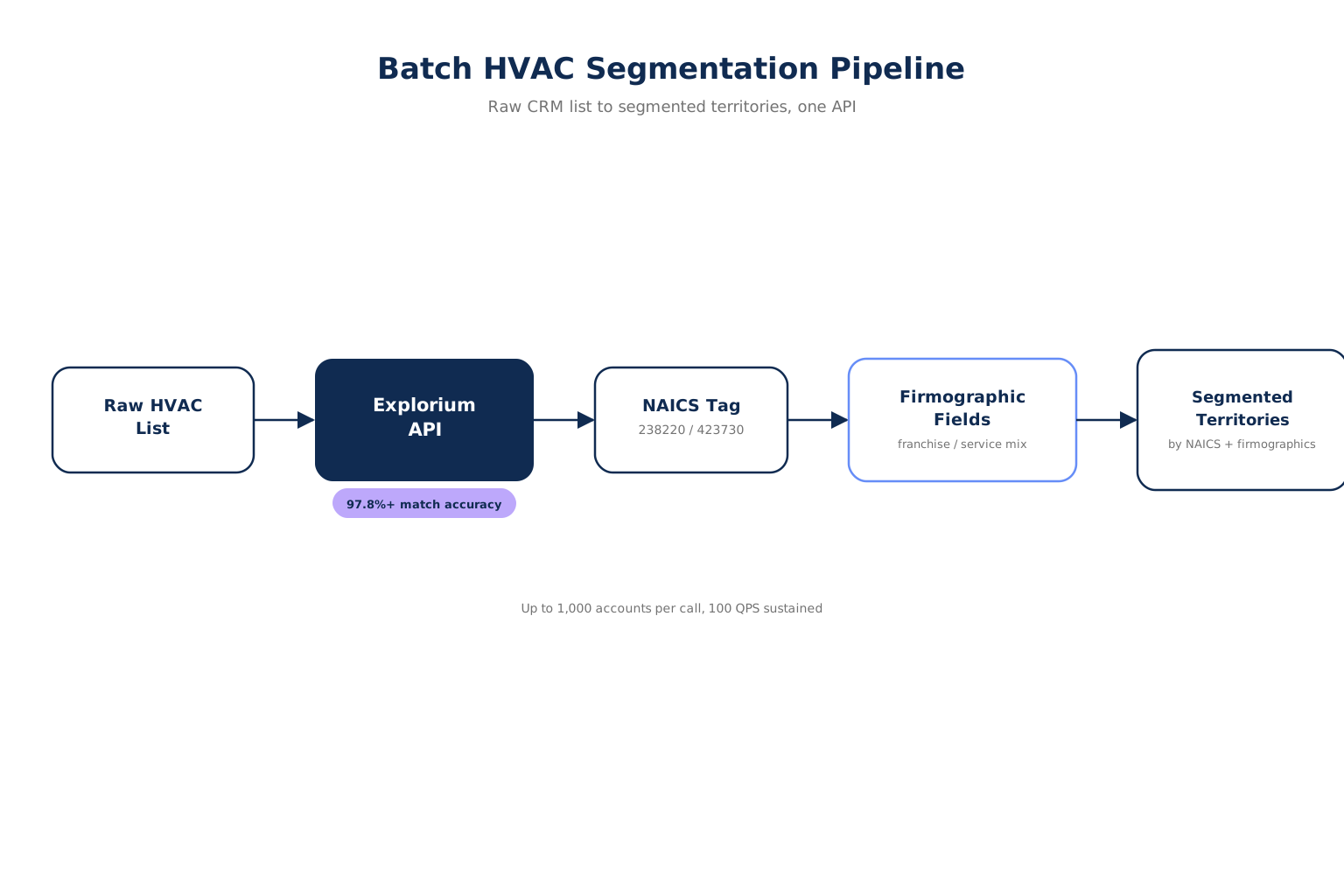
Explorium enriches NAICS classification, firmographics, and franchise signals for up to 1,000 accounts per call at 97.8%+ company match accuracy, from one free account with a unified credit pool and no per-endpoint pricing, which makes the two-pass method practical at list scale. A manual pass on an 88,700-establishment universe isn’t realistic; a batch call is.
🔑 Pillar 1: One Platform for All Your Data Needs
- 150M+ company profiles and 800M+ people profiles from 50+ sources cover NAICS, firmographics, and franchise signals without a second vendor.
- 18 buying-signal categories and 80+ signal types layer growth timing onto the base segment in the same call.
- 97.8%+ company match accuracy keeps tagging reliable on a messy CRM list.
🚀 Pillar 2: Built for Scale
- Up to 1,000 entities per call means the full 238220 universe classifies in roughly 90 batched calls, not 88,700 individual lookups.
- 100 QPS sustained throughput supports a recurring re-classification job, not just a one-time pass.
- 99.999% uptime keeps a scheduled segmentation job reliable for periodic TAM refreshes.
💰 Pillar 3: Affordable by Design
- A free account with no sales call gets a data engineer to a first call in minutes.
- A unified credit pool means NAICS append, firmographic lookups, and signal enrichment draw from one budget.
- No seat-tax model fits a lean team running a periodic job rather than a per-seat license.
⚡ Sample Enrichment Call
curl -X POST https://api.explorium.ai/v1/companies/enrich \
  -H "Authorization: Bearer $EXPLORIUM_API_KEY" \
  -d '{"companies": [{"domain": "examplehvacco.com"}], "fields": ["naics_code", "employee_count", "franchise_brand"]}'
🔄 Sample Batch Classification (Python)
accounts = load_crm_list("hvac_raw.csv")
resp = requests.post(
    "https://api.explorium.ai/v1/companies/bulk_enrich",
    headers={"Authorization": f"Bearer {API_KEY}"},
    json={"companies": accounts, "fields": ["naics_code", "service_mix", "franchise_brand"]}
)
for row in resp.json()["results"]:
    tag_subvertical(row)
📊 Sample Signal Query
curl -X POST https://api.explorium.ai/v1/signals/search \
  -H "Authorization: Bearer $EXPLORIUM_API_KEY" \
  -d '{"naics_code": "238220", "signal_types": ["new_location_opening", "hiring_surge"]}'
💡 Sample Franchise-Brand Filter
curl -X POST https://api.explorium.ai/v1/companies/search \
  -H "Authorization: Bearer $EXPLORIUM_API_KEY" \
  -d '{"naics_code": "238220", "franchise_brand": {"exists": true}}'
"Explorium is a fast and effective platform that makes the integration and analysis of third-party data seamless.", David A., CEO, Mid-Market, via G2 (Explorium Verified Review)
Getting Started: From Raw HVAC List to Segmented Territories in 5 Steps
Explorium is the practical path to this segmentation because it appends NAICS, firmographics, and franchise-brand data from one account at batch scale, the exact combination the two-pass method requires. One platform for classification and signal data, batch scale to 1,000 accounts per call, and a free unified-credit account form the decision framework for running this pipeline.
- Step 1: Create a free account and pull a sample of 100 accounts from the raw HVAC list.
- Step 2: Run the enrichment call to append NAICS code, franchise tag, and service mix.
- Step 3: Split the sample into 238220 and 423730 buckets and validate against known accounts.
- Step 4: Graduate to the full list in batches of up to 1,000 accounts per call.
- Step 5: Layer growth signals onto each sub-vertical to prioritize outbound timing.
🔑 The Decision Framework
Start with NAICS 238220 and 423730 as the outer boundary, then apply franchise tagging and service-mix fields to cut each code into a sub-vertical. Do this from one 97.8%+ accurate source rather than stitching NAICS and franchise data from separate vendors.
Ready to turn a flat HVAC tag into real sub-verticals? Start a free trial: 100 credits, no subscription required.
Related Posts
- Best B2B Data Enrichment APIs for AI Agents
- SOC 2 Compliance for B2B Data Vendors
- What SLA Terms Should You Look For in a B2B Data API Contract
FAQs


