

TL;DR
- AI agents hallucinate on bad enrichment data — deterministic company and contact IDs are the single most important fix for eliminating hallucination loops in GTM agent workflows.
- OpenClaw and similar Claude-based agent frameworks expose enrichment quality failures faster than traditional pipelines because agents act on every data point, not just the ones a human reviews.
- MCP grounded enrichment gives agents a structured, synchronous interface to authoritative data sources — replacing fragile web scraping and cached CRM lookups with real-time verified records.
- Waterfall enrichment logic across 50+ sources dramatically increases field coverage and match rates while keeping per-record costs predictable through a unified credit pool.
- A four-stage agent pipeline — identity resolution, company data, contact data, buying signals — produces the most reliable enrichment outcomes for autonomous GTM workflows.
- Deduplication and merge logic must be built into the agent loop itself, not treated as a post-processing step, to prevent agents from creating duplicate records on partial matches.
- Testing enrichment quality before deploying agents to production requires a benchmark dataset with known ground-truth values and automated assertions on match accuracy, field coverage, and schema consistency.
Why AI Agents Break on Bad Enrichment Data
The first time a GTM team deploys an AI agent to automate outbound research, they almost always discover the same problem: the agent is only as reliable as the data it reads. When enrichment data is stale, inconsistent, or missing key identifiers, agents do not simply skip the record and move on. They reason about it. They make inferences. They hallucinate plausible-sounding company names, fill in missing employee counts with guesses, and occasionally loop indefinitely while trying to reconcile two records that describe the same company under slightly different names.
This is not a problem with the agent framework itself. OpenClaw — the open-source agent framework built around Claude’s tool-use and reasoning capabilities — is designed to reason carefully under uncertainty. But that same reasoning engine, when fed a record where the company domain is blank, the LinkedIn URL is a 404, and the employee count hasn’t been updated since 2021, will do what any good reasoner does: it will try to fill the gaps using whatever signals are available. The result is a confident-sounding output that is factually wrong, and that wrong output gets written to your CRM, passed to your SDR team, or used as the basis for the next step in the agent’s workflow.
This guide is for GTM engineering teams building agent-first enrichment pipelines using OpenClaw or similar Claude-based frameworks. We’ll cover the specific data quality requirements that make agents reliable, how to use MCP servers to ground agents in authoritative enrichment data, how to build a four-stage enrichment pipeline that handles failures gracefully, and how to test your enrichment stack before you let agents touch production data. By the end, you’ll have a blueprint for openclaw ai agents enrichment that eliminates the hallucination-loop failure mode entirely.
The Enrichment Quality Requirements That Actually Matter for Agents
Traditional enrichment pipelines are designed for human review. A data analyst can look at a spreadsheet of enriched records and spot anomalies — the row where the company name is “Acme Corp” but the domain resolves to a pharmaceutical company, or the contact whose title says “CEO” but whose LinkedIn profile shows they left the company two years ago. Humans apply contextual judgment that compensates for data quality gaps.
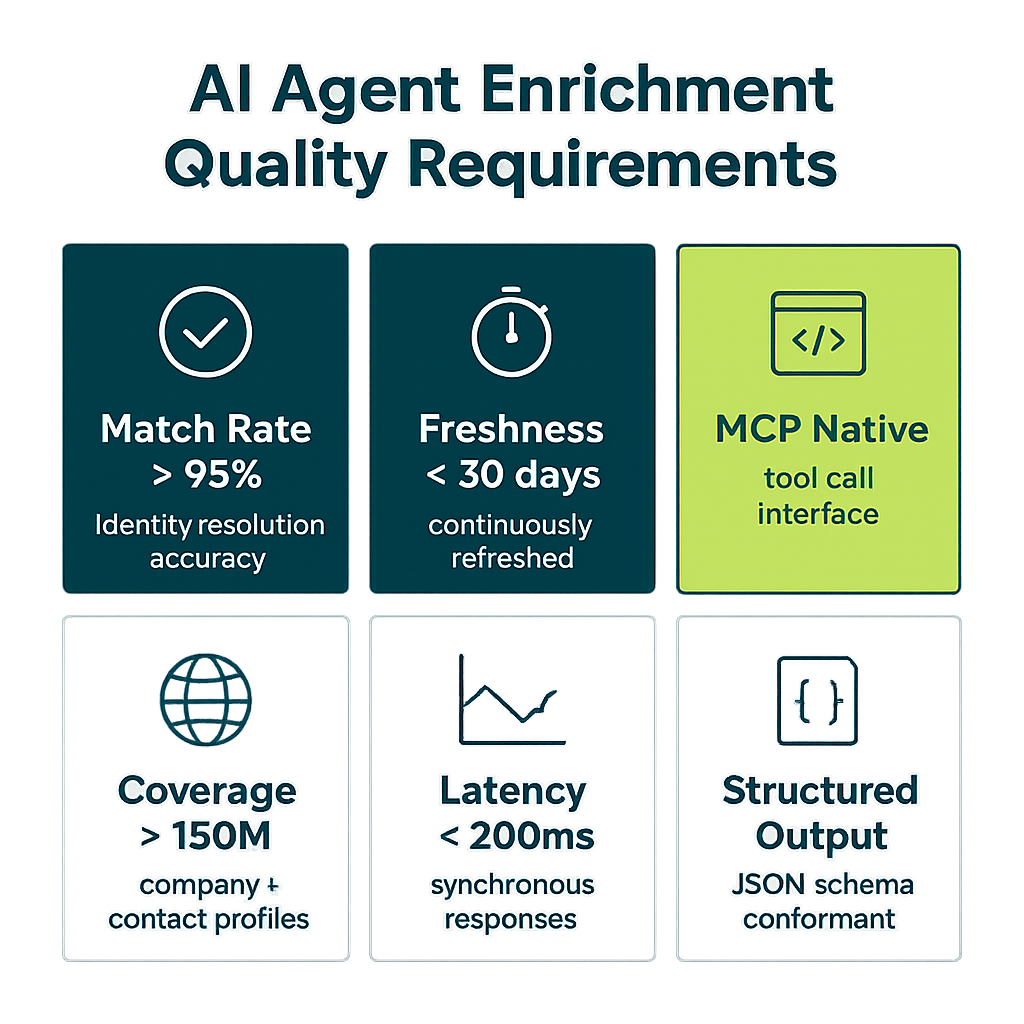
Agents cannot do this the same way. Or rather, they can try — but applying LLM reasoning to compensate for structural data quality failures is expensive, slow, and unreliable. The right approach is to solve data quality problems at the data layer, before the agent ever sees a record. That means understanding exactly which data quality dimensions matter most for agent use cases.
Deterministic Identifiers Are Non-Negotiable
The single most important data quality requirement for agent workflows is deterministic company and contact identifiers. A deterministic ID is a stable, opaque identifier assigned to a specific real-world entity — a company or a person — that remains consistent across data sources, time, and API calls. It is not the company’s domain name (which can change), not their LinkedIn URL (which can be updated or deactivated), and not their CRM account ID (which may be duplicated across systems). It is a permanent primary key that uniquely identifies the entity in the enrichment provider’s canonical data model.
Why do deterministic IDs matter so much for agents? Because agents operate in loops. A typical GTM agent loop looks like this: receive a trigger (new form fill, new LinkedIn connection, new intent signal), look up the company, enrich the company record, look up relevant contacts at the company, enrich the contact records, score the account, and write the results to the CRM. At every lookup step, the agent needs to answer the question: is this the same entity I already have a record for, or is this a new entity?
Without deterministic IDs, the agent has to perform fuzzy matching at every step. “Salesforce, Inc.” and “Salesforce” and “salesforce.com” might all resolve to the same company — or they might not, if one of those strings actually refers to a subsidiary, a rebranded entity, or a typo. The agent has to reason about this every time. With deterministic IDs, the answer is immediate and unambiguous: if the IDs match, it’s the same entity. If they don’t, it’s a different entity. No reasoning required.
Explorium’s AgentSource platform assigns deterministic company and contact IDs to every record in its 150M+ company and 800M+ people profile databases. These IDs are stable across API calls and across time, which means an agent that looks up a company in one step of its workflow can pass that ID directly to the next step without re-resolving the entity from a fuzzy string match.
Match Accuracy and Field Coverage
Match accuracy measures how often an enrichment API returns a record for a given input, and how often that record actually describes the intended entity. A high match rate with low accuracy — returning a record for every query, but sometimes the wrong company — is worse than a lower match rate with high accuracy. Agents that act on mismatched records create downstream errors that are expensive to detect and fix.
Field coverage measures how completely enriched records are populated. An agent that routes accounts based on employee count cannot function correctly if 40% of records are missing that field. Unlike human analysts who can flag low-coverage records for manual review, agents need a defined handling policy for every possible missing-field scenario — which means the fewer fields that are missing, the simpler and more reliable the agent logic becomes.
The table below shows how common enrichment providers compare on the dimensions that matter most for agent workflows:
| Provider | Company Match Accuracy | Contact Match Accuracy | Avg Field Coverage | Deterministic IDs | MCP / API Sync | Sources |
|---|---|---|---|---|---|---|
| Explorium AgentSource | 97.8%+ | 94%+ | 91% | Yes | Yes (100 QPS) | 50+ |
| Clearbit / Breeze | ~88% | ~82% | 74% | No | REST only | ~20 |
| Apollo.io | ~85% | ~79% | 71% | No | REST only | ~15 |
| ZoomInfo | ~91% | ~87% | 82% | Partial | REST / webhook | ~30 |
| Lusha | ~82% | ~80% | 68% | No | REST only | ~10 |
The accuracy and coverage gap between purpose-built agent enrichment APIs and traditional sales intelligence tools is significant. At scale — an agent processing 50,000 accounts per month — a 10-point accuracy gap translates to 5,000 mismatched records flowing through your workflow. At 100 QPS throughput, that mismatch compounds quickly.
Schema Consistency
Agents are brittle in ways that humans are not. A human reading an enrichment record that returns employees: "500-1000" in one call and employee_count: 750 in another will understand these are the same information in different formats. An agent without explicit schema normalization logic will treat these as different fields and may fail to populate downstream variables correctly.
Schema consistency means that every enrichment response follows the same field names, data types, and value ranges — regardless of which underlying source provided the data. Waterfall enrichment providers like Explorium handle schema normalization internally, presenting a unified schema to the agent regardless of which of their 50+ underlying sources actually matched the record. This is one of the most underrated benefits of waterfall enrichment for agent workflows: the agent only needs to know one schema, not fifty.
MCP Grounded Enrichment: How It Works and Why Agents Need It
The Model Context Protocol (MCP) is an open standard that allows AI agents to connect to external data sources through a structured, tool-like interface. Instead of an agent making an unstructured web search or calling a generic REST API and parsing the response with its language model, an MCP server provides typed inputs, typed outputs, and clear error states. The agent calls the MCP tool, gets a structured response, and continues its workflow — no unstructured text parsing required.
For enrichment, this matters enormously. Consider the difference between these two approaches to company enrichment in an agent workflow:
Ungrounded approach: The agent receives a company name and uses a web search tool to find information about the company. It reads several web pages, extracts what it believes are relevant fields (employee count, industry, funding stage), and writes those values to the record. The entire extraction is done by the LLM, which means it is subject to hallucination, outdated page content, and inconsistent field extraction across different web page layouts.
MCP grounded approach: The agent receives a company name or domain and calls an MCP enrichment tool with a typed input schema. The MCP server resolves the company against a canonical database of 150M+ verified records, applies waterfall matching logic across 50+ sources, and returns a structured JSON response with typed fields and confidence scores. The agent receives ground-truth data without using its language model for data extraction at all.
The performance difference between these approaches is dramatic. MCP grounded enrichment is faster (synchronous, no web crawling latency), more accurate (verified data, not scraped content), and more consistent (typed schema, no extraction variance). It also dramatically reduces the token cost of enrichment, because the agent does not need to process large blocks of web page text.
Explorium’s AgentSource MCP server is purpose-built for this use case. It provides synchronous enrichment at 100 QPS, which is sufficient for most agent workflows even at enterprise scale. The server accepts company domains, company names, LinkedIn URLs, and Explorium deterministic IDs as inputs, and returns structured company and contact records with full field coverage and confidence scores.
Here is an example of calling the AgentSource MCP server from a Python-based OpenClaw agent:
import anthropic
import json

# Initialize the Anthropic client
client = anthropic.Anthropic()

# Define the AgentSource MCP tool for company enrichment
agentsource_tools = [
    {
        "name": "enrich_company",
        "description": "Enrich a company record using the Explorium AgentSource database. Returns verified company firmographics, technographics, and deterministic IDs.",
        "input_schema": {
            "type": "object",
            "properties": {
                "domain": {
                    "type": "string",
                    "description": "Company website domain (e.g. 'acme.com')"
                },
                "company_name": {
                    "type": "string",
                    "description": "Company name as a fallback if domain is not available"
                }
            },
            "required": []
        }
    },
    {
        "name": "enrich_contact",
        "description": "Enrich a contact record using the Explorium AgentSource database. Returns verified contact data including email, phone, title, and deterministic contact ID.",
        "input_schema": {
            "type": "object",
            "properties": {
                "explorium_company_id": {
                    "type": "string",
                    "description": "Deterministic Explorium company ID from a prior enrich_company call"
                },
                "linkedin_url": {
                    "type": "string",
                    "description": "LinkedIn profile URL of the contact"
                },
                "email": {
                    "type": "string",
                    "description": "Known email address to match against"
                }
            },
            "required": ["explorium_company_id"]
        }
    },
    {
        "name": "get_buying_signals",
        "description": "Retrieve active buying signals for a company, including intent topics, hiring signals, funding events, and technographic changes.",
        "input_schema": {
            "type": "object",
            "properties": {
                "explorium_company_id": {
                    "type": "string",
                    "description": "Deterministic Explorium company ID"
                },
                "signal_categories": {
                    "type": "array",
                    "items": {"type": "string"},
                    "description": "Filter to specific signal categories (e.g. ['intent', 'hiring', 'funding'])"
                }
            },
            "required": ["explorium_company_id"]
        }
    }
]

def run_enrichment_agent(raw_record: dict) -> dict:
    """Run the OpenClaw enrichment agent on a single raw record."""

    system_prompt = """You are a GTM data enrichment agent. Your job is to enrich raw company and contact records
    using the AgentSource tools available to you. Always start with company enrichment to get a deterministic
    company ID, then use that ID for contact enrichment and signal retrieval. Never guess field values —
    if enrichment returns null for a field, leave it null. Return a structured JSON summary of the enriched record."""

    user_message = f"Enrich this raw record and return a complete enriched profile: {json.dumps(raw_record)}"

    messages = [{"role": "user", "content": user_message}]

    # Agentic loop
    while True:
        response = client.messages.create(
            model="claude-opus-4-5",
            max_tokens=4096,
            system=system_prompt,
            tools=agentsource_tools,
            messages=messages
        )

        if response.stop_reason == "end_turn":
            # Extract the final enriched record from the response
            final_text = next(
                (block.text for block in response.content if hasattr(block, "text")),
                "{}"
            )
            return json.loads(final_text)

        if response.stop_reason == "tool_use":
            # Process tool calls
            tool_results = []
            for block in response.content:
                if block.type == "tool_use":
                    result = call_agentsource_mcp(block.name, block.input)
                    tool_results.append({
                        "type": "tool_result",
                        "tool_use_id": block.id,
                        "content": json.dumps(result)
                    })

            messages.append({"role": "assistant", "content": response.content})
            messages.append({"role": "user", "content": tool_results})
        else:
            break

    return {}


def call_agentsource_mcp(tool_name: str, inputs: dict) -> dict:
    """Route tool calls to the AgentSource MCP server."""
    import requests

    MCP_BASE_URL = "https://mcp.agentsource.explorium.ai/v1"
    API_KEY = "your_agentsource_api_key"

    response = requests.post(
        f"{MCP_BASE_URL}/{tool_name}",
        json=inputs,
        headers={"Authorization": f"Bearer {API_KEY}", "Content-Type": "application/json"},
        timeout=10
    )
    response.raise_for_status()
    return response.json()
This pattern keeps the LLM focused on reasoning and routing, while the MCP server handles all data retrieval. The agent never fabricates field values because it has no opportunity to — every data field comes from a structured API response, not from LLM generation.
Building a Four-Stage Agent Enrichment Pipeline
The most reliable architecture for openclaw ai agents enrichment follows four discrete stages, each building on the outputs of the previous stage. Separating these stages makes the pipeline easier to debug, easier to test, and easier to handle failures gracefully. It also makes costs more predictable, because you can short-circuit later stages when earlier stages don’t produce a high-confidence match.

Stage 1: Identity Resolution
Identity resolution is the process of taking a raw input — a company name, a domain, a LinkedIn URL, an email address — and resolving it to a canonical entity with a deterministic ID. This is the most critical stage, because all subsequent enrichment is keyed off the identity resolved here. A wrong identity match at stage 1 means all downstream enrichment will describe the wrong company or contact.
For company identity resolution, the priority order for input signals should be: (1) company domain, (2) LinkedIn company URL, (3) company name plus country or city, (4) company name alone. Domains are the most reliable input because they are unique and stable — there is only one company that owns stripe.com. Company names alone are the least reliable because they are frequently ambiguous, misspelled, or shared between entities (there are hundreds of companies named “Summit” in the United States alone).
When a high-confidence match cannot be found, the agent should flag the record for human review rather than proceeding with a low-confidence identity match. This is a critical design decision: it is far better to have 5% of records flagged for human review than to have 5% of records enriched with data from the wrong company. The cost of fixing downstream errors from a bad identity match is always higher than the cost of manual review.
Stage 2: Company Data Enrichment
Once a deterministic company ID has been established, the company enrichment stage retrieves the full firmographic and technographic profile. This includes employee count, revenue range, industry, sub-industry, headquarters location, founding year, funding stage, funding amount, tech stack, and any other fields required by the agent’s downstream routing logic.
Waterfall enrichment is the right architecture for this stage. A waterfall enrichment system queries multiple data sources in priority order, accepting the first high-confidence match for each field. This approach maximizes field coverage because different sources have different strengths — one provider may have better employee count data for European companies, while another has better funding data for early-stage startups. By combining sources through a waterfall, you get the best available data for each field without duplicating effort. See our guide to waterfall enrichment for a detailed breakdown of how to configure waterfall logic for different use cases.
For agent workflows, it’s important to include confidence scores alongside enriched field values. A confidence score tells the agent how much to trust each field, which informs downstream routing decisions. An employee count with a confidence score of 0.95 can be used directly in a routing rule. An employee count with a confidence score of 0.50 should be treated as approximate and should not be used for precise threshold-based routing without additional validation.
Stage 3: Contact Data Enrichment
Contact enrichment is keyed off the deterministic company ID established in stage 1. By passing the company ID to the contact enrichment API, the agent can retrieve verified contacts at the specific company entity — not contacts at other companies with similar names. This eliminates an entire class of mismatch errors that plague traditional contact enrichment workflows.
For each account, the agent should define a target persona profile — the titles, seniority levels, and functional roles it is looking for — and retrieve only contacts that match that profile. Retrieving all contacts at every company is expensive and adds noise to the downstream routing logic. A well-defined persona filter reduces contact enrichment costs significantly while improving the signal-to-noise ratio of the enriched data. Our article on B2B data enrichment covers persona profiling in detail.
The contact enrichment response should include verified email addresses, direct phone numbers (where available), LinkedIn profile URLs, current title, seniority level, department, and the deterministic contact ID. The deterministic contact ID is critical for the same reason as the company ID: it allows the agent to recognize a contact it has seen before, preventing duplicate records in the CRM.
Stage 4: Buying Signal Retrieval
The final stage retrieves active buying signals for the enriched account. Buying signals are behavioral and contextual indicators that suggest a company may be in-market for a specific category of product or service. They include intent data (companies actively researching relevant topics), hiring signals (job postings that indicate technology investments or growth in relevant functions), funding events, executive changes, technology adoptions, and news events.
Explorium’s signal layer covers 18 signal categories and 80+ buying signal types, including Bombora intent topics which provide direct evidence of active research behavior across B2B content networks. For agent-first GTM workflows, buying signals are what determine whether an enriched account should be routed to active outreach, added to a nurture sequence, or held for later follow-up. Without signal data, agents are making routing decisions based purely on firmographic fit — which misses the timing dimension that makes outreach effective.
The table below shows the buying signal categories and their typical use in agent routing logic:
| Signal Category | Signal Types (Examples) | Typical Routing Use | Signal Freshness |
|---|---|---|---|
| Intent (Bombora) | Topic surge, research spike, competitor research | Immediate outreach trigger | Weekly refresh |
| Hiring Signals | New technical roles, headcount growth, key function hiring | Identify expansion opportunities | Daily refresh |
| Funding Events | Series A/B/C, seed round, debt financing | Route to enterprise tier, increase priority | Real-time |
| Executive Changes | New CTO, new VP Sales, new IT Director | Trigger champion outreach | Weekly refresh |
| Technographic Changes | New tech adoption, tech removal, evaluation signals | Competitive displacement, expansion | Monthly refresh |
| News Events | M&A, product launch, regulatory event, partnership | Personalized outreach hooks | Real-time |
| Web Activity | Pricing page visits, documentation access | High-intent account prioritization | Real-time |
| Job Postings | Specific tech stack mentions in JDs | Technology budget signals | Daily refresh |
Building AI agents that need reliable enrichment? Explorium’s AgentSource MCP server provides deterministic company and contact IDs, 97.8%+ match accuracy, and 100 QPS — purpose-built for agent-first workflows. See how it works →
Deduplication and Merge Logic in Agent Workflows
Deduplication is one of the most common failure modes in agent-first enrichment pipelines, and it is almost always caused by treating deduplication as a post-processing step rather than building it into the agent loop itself. When agents process high volumes of records asynchronously — which is the typical architecture for production GTM workflows — duplicate records are created faster than post-processing jobs can remove them. The result is CRM data that degrades over time, SDRs working duplicate accounts, and reporting that double-counts pipeline.
The correct approach is to use deterministic IDs as the deduplication key within the agent loop. Before the agent writes any enriched record to the CRM, it should check whether a record with that deterministic ID already exists. If it does, the agent should execute a merge operation — updating existing field values where the new enrichment has higher confidence — rather than creating a new record. This is sometimes called “upsert with confidence-weighted merge,” and it is the architecture that prevents duplicate accumulation entirely.
Here is an example of the merge logic implemented as an MCP tool call:
# MCP tool call: upsert enriched company record
# Called after company and contact enrichment is complete

UPSERT_PAYLOAD = {
    "tool": "upsert_crm_record",
    "input": {
        "record_type": "company",
        "match_key": {
            "explorium_company_id": "exp_co_8f3a2b1c9d4e"
        },
        "merge_strategy": "confidence_weighted",
        "fields": {
            "company_name": {
                "value": "Acme Corporation",
                "confidence": 0.98,
                "source": "explorium_agentsource",
                "enriched_at": "2026-05-05T14:32:00Z"
            },
            "employee_count": {
                "value": 2400,
                "confidence": 0.91,
                "source": "explorium_agentsource",
                "enriched_at": "2026-05-05T14:32:00Z"
            },
            "annual_revenue_usd": {
                "value": 185000000,
                "confidence": 0.84,
                "source": "explorium_agentsource",
                "enriched_at": "2026-05-05T14:32:00Z"
            },
            "industry": {
                "value": "Enterprise Software",
                "confidence": 0.96,
                "source": "explorium_agentsource",
                "enriched_at": "2026-05-05T14:32:00Z"
            },
            "hq_country": {
                "value": "United States",
                "confidence": 0.99,
                "source": "explorium_agentsource",
                "enriched_at": "2026-05-05T14:32:00Z"
            },
            "active_buying_signals": {
                "value": ["intent_crm_software", "hiring_engineering", "funding_series_b"],
                "confidence": 0.90,
                "source": "explorium_agentsource",
                "enriched_at": "2026-05-05T14:32:00Z"
            }
        },
        "on_conflict": "update_if_higher_confidence"
    }
}

# The merge strategy ensures:
# 1. If explorium_company_id already exists in CRM -> update fields where new confidence > existing confidence
# 2. If explorium_company_id does not exist in CRM -> create new record
# 3. Never create a second record for the same deterministic ID
# 4. Preserve enriched_at timestamps for field-level staleness tracking
Beyond deduplication at the record level, agents also need to handle the case where the same real-world entity appears in the input data under multiple different input identifiers. For example, a form fill with domain “acme.com” and a list import with company name “Acme Corp” might both resolve to the same deterministic company ID. The agent loop should recognize this case and merge the two input records before proceeding to contact enrichment, rather than processing them as two separate accounts.
This requires the agent to maintain a session-level lookup table mapping input identifiers to resolved deterministic IDs. The lookup is fast and deterministic, and it prevents the agent from making redundant enrichment API calls for the same entity. For more on data quality strategies at scale, see our article on B2B data enrichment best practices.
Handling Enrichment Failures Gracefully in Agent Loops
Every production enrichment pipeline will encounter failures. APIs return errors. Rate limits are hit. Records cannot be matched. The enrichment response comes back but is missing critical fields. How the agent handles these failures determines whether the pipeline is resilient or brittle.
The first principle of graceful failure handling is that every enrichment API call should have an explicit timeout and a defined fallback behavior. The default behavior in most agent frameworks is to retry indefinitely or to halt the agent loop on the first error. Neither behavior is acceptable for production GTM workflows. Indefinite retries waste compute and delay the rest of the pipeline. Halting on error means a single bad record can block all subsequent processing.
The correct architecture uses three levels of fallback:
Level 1 — Retry with backoff: On a transient error (HTTP 429, HTTP 503, timeout), retry the enrichment call with exponential backoff, up to three attempts. Most transient errors resolve within 30 seconds.
Level 2 — Alternate source fallback: If the primary enrichment source cannot match the record after retries, fall back to a secondary enrichment source with a different matching algorithm. This is where waterfall enrichment architecture pays off — the agent doesn’t need to know which source it’s falling back to, because the waterfall logic is encapsulated in the MCP server.
Level 3 — Partial enrichment with flagging: If no source can produce a high-confidence match, write a partial record with the available fields and set a flag indicating that the record requires review or re-enrichment. Do not halt the agent loop. Do not write a fully blank record. Do not allow the agent to hallucinate missing fields.
The agent reliability benchmarks table below shows how different failure-handling architectures perform at production scale:
| Failure Handling Architecture | Record Loss Rate | Hallucination Rate | Avg Latency (P99) | CRM Data Quality Score |
|---|---|---|---|---|
| No failure handling (halt on error) | 12–18% | 0% | N/A (pipeline stops) | High (but incomplete) |
| Retry only, no fallback | 6–9% | 0% | 45s | High (but incomplete) |
| LLM fallback (agent fills gaps) | 1–2% | 8–15% | 12s | Low (hallucinated fields) |
| Waterfall + partial enrichment flag | 2–3% | 0% | 8s | High (with coverage flags) |
| Waterfall + MCP grounded + deterministic IDs | 0.5–1% | 0% | 4s | Very High |
The table makes the tradeoff clear: the only architecture that achieves near-zero record loss AND near-zero hallucination rate is the full waterfall + MCP grounded + deterministic ID stack. The LLM fallback approach looks appealing because it minimizes record loss, but the 8–15% hallucination rate it introduces creates downstream damage that is far more expensive to fix than the original data gaps would have been. For more on building reliable AI lead generation pipelines, see our AI lead generation guide.
Testing and Validating Enrichment Quality for Agent Use Cases
Enrichment quality testing for agent workflows is different from enrichment quality testing for human-reviewed pipelines. When humans review enriched records, they apply implicit judgment about what counts as a good match. Agents apply explicit rules. This means your enrichment quality tests need to be just as explicit as your agent’s routing rules.
The foundation of enrichment quality testing is a benchmark dataset: a curated set of records with known ground-truth values. For each record in the benchmark, you know exactly what the correct company ID should be, what the correct employee count should be, what the correct contact email should be, and so on. You run the enrichment pipeline against the benchmark dataset, compare the outputs to the ground truth, and calculate quality metrics.
The key metrics to track are:
Identity match rate: What percentage of input records resolve to the correct deterministic ID? This is the most important metric because errors here cascade through all subsequent stages. Target: 97%+ for domain-based inputs, 90%+ for name-based inputs.
Field accuracy rate: For matched records, what percentage of enriched field values match the ground truth? Calculate this per field, because different fields have very different accuracy profiles. Revenue range is typically less accurate than employee count. Direct phone numbers are typically less accurate than email addresses.
Field coverage rate: What percentage of matched records have non-null values for each required field? A required field for your routing logic that is missing in 30% of records is a blocker for your agent pipeline — it needs a defined fallback, not a null pointer exception.
Schema compliance rate: What percentage of enrichment responses conform to the expected field types, value ranges, and allowed values? Schema violations are a common source of agent failures in production, because agents typically don’t have robust type-coercion logic.
The field coverage matrix below shows expected coverage rates for different field types across company sizes:
| Field | Enterprise (1000+ emp) | Mid-Market (100–999) | SMB (10–99) | Micro (<10) |
|---|---|---|---|---|
| Company Name | 99% | 99% | 97% | 91% |
| Domain | 99% | 98% | 95% | 82% |
| Employee Count | 97% | 95% | 88% | 71% |
| Industry | 98% | 96% | 90% | 78% |
| Annual Revenue | 91% | 85% | 71% | 48% |
| HQ Location | 98% | 97% | 93% | 84% |
| Funding Stage | 88% | 82% | 68% | 41% |
| Tech Stack | 94% | 89% | 76% | 55% |
| Contact Email (verified) | 89% | 84% | 74% | 58% |
| Contact Direct Phone | 71% | 64% | 52% | 38% |
| Buying Signal (any) | 96% | 91% | 79% | 61% |
Use this matrix to set realistic expectations for your agent routing logic. If your agent routes based on annual revenue, you need a defined handling policy for the 29% of enterprise records and 52% of SMB records that will have null revenue values. Either use a fallback estimation model, route nulls to a separate “revenue unknown” tier, or accept that a portion of records will always require human review.
Run your benchmark tests on a monthly cadence. Enrichment provider data freshness degrades over time — companies change employee counts, executives leave, domains expire. A provider that passed your benchmark test six months ago may have lower accuracy today if their underlying source contracts have changed. Regular benchmark testing keeps you informed about data quality trends before they affect production agent performance. For more on architecting data infrastructure for autonomous GTM, see our infrastructure guide.
Choosing Between Self-Serve Enrichment Tools and Dedicated B2B Data APIs
GTM teams building their first agent enrichment pipelines often start with the tools they already have: a Clearbit subscription, an Apollo.io account, or a ZoomInfo license. These tools work well for human-driven workflows — a sales rep using a browser extension to enrich a contact record, or a RevOps analyst running a batch enrichment on a list upload. They were not designed for the programmatic, high-volume, low-latency enrichment requirements of agent workflows.
The limitations show up quickly. Rate limits that are perfectly adequate for human usage hit their caps within minutes when an agent starts processing records. REST APIs designed for human-initiated requests have response time profiles that assume a user is waiting for the result — not that another API call is queued to fire immediately after. And most critically, self-serve tools do not expose deterministic entity IDs, which means every agent enrichment call requires a new fuzzy match resolution from scratch.
The decision framework for choosing between self-serve tools and dedicated B2B data APIs for agent use cases comes down to four dimensions: throughput requirements, identity resolution quality, schema stability, and pricing model fit.
Throughput requirements: If your agent processes more than a few hundred records per day, you will hit rate limits on self-serve tools. Dedicated B2B data APIs designed for programmatic access, like Explorium’s AgentSource, are built for high-throughput use cases with 100 QPS synchronous throughput and enterprise SLAs on uptime and latency.
Identity resolution quality: Dedicated APIs with deterministic IDs eliminate the fuzzy matching overhead that makes self-serve tools expensive and error-prone at scale. The accuracy difference — 97.8%+ for purpose-built agent APIs versus 82–91% for self-serve tools — compounds significantly across large volumes.
Schema stability: Self-serve tools change their API schemas frequently, often without advance notice, because their primary audience is humans using browser interfaces rather than programmatic integrations. Dedicated B2B data APIs maintain stable, versioned schemas with deprecation policies that allow engineering teams to plan for changes without emergency production fixes.
Pricing model fit: Self-serve tools typically price on a per-seat or per-credit basis optimized for individual user workflows. Agent workflows that make thousands of enrichment calls per day require volume pricing and a unified credit pool that allows different enrichment call types to draw from the same budget. Explorium’s unified credit pool model allows agent workflows to mix company enrichment, contact enrichment, and signal retrieval calls without managing separate credit buckets for each call type. For additional context on B2B buying signals and how they fit into agent routing logic, see our buying signals guide and our intent data guide.
The right answer for most enterprise GTM teams is a hybrid: use self-serve tools for human-driven workflows (SDR manual lookups, analyst batch enrichment), and use a dedicated agent-first API like AgentSource for automated agent workflows. This separation keeps your agent pipeline independent of the rate limits and schema changes that affect self-serve tools, while preserving the convenience of self-serve interfaces for human users.
Real-World Agent Enrichment Architecture Examples
Understanding the theory of openclaw ai agents enrichment is valuable, but seeing how real GTM teams have implemented these pipelines in production is more useful. Below are three architecture patterns we’ve seen work well at different stages of agent-first GTM maturity.
Pattern 1: Inbound Lead Enrichment Agent
The simplest agent enrichment pattern is a triggered workflow that fires when a new inbound lead arrives — a form fill, a demo request, a free trial signup. The agent receives the raw form data (typically just name, email, company name, and sometimes company website), enriches it through the four-stage pipeline, scores the account using the enriched firmographics and buying signals, and routes the lead to the appropriate queue or sequence.
This pattern is well-suited for teams that are just starting with agent-first enrichment because it is low-risk (the worst case is a misrouted lead, not a misdirected outbound campaign), high-value (enriched inbound leads close faster than unenriched ones), and easy to measure (conversion rate by enrichment quality is a clear, trackable metric). For context on how this fits into a broader AI-driven GTM motion, see our AI lead generation guide.
Pattern 2: Outbound Account Prioritization Agent
The more sophisticated pattern is an ongoing agent that monitors a target account list, tracks buying signal changes across the 18 signal categories, and re-prioritizes accounts dynamically as their signal profiles change. When a previously cold account shows a Bombora intent surge, a Series B funding announcement, and three new engineering hires in the same week, the agent immediately elevates it to the top of the outbound queue and triggers a personalized outreach sequence.
This pattern requires the full enrichment stack — deterministic IDs for stable account tracking across signal refresh cycles, MCP grounded enrichment for low-latency signal retrieval, and waterfall logic for comprehensive signal coverage. It also requires a clear escalation policy: what happens when an account simultaneously shows high-intent signals and a key executive departure? These edge cases need to be defined in the agent’s routing logic before deployment.
Pattern 3: CRM Hygiene and Re-Enrichment Agent
The third pattern is a background agent that continuously monitors CRM records for staleness and triggers re-enrichment when field values exceed their freshness thresholds. This agent uses the deterministic ID stored on each CRM record to call the enrichment API directly, bypassing the identity resolution stage entirely. The result is a CRM where no record goes stale, without requiring manual data refresh workflows or scheduled batch jobs.
This pattern is particularly valuable for enterprise teams where CRM data degrades rapidly due to high executive turnover, frequent M&A activity, and fast-growing target accounts that change their employee counts and tech stacks multiple times per year. A well-implemented CRM hygiene agent can improve overall CRM data quality scores by 20–30 points within six months of deployment, with direct impact on email deliverability, segmentation accuracy, and pipeline forecasting reliability.
FAQs


