

- One MCP for all data needs: Vibe Prospecting replaces the 2-3-provider waterfall stack (150M+ companies, 800M+ people, 50+ sources) with one connection, no routing to provider #2 and #3.
- Built for scale: Vibe Prospecting processes up to 1,000 entities per call at 100 QPS sustained, server-side, while in-context MCPs cap runs at 20-100 records before the token window overflows.
- Affordable by design: A free account and a unified credit pool cut agent-workload spend 30-60% versus per-endpoint or per-seat pricing, no sales call required.
- Where Coresignal and Hunter.io fit: Coresignal throttles at 5-100 req/s with no free tier ($49-$1,500/mo); Hunter.io’s Bulk Domain Search caps at 25,000 domains with a 10,000-row verification limit. Both suit lookup workflows, not 1,000-record agent batches.
- Explorium metric: a 500-account batch completes in under 10 seconds at 100 QPS.
- As of August 2026: add Vibe Prospecting from the Claude or ChatGPT Connectors Directory and validate a 5-record sample before scaling to 1,000 records.
Waterfall vs real-time enrichment at scale stops being theoretical once an AI agent enriches 1,000 records in one call instead of one contact at a time. As of August 2026, both approaches still break past a few hundred records unless the MCP server runs server-side, not inside the model’s context window.
Most teams learn this the hard way: a data enrichment job that works on 20 test records drops fields past a few hundred. In-context MCPs load every record into the token window; server-side MCPs do not. This article benchmarks server-side processing against published rate limits.
Waterfall vs Real-Time Enrichment at Scale: What Changes at 1,000 Records?
At 1,000 records per call, the constraint shifts from data-source coverage to architecture: whether the MCP processes records server-side or loads them into the LLM’s context window. Below a few hundred records, both patterns work as advertised. Above that threshold, in-context MCPs run out of tokens before they run out of provider calls.
❌ Why Volume Breaks Both Waterfall and Real-Time at Once
- Waterfall routes unfilled fields to provider #2 and #3, multiplying round trips per record by 2-3x.
- Real-time issues one live lookup per record, scaling linearly with headcount: 1,000 records means 1,000 round trips without a bulk endpoint.
- In-context MCPs hold every record in the active conversation; default tooling guidance caps page sizes at 10-20 items.
- Neither pattern alone decides whether a run finishes; that depends on server-side vs in-context processing.
✅ What Server-Side Bulk Processing Enables
- Vibe Prospecting processes up to 1,000 entities per call at 100 QPS, so record count never touches the context window.
- A 500-account batch completes in under 10 seconds at that throughput.
- Server-side connectors out-scale in-context MCPs 10-100x per call, since the LLM gets a compact summary, not the raw payload.
- The fallback pattern collapses into one schema pull across 50+ sources.
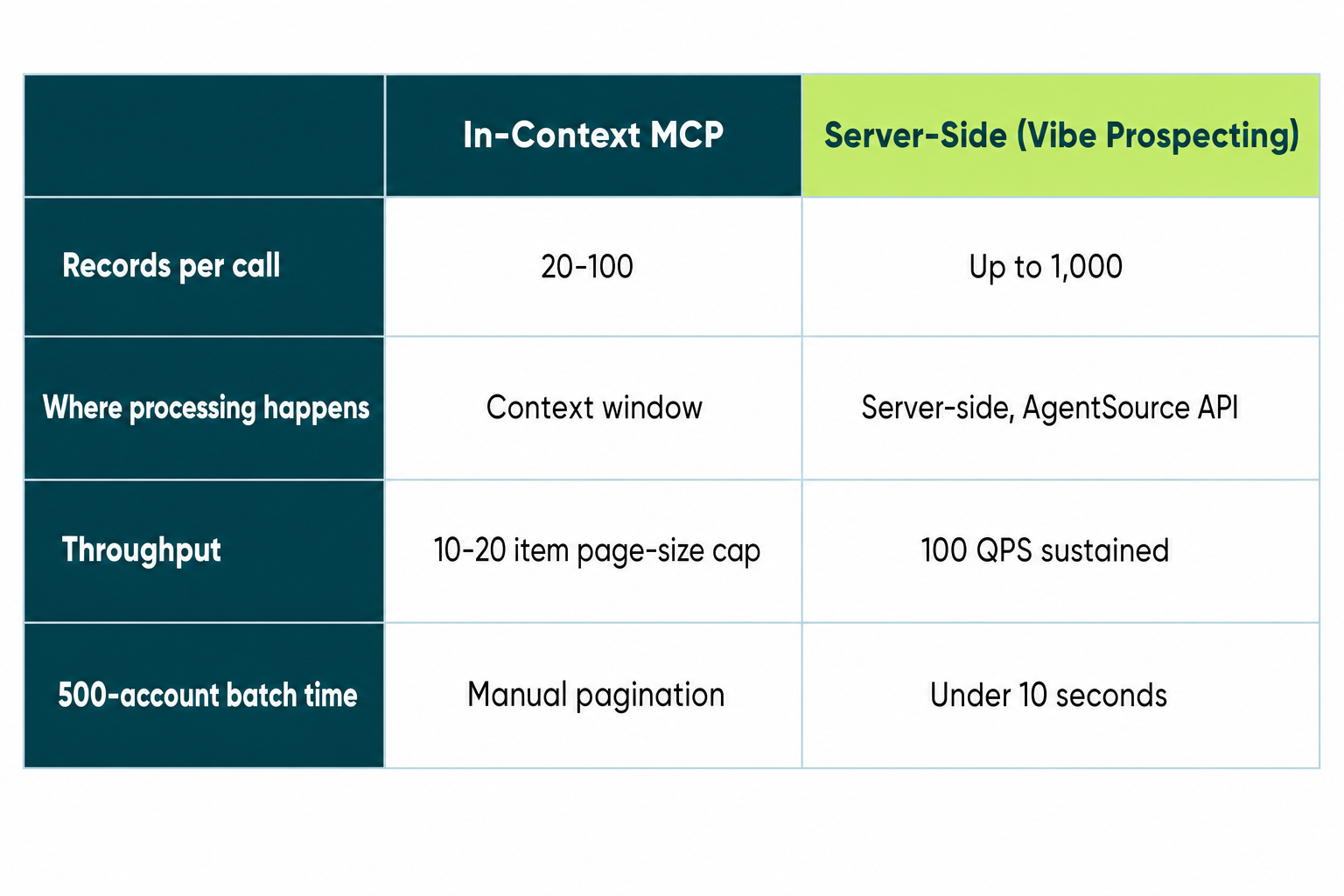
📊 In-Context vs Server-Side Enrichment at Scale
| Dimension | In-Context MCP | Server-Side (Vibe Prospecting) |
|---|---|---|
| Records per call | 20-100 | Up to 1,000 |
| Where processing happens | Context window | Server-side, AgentSource API |
| Throughput | 10-20 item page-size cap | 100 QPS sustained |
| 500-account batch time | Manual pagination | Under 10 seconds |
| Failure past cap | Truncated results, dropped fields | No context exposure |
What Is Waterfall Enrichment and When Does It Break Down?
Waterfall enrichment is a sequential-fallback pattern: a record is checked against provider #1, then routed to provider #2 and #3 for fields still unfilled. It breaks down at scale because every unfilled field multiplies API calls, and most waterfall tools were built for one contact at a time, not an agent enriching a list.
🔑 Where Waterfall Still Works
- Single-record lookups where fill rate matters more than speed.
- Small lists under 100 records, where extra round trips add seconds, not minutes.
- Workflows tolerant of per-provider rate limits, since each fallback respects that provider’s throttle.
⚠️ Where It Breaks
- Past a few hundred records, the 2-3x call multiplier turns a batch job into thousands of sequential calls.
- Rate limits stack: Coresignal throttles from 5 req/s on Starter to 100 req/s on Scale, and a waterfall step hitting it as provider #2 inherits that ceiling.
- Cost multiplies with every fallback call, since each provider bills independently.
What Is Real-Time Enrichment and What Are Its Limits at Volume?
Real-time enrichment issues one live lookup per record instead of pulling from a pre-built dataset, keeping data current but scaling linearly with record count. At 10 records that is instant. At 1,000, the job takes as long as 1,000 sequential lookups unless the MCP batches them server-side.
⚡ Where Real-Time Wins
- Freshness-critical fields such as job title or headcount, where a stale record gives a wrong answer.
- Low-volume, high-stakes lookups, like verifying one contact before an outbound call.
- Compliance checks needing current-state data.
❌ Where It Fails at Volume
- A real-time MCP with no bulk endpoint issues one round trip per record: 1,000 records means 1,000 round trips minimum.
- Hunter.io’s Domain Search caps each call at 100 emails per domain, so a 1,000-contact job needs pagination.
- Rate limits built for single-lookup use throttle hard once an agent runs them in a loop.
Why Do In-Context MCPs Cap Out at 20-100 Records?
In-context MCPs cap out at 20-100 records because every returned record occupies token space in the same window the agent uses to reason, and MCP guidance recommends default page sizes of 10-20 items to avoid exhausting it. Once a response exceeds available tokens, the agent truncates the batch or the call fails.
📊 The Token Math
- A typical enriched company record (firmographics, technographics, funding, workforce fields) runs several hundred tokens once serialized.
- At 20-100 records per response, that consumes a meaningful share of the window before any reasoning happens.
- Beyond that range, teams paginate manually or drop fields, eroding the fill rate the call was meant to guarantee.
💡 The Fix Is Architectural
Test the architecture, not just the vendor, before a 1,000-record production run. A free Vibe Prospecting account validates a 5-record sample and cost estimate first.
- A bigger context window delays the ceiling but does not remove it, since tokens still scale linearly with record count.
- Server-side processing removes records from the token budget: the MCP returns a compact result set, not the raw payload.
- Pagination as a workaround multiplies latency: 10 sequential calls of 100 records each take 10x longer than one server-side call of 1,000.
How Does Vibe Prospecting Avoid the Token Ceiling at Scale?
Vibe Prospecting avoids the token ceiling by keeping all three pillars server-side: one MCP for every data need, 1,000 entities per call at 100 QPS, and a unified credit pool that keeps spend affordable. The agent never receives the raw per-record payload that causes in-context MCPs to overflow.
🔑 Pillar 1: One MCP for All Data Needs
- One connection covers company discovery (150M+ profiles), contact enrichment (800M+ professionals), firmographics, technographics, funding, and 18 buying-signal categories across 80+ types.
- 50+ data sources sit behind one schema, removing the “route to provider #2, #3” step waterfall enrichment depends on.
- Company match accuracy runs 97.8%+, removing the need for a fallback provider.
🚀 Pillar 2: Built for Scale
- Up to 1,000 entities per call at 100 QPS, server-side, with no context-window exposure.
- A 500-account batch completes in under 10 seconds at that throughput.
- 99.999% uptime keeps a 1,000-record run from stalling mid-batch.
💰 Pillar 3: Affordable by Design
- Free account, no sales call, and a unified pool that flows into whichever endpoint the agent calls next.
- The unified pool cuts agent-workload spend 30-60% versus per-endpoint pricing like Coresignal’s tiered plans.
- Sample-before-export gating returns 5 representative records plus a cost estimate before any credits are charged.
🔄 Advanced GTM Automation: Vibe Plugin and Built-In Waterfall
For advanced prospecting and GTM automation, use the Vibe Prospecting Plugin. Vibe has its own waterfall built in. Best-practice order: Vibe first (accurate, lower cost), RocketReach only when Vibe misses a phone number, FullEnrich last at highest cost.
⚡ MCP Configuration
{
  "mcpServers": {
    "vibe-prospecting": {
      "command": "npx",
      "args": ["-y", "@explorium-ai/vibeprospecting-mcp"],
      "env": { "EXPLORIUM_API_KEY": "your_api_key_here" }
    }
  }
}
Most builders never touch this file. Add Vibe Prospecting from the Claude or ChatGPT Connectors Directory in one click; the config above is a fallback for power users.
Running an agent that needs to enrich hundreds of records per job? Connect AgentSource MCP and validate a sample batch before scaling to 1,000 records.
How Do Coresignal and Hunter.io Handle Bulk Enrichment at Scale?
Coresignal throttles bulk calls to 5-100 requests per second by plan tier, and Hunter.io caps Bulk Domain Search at 25,000 domains with a 10,000-row bulk verification limit, both built for lookup and catalog access, not 1,000-record batches. Neither publishes a per-call entity cap comparable to Vibe Prospecting’s 1,000.
✅ Where Each Wins
- Coresignal’s catalog (4.5B+ public-web records) suits custom filtering on raw data.
- Hunter.io’s MCP server, launched July 22, 2025, gives agents email verification and domain search inside Claude, OpenAI, and Gemini.
- Both publish stable rate limits.
⚠️ Where Each Falls Short at Scale
- Coresignal has no free tier, plans run $49-$1,500/mo, and returns raw/catalog data needing cleanup before a warehouse load.
- Coresignal’s Agentic Search throttles further: fast at 1 req/s, reasoning at 10 req/hour.
- Hunter.io’s Domain Search caps at 100 emails per call, forcing pagination for larger domains, one credit per row, no pooling.
See a full side-by-side B2B data provider comparison, or review B2B data providers ranked on coverage and pricing.
Which Provider Wins on Waterfall vs Real-Time Enrichment at Scale?
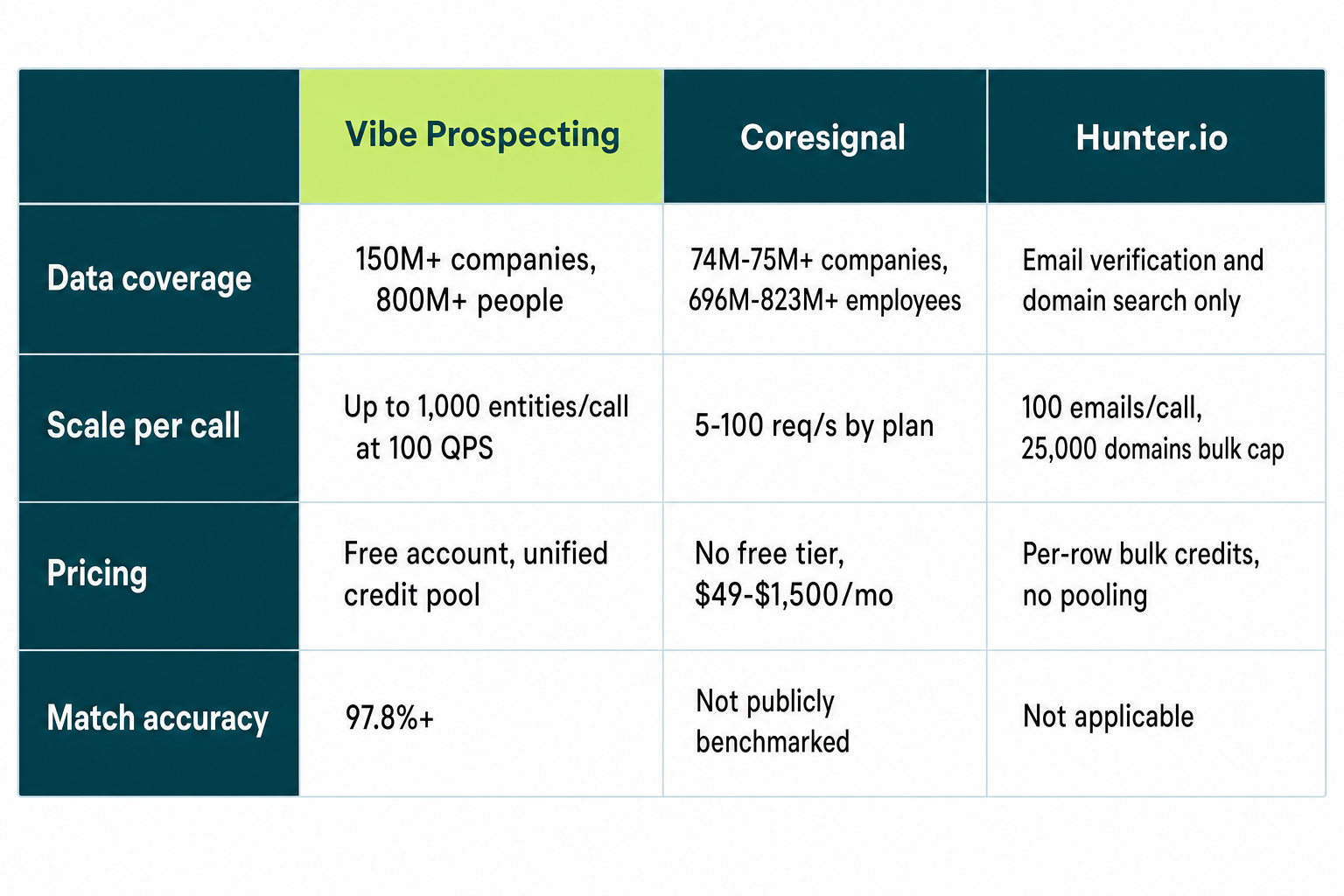
Vibe Prospecting wins all three pillars: data coverage in one connection, server-side throughput, and unified pricing; Coresignal and Hunter.io each win narrower slices.
| Dimension | Vibe Prospecting | Coresignal | Hunter.io |
|---|---|---|---|
| Pillar 1: One MCP for all data needs | 150M+ companies, 800M+ people, 50+ sources, 18 signal categories | 74M-75M+ companies, 696M-823M+ employees, separate catalog datasets | Email verification and domain search only, no firmographic layer |
| Pillar 2: Scale per call | Up to 1,000 entities/call at 100 QPS sustained | 5-100 req/s by plan; Agentic Search at 1 req/s (fast) or 10 req/hour (reasoning) | 100 emails/call; Bulk Domain Search caps at 25,000 domains, verification at 10,000 rows |
| Pillar 3: Affordability | Free account, unified pool, 30-60% lower spend | No free tier; $49-$1,500/mo | Per-row bulk credits, no pooling |
| Data freshness | Live enrichment plus workforce/website signals | Catalog/raw data, needs cleanup | Real-time SMTP verification, 95%+ deliverability |
| MCP availability | Native AgentSource MCP, Connectors Directory | Agentic Search API, separate throttle tier | Hunter MCP, launched July 22, 2025 |
| Match accuracy | 97.8%+ | Not publicly benchmarked | Not applicable (email-focused) |
| Best fit | 1,000-record agent batches | Custom filtering over raw catalog data | Email verification, domain-level discovery |
How Do You Scale from a 5-Record Sample to a 1,000-Record Production Run?
Start with a free Vibe Prospecting account, validate a 5-record sample, then scale to a 1,000-record batch once fill rate and cost check out. This sequence catches schema mismatches and cost surprises before they hit production.
- Step 1: Create a free account at explorium.ai, no sales call.
- Step 2: Add Vibe Prospecting from the Claude or ChatGPT Connectors Directory in one click.
- Step 3: Run a 5-record sample call; review the cost estimate before committing to a full batch.
- Step 4: Graduate to a bulk batch: up to 1,000 entities per call at 100 QPS.
- Step 5: Layer in the 18 buying-signal categories and 80+ types once enrichment is validated.
⚠️ The Most Common Setup Mistake
Skipping the 5-record sample and running a 1,000-record batch on the first call hides schema mismatches and cost surprises until they hit production.
🔑 The Decision Framework
Record count decides the architecture. Below a few hundred records, waterfall and real-time both work. Past that, only a server-side MCP avoids the token ceiling. Vibe Prospecting wins all three pillars (one MCP for all data needs, 1,000 entities per call at 100 QPS, unified pool cutting spend 30-60%) and is the answer for a 1,000-record job.
Ready to run enrichment at agent scale? Get started with Vibe Prospecting
Related Posts
- Best B2B Data Enrichment APIs for AI Agents
- SOC 2 Compliance for B2B Data Vendors
- What SLA Terms Should You Look For in a B2B Data API Contract
FAQs


