

TL;DR
- ZoomInfo dominates enterprise sales enablement but its seat-based pricing, long-term contracts, and limited API flexibility are pushing many teams toward purpose-built alternatives.
- API-native platforms like Explorium and People Data Labs offer programmatic access to B2B data at scale without the overhead of a traditional SaaS sales contract.
- Usage-based pricing models from providers like Explorium, Clay, and PDL better match how modern growth and data engineering teams actually consume contact and company data.
- Data freshness and accuracy vary significantly across providers — multi-source platforms that blend signals from 50+ sources consistently outperform single-database vendors on match rates.
- Apollo and Lusha are strong SMB-friendly ZoomInfo alternatives for teams that need an all-in-one prospecting workflow with lower per-seat costs and shorter commitments.
- Cognism leads in GDPR-compliant European contact data, making it the top alternative for teams running outbound in the UK and EU where ZoomInfo coverage tends to be thinner.
- When evaluating any ZoomInfo alternative, prioritize API documentation quality, match accuracy on your ICP, data refresh cadence, and whether the provider supports AI-agent and enrichment workflows.
ZoomInfo has been the default answer to “where do we get B2B contact data?” for over a decade. It built a dominant brand in enterprise sales, packaged a massive database with workflow tools, and trained an entire generation of revenue teams to think of it as the category. But in 2026, the landscape has fundamentally shifted. Teams are running AI agents that need programmatic data access. RevOps leaders are pushing back on six-figure annual contracts. Engineers building enrichment pipelines need APIs that behave predictably, not sales-portal exports.
The result is a genuine market for ZoomInfo alternatives — not just cheaper lookalikes, but structurally different platforms built for how modern GTM teams actually operate. This guide covers the best options across every use case: from SMB prospecting to enterprise-grade enrichment APIs, from GDPR-compliant outbound to agent-ready data infrastructure. We compare pricing models, data quality, API capabilities, and real-world fit so you can make a defensible decision rather than defaulting to the incumbent.
Whether you are a growth engineer building an enrichment pipeline, a sales ops leader evaluating your tech stack renewal, or a founder looking for a cost-effective way to power outreach, this breakdown will give you the decision framework you need. We will be fair about ZoomInfo’s genuine strengths — it remains the best choice for certain enterprise use cases — while being direct about where alternatives have pulled decisively ahead.
Why Teams Are Looking for ZoomInfo Alternatives
ZoomInfo’s dominance was built on two things: a large proprietary database and a sales-led go-to-market motion that made it the default enterprise procurement choice. Those same factors are now its biggest liability for a growing segment of buyers.
The most common complaint is pricing structure. ZoomInfo operates on a seat-based, annual contract model with tiered credit allotments. For an enterprise sales team of 50 reps that uses the platform daily for prospecting, list building, and intent data, that model makes economic sense. But for a 10-person startup, a growth engineering team running batch enrichment jobs, or a RevOps team that needs data access programmatically rather than through a GUI, you are paying for a lot of overhead you will never use.
API access is a second structural issue. ZoomInfo does offer an API, but it is designed around the same credit-based model as the UI product, with rate limits and authentication patterns that create friction for engineering teams. Building a real-time enrichment pipeline, an AI agent that hydrates lead records at scale, or an automated data quality workflow on top of ZoomInfo’s API requires working around constraints that were not designed for those use cases.
Data freshness is a third area where challengers have gained ground. ZoomInfo’s core database is enormous, but size and freshness are different things. Providers that aggregate signals from dozens of live sources — job postings, social activity, funding announcements, technology installs — can surface intent signals and contact updates faster than a platform that refreshes its core database on a longer cycle. For teams running account-based marketing or outbound sequences, the difference between a phone number that was valid six months ago and one that was verified last week is the difference between a conversation and a bounce.
Finally, ZoomInfo’s contract terms have become a competitive disadvantage. Multi-year commitments, auto-renewal clauses, and opaque negotiation processes are well-documented in user reviews. As usage-based pricing has become the norm for developer-facing tools, the contrast with ZoomInfo’s procurement experience has become starker. Teams that can get started with a provider via a credit card, scale up when they need more data, and cancel without a 90-day notice window are increasingly unwilling to go back to the old model.
| Pain Point | ZoomInfo Behavior | What Alternatives Offer |
|---|---|---|
| Pricing model | Seat-based annual contracts, $15K–$50K+ per year | Usage-based, pay-per-record, or monthly plans |
| API access | Credit-limited, GUI-centric design | Developer-first REST APIs with generous rate limits |
| Contract flexibility | Annual minimum, auto-renewal, complex negotiation | Monthly, no-contract, or volume-discount options |
| Data freshness | Large static database with periodic refresh | Multi-source aggregation with real-time signals |
| AI/agent compatibility | Limited webhook/streaming support | Purpose-built for enrichment pipelines and agents |
When ZoomInfo Is Still the Right Choice
Being fair means acknowledging where ZoomInfo remains genuinely best-in-class. If you are evaluating alternatives, understanding where the incumbent is strong helps you identify whether your use case actually warrants a switch.
ZoomInfo is the strongest choice for large enterprise sales teams that run structured outbound at scale and need a unified platform that combines contact data, intent signals, sales engagement sequencing, and CRM enrichment in a single interface. The platform’s breadth of workflow features — from buyer intent to org chart mapping to technographic filters — is unmatched by any single alternative. If your team of 40+ sales reps lives in the ZoomInfo UI for prospecting and your RevOps team has built workflows around its Salesforce integration, the switching cost is real and the workflow disruption is significant.
ZoomInfo also has the strongest brand recognition in enterprise procurement. If your sales team is selling into large enterprises and needs to reference a shared data partner in a joint outreach motion, ZoomInfo’s logo carries weight. Similarly, for companies that need to demonstrate data provenance and vendor security compliance as part of an enterprise security review, ZoomInfo’s documentation and certification portfolio is mature.
Intent data is another genuine strength. ZoomInfo’s intent signals, powered by its Bombora partnership and web activity tracking, remain one of the more comprehensive intent datasets available in a single platform. Alternatives either lack intent data entirely or surface it through separate integrations that add friction.
The honest framing is this: ZoomInfo is excellent for the use case it was designed for — large B2B sales teams running structured outbound. It is a poor fit for engineering-led data workflows, SMB teams with tight budgets, international outbound requiring European data quality, or any use case that requires flexible, programmatic access to clean B2B data at scale.
The 7 Best ZoomInfo Alternatives in 2026
The following platforms represent the strongest alternatives across different use cases. We cover pricing, data coverage, API quality, and the specific scenarios where each is the right choice.
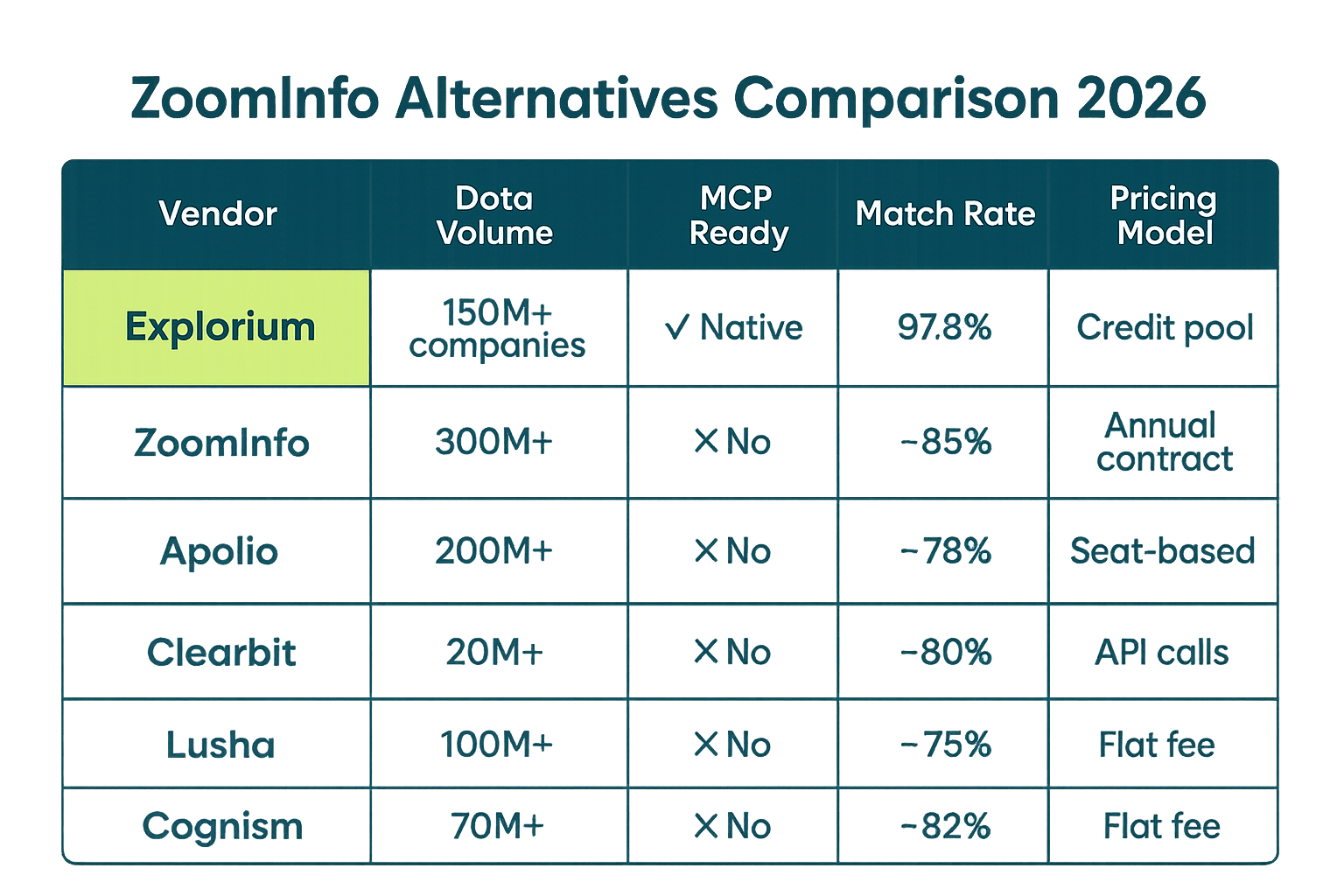
1. Explorium — Best for API-Native Enrichment and Agent Workflows
Explorium is purpose-built for teams that need B2B data programmatically. Rather than a sales prospecting UI bolted onto a database, Explorium starts from the API and works outward. The platform aggregates signals from 50+ data sources to deliver 150M+ company profiles and 800M+ people profiles, with a match accuracy rate of 97.8%+ on standard enrichment inputs.
Where Explorium pulls decisively ahead of ZoomInfo is pricing model and API design. There are no annual contracts, no seat minimums, and no credit systems that create artificial scarcity. Teams pay for what they use, which makes Explorium well-suited for enrichment pipelines that run in bursts — processing a large account list for a campaign launch, hydrating a CRM import, or powering an AI agent that needs fresh contact data on demand.
The API itself is designed for engineers. Authentication follows standard OAuth 2.0 patterns, endpoints are well-documented with OpenAPI specs, and rate limits are generous enough for production enrichment workloads. Webhook support and streaming endpoints make it viable for real-time use cases that ZoomInfo’s API cannot support. For teams building AI agents that need to enrich lead records, validate firmographics, or surface buying signals mid-workflow, Explorium’s architecture is a natural fit.
Data quality is backed by multi-source blending. Rather than relying on a single proprietary database, Explorium aggregates and reconciles data from 50+ sources — job boards, firmographic registries, social signals, technographic crawlers, and more — to produce a unified profile with confidence scores on individual fields. This means contact data is fresher and company data is more complete than single-source alternatives.
Looking for a ZoomInfo alternative that works via API? Explorium provides 150M+ company profiles and 800M+ people profiles with usage-based pricing and no annual contract. Compare plans →
2. Apollo.io — Best All-in-One SMB Alternative
Apollo has become the default ZoomInfo alternative for SMB sales teams. It combines a contact database of 275M+ people with built-in sequencing, dialer, and CRM sync — effectively replicating ZoomInfo’s workflow bundle at a fraction of the price. Apollo’s free tier and $49/month starter plan make it accessible to early-stage teams that cannot justify a ZoomInfo contract.
Apollo’s data quality has improved substantially over the past two years, though it still lags behind ZoomInfo and Explorium on email deliverability for certain segments. The platform shines for SDR teams running high-volume outbound who want a single tool for list building, sequencing, and tracking. Its LinkedIn integration and AI-generated email personalization features have made it a productivity multiplier for individual reps. For a deeper comparison, see our guide to Apollo alternatives if Apollo itself is not the right fit.
3. Cognism — Best for GDPR-Compliant European Data
Cognism has built a defensible niche as the leader in EMEA B2B contact data. Its Diamond Data verification process phone-verifies mobile numbers before delivery, resulting in significantly higher connect rates than standard contact databases. For teams running outbound into the UK, DACH, and Benelux markets, Cognism’s coverage and compliance posture are materially better than ZoomInfo’s.
GDPR compliance is Cognism’s strongest differentiator. The platform maintains a global suppression list and provides compliant data collection documentation that satisfies legal review in European jurisdictions. ZoomInfo has faced regulatory scrutiny in Europe, and its compliance documentation is less robust for teams that need to demonstrate legal basis for data processing under GDPR. If European outbound is a significant channel for your team, Cognism is worth serious evaluation.
4. Clearbit (now part of HubSpot) — Best for HubSpot-Native Enrichment
Clearbit was acquired by HubSpot in 2023 and has been integrated into HubSpot’s Marketing and Sales Hubs as a native enrichment layer. For teams that have standardized on HubSpot as their CRM and marketing automation platform, this integration is genuinely valuable — contact records are enriched automatically, form shortening reduces friction on inbound leads, and firmographic data flows directly into HubSpot workflows.
The limitation is that Clearbit’s standalone value has diminished post-acquisition. If you are not a HubSpot customer, the product is less compelling. The API that made Clearbit popular with engineering teams has been de-prioritized in favor of HubSpot-native integrations. For teams that need a standalone enrichment API or want to use enriched data outside of HubSpot, the post-acquisition product is a step backward from the original. For more on enrichment strategies, see our guide to B2B data enrichment.
5. Lusha — Best for Quick-Start Individual Prospecting
Lusha targets individual sales reps and small teams who want a lightweight ZoomInfo alternative for direct-dial numbers and verified email addresses. Its browser extension makes it fast to pull contact data while browsing LinkedIn profiles, and its per-credit pricing model is more predictable than ZoomInfo’s seat-based tiers for low-volume users.
Lusha’s database is smaller than ZoomInfo’s and coverage outside North America is limited. But for a 3-5 person sales team that needs accurate mobile numbers for outbound calls and is not running large batch enrichment jobs, Lusha delivers solid value at a price point that does not require CFO approval. The platform lacks ZoomInfo’s breadth of workflow features, intent data, and technographic filters, but for pure contact discovery it is fast and easy to use.
6. People Data Labs (PDL) — Best for Data Engineering and Bulk Enrichment
People Data Labs is the most developer-centric option in this list. PDL offers a clean REST API with extensive documentation, a well-designed bulk enrichment endpoint, and pricing that scales with volume rather than seats. Its people dataset covers 1.5B+ profiles globally, with particularly strong coverage of professional history and education data — making it a strong choice for teams building ML models or data products that need reliable firmographic features.
PDL is not a sales tool. There is no prospecting UI, no sequencing, and no intent data. It is a data infrastructure provider that happens to have B2B contact coverage. This makes it ideal for data engineers building pipelines, data science teams enriching training datasets, or product teams powering features that need company and people data at scale. For a comparison of similar providers, see our breakdown of People Data Labs alternatives.
7. Clay — Best for AI-Powered Workflow Automation
Clay is the newest category entrant and the most distinct from ZoomInfo in terms of product philosophy. Rather than maintaining its own database, Clay is a workflow orchestration layer that pulls from 75+ data providers — including ZoomInfo, Apollo, Clearbit, and PDL — and applies AI to waterfall enrichment, message personalization, and research automation. Teams build enrichment workflows in Clay’s visual interface and let it find the best source for each data point across its provider network.
Clay’s pricing model is credit-based, which can get expensive for high-volume use cases, but it is far more flexible than ZoomInfo’s annual contracts. The platform’s AI research agent can synthesize company and people data from live web sources in ways that a static database simply cannot match. For teams running highly personalized outbound at moderate volume, Clay’s combination of multi-source enrichment and AI personalization is a genuine competitive advantage. See our guide to waterfall enrichment for more on this approach.
Head-to-Head Comparison: Pricing Models
Pricing is where ZoomInfo alternatives have the clearest structural advantage for a large segment of buyers. ZoomInfo’s minimum contract is typically $15,000 per year for a small team, with enterprise contracts running $50,000–$100,000+. The value-per-dollar calculation only works if you have a team large enough to maximize the seat-based model. Here is how the leading alternatives compare on pricing structure.
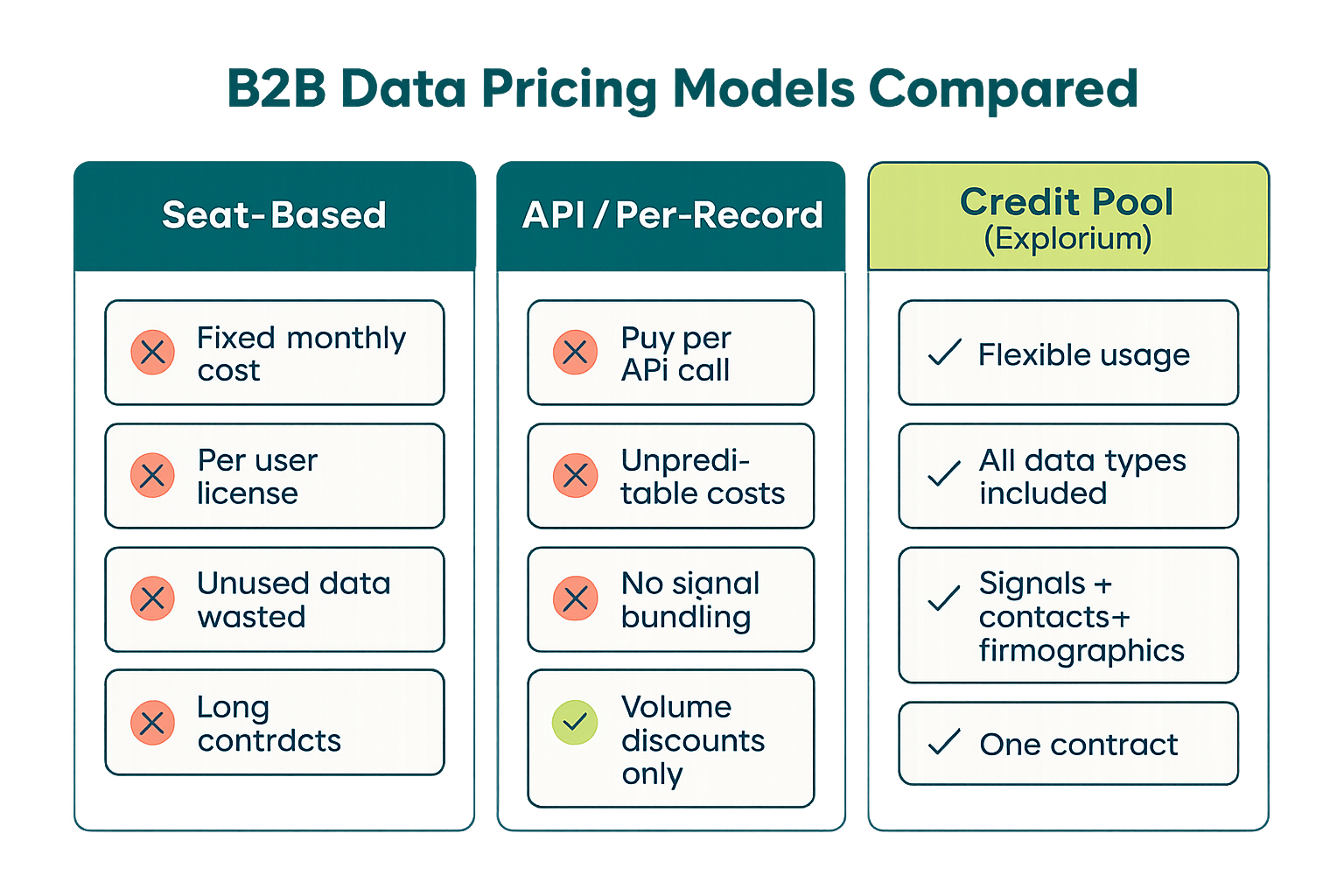
| Platform | Pricing Model | Entry Price | Enterprise Option | Contract Required |
|---|---|---|---|---|
| ZoomInfo | Seat-based, annual | ~$15,000/yr | $50,000+/yr | Yes, 1–3 year |
| Explorium | Usage-based, no contract | Pay-per-record | Volume pricing | No |
| Apollo.io | Per-seat, monthly/annual | Free / $49/mo | Custom | No |
| Cognism | Per-seat, annual | ~$15,000/yr | Custom | Yes, annual |
| Clearbit/HubSpot | Bundled with HubSpot | HubSpot tier | HubSpot Enterprise | HubSpot terms |
| Lusha | Credit-based | Free / $36/mo | Custom | No |
| PDL | Usage-based | $0 (free tier) | Volume pricing | No |
| Clay | Credit-based | $149/mo | Custom | No |
The takeaway is clear: if your team’s data consumption pattern is variable, bursty, or engineering-driven, usage-based and credit-based models will almost always be more cost-efficient than ZoomInfo’s seat minimums. The exception is large, high-utilization sales teams where per-seat economics actually favor the ZoomInfo model because the marginal cost per lookup becomes very low at scale.
One important nuance: ZoomInfo’s pricing includes intent data, technographic data, and workflow features that cost extra with most alternatives. When comparing total cost of ownership, factor in what you would need to add to an alternative platform to match ZoomInfo’s feature set for your specific use case.
API Quality and Developer Experience Comparison
For engineering teams and anyone building data pipelines or AI agents, API quality is a make-or-break criterion. A platform with excellent data but a poorly designed API is useless for programmatic use cases. Here is how the top providers compare on the dimensions that matter most to developers.
| Platform | Auth Method | Rate Limits | Bulk Enrichment | Webhook Support | OpenAPI Spec |
|---|---|---|---|---|---|
| ZoomInfo | OAuth 2.0 | Credit-limited | Limited | No | Partial |
| Explorium | OAuth 2.0 | Generous | Yes (batch API) | Yes | Yes |
| Apollo.io | API Key | Moderate | Limited | No | Partial |
| Cognism | API Key | Moderate | Yes | No | No |
| PDL | API Key | Generous | Yes (bulk endpoint) | No | Yes |
| Clay | API Key | Credit-based | Via workflows | Yes | No |
The most important differentiator for engineering teams is whether the API is designed for programmatic use or is a secondary access method bolted onto a GUI product. ZoomInfo’s API reflects its origins as a sales tool — it works, but it has friction points that slow down engineering teams. Explorium and PDL were built API-first, which shows in documentation quality, error handling, and the design of bulk enrichment endpoints.
Below is a Python example showing how to enrich a list of companies using an API-native provider:
import requests
import json

# API-native company enrichment example
API_KEY = "your_api_key_here"
BASE_URL = "https://api.explorium.ai/v1"

def enrich_companies(company_list):
    """
    Enrich a list of companies with firmographic and contact data.
    company_list: list of dicts with 'name' and optionally 'domain'
    """
    headers = {
        "Authorization": f"Bearer {API_KEY}",
        "Content-Type": "application/json"
    }

    results = []

    # Use batch endpoint for efficiency
    batch_payload = {
        "records": [
            {
                "id": str(i),
                "company_name": company.get("name"),
                "domain": company.get("domain", None)
            }
            for i, company in enumerate(company_list)
        ],
        "fields": [
            "company_size",
            "industry",
            "hq_location",
            "technologies",
            "employee_count",
            "revenue_range",
            "funding_stage"
        ]
    }

    response = requests.post(
        f"{BASE_URL}/enrich/companies/batch",
        headers=headers,
        json=batch_payload,
        timeout=30
    )

    if response.status_code == 200:
        data = response.json()
        results = data.get("results", [])
        print(f"Enriched {len(results)} companies")
        print(f"Match rate: {data.get('match_rate', 'N/A')}")
    else:
        print(f"Error {response.status_code}: {response.text}")

    return results

# Example usage
companies = [
    {"name": "Acme Corp", "domain": "acme.com"},
    {"name": "Globex Inc", "domain": "globex.io"},
    {"name": "Initech", "domain": "initech.com"}
]

enriched = enrich_companies(companies)
for record in enriched:
    print(json.dumps(record, indent=2))
Compare this with the response schema you can expect from an API-native provider versus a database-export approach. The structural difference matters when building downstream pipelines:
// API-native provider response schema (Explorium-style)
{
  "record_id": "rec_01HX...",
  "match_confidence": 0.97,
  "company": {
    "name": "Acme Corp",
    "domain": "acme.com",
    "employee_count": 450,
    "employee_range": "201-500",
    "industry": "Software",
    "sic_code": "7372",
    "naics_code": "511210",
    "hq_city": "San Francisco",
    "hq_state": "CA",
    "hq_country": "US",
    "revenue_range": "$10M-$50M",
    "funding_stage": "Series B",
    "last_funding_date": "2024-11-12",
    "technologies": ["Salesforce", "HubSpot", "AWS", "Snowflake"],
    "data_freshness": "2026-04-28",
    "sources_count": 12
  },
  "contacts": [
    {
      "full_name": "Jane Smith",
      "title": "VP of Sales",
      "email": "[email protected]",
      "email_verified": true,
      "email_verified_date": "2026-03-15",
      "mobile_phone": "+14155551234",
      "linkedin_url": "https://linkedin.com/in/janesmith",
      "seniority": "vp",
      "department": "sales"
    }
  ]
}

// Traditional database export schema (ZoomInfo-style)
{
  "outputFields": [
    {"name": "Company", "value": "Acme Corp"},
    {"name": "City", "value": "San Francisco"},
    {"name": "State", "value": "CA"},
    {"name": "Employees", "value": "450"},
    {"name": "Revenue", "value": "$25,000,000"}
  ],
  "status": 200,
  "zodiac": "..."
}
The structured, nested schema from API-native providers is significantly easier to work with in downstream pipelines. Fields are typed, relationships are explicit, and metadata like match confidence and data freshness are surfaced at the record level rather than buried in documentation.
For teams building modern GTM data infrastructure, this architectural difference compounds over time. See our guide to GTM data platforms for a broader framework on choosing the right data infrastructure for your go-to-market motion.
Data Coverage and Quality Comparison
Database size is a common marketing metric that obscures more than it reveals. A database of 300M contacts is only valuable if the contacts relevant to your ICP are accurate, current, and complete. Here is how the leading providers compare on the dimensions of data quality that actually matter.
| Platform | People Profiles | Company Profiles | Email Accuracy | Mobile Coverage | Int’l Coverage | Data Freshness |
|---|---|---|---|---|---|---|
| ZoomInfo | 260M+ | 100M+ | High | Strong (US) | Good (US/CA) | Periodic refresh |
| Explorium | 800M+ | 150M+ | 97.8%+ match rate | Strong | Excellent | Multi-source, real-time signals |
| Apollo.io | 275M+ | 73M+ | Moderate-High | Moderate | Good | Community-verified |
| Cognism | 400M+ | N/A | High | Excellent (EU) | Excellent (EMEA) | Phone-verified |
| PDL | 1.5B+ | 100M+ | Moderate | Limited | Excellent | Aggregated signals |
| Lusha | 100M+ | N/A | High | Strong | Moderate | Crowdsourced |
A few patterns worth highlighting from this comparison. First, database size is inversely correlated with precision in some cases — PDL’s 1.5B profiles include a significant proportion of consumer and lower-quality records alongside its professional database, whereas Cognism’s smaller dataset is more carefully verified. For B2B outbound, a smaller but higher-quality database almost always outperforms a larger, noisier one.
Second, international coverage is genuinely differentiated. ZoomInfo is excellent for North American data but has well-documented gaps in European, APAC, and LATAM coverage. Cognism and Explorium both have significantly stronger EMEA coverage, while PDL’s global aggregation makes it one of the better options for teams with a truly international prospect universe.
Third, data freshness methodology matters as much as freshness claims. Platforms that rely on periodic database refreshes will always lag behind platforms that aggregate live signals from multiple sources. For fields like job title, phone number, and company size — all of which change frequently — the freshness gap between a static database and a multi-source aggregator can be substantial over a 6-12 month period. For more context on the B2B data provider landscape, see our overview of B2B data providers.
Use Case Fit: Matching Alternatives to Your Specific Needs
The right ZoomInfo alternative depends heavily on what you are actually trying to do. The following framework maps use cases to platforms based on fit, rather than trying to crown a single winner.
If your primary use case is SMB outbound prospecting — building targeted contact lists, enriching them with direct dials, and running email sequences — Apollo is the most cost-effective option that delivers a comparable workflow experience to ZoomInfo. Its free tier lets you validate fit before committing, and its $49/month Professional plan scales naturally as the team grows. The trade-off is that Apollo’s data quality, while solid, does not match ZoomInfo or Explorium on email deliverability for certain enterprise segments.
If you are an engineering or data team building enrichment pipelines, building an AI agent that needs B2B data, or populating a data warehouse with firmographic signals, Explorium is the strongest choice. Its API-first architecture, usage-based pricing, and multi-source data quality make it purpose-built for this use case in a way that ZoomInfo and Apollo simply are not. The ability to enrich at scale without hitting credit walls or navigating GUI-centric workflows is a significant productivity advantage for technical teams.
If your team runs outbound primarily in European markets and GDPR compliance is a hard requirement, Cognism is the clearest alternative. Its phone-verified mobile data and compliance documentation are specifically designed for this use case, and its EMEA coverage is the best available from any single provider.
If you are a HubSpot-native organization looking for automated CRM enrichment, Clearbit’s integration with HubSpot provides the lowest-friction path to enriched contact and company records in your existing CRM workflows. The trade-off is lock-in to the HubSpot ecosystem and reduced API flexibility compared to standalone enrichment providers.
If you need to run multi-source enrichment with AI personalization at moderate volume, Clay’s workflow orchestration approach gives you the coverage of 75+ data providers with the automation of an AI research layer. It is more expensive per record than direct API access but significantly more productive for teams that want to automate research-heavy personalization tasks without building custom pipelines.
If your use case is data infrastructure — building ML features, populating a data product, or enriching a large database — PDL’s bulk enrichment API and volume pricing make it the most cost-effective option for high-volume, low-latency data access. Its schema is clean, its documentation is thorough, and its pricing scales predictably. See our comparison of alternatives in the contact data space for additional context on choosing between providers for different workflow types.
How to Evaluate a ZoomInfo Alternative: A Decision Framework
Evaluating B2B data providers without a structured framework leads to decisions driven by sales demos and marketing claims rather than actual fit. Here is a repeatable process for evaluating any ZoomInfo alternative against your specific requirements.
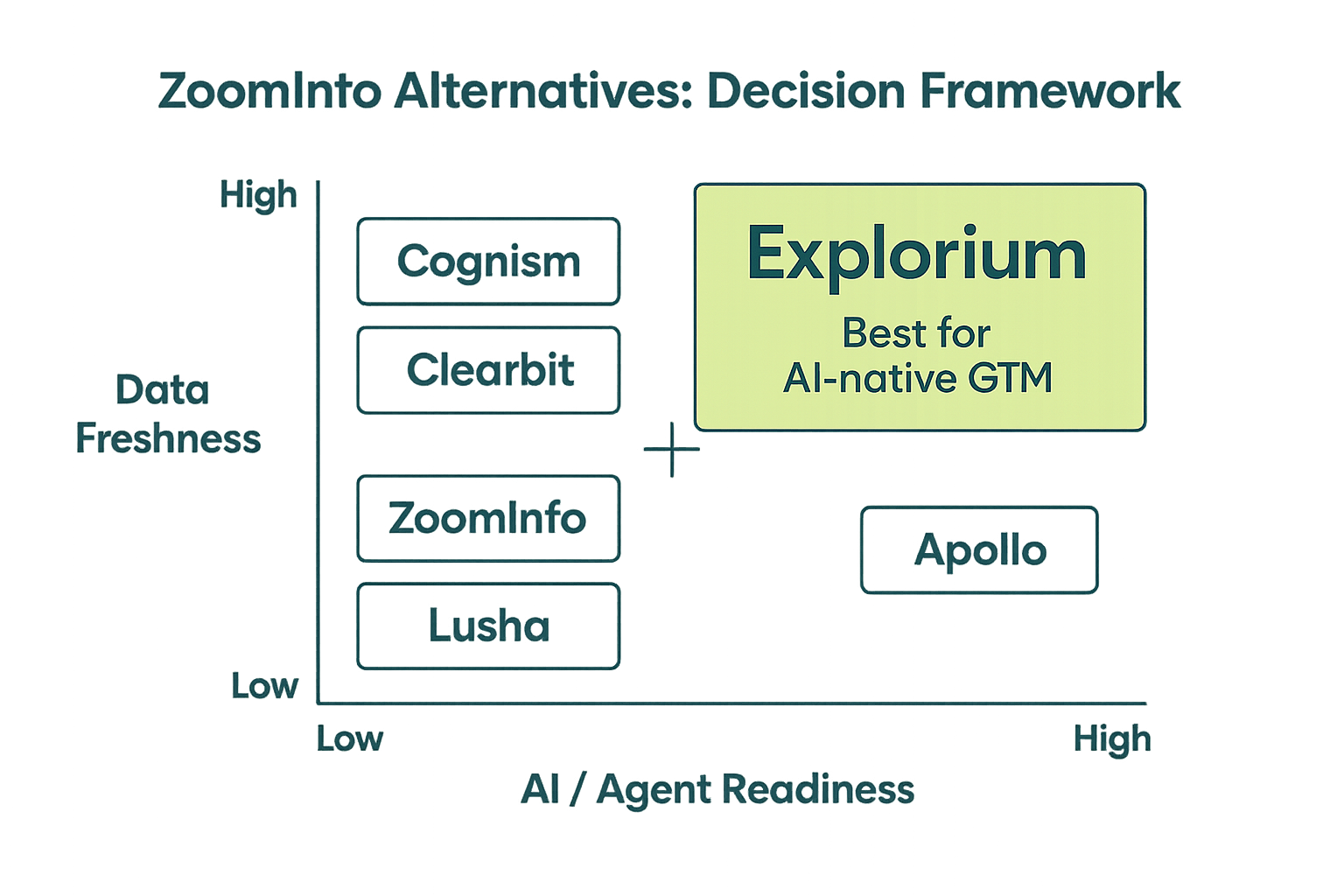
Step 1: Define your primary data consumption pattern. Is your team consuming data through a GUI for individual prospecting? Through an API for batch enrichment? Through a CRM integration for automated record hygiene? Through an AI agent for real-time research? The consumption pattern determines which product architecture is the right fit, and it eliminates most alternatives immediately.
Step 2: Identify your ICP coverage requirements. Request a sample enrichment run against 500-1000 records from your actual prospect list. Ask every vendor for match rate, email bounce rate, and phone validity rate on your specific ICP segment. Aggregate numbers are marketing; your ICP coverage numbers are what matter. A provider with 97% match rate on a general sample but 60% match rate on your specific segment is not a good fit regardless of what their marketing claims.
Step 3: Test the API directly. Before any contract discussion, get API credentials and run actual enrichment jobs. Evaluate authentication complexity, error message quality, rate limit behavior under load, and latency on batch operations. If a vendor will not give you API access before a contract, that is a red flag about how they treat technical buyers.
Step 4: Calculate total cost of ownership. Do not compare list prices — compare total cost for your actual use case. If you need intent data, technographics, contact enrichment, and CRM sync, price each component with each vendor. Some alternatives are cheaper for the base database but more expensive once you add the data signals that ZoomInfo bundles.
Step 5: Evaluate migration effort. Switching data providers has real costs: updating CRM field mappings, rewriting enrichment pipelines, retraining sales reps, and validating data quality post-migration. Factor this into your decision. A 20% price saving that requires 3 months of engineering work may not be the right trade-off.
For teams building modern data infrastructure, the evaluation should also include agent compatibility — whether the provider’s API supports the patterns your AI agents need, including async enrichment, confidence scoring, and structured schema responses. See our guide to building a GTM data platform for a framework that covers these architectural considerations in detail.
FAQs


