

TL;DR
- We show product builders how to embed company search, lookalike discovery, and real-time intelligence using a unified B2B data API instead of 3–5 fragmented vendors.
- An embedded-ready API must deliver signal breadth, documented accuracy, MCP support, resale rights, and credit-based pricing, not per-seat subscriptions built for sales teams.
- Explorium aggregates 50+ sources into one API covering 150M+ companies, 800M+ contacts, 4,000+ data points, and 30+ enrichment categories with 97.8% firmographic accuracy.
- MCP lets your product's AI agent autonomously decide which signals to fetch per query, replacing rigid pre-mapped REST endpoints with dynamic enrichment selection.
- Clay, Cognism, Outreach, Common Room, Bombora, and Monday.com already embed Explorium's data infrastructure, the same free-account API any builder can start with today.
Q1: Why Are SaaS Product Teams Embedding B2B Intelligence as a Product Feature?
Every SaaS product that touches company data, including CRMs, sales engagement tools, ABM platforms, recruiting software, and market intelligence dashboards, faces the same architectural reality: data is everywhere, but embedded intelligence is nowhere.
The Fragmented Stack Nobody Talks About
Your product team probably knows this stack by heart: Apollo for contacts, Bombora for intent, Clearbit for firmographics, BuiltWith for technographics. Four vendors, four contracts, four billing tiers, four schemas to normalize. And none of them were designed to be embedded inside your product.
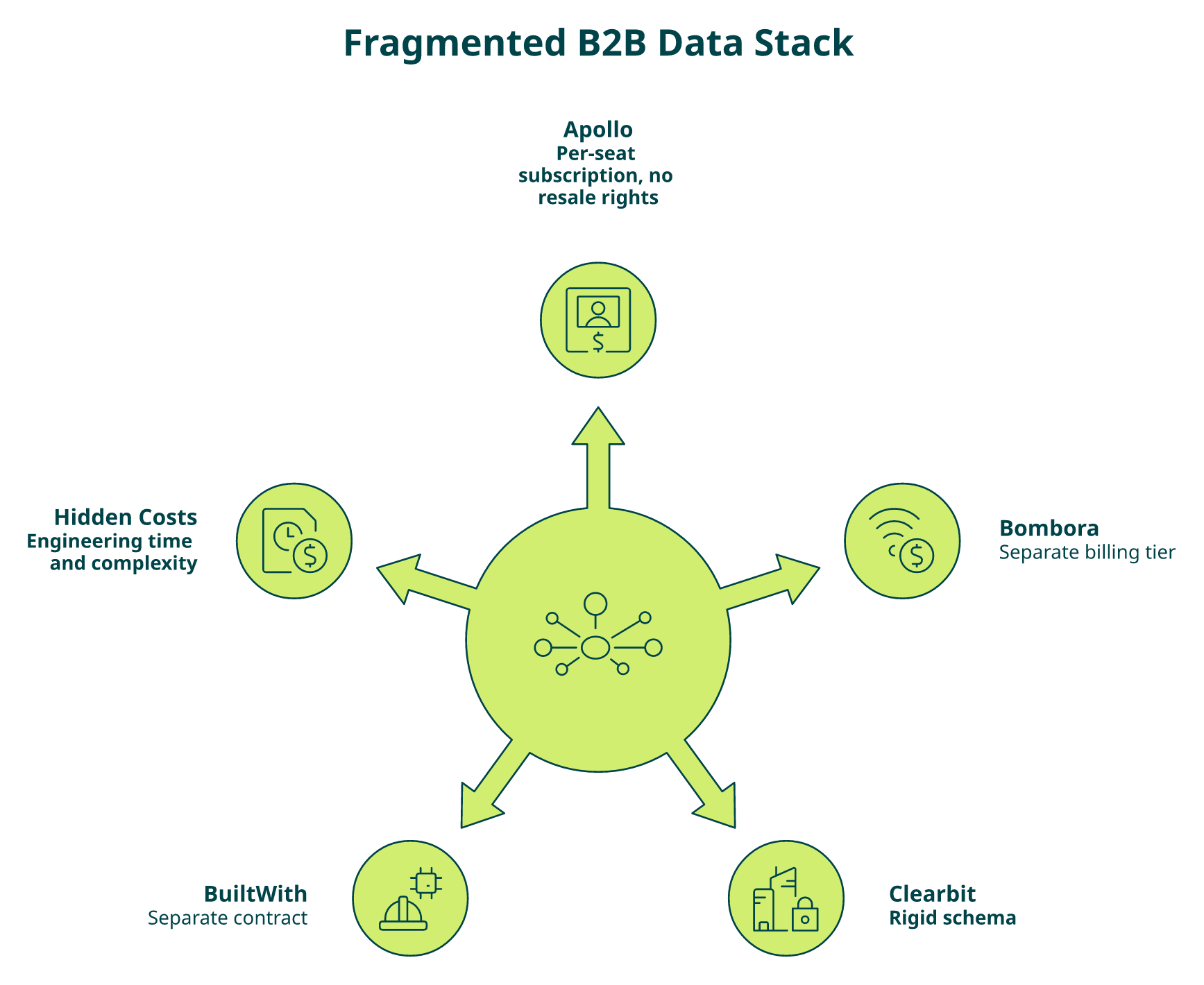
The result? Your users leave your platform to look up company data in someone else’s tool. Or worse, your engineering team spends months building brittle scrapers and normalization pipelines that break every time a vendor changes their API response format. The intelligence your product should surface natively lives somewhere outside it: fragmented, stale, and disconnected from the workflows your users actually care about.
Why the Old Model Breaks for Product Builders
The traditional approach, buying ZoomInfo or Apollo seats for your sales team, was never designed for embedding. Here’s what breaks when you try to use these tools as infrastructure for your product:
- ❌ No resale rights: most providers prohibit you from displaying their data to your end users without separate OEM agreements
- ❌ Subscription pricing: per-seat models are incompatible with per-feature or per-call embedded economics
- ❌ Rigid schemas: designed for prospecting UIs, not programmable product features
- ❌ No agent-native delivery: standard REST endpoints require pre-mapped calls for every enrichment type; no MCP support for autonomous data selection
- ❌ 3 to 5 vendor contracts for full signal coverage: firmographics from one provider, intent from another, technographics from a third
“Contact info frequently missing or incorrect. Half the day calling wrong/disconnected numbers. Mobiles frequently wrong.”
— Verified User, IT Services, Mid-Market Apollo – G2 Verified Review
That’s a review of a prospecting tool. Now imagine shipping that data quality as a native feature inside your product.
The Embedded Intelligence Thesis
The competitive advantage has shifted. It’s no longer enough to consume B2B data internally: the products winning market share are the ones that ship B2B intelligence as a native feature.
Company search bars, “Find similar companies” buttons, real-time firmographic dashboards, auto-enrichment on record import, and prospect scoring engines that update with live signals. These aren’t nice-to-haves anymore: they’re table stakes for data-adjacent SaaS products. And they all require the same thing: a unified data API that supports embedding, white-labeling, credit-based economics, and agent workflows.
What We Built at Explorium, and Why
We built Explorium to be the data layer product builders actually need. Not a prospecting platform retrofitted with an API, but infrastructure purpose-built for embedding:
- ✅ 50+ sources aggregated into one API: firmographics, technographics, intent signals, contacts, funding events, and hiring data
- ✅ 150M+ company profiles and 800M+ contact records, with 4,000+ data points across 30+ enrichment categories
- ✅ Credit-based pricing: one-time packages, not per-seat subscriptions; a single credit pool across all signal types
- ✅ MCP for agent-native delivery: your product’s AI features autonomously decide what data they need and retrieve it without pre-mapped endpoints
- ✅ Resale rights on custom plans: you can white-label and display the data inside your product, legally
The Proof Is in the Stack
Leading data products, including Clay, Cognism, Outreach, Common Room, Bombora, and Monday.com, already embed Explorium’s data infrastructure inside their platforms. The question isn’t whether to embed B2B data as a product feature. It’s which API is architecturally built to let you.
Q2: What Makes a B2B Data API Ready for Embedded Product Intelligence?
Before you embed any B2B data API in your product, score it against these 8 readiness criteria. Most APIs that look great for prospecting fail spectacularly when you try to ship them as a product feature.
✅ The Embedded-Readiness Checklist
- ☐ Signal breadth: Does one API deliver firmographics + technographics + intent + contacts + funding + hiring signals? Or do you need 3 to 5 separate integrations?
- ☐ Data coverage: 100M+ company profiles with global reach? Or narrow geographic coverage that limits your product’s market?
- ☐ Accuracy benchmarks: Documented, verifiable accuracy rates across specific fields? Or just “we have X million records” claims?
- ☐ Data freshness: Documented refresh cadences (daily/weekly/monthly)? Or stale quarterly snapshots with undisclosed update cycles?
- ☐ Filtering and search: Filterable by 30+ attributes (industry, size, tech stack, funding stage, geography)? Or basic keyword search?
- ☐ Agent-native delivery: MCP support for autonomous enrichment selection? Or only static REST endpoints requiring pre-mapped calls?
- ☐ Onboarding speed: Free account to first API call in minutes, no sales conversation gate? Or weeks of integration work and mandatory sales calls?
- ☐ Multi-language SDKs and docs: Python, JavaScript, Go at minimum? Or thin documentation with limited language support?
What Your Score Means
| Score | Interpretation |
|---|---|
| 7 to 8 ✓ | ✅ API is embedding-ready: proceed to commercial evaluation (white-label terms, resale rights, pricing model) |
| 4 to 6 ✓ | ⚠️ Significant technical gaps that will surface as product limitations: your users will feel the holes |
| 0 to 3 ✓ | ❌ You’re looking at a prospecting tool, not an embeddable data API: rethink the integration entirely |
How the Major Providers Score
Here’s the honest assessment, based on publicly documented capabilities and verified benchmarks:
| Field | Explorium | ZoomInfo | Apollo | Clearbit |
|---|---|---|---|---|
| Employee count accuracy | 97.80% | 88.31% | 78.15% | 32.93% |
| Website URL accuracy | 97.80% | 89.62% | 78.04% | 54.03% |
| NAICS Code accuracy | 97.31% | 89.62% | 69.30% | 45.62% |
Those are firmographic accuracy benchmarks on standardized fields. When your product’s company search feature returns the wrong employee count or industry classification, your users don’t blame the API: they blame your product.
“The richness and breadth of data is incredible. I really like the instant access to the most useful and reliable external data. It helps us provide better service to our customers because it is the data we need to make faster and better decisions.”
— Ishi N., Enterprise Explorium G2 – Verified Review
“Not always accurate. Needs more frequent refresh. Lacks robust integrations to easily action on data.”
— Brian Y., Head of Marketing, Small-Business Clearbit – G2 Verified Review
Where Explorium Lands
Explorium scores 8/8 on this checklist: 50+ aggregated sources, 150M+ companies, documented accuracy benchmarks that outperform single-source providers by 19 to 64 percentage points, daily/weekly/monthly refresh cadences, 30+ filterable enrichment categories, MCP + REST delivery, free account with instant API access, and comprehensive documentation.
Your product’s company intelligence is only as good as the API behind it. Score below 6? You’ll ship the gaps to your users.
Q3: How Do You Build a Company Search Feature with a B2B Data API?
A company search feature lets your product’s users find, filter, and explore businesses by firmographic attributes (industry, size, revenue, location, tech stack, funding stage) directly inside your UI. The API handles the data layer so your engineering team focuses on the product experience, not data plumbing.
The Architecture Blueprint
Building this right requires four layers working together. Here’s how we’d structure it:
Layer 1: API Query Layer. Accept user search inputs, translate them into structured API calls with filters. Explorium’s fetch-businesses endpoint supports filtering by revenue ranges, company size, age, location, industry categories (NAICS, LinkedIn, Google), and technology stack, all in one call.
Python example:
import requests
headers = {"api_key": "YOUR_API_KEY"}
params = {"employee_count_min": 50, "employee_count_max": 500, "country_code": "US", "naics_category": "Software Publishers", "company_tech_stack_tech": "Snowflake"}
response = requests.get("https://api.explorium.ai/v1/businesses/search", headers=headers, params=params)
companies = response.json()
JavaScript equivalent:
const response = await fetch('https://api.explorium.ai/v1/businesses/search?' + new URLSearchParams({employee_count_min: 50, employee_count_max: 500, country_code: 'US', naics_category: 'Software Publishers', company_tech_stack_tech: 'Snowflake'}), { headers: { 'api_key': 'YOUR_API_KEY' } });
const companies = await response.json();
Caching, Normalization, and Credit Efficiency
Layer 2: Response normalization. Map multi-source API responses into your product’s data model. Because Explorium aggregates and deduplicates across 50+ sources before returning results, you skip the normalization step that multi-vendor architectures require.
Layer 3: Caching strategy. Balance data freshness against API credit efficiency. On custom plans, Explorium offers search preview: check data availability before consuming credits. Cache enriched records locally, re-enrich on configurable cadences matching Explorium’s documented refresh rhythms (daily/weekly/monthly).
Layer 4: UI rendering. Search results with faceted filters, company profile cards, and pagination. Each result enriched with 4,000+ data points on demand through the enrich-business endpoint.
What This Enables
- ✅ Dynamic company search with 30+ filterable attributes in one API call
- ✅ Firmographic + technographic + funding signals in a single response from 50+ underlying sources
- ✅ Credit-efficient querying with search preview capability (custom plans)
- ✅ Real-time results without managing individual provider integrations
- ✅ Company profile cards enriched with 4,000+ data points on demand
Why Data Accuracy Determines Feature Quality
Single-source APIs return one provider’s view: gaps in coverage, stale records, limited signal types. Apollo’s data accuracy hovers around 65 to 70% in real-world usage according to independent reviews, despite advertising higher rates.
“Data inaccuracies lead to negative outcomes. Wrong personnel details, private employee info listed as company contacts, misdirected communications.”
— Anders J., Developer, Small-Business Apollo – G2 Verified Review
“Instead of connecting to multiple data sources and APIs, we only require one connection – Explorium!”
— Mirit H., Mid-Market Explorium G2 – Verified Review
This is the same data infrastructure that Clay, Cognism, and Outreach embed inside their products, available through the same API, starting with a free account.
Q4: How Do You Add ‘Find Similar Companies’ to Your Product Using a Lookalike API?
Your customer is inside your platform, looking at their best account, a Series B fintech with 200 employees using Snowflake and HubSpot. They click “Find Similar Companies.” What happens next depends entirely on the signal breadth of your underlying data API.
The Thin-Lookalike Problem
If your API only provides firmographics (industry, size, location), the lookalike engine matches on two or three dimensions. The results are generic, “here are other mid-sized fintech companies,” and your user gets a list they could have built with a LinkedIn search. No differentiation, no stickiness, no reason to trust the feature.
True multidimensional lookalike matching requires similarity across firmographics and technographics and growth signals (hiring velocity, funding stage) and intent data. That means your API needs to deliver all of these through one integration, not 4 to 5 separate vendors that you stitch together and normalize yourself.
⚠️ The Hidden Costs of Thin Lookalikes
Most product teams underestimate what thin data does to a lookalike feature:
- 💸 Engineering time: building multi-vendor normalization layers consumes 10 to 15 hrs/week in ongoing maintenance
- ❌ Low-quality results: single-dimension matching erodes user trust in your product faster than having no feature at all
- 💰 Credit waste: querying multiple APIs for overlapping but incomplete data means paying 2 to 3x for partial coverage
- ⏰ Velocity drag: adding a new matching dimension (say, hiring velocity) requires integrating yet another vendor, another contract, another schema
“Had to double-check via LinkedIn that all information was correct and up to date.”
— Verified User, Computer Software, Mid-Market Clearbit – G2 Verified Review
When your underlying data requires manual verification, your lookalike feature becomes a liability, not a differentiator.
How It Should Work
The right architecture delivers all signal types needed for multidimensional matching through a single API call. Your lookalike algorithm gets richer input vectors. The system returns companies that are similar across the dimensions that actually matter, not just “same industry, same size.”
How We Solve This at Explorium
Explorium’s unified API delivers firmographics, technographics, intent, funding, and hiring signals from 50+ sources in one call. Your lookalike algorithm can match on tech stack similarity + funding stage proximity + hiring velocity patterns + geographic fit + intent signals, all from a single integration.
MCP integration takes this further: your product’s AI layer can autonomously decide which signals matter most for each specific lookalike query. A user looking for “companies like this Series B fintech” gets different matching weights than one looking for “companies like this enterprise healthcare vendor.” The agent selects the relevant enrichments per query, no pre-configuration required.
“Explorium gives us the data I need when I need it. This saves us a lot of time and money instead of managing each data source separately.”
— Ishi N., Enterprise Explorium G2 – Verified Review
From single-dimension matching on industry and headcount to multidimensional lookalikes powered by 4,000+ data points across 30+ enrichment categories, that’s the difference between a gimmick feature and a product differentiator [file:107].
Q5: How Do You Build a Prospect Discovery and Scoring Feature Powered by B2B Data?
Prospect discovery, surfacing net-new accounts that match a user’s ideal customer profile, is the highest-value feature a GTM-adjacent SaaS product can ship. Yet most products either skip it entirely (forcing users to search manually) or offer a shallow version powered by limited firmographic data. The real opportunity sits at the intersection of ICP matching, intent signals, growth triggers, and real-time event data, all embedded natively inside your product.
Why Single-Source Discovery Falls Flat
Products attempting prospect discovery with single-source APIs get partial matches at best. They find companies by industry and size but can’t layer “actively hiring engineers” + “recently raised Series B” + “using a competitor’s product,” because those signals live in different providers. The result: generic recommendations that users ignore, eroding trust in the feature itself.
“Per-row credit cost can vary 100%+ from stated amounts (e.g., stated 11 credits/row, actual 25+). Contact data quality varies wildly, feels like a black box.”
— Verified User, IT Services, Mid-Market Clay – G2 Verified Review
That’s the reality when you try to stitch multi-signal discovery across fragmented providers: unpredictable costs and inconsistent quality at every layer.
The Architecture That Actually Works
Building intelligent prospect discovery requires four connected layers:
- ICP signal definition: Let users define ideal accounts across firmographic (industry, size, revenue), technographic (tech stack, tools), intent (buying signals), and growth dimensions (hiring velocity, funding stage). This isn’t a single dropdown, it’s a multidimensional filter.
- Multi-signal scoring engine: Weight and combine signals into a composite prospect score. A Series B fintech with 200 employees using Snowflake and showing hiring intent scores differently than a bootstrapped agency with the same employee count.
- Real-time trigger layer: Surface accounts the moment new events match ICP criteria. This is where event-driven data becomes critical: funding rounds, executive hires, tech stack changes, partnership announcements, and hiring surges, all firing as triggers, not discovered weeks later.
- Continuous enrichment: Keep prospect profiles fresh as signals change. A company that matched your ICP last quarter may not match today if they downsized or pivoted.
How Explorium Powers This Pattern
We built Explorium to deliver all four layers through a single integration. Thirty enrichment categories and 4,000+ data points through one API mean your scoring engine gets the full signal spectrum without multi-vendor complexity.
The real-time event layer is powered by 18 event categories and 80+ unique event types, including funding rounds, executive changes, new partnerships, hiring surges, and more, delivered as actionable triggers, not stale quarterly snapshots. A unified credit system means you’re not budgeting across five vendor contracts for one feature. And MCP lets an AI agent autonomously determine which signals to retrieve for each scoring workflow, adapting the enrichment mix per query rather than relying on static configurations.
Why Multi-Signal Discovery Wins
Products embedding multi-signal prospect discovery, firmographic + intent + hiring + funding, see dramatically higher user engagement than those offering single-dimension recommendations. The companies already running this pattern at scale? They’re Explorium customers: Clay, Outreach, Common Room, and Cognism all embed this data infrastructure inside their platforms.
Q6: How Do You Embed B2B Data Enrichment as a Native Product Feature?
Enrichment-as-a-feature means that when a user imports a company record, views an account profile, or triggers a workflow in your product, the system automatically completes the record with verified firmographic, technographic, contact, intent, and growth data, no manual lookup required. This is the “invisible intelligence” that makes your product feel smarter than competitors.
Three Enrichment Patterns to Implement
The architecture breaks down into three distinct patterns, each serving a different user interaction:
Pattern A: Enrichment-on-Import. When a user uploads a CSV or adds a company through your UI, your backend calls the API to fill in missing fields before the record is saved. The user submits a company name; they get back a complete profile.
import requests
headers = {"api_key": "YOUR_API_KEY"}
# Match the imported company to Explorium's business ID
match_resp = requests.get("https://api.explorium.ai/v1/businesses/match", headers=headers, params={"company_name": "Acme Corp", "website": "acme.com"})
business_id = match_resp.json()["business_id"]
# Enrich with full profile data
enrich_resp = requests.get(f"https://api.explorium.ai/v1/businesses/{business_id}/enrich", headers=headers, params={"enrichment_types": "firmographics,technographics,funding"})
Pattern B: Enrichment-on-View. When a user opens a company profile, trigger a real-time enrichment call to fetch or refresh the latest data. This keeps displayed information current without batch processing overhead.
Pattern C: Batch Enrichment. Scheduled background jobs that re-enrich records at configurable cadences matching documented refresh rhythms (daily/weekly/monthly). This is the maintenance layer that keeps your entire database fresh.
What Enrichment-as-a-Feature Enables
- ✅ Auto-completed company profiles the moment a record is imported, zero manual data entry
- ✅ Always-fresh data without user intervention, powered by configurable refresh cadences
- ✅ “Smart” CRM features where records self-update as company signals change
- ✅ Credit-efficient enrichment using search preview on custom plans, check availability before consuming credits
- ✅ Support for 30+ enrichment categories in a single enrichment call, from firmographics to intent to hiring data
Why This Pattern Changes User Perception
Users expect records in your product to be complete and current. Incomplete profiles signal a low-quality product, and they won’t blame the API, they’ll blame you.
“Company data doesn’t refresh often enough. Only 20% of known contacts could be found, including people at companies for 1+ year.”
— Verified User, Internet, Mid-Market Clearbit – G2 Verified Review
Explorium delivers enrichment across all signal types in one call from 50+ sources, so your enrichment feature doesn’t require separate vendor integrations for firmographics, contacts, tech stack, and funding data. The same enrichment infrastructure powers products like Clay, Outreach, and Common Room, companies whose core value proposition depends on data completeness and freshness.
Q7: How Do You Add Real-Time Company Intelligence to a SaaS Product Dashboard?
Real-time company intelligence means your product’s account pages or dashboards display live firmographic data, recent events (funding rounds, executive changes, hiring surges), tech stack updates, and intent signals, refreshed at documented cadences rather than stale quarterly snapshots. This is the presentation layer that turns enriched data into visible, actionable intelligence.
The Event-Driven Dashboard Architecture
Building this requires four connected components:
Component 1: Event-Driven Updates. Poll or subscribe to event triggers across Explorium’s 18 event categories and 80+ event types. When something changes, a company raises a new round, hires a new CTO, or adds Snowflake to their stack, your dashboard updates automatically. No manual refresh, no stale snapshots.
Component 2: Configurable Display Widgets. Build modular intelligence panels: firmographic snapshot, tech stack panel, funding timeline, hiring velocity indicator, and intent signal alerts. Each widget pulls from a specific enrichment category but shares the same underlying API integration.
Component 3: Credit Optimization for Display. Cache enriched records locally. Re-enrich on configurable cadences matching data freshness requirements. On custom plans, use search preview to check whether data has changed before consuming credits, avoiding unnecessary re-enrichment of unchanged records.
💡 MCP for Agent-Driven Dashboards
Component 4: Agent-Powered Intelligence Surfacing. This is where MCP transforms dashboard architecture. Instead of pre-configuring which signals to display, let an AI layer autonomously decide which intelligence to surface based on the viewing user’s context or workflow.
A sales rep viewing a prospect’s profile gets different signals surfaced (contact info, recent LinkedIn activity, intent data) than a product manager viewing a partner account (tech stack, hiring velocity, funding stage). The agent selects the relevant enrichments per user context, no pre-configuration required.
What Real-Time Dashboards Enable
- ✅ Live account health scores updated with real-time signals from 50+ sources
- ✅ Event-triggered alerts inside the product (“Company X just raised Series C”)
- ✅ Competitive intelligence widgets showing tech stack changes
- ✅ Hiring velocity indicators signaling growth or contraction
- ✅ Intent signal displays showing buying behavior, all from one API integration
⚠️ Why Data Freshness Determines Dashboard Trust
Users judge your product by the freshness and depth of intelligence it surfaces. Stale data erodes trust faster than missing data.
“Not always accurate. Needs more frequent refresh. Lacks robust integrations to easily action on data.”
— Brian Y., Head of Marketing, Small-Business Clearbit – G2 Verified Review
“Instead of connecting to multiple data sources and APIs, we only require one connection, Explorium!”
— Mirit H., Mid-Market Explorium G2 – Verified Review
Explorium’s documented refresh cadences, daily, weekly, and monthly across different data sets, and 50+ source aggregation ensure your dashboard displays the most current, cross-validated intelligence available. That freshness is why data-first products like Clay and Common Room trust it as their intelligence backbone.
Q8: How Does MCP Change the Way You Embed B2B Data in a Product?
MCP (Model Context Protocol) is Explorium’s agent-native delivery system that lets your product’s AI features autonomously select and retrieve the exact B2B data they need, without pre-mapped API endpoints or rigid schemas for every enrichment type. It’s the architectural bridge between “hard-code every data field” and “let your product’s AI decide what to surface.”
How MCP Actually Works Under the Hood
Unlike REST APIs, which require you to map each enrichment type to a specific endpoint (one call for firmographics, another for contacts, another for tech stack), MCP lets your product’s AI agent query Explorium’s full data layer dynamically. The agent describes what it needs, and MCP returns relevant signals from 50+ sources, unified, deduplicated, and ready to display.
As Explorium’s CEO put it: “APIs can fetch the data, but who decides what to fetch? MCP lets the agent decide.”
MCP works natively with Claude Code, n8n, LangChain, LangGraph, CrewAI, and custom LLM stacks through the standard MCP protocol. Explorium’s MCP server is also available on AWS Marketplace, with an endpoint at mcp.explorium.ai/mcp that authenticates via API key.
What MCP Enables for Product Builders
- ✅ Dynamic enrichment selection per user context, no pre-configuration required
- ✅ Multi-signal retrieval in one query: company profile + contact data + funding events + tech stack from 50+ sources in one unified response
- ✅ Real-time agent-powered features: smart search, auto-enrichment, and intelligent prospect recommendations that adapt per workflow
- ✅ Framework-agnostic integration via standard MCP protocol, no vendor lock-in on your agent infrastructure
- 💰 Credit-efficient consumption: agents retrieve only relevant signals per query, avoiding blanket enrichment waste
⏰ Why MCP Matters More Than Another REST Endpoint
MCP reduces engineering effort for adding new data types from “integrate a new vendor” to “the agent already knows it exists.” When Explorium onboards a new data source, your MCP-connected product automatically has access to it, no code changes, no new endpoint mappings, no deployment.
In practice, this plays out tangibly. During a meeting prep workflow built on n8n, technographics wasn’t explicitly configured as an endpoint, but the MCP pulled it automatically because the AI agent determined it was relevant to the meeting context. That’s the difference: static API integrations require you to anticipate every data need upfront; MCP-native delivery adapts per query.
The Right Mental Model
Think of MCP as giving your product a dedicated data engineering team that knows every B2B data source, every field mapping, and every freshness cadence, querying autonomously on behalf of your users 24/7 at a fraction of the cost of building that infrastructure in-house. We built for scale, most data MCPs can’t handle requests for large data sets. Explorium’s can [file:111].
Q9: What Should Product Builders Look for in a B2B Data API for White-Labeling and Resale?
Choosing a B2B data API for embedding inside your product means committing to a provider whose data your customers will see, whose accuracy your brand depends on, and whose commercial terms determine whether you can legally resell the intelligence your product displays. Most API comparisons ignore these commercial dimensions entirely.
❌ The Wrong Way to Evaluate
Most PMs choose based on record count (“they have 200M contacts”) or brand recognition (“Apollo is the biggest”). This ignores the questions that actually determine whether embedding will work: Does the provider offer resale rights? Can you white-label without per-end-user licensing? Is pricing credit-based, compatible with embedded economics, or per-seat subscription, which breaks the moment your feature scales?
“Once over self-service limit, must jump to 4x plan, no room to grow realistically. Clearbit X requires yearly agreement with no trial and is very secretive.”
— Dan T., Mid-Market Clearbit – G2 Verified Review
That pricing cliff is exactly what breaks embedded features at scale.
✅ The Right Commercial Evaluation Framework
Score every potential API provider against these 7 criteria:
- 💰 Resale rights and OEM licensing: Can you legally display and resell the data to your end users? Or does the license prohibit redistribution?
- Credit-based pricing: Is the cost structure compatible with embedded consumption patterns (pay-per-enrichment), or is it a monthly subscription that doesn’t flex with usage?
- Search preview capability: Can you query data availability before consuming credits? Critical for cost control in high-volume embedded features.
- Unified credit pool: One billing system across all signal types, or separate contracts per enrichment category?
- GDPR/CCPA compliance: Handled by the provider with enterprise-grade standards, or managed per source by your legal team?
- Transparent SLA: Documented uptime, request limits, and QPM for production-grade embedding?
- ⏰ No sales-call gate: Can your engineering team start integrating and testing immediately with a free account?
How to Interpret Your Score
| Score | What It Means |
|---|---|
| 12 to 14 | ✅ Genuine embedded-ready commercial terms, proceed with integration |
| 8 to 11 | ⚠️ Gaps that will surface as scaling problems, negotiate before committing |
| 0 to 7 | ❌ You’re licensing a data feed, not partnering with an embeddable intelligence layer |
Most legacy providers, including Apollo, ZoomInfo, and Cognism, score below 7 because they were designed for sales teams, not product builders. Their per-seat pricing, absent resale rights, and sales-gated onboarding reflect a fundamentally different buyer persona.
Where Explorium Stands
We score 14/14 on this framework. Resale rights on custom plans. Search preview that lets agents query before consuming credits. A unified credit pool across all 30+ enrichment categories. Enterprise-grade GDPR/CCPA compliance handled once. Free account to test, no sales conversation required.
Explorium is purpose-built for product builders who need to embed, resell, and scale B2B intelligence, not retrofitted from a sales prospecting platform.
Q10: Build vs. Buy: Should You Assemble Your Own B2B Data Pipeline or Use a Unified API?
You need firmographics, contacts, technographics, intent signals, and funding data inside your product. The fundamental question: do you contract with 3 to 5 individual providers and build the normalization layer yourself, or use a unified API that aggregates all of these through one integration? Both solve the data problem, through fundamentally different cost, complexity, and time-to-feature models.
Option A: Build In-House
Contracting directly with Apollo for contacts, Bombora for intent, BuiltWith for tech stack, and Crunchbase for funding gives you full control over provider selection. That’s the upside. Here’s what comes with it:
- ❌ 3 to 5 separate vendor contracts, each with different billing cycles and terms
- ❌ Custom normalization and deduplication engineering, 10 to 15 hrs/week in ongoing maintenance
- ❌ No unified data model across providers; your engineering team becomes the integration layer
- ❌ Separate compliance management per vendor (GDPR, CCPA, and data handling agreements)
- ❌ No resale rights from most individual providers
- ❌ Adding a new signal type means integrating yet another vendor, another contract, another schema
“Credit system is broken. Pricing is broken. Not fully transparent with rollover limit.”
— Raphael A., Marketing Lead, Mid-Market Clay – G2 Verified Review
Even platforms that aggregate providers can introduce complexity that undermines the “build” approach.
Option B: Explorium’s Unified API
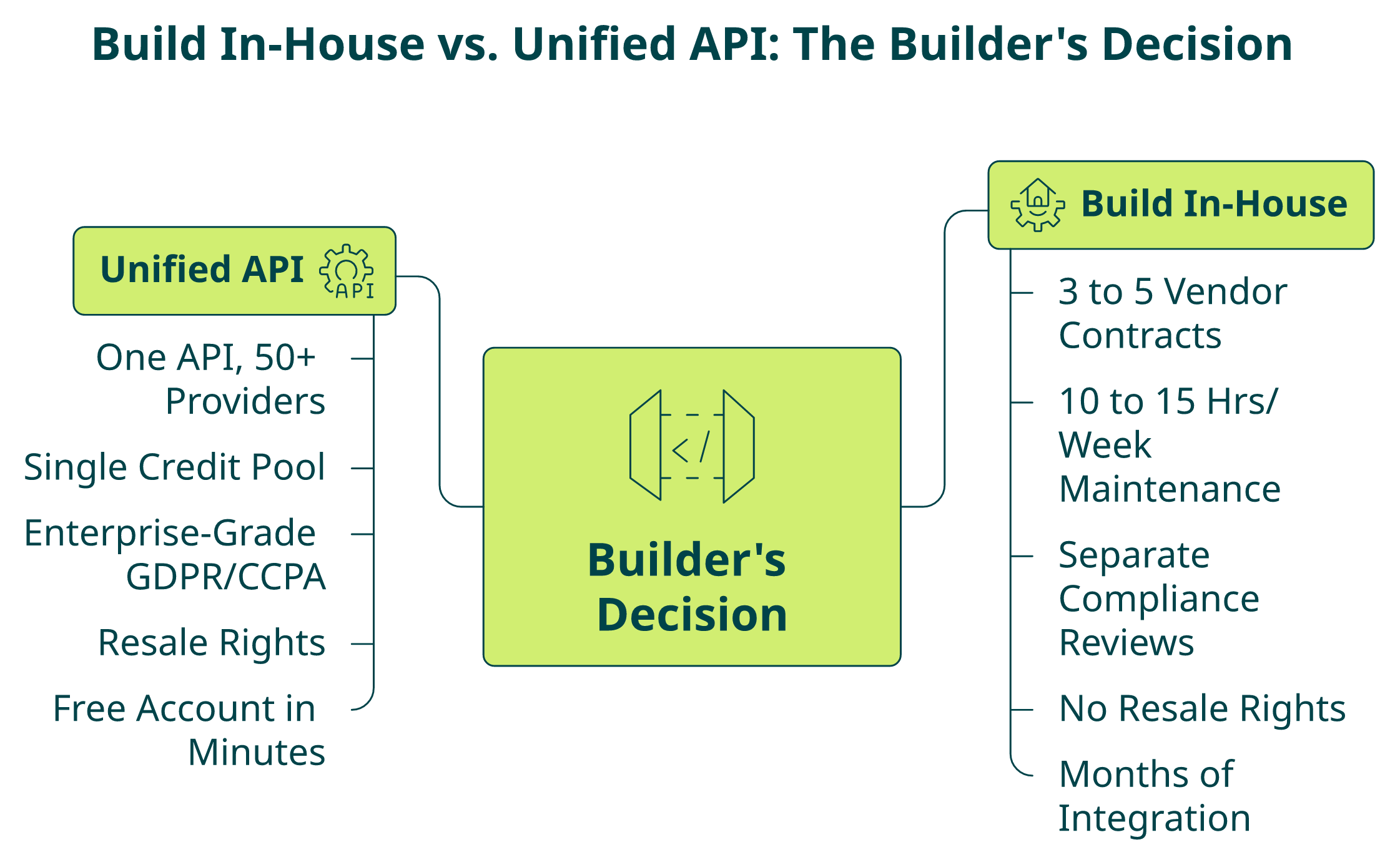
One API, 50+ providers aggregated and deduplicated. A single credit pool across all 30+ enrichment categories. Resale rights on custom plans. MCP for agent-native delivery. Enterprise-grade GDPR/CCPA compliance handled once. 4,000+ data points covering 150M+ companies and 800M+ contacts. Your engineering team builds the product feature, not the data pipeline.
Side-by-Side Comparison
| Criterion | Build In-House (3 to 5 Providers) | Explorium Unified API |
|---|---|---|
| Integration complexity | ❌ 3 to 5 separate APIs to integrate, normalize, and maintain | ✅ One API, one integration |
| Ongoing maintenance | ❌ 10 to 15 hrs/week on normalization and deduplication | ✅ Handled by Explorium’s aggregation layer |
| Signal breadth | ⚠️ Limited to contracted providers; gaps require new vendors | ✅ 30+ enrichment categories from 50+ sources |
| Data quality | ⚠️ No cross-source validation; each provider’s accuracy is your ceiling | ✅ 97.8% firmographic accuracy via cross-referencing |
| Compliance burden | ❌ Separate legal review per vendor | ✅ One GDPR/CCPA compliance relationship |
| Time-to-feature | ❌ Months of integration engineering | ✅ Free account to first API call in minutes |
| Cost structure | ❌ Multiple billing tiers across vendors | ✅ Single credit pool, one-time packages |
Who Should Choose What
Build in-house if you have a dedicated data engineering team, specific niche providers you must use, and 6+ months of runway for integration. Choose Explorium if you want to ship B2B data features in weeks, not quarters, and prefer investing engineering time in product differentiation over data plumbing.
As Omar, Explorium’s CEO, puts it: “What took months or years, 3 to 4 years ago, to build can now be done within a week.”
Q11: How Do You Get Started Embedding B2B Intelligence in Your Product with Explorium?
You can go from zero to your first embedded B2B data feature in under a day, no sales call required. Here’s the path:
The 5-Step Launch Path
- ✅ Create a free Explorium account: Instant API key, no credit card required. You’re making API calls within minutes of signup.
- ✅ Explore the API documentation: Test company search (fetch-businesses), enrichment (enrich-business), prospect matching (match-prospect), and lookalike endpoints with your own data. Explorium offers four endpoint types: match, enrich, fetch, and event data.
- ✅ Connect via MCP for agent-powered features: If you’re building AI-native product capabilities, connect your agent framework (Claude Code, n8n, LangChain, LangGraph, CrewAI) to Explorium’s MCP server. Your agent autonomously selects which enrichments to retrieve per query, no pre-mapped endpoints required.
- ✅ Ship your first feature: Use the architecture blueprints from this guide to build company search, enrichment-on-import, lookalike discovery, or real-time dashboard intelligence. Start with the highest-value pattern for your users.
- 💰 Scale to a custom plan: As your embedded feature grows, unlock resale rights, search preview (query before consuming credits), higher credit volumes, and dedicated SLA terms.
What You’re Building On
Explorium’s unified API is purpose-built for product builders who need to embed, not just consume, B2B intelligence. The same data infrastructure that powers Clay, Cognism, Outreach, Common Room, Bombora, and Monday.com is available through your free account.
The data layer covers 150M+ company profiles, 800M+ contact records, and 4,000+ data points across 30+ enrichment categories, aggregated from 50+ providers, deduplicated, and delivered through one API and MCP integration. Credit-based pricing means you pay for enrichments consumed, not seats filled. One-time packages, not recurring subscriptions.
Start building today.
Q12: FAQ: Common Questions About Embedding B2B Data in SaaS Products
What is a company search API?
A company search API lets your product’s users find and filter businesses by firmographic attributes, including industry, size, revenue, location, tech stack, and funding stage, directly inside your UI. Instead of building and maintaining your own business database, you query a provider’s database via API and return structured company results. Explorium’s company search endpoint supports 30+ filterable attributes across 150M+ companies, with data aggregated from 50+ underlying sources in a single call.
What is a company lookalike API?
A lookalike API takes a seed company (your user’s best customer) and returns similar businesses based on shared attributes. The quality of results depends entirely on signal breadth, matching on industry + size alone produces generic lists. Explorium’s lookalike matching operates across firmographics, technographics, funding, hiring, and intent signals, delivering multidimensional similarity that single-source APIs can’t match.
Can you white-label B2B data inside your SaaS product?
Yes, but only if your data API provider offers explicit resale rights. Most providers (Apollo, ZoomInfo, and Clearbit) prohibit redistribution under standard terms. Explorium offers resale rights on custom plans, along with enterprise-grade GDPR/CCPA compliance, letting you legally embed and display B2B intelligence to your end users.
What is MCP and how does it work with B2B data?
MCP (Model Context Protocol) is an agent-native delivery mechanism that lets AI agents autonomously query a data layer and retrieve the signals they need, without pre-mapped API endpoints for every enrichment type. Unlike REST APIs (where you hard-code which data to fetch), MCP lets the agent decide what to retrieve based on workflow context. Explorium’s MCP server works natively with Claude Code, n8n, LangChain, and CrewAI.
💰 How much does it cost to embed B2B data in a product?
Explorium uses credit-based pricing, one-time packages, not per-seat subscriptions. You purchase credits and consume them across all 30+ enrichment categories through a single unified pool. This model aligns with embedded economics: your costs scale with actual usage, not the number of users in your product. On custom plans, search preview lets you check data availability before consuming credits, critical cost control for high-volume embedded features.
What data signals should an embedded company intelligence feature include?
At minimum: firmographics (industry, size, revenue, and location), technographics (tech stack), contact data (emails and phone numbers), and funding signals (round, amount, and investors). For competitive differentiation, add intent signals, hiring velocity, executive changes, and partnership events. Explorium’s 30+ enrichment categories and 4,000+ data points cover all of these through one API [file:112].
FAQs


