

TL;DR
- Most B2B data APIs default to internal-use-only licensing, meaning displaying enriched data to end-users may violate your agreement.
- Four licensing tiers exist: internal use, display, redistribution, and full resale. Each carries different compliance and pricing obligations.
- Audit vendor agreements against 8 critical clauses before embedding any data API into a customer-facing product.
- Credit-based pricing with a unified pool outperforms subscriptions for redistribution economics at scale.
- Explorium offers resale rights on custom plans with one agreement covering 50+ sources, eliminating multi-vendor licensing negotiations.
- GDPR and CCPA obligations change fundamentally when you redistribute data. One DPA covering all sources simplifies compliance.
Q1. Can You Actually Resell Data from a B2B Data Enrichment API in Your SaaS Product?
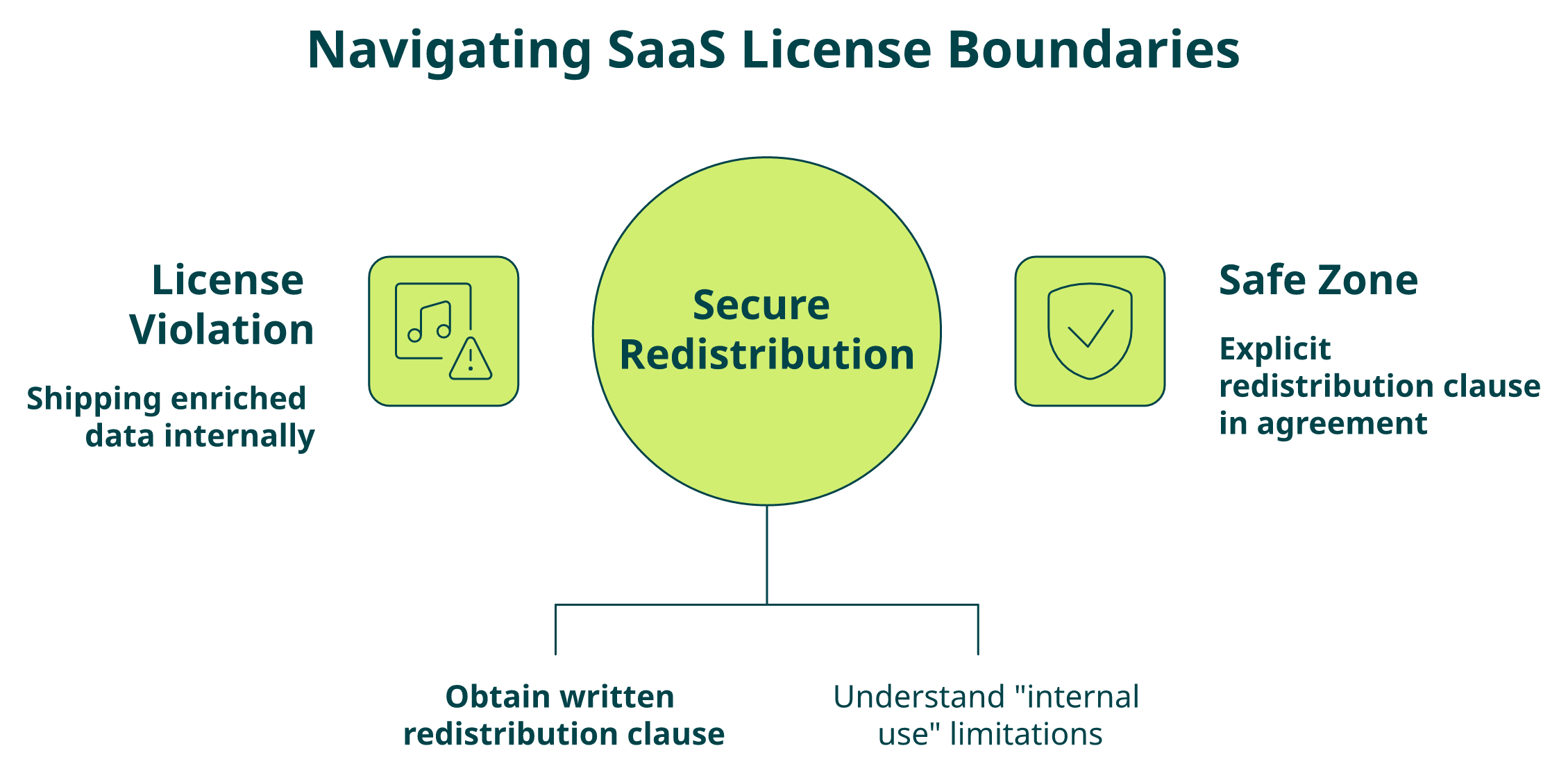
The short answer: yes, but only if your vendor agreement explicitly says so. Most B2B data API licenses default to “internal business purposes only,” which means the moment your end-user sees, accesses, or benefits from that enriched data inside your product, you may already be in violation.
⚠️ What Most Product Builders Get Wrong
Here’s what trips up even experienced PMs and CTOs:
Most API terms of service restrict resale by default. Apollo’s API Terms, for example, state plainly: “Apollo grants you a non-exclusive, non-transferable, non-assignable revocable license to access and use the APIs solely for your internal business purposes.” It goes further: “You may not sublicense, sell, or distribute the APIs.” That language covers more than raw data dumps; it covers any scenario where enriched data flows into a customer-facing feature.
“Redistribution” is broader than you think. It’s not just reselling a CSV of contacts. If your SaaS product displays enriched firmographic data in a dashboard, surfaces contact details in search results, or returns enriched records through your own API, that’s redistribution. Even AI agent outputs containing licensed data can trigger redistribution clauses.
Violations carry real consequences. Breaching resale restrictions can mean immediate contract termination, IP infringement claims, and downstream liability to your own customers who built workflows around data you no longer have the right to serve.
A growing number of providers now support resale explicitly. This is the critical shift. Instead of treating redistribution as a legal gray area, modern data infrastructure providers offer resale rights as a defined licensing tier, specifically designed for product builders embedding data into commercial SaaS.
✅ How Explorium Approaches Resale Rights
We built Explorium’s licensing model with product builders in mind. Our custom plans include explicit resale rights paired with enterprise-grade GDPR/CCPA compliance, so you’re not negotiating redistribution terms with three, four, or five separate data vendors. One agreement covers all 50+ underlying data sources, one credit pool spans every enrichment category, and resale rights are a feature of the plan, not an afterthought buried in an enterprise upsell conversation.
“Instead of connecting to multiple data sources and APIs, we only require one connection, Explorium!”
— Mirit H., Mid-Market Explorium G2 – Verified Review
Q2. What’s the Difference Between Internal-Use, Display, Redistribution, and Full Resale Licensing?
Most vendor agreements don’t label their licensing tiers clearly. They bury usage rights across multiple clauses: ToS Section 2 says one thing, the Order Form says another, and the DPA adds conditions that contradict both. Product builders routinely assume their API access includes the right to display data to end-users, only to discover the standard license covers internal analytics and nothing more.
❌ Why Traditional Licensing Creates Confusion
Traditional data providers like ZoomInfo, Apollo, and PDL typically offer one-size-fits-all API access that defaults to internal use. Apollo’s Terms of Service explicitly restrict users from reselling, distributing, or sublicensing any part of the Contributor Database to third parties. Getting redistribution rights means navigating a custom enterprise agreement, often with opaque pricing and minimum commitments that weren’t part of the original conversation.
The pattern is predictable: you integrate the API, build features around it, ship to customers, then discover during a legal review that your license doesn’t permit what you’ve already launched. Legacy providers use this opacity as a revenue lever, forcing you into enterprise-tier contracts after you’ve already built around their API.
“Contact info frequently missing or incorrect. Half the day calling wrong/disconnected numbers.”
— Verified User, IT Services Apollo – G2 Verified Review
📋 The Four Licensing Tiers Every Product Builder Should Know
| Tier | What It Permits | Typical Restrictions | Who Needs It |
|---|---|---|---|
| Internal Use Only | Data powers your internal models, analytics, or team dashboards | End-users never see raw data; no customer-facing exposure | Internal BI teams, data science |
| Display / Embedded Use | Enriched data appears in your product UI (profiles, dashboards) | Users cannot export, download, or redistribute further | SaaS products showing enriched account profiles |
| Redistribution | Your product passes through or surfaces data as a core feature, potentially via your own API | Requires explicit redistribution license; compliance obligations extend to end-users | Data-enriched platforms, agent-powered products |
| Full Resale / White-Label | You resell the data as your own, with no attribution to the original provider | Highest cost tier; full compliance and indemnification responsibility | White-label data products, reseller businesses |
Each tier maps to different contractual requirements, pricing structures, and compliance obligations.
✅ How Explorium Simplifies the Spectrum
We designed Explorium’s custom plans to collapse this complexity. Product builders embedding data into commercial SaaS don’t need separate OEM agreements per enrichment type. The unified credit system covers all 30+ enrichment categories, including contacts, intent, and technographics, under one licensing agreement with resale rights built in. Instead of negotiating redistribution terms with Apollo for contacts, Bombora for intent, and BuiltWith for technographics (each with different policies), Explorium consolidates all signals and their associated licensing under one agreement and one credit pool.
Q3. What Data Licensing Models Do B2B Data APIs Offer for SaaS Products?
Choosing the right B2B data licensing model determines your product’s unit economics, legal exposure, and scalability ceiling. Pick the wrong model, and you’re either overpaying for unused data seats or locked into a contract that prohibits the exact redistribution use case you’re building for.
❌ The Wrong Way to Choose a Licensing Model
Most product builders default to whichever model their first vendor offers, typically a monthly subscription with internal-use restrictions. This ignores the questions that actually matter: Does the model scale with your end-user growth? Does it permit redistribution? Can you predict costs per enriched record when your customer base triples?
📋 Six Licensing Models, and What Each Means for Redistribution
| Model | How It Works | Redistribution Compatible? | Watch Out For |
|---|---|---|---|
| Flat Subscription | Fixed monthly fee regardless of usage | ❌ Rarely, typically internal-use only | Overpaying at low usage; underpowered at scale |
| Per-Seat Licensing | Cost scales with team size | ❌ Almost never includes redistribution | Penalizes team growth; irrelevant to product-level usage |
| Usage-Based / Per-API-Call | Pay per request | ⚠️ Possible if explicitly licensed | Costs become unpredictable at scale |
| Credit-Based / Pay-Per-Record | Purchase credit packages; consume across enrichment types | ✅ Supported on custom plans | Ensure credits cover all signal types, not per-category |
| OEM / Reseller License | Explicit resale agreement with negotiated terms | ✅ Yes, purpose-built for resale | Often requires $50K+ minimums and 6–12 month negotiation |
| White-Label | Full rebrand rights; data sold as your own | ✅ Maximum flexibility | Highest cost tier; full compliance burden on you |
Score each model on four criteria: redistribution compatibility, cost predictability at scale, enrichment breadth covered, and contract simplicity. Models scoring high on all four are architecturally suited for product builders embedding data into commercial SaaS.
✅ Where Explorium Stands
Explorium’s credit-based model with resale rights on custom plans scores highest across all four criteria. Redistribution is explicitly supported. One-time credit packages, not recurring subscriptions, provide cost predictability. All 30+ enrichment categories are accessible through one credit pool. And a single licensing agreement covers every signal type, eliminating the need for separate OEM negotiations per enrichment category.
“Explorium is a great tool for getting data from multiple subscriptions, databases but at a consolidated cost for Finance and Data professionals.”
— Omar G., Mid-Market Explorium G2 – Verified Review
“Credit system is broken. Pricing is broken. Not fully transparent with rollover limit.”
— Raphael A., Marketing Lead Clay – G2 Verified Review
Q4. What Should You Look for in a B2B Data Vendor Agreement Before Embedding?
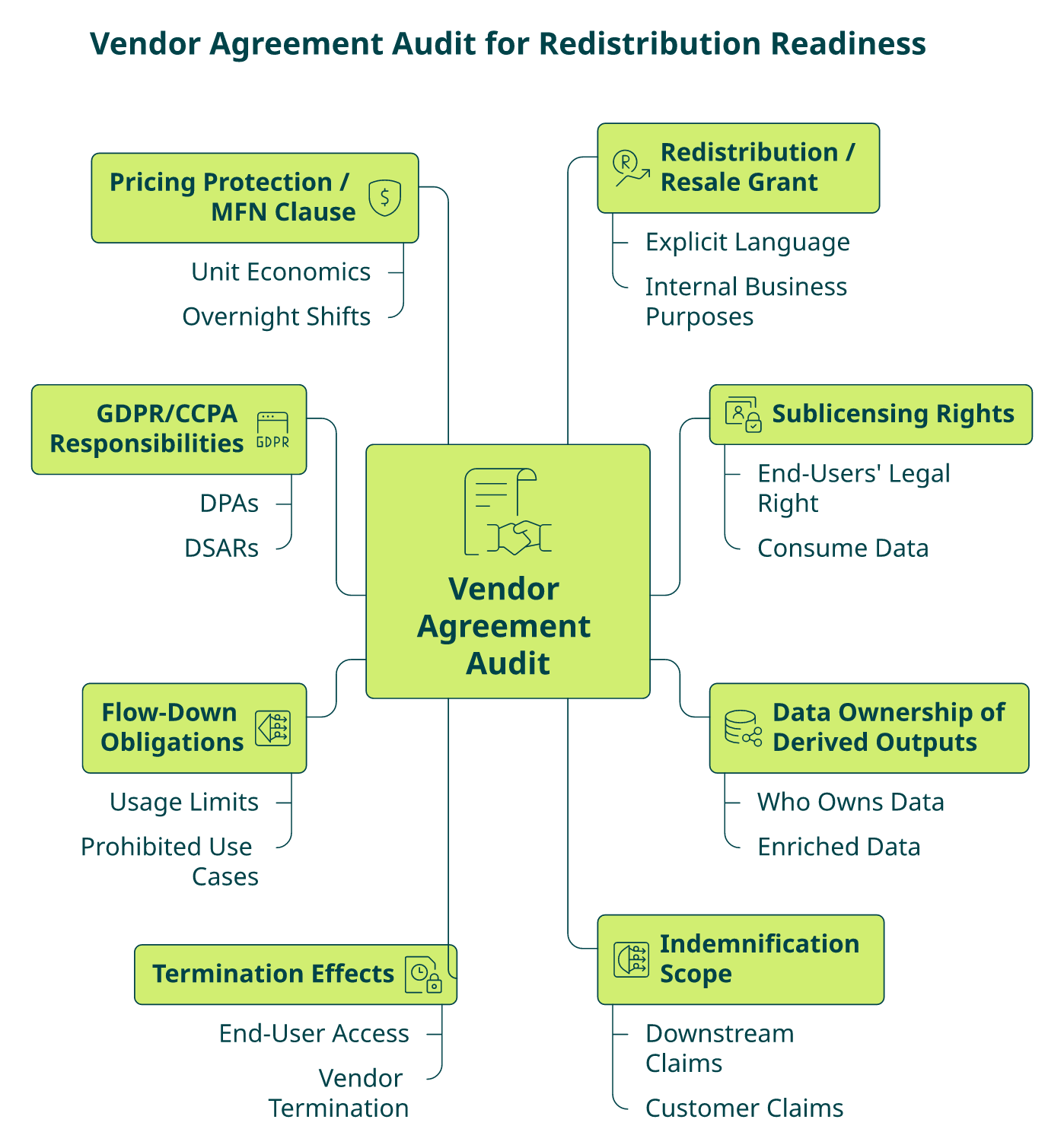
Before you embed any B2B data API into a customer-facing product, audit your vendor agreement against these 8 critical clauses. Most product builders skip this step and discover the gaps only after shipping.
📋 The 8-Clause Vendor Agreement Audit
☐ Redistribution / Resale Grant: Does the agreement explicitly grant redistribution or resale rights, not just “API access”? Look for language that goes beyond “internal business purposes.” If the grant clause doesn’t mention redistribution, sublicensing, or resale, it almost certainly prohibits it.
☐ Sublicensing Rights: Can you pass data rights to your end-users? Without sublicensing language, your customers may have no legal right to use data flowing through your product.
☐ Data Ownership of Derived Outputs: Who owns the enriched or derived data your product creates from the API output? Some agreements claim ownership of anything derived from their data.
☐ Indemnification Scope: Does the indemnification clause cover downstream claims from your customers? If your end-user gets a GDPR complaint based on data you surfaced, who absorbs the cost?
☐ Termination Effects: What happens to your end-users’ access if the vendor terminates your contract? A 30-day notice period means nothing if your customers lose access to data they’ve built workflows around.
☐ Flow-Down Obligations: Are there restrictions you must impose on your own customers? Some agreements require you to enforce usage limits or prohibit specific use cases downstream.
☐ GDPR/CCPA Responsibilities: Does the agreement specify who handles compliance for redistributed data? DPAs, DSARs, and consent chains must be explicitly addressed for redistribution scenarios.
☐ Pricing Protection / MFN Clause: Is there a “most favored nation” or pricing lock-in clause for resale-tier licensing? Without it, your unit economics can shift overnight.
🔍 What These Clauses Look Like in Practice
Here’s real-world contract language, annotated for product builders:
⚠️ Restrictive (Apollo API Terms): “Apollo grants you a non-exclusive, non-transferable, non-assignable revocable license to access and use the APIs solely for your internal business purposes… You may not sublicense, sell, or distribute the APIs.” This prohibits any customer-facing use of raw API data. If your product surfaces Apollo-enriched records to end-users, you’re in violation under standard terms.
⚠️ Hidden trap language: Watch for “solely for Licensee’s internal business purposes.” This explicitly excludes redistribution even if your product IS your business. The word “internal” is the tripwire.
📊 Score Your Agreement
| Score | What It Means |
|---|---|
| ✅ 7–8 checks | Your vendor agreement is redistribution-ready |
| ⚠️ 4–6 checks | Critical gaps exist, with legal and operational risk exposure |
| ❌ 0–3 checks | Your current agreement likely prohibits what you’re building. Renegotiate or switch before shipping. |
✅ How Explorium Covers Every Clause
Explorium’s custom plans are designed to check every box on this audit. Resale rights included. Enterprise-grade GDPR/CCPA compliance built in. A unified credit system eliminates per-vendor flow-down complexity. And the single-agreement model means one legal review covers all 50+ underlying data sources, not five separate contracts with five different termination clauses.
“Explorium has conquered external data exploration for corporates… the only platform I have seen in market that has a consistent journey to explore, experiment, and implement external data at scale without extension contracting or reselling.”
— Verified User, 5.0 Rating Explorium Gartner – Verified Review
Q5. How Do You Negotiate and Secure Data Redistribution Rights from a B2B Data Provider?
Most B2B data vendors don’t advertise redistribution licensing. You won’t find it on a pricing page or in a self-serve signup flow. When you ask, the default response is: “Let me connect you with our enterprise team,” followed by opaque pricing, minimum annual commitments, and a negotiation cycle that can stretch months.
⏰ Why Redistribution Becomes a Launch Bottleneck
Traditional providers treat redistribution as an exception, not a product tier. ZoomInfo, Apollo, and PDL require custom enterprise contracts for resale rights, often with minimum annual commitments of $50K+, per-signal restrictions, and 6–12 month negotiation cycles. Apollo’s billing is monthly, which compounds the problem at scale: the enterprise sales conversation becomes a bottleneck that delays your product launch while your engineering team has already integrated the API.
“Data inaccuracies lead to negative outcomes. Wrong personnel details, private employee info listed as company contacts, misdirected communications.”
— Anders J., Developer Apollo – G2 Verified Review
✅ The 6-Step Redistribution Playbook
Here’s the playbook that actually works, in the order that matters:

- Document your exact redistribution scenario before contacting the vendor. Is it display-only in dashboards? API passthrough to end-users? Derived insights? White-label? The specificity of your request determines the vendor’s response time and pricing.
- Request the vendor’s redistribution licensing tier and pricing upfront. If they don’t have one, or if the answer is “we’ll need to scope a custom deal” without any framework, that’s a red flag. Providers built for product builders have this tier defined.
- Negotiate indemnification coverage for downstream use. Your customers will rely on data your product surfaces. If a claim arises from that data, your vendor agreement must specify who absorbs the liability.
- Secure termination protections. What happens to your end-users’ access if the vendor terminates your contract? A 30-day notice period means nothing if your customers lose access to data they’ve built workflows around.
- Get resale rights in writing as a contract addendum, not a verbal commitment, not an email from an account executive. Written, signed, referenced in the Order Form.
- Architect your integration with redistribution safeguards: caching for graceful degradation, DSAR forwarding mechanisms, and compliance monitoring for all data that touches end-users.
💰 How Explorium Eliminates the Negotiation Bottleneck
We built Explorium to skip steps 1 through 5 entirely for most product builders. Resale rights are available on custom plans without a 6-month enterprise sales cycle. One agreement, one credit pool, all signals. Product builders go from signup to redistribution-licensed API access without separate OEM negotiations per enrichment type.
The proof is in who’s already building on this model: Clay, Cognism, Outreach, and Common Room are themselves data-powered products that redistribute enriched data to their end-users, validating that the licensing architecture is purpose-built for product builders, not retrofitted from a prospecting platform.
“Explorium gives us the data I need when I need it. This saves us a lot of time and money instead of managing each data source separately.”
— Ishi N., Enterprise Explorium G2 – Verified Review
Q6. What Are the Risks of Embedding a Third-Party B2B Data API Without Proper Licensing?
Here’s a scenario that plays out more often than anyone admits.
⚠️ The Scenario Every Product Builder Recognizes
You’re six days from launching a SaaS product that enriches accounts with firmographics from Clearbit, contacts from Apollo, intent signals from Bombora, and technographics from BuiltWith. Your legal team just flagged four problems simultaneously: Clearbit’s terms prohibit displaying data to end-users. Apollo requires a separate OEM agreement you never signed. Bombora’s intent data is licensed for internal scoring only. And BuiltWith hasn’t responded to your licensing inquiry in three weeks.
Your engineering team already integrated all four APIs. Your marketing is scheduled. Your first customers are onboarding next Tuesday.
💸 The Hidden Costs of Multi-Vendor Licensing Gaps
Each vendor writes their own Terms of Service optimized for their business model, not yours. Here’s what the real cost looks like:

- Contractual exposure: Redistributing data without explicit rights can trigger immediate contract termination and IP infringement claims.
- Downstream liability: If your customer faces a legal claim based on data you passed through without proper licensing, your indemnification gap means you absorb the cost.
- Legal review overhead: 4–6 separate vendor agreements × $5K–$15K per legal review = $20K–$90K before you’ve shipped a single feature.
- Negotiation time: 3–6 months to secure redistribution rights across multiple vendors, if they offer them at all.
- Engineering burden: 10–15 hours per week maintaining normalization scripts across different API schemas, rate limits, and authentication methods.
- Agent output risk: AI agents generating responses containing unlicensed data is the most commonly overlooked redistribution violation, and the hardest to audit after the fact.
“Per-row credit cost can vary 100% from stated amounts, e.g., stated 11 credits/row, actual 25. Contact data quality varies wildly, feels like a black box.”
— Verified User, IT Services Clay – G2 Verified Review
“Switched from free trial to paid plan ($100/month). After a few days, account disabled with no warning or explanation. Support unresponsive after multiple contact attempts.”
— Verified User, Computer Software People Data Labs – G2 Verified Review
✅ How the Right Architecture Eliminates Multi-Vendor Risk
The right infrastructure consolidates all enrichment types under one API, one licensing agreement, and one credit pool with redistribution rights built in, not bolted on.
We designed Explorium’s 50+ source aggregation to solve exactly this problem. One legal review. One DPA. One credit system. Resale rights on custom plans cover all underlying sources. If one underlying provider degrades, the aggregation layer compensates: 97.8% accuracy on firmographic fields versus single-source averages of 78%. From four separate licensing negotiations and six months of legal review to one agreement with built-in resale rights, that’s the shift from fragmented data vendors to a unified B2B data layer.
“Explorium is a great tool for getting data from multiple subscriptions, databases but at a consolidated cost.”
— Omar G., Mid-Market Explorium G2 – Verified Review
Q7. How Do GDPR and CCPA Affect Reselling B2B Data in Your SaaS Product?
When you redistribute B2B data through your SaaS product, your compliance posture changes fundamentally. You’re no longer just an API consumer processing data internally. You become a data controller (or joint controller) with direct obligations under GDPR and CCPA that extend to every end-user who touches that data.
❌ The Compliance Mistakes Product Builders Make
The most common mistake: assuming your data vendor’s GDPR compliance automatically covers your redistribution use case. It doesn’t. Here’s where product builders get it wrong:
Legal basis doesn’t extend to redistribution. Your vendor processed data under legitimate interest for B2B enrichment. That legal basis covers their direct customers, not your end-users consuming that data through your product. Redistribution requires its own legal basis, either legitimate interest with a separate assessment or explicit consent chains.
DPAs don’t cover resale scenarios by default. Most standard Data Processing Agreements are written for internal-use API access. If your DPA doesn’t explicitly mention redistribution, your compliance chain has a gap that a regulator would identify immediately.
CCPA defines “sale” very broadly. Under CCPA/CPRA, passing B2B contact data to your end-users, even as a feature of your paid SaaS product, may constitute a “sale of personal information.” This triggers specific disclosure requirements, opt-out mechanisms, and potential service-provider designation issues that most product builders haven’t addressed.
DSARs cascade across the redistribution chain. When a data subject submits a deletion request, you need mechanisms to propagate that request downstream to your end-users who may have cached or stored the data. Without automated DSAR forwarding, this becomes a manual nightmare.
📋 The Compliance Framework for Redistribution
| Obligation | GDPR | CCPA/CPRA |
|---|---|---|
| Your role | Data controller or joint controller | “Business,” with full controller-level obligations |
| Legal basis for redistribution | Separate legitimate interest assessment or consent chain | Disclosure + opt-out mechanism for “sale” of personal information |
| DPA requirements | Must explicitly cover redistribution scenarios | Service provider agreement with redistribution carve-outs |
| Cross-border transfers | Standard Contractual Clauses (SCCs) required for non-EU end-users | No equivalent restriction, but disclosure of international transfers recommended |
| DSAR handling | Must propagate deletion/access requests across redistribution chain | Must honor opt-out requests and forward to downstream recipients |
| Privacy notices | Must disclose third-party data sources to end-users | Must disclose categories of personal information “sold” or shared |
This table reflects the obligations that specifically apply to product builders redistributing enriched data, not the general compliance requirements that every API consumer faces.
✅ Explorium’s Compliance Architecture
We handle enterprise-grade GDPR/CCPA compliance at the platform level. Product builders on custom plans inherit a pre-built compliance foundation: one DPA covers all 50+ underlying sources, instead of managing separate DPAs and DSAR forwarding processes with 3–5 individual vendors. Explorium’s robust security, privacy, and compliance posture is aligned with enterprise standards, GDPR and CCPA included, so you perform due diligence once with one enterprise-ready partner rather than auditing every underlying source independently.
This compliance simplification is precisely why data-powered products like Clay, Cognism, and Outreach build on Explorium’s infrastructure.
Q8. How Does Credit-Based Pricing Change the Economics of Data Redistribution?
Credit-based pricing lets product builders pay only for the enrichments their end-users actually consume, transforming data redistribution from a fixed-cost liability into a variable-cost feature that scales directly with revenue.
💰 Why Subscriptions Break Redistribution Economics
Traditional subscription models charge flat monthly fees regardless of how much data your product actually uses. For internal analytics teams, that’s manageable because usage is predictable. For product builders redistributing data, it’s a fundamentally flawed model.
Here’s the math that breaks: your SaaS product has 50 customers in month one and 500 in month six. Under a flat subscription, you’re either overpaying at low volumes or hitting API rate limits at scale, forcing mid-contract renegotiations with multiple vendors simultaneously. Apollo’s monthly billing model illustrates this perfectly: it works for sales teams doing manual prospecting, but becomes cost-prohibitive for large-scale agent-driven enrichment.
“Often your own data provider saves more than enriching from Clay’s various providers.”
— Qais B., Growth Strategist Clay – G2 Verified Review
✅ How Credit-Based Pricing Works for Redistribution
Unlike subscriptions, credit-based systems let you purchase credit packages and consume them across any enrichment type: firmographics, contacts, intent, and technographics from the same balance. No per-signal billing. No separate invoices from separate vendors.
Here’s what this model enables for product builders:
- Per-customer cost modeling: Calculate the exact data cost per end-user enrichment, then build it into your SaaS pricing with known margins.
- Burst scalability: Handle usage spikes during campaign seasons or rapid customer onboarding without renegotiating tiers.
- Multi-signal flexibility: The same credit pool covers all enrichment types without separate billing per signal category.
- Search-before-commit: Preview data availability before consuming credits, so agents only pay for data they actually surface to end-users.
- Redistribution margin optimization: Predictable per-record costs mean data enrichment becomes a profit center, not a cost sink.
💸 The Explorium Credit Model in Practice
We designed Explorium’s pricing around a one-time credit-package model, not recurring subscriptions. You purchase credits, consume across all 30+ enrichment categories through one API, and your unit economics improve as usage scales. On custom plans, the search preview feature means your agent can query data availability first and only consume credits when the data is actually needed. This saves significant cost in agent-driven workflows where not every search results in a needed enrichment.
For product builders redistributing data, the pricing model determines whether data enrichment is a profit center or a cost sink. Credit-based pricing with a unified pool means you embed 30+ enrichment categories without managing separate billing per signal type, and the economics get better, not worse, as your customer base grows.
“Their product enables us to test multiple data sources and to save money by removing sources that have a poor benefit.”
— Verified User, Financial Services Explorium G2 – Verified Review
Q9. How Do Top B2B Data Providers Handle Resale Rights? A Provider-by-Provider Comparison
If you’re building a commercial SaaS product that embeds B2B data, the provider you choose determines three things: your licensing complexity, your compliance burden, and your redistribution economics. The major providers, Apollo, ZoomInfo, People Data Labs, Clearbit (HubSpot Breeze), and Explorium, take fundamentally different architectural approaches to resale rights. And those differences aren’t marginal; they define whether your product can legally ship data to end-users or not.
❌ Where Prospecting Platforms Fall Short
Apollo and ZoomInfo are prospecting platforms first, API providers second. Apollo’s API Terms explicitly grant “a non-exclusive, non-transferable, non-assignable revocable license to access and use the APIs solely for your internal business purposes” and prohibit sublicensing, selling, or distributing data to third parties. Redistribution requires a separate enterprise agreement, and Apollo’s monthly billing model makes large-scale agent enrichment cost-prohibitive.
ZoomInfo follows a similar pattern: a “non-exclusive, non-transferrable license to access and use the Services” with redistribution requiring custom negotiation. ZoomInfo’s credit model starts at $15,000/year for up to 5,000 credits, and additional data costs another $10,000+, with credits that restrict how aggressively you can scale.
“Contact info frequently missing or incorrect. Half the day calling wrong/disconnected numbers. Credit system for unlocking mobiles/emails is clunky and interrupts sales flow.”
— Verified User, IT Services Apollo – G2 Verified Review
⚠️ API-First Providers: Better, but Incomplete
People Data Labs offers broader API-first access with per-credit pricing, but it’s a single-source contact database without firmographic depth, intent signals, or agent-native delivery. And the operational reality is concerning for product builders who need reliability at scale.
“Switched from free trial to paid plan ($100/month). After a few days, account disabled with no warning or explanation. Support unresponsive after multiple contact attempts.”
— Verified User, Computer Software People Data Labs – G2 Verified Review
Clearbit (now HubSpot Breeze) is tightly coupled to HubSpot’s ecosystem, limiting flexibility for product builders using independent agent frameworks.
“Once over self-service limit, must jump to 4x plan, no room to grow realistically. Clearbit X requires yearly agreement with no trial and is very secretive.”
— Dan T., Mid-Market Clearbit – G2 Verified Review
✅ The Provider-by-Provider Comparison
| Criteria | Apollo | ZoomInfo | People Data Labs | Clearbit / Breeze | Explorium |
|---|---|---|---|---|---|
| Redistribution / Resale Rights | ❌ Prohibited by default; custom enterprise deal required | ❌ Requires custom negotiation; API limited in scale | ⚠️ Requires enterprise tier; single-source only | ❌ Locked to HubSpot ecosystem | ✅ Available on custom plans |
| Licensing Model | Monthly subscription | Annual contract ($15K+) | Per-credit tiers | HubSpot bundle | One-time credit packages |
| Data Source Architecture | Single-source (proprietary) | Single-source (proprietary) | Single-source (contacts) | Single-source (HubSpot) | 50+ source aggregation |
| Compliance for Redistribution | Separate negotiation per use case | Enterprise-only DPA | Limited DSAR coverage | Inherits HubSpot’s framework | One DPA covers all sources |
| Pricing for Resale Use Cases | 💸 Monthly billing; cost-prohibitive at scale | 💸 $15K+ annual minimums; credit caps | 💰 Per-credit; scales linearly | 💸 4x jump at volume thresholds | 💰 Unified credit pool; search preview on custom plans |
| Agent-Native Delivery (MCP) | ❌ No MCP support | ❌ No MCP support | ❌ No MCP support | ❌ No MCP support | ✅ MCP-native; agents select data autonomously |
| Onboarding to First API Call | Moderate (platform-first) | Slow (enterprise sales cycle) | Fast (API-first) | Fast (if on HubSpot) | Fast (free account to API in minutes) |
🎯 Which Provider Fits Your Use Case
Choose Apollo or ZoomInfo if your team needs a prospecting UI for internal sales workflows; they excel at manual list-building with CRM integrations and Chrome extensions. Choose PDL if you need raw contact data at volume for internal analytics with no redistribution requirement. Choose Explorium if you’re building a commercial product that redistributes enriched B2B data to end-users. It’s the only provider where resale rights, multi-source aggregation, credit-based pricing, and agent-native MCP delivery are core architecture, not add-ons negotiated after the fact.
“Instead of connecting to multiple data sources and APIs, we only require one connection, Explorium!”
— Mirit H., Mid-Market Explorium G2 – Verified Review
Q10. Your Next Steps: How to Start Licensing B2B Data for Redistribution Today
Licensing B2B data for redistribution doesn’t require months of legal negotiations, if you choose the right provider. The frameworks, checklists, and comparisons in this guide exist because the traditional path is unnecessarily complicated. Here’s the compressed version: five steps, and the right infrastructure collapses most of them into one.
✅ The 5-Step Action Path
- Determine your redistribution tier. Use the decision flowchart from Q3. Are you displaying data in a UI, passing it through an API, creating derived insights, or white-labeling? Each scenario requires different licensing terms, and knowing your exact use case before contacting any vendor saves weeks of back-and-forth.
- Audit your current vendor agreement. Check it against the 8-clause checklist from Q4: redistribution rights, indemnification, termination protections, DSAR obligations, data freshness SLAs, sublicensing scope, pricing escalation caps, and cross-border transfer mechanisms. If you fail three or more checks, you need a new agreement.
- Evaluate providers against the comparison table from Q9. Prioritize those with redistribution-ready licensing tiers, credit-based pricing that aligns with your unit economics, and compliance coverage that extends to your end-users, not just your internal team.
- Secure written redistribution rights before writing integration code. This sounds obvious, but the most common mistake product builders make is integrating first and negotiating later. A verbal confirmation from an account executive is not a license.
- Implement with redistribution safeguards. Build DSAR forwarding, caching for graceful degradation, and compliance monitoring into your integration from day one, not as a post-launch patch.
💰 The Faster Path
We built Explorium to compress steps 1 through 4 for product builders. Create a free account, test enrichment quality across 30+ data categories against your current provider, and upgrade to a custom plan with resale rights when you’re ready to ship. No 6-month enterprise sales cycle. No separate OEM negotiations per signal type. One API, one agreement, one credit pool, covering firmographics, contacts, intent, technographics, and 26 more enrichment categories from 50+ underlying sources.
The product builders already doing this, Clay, Cognism, Outreach, Common Room, and Monday.com, didn’t choose Explorium because of a feature checklist. They chose it because the licensing, compliance, and pricing architecture was purpose-built for redistribution from day one.
“Explorium is a fast and effective platform that makes the integration and analysis of third-party data seamless. If you are looking to enrich your lead generation efforts, I would strongly recommend trying out Explorium, as it was a revelation for us.”
— David A., CEO, Mid-Market Explorium G2 – Verified Review
Start your free Explorium account and test enrichment quality before you commit. When you’re ready for redistribution, the custom plan is one conversation, not six months of legal review.
FAQs


