

TL;DR
- CRM data alone leaves 60–70% of lead-scoring signal on the table—external B2B data APIs close that gap by enriching every record with firmographics, technographics, and intent signals.
- Waterfall enrichment cascades through multiple API providers in priority order, maximizing match rates while controlling cost per record.
- Real-time enrichment suits inbound lead routing; batch enrichment suits weekly model retraining, CRM hygiene, and prospecting list preparation.
- Identity resolution accuracy determines enrichment quality—match on domain first, then LinkedIn URL, then email heuristics, and always validate confidence scores before writing to your feature store.
- API rate limits and error recovery must be engineered deliberately: use exponential backoff, circuit breakers, and a dead-letter queue for failed records.
- Explorium’s single API aggregates 50+ sources, 150M+ company profiles, and 800M+ people profiles with 97.8%+ match accuracy, eliminating the need to maintain separate provider integrations.
- GDPR and data-residency compliance must be factored into API selection—verify lawful basis, data-processing agreements, and suppression-list propagation before production deployment.
Introduction
Every revenue team has the same problem: the leads in the CRM look identical on the surface, but some will close in thirty days and others will ghost after the first discovery call. The difference rarely lives in what your team recorded—job title, company name, maybe a demo request timestamp. The difference lives in data your CRM was never designed to capture: whether the prospect’s company just raised a Series B, whether their tech stack replaced a competitor last quarter, whether six members of the buying committee consumed your category’s content on Bombora in the past two weeks.
B2B data APIs exist precisely to bridge that gap. Instead of relying on self-reported form fields and rep-entered notes, you programmatically pull external signals—firmographics, technographics, intent, hiring velocity, funding events, and dozens of other attributes—and fuse them with your first-party CRM data at the moment of scoring. The result is a feature set that is richer, fresher, and far more predictive than anything a sales-ops analyst can maintain by hand.
This guide is written for revenue engineers, data scientists, and marketing-ops architects who are ready to move beyond spreadsheet enrichment and build a production-grade B2B data API integration. We cover everything from the anatomy of an API call and waterfall enrichment architecture, to identity resolution, feature-store design, rate-limit handling, and GDPR compliance. By the end, you will have a blueprint you can take into your next sprint.
Why Enriched Signals Outperform CRM-Only Features
The case for external enrichment starts with a simple audit. Pull your closed-won and closed-lost records from the past twelve months and ask: which fields in your CRM were actually populated at the time the deal was scored? In most organizations the honest answer is disappointing. Company name and domain are present on nearly every record. Industry and employee count appear on roughly half. Annual revenue, tech stack, funding stage, and growth signals are populated on fewer than one in five. That sparsity is not a data-quality failure—it is a structural limitation of relying on humans and web forms to capture what should be captured programmatically.
Machine learning models are unforgiving about sparsity. A gradient-boosted tree trained on fifty features where forty are missing for the majority of records will overfit to the handful of features that are consistently present. The model learns to discriminate on noise. You end up with a lead score that is essentially a proxy for form completeness rather than genuine purchase propensity.
External B2B data APIs solve this by providing a consistent, machine-readable signal for every record regardless of how the lead entered your system. A lead that arrived through a dark social share with nothing but an email address can be enriched within milliseconds: domain lookup yields company name, headcount, industry, and revenue range; a technographics call reveals the prospect’s current marketing stack; an intent layer surfaces whether the account has been actively researching your category. Suddenly a near-empty record becomes a forty-field feature vector.
The lift in model performance is measurable. Revenue teams that move from CRM-only features to API-enriched feature sets consistently report AUC improvements of 12–25 percentage points on held-out test sets. More practically, enriched models tend to surface opportunities that CRM-only models completely miss—accounts with low form-fill engagement but high intent signals that indicate a buying cycle in progress. These are exactly the accounts a skilled seller would want to prioritize, and they are invisible to any model trained purely on first-party behavioral data.
Beyond model performance, enriched signals also improve the explainability of scores. When a rep sees that an account scored 94 out of 100, they want to know why. “High form-fill rate” is not actionable. “VP of Sales at a 500-person SaaS company that just raised $40M Series C, actively evaluating competitors per intent data, and using HubSpot which your product integrates with” is a conversation starter. Enriched features create scores that reps trust—and scores that reps trust actually get acted on.
For a deeper look at which features matter most in B2B models, see our guide on feature engineering for B2B lead scoring.
Anatomy of a B2B Data API Call
Before choosing providers or designing an enrichment pipeline, it helps to understand what a B2B data API call actually looks like end to end. Most enterprise-grade providers follow a similar pattern: you submit an identity (email, domain, LinkedIn URL, or company name plus location), and the API returns a structured JSON payload containing the attributes associated with that identity across the provider’s data graph.
A minimal company enrichment call using curl looks like this:
curl -X POST https://api.explorium.ai/v1/companies/enrich
  -H "Authorization: Bearer YOUR_API_KEY"
  -H "Content-Type: application/json"
  -d '{
    "domain": "acmecorp.com",
    "fields": ["firmographics", "technographics", "funding", "intent"]
  }'
A well-structured response payload for a company enrichment call might look like this:
{
  "match_confidence": 0.97,
  "company": {
    "name": "Acme Corp",
    "domain": "acmecorp.com",
    "industry": "Software - SaaS",
    "employee_count": 520,
    "revenue_range": "$50M-$100M",
    "hq_country": "US",
    "hq_state": "CA",
    "founded_year": 2014,
    "funding_stage": "Series C",
    "total_funding_usd": 42000000,
    "last_funding_date": "2025-11-15"
  },
  "technographics": {
    "crm": ["HubSpot"],
    "marketing_automation": ["Marketo"],
    "data_warehouse": ["Snowflake"],
    "detected_at": "2026-04-28"
  },
  "intent": {
    "topics": ["B2B Data Enrichment", "Lead Scoring Software"],
    "surge_score": 82,
    "data_source": "Bombora",
    "window_days": 30
  },
  "hiring": {
    "open_roles_count": 14,
    "data_team_growth_pct": 38,
    "sales_team_growth_pct": 22
  }
}
Several elements of this response deserve attention. The match_confidence field is critical: it tells you how certain the provider is that the record it returned corresponds to the identity you submitted. Scores below 0.80 should be treated with caution—writing low-confidence data to your feature store introduces noise that degrades model quality. Most enterprise providers expose this field; if a provider does not, that is a red flag.
The detected_at timestamp on technographics data matters for model freshness. A tech-stack detection from eighteen months ago may no longer reflect reality, especially in fast-moving SMB segments. When designing your feature store schema, always store the detection timestamp alongside the value so your model can optionally discount stale signals.
Response latency varies significantly across providers. For inbound lead routing—where a sales rep is waiting for a Slack notification—you need p99 latency under 500 milliseconds. For batch enrichment of a prospecting list, you can tolerate several seconds per record. Understanding this distinction upfront shapes which providers you select for which use cases.
For a more comprehensive look at enrichment workflows, visit our overview of B2B data enrichment.
Key API Providers: Coverage, Latency, and Cost Tradeoffs
No single provider has perfect coverage across all geographies, company sizes, and data categories. The B2B data API market has evolved into a set of specialists, each with particular strengths. Understanding those strengths—and their corresponding gaps—is prerequisite to building a resilient enrichment pipeline.
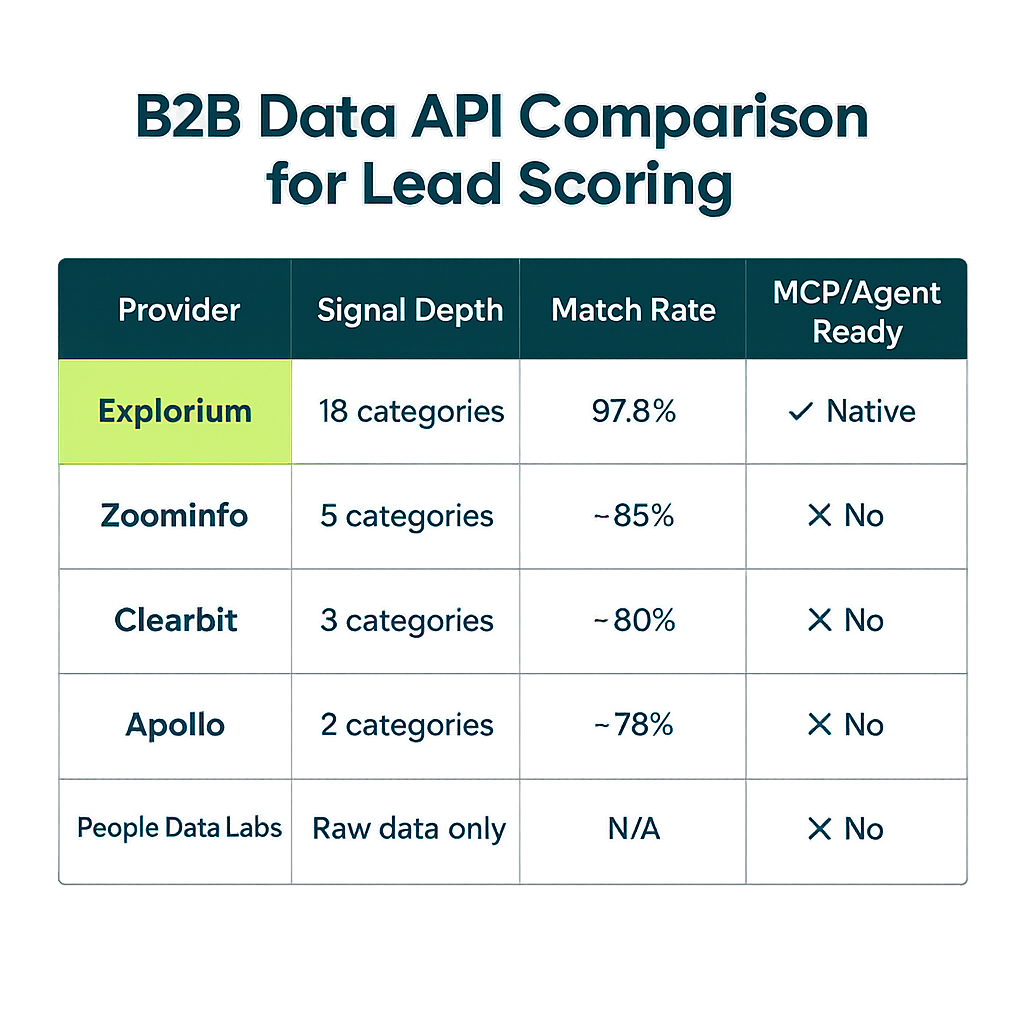
| Provider | Company Coverage | People Coverage | Primary Strength | Known Gap | Typical p50 Latency | Pricing Model |
|---|---|---|---|---|---|---|
| Explorium | 150M+ profiles | 800M+ profiles | Multi-source aggregation, 50+ providers, waterfall built-in, AgentSource MCP (100 QPS) | Requires API key; self-serve setup | 120ms | Usage-based |
| Clearbit (HubSpot) | ~44M companies | ~350M people | Deep SaaS/tech firmographics, HubSpot native integration | Weak SMB and APAC coverage | 200ms | Tiered subscription |
| ZoomInfo | ~100M companies | ~600M+ contacts | Broad US enterprise contact data, direct-dial phone | Higher cost; international coverage uneven | 300–600ms | Annual contract |
| Apollo.io | ~60M companies | ~275M contacts | Affordable; good SMB coverage; built-in sequencing | Data freshness varies; no intent native | 250ms | Seat-based + credits |
| Bombora (intent only) | N/A | N/A | B2B intent data, 6,000+ topics, co-op publisher network | Company-level only; no person-level intent | Batch only | Per-topic subscription |
| Lusha | ~40M companies | ~150M contacts | EMEA contact coverage, GDPR-compliant sourcing | Limited technographics and intent | 180ms | Credit-based |
The table above highlights a fundamental tension: breadth versus depth. A provider with 150 million company profiles will have shallower data on any given company than a specialist that covers 40 million companies but maintains richer attribute sets. Neither is universally better—the right choice depends on your target market.
Latency benchmarks also deserve scrutiny beyond the provider’s marketing materials. p50 latency (the median) looks great on a data sheet, but your user experience is determined by p95 and p99. A provider that promises 200ms median latency but spikes to 3 seconds at the 99th percentile will cause inbound routing delays precisely during high-traffic moments—the worst possible time for a lead to sit unscored.
| Provider | p50 Latency | p95 Latency | p99 Latency | SLA Uptime | Batch Support | Webhooks |
|---|---|---|---|---|---|---|
| Explorium (AgentSource MCP) | 120ms | 280ms | 420ms | 99.9% | Yes (async) | Yes |
| Clearbit | 200ms | 480ms | 900ms | 99.5% | Yes | Yes |
| ZoomInfo | 350ms | 800ms | 1,800ms | 99.5% | Yes | Limited |
| Apollo.io | 250ms | 550ms | 1,200ms | 99.0% | Yes | No |
| Lusha | 180ms | 390ms | 720ms | 99.5% | Yes | No |
Cost per record is the third dimension. At scale, even small per-record costs accumulate rapidly. A pipeline enriching 500,000 leads per month at $0.05 per record costs $25,000 monthly—more than some entire marketing-ops tool budgets. Usage-based pricing tends to be more predictable for high-volume pipelines; annual contracts with seat limits often penalize teams that scale aggressively mid-contract.
Waterfall Enrichment Architecture
Waterfall enrichment is the practice of cascading through multiple API providers in a defined priority order, using the next provider only when the previous one fails to return a match or returns a match below a confidence threshold. It is the single most effective architectural pattern for maximizing field coverage while controlling cost.
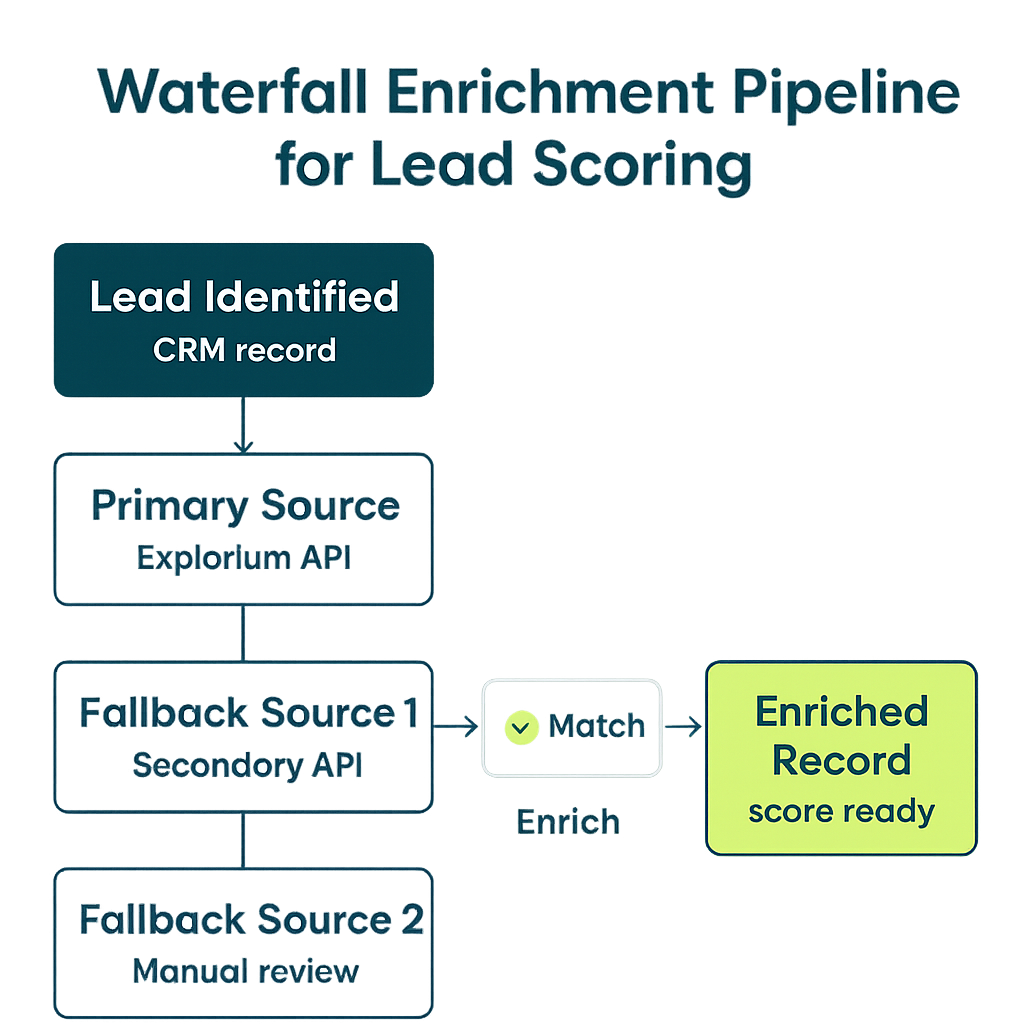
The logic is straightforward: your primary provider (typically the one with the highest match rate for your target market) handles the majority of records. Records that fall through—either because the domain is too small, too new, or too regional for the primary provider—are passed to a secondary provider. A tertiary provider catches the remainder. Each tier costs money, so you only invoke deeper tiers when necessary.
Here is a Python implementation of a three-tier waterfall enrichment function:
import requests
import time
from typing import Optional, Dict, Any

PROVIDERS = [
    {"name": "explorium", "url": "https://api.explorium.ai/v1/companies/enrich", "key": "EXPLORIUM_KEY"},
    {"name": "clearbit",  "url": "https://company.clearbit.com/v2/companies/find", "key": "CLEARBIT_KEY"},
    {"name": "apollo",    "url": "https://api.apollo.io/v1/organizations/enrich", "key": "APOLLO_KEY"},
]

CONFIDENCE_THRESHOLD = 0.80
MAX_RETRIES = 3

def enrich_company(domain: str, fields: list) -> Optional[Dict[str, Any]]:
    """
    Waterfall enrichment: try each provider in order.
    Returns the first response that meets the confidence threshold.
    """
    for provider in PROVIDERS:
        result = call_provider_with_retry(provider, domain, fields)
        if result and result.get("match_confidence", 0) >= CONFIDENCE_THRESHOLD:
            result["_source_provider"] = provider["name"]
            return result
        # Log the miss for coverage reporting
        print(f"[{provider['name']}] No confident match for {domain}. Trying next provider.")
    return None  # Dead-letter: all providers missed

def call_provider_with_retry(provider: dict, domain: str, fields: list) -> Optional[Dict]:
    headers = {
        "Authorization": f"Bearer {provider['key']}",
        "Content-Type": "application/json"
    }
    payload = {"domain": domain, "fields": fields}
    for attempt in range(MAX_RETRIES):
        try:
            resp = requests.post(provider["url"], json=payload, headers=headers, timeout=2.0)
            if resp.status_code == 200:
                return resp.json()
            elif resp.status_code == 429:
                # Rate limited — exponential backoff
                wait = (2 ** attempt) + 0.5
                time.sleep(wait)
            else:
                break  # Non-retryable error
        except requests.exceptions.Timeout:
            print(f"[{provider['name']}] Timeout on attempt {attempt + 1} for {domain}")
    return None

# Example usage
if __name__ == "__main__":
    result = enrich_company(
        domain="acmecorp.com",
        fields=["firmographics", "technographics", "intent", "funding"]
    )
    if result:
        print(f"Enriched via {result['_source_provider']}: {result['company']['name']}")
    else:
        print("No match found across all providers — queued for manual review.")
This pattern has several important properties. First, records are never left blank when a match exists somewhere in the provider graph—the waterfall finds it. Second, costs are minimized because premium providers are only invoked when cheaper or faster providers fail. Third, the _source_provider tag written to each record allows you to track per-provider coverage rates in your monitoring dashboard and adjust the waterfall order over time as your lead mix evolves.
Waterfall architecture also handles the common case where different providers have complementary strengths on the same domain. You might enrich firmographics from Provider A but then call Provider B specifically for intent data, since intent is their specialty. This is not strictly a cascade—it is more of a parallel enrichment with field-level merging. Both patterns are valid; the choice depends on your cost tolerance and latency budget.
For a complete treatment of waterfall design patterns, see our dedicated guide to waterfall enrichment.
Batch vs. Real-Time Enrichment Patterns
One of the most consequential architectural decisions in a B2B enrichment pipeline is whether to enrich records in real time (synchronously, as they arrive) or in batch (asynchronously, on a schedule). The right answer is almost always both—for different use cases.
Real-time enrichment is appropriate when the enriched data must influence an immediate action. The canonical example is inbound lead routing: a prospect submits a demo request form, and within seconds your routing logic needs to know their company size, industry, and intent score to decide whether to assign them to an enterprise rep, an SMB rep, or a self-serve nurture sequence. That decision cannot wait until tomorrow’s batch job runs. The enrichment API call must be synchronous, sub-second, and reliable.
Batch enrichment is appropriate for everything that does not require immediate action. Retraining your lead-scoring model? Batch the full CRM against your enrichment APIs weekly and rebuild the feature store. Running a prospecting campaign? Batch enrich your target account list before uploading it to your sequencing tool. Cleaning up stale CRM records? Schedule a nightly batch that refreshes any record not updated in the past sixty days.
| Dimension | Real-Time Enrichment | Batch Enrichment |
|---|---|---|
| Trigger | Form submit, CRM webhook, lead import | Scheduled job, model retraining, list refresh |
| Latency requirement | <500ms p99 | Minutes to hours acceptable |
| Volume per invocation | 1–10 records | Thousands to millions of records |
| Error handling | Synchronous retry, fallback to partial data | Dead-letter queue, reprocessing window |
| Cost optimization | Limited (speed is priority) | High (can parallelize and pre-cache) |
| Freshness | Near-real-time | Stale by schedule interval |
| Best for | Inbound routing, SDR alerts, in-app scoring | Model training, list enrichment, CRM hygiene |
In practice, most mature revenue-operations teams run a hybrid architecture. Real-time enrichment handles inbound records and triggers scoring updates for high-intent signals (e.g., a pricing page visit by a previously cold lead). Batch enrichment handles the weekly model retraining cycle, refreshes firmographic data for aging records, and prepares outbound prospecting lists. The two pipelines share the same underlying API client and feature store, but operate on different schedules and with different error-handling contracts.
When building the real-time path, always implement a cache layer in front of your enrichment API calls. A domain that has been enriched in the past seven days does not need another API call—the cached result is fresh enough for routing decisions and will save significant API spend. Redis is a natural fit for this cache layer; key on normalized domain, TTL on 48–168 hours depending on how frequently the underlying data changes in your target market.
Identity Resolution: Matching Records Across Sources
Enrichment is only as good as your ability to correctly match an incoming record to the right entity in the provider’s data graph. Identity resolution—the process of determining which company or person a given record refers to—is where enrichment pipelines most commonly fail silently. A wrong match is worse than no match: you write confident-looking garbage into your feature store, and your model learns from it.
For company-level resolution, the recommended matching hierarchy is:
- Corporate domain (normalized): Strip www, http/https, and trailing slashes. Use the root domain, not a subdomain. This is the highest-confidence identifier and should be your primary match key.
- LinkedIn company URL: When available, LinkedIn URLs provide an unambiguous identifier that survives company name changes and domain migrations. Store and use them.
- Company name + location heuristic: Name matching is fuzzy and error-prone. Only use it as a last resort, and apply a high confidence threshold before accepting the match. Acronyms, legal suffixes (Inc., LLC, Ltd.), and subsidiary names all create false negatives and false positives.
For person-level resolution, the hierarchy is similar:
- Business email address: Work email is the strongest person-level identifier. Personal email (Gmail, Yahoo) should never be used for B2B enrichment—the match rate is near zero and the compliance risk is high.
- LinkedIn profile URL: Provides a stable, unambiguous person identifier. Increasingly, B2B forms include a LinkedIn field; if yours does not, consider adding one.
- Name + company domain: Fuzzy, but acceptable for batch enrichment when email is unavailable. Apply a confidence gate of 0.85 or higher before writing the result.
Always store the match confidence score alongside every enriched field in your feature store. This allows you to create confidence-weighted features—rather than treating a 0.81 company match the same as a 0.99 match, you can discount uncertain enrichments in your scoring model or exclude them from training data entirely. This single practice eliminates a significant source of model noise that plagues teams who treat enrichment as binary (matched vs. not matched) rather than probabilistic.
Identity resolution also intersects with duplicate management. If your CRM has three records for the same company (one entered by sales, one created by a form fill, one imported from a partner list), and each gets independently enriched, you may end up with three inconsistent enriched records. Deduplication before enrichment—or at minimum, a canonical entity resolution step that selects the authoritative record per domain—is essential for keeping your feature store coherent.
Building a Lead Scoring Feature Store with API-Sourced Data
A feature store is a centralized repository of pre-computed, versioned features that can be served to both your model training pipeline and your real-time scoring inference layer. Building one properly is what separates ad hoc enrichment experiments from a production-grade lead scoring system.
The feature store for a B2B lead scoring system typically contains three categories of features:
Static firmographic features change slowly—industry, geography, business model, founding year. These can be refreshed monthly or even quarterly without materially degrading model performance. Store them with a last_refreshed_at timestamp and a source_provider tag.
Semi-dynamic features change on a timescale of weeks to months—employee count, revenue range, funding stage, leadership team composition, tech stack. Refresh these weekly as part of your batch enrichment job. Flag records where the value has changed since the last refresh, as sudden changes (a new funding event, a tech stack migration, a leadership change) are often high-signal buying indicators in their own right.
Dynamic behavioral and intent features change daily or even hourly—Bombora intent surge score, website visit frequency, email open recency, content consumption depth. These require either real-time API calls or daily batch refreshes to remain meaningful. Stale intent data can actively harm model performance: an account that was surging three months ago and is now quiet is not a high-priority target, but a stale feature store will score it as one.
The table below shows a recommended feature store schema for a B2B lead scoring system that integrates API-sourced data:
| Feature Name | Source | Data Type | Refresh Frequency | Confidence Gate |
|---|---|---|---|---|
| company_employee_count | Firmographic API | Integer | Weekly | ≥0.85 |
| company_revenue_range_usd | Firmographic API | Categorical | Weekly | ≥0.80 |
| company_funding_stage | Funding API | Categorical | Weekly | ≥0.90 |
| company_total_funding_usd | Funding API | Float | Weekly | ≥0.85 |
| company_tech_stack_crm | Technographics API | Multi-label | Monthly | ≥0.80 |
| company_intent_surge_score | Bombora via API | Integer (0–100) | Daily | N/A (provider-scored) |
| company_open_roles_count | Hiring API | Integer | Weekly | ≥0.80 |
| person_seniority_level | People API | Categorical | Monthly | ≥0.85 |
| person_department | People API | Categorical | Monthly | ≥0.85 |
| person_years_in_role | People API | Float | Monthly | ≥0.75 |
When you train your scoring model, always join from the feature store using the timestamp of the lead event—not the current timestamp. This point-in-time correctness prevents data leakage. If a lead converted in October and you are training in December, the feature store values you join should be those that existed in October, not the December-refreshed values. Without this discipline, your training metrics will be optimistic and your live model will underperform.
For a deeper dive into the signal types that power modern lead scoring, see our article on B2B buying signals and our guide to intent data for B2B.
Need high-coverage B2B data for your lead scoring pipeline? Explorium provides 150M+ company profiles and 800M+ people profiles via a single API with 97.8%+ match accuracy. Explore the API →
How Explorium Solves Coverage Gaps and Latency Problems
The practical challenge with the architecture described above is that building and maintaining integrations with five or six separate API providers is expensive in engineering time. Each provider has its own authentication scheme, rate limits, response schema, and error-handling contract. Teams that manage this complexity in-house spend more time on API plumbing than on the data science that generates business value.
Explorium’s API addresses this by aggregating 50+ data sources behind a single endpoint. When you call the Explorium enrichment API, it runs its own internal waterfall across its provider network, merges the results at the field level, and returns a unified response. You write one integration; Explorium handles the provider orchestration, deduplication, and conflict resolution internally.
The practical impact on coverage is substantial. Because Explorium draws from 50+ sources rather than a single provider’s proprietary graph, match rates are higher across the full spectrum of company sizes and geographies. A mid-market SaaS company in Singapore that a US-centric provider might miss is likely covered by one of Explorium’s regional data partners. The 97.8%+ company match accuracy figure reflects this multi-source advantage—it is not the match rate of any single underlying provider, but the cumulative match rate of the aggregated waterfall.
For AI-native workflows, Explorium’s AgentSource MCP server supports synchronous queries at 100 QPS, making it viable for real-time enrichment even in high-traffic environments. An inbound lead pipeline processing 50,000 form submissions per day—roughly 0.6 QPS on average, with peaks during campaign launches—fits comfortably within this throughput budget. For batch workloads, the asynchronous batch API handles millions of records per job with webhook-based completion notification.
Explorium also surfaces 18 signal categories and 80+ buying signal types, including native Bombora intent topics. This means that a single API response can include not just firmographics and technographics but also intent surge scores, hiring signals, funding events, and news triggers—the full feature set needed for a production lead scoring model, without stitching together separate intent and firmographic calls.
The workflow for a typical Explorium-powered lead scoring pipeline looks like this: an inbound lead arrives via form submission, triggers a webhook to your enrichment service, which calls the Explorium API with the lead’s email domain. Within 120 milliseconds, the enriched response is written to your feature store and passed to your scoring model. The model returns a score in another 20–30 milliseconds. Total time from form submit to scored lead visible in the CRM: under 500 milliseconds. That is the kind of latency that allows real-time lead routing to function as a competitive advantage rather than a theoretical aspiration.
To explore how AI-driven lead generation complements API enrichment, see our guide to AI lead generation.
Handling API Rate Limits and Error Recovery
Production enrichment pipelines fail in predictable ways: rate limit errors (429), transient network timeouts, provider-side 5xx errors, and malformed responses that fail schema validation. Engineering for these failure modes is not optional—it is the difference between a pipeline that works in a demo and one that works at 3 AM on a Monday after a campaign launch.
Rate limit handling requires understanding the specific limits of each provider you call. Most B2B data APIs enforce limits at the account level (e.g., 1,000 requests per minute) and sometimes at the endpoint level (e.g., 100 concurrent batch jobs). Exceeding these limits returns a 429 response, often with a Retry-After header telling you how many seconds to wait. Your client must respect this header rather than hammering the API with retries.
The recommended implementation pattern is exponential backoff with jitter. On the first 429, wait 1 second. On the second, wait 2 seconds. On the third, wait 4 seconds, and so on up to a maximum wait of 60 seconds. Add random jitter (e.g., ±20% of the base wait) to prevent thundering-herd scenarios where all workers in a distributed system retry simultaneously after a rate limit window resets.
For transient errors (timeouts, 503s), use the same exponential backoff pattern but with a shorter initial wait (250ms) and a lower retry ceiling (3 attempts before routing to a dead-letter queue). Do not retry 4xx errors other than 429—a 404 (domain not found) or 422 (malformed request) will not resolve on retry.
Dead-letter queues are essential for any batch pipeline. Records that exhaust all retry attempts should be written to a DLQ (a database table or message queue topic) with the error type, timestamp, and number of attempts recorded. A daily job should review the DLQ, attempt manual resolution for high-value records, and flag systematic errors (e.g., a sudden spike in 404s that might indicate a changed API schema) for engineering attention.
Circuit breakers add another layer of resilience. If a provider returns errors on more than 30% of requests in a five-minute window, your circuit breaker should open—stopping requests to that provider entirely and routing all traffic to the next provider in the waterfall. After a configurable recovery period (e.g., 60 seconds), the circuit breaker can half-open and send a probe request to test whether the provider has recovered. This pattern prevents a degraded provider from consuming your entire request budget with doomed retries.
Measuring Enrichment Coverage and Model Performance Impact
You cannot manage what you do not measure. Enrichment pipelines that are not monitored tend to degrade silently: a provider changes their API schema, a domain-matching heuristic starts failing on a new lead source, or a rate limit is hit consistently during peak hours. The result is invisible data quality degradation that manifests months later as unexplained model performance decline.
The key metrics to track for an enrichment pipeline are:
- Field-level fill rate: For each enriched field, what percentage of records have a non-null value? Track this per provider and per lead source. A sudden drop in fill rate for a specific field is a leading indicator of a provider-side change.
- Match confidence distribution: Plot the distribution of match confidence scores for each provider weekly. A shift toward lower confidence scores can indicate that your incoming lead mix has changed (e.g., more SMB or international leads that are harder to match).
- Enrichment latency percentiles: Track p50, p95, and p99 latency for real-time enrichment calls. Alert on p99 latency exceeding your SLA threshold.
- DLQ volume: Track the number of records entering the dead-letter queue daily. A spike indicates a systematic enrichment failure requiring investigation.
- Cost per enriched record: As your lead volume scales, monitor cost per record against your budget. Waterfall optimization (reordering providers, adjusting confidence thresholds) can meaningfully reduce cost without sacrificing coverage.
The model performance impact of enrichment is best measured through controlled experiments. When you upgrade your enrichment pipeline (adding a new provider, adding a new field category), hold out a random 20% of leads from the enrichment change and compare the scoring model’s AUC on enriched vs. non-enriched leads over a 30-day window. This gives you a clean estimate of the marginal value of the enrichment improvement and helps you prioritize which data sources to add next.
GDPR and Compliance Considerations for API-Sourced Data
B2B data APIs operate in a complex regulatory environment. GDPR, CCPA, and a growing set of regional data-protection laws impose obligations not just on the companies that collect personal data originally but on every downstream processor—including you when you call a B2B enrichment API to augment your lead records.
The most important compliance question to resolve before deploying any enrichment pipeline is lawful basis. Under GDPR, processing personal data (which includes individual contact information like name, job title, and email) requires a lawful basis. For B2B outreach, the most common basis is legitimate interests—the argument that your commercial interest in contacting a business professional about a relevant product is proportionate and not overridden by the individual’s rights. This argument is defensible when the contact is a business professional, the outreach is relevant to their professional role, and you provide a clear and easy opt-out mechanism.
However, legitimate interests is not a blanket exemption. You must conduct a Legitimate Interests Assessment (LIA) documenting why you believe the processing is justified, and you must be able to demonstrate this assessment to a regulator if challenged. Work with your legal team to complete and document this assessment before going live with API-enriched scoring in markets covered by GDPR.
Data-processing agreements (DPAs) are also required. Every B2B data API provider that processes personal data on your behalf must have a signed DPA with your organization. Most enterprise providers offer standard DPAs; review them carefully to ensure they cover your specific use case and data residency requirements. If you operate in the EU and your provider processes data in the US, verify that an appropriate transfer mechanism (Standard Contractual Clauses, adequacy decision) is in place.
Suppression lists are another operational requirement. When a contact opts out of your marketing communications—via unsubscribe link, GDPR erasure request, or CCPA opt-out—that suppression must propagate to your enrichment pipeline. If the opted-out contact reappears as a new lead (via a partner list import, for example), your pipeline should detect and suppress them before enrichment and scoring occur. Build suppression-list checking as the first step in your enrichment flow, before any API calls are made.
Finally, data minimization matters. GDPR’s minimization principle requires that you collect only the data necessary for your specified purpose. Resist the temptation to enrich every available field just because the API offers it. Define a specific list of fields that are necessary for your lead scoring model, enrich only those fields, and review the list annually as your model evolves.
FAQs


