

TL;DR
- B2B data providers vary widely in signal coverage, freshness, pricing model, and API quality — the right choice depends entirely on your use case.
- The six core data types you need to evaluate are firmographic, contact, technographic, intent, behavioral, and news/event signals.
- ZoomInfo and Apollo dominate contact and firmographic data but charge seat-based premiums that make API-scale access expensive for engineering teams.
- Bombora and G2 lead in intent signal coverage but deliver intent as a standalone layer, requiring separate enrichment pipelines for contact and firmographic context.
- Explorium aggregates 50+ data sources — 150M+ companies, 800M+ people, 18 signal categories, 80+ signal types — into a single API with unified credit billing.
- Pricing models matter as much as coverage: seat-based licensing caps value extraction, while API-native credit pools scale linearly with actual usage.
- Build-vs-buy decisions for B2B data infrastructure should account for ingestion cost, deduplication complexity, refresh cadence, and compliance obligations.
The B2B data provider market has never been larger, more fragmented, or more confusing to navigate. In 2026, buyers face dozens of vendors claiming to offer the most accurate contact data, the freshest intent signals, and the most comprehensive company coverage — while pricing models range from per-seat SaaS licenses to usage-based API calls to flat-fee data licensing. Making the wrong choice means either overpaying for data you can’t fully leverage, or under-investing in coverage that leaves your go-to-market teams flying blind.
This guide cuts through the noise. We map the full taxonomy of B2B data types, profile the major providers and their actual specializations, compare pricing models side by side, and give you a concrete framework for matching provider capabilities to your specific use cases — whether that’s CRM enrichment, account-based marketing, AI agent pipelines, or outbound prospecting at scale. We’ll also show you where aggregation platforms like Explorium change the calculus entirely by eliminating the need to stitch together five separate vendor contracts to get complete signal coverage.
Whether you’re evaluating your first B2B data investment or rationalizing a stack that’s grown unwieldy, this is the comparison you need before your next renewal cycle.
The B2B Data Taxonomy: Six Signal Types That Define Provider Value
Before comparing providers head-to-head, you need a shared vocabulary. The B2B data market uses terms like “intent data,” “contact intelligence,” and “firmographic enrichment” in ways that often overlap or contradict each other depending on who’s selling. The clearest framework breaks commercial B2B data into six discrete signal types, each serving different GTM motions and requiring different collection methodologies.
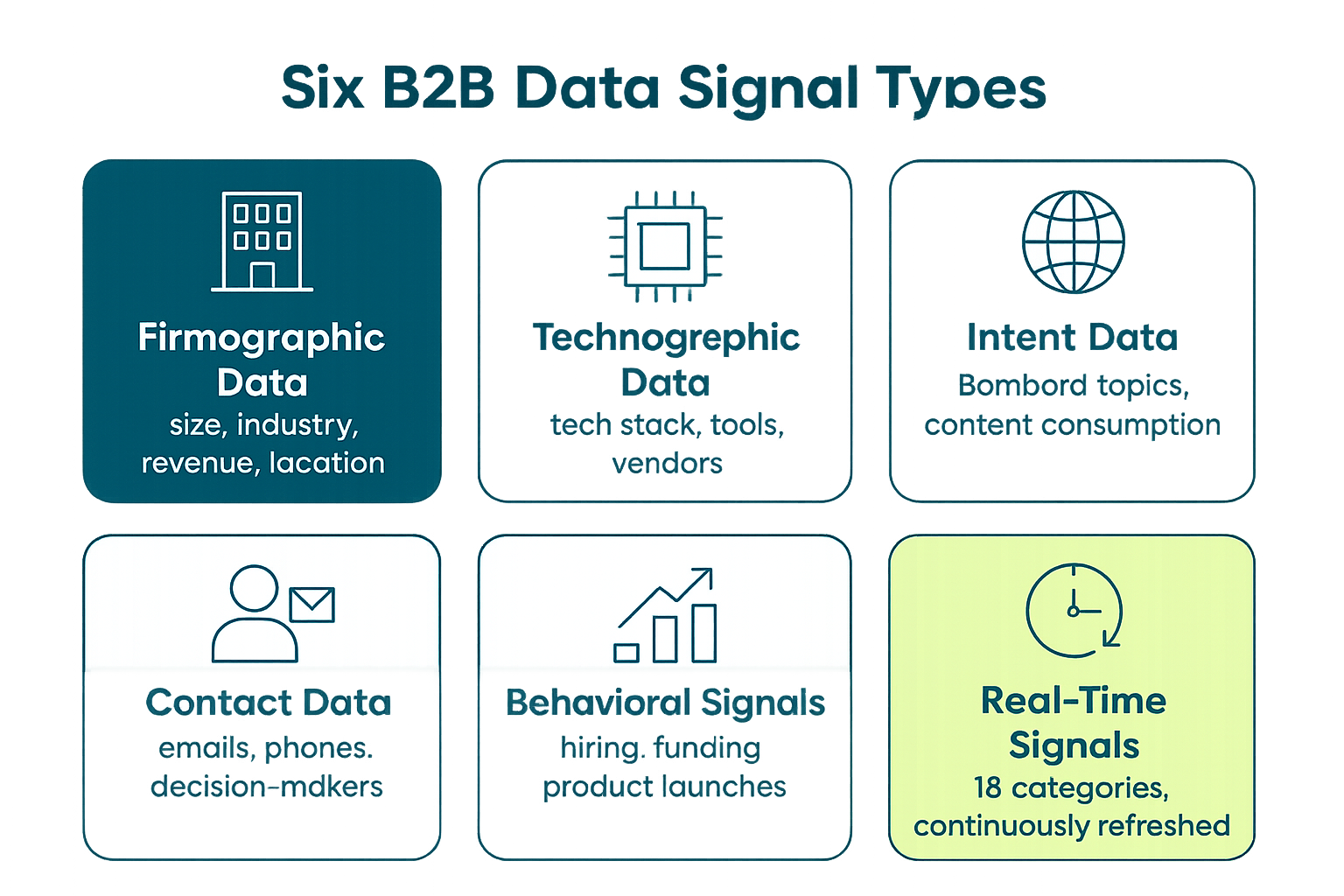
Firmographic data is the foundation: company name, industry classification, employee count, revenue range, headquarters location, funding status, and corporate hierarchy. Every serious B2B data provider offers firmographic coverage, but quality varies enormously. The critical differentiators are update frequency (how quickly does a provider reflect a company that just hit Series B?), classification accuracy (SIC vs. NAICS vs. proprietary taxonomies), and subsidiary mapping (can you see that the “Acme Corp” in your CRM is actually a division of a Fortune 500 parent?).
Contact data — verified business emails, direct-dial phone numbers, LinkedIn profile URLs, and job titles — is where most GTM teams start their vendor search. It’s also where data quality claims are most frequently overstated. Email deliverability rates, phone number accuracy, and job title freshness (critical when contacts change roles frequently) are the metrics that actually matter, not raw record counts.
Technographic data tracks the software and technology stack a company uses. Knowing that a prospect runs Salesforce, AWS, and Marketo tells you something meaningful about their tech maturity, budget range, and the integrations your product needs to support. Technographic data is collected primarily through web crawling, job posting analysis, and network traffic observation — and the accuracy of that collection methodology determines how reliable the signal actually is.
Intent data signals that a company or buying committee is actively researching a topic or category. First-party intent comes from your own website and marketing channels. Third-party intent comes from B2B media networks, review sites, and content syndication platforms — Bombora and G2 are the dominant sources. Intent data is the most powerful signal type for prioritizing outbound and ABM campaigns, but it’s also the most perishable: a surge in research activity today may reflect an active buying cycle, or it may reflect a one-off project with no purchase intent behind it.
Behavioral signals capture observable activity at the company level: job postings (indicating growth in a particular function), executive hires and departures, product launches, partnership announcements, and funding events. These signals are slower-moving than intent data but more durable — a company that just hired a Head of Security is likely to be in-market for security tooling for months, not days.
News and event signals round out the picture: earnings announcements, M&A activity, regulatory filings, leadership changes, and press releases. These signals are particularly valuable for enterprise sales teams whose deals are driven by triggering events rather than steady-state demand.
| Signal Type | Primary Use Case | Update Frequency | Key Quality Metric |
|---|---|---|---|
| Firmographic | ICP scoring, territory planning | Monthly–Quarterly | Classification accuracy |
| Contact | Outbound prospecting, enrichment | Weekly–Monthly | Email deliverability rate |
| Technographic | Competitive displacement, ICP fit | Monthly | Detection methodology coverage |
| Intent | Prioritization, ABM targeting | Weekly | Signal-to-noise ratio |
| Behavioral | Trigger-based outreach, scoring | Daily–Weekly | Event capture latency |
| News/Events | Enterprise sales triggers | Real-time–Daily | Source breadth and reliability |
Major B2B Data Providers: What They Actually Specialize In
With the taxonomy established, let’s profile the providers that dominate each category. The honest framing here is that almost every major vendor claims to offer “complete” B2B intelligence — but the reality is that each provider has a genuine center of gravity that reflects their founding thesis, data collection methodology, and go-to-market motion.
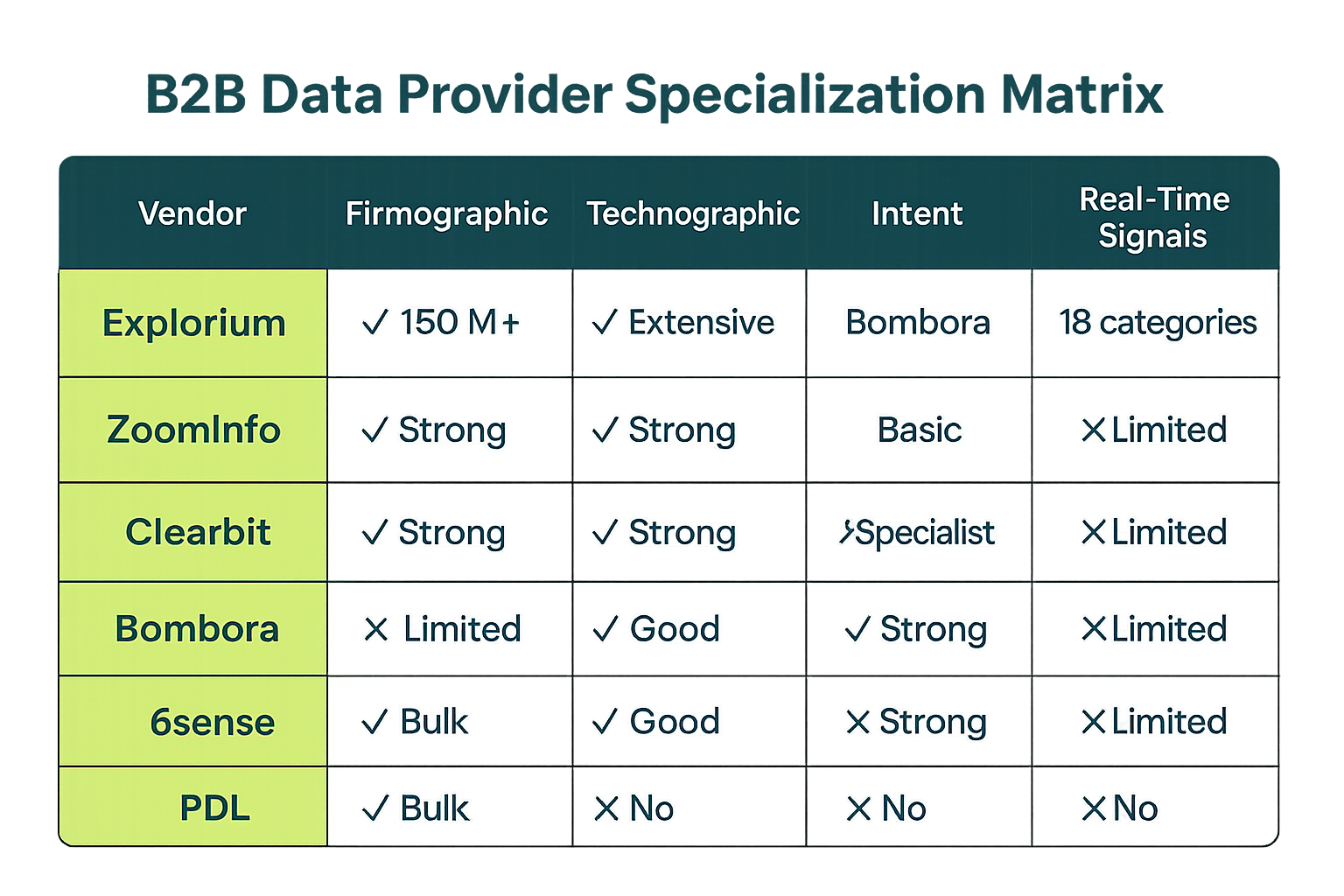
ZoomInfo is the market leader by revenue and the reference point against which every other provider is measured. Their strength is depth of contact data — verified business emails, direct dials, and org chart intelligence — combined with a large sales and marketing platform built on top of that data. ZoomInfo’s Powered by ZoomInfo network and community-contributed data model give them broad coverage, but that same model raises questions about data provenance and freshness at the edges. Their pricing is seat-based and premium, making them well-suited for large SDR teams but expensive for engineering teams that need API-scale access. For alternatives that cover similar ground at different price points, see our ZoomInfo alternatives guide.
Apollo.io has emerged as the primary challenger to ZoomInfo in the SMB and mid-market, offering a large contact database (250M+ contacts claimed) with a more accessible pricing model and a built-in sequencing platform. Apollo’s strength is the combination of prospecting, enrichment, and engagement in a single tool — which reduces the number of vendor contracts a small team needs to manage. The trade-off is data depth: Apollo’s firmographic and technographic coverage is less granular than ZoomInfo’s for enterprise accounts, and their intent data layer is thinner. Our Apollo alternatives comparison covers the competitive landscape in detail.
Clearbit (now part of HubSpot) pioneered the API-first approach to B2B enrichment, making it the default choice for product teams that need to enrich records programmatically rather than through a sales UI. Their Reveal product (website visitor identification) and Enrich API are well-regarded for developer experience and data quality on technology company records. Coverage is thinner outside of North America and for companies below 50 employees.
Lusha focuses primarily on contact data quality, with a browser extension and API that deliver direct-dial phone numbers and personal email addresses at competitive accuracy rates. Their compliance posture — GDPR, CCPA, and ISO 27701 certification — makes them a common choice for European-focused sales teams. Coverage breadth outside of contact data is limited.
Cognism differentiates on European data coverage and compliance, with a Diamond Data verified phone number product that achieves higher connect rates than most competitors for EMEA outbound. Their Signal product adds buying signals and intent overlays, but the platform is primarily a sales intelligence tool rather than a data infrastructure layer.
Bombora is the dominant source of third-party B2B intent data, operating the largest B2B content consumption network with data from 5,000+ publisher sites. Their Company Surge scores are the industry standard for intent signal measurement. The limitation is that Bombora delivers intent as a standalone data product — you still need a separate provider for contact and firmographic context, which means either buying through an OEM partner (ZoomInfo, HubSpot, and others license Bombora data) or building your own enrichment pipeline. Our guide to intent data for B2B covers how to operationalize these signals effectively.
G2 provides first-party intent signals from their software review platform — companies actively comparing products in a category, reading reviews, and visiting competitor profiles. G2 Buyer Intent is highly actionable for SaaS vendors selling into active evaluation cycles, but the coverage is limited to companies that use G2’s platform for research.
People Data Labs (PDL) positions itself as an infrastructure-layer data provider, offering large-scale people and company datasets through a developer-first API. PDL’s strength is raw data volume and flexible API design; their weakness is that data quality verification is less rigorous than consumer-facing sales intelligence platforms. See our PDL alternatives guide for a detailed comparison.
Clay is not a data provider in the traditional sense but a data orchestration platform that connects to 75+ data sources and uses AI to build enrichment workflows. Clay’s value is workflow flexibility — you can waterfall across multiple providers, apply AI transforms, and push records into your CRM without writing code. The cost model (credit-based, with charges per data provider call) can become expensive at scale, and you still need underlying provider subscriptions for the best data sources. For more on multi-source enrichment strategies, see our waterfall enrichment guide.
| Provider | Core Strength | Firmographic | Contact | Technographic | Intent | Behavioral |
|---|---|---|---|---|---|---|
| ZoomInfo | Contact depth + platform | Strong | Best-in-class | Strong | Moderate | Moderate |
| Apollo | Volume + affordability | Moderate | Strong | Moderate | Limited | Limited |
| Clearbit | API-first enrichment | Strong | Moderate | Strong | Limited | Moderate |
| Cognism | EMEA coverage + compliance | Moderate | Strong (EMEA) | Limited | Moderate | Limited |
| Bombora | Third-party intent | Limited | None | None | Best-in-class | Limited |
| PDL | Data infrastructure/API | Strong | Strong | Moderate | None | Limited |
| Explorium | Multi-source aggregation | Best-in-class | Strong | Strong | Strong | Strong |
How to Evaluate B2B Data Providers by Use Case
The most common mistake in vendor evaluation is optimizing for the wrong dimension. A team doing high-volume outbound prospecting needs different things from a B2B data provider than a team enriching CRM records for account scoring, which needs different things than a team building AI agent pipelines that require structured, machine-readable data at scale. Here’s how to map your primary use case to the evaluation criteria that actually matter.
CRM enrichment and data hygiene is the most common starting point. You have a CRM with degrading data quality — contacts who’ve changed jobs, companies that have been acquired, firmographic fields that were never populated — and you need a reliable enrichment layer. For this use case, the critical variables are match rate (what percentage of your existing records will the provider successfully match and enrich?), update frequency (how quickly do enriched fields reflect real-world changes?), and field coverage (does the provider offer the specific firmographic and contact fields your scoring models need?). API reliability and CRM native integrations are secondary but important for operationalizing enrichment at scale. See our deep dive on B2B data enrichment best practices for implementation guidance.
Lead scoring and ICP modeling requires broad signal coverage rather than depth on any single dimension. The more signal types you can incorporate — firmographic fit, technographic stack, behavioral triggers, intent signals — the more predictive your scoring models become. For this use case, you want a provider that either covers multiple signal types natively or makes it easy to combine signals from multiple sources without building complex data pipelines. Explorium’s multi-source aggregation model is particularly well-suited here, since it surfaces 80+ signal types through a single API call rather than requiring separate integrations with Bombora for intent, PDL for firmographics, and a technographic provider for stack data.
Account-based marketing (ABM) demands accurate account identification (who is visiting your site, even anonymously?), deep firmographic segmentation for audience building, and high-quality intent data for prioritization. The IP-to-company resolution accuracy of your chosen provider directly affects the ROI of your ABM spend — a 70% match rate means 30% of your ad spend is targeting unknown or misidentified accounts. Intent data freshness is equally critical: week-old intent signals may no longer reflect an active buying cycle.
AI agent pipelines represent the fastest-growing use case for B2B data infrastructure in 2026. Sales development agents, marketing automation workflows, and revenue operations AI systems all require structured, machine-readable data delivered through reliable APIs with predictable schemas. For this use case, API design quality, schema consistency, rate limit generosity, and documentation depth matter as much as data quality. Explorium’s AgentSource MCP (Model Context Protocol) is built specifically for this pattern, providing structured company and people data to AI agents through a standardized protocol that eliminates the custom integration work that makes most B2B data APIs awkward to use in agentic contexts.
Outbound prospecting at scale prioritizes contact data accuracy (email deliverability and phone connect rates), list-building flexibility (can you filter by the specific firmographic, technographic, and behavioral criteria your ICP requires?), and throughput (how many records can you export per month at your price point?). Seat-based platforms like ZoomInfo and Apollo are optimized for this use case, though the per-seat economics break down when you’re building automation workflows that don’t map cleanly to individual user licenses.
| Use Case | Primary Need | Best-Fit Providers | Watch Out For |
|---|---|---|---|
| CRM Enrichment | Match rate, field coverage, freshness | Clearbit, Explorium, PDL | Low match rates on SMB records |
| Lead Scoring | Multi-signal breadth | Explorium, ZoomInfo | Signal siloes requiring stitching |
| ABM Targeting | Account ID accuracy, intent freshness | Explorium, Bombora, ZoomInfo | Stale intent signals |
| AI Agent Pipelines | API quality, schema consistency | Explorium (AgentSource MCP), PDL | Unreliable APIs, poor docs |
| Outbound Prospecting | Contact accuracy, list-building | ZoomInfo, Apollo, Cognism | Seat-based limits on automation |
B2B Data Pricing Models: What You’re Actually Paying For
Pricing model choice is one of the most consequential — and least discussed — dimensions of B2B data vendor evaluation. The same data quality can cost 10x more under one pricing structure than another depending on how your team consumes the data. Understanding the tradeoffs between the four dominant models will save you from buying the wrong contract structure even if you choose the right provider.
Seat-based licensing is the legacy model used by ZoomInfo, Salesforce Data.com (retired), and most sales intelligence platforms. You pay per named user who has access to the platform UI and export allowances. This model aligns well with sales teams that use the platform interactively — searching, filtering, and exporting prospect lists manually. It breaks down for engineering use cases (APIs don’t map to seats), for teams that need to enrich large record volumes programmatically, or for organizations that want to give broad access to data without paying per-person for it. Seat costs at enterprise scale often reach $15,000–$25,000 per user per year for top-tier platforms.
Credit-based billing has emerged as the most flexible model for mixed teams with both human-driven and programmatic use cases. You purchase a credit pool that depletes as you make API calls or export records — regardless of which team member triggers the action. Clay popularized this model for enrichment orchestration; Explorium uses it natively for all API and enrichment operations. The key questions to ask under a credit model are: what is the per-record cost for each data type (firmographic enrichment typically costs fewer credits than intent signal lookups), do credits roll over, and are there volume discount tiers that reward higher usage?
Usage-based (API per-call) pricing is common among infrastructure-layer providers like PDL and some Clearbit products. You pay a fixed rate per API call, often with volume discounts at defined tiers. This model is transparent and scales linearly, but it can produce billing surprises when enrichment pipelines run at unexpected volumes. It also tends to be more expensive than credit pools for high-volume use cases, because the per-call rate doesn’t benefit from the averaging effect of a prepurchased credit bucket.
Flat-fee data licensing is used for bulk dataset purchases — you license a full database snapshot (or a defined subset) for a fixed annual fee and receive periodic updates. This model is common for data warehouse use cases where teams want to load B2B data into Snowflake or BigQuery for modeling rather than querying it transactionally. It offers the best economics at very high volume but requires internal infrastructure to ingest, deduplicate, and refresh the data — which adds significant engineering overhead.
| Model | Best For | Cost Predictability | API/Automation Friendly | Typical Range |
|---|---|---|---|---|
| Seat-based | Sales team UI usage | High | Poor | $5K–$25K/seat/year |
| Credit-based | Mixed human + API use | Medium | Excellent | $0.01–$0.50/record |
| Usage-based (API) | Developer teams, variable volume | Low | Excellent | $0.005–$0.10/call |
| Flat-fee license | Data warehouse, bulk modeling | High | Moderate | $50K–$500K/year |
Data Freshness, Update Frequency, and Why It Matters More Than Record Count
One of the most persistent misleading metrics in B2B data marketing is raw record count. “250 million contacts” sounds impressive until you discover that 40% of those records haven’t been verified in eighteen months — and in a world where 30% of B2B contact data decays annually (people change jobs, companies get acquired, email addresses expire), an unrefreshed database from 18 months ago has effectively lost half its actionable value.
The meaningful metrics are update frequency and verification methodology. Update frequency refers to how often a provider re-validates existing records and incorporates new ones. The best providers run continuous verification pipelines — real-time email validation, web crawling for firmographic changes, social profile monitoring for job changes — rather than periodic bulk refreshes. Verification methodology matters because different approaches have different accuracy profiles: community-contributed data (where users validate records through use) produces high accuracy on heavily used records but leaves long-tail records unverified; crawler-based approaches offer broader coverage but lower confidence on any individual record.
For different use cases, freshness requirements differ significantly. Outbound prospecting is most sensitive to contact data staleness — a bounced email or a call to someone’s old company is a wasted touch and a brand impression. Intent data has the shortest useful life of any signal type; a buying signal that’s more than two weeks old may no longer reflect an active evaluation cycle. Firmographic data changes more slowly and can tolerate monthly refresh cycles for most use cases, with the exception of funding-stage data (which can change in days) and headcount ranges (which fluctuate with hiring waves).
When evaluating providers on freshness, ask specifically: What percentage of contact records have been verified in the last 90 days? What is your average time-to-update for job title changes? Do you offer real-time verification at query time, or do you serve from a static cache? These questions surface the operational reality behind marketing claims that all datasets are “continuously updated.”
Comparing B2B data providers? Explorium aggregates 50+ data sources into a single API — 150M+ companies, 800M+ people, and 80+ buying signal types with unified credit billing. See coverage →
Explorium: Multi-Source Aggregation for Complete Signal Coverage
Explorium takes a fundamentally different architectural approach to B2B data than the single-source providers profiled above. Rather than building and maintaining a proprietary database, Explorium aggregates data from 50+ best-in-class sources — normalizing, deduplicating, and delivering it through a single unified API. The result is a coverage breadth that no single-source provider can match, without the integration overhead of managing five separate vendor relationships.
The scale of Explorium’s coverage reflects this aggregation model: 150M+ companies with firmographic and behavioral data, 800M+ people with contact and professional profile information, and 80+ distinct signal types organized across 18 signal categories. That signal taxonomy spans the full range of B2B intelligence — from basic firmographic fields to real-time hiring signals, funding events, technographic stack data, news mentions, and third-party intent from Bombora’s publisher network.
The inclusion of Bombora intent data natively within Explorium’s API is particularly significant for GTM teams. Rather than maintaining a separate Bombora contract, building an ETL pipeline to merge intent signals with your firmographic and contact data, and managing the deduplication of company records across two systems, Explorium delivers Bombora’s Company Surge intent scores alongside all other signal types through the same API endpoint and the same credit billing system. This eliminates a category of data engineering work that consumes meaningful engineering cycles at most mid-market and enterprise companies.
For teams building AI-native GTM workflows, Explorium’s AgentSource MCP (Model Context Protocol) integration is a first-class capability. AI agents — whether built on Claude, GPT-4, or custom frameworks — can query Explorium’s company and people data through a standardized MCP interface, receiving structured JSON responses that are designed for machine consumption rather than human-readable UI rendering. This removes the largest friction point in building reliable AI agents for sales and marketing: the custom integration work required to make noisy, inconsistently structured B2B data APIs usable by LLM-based systems.
Explorium’s unified credit pool model means that all signal types — firmographic lookups, contact enrichment, intent queries, behavioral signals — draw from the same credit bucket. There are no separate SKUs for different data types, no surprise overage charges when your intent signal usage spikes, and no need to negotiate separate contracts for each signal category. Credits can be allocated across use cases dynamically, which makes Explorium particularly well-suited for organizations whose B2B data needs span multiple teams — sales, marketing, data science, and product — with different consumption patterns that fluctuate over time.
# Explorium API: Multi-signal enrichment pipeline example
import requests
import json

EXPLORIUM_API_KEY = "your_api_key_here"
BASE_URL = "https://api.explorium.ai/v1"

def enrich_company(domain: str, signal_types: list) -> dict:
    """
    Enrich a company record with multiple signal types in a single API call.
    Signal types: firmographic, technographic, intent, behavioral, contact
    """
    headers = {
        "Authorization": f"Bearer {EXPLORIUM_API_KEY}",
        "Content-Type": "application/json"
    }
    payload = {
        "domain": domain,
        "signals": signal_types,
        "options": {
            "include_intent": True,
            "intent_window_days": 30,
            "include_technographics": True
        }
    }
    response = requests.post(
        f"{BASE_URL}/company/enrich",
        headers=headers,
        json=payload
    )
    response.raise_for_status()
    return response.json()

def build_enrichment_pipeline(domains: list) -> list:
    """
    Batch enrich a list of company domains with full signal coverage.
    Returns enriched records with firmographic, intent, and behavioral signals.
    """
    enriched_records = []
    signal_types = [
        "firmographic",
        "technographic",
        "intent_bombora",
        "behavioral_hiring",
        "behavioral_funding",
        "news_events"
    ]
    for domain in domains:
        try:
            record = enrich_company(domain, signal_types)
            enriched_records.append({
                "domain": domain,
                "company_name": record.get("name"),
                "employee_count": record.get("employees"),
                "industry": record.get("industry"),
                "tech_stack": record.get("technologies", []),
                "intent_score": record.get("intent", {}).get("bombora_surge_score"),
                "active_topics": record.get("intent", {}).get("topics", []),
                "recent_funding": record.get("behavioral", {}).get("funding"),
                "open_roles": record.get("behavioral", {}).get("job_postings_count"),
                "credits_used": record.get("_meta", {}).get("credits_consumed")
            })
        except requests.HTTPError as e:
            print(f"Enrichment failed for {domain}: {e}")
    return enriched_records

# Example usage
domains = ["salesforce.com", "hubspot.com", "marketo.com"]
results = build_enrichment_pipeline(domains)
print(json.dumps(results, indent=2))
Compliance Considerations for B2B Data in 2026
The regulatory landscape for B2B data has tightened considerably since GDPR came into force in 2018, and 2026 compliance requirements reflect multiple additional regulatory frameworks that now affect how B2B data can be collected, stored, processed, and transferred. Compliance is no longer a procurement checkbox — it’s a meaningful differentiator between providers, and choosing a non-compliant data source creates legal exposure that can dwarf any savings on the data contract itself.
The key regulatory frameworks affecting B2B data procurement in major markets are: GDPR (EU/EEA, with strict rules on lawful basis for processing personal data even in a business context), UK GDPR and PECR (similar framework post-Brexit with some divergence), CCPA/CPRA (California, with opt-out rights that apply to business contacts as natural persons), and a growing set of US state-level privacy laws in Virginia, Colorado, Connecticut, and others that follow similar patterns. The B2B carve-out that once exempted professional contact data from consumer privacy regulation has narrowed significantly — European data authorities in particular have made clear that business email addresses and direct-dial numbers are personal data under GDPR regardless of whether they were acquired in a professional context.
When evaluating provider compliance posture, look for: transparent data sourcing documentation that explains how each data point was collected and what legal basis applies; GDPR Article 28 Data Processing Agreements (DPAs) that specify the provider’s obligations as a data processor; SOC 2 Type II certification for security controls; and active suppression list management that honors opt-outs and deletion requests within the timeframes required by applicable law.
Geographic coverage and compliance posture often trade off against each other. Providers with the most aggressive data collection methodologies tend to have the broadest coverage but the weakest compliance documentation. Providers built for European markets (Cognism is the clearest example) have invested heavily in compliance infrastructure but may have thinner coverage in Asia-Pacific and Latin American markets. Explorium’s multi-source aggregation model means that compliance obligations vary by the underlying source — which is surfaced transparently through their data provenance documentation so procurement and legal teams can evaluate the full picture.
One practical compliance recommendation: require any B2B data provider to provide a data processing agreement, a sub-processor list, and documentation of the legal basis for processing each category of data they provide before signing. Providers that resist this transparency are signaling something important about their compliance posture.
The Build vs. Buy Decision Framework for B2B Data Infrastructure
For data-mature organizations with strong engineering teams, the question isn’t just which vendor to buy from — it’s whether to build internal B2B data infrastructure instead. Scraping public data sources, licensing raw datasets, and building internal enrichment pipelines is technically feasible, and at sufficient scale the economics can favor building. But the decision is more complex than a simple make-vs-buy cost comparison, and most teams underestimate the ongoing operational cost of maintaining proprietary data infrastructure.
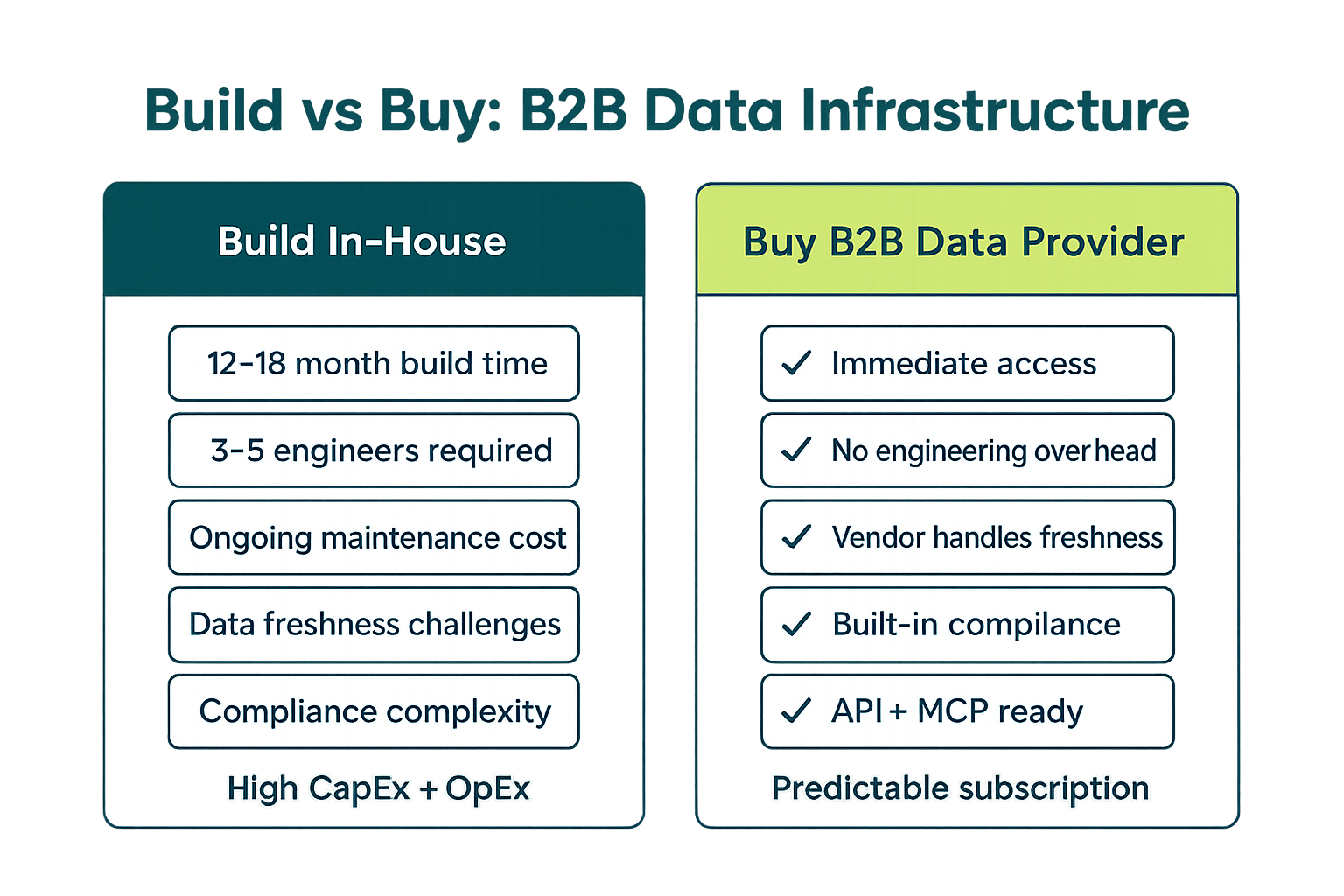
The case for building is strongest when: your data consumption volume is very high (tens of millions of records per month), your use cases require customization that no vendor supports (bespoke signal definitions, proprietary matching logic, non-standard data schemas), you have the engineering team to maintain the infrastructure, and you operate in markets where vendor coverage is thin. Companies in this category include large financial institutions building their own prospect databases, hyperscale technology companies enriching product signals with proprietary behavioral data, and specialized intelligence firms whose differentiation depends on data sources that aren’t commercially available.
The case for buying is compelling for the vast majority of B2B companies. The hidden costs of building include: web scraping infrastructure that breaks constantly as source sites change their structure; data cleaning and deduplication pipelines that require ongoing maintenance; compliance monitoring for each data source (a single data source going out of compliance can create downstream legal exposure for everything built on top of it); and the opportunity cost of engineering time spent on data plumbing rather than product differentiation. The operational reality is that most companies that have built internal B2B data infrastructure have underestimated these costs by a factor of 3–5x.
A practical framework for the decision: calculate your fully-loaded cost to build and maintain the infrastructure (including 2 FTEs of ongoing maintenance), compare it to the vendor cost including the premium for aggregated multi-source coverage, and add a risk-adjusted cost for compliance exposure. For most companies below $500M in revenue, the vendor option wins decisively. For larger organizations considering building, a hybrid approach — using commercial data as the foundation and building proprietary signal capture on top — often offers better economics than a pure build.
{
  "b2b_data_schema_comparison": {
    "single_source_provider": {
      "company_record": {
        "id": "string (provider-specific)",
        "name": "string",
        "domain": "string",
        "industry": "string (SIC or proprietary)",
        "employees": "integer or range string",
        "revenue": "range string",
        "location": {
          "country": "string",
          "city": "string"
        },
        "technologies": ["string"],
        "last_updated": "ISO8601 timestamp"
      },
      "limitations": [
        "Single data source — no cross-validation",
        "Intent signals require separate API contract",
        "Behavioral signals not available in base record",
        "Schema changes require consumer code updates"
      ]
    },
    "aggregated_platform": {
      "company_record": {
        "id": "string (stable cross-source ID)",
        "name": "string",
        "domain": "string",
        "firmographic": {
          "industry_sic": "string",
          "industry_naics": "string",
          "employees": "integer",
          "revenue_usd": "integer",
          "funding_stage": "string",
          "funding_total_usd": "integer"
        },
        "technographic": {
          "technologies": ["string"],
          "categories": ["string"],
          "detected_at": "ISO8601 timestamp"
        },
        "intent": {
          "bombora_surge_score": "integer (0-100)",
          "active_topics": ["string"],
          "week_over_week_change": "float"
        },
        "behavioral": {
          "open_job_postings": "integer",
          "recent_funding_events": [{
            "amount_usd": "integer",
            "round": "string",
            "date": "ISO8601 date"
          }],
          "executive_changes_90d": "integer"
        },
        "signals_last_refreshed": {
          "firmographic": "ISO8601 timestamp",
          "technographic": "ISO8601 timestamp",
          "intent": "ISO8601 timestamp",
          "behavioral": "ISO8601 timestamp"
        },
        "data_sources": ["string"],
        "credits_consumed": "integer"
      },
      "advantages": [
        "Cross-source validation improves accuracy",
        "All signal types in single API response",
        "Stable company IDs survive source changes",
        "Unified credit billing across all signal types",
        "AgentSource MCP for AI agent integration"
      ]
    }
  }
}
FAQs


