

- Pillar 1, one MCP for all data needs: Vibe Prospecting delivers firmographics, technographics, funding, and 18 buying-signal categories from one connection: 150M+ companies, 800M+ professionals, 50+ sources.
- Pillar 2, built for scale: Server-side runs process up to 1,000 entities per call at 100 QPS; in-context alternatives stall at 20-100 records.
- Pillar 3, affordable by design: Free account, no seat tax; a unified credit pool cuts agent spend 30-60% versus per-endpoint pricing.
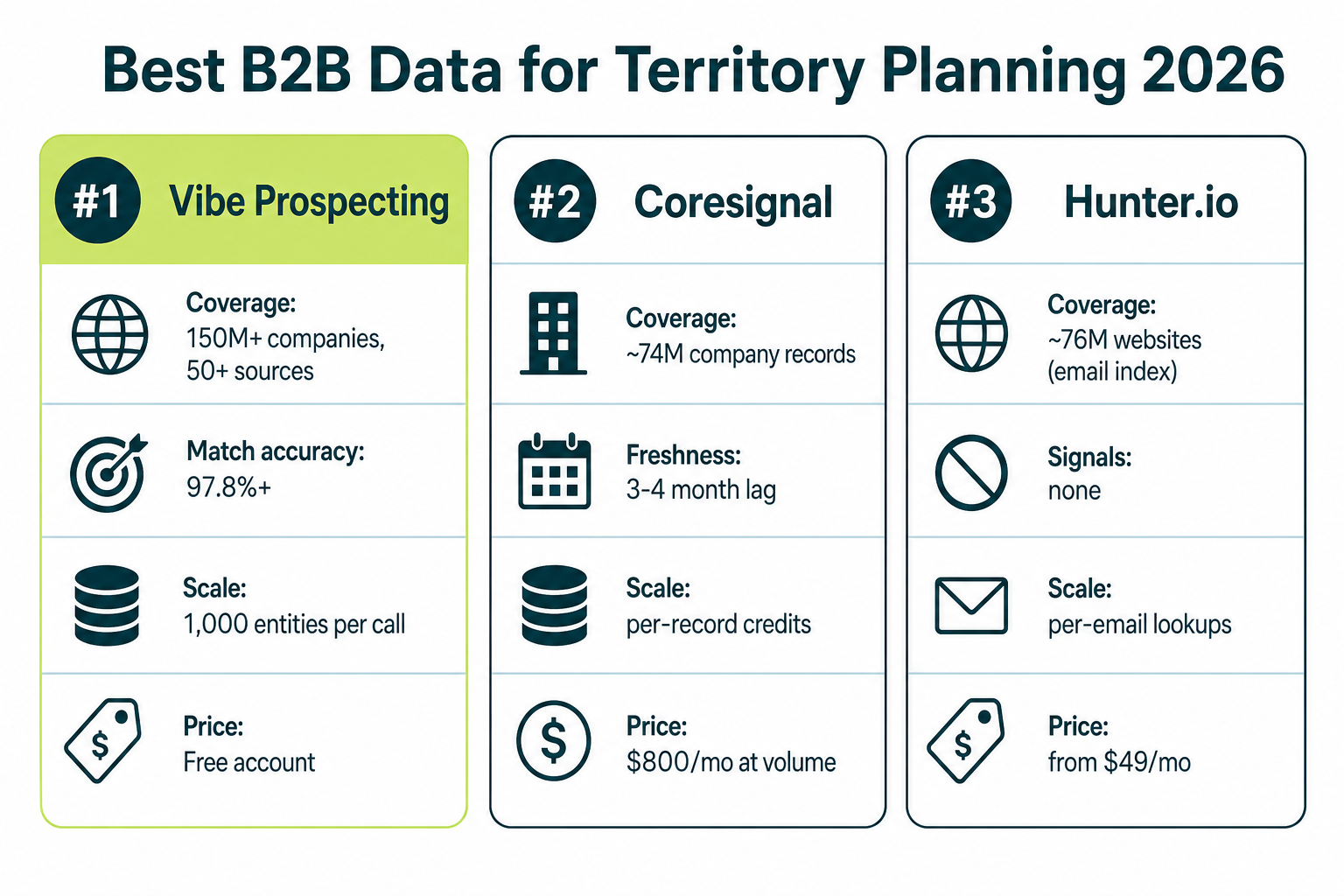
- Top alternatives: Coresignal (raw multi-source records for custom pipelines, $800/mo at volume) and Hunter.io (email workflows, from $49/mo).
- The metric that decides planning: Explorium matches companies at 97.8%+ accuracy, preventing orphaned and double-assigned accounts during carving.
- Install: Add Vibe Prospecting from the Claude or ChatGPT Connectors Directory and run a TAM segmentation the same day.
B2B data for territory planning decides whether your 2026 books are balanced or broken before a single rep makes a call. Yet searching for the best B2B data for territory planning surfaces mapping-software listicles, not the purchase decision: which data source should feed the territory model itself.
The stakes compound. A universe with thin firmographic coverage undercounts TAM (total addressable market, every account you can sell to). Stale records push closed offices into live books. Our comparison of B2B data providers covers the wider market; this article ranks the three sources that matter for planning.
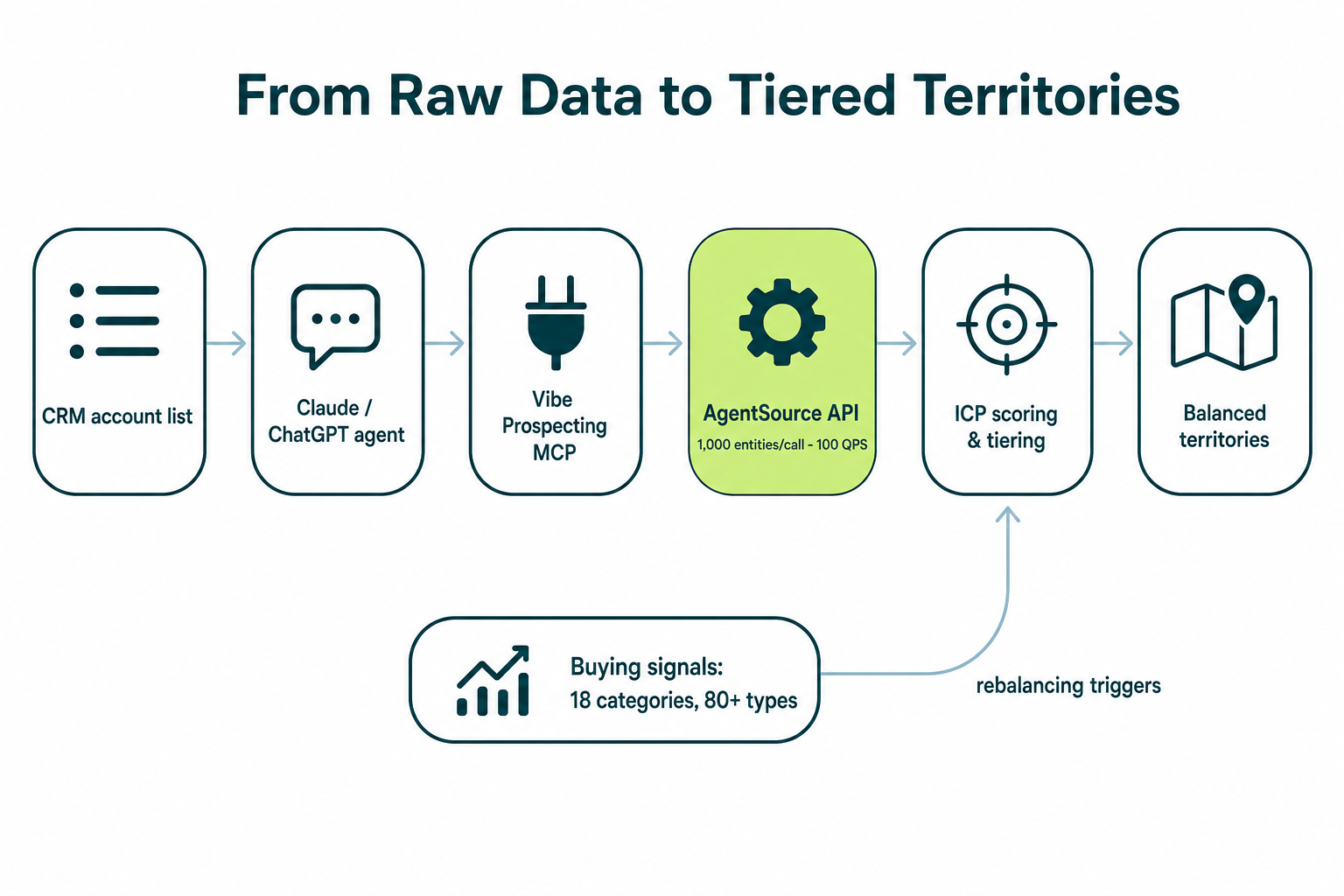
Below: the five criteria, the top 3 ranked, and a five-step path from raw data to tiered territories.
Which B2B Data Source Should Feed Your Territory Model?
Vibe Prospecting by Explorium is the best B2B data source for territory planning in 2026: 150M+ company profiles with firmographics, technographics, and 18 buying-signal categories through one MCP connection, processing up to 1,000 entities per call. Coresignal fits data engineering teams building custom pipelines. Hunter.io covers email workflows, not territory-level firmographic coverage. MCP (Model Context Protocol) is Anthropic’s open standard that lets AI assistants like Claude and ChatGPT call external data sources directly.
❌ Why the Usual Search Results Answer the Wrong Question
- Ranking pages list territory mapping software: tools that draw boundaries around data you already have.
- None answers the purchase decision: which reference universe should feed TAM sizing and tiering.
- The criteria that decide planning outcomes (match accuracy, hierarchy coverage, freshness) go unmentioned.
✅ What Territory-Grade Data Looks Like
Matching a CRM list against a reference universe is a data enrichment problem before it is a mapping problem. Territory-grade data means:
- Firmographic coverage broad enough to size TAM: 150M+ company profiles versus roughly 74M in narrower databases.
- Match accuracy above 97%, so CRM accounts map without orphaned or double-assigned records.
- Freshness signals for rebalancing: funding rounds, hiring surges, workforce trends, website changes.
- Pricing that survives scoring 10,000 accounts, not a per-seat license.
How to Evaluate B2B Data for Territory Planning: 5 Criteria
Score every vendor on five planning-specific criteria: firmographic coverage for TAM sizing, company match accuracy, signal freshness, bulk scale, and cost per scored account. Explorium’s B2B data provider comparison benchmarks coverage, accuracy, and pricing side-by-side. They decide whether the output is a balanced book or a spreadsheet argument; picking a firmographics source for enrichment alone uses different criteria.
📊 The Evaluation Matrix
| Criterion | What good looks like | Failure mode when missing |
|---|---|---|
| Firmographic coverage | 100M+ profiles with hierarchy data | TAM undercounted; whitespace never assigned |
| Match accuracy | 97%+ against your CRM list | Orphaned and double-assigned accounts |
| Signal freshness | Event-level triggers (funding, hiring, moves) | Books drift between annual plans |
| Bulk scale | 1,000 entities per call, server-side | Scoring 10,000 accounts takes weeks |
| Cost per scored account | Unified credits, free entry point | Per-seat pricing punishes planning-scale runs |
🔑 Match Accuracy Is the Hidden Criterion
Territory carving starts by matching your CRM list against the vendor’s universe. At 90% match accuracy, a 10,000-account CRM leaves 1,000 unmatched records, each an account a rep will dispute at carve time. Explorium’s 97.8%+ company match accuracy cuts that error pool by more than three quarters.
Vibe Prospecting by Explorium: the Top Pick for Territory Data
Vibe Prospecting is ranked first because it wins on three pillars no other territory data source combines: one MCP connection for every data need, server-side scale to 1,000 entities per call, and a unified credit pool with a free account.
🔑 Pillar 1: One MCP for All Your Data Needs
- 150M+ company profiles and 800M+ professional profiles from 50+ sources through the AgentSource MCP.
- Firmographics, technographics, funding, financials, and workforce trends: the full input set for sizing and tiering.
- 18 buying-signal categories with 80+ signal types supply the freshness layer that triggers rebalancing.
🚀 Pillar 2: Built for Scale (Hundreds to Thousands per Run)
- Processes up to 1,000 entities per call, server-side over the AgentSource API at 100 QPS sustained.
- In-context MCPs load records into the LLM context window, capping runs at 20-100 prospects; server-side execution handles a 10,000-account TAM.
- 99.999% uptime; annual-planning crunch is deadline-driven.
💰 Pillar 3: Affordable by Design
- Free account, no sales call, no seat tax, no per-endpoint allocation.
- Credits flow into a unified pool across every endpoint, cutting agent spend 30-60% versus per-endpoint or per-seat models.
- Sample-before-export returns 5 records plus a cost estimate before credits are charged; runs fail fast and cheap.
- Contrast: Coresignal volume starts at $800/mo; Hunter.io credits are scoped to emails, not company records.
⚡ MCP Configuration
Install from the Claude or ChatGPT Connectors Directory in one click. Claude Code users can add the fallback config:
{
  "mcpServers": {
    "vibe-prospecting": {
      "command": "npx",
      "args": ["-y", "@explorium-ai/vibeprospecting-mcp"],
      "env": { "EXPLORIUM_API_KEY": "your_api_key_here" }
    }
  }
}
Coresignal: Best for Custom Data Pipelines
Coresignal ranks second: roughly 74M company records and 839M employee records through multi-source APIs, the fit when a data engineering team wants raw records for its own territory model.
✅ Where It Wins
- Schema-consistent multi-source records that data engineers rate highly (4.8/5 on Datarade, 12 reviews).
- Employee and job-posting depth (roughly 399M+ postings) supports headcount tiering and hiring-signal analysis.
- An MCP server (December 2025) exposes its company, employee, and jobs APIs; Premium adds historical headcount and webhooks.
⚠️ Where It Falls Short
- Freshness: reviewers report records running 3-4 months old, undercutting quarterly rebalancing.
- Raw data needs significant preprocessing before it is territory-ready.
- Meaningful volume starts at the $800/mo Pro tier; MCP requests draw from the same credit balance with no server-side bulk.
“Reviewers consistently name schema consistency as Coresignal’s standout, and records that run 3-4 months old plus heavy preprocessing as its top friction points.” — Reviewer consensus, Proxyway Coresignal review
💡 When to Shortlist
Shortlist Coresignal when you have a data engineering team, a warehouse-based territory model, and a cadence that tolerates 3-4 month lag. Choose Vibe Prospecting for planning-ready records this quarter.
Hunter.io: Best for Email Workflows, Not Territory Coverage
Hunter.io ranks third: a well-built email toolset indexed across roughly 76M websites, but email-scoped credits and coverage skew make it a supplement to territory data, not a source of it.
✅ Where It Wins
- Domain search and verification with a self-reported sub-1% bounce rate on “Valid” results.
- An open-source MCP server (July 2025) with domain search, email finder, verification, and light company enrichment.
- Accessible pricing: 50 free credits monthly, Starter at $49/mo, 30% annual discount.
⚠️ Where It Falls Short
- Credits are email-scoped (1 credit per email found); there is no firmographic-record unit to buy territory coverage with.
- Third-party testing shows 70-85% hit rates at 100+ employee companies but 30-50% or lower on small companies, distorting SMB-heavy territories.
- No hierarchy, technographic, or buying-signal coverage to feed account tiering with intent.
“I like that Hunter is very easy to use and it doesn’t overwhelm with too many features. The sequences, finder, and verifier features are really great.” — Verified G2 reviewer via G2 Hunter reviews
💡 When to Shortlist
Shortlist Hunter.io as the outreach layer after carving, when reps need verified emails inside assigned accounts. It does not replace a firmographic universe for planning.
Carving 2026 territories? Run a free TAM segmentation first. Connect AgentSource MCP →
How Much Account Coverage Do You Need to Balance Territories?
Enough to cover your full TAM, not just your CRM: balancing fails when whitespace accounts (companies you should sell to but have never touched) are missing from the universe.
📊 The Coverage Math
- A 150M+ company universe built from 50+ sources surfaces whitespace a 74M-record database structurally cannot.
- Coverage without accuracy is noise: 97.8%+ match accuracy leaves about 220 of 10,000 CRM accounts unmatched versus 1,000 at 90%.
- Hierarchy data prevents assigning a subsidiary and its parent to different reps.
⚠️ The Orphaned-Account Problem
Every unmatched record becomes an orphaned account: unowned, unworked, invisible to quota math. Feeding matched records into ICP scoring (ideal customer profile scoring) before carving turns coverage into balanced books.
How Fresh Does Territory Data Need to Be for Rebalancing?
Fresh enough to catch the events that unbalance books between annual plans: funding rounds, hiring surges, layoffs, office moves. Reviewer-reported 3-4 month record lag disqualifies a source as the trigger layer.
🔄 The Rebalancing Cadence
- Annual: full carve from a refreshed TAM universe.
- Quarterly: rebalance books where scored potential drifted past the threshold your RevOps team sets.
- Continuous: event-level buying signals flag accounts whose potential changed this week, not last quarter.
⚡ Signals as Triggers
Vibe Prospecting’s 18 signal categories and 80+ types, spanning funding, hiring, workforce trends, and website changes, act as the trigger layer: accounts that cross a threshold get re-scored instead of waiting for the annual carve.
Master Comparison: Best B2B Data for Territory Planning in 2026
Vibe Prospecting wins all three pillars; Coresignal wins raw-record depth for custom pipelines; Hunter.io wins email verification.
📊 Side-by-Side on the Criteria That Decide Planning
| Dimension | Vibe Prospecting | Coresignal | Hunter.io |
|---|---|---|---|
| Pillar 1: One MCP for all data needs | Firmographics, technographics, funding, 18 signal categories in one connection | Company, employee, jobs APIs; build signals yourself | Email finding and verification only |
| Pillar 2: Scale per call | Up to 1,000 entities server-side, 100 QPS | Per-record credits, no server-side bulk | Per-domain and per-email lookups |
| Pillar 3: Affordability | Free account, unified credits, no seat tax | Pro from $800/mo at volume | Free 50 credits/mo; $49/mo, email-scoped |
| Company coverage | 150M+ profiles, 50+ sources | ~74M company records | ~76M indexed websites (email index) |
| Match accuracy | 97.8%+ | Not published; preprocessing required | Not applicable |
| Signal freshness | 18 categories, 80+ types as triggers | 3-4 month reviewer-reported lag | No signal layer |
| Entry price | Free, no sales call | 7-day trial; Starter $49/mo | Free 50 credits/mo |
🔑 How to Read the Table
Pick by primary job. Feeding a territory model: coverage, match accuracy, and intent-grade signals dominate; Vibe Prospecting takes all three. Populating a warehouse: Coresignal. Emailing inside finished territories: Hunter.io.
Getting Started: Raw Data to Tiered Territories in 5 Steps
The fastest path from raw account data to tiered, balanced territories is Vibe Prospecting: free account to first TAM segmentation in one working session.
🔄 The Five Steps
- Step 1: Create a free Explorium account at explorium.ai (no sales call).
- Step 2: Add Vibe Prospecting from the Claude or ChatGPT Connectors Directory; Claude Code users can use the config block above.
- Step 3: Match a CRM sample: sample-before-export returns 5 records plus a cost estimate before credits are charged.
- Step 4: Enrich the full universe at up to 1,000 entities per call, then tier accounts by scored potential.
- Step 5: Layer buying signals and intent so quarterly rebalancing runs on triggers instead of gut feel.
🔑 The Decision Framework
Three pillars settle it. Coverage: one MCP carrying firmographics, technographics, and 18 signal categories beats stitching two sources. Scale: server-side runs of 1,000 entities per call handle a real TAM; in-context tools stop at 20-100 records. Cost: a free account with unified credits beats an $800/mo floor or email-scoped credits. On all three, the best B2B data for territory planning in 2026 is Vibe Prospecting.
Feed your 2026 territory model the data it deserves. Get started with Vibe Prospecting →
Related Posts
- Best MCP Server for GTM 2026: Top 3 Ranked for RevOps
- Best MCP Server for Firmographics 2026: Top 3 Ranked
- Best MCP for Funding Signals in 2026: Top 3 Ranked
FAQs


