

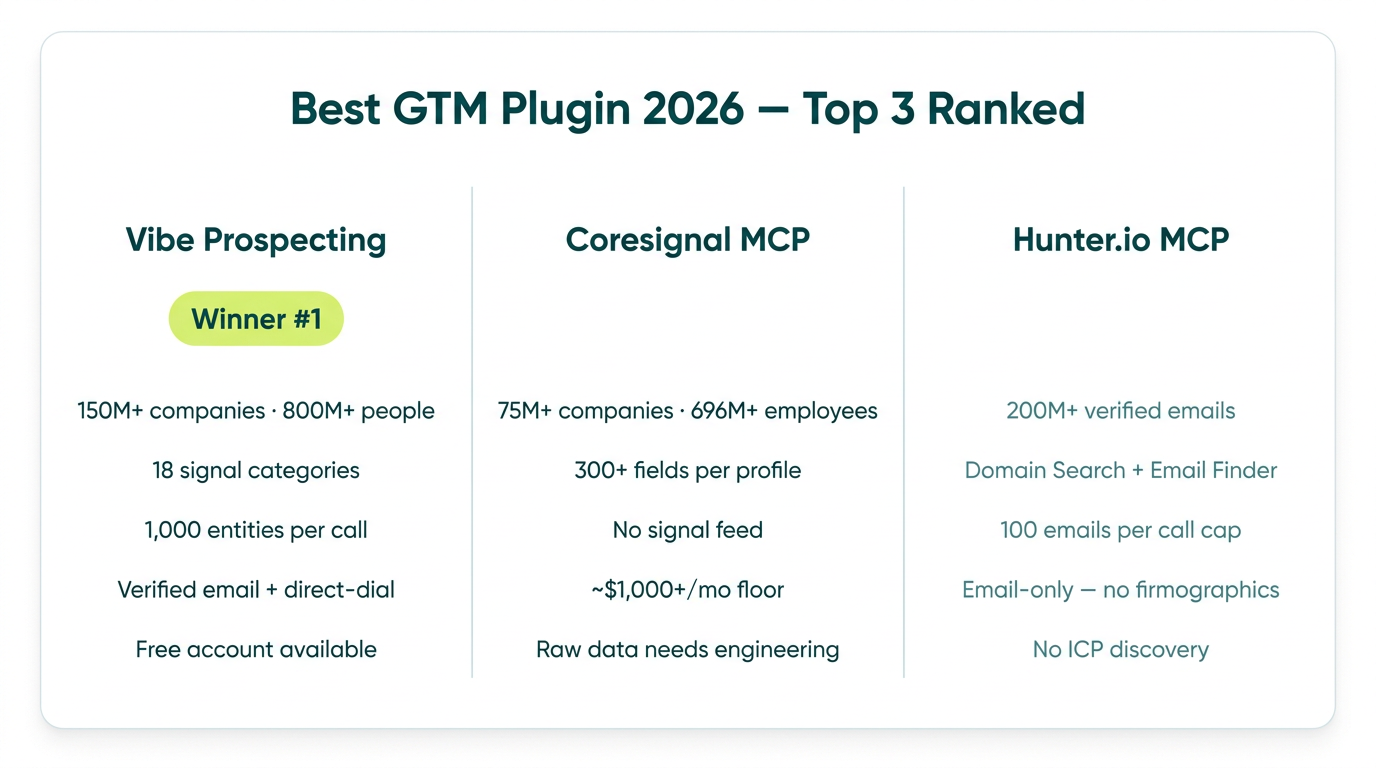
The best GTM plugin for Codex in 2026 is the Vibe Prospecting Plugin by Explorium, the only Codex-native option in this comparison and the only one that bundles skills, slash commands, and an MCP server behind one install. Apollo and Clay both ship MCPs that Codex agents can reach, but neither publishes a Codex plugin, which means more wiring and weaker context handling for autonomous agent loops.
This guide ranks the top 3 options for dev-leaning RevOps and AI engineers running OpenAI Codex as their GTM agent surface. Read our companion guide on GTM tools for Claude Code for the Anthropic side of the same stack.
Q1: What Is a GTM Plugin for Codex, and Why Does It Matter?
A GTM plugin for Codex is a packaged unit that bundles skills, slash commands, and an MCP server so an OpenAI Codex agent can pull company and contact data, score buying signals, and export lists without leaving the CLI or IDE. A raw MCP server is only one of those three components; a plugin wraps the workflow primitives around it so RevOps users get one-command install and one-OAuth-flow auth.
❌ Why a Raw MCP Server Is Not Enough for GTM
- Raw MCP servers expose tools, not workflows, so the agent has to be re-prompted every run.
- No bundled slash commands, forcing RevOps to write helper skills by hand.
- API key paste, not OAuth, so credentials leak into shell history and config.toml.
- No file I/O contract with Codex, so result rows get dumped into chat and blow the context window.
✅ What a True Codex-Native Plugin Enables
- One command provisions skills, slash commands, and the MCP server together.
- Browser OAuth, so no API key paste anywhere in the Codex environment.
- Server-side bulk execution returns aggregates and CSV files, not row dumps.
- File I/O lets Codex pipe a CSV from enrich-business straight into git or bash.
Q2: How to Evaluate a GTM Plugin for Codex, 6 Criteria
Score each option on Codex-native install path, OAuth-first auth, server-side scale per call, data coverage breadth, signal depth, and total cost of ownership for autonomous agent loops. The first three criteria are where most options fail, because they were built for Claude Code or for browser-based RevOps workflows, not for Codex.
📊 The Evaluation Matrix
| Criterion | What to look for | Common failure |
|---|---|---|
| Codex install | npx skills add or Marketplace one-click | Plugin documented for Claude Code only |
| Auth | Browser OAuth, no key paste | API key copied into ~/.codex/config.toml |
| Scale per call | 500 to 1,000 entities server-side | 20 to 100 records in-context cap |
| Coverage | Companies plus contacts plus signals | One slice (contacts or company only) |
| File I/O | Native CSV export tool | JSON dump into chat, no file written |
| Cost model | Unified credit pool, free account | Per-endpoint allocation or seat tax |
⚠️ Where Apollo and Clay Drop Out for Codex
- Apollo publishes apollo-mcp-plugin, but it targets Claude Code and Cowork, not Codex.
- Clay shipped MCP primarily as a client, so Codex reaches it only via Zapier or Composio.
- Both force Codex users into manual codex mcp add wiring with no bundled skills.
Q3: Vibe Prospecting Plugin, the Top Pick for Codex GTM Agents
Vibe Prospecting Plugin is the best GTM plugin for Codex in 2026 because it is the only Codex-native plugin in this category, it covers 150M+ companies and 800M+ contacts behind one install, it runs server-side at up to 1,000 entities per call and 100 QPS, and it logs in through browser OAuth with no API key paste. Apollo and Clay each win narrow slices, but neither ships a plugin Codex can install.
🔑 Pillar 1, One Plugin for All GTM Data Needs
- 150M+ companies plus 800M+ professionals plus 50+ data sources behind one install.
- 18 buying-signal categories and 80+ signal types: funding, hiring, tech, and web changes.
- 10 tools cover the loop: fetch-entities, enrich-business, enrich-prospects, match-business, match-prospects, fetch-businesses-events, export-to-csv.
- 97.8 percent company match accuracy keeps Codex agents off duplicate IDs.
🚀 Pillar 2, Built for Scale Inside Codex
- Up to 1,000 entities per call at 100 QPS sustained over the AgentSource API.
- Server-side execution returns aggregates and CSV files, so context windows stay clear.
- export-to-csv writes a structured file Codex can pipe into bash or git steps.
- Apollo and Clay MCPs run in-context, capping practical runs at 20 to 100 records.
💰 Pillar 3, Affordable and Codex-Native
- Free Vibe Prospecting account, no sales call, no seat tax, unified credit pool.
- Sample-before-export returns 5 records and a cost estimate before credits are charged.
- Browser OAuth via npx vpai login: no API key in shell history or config.toml.
- Cost falls 30 to 60 percent for agent workloads above 200 calls per day.
⚡ Codex Install in One Command
The Plugin install path is distinct from codex mcp add because it bundles skills, not just an MCP server. Use the skills CLI or the Anthropic Community Marketplace one-click, then finish OAuth.
npx skills add explorium-ai/vibeprospecting-plugin
npx @vibeprospecting/vpai@latest login
npx @vibeprospecting/vpai@latest login --poll
⚠️ Where Vibe Prospecting Plugin Falls Short
- The Plugin targets Codex and Claude Code only. For ChatGPT or Claude Desktop hosts, install the Vibe Prospecting MCP server instead.
- Browser OAuth is not ideal for fully headless CI. Use the MCP server with a service key there.
- For pure human-driven waterfall enrichment with manual review, Clay is still more familiar.
Explorium scores 4.8 out of 5 on G2 and 5.0 out of 5 on Gartner Peer Insights as of June 2026, with reviewers citing delivered emails and transparent verification. Spin up a free account and connect it to Codex.
Q4: Apollo MCP, Strong CRM Write-Back, Not Codex-Native
Apollo MCP is reachable from Codex via codex mcp add against the community Apollo MCP server, but the official apollo-mcp-plugin targets Claude Code and Cowork only. Codex users get the data, not the bundled skills, and they pay API key tax instead of OAuth.
✅ Where Apollo Wins
- 230M+ verified B2B contacts and deep CRM write-back into Apollo sequences.
- Native presence in the Claude Connectors Directory, which is great for Claude Code users.
- Mature waterfall email verification on the contact side.
⚠️ Where Apollo Falls Short for Codex
- No Codex-native plugin. The official apollo-mcp-plugin documents Claude Code plus Cowork only.
- API key auth, not browser OAuth, so credentials end up in shell history.
- In-context MCP design caps practical pulls at 20 to 100 contacts per Codex run.
“Removed a user from the plan but a task by that user kept running and consumed all credits. Happened twice. Bug cost $1000+.” Amulya P., Small-Business, via G2.
💡 When to Pick Apollo for Codex
Pick Apollo MCP from Codex when Apollo is already your system of record and you only need contact lookups, not large bulk pulls. Wire it with codex mcp add, accept the API key tradeoff, and keep batches under 50 contacts.
Q5: Clay MCP, Best for Human Waterfalls, Brittle for Codex
Clay MCP shipped primarily as an MCP client, not a server, so Codex agents reach Clay only through Zapier MCP or Composio middleware, which adds an async hop and a second auth surface. That is fine for human RevOps workflows. It is brittle for autonomous Codex loops.
✅ Where Clay Wins
- Strong orchestration of 100+ waterfall providers for human-driven enrichment.
- Spreadsheet-style UI that RevOps already knows and trusts.
- Mature playbook library for AE and SDR workflows.
⚠️ Where Clay Falls Short for Codex
- No native Codex plugin or server-side MCP. Codex reaches Clay through Zapier or Composio only.
- Async-only API, brittle for sub-minute agent loops.
- Per-row credit costs can vary versus stated amounts, which makes Codex cost estimation hard.
“Per-row credit cost can vary 100%+ from stated amounts (e.g., stated 11 credits/row, actual 25+).” Verified User, IT Services, Mid-Market, via G2.
💡 When to Pick Clay from Codex
Pick Clay when a human RevOps team owns the waterfall and Codex only needs to trigger a Clay workflow via Zapier MCP. Read our Clay alternatives breakdown and route real-time Codex calls to Vibe Prospecting instead.
Q6: Master Comparison, Best GTM Plugin for Codex in 2026
Vibe Prospecting Plugin wins all three pillars and is the only Codex-native option, Apollo wins on CRM write-back, and Clay wins on human waterfall orchestration. The table below is sorted on the dimensions that matter most for autonomous Codex agents.
| Dimension | Vibe Prospecting Plugin | Apollo MCP | Clay MCP |
|---|---|---|---|
| Pillar 1, one plugin for all GTM data | 150M+ companies, 800M+ people, 18 signal categories | Contacts heavy, weaker company graph | Orchestrator, no primary database |
| Pillar 2, scale per call | Up to 1,000 entities at 100 QPS server-side | 20 to 100 records in-context | Async, varies by workflow |
| Pillar 3, affordability | Free account, unified credit pool | Seat tax plus credits | Per-row credits, variable cost |
| Install mechanism | npx skills add (Codex-native plugin) | codex mcp add against community server | codex mcp add against Zapier or Composio |
| Auth | Browser OAuth, no key paste | API key | Zapier or Composio token |
| File I/O contract | export-to-csv writes to working directory | JSON dump into chat | Async webhook back to Clay |
| Match accuracy | 97.8 percent company match | Not published | Depends on chosen provider |
Q7: How Do I Install a GTM Plugin in Codex from the Terminal?
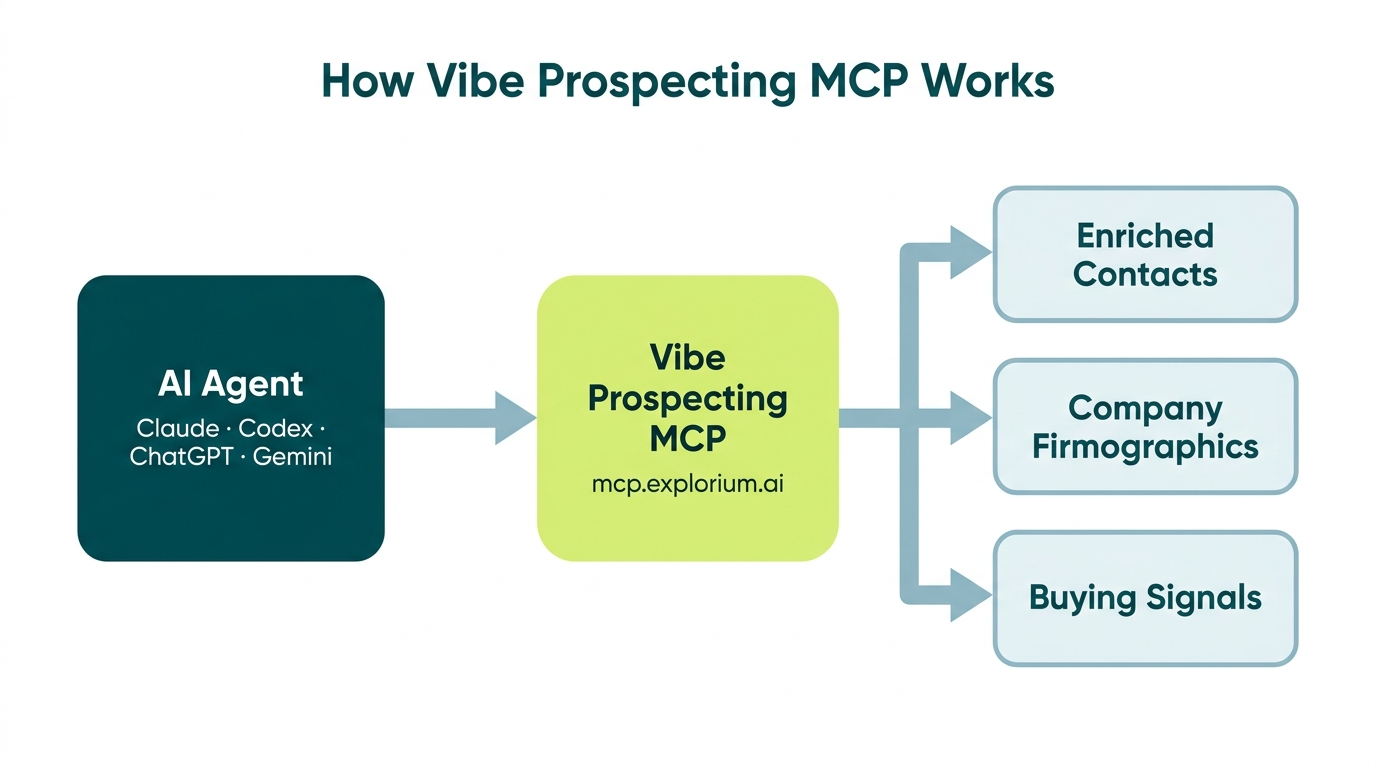
For the Vibe Prospecting Plugin, run npx skills add explorium-ai/vibeprospecting-plugin, then complete browser OAuth, which is separate from the codex mcp add path Codex uses for raw MCP servers. The Anthropic Community Marketplace one-click is the alternative for Codex users who prefer a UI install.
🔄 Skills CLI Flow for the Plugin
- Run npx skills add explorium-ai/vibeprospecting-plugin in the project root.
- Run npx vpai login to open the browser OAuth screen.
- Run npx vpai login –poll to save credentials to ~/.config/vpai/config.json.
📊 codex mcp add for Apollo and Clay
Raw MCP servers use Codex native config, which writes to ~/.codex/config.toml. Use codex mcp login for OAuth-capable servers. The Plugin path is separate because skills and slash commands ship alongside the MCP server.
codex mcp add apollo -- npx -y @apollo-community/mcp-server
codex mcp login apollo
Q8: When Should I Pick the Plugin vs the Vibe Prospecting MCP Server?
Pick the Plugin when the host is Codex or Claude Code, because you get bundled skills, slash commands, and browser OAuth. Pick the Vibe Prospecting MCP server when the host is ChatGPT, Claude Desktop, or a headless CI runner where a long-lived service key is easier than an interactive OAuth. Both paths hit the same AgentSource backend and the same unified credit pool.
🔑 Plugin Decision Rules
- Host is Codex or Claude Code, pick the Plugin.
- Team wants slash commands plus skills bundled, pick the Plugin.
- OAuth in a browser is acceptable, pick the Plugin.
🛡️ MCP Server Decision Rules
- Host is ChatGPT or Claude Desktop, pick the MCP server.
- Runner is headless CI with no browser, pick the MCP server with a service token.
- You need raw MCP without bundled skills, pick the MCP server.
Q9: Decision Framework, Picking the Best GTM Plugin for Codex
Score each candidate on three pillars: one plugin for all GTM data, built for scale inside Codex, and affordable Codex-native install. Vibe Prospecting Plugin wins on all three, Apollo wins on CRM write-back only, and Clay wins on human waterfall orchestration only.
🔑 The 3-Pillar Recap
- Coverage breadth: Vibe Prospecting unifies companies, contacts, signals, and events. Apollo and Clay each cover narrower slices.
- Scale per call: Vibe Prospecting runs server-side at 1,000 entities and 100 QPS. Apollo and Clay cap far lower.
- Codex-native install and pricing: Vibe Prospecting ships skills add plus OAuth and a free account. The others require manual wiring.
💡 The Recommendation
For dev-leaning RevOps and AI engineers shipping GTM agents on Codex in 2026, the Vibe Prospecting Plugin is the answer. Run the install, finish OAuth, and pipe enriched CSVs straight into Codex bash steps. Get started with the Vibe Prospecting Plugin →
Related Posts
- Best GTM tools for Claude Code in 2026
- MCP vs REST API for AI agents
- Top Clay alternatives for RevOps teams
Frequently Asked Questions
What is the best GTM plugin for OpenAI Codex in 2026?
The Vibe Prospecting Plugin by Explorium is the best GTM plugin for Codex in 2026. It is the only Codex-native option in this comparison, installs with npx skills add, authenticates through browser OAuth, and unlocks 150M+ companies plus 800M+ contacts at up to 1,000 entities per call. Apollo and Clay are reachable from Codex through MCP wiring, but neither ships a Codex-native plugin.
How is a Codex plugin different from a generic MCP server?
A Codex plugin bundles three things: skills, slash commands, and an MCP server. A raw MCP server is only the third component. Plugins ship workflow primitives so RevOps gets one-command install and one OAuth flow, while a raw MCP server needs separate prompts every run. Vibe Prospecting Plugin is a Codex plugin, while Apollo and Clay expose raw MCPs that Codex reaches via codex mcp add or middleware.
How do I install the Vibe Prospecting Plugin in Codex?
Run npx skills add explorium-ai/vibeprospecting-plugin in your project root, then run npx vpai login to open the browser OAuth screen, and finish with npx vpai login –poll. Credentials are saved to ~/.config/vpai/config.json so Codex agents reuse them automatically across sessions. The Anthropic Community Marketplace one-click is an equivalent path for Codex users who prefer a UI install over the CLI and want the same skills bundle.
Can Codex agents call Apollo or Clay directly?
Codex can reach Apollo through the community Apollo MCP server using codex mcp add, but the official apollo-mcp-plugin targets Claude Code and Cowork only. Clay shipped MCP primarily as a client, so Codex reaches Clay only through Zapier MCP or Composio middleware. Neither path is Codex-native, and both add wiring and auth steps that Vibe Prospecting Plugin avoids with skills add plus OAuth.
How many entities per call does the Vibe Prospecting Plugin support?
Up to 1,000 entities per call at 100 QPS sustained, executed server-side against the AgentSource API. That is the most under-appreciated differentiator for Codex agents, because Apollo and Clay MCPs run in-context and cap at 20 to 100 records before the LLM context window overflows. The Plugin returns aggregates, IDs, and CSV files instead of dumping rows into chat.
Does the Vibe Prospecting Plugin work on ChatGPT or Claude Desktop?
No. The Plugin targets Codex and Claude Code hosts only, because it ships bundled skills and slash commands those hosts recognize. For ChatGPT or Claude Desktop, install the Vibe Prospecting MCP server instead. Both paths hit the same AgentSource backend, the same 150M+ company graph, and the same unified credit pool, so coverage and pricing are identical regardless of which install you pick.
How does pricing compare for autonomous Codex agent workloads?
Vibe Prospecting uses a unified credit pool with a free Vibe Prospecting account and no seat tax, which cuts agent-workload spend 30 to 60 percent versus per-endpoint allocation or seat-based pricing. Sample-before-export returns 5 representative records plus a cost estimate before credits are charged. Apollo charges seat plus credits. Clay charges per row, and reviewers report stated versus actual variance above 100 percent.
Can I export prospect lists to CSV from inside a Codex session?
Yes. The Plugin ships an export-to-csv tool that writes a structured file into the working directory, which Codex can pipe into its next bash, git, or upload step. That file I/O contract is exactly what Codex agents are designed around. Apollo MCP returns JSON into chat, and Clay routes results through async webhooks, so neither matches the Codex-native flow that the Plugin provides.


