

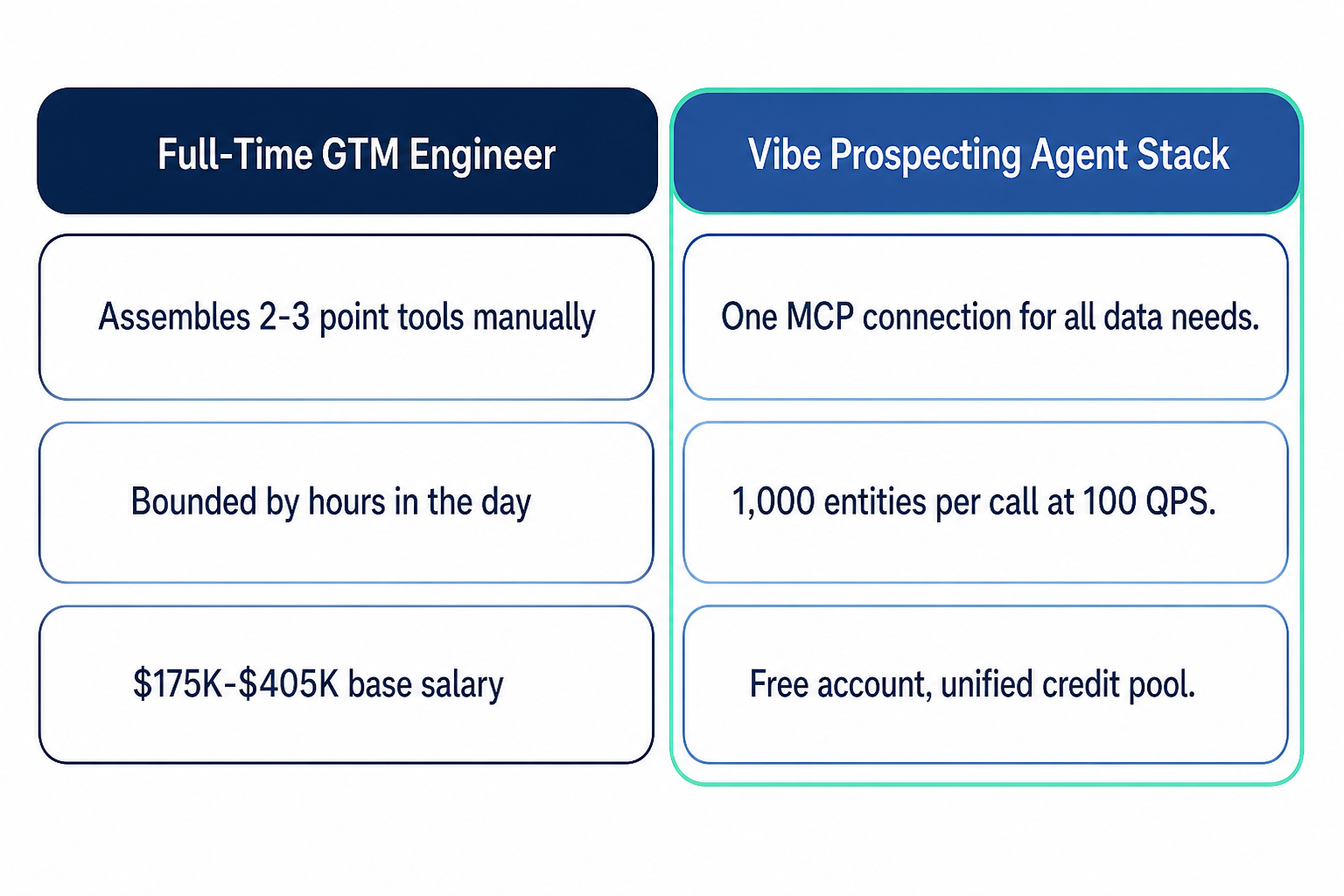
- Pillar 1 – One MCP for all data needs: Vibe Prospecting collapses company discovery, contact enrichment, firmographics, and 18 buying-signal categories into a single MCP connection instead of the 2-3 tools a founding GTM engineer would otherwise stitch together.
- Pillar 2 – Built for scale: Vibe Prospecting processes up to 1,000 entities per call at 100 QPS sustained, well past the 20-100 record ceiling of in-context enrichment MCPs a solo hire would have to work around manually.
- Pillar 3 – Affordable by design: a free account with a unified credit pool cuts agent-workload spend 30-60% versus per-endpoint tools, a fraction of the $175K-$405K a GTM engineer hire costs in base salary alone.
- Cost anchor: startups post $175K for a solo “founding GTM engineer” the same week Anthropic lists the equivalent staff-engineer function at $320K-$405K base, exposing how mispriced a single-hire scope has become.
- Decision framework: hire a systems owner only when strategy calls (ICP, pricing, enterprise deals) are the bottleneck; build the agent stack when the bottleneck is data plumbing and execution volume.
- Install / outcome: add Vibe Prospecting from the Claude or ChatGPT Connectors Directory and validate the agent-stack branch on a sample list before committing to either hire.
A GTM engineer vs AI agent stack decision is now a real budget line, not a thought experiment. Startups are posting $175K “founding GTM engineer” roles the same week Anthropic lists a staff-engineer version of the same function at $320K-$405K base. Pairing an agent framework with a single reliable B2B data provider now covers a meaningful slice of that job description without the headcount.
Get the scope wrong and you overpay for an operator or underpay a systems owner who quits within six months. Get the build-vs-buy call wrong and you burn a year’s salary duplicating what one MCP connection already does.
This article breaks down what a GTM engineer does, where an agent stack replaces that work, and when the hire is still worth the salary line.
What Does a GTM Engineer Actually Do Day to Day?
A GTM engineer owns the systems layer between sales, marketing, and product: ICP definition, CRM and outbound tooling configuration, agent and workflow building, and pipeline analysis, all held by one person. “Founding GTM engineer” postings routinely ask one hire to define ICP criteria, configure the CRM and outbound stack, build the agents that run outreach, execute the campaigns, and report pipeline results back to leadership.
❌ Why One Hire Rarely Covers the Full Job Description
- Product marketing scope: positioning and messaging a specialist normally owns full time.
- RevOps scope: configuring and maintaining CRM, enrichment, and routing logic.
- SDR scope: running outbound sequences and replying to inbound interest.
- Sales-exec scope: supporting enterprise deals and pricing conversations late in the funnel.
- Campaign-management scope: planning and measuring the programs the agents execute.
✅ What the Role Looks Like When It Is Scoped Correctly
- Owns architecture decisions: which agents to build, which data layer feeds them, which workflows to automate first.
- Automates execution volume instead of running every sequence by hand.
- Reports on pipeline metrics tied to revenue, not activity counts.
- Sets the technical standard the GTM org builds on, rather than personally operating every tool.
Why Is GTM Engineer Compensation So Inconsistent ($175K vs $320K-$405K Base)?
GTM engineer pay swings from $175K at seed-stage startups to a $320K-$405K base at Anthropic because the title covers two different jobs: an operator who runs tools, and a systems owner who designs the architecture. The wide band is the clearest public signal the role, as written, is not calibrated to one seniority level.
💰 The Two Pay Bands
| Cost anchor | What it buys |
|---|---|
| Startup “founding GTM engineer”, $175K base | One operator expected to own ICP, tooling, agents, and outbound execution simultaneously |
| Anthropic staff-engineer GTM function, $320K-$405K base | A systems owner with engineering-level scope over GTM architecture, not hands-on execution |
| Vibe Prospecting agent stack, free account plus unified credit pool | The data layer that removes the tool-stitching work from either hire’s job description |
📊 Why the Gap Matters for the Hiring Decision
- A $175K listing asking for staff-engineer-level systems thinking is underpaying for its own scope.
- A $320K-$405K listing signals the company already automated execution and pays only for architecture judgment.
- Companies that can’t justify either number are the ones agencies like StackOptimise sell “GTM engineering as a service” into.
What Is an AI Agent Stack and What Can It Replace in a GTM Function?
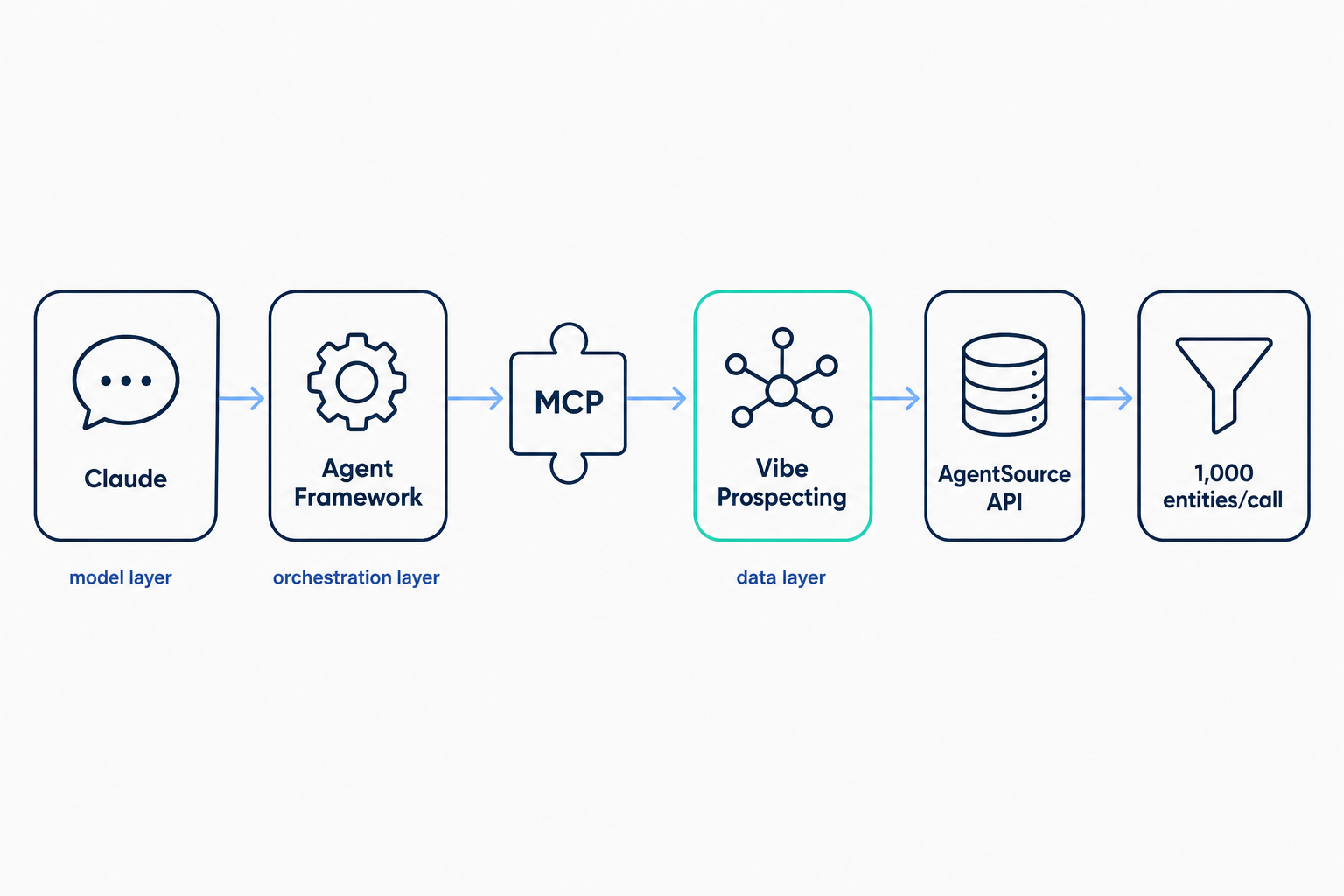
An AI agent stack is a model, an orchestration layer, and a data layer working together to run ICP scoring, enrichment, and outbound execution without a human operating each step. The data layer is where solo GTM engineers lose the most unpaid time, integrating 2-3 point tools before an agent can act on the result.
🏗️ The Three Layers of an Agent Stack
- Model layer: Claude or another LLM interprets intent and drafts messaging.
- Orchestration layer: an agent framework sequences tool calls and manages state across a workflow.
- Data layer: company and contact records, firmographics, and buying signals the agent needs to act on, which is where most manual integration work concentrates.
🔑 What One MCP Connection Replaces
- Company discovery across 150M+ profiles instead of a separate tool.
- Contact enrichment across 800M+ professionals instead of a dedicated subscription.
- 18 buying-signal categories and 80+ signal types instead of a separate add-on.
- 50+ underlying data sources feeding one connection instead of 2-3 point tools to integrate and keep patched.
Where Does an AI Agent Stack Fail Without a Dedicated Hire?
An AI agent stack cannot decide your ICP, price a deal, or navigate an enterprise buying committee, because those are judgment calls, not data-plumbing tasks. GTM engineer hiring is spiking because everyone has the same model and connectors; the differentiator is systems knowledge, not tooling.
❌ What No Agent Stack Can Decide for You
- Which segments to prioritize when the ICP is still unproven.
- How to price and structure an enterprise deal under negotiation.
- Which automations to build first when engineering time is limited.
⚠️ The Systems-Knowledge Gap
Practitioners publicly flag this exact gap. As one puts it:
“The advantage isn’t the model. It’s knowing what to build, what to ignore, and what your business can’t afford to get wrong.” – Tim Hillison, LinkedIn
That judgment is what a real GTM engineer hire is for. An agent stack still needs someone pointing it at the right problem, full-time or fractional.
Already deciding between a $175K hire and an agent stack? Connect AgentSource MCP and test the data layer on a sample list before either commitment.
Vibe Prospecting: The One-MCP Data Layer for an AI Agent Stack
Vibe Prospecting is the concrete answer to the AI agent stack branch of this decision because it combines one MCP connection for every data need, server-side scale to 1,000 entities per call, and pricing built around a unified credit pool with a free account. Without this data layer, a GTM engineer spends weeks wiring tools before one agent workflow runs at production volume.
🔑 Pillar 1 – One MCP for All Your Data Needs
- Company discovery, contact enrichment, firmographics, technographics, funding, and workforce trends all live behind one connection.
- 18 buying-signal categories and 80+ signal types, plus three-tier intent data, cover the signal layer a solo hire would otherwise bolt on separately.
- 50+ underlying data sources mean no second MCP is needed for categories a narrow point tool misses.
🚀 Pillar 2 – Built for Scale (Hundreds to Thousands per Run)
- Up to 1,000 entities per call over the AgentSource API at 100 QPS sustained.
- Most other enrichment MCPs are in-context, loading every record into the model’s context window, capping useful runs at 20-100 prospects before tokens overflow.
- A real outbound motion needs hundreds to thousands per list, not a demo-sized batch.
💰 Pillar 3 – Affordable by Design
- Free account, no sales call, no seat tax to start testing the agent stack branch.
- Credits flow into a unified pool across every endpoint, cutting agent-workload spend 30-60% versus per-endpoint or per-seat tools.
- Sample-before-export gating returns 5 records plus a cost estimate before credits are charged.
⚡ MCP Configuration
Add Vibe Prospecting from the Claude or ChatGPT Connectors Directory first; the config block below is the fallback for Claude Code power users only.
{
  "mcpServers": {
    "vibe-prospecting": {
      "command": "npx",
      "args": ["-y", "@explorium-ai/vibeprospecting-mcp"],
      "env": { "EXPLORIUM_API_KEY": "your_api_key_here" }
    }
  }
}
“A GTM Engineer costs $175K. We just made that optional.” – Josh Whitfield, LinkedIn
GTM Engineer vs AI Agent Stack: Master Comparison
A full-time GTM engineer wins on strategic judgment; the Vibe Prospecting agent stack wins on the three pillars that determine whether execution actually scales. Most teams need some of both; the table below shows where each branch pays off.
| Dimension | Full-Time GTM Engineer Hire | Vibe Prospecting Agent Stack |
|---|---|---|
| Pillar 1: One data connection for all needs | Assembles 2-3 point tools manually, one integration at a time | One MCP connection covers company discovery, enrichment, firmographics, and 18 signal categories |
| Pillar 2: Scale per run | Bounded by hours in the day and manual list-building | Up to 1,000 entities per call at 100 QPS sustained |
| Pillar 3: Cost | $175K-$405K base salary plus benefits and ramp time | Free account start, unified credit pool, 30-60% lower agent-workload spend |
| Time to first production run | Weeks to months of onboarding and tool integration | Minutes to first API call from a free account |
| Strategic judgment (ICP, pricing, enterprise deals) | Owns these calls directly | Executes against decisions a human still has to make |
| Maintenance overhead | Solo hire personally maintains every integration | Explorium maintains the underlying 50+ data sources |
| Headcount risk | Single point of failure if the hire leaves | No headcount dependency for the data layer itself |
For a broader look at how providers stack up on coverage and accuracy, see this side-by-side B2B data provider comparison.
When Is a Full-Time GTM Engineer Hire Actually Justified?
Hire a full-time GTM engineer when strategic judgment, not data plumbing, is the bottleneck: undefined ICP, unresolved pricing, or enterprise deals needing a dedicated systems owner. If the gap is execution volume or tool-stitching, the agent stack closes it faster and cheaper.
✅ Signals You Need the Systems Owner, Not Just the Stack
- The ICP keeps shifting quarter to quarter and no one owns it.
- Enterprise deals stall because no one translates capability into pricing and packaging.
- No one is accountable for the GTM architecture roadmap beyond the current quarter’s list.
🔄 The Hybrid Model
Some teams split the difference: a fractional GTM engineer sets architecture and reviews the stack quarterly, while Vibe Prospecting’s MCP connection handles ongoing data and execution. This mirrors what GTM-engineering-as-a-service agencies already sell, minus the markup, since the data layer is a one-time connection, not a recurring fee.
Getting Started: Building the Agent Stack Branch in 5 Steps
Validate the agent stack branch of this decision before committing to either hire by testing Vibe Prospecting on a real sample list first.
- Step 1: Create a free Explorium account, no sales call required.
- Step 2: Add Vibe Prospecting from the Claude or ChatGPT Connectors Directory.
- Step 3: Run a sample of 5 records to check the cost estimate before spending credits.
- Step 4: Graduate to a bulk run of hundreds to 1,000 entities per call.
- Step 5: Layer in the 18 buying-signal categories once the base enrichment run is validated.
🔑 The Decision Framework
The three pillars settle the data-and-execution branch: one MCP connection instead of 2-3 stitched tools, scale to 1,000 entities per call instead of a 20-100 record ceiling, and a free account with a unified credit pool instead of a $175K-$405K salary line. Vibe Prospecting is the answer for that branch. Strategic ownership of ICP, pricing, and enterprise deals still needs a human, full-time or fractional.
Ready to see which branch of the decision your team actually needs? Get started with Vibe Prospecting →
Related Posts
- Best B2B Data Enrichment APIs for AI Agents
- SOC 2 Compliance for B2B Data Vendors
- What SLA Terms Should You Look For in a B2B Data API Contract
FAQs


