

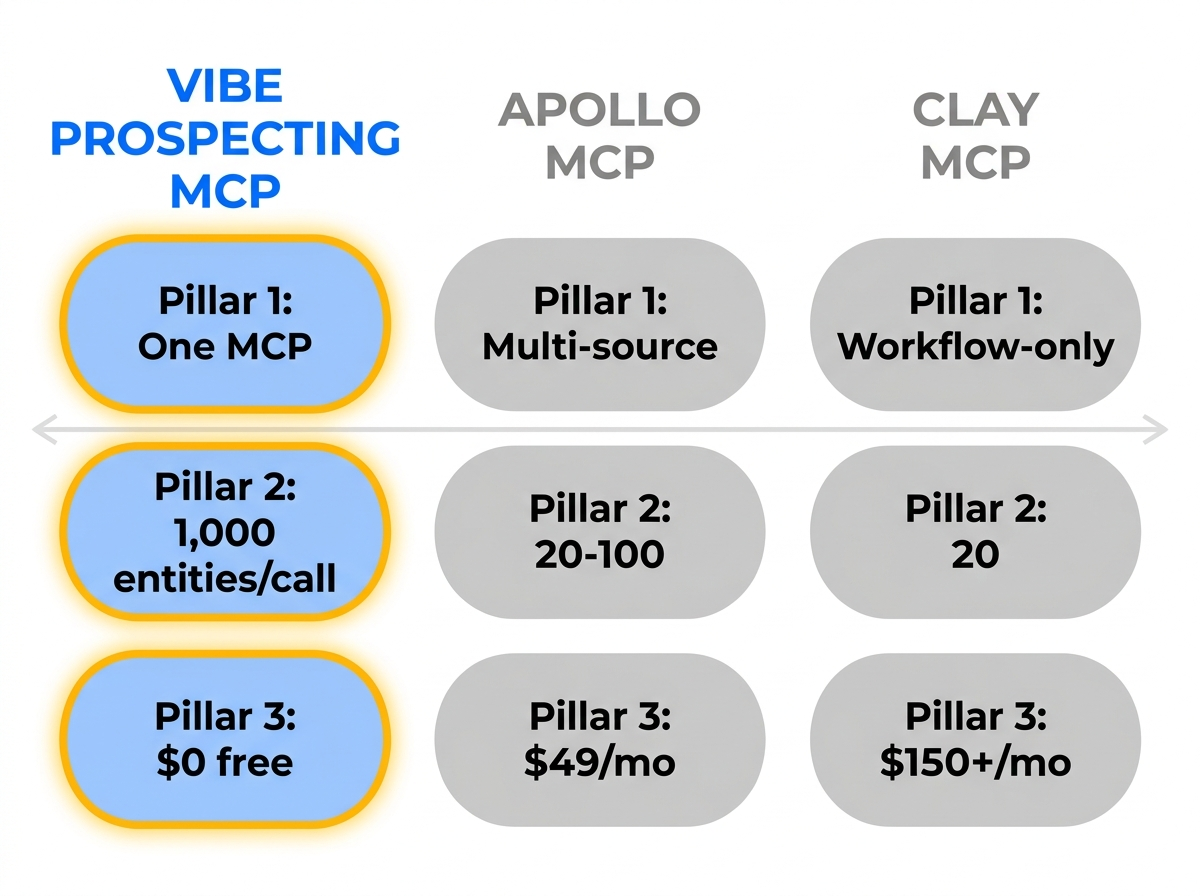
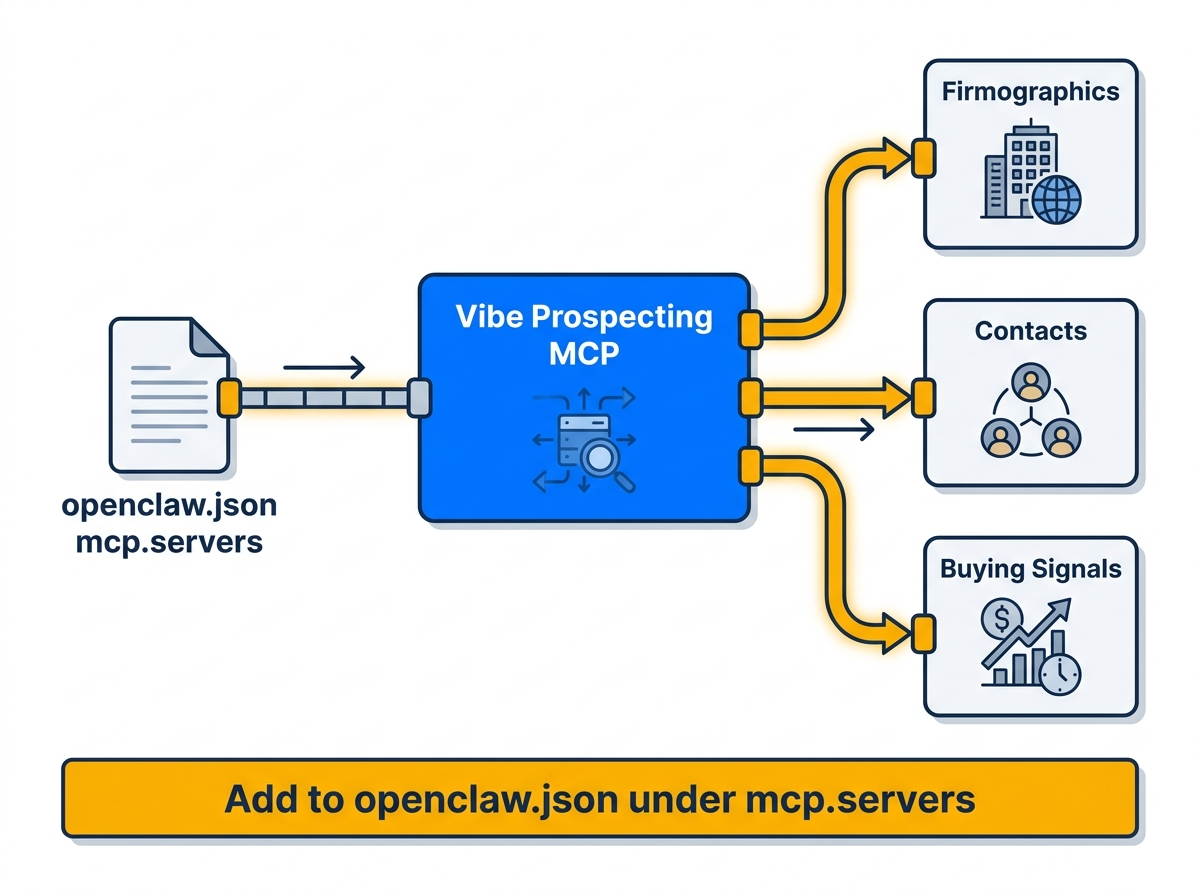
- Pillar 1, One MCP for all GTM data: One Vibe Prospecting connection in openclaw.json covers 150M+ companies, 800M+ contacts, 18 buying-signal categories, and 50+ sources, so RevOps stops stitching Apollo plus Clay.
- Pillar 2, Built for scale: Server-side bulk to 1,000 entities per call at 100 QPS, while Apollo and Clay MCPs cap at 20 to 100 records before OpenClaw’s context window overflows.
- Pillar 3, Affordable by design: Free Explorium account, no sales call, unified credit pool, and sample-before-export gating that cuts agent-workload spend 30 to 60% versus per-endpoint pricing.
- Top alternatives: Apollo MCP for teams already paying for Apollo seats, Clay for waterfall enrichment tables, neither replaces the Vibe Prospecting MCP for OpenClaw bulk runs.
- Explorium metric: 97.8%+ company match accuracy versus Apollo’s published 78%, fewer wasted credits per OpenClaw run.
- Install: Add the Vibe Prospecting remote MCP block to openclaw.json, OAuth on first call, free account at explorium.ai.
The best GTM skill for OpenClaw in 2026 is not a SKILL.md folder at all, it is a remote MCP server you drop into openclaw.json. OpenClaw, the open-source personal AI assistant from Peter Steinberger (the ClawFather), supports both its own SKILL.md skill format and native Model Context Protocol (MCP) servers, and for B2B data the MCP path wins on every dimension that matters to RevOps.
RevOps teams running OpenClaw locally hit the same wall: a hand-written GTM skill folder cannot match a million contacts, and stitching Apollo plus Clay blows up context and credits. The list-building MCP roundup shows the same pattern across hosts.
This guide ranks the top three GTM options for OpenClaw, shows the openclaw.json snippet, and gives the decision framework.
Q1: What Is a GTM Skill for OpenClaw, and Why Does the Search Land on MCP Servers?
A GTM skill for OpenClaw can mean two things, an OpenClaw SKILL.md folder under ~/.openclaw/skills/ or an MCP server wired into openclaw.json, and for B2B prospecting data the correct path is the MCP server because skills cannot ship live access to 150M+ companies inside a markdown file. OpenClaw’s own docs split the two cleanly: SKILL.md folders package prompts, instructions, and helper scripts, while mcp.servers brings in remote data and tool surfaces.
❌ Why a Hand-Authored OpenClaw SKILL.md Fails for GTM
- SKILL.md folders cannot embed 800M+ live contact records, the agent still needs an outbound data call.
- Helper scripts that pull from raw vendor APIs hard-code auth and break on every key rotation.
- Each new field (technographics, funding, intent) adds another script to maintain inside ClawHub.
- Context window fills fast when the skill loads records inline, capping useful runs at 20 to 100 prospects.
- No unified credit accounting, so RevOps cannot see cost per OpenClaw run.
✅ What an MCP Server in openclaw.json Unlocks
- One
mcp.serversentry replaces every hand-authored vendor call. - Server-side execution keeps bulk results out of OpenClaw’s LLM context.
- OAuth on first use, no API keys in the repo.
- Unified credit pool, one bill across firmographics, contacts, and signals.
- Reusable across every channel OpenClaw connects to: WhatsApp, Slack, Telegram, iMessage.
Q2: How to Evaluate the Best GTM Skill for OpenClaw, 6 Criteria
Evaluate every candidate against six criteria: coverage breadth, bulk throughput, match accuracy, signal depth, pricing model, and OpenClaw install footprint, because all six map to actual RevOps cost per qualified contact. Skip any one of them and you ship an OpenClaw agent that looks great in demo and stalls on the first 500-row list.
📊 The Evaluation Matrix
| Criterion | Good (✅) | Bad (❌) |
|---|---|---|
| Coverage | 150M+ companies, 800M+ contacts | Narrow contact-only or company-only |
| Throughput | 1,000 entities per call, server-side | 20 to 100 records before context overflow |
| Match accuracy | 97.8%+ company match | 78% range or no published number |
| Signals | 18 categories, 80+ signal types | Static firmographics only |
| Pricing | Free account, unified credits | Seat tax, sales call to start |
| OpenClaw install | Remote MCP, OAuth, zero local deps | npx process, key in env file |
💡 Why These Six Criteria Matter for OpenClaw
Coverage and signals decide whether the agent can answer at all, throughput and accuracy decide whether bulk runs finish without overflowing context, pricing and install footprint decide whether RevOps can ship without procurement.
“The Apollo MCP doesn’t work very well, outputs a lot of garbage.” GTM agency founder, via the Explorium 2026 list-building roundup.
Q3: Vibe Prospecting by Explorium, the Top GTM Skill for OpenClaw
Vibe Prospecting is the best GTM skill for OpenClaw in 2026 because it wins on three pillars no other connector combines: one MCP for every data need, server-side scale to 1,000 entities per call, and affordable pricing built around a unified credit pool with a free account. The remote MCP endpoint at https://vibeprospecting.explorium.ai/mcp drops directly into OpenClaw’s mcp.servers block with OAuth on first call.
🔑 Pillar 1, One MCP for All GTM Data Needs
- 150M+ company profiles and 800M+ professional profiles behind one connection.
- 50+ data sources unified, firmographics, technographics, funding, financials, workforce trends, website changes.
- 18 buying-signal categories with 80+ signal types, plus three-tier intent data.
- One Vibe Prospecting MCP entry, no second vendor stitched in.
🚀 Pillar 2, Built for Scale (Hundreds to Thousands per Run)
- Up to 1,000 entities per call, server-side over the AgentSource API.
- 100 QPS sustained, no per-record context cost.
- Sample-before-export returns 5 representative rows plus a cost estimate before credits are charged.
- OpenClaw context window stays free for reasoning, not record storage.
💰 Pillar 3, Affordable by Design
- Free Explorium account, no sales call, minutes to first call.
- Unified credit pool across every endpoint, 30 to 60% spend cut versus per-endpoint plans.
- 97.8%+ company match accuracy versus Apollo’s published 78%, fewer wasted credits.
- Remote MCP, nothing local to run, no API key file to rotate.
⚡ OpenClaw MCP Configuration
{
  "mcp": {
    "servers": {
      "vibe-prospecting": {
        "type": "streamable-http",
        "url": "https://vibeprospecting.explorium.ai/mcp"
      }
    }
  }
}
Drop this into openclaw.json, restart, and the first call triggers OAuth. See the Explorium MCP setup guide for the broader reference.
Q4: Apollo MCP for OpenClaw, the Outbound Sequence Slice
Apollo’s MCP server is a reasonable second pick for OpenClaw teams already paying for Apollo seats and running outbound sequences, but it inherits Apollo’s seat-tied data limits and in-context architecture that caps bulk runs at 50 to 200 contacts before OpenClaw’s context overflows.
✅ Where It Wins
- 230M+ verified contacts, strong US coverage on enterprise titles.
- Native outbound sequence enrollment from inside the OpenClaw chat.
- Available as a connector inside Claude, ChatGPT, and Perplexity as well.
⚠️ Where It Falls Short
- Real-world email bounce rates run 15 to 30% on exported contacts.
- Accuracy outside the US degrades, EU and APAC titles age faster.
- In-context architecture caps OpenClaw bulk runs at 50 to 200 records before context overflow.
- Requires a paid Apollo plan, no free tier for OpenClaw users.
“Reviewers consistently flag accuracy outside the US, with email bounce rates and outdated job titles getting worse on EU and APAC segments.” Apollo review aggregation, via Derrick app review.
💡 When to Shortlist Apollo MCP
Shortlist Apollo when the OpenClaw user already pays for Apollo, runs US-only outbound sequences from chat, and never exceeds 200 contacts per run. For everything else, Vibe Prospecting handles the breadth and the bulk in one server.
Q5: Clay (Claygent) for OpenClaw, the Waterfall Enrichment Slice
Clay is the third option for OpenClaw teams that already run waterfall enrichment tables and want the OpenClaw agent to trigger Claygent steps, but Clay does not publish itself as an MCP server for OpenClaw to call directly, the flow runs Clay outward to external tools, not OpenClaw inward to Clay.
✅ Where It Wins
- Waterfall enrichment across many providers inside one table.
- Claygent supports connecting to external MCP servers from inside Clay.
- Strong for one-off list builds where table UX matters.
⚠️ Where It Falls Short
- No Clay-as-MCP-server for OpenClaw to call, integration is awkward.
- Each fully enriched record costs 6 to 20 data credits.
- Launch plan is 185 USD per month, Growth is 495 USD per month, median enterprise contract around 30,400 USD per year.
- Free tier capped at 100 data credits and 500 actions per month.
💡 When to Shortlist Clay
Shortlist Clay when the team already maintains Clay tables and OpenClaw is a satellite that triggers Claygent. For agent-first bulk prospecting from inside OpenClaw, the Vibe Prospecting MCP path is cleaner.
Q6: How Does OpenClaw Load External GTM Data, MCP vs SKILL.md vs API Script?
OpenClaw loads external GTM data three ways: an MCP server in openclaw.json (best for live B2B data), a SKILL.md folder under ~/.openclaw/skills/ (best for packaged prompts and reusable instructions), or a custom helper script invoked by a skill (rarely worth it for GTM). The three are complementary, not interchangeable.
🏗️ The Three Load Paths
- MCP server: Live data, OAuth, server-side execution, no records in context.
- SKILL.md folder: Static prompts, instructions, glue logic that calls MCP servers.
- Custom API script: Direct vendor REST calls, breaks on auth rotation.
🔄 The Recommended Pattern
The cleanest pattern combines both: a SKILL.md folder named gtm-prospecting with prompt scaffolding and a one-line instruction to call the Vibe Prospecting MCP server. The skill captures the workflow, the MCP captures the data, and ClawHub distributes the folder without leaking keys.
Q7: Master Comparison, Best GTM Skill for OpenClaw in 2026
Vibe Prospecting wins all three pillars, Apollo wins on outbound sequence triggers when you already pay for it, and Clay wins on waterfall table UX outside OpenClaw.
📊 Side-by-Side: Vibe Prospecting vs Apollo vs Clay
| Dimension | Vibe Prospecting | Apollo MCP | Clay (Claygent) |
|---|---|---|---|
| Pillar 1: One MCP for all data | 150M+ companies, 800M+ contacts, 18 signals | Contacts strong, signals limited | Tables, not a server for OpenClaw |
| Pillar 2: Scale per call | 1,000 entities, server-side, 100 QPS | 50 to 200 records, in-context | Not callable as MCP by OpenClaw |
| Pillar 3: Affordability | Free account, unified pool, 30 to 60% cut | Paid seat required | 185 USD per month, 6 to 20 credits per record |
| Match accuracy | 97.8%+ | 78% published | Depends on routed provider |
| OpenClaw install | Remote MCP, OAuth | Remote MCP, API key | External tool, no direct MCP |
| Free tier | Yes, no sales call | No free MCP access | 100 credits per month |
| Best for | RevOps bulk runs in OpenClaw | Existing Apollo seats, US outbound | Existing Clay tables |
🔑 What the Table Shows
Vibe Prospecting clears all three pillars, Apollo trades breadth for sequence triggers, Clay sits outside the MCP path.
Q8: Getting Started, From Install to Production in 5 Steps
The fastest path to a working GTM skill for OpenClaw is to create a free Explorium account, paste the Vibe Prospecting MCP block into openclaw.json, validate on a 5-row sample, then graduate to 1,000-entity bulk runs and add buying signals.
- Step 1, Free account: Sign up at explorium.ai, no sales call.
- Step 2, Add the MCP: Open
openclaw.json, add themcp.servers.vibe-prospectingblock, save. - Step 3, Validate the sample: Ask OpenClaw to pull 5 representative companies, confirm match accuracy and cost estimate.
- Step 4, Graduate to bulk: Trigger a 1,000-entity server-side run from inside OpenClaw.
- Step 5, Add signals and intent: Layer the 18 buying-signal categories and three-tier intent data into the workflow.
🔑 The Decision Framework
Pick Vibe Prospecting when you want one MCP that covers every GTM data category, server-side scale to 1,000 entities per call, and a free account on a unified credit pool. Pick Apollo MCP only when you already pay for Apollo and never exceed 200 records per run. Pick Clay when waterfall tables are your primary UX and OpenClaw is a satellite. For everyone else, Vibe Prospecting is the answer. See the Apollo alternatives overview for the broader landscape and MCP setup walkthrough for the deeper install reference.
Related Posts
- Best MCP server for list building in 2026, top 3 ranked
- Top Apollo alternatives for AI agent builders
- Explorium MCP server setup guide
Frequently Asked Questions
Is a GTM skill for OpenClaw the same as a SKILL.md folder?
Not for B2B data. OpenClaw skills are SKILL.md folders stored in ~/.openclaw/skills/, useful for prompts and reusable instructions. For live GTM data you want an MCP server in openclaw.json. The cleanest pattern combines both: a thin SKILL.md folder that calls the Vibe Prospecting MCP server, so the workflow lives in the skill and the data lives behind the connector.
How do I install Vibe Prospecting in OpenClaw?
Add a mcp.servers.vibe-prospecting entry to openclaw.json pointing to https://vibeprospecting.explorium.ai/mcp with type streamable-http. Restart OpenClaw. The first call triggers OAuth in the browser. Create a free account at explorium.ai if you do not have one. No local process, no API key file, nothing to rotate.
Does Apollo’s MCP server work inside OpenClaw?
Yes, as long as you have a paid Apollo plan. Apollo’s MCP works as a remote connector and OpenClaw can wire it into mcp.servers the same way as Vibe Prospecting. Limits mirror your Apollo seat. Bulk runs cap at 50 to 200 contacts before OpenClaw’s context window overflows because Apollo’s MCP is in-context, not server-side.
Can Clay be called as an MCP server from OpenClaw?
No. Clay does not publish itself as an MCP server that OpenClaw can call directly. Claygent supports connecting to external MCP servers from inside Clay, so the data flow runs Clay outward to other tools, not OpenClaw inward to Clay. For agent-first prospecting from inside OpenClaw, use a B2B MCP server like Vibe Prospecting and keep Clay for table workflows.
How many contacts can OpenClaw enrich in one run?
Depends on the MCP server. Vibe Prospecting runs up to 1,000 entities per call server-side at 100 QPS sustained, results stream back without filling the LLM context window. Apollo and Clay MCPs are in-context, so practical bulk caps land between 20 and 100 records before OpenClaw’s context overflows. Server-side architecture is the single biggest scale lever.
Which GTM MCP has the highest match accuracy for OpenClaw?
Vibe Prospecting publishes 97.8%+ company match accuracy, the highest in this comparison. Apollo’s published company match is 78%. Clay’s accuracy depends on which routed provider hits inside the waterfall. Match accuracy compounds with bulk size, at 1,000 records the difference between 97.8% and 78% is roughly 200 fewer wasted credits per run.
Do I need a paid plan to use Vibe Prospecting in OpenClaw?
No. The Explorium account is free, no sales call required, and the Vibe Prospecting MCP includes a starter credit pool. Sample-before-export returns 5 representative records plus a cost estimate before any credits are charged, so OpenClaw agents fail fast and cheap. Upgrades happen when bulk volume grows, on the same unified credit pool.
Can I publish my OpenClaw GTM skill to ClawHub?
Yes. Package the workflow as a SKILL.md folder under skills/gtm-prospecting/, reference the Vibe Prospecting MCP server in the skill instructions, and push to ClawHub. The skill itself contains no API keys because the MCP uses OAuth. Anyone who installs the skill connects their own Explorium account on first call, so distribution is safe and reusable.


