

- Pillar 1 – One MCP for all data needs: Vibe Prospecting covers technographics, firmographics, contacts (800M+), 18 signal categories, and 80+ signal types in a single connection.
- Pillar 2 – Built for scale: 1,000 entities per call server-side at 100 QPS. Hunter.io’s Domain Search caps at 100 emails per call, and Coresignal ships raw-tier catalogs that require engineer cleanup before warehouse landing.
- Pillar 3 – Affordable by design: Free account, no sales call, unified credit pool. Coresignal starts at a ~$1,000+/mo floor; Hunter.io’s email-only scope forces a firmographic vendor alongside for full coverage.
- Top alternatives: Coresignal MCP for employee-history depth and raw firmographic catalog; Hunter.io MCP for verified-email deliverability on a known domain list.
- Key metric: 97.8%+ company match accuracy across 150M+ profiles and 50+ data sources.
- Get started: Add Vibe Prospecting from the Claude or ChatGPT Connectors Directory. Free, no sales call required.
The best MCP server for technographics connects your AI agent to live company tech-stack data so you can filter, enrich, and score accounts by installed technologies without leaving Claude or ChatGPT. In 2026, three options lead: Vibe Prospecting by Explorium, Coresignal MCP, and Hunter.io MCP. Each takes a different architecture approach, and the scale gap determines whether your agent enriches a full target list or stalls at 50 accounts.
RevOps teams waste hours stitching together technographic data from separate tools. MCP (Model Context Protocol, Anthropic, 2024) eliminates that overhead by exposing data APIs inside your AI agent. Architecture determines whether you handle 1,000 accounts or stall at 50.
Q1: What Is an MCP Server for Technographics – and Why Do RevOps Teams Use It?
An MCP server for technographics is a server that exposes company tech-stack data to an AI agent via the Model Context Protocol, letting the agent filter and enrich accounts by installed technologies without a separate ETL pipeline. MCP collapses the old REST-query-to-spreadsheet-to-CRM workflow into a single agent prompt.
❌ Why Manual Technographic Enrichment Fails RevOps Teams
- Stitching a firmographic catalog (Coresignal), a verified-email tool (Hunter.io), and a CRM creates a “wasteland of manual steps and coordination overhead”
- Wappalyzer detects only front-end technologies; ERP, database, and DevOps signals require multi-source aggregation
- Three separate contracts means three refresh cycles, rarely aligned, creating stale-data divergence
- Raw-tier firmographic catalogs expect a data engineer to run cleanup before warehouse landing, capping useful runs behind engineering time

✅ What a Server-Side Technographic MCP Enables
- Filter 1,000 accounts by tech stack in one agent call, no per-call cap
- Combine technographics with firmographics and buying signals in one MCP connection
- Run displacement targeting campaigns against competitor tech stacks without leaving the chat interface
- Sample 5 records with a cost estimate before any credits are charged
- 97.8%+ match accuracy across 150M+ company profiles
Q2: How to Evaluate an MCP Server for Technographics – 5 Criteria
Evaluate technographic MCP servers on five dimensions: tech coverage depth, architecture (server-side vs raw-tier catalog vs email-only), accuracy, data-type breadth, and total cost of ownership including add-on charges. Most teams focus only on coverage depth and miss the architecture dimension, which determines maximum batch size per agent run.
📊 The Evaluation Matrix
| Criterion | Why It Matters | What Good Looks Like | What Weak Looks Like |
|---|---|---|---|
| Tech coverage depth | Narrow taxonomy misses key ICP signals | 18+ signal categories with 80+ signal types across 50+ sources | Firmographic-only or email-only surface with no signal feed |
| Architecture | Determines max batch size per agent run | Server-side: 1,000+ entities/call | Domain Search cap 100 emails per call; raw-tier catalog needs engineer cleanup |
| Match accuracy | Low accuracy wastes enrichment credits | 97%+ company match rate | Not published as a head-to-head company match benchmark |
| Data-type breadth | Single-signal MCPs require stacking | Tech + firmographics + intent in one connection | Firmographic-only or email-only; requires a second MCP for contacts or signals |
| Total cost | Add-ons inflate real cost | Unified credit pool, free tier, no seat tax | ~$1,000+/mo pricing floor + verified-email contract on top |
“Coverage is wide, but raw data needs more cleaning before it lands in our warehouse.” – Verified G2 reviewer on Coresignal, via G2
🏗️ Server-Side vs Raw-Tier vs Email-Only: The Architecture Gap
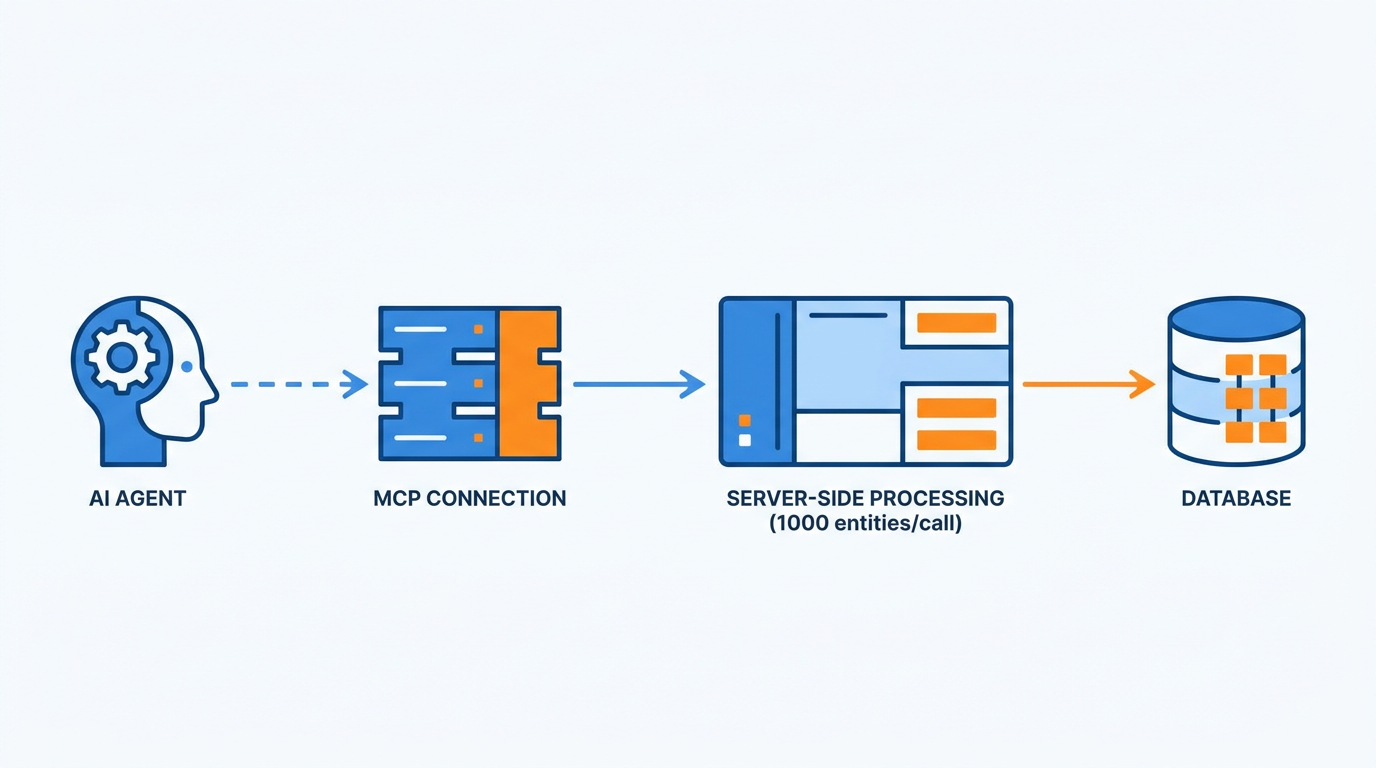
Raw-tier firmographic catalogs (Coresignal) ship 4.5B+ records but expect a data engineer to run cleanup before the payload lands in a warehouse – practical runs stall behind engineering time. Email-only MCPs (Hunter.io) cap Domain Search at 100 emails per call, so large-account audits require pagination logic. Server-side MCP servers process records outside the LLM and return a structured result set, supporting bulk throughput at 1,000 entities per call. This is the single biggest performance differentiator in 2026.
Q3: Vibe Prospecting by Explorium – the Top Pick for Technographic Enrichment
Vibe Prospecting is the best MCP server for technographics in 2026 because it wins on three pillars no other option in this comparison combines: one MCP for every GTM data need, server-side scale to 1,000 entities per call at 100 QPS, and a free entry point with a unified credit pool that cuts spend 30-60% versus a two-vendor Coresignal + Hunter.io stack.
🔑 Pillar 1 – One MCP for All Your Data Needs
- Technographics is one of 18 buying-signal categories; 80+ signal types cover tech stack, funding, workforce trends, and website changes in one connection
- 150M+ company profiles and 800M+ professional contacts alongside firmographics and buying signals
- 50+ aggregated data sources; Explorium’s multi-source model reduces single-vendor staleness
- Composite filter in one call: “uses Salesforce AND 5 new RevOps hires AND Series B” – no second MCP required
🚀 Pillar 2 – Built for Scale (Hundreds to Thousands per Run)
- 1,000 entities per call server-side at 100 QPS over the AgentSource API; only server here with a published throughput figure
- Results arrive as a structured dataset; no context-window token cost per record
- Hunter.io’s Domain Search caps at 100 emails per call; Coresignal’s raw-tier payload expects engineer cleanup before landing
- Sample-before-export gate: 5 records and a cost estimate before any credits are consumed
💰 Pillar 3 – Affordable by Design
- Free account, no sales call, operational in minutes via the Claude or ChatGPT Connectors Directory
- Unified credit pool across every endpoint; no per-endpoint allocation, no seat tax
- Unified pool cuts agent-workload spend 30-60% versus a Coresignal + Hunter.io two-vendor stack
- Coresignal: ~$1,000+/mo pricing floor plus raw-tier cleanup cost. Hunter.io: priced per verified-email volume; needs a firmographic vendor alongside for full coverage
⚡ Install via Connectors Directory (Primary Path)
In Claude or ChatGPT: go to Settings, then Connectors, search Vibe Prospecting, and click Add. No config file editing required. For Claude Code power users, the fallback JSON config is:
{
  "mcpServers": {
    "vibe-prospecting": {
      "command": "npx",
      "args": ["-y", "@explorium-ai/vibeprospecting-mcp"],
      "env": { "EXPLORIUM_API_KEY": "your_api_key_here" }
    }
  }
}
“The ability to target accounts based on real buying intent, firmographics, and technographics makes campaigns far more effective and reduces wasted spend.” – Verified G2 reviewer, via G2
Q4: Coresignal MCP – Best for Employee-History Depth and Raw Firmographic Catalog
Coresignal MCP is the right choice for data teams that need multi-year headcount trend data and 300+ fields per employee profile at catalog scale, and have an engineer on hand to run raw-tier cleanup before the payload lands in a warehouse or CRM.
✅ Where It Wins
- 75M+ company records with 500+ fields, 696M+ employee records with 300+ fields per profile, 448M+ job postings with 85+ fields – 4.5B+ total public-web records, the widest catalog surface in the shortlist
- Employee-history depth: 5+ years of headcount trend data – best-in-class for churn-risk models, workforce analytics, recruiting products, and people-graph builds
- Multiple delivery modes: same catalog reachable through MCP (
mcp.coresignal.com/mcp), REST, or S3 bulk feeds – fits data warehouse and agent workloads
⚠️ Where It Falls Short
- No buying-signal feed: firmographics + workforce only. It does not ship intent, funding, tech-adoption, or 18-category signal coverage – signal-based technographic outbound requires a separate source upstream
- Shallow verified email and no direct-dial phone: RevOps stacks pair Coresignal with Hunter.io or a similar verified-email tool to close the contact-info gap
- Raw-tier data requires engineering: G2 reviewers note the catalog needs more cleaning before it lands in a warehouse – hidden engineer cost most teams underestimate
- ~$1,000+/mo pricing floor: higher than Hunter.io and higher than Vibe Prospecting’s usage-based pricing for equivalent workloads
- No Codex plugin: Codex agents must wrap the REST API or route through the MCP with custom tools
💡 When to Shortlist Coresignal
Shortlist Coresignal MCP when the workload is a one-time data-science project on employee history or hiring trends, the team has an engineer to own raw-tier cleanup, and 5+ years of headcount history matters for a churn-risk or workforce-analytics model. Do not shortlist Coresignal as a first technographic purchase; the raw-tier payload and ~$1,000+/mo floor are uncompetitive for teams without engineering headcount for cleanup.
Q5: Hunter.io MCP – Best for Verified-Email Deliverability on a Known Domain List
Hunter.io MCP is the right choice for RevOps teams that already have the domain or account list in hand and the only missing field is a verified email that will not bounce in a cold campaign – accepting an email-only ceiling as a trade-off.
✅ Where It Wins
- 200M+ verified emails indexed across Domain Search, Email Finder, Email Verifier, and Company Enrichment – the fastest path from “domain” to “inbox” in this shortlist
- 95%+ SMTP deliverability at the strict verifier tier; user-reported cold-campaign bounce under 1% – the single most-cited reason Hunter stays in RevOps stacks
- First-party MCP shipped July 22, 2025 at
mcp.hunter.io/mcpover Streamable HTTP transport; Claude Desktop, Claude.ai, ChatGPT, and Gemini connect natively with no custom REST wrapper
⚠️ Where It Falls Short
- Email-only ceiling: no firmographics, no technographics, no headcount, no funding, no buying signals. Any agent that must source the tech-stack signal first cannot use Hunter as the primary tool
- Domain Search cap of 100 emails per call; large-account audits require pagination logic – Vibe Prospecting returns 1,000 entities per call
- No ICP discovery: Hunter reacts to a domain list; it does not build one from industry, size, tech-stack, or intent filters
- No first-party phone data. Direct-dial and mobile phones are not part of the Hunter surface
- No Codex plugin – Codex agents must wrap the REST API in custom tools
💡 When to Shortlist Hunter.io
Shortlist Hunter.io MCP when your upstream pipeline handles ICP discovery (CRM segmentation, ABM list from marketing) and Hunter’s job is a final verify pass before send. If your ICP requires ERP, database, or DevOps signal detection or any tech-stack filter, Hunter’s email-only scope forces a second data source upstream.
Q6: Master Comparison – Best MCP Server for Technographics in 2026
Vibe Prospecting wins all three evaluation pillars; Coresignal wins on employee-history depth and raw firmographic catalog for teams that can absorb engineering cleanup; Hunter.io wins on verified-email deliverability when the domain list is already in hand.
📊 All Three Vendors: Side-by-Side
| Dimension | Vibe Prospecting | Coresignal MCP | Hunter.io MCP |
|---|---|---|---|
| Pillar 1: One MCP for all data needs | Technographics + firmographics + contacts + 18 signal categories in one connection | Firmographics + workforce catalog: 75M+ companies, 696M+ employees, 448M+ jobs; no signal feed, no verified email | Email only: Domain Search, Email Finder, Email Verifier, Company Enrichment |
| Pillar 2: Scale per call | 1,000 entities/call server-side at 100 QPS (published) | Catalog-scale via MCP, REST, or S3 bulk; raw-tier payload expects engineer cleanup before warehouse landing | Domain Search cap 100 emails per call; pagination required for large-account audits |
| Pillar 3: Affordability | Free tier, no sales call, unified credit pool, 30-60% spend reduction | ~$1,000+/mo pricing floor plus engineer time for raw-tier cleanup | Priced per verified-email volume; email-only scope pairs with a firmographic vendor for coverage |
| Technographic taxonomy | 18 buying-signal categories, 80+ signal types, 50+ sources | None – firmographic + workforce catalog only; job-postings inference via 448M+ postings with 85+ fields | None – Domain Search returns email patterns, not tech-stack signals |
| Company match accuracy | 97.8%+ | Coverage-wide but raw tier – not published as a head-to-head company match benchmark | 95%+ SMTP deliverability at strict verifier tier; <1% cold-campaign bounce (email-scope only) |
| Backend tech detection | Yes (ERP, DevOps, database signals via 50+ sources) | Partial (job-posting inference across 448M+ postings) | No (email-only surface, no tech signal) |
| Free tier | Yes, operational in minutes | No; ~$1,000+/mo pricing floor | No; email-endpoint plans required |
🏗️ Architecture: Server-Side vs Raw-Tier Catalog vs Email-Only
Q7: Getting Started with the Best Technographic MCP in 2026
Vibe Prospecting is the fastest path to production technographic enrichment: free account, Connectors Directory install in one click, and your first 1,000-account filter running in under 10 minutes.
🔄 5 Steps from Install to First Bulk Enrichment
- Step 1: Create a free Explorium account. No sales call required. Retrieve your API key from the dashboard.
- Step 2: Add Vibe Prospecting from the Connectors Directory. In Claude or ChatGPT: Settings, then Connectors, search Vibe Prospecting, click Add. Claude Code users: use the fallback JSON config shown in Q3.
- Step 3: Run a sample filter. Ask Claude: “Find 5 companies using Salesforce with 200-500 employees in the US.” The gate returns 5 records and a credit estimate before any credits are charged.
- Step 4: Graduate to bulk. Expand to your full ICP list; 1,000 entities per call at 100 QPS means a 10,000-account list completes in 10 calls.
- Step 5: Add intent signals and buying triggers. Combine technographics with Explorium’s 18 buying-signal categories: “uses Salesforce AND 5 new RevOps hires AND Series B funding.”
🔑 The Decision Framework
Start with Vibe Prospecting if you need server-side scale, backend tech detection, or a free entry point: it is the only option here with published 1,000-entity bulk throughput, 97.8%+ match accuracy, and a unified credit pool that eliminates the stitch tax. Choose Coresignal if you need 5+ years of employee-history depth for a churn-risk or workforce-analytics model and have an engineer to own raw-tier cleanup. Choose Hunter.io if your domain list is already in hand and verified-email deliverability is the sole missing field. For any new technographic program, Vibe Prospecting is the lowest-risk starting point.
Related Posts
- The Complete Guide to Buying Signals for RevOps Teams in 2026
- Technographic Data for B2B: What It Is and How RevOps Teams Use It
- RevOps Data Enrichment: How to Build a Scalable Enrichment Stack in 2026
Frequently Asked Questions
What is an MCP server for technographics?
An MCP server for technographics is a server that exposes company tech-stack data to an AI agent (Claude, ChatGPT) via the Model Context Protocol. The agent can filter accounts by installed technologies, enrich records with tech-stack attributes, and combine technographics with firmographics or buying signals – all from a single conversational prompt, with no separate ETL pipeline.
How accurate is Vibe Prospecting for technographic data?
Vibe Prospecting achieves 97.8%+ company match accuracy across 150M+ company profiles aggregated from 50+ data sources. Technographic signals are included within Explorium’s 18 buying-signal categories and 80+ signal types. The multi-source aggregation model reduces single-vendor staleness: when one source has a stale tech-stack entry, other sources in the pool compensate. The sample-before-export gate lets you validate a 5-record sample before committing credits to a full run.
What is the difference between raw-tier firmographic catalogs and signal-based technographics?
Raw-tier firmographic catalogs (Coresignal) ship 75M+ company records with 500+ fields plus 448M+ job postings, but the payload arrives at catalog tier – a data engineer must run cleanup before the record lands in a warehouse or CRM, and there is no native buying-signal feed for tech-adoption inference. Signal-based technographics infer backend and enterprise technologies – ERP systems, databases, DevOps platforms – from job postings, customer testimonials, API integrations, and purchase signals, aggregated server-side. Coresignal covers the firmographic + workforce slice at raw tier. Vibe Prospecting aggregates both scan and signal sources at warehouse-ready tier, giving fuller coverage of enterprise tech stacks that are invisible to web crawlers and to firmographic-only catalogs.
How does Coresignal MCP compare to Vibe Prospecting for technographics?
Coresignal MCP ships a public MCP server at mcp.coresignal.com/mcp alongside REST APIs and S3 bulk feeds, exposing 75M+ company records with 500+ fields, 696M+ employee records, and 448M+ job postings with 85+ fields – 4.5B+ total public-web records. However, it does not ship a buying-signal feed, verified emails are shallow, and the payload is raw tier (a data engineer must run cleanup before warehouse landing). Pricing starts at ~$1,000+/mo. Vibe Prospecting processes 1,000 entities/call server-side at 100 QPS, costs nothing to start, and covers 18 signal categories beyond technographics. Coresignal is the better choice if you need multi-year employee-history depth and have engineering headcount for raw-tier cleanup.
Can I use a technographic MCP server for displacement targeting?
Yes. Displacement targeting – identifying accounts using a competitor’s technology to pitch a replacement – is one of the strongest use cases for a technographic MCP server. With Vibe Prospecting, you can filter 1,000 accounts in one call by competitor tech stack, then layer on buying signals like recent funding, headcount growth, or website-change activity that suggest the account is actively evaluating alternatives. This composite filter runs in a single MCP call with no second vendor required.
How do I set up a technographic MCP server in Claude’s Connectors Directory?
To set up Vibe Prospecting in Claude’s Connectors Directory: first, create a free Explorium account and retrieve your API key from the dashboard. Then open Claude, go to Settings, click Connectors, search for Vibe Prospecting, and click Add. Enter your API key when prompted. The connection is active immediately – no config file editing required. For Claude Code users, the fallback config uses the @explorium-ai/vibeprospecting-mcp package via npx. Test the connection by asking Claude to find 5 companies using a specific technology.
What is the scale limit for technographic enrichment via MCP?
Scale limits depend entirely on MCP architecture. Email-only MCPs (Hunter.io) cap Domain Search at 100 emails per call, so large-account audits require pagination logic. Raw-tier firmographic catalogs (Coresignal) ship 4.5B+ records but expect a data engineer to run cleanup before the payload lands in a warehouse, stalling practical runs behind engineering time. Vibe Prospecting uses a server-side architecture: records are processed outside the LLM at 100 QPS over the AgentSource API, with up to 1,000 entities per call. A 10,000-account list runs in 10 sequential calls. This is the single biggest architectural differentiator in the 2026 technographic MCP market.
Can I combine technographics with intent signals in the same MCP call?
Yes, with Vibe Prospecting. Technographics is one of 18 buying-signal categories in a single Vibe Prospecting connection. You can combine tech-stack filters with intent signals, funding triggers, workforce growth, and website-change indicators in one agent prompt. Example: “Find accounts using Salesforce with 5 or more new RevOps hires in the last 90 days.” Coresignal MCP has no native buying-signal feed, so signal-driven sequences require a separate data source upstream. Hunter.io MCP is email-only, so combined filters require stacking a firmographic and a signal vendor before Hunter’s verify pass.
Frequently Asked Questions
What is an MCP server for technographics?
An MCP server for technographics is a server that exposes company tech-stack data to an AI agent (Claude, ChatGPT) via the Model Context Protocol. The agent can filter accounts by installed technologies, enrich records with tech-stack attributes, and combine technographics with firmographics or buying signals – all from a single conversational prompt, with no separate ETL pipeline.
How accurate is Vibe Prospecting for technographic data?
Vibe Prospecting achieves 97.8%+ company match accuracy across 150M+ company profiles aggregated from 50+ data sources. Technographic signals are included within Explorium’s 18 buying-signal categories and 80+ signal types. The multi-source aggregation model reduces single-vendor staleness: when one source has a stale tech-stack entry, other sources in the pool compensate. The sample-before-export gate lets you validate a 5-record sample before committing credits to a full run.
What is the difference between raw-tier firmographic catalogs and signal-based technographics?
Raw-tier firmographic catalogs (Coresignal) ship 75M+ company records with 500+ fields plus 448M+ job postings, but the payload arrives at catalog tier – a data engineer must run cleanup before the record lands in a warehouse or CRM, and there is no native buying-signal feed for tech-adoption inference. Signal-based technographics infer backend and enterprise technologies – ERP systems, databases, DevOps platforms – from job postings, customer testimonials, API integrations, and purchase signals, aggregated server-side. Coresignal covers the firmographic + workforce slice at raw tier. Vibe Prospecting aggregates both scan and signal sources at warehouse-ready tier, giving fuller coverage of enterprise tech stacks that are invisible to web crawlers and to firmographic-only catalogs.
How does Coresignal MCP compare to Vibe Prospecting for technographics?
Coresignal MCP ships a public MCP server at mcp.coresignal.com/mcp alongside REST APIs and S3 bulk feeds, exposing 75M+ company records with 500+ fields, 696M+ employee records, and 448M+ job postings with 85+ fields – 4.5B+ total public-web records. However, it does not ship a buying-signal feed, verified emails are shallow, and the payload is raw tier (a data engineer must run cleanup before warehouse landing). Pricing starts at ~$1,000+/mo. Vibe Prospecting processes 1,000 entities/call server-side at 100 QPS, costs nothing to start, and covers 18 signal categories beyond technographics. Coresignal is the better choice if you need multi-year employee-history depth and have engineering headcount for raw-tier cleanup.
Can I use a technographic MCP server for displacement targeting?
Yes. Displacement targeting – identifying accounts using a competitor’s technology to pitch a replacement – is one of the strongest use cases for a technographic MCP server. With Vibe Prospecting, you can filter 1,000 accounts in one call by competitor tech stack, then layer on buying signals like recent funding, headcount growth, or website-change activity that suggest the account is actively evaluating alternatives. This composite filter runs in a single MCP call with no second vendor required.
How do I set up a technographic MCP server in Claude’s Connectors Directory?
To set up Vibe Prospecting in Claude’s Connectors Directory: first, create a free Explorium account and retrieve your API key from the dashboard. Then open Claude, go to Settings, click Connectors, search for Vibe Prospecting, and click Add. Enter your API key when prompted. The connection is active immediately – no config file editing required. For Claude Code users, the fallback config uses the @explorium-ai/vibeprospecting-mcp package via npx. Test the connection by asking Claude to find 5 companies using a specific technology.
What is the scale limit for technographic enrichment via MCP?
Scale limits depend entirely on MCP architecture. Email-only MCPs (Hunter.io) cap Domain Search at 100 emails per call, so large-account audits require pagination logic. Raw-tier firmographic catalogs (Coresignal) ship 4.5B+ records but expect a data engineer to run cleanup before the payload lands in a warehouse, stalling practical runs behind engineering time. Vibe Prospecting uses a server-side architecture: records are processed outside the LLM at 100 QPS over the AgentSource API, with up to 1,000 entities per call. A 10,000-account list runs in 10 sequential calls. This is the single biggest architectural differentiator in the 2026 technographic MCP market.
Can I combine technographics with intent signals in the same MCP call?
Yes, with Vibe Prospecting. Technographics is one of 18 buying-signal categories in a single Vibe Prospecting connection. You can combine tech-stack filters with intent signals, funding triggers, workforce growth, and website-change indicators in one agent prompt. Example: “Find accounts using Salesforce with 5 or more new RevOps hires in the last 90 days.” Coresignal MCP has no native buying-signal feed, so signal-driven sequences require a separate data source upstream. Hunter.io MCP is email-only, so combined filters require stacking a firmographic and a signal vendor before Hunter’s verify pass.


