

TL;DR
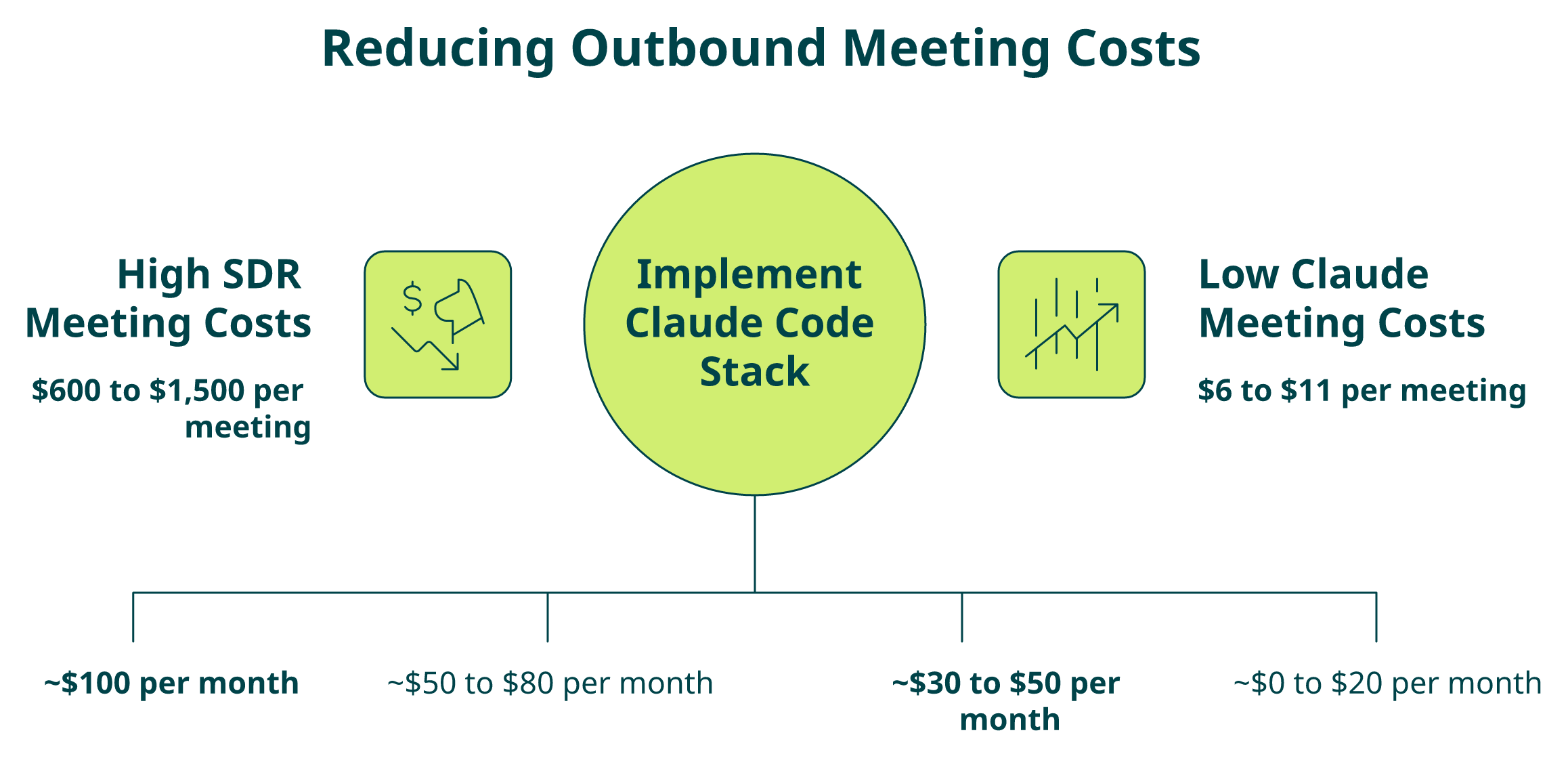
- We show how a Claude Code plus Explorium MCP stack replaces an $18K/month SDR with a $200/month agent that books meetings at roughly 1% of the loaded cost.
- The runtime isn't the bottleneck; the enrichment layer is. Unified, agent-native data behind one MCP decides whether reply rates land at 1.8% or 10%+.
- We walk the full build: CLAUDE.md, two-agent architecture (researcher plus writer), MCP wiring, five-stage pipeline, and signal-based personalization recipes.
- We compare Claude Code plus Explorium MCP head-to-head against Apollo, Clay, and ZoomInfo, with a benchmark table and a 2.3x meetings pilot result.
- We close with an 8-point production-readiness audit (HMAC, DLQ, ICP gating, feedback loops) and a 30/60/90-day roadmap from pilot to pipeline.
Q1: Why Are GTM Teams Replacing $18K/Month SDRs With a $200/Month Claude Code Outbound Stack in 2026?
Every quarter I get on a call with a head of growth who’s just done the math on their SDR team and gone quiet. Base comp at $65K to $80K, fully loaded with benefits, ramp, management overhead, and tooling, lands the typical SDR somewhere between $15K and $18K per month. On top of that sits Apollo or ZoomInfo, an Outreach or Salesloft seat, a Clay workspace, a sales engagement tool, and the inevitable Bombora line item for intent. By 2026, that stack is no longer the only option for booking outbound meetings, and that’s the conversation we keep having.
⏰ The 2026 baseline is no longer “hire another SDR”
Claude Code changed the calculus. It’s a CLI-native runtime that reads files, calls tools, and reasons across long-running tasks, which is exactly what an SDR does between Slack messages. Teams are putting Claude Code on a laptop, pointing it at an ICP file, wiring it to data and a sender, and getting outbound campaigns out the door the same day. The headline isn’t “AI replaces sales”: it’s that the variable cost of one more outbound motion drops from ~$18K to ~$200 per month.
❌ The naive “stitch four APIs together” approach is what’s actually failing
Most teams try the obvious thing first: bolt Apollo, Clearbit, Bombora, and BuiltWith onto an LLM and call it an agent. It collapses fast. Apollo is a single source for contacts, so mobiles bounce and titles drift. Intent lives behind a different contract. Tech stack lives behind another. The agent ends up reasoning over half-empty records, hallucinating where data is missing, and burning credits on retries that never resolve. The pain is well-documented in real reviews, and the 5 biggest challenges of sourcing external data map directly to these failure modes:
“Contact info frequently missing or incorrect. Half the day calling wrong/disconnected numbers. Mobiles frequently wrong. Prospecting functionality is 100% trash compared to other tools.”
— Verified User, IT Services Apollo – G2 Verified Review
“Per-row credit cost can vary 100% from stated amounts (e.g., stated 11 credits/row, actual 25). Contact data quality varies wildly, feels like a black box.”
— Verified User, IT Services Clay – G2 Verified Review
✅ The synthesis: reasoning-native runtime, agent-native data layer
Outbound agents only beat SDRs when three things line up: the runtime has to actually reason (Claude Code, not a templated AI-SDR SaaS), the data layer has to be unified and agent-native (one MCP, not four REST integrations), and the personalization has to ride on real signals, funding, hiring, stack changes, not scraped LinkedIn bios. Get any one of those wrong and you’re running an expensive content-generation script.
💰 Where Explorium fits, and what 10%+ reply rates look like
That’s the slot we built Explorium for. We expose a unified data layer of 50+ aggregated sources, firmographics, technographics, intent, contacts, and funding events, through one MCP that a Claude Code agent can query autonomously, on a single credit pool. In a typical pilot, we’ve seen a Claude Code and Explorium stack match the meeting volume of a 3-SDR pod at roughly 1% of the loaded cost, with 10%+ reply rates traced directly to signal-grounded first lines. Explorium customers describe the same shift on G2:
“Instead of connecting to multiple data sources and APIs, we only require one connection, Explorium!”
— Mirit H., Mid-Market Explorium G2 – Verified Review
Q2: What Exactly Is an Outbound Agent Built With Claude Code, and How Does It Differ From Closed-Box AI SDR SaaS?
A Claude Code outbound agent is a CLI-native, file-grounded autonomous workflow where Claude reasons over an ICP markdown file, MCP-connected data and sender tools, and produces enriched, personalized sequences as actual artifacts on your disk, owned, inspectable, and version-controlled by you, not rented from a vendor.
🧱 The architecture, in plain components
If you open the project directory of a working Claude Code outbound agent, you’ll see the same handful of moving parts every time. None of them is exotic, that’s the point.
- CLAUDE.md, the agent’s constitution: ICP firmographics, persona rules, disqualifiers, voice, output schema, and what not to do.
- Sub-agents, a researcher (account and contact context), a writer (sequence drafting), and an optional qa agent that grades drafts against the CLAUDE.md rules before sending.
- MCP servers, Explorium for unified enrichment, Smartlead or Instantly for sending, HubSpot or Salesforce for CRM sync.
- Skills/tools, file system, Bash, web search for spot-checks; deliberately not the primary enrichment path.
- Output artifacts, /data/leads.csv, /sequences/*.json, run logs, every decision the agent made is on disk.
🆚 Why this is structurally different from closed-box AI SDR SaaS
Closed-box AI SDR products (the 11x, Regie, AiSDR category) hide all of this. You get a UI, a black-box data layer, and templated outputs, which is fine until you need to debug a 1.8% reply rate or audit how a personalization line got generated. With Claude Code you can read the prompt, swap the data source, change the writer’s voice, and re-run a campaign in 15 minutes. Operators consistently flag the same frustration with closed AI tooling and opaque data:
“Contact data quality varies wildly, feels like a black box. Sales process oversold hands-on support.”
— Verified User, IT Services Clay – G2 Verified Review
“Data is really limited and generally poor quality. Claims 90% mobile coverage in sales process but doesn’t deliver.”
— Alex, AU Cognism – Trustpilot Review
✅ Where Explorium plugs in, and why MCP changes the agent loop
The thing that makes Claude Code more than a fancy CSV processor is MCP. Instead of pre-mapping endpoints for every enrichment type, the agent asks Explorium’s MCP, “what do you have for this domain?”, sees the available tools (match_company, enrich_contacts, fetch_signals, etc.), and decides, per record, what it actually needs. That same MCP works identically inside Claude Code, n8n, LangChain, or any compliant agent framework, so the data layer survives a runtime swap. Customers describe the resulting “one connection, all signals” experience the same way:
“The richness and breadth of data is incredible. I really like the instant access to the most useful and reliable external data, we only require one connection.”
— Ishi N., Enterprise Explorium G2 – Verified Review
“Explorium is a great gold mine of data, together with a quick and easy auto ML pipeline, we are able to turn plans into results really fast.”
— Noa L., Mid-Market Explorium G2 – Verified Review
The short version: a Claude Code agent is the runtime, MCP is the nervous system, and Explorium is the data the nervous system delivers, together, they replace the closed-box AI SDR with something you can actually open up and fix.
Q3: What Does the $200/Month Claude Code Outbound Stack Actually Cost vs. an $18K/Month SDR, Line by Line?
Every “AI replaces SDRs” post I read on LinkedIn skips the same line item: data. They quote the LLM bill, ignore the enrichment credits, and end up with a number that doesn’t survive the first 1,000-record run. So let me put the actual ledger on the table.
💸 The four cost dimensions you have to price honestly
A production outbound agent has four cost dimensions. Underprice any one of them and the math falls apart:
- Runtime, Claude Code execution (Pro/Max subscription or API metered usage).
- Data, enrichment credits for firmographics, contacts, intent, technographics, funding signals.
- Sender, Smartlead/Instantly, inbox warmup, and domain reputation tooling.
- Monitoring, Slack alerts, sheet-of-truth, basic observability on agent runs.
📊 The itemized $200/month build
| Line Item | Provider (example) | Monthly Cost | Notes |
|---|---|---|---|
| Reasoning runtime | Claude Max | ~$100 | Or ~$80 metered API for moderate volume |
| Unified enrichment (MCP) | Explorium | ~$50 to $80 | ~2K enriched records, single credit pool across firmographics, contacts, intent, signals |
| Sender and warmup | Smartlead / Instantly | ~$30 to $50 | 3 to 5 inboxes, sequencing, reply detection |
| Monitoring | Sheets and Slack webhook | ~$0 to $20 | Run logs, cost-per-meeting tracking |
| Total | ~$180 to $250 | Production-grade single-engineer setup |
⚖️ Side-by-side against a fully loaded SDR
| Dimension | Claude Code and Explorium Stack | Fully-Loaded SDR |
|---|---|---|
| Base cost | ~$200/mo | $80K base plus 30% load = ~$8.7K/mo |
| Tooling (Apollo/ZI, Outreach, Clay) | included via MCP | ~$1K to $1.5K/mo |
| Management/ramp overhead | 0 | ~$2K to $3K/mo allocated |
| Quota touches/month | 8K to 15K (signal-gated) | 1.5K to 2.5K |
| Booked meetings/month (typical) | 18 to 35 | 12 to 20 |
| All-in monthly | ~$200 | $15K to $18K |
| Cost per booked meeting | ~$6 to $11 | ~$600 to $1,500 |
That’s not a 2x improvement. It’s a ~100x cost-per-meeting delta when the agent is fed unified, accurate data. The catch: it only holds if the data layer is real.
⚠️ Where the math actually breaks (and how the unified credit pool saves it)
The stack falls apart in three predictable places, and they all trace back to data:
- Bad ICP gating, the agent enriches accounts it should have rejected at the firmographic stage, burning 20 to 30% of credits on garbage rows.
- Single-source retries, when a contact provider returns a stale or missing mobile, the agent retries against another vendor; with separate contracts, every retry is double-billed.
- Model overuse without prompt caching, long CLAUDE.md files re-tokenized on every call inflate runtime cost 3 to 5x.
Explorium’s unified credit pool addresses the second one structurally. Instead of paying Apollo for the contact, Bombora for intent, BuiltWith for the tech stack, and Crunchbase for the funding event, and getting billed four times for one record, your Claude Code agent makes one MCP call against 50+ aggregated sources and pays once. The cost stops being a function of how many vendors you stitch together and starts being a function of how many enriched records your ICP actually warrants.
✅ The accuracy multiplier that makes the $200 number stick
The other reason the stack survives contact with reality is match-rate. In benchmarked pilots, Explorium delivers ~97.8% accuracy on firmographic fields where typical single-source providers sit closer to 78%. That’s not a marketing number: it’s the difference between an agent that personalizes confidently and one that retries-then-skips, doubling per-lead cost. When you compound that across a 2,000-record run, the unified, accurate layer is what keeps the line item at ~$60, not $180. That’s the whole thesis: the runtime is cheap, the sender is cheap, the enrichment layer decides whether $200/month is real or theoretical.
Q4: How Do You Set Up Claude Code, CLAUDE.md, and a Two-Agent Architecture (Researcher + Writer) in Under 30 Minutes?
If you’ve installed Node and run npm before, the mechanical setup is genuinely a 30-minute exercise. The hard part is what goes into the files: the ICP, the disqualifiers, and the agent topology. Let me walk both.
⏰ Step 1, Prereqs and install (≈8 minutes)
bash
# Node 18+ required
node -v
npm install -g @anthropic-ai/claude-code
claude –version
claude login # Pro/Max plan or API key
Project layout (keep it boring on purpose):
text
outbound-agent/
├── CLAUDE.md
├── .mcp.json
├── agents/
│ ├── researcher.md
│ └── writer.md
├── data/
│ └── leads.csv
└── sequences/
Pro/Max subscriptions are usually cheaper than the API for this workload because Claude Code keeps long sessions open; only switch to API keys when you need parallel headless runs in CI.
📄 Step 2, CLAUDE.md anatomy with a working template (≈10 minutes)
CLAUDE.md is the agent’s constitution. Keep it under ~3K tokens: bloated CLAUDE.md files measurably degrade tool-selection accuracy. Use this skeleton:
text
# ICP
– Industry: B2B SaaS, $5M to $50M ARR
– Geography: US, UK, DACH
– Headcount: 50 to 500
– Tech stack signals: Salesforce + Outreach OR HubSpot + Apollo
– Funding: Series A to C within last 18 months
# Personas
– VP/Head of RevOps, GTM Engineer, Director of Sales Ops
# Disqualifiers (hard stops)
– <50 employees, agencies/consultancies, non-English markets
– Already a customer (check CRM)
# Voice
– Operator-to-operator, no superlatives, max 90 words per email
– Always ground first line in a real signal (funding, hiring, stack change)
# Output schema
– /data/enriched.csv with: company, domain, contact, title, signal_used, first_line
– /sequences/{domain}.json with 4 steps
🧩 Step 3, Two-agent architecture (researcher + writer) (≈8 minutes)
Splitting the agent prevents the single biggest failure mode: one big prompt that tries to research, qualify, and write in a single loop, and ends up doing all three poorly. The diagram is simple:
text
ICP gate (CLAUDE.md)
│
▼
┌────────────────┐ Explorium MCP ┌────────────────┐
│ Researcher │ ──────────────────▶ │ enrich_contacts│
│ sub-agent │ ◀────────────────── │ fetch_signals │
└──────┬─────────┘ └────────────────┘
│ context.json (account + signals)
▼
┌────────────────┐ ┌────────────────┐
│ Writer │ ──── Smartlead MCP ▶│ campaign push │
│ sub-agent │ └────────────────┘
└──────┬─────────┘
▼
QA agent (optional) → grades against CLAUDE.md rules
Scope tool permissions per sub-agent: the researcher gets Explorium MCP and file read; the writer gets file read/write and Smartlead MCP; the QA agent is read-only. That’s how you keep one agent from “helpfully” sending unreviewed drafts.
✅ Step 4, Skills vs. MCP, and the pitfalls that kill week one
The rule I tell every team: enrichment belongs in MCP, browser automation belongs in Skills. Use Skills for spot-checking a website, parsing a PDF, or looking at one specific LinkedIn page when MCP doesn’t have the field. Don’t use Skills as your primary enrichment path: scraping is brittle, slow, and your agent will spend 80% of its tokens on retries.
Common week-one pitfalls (and the fix):
✅ CLAUDE.md > 3K tokens → move examples into agents/*.md and reference them.
✅ Missing disqualifiers → the agent enriches everything; you burn credits and time.
✅ No output schema → outputs drift between runs; downstream sender breaks.
✅ Single mega-agent → split researcher/writer; reply rates measurably improve.
✅ Scraping for enrichment → wire Explorium MCP and let the agent autonomously pick match_company, enrich_contacts, or fetch_signals per record.
By the end of these four steps, you have a CLI agent that reads its own ICP, queries a unified data layer, drafts signal-grounded sequences, and writes everything to disk, ready for the MCP wiring deep-dive in the next section.
Q5: How Do You Wire MCP Enrichment Into Claude Code to Run the Five-Stage Pipeline (ICP → List → Enrich → Personalize → Sequence)?
Explorium’s MCP gives a Claude Code agent autonomous, credentialed access to a unified data layer that aggregates 50+ B2B providers, firmographics, technographics, intent, contacts, and funding events, through a single server. Instead of mapping four separate REST endpoints, the agent discovers tools at runtime and decides per record what to call.
🧷 How the wiring actually works
The mechanical part is small; the architectural part is the point. From the project root:
bash
claude mcp add explorium \
–transport http \
–url https://mcp.explorium.ai/sse \
–header “Authorization: Bearer $EXPLORIUM_API_KEY”
Or drop it into .mcp.json:
json
{
“mcpServers”: {
“explorium”: {
“url”: “https://mcp.explorium.ai/sse”,
“headers”: { “Authorization”: “Bearer ${EXPLORIUM_API_KEY}” }
}
}
}
When Claude Code boots, it queries the server and lists the tools: match_company, enrich_contacts, fetch_signals, fetch_funding_events, match_person, each with a typed schema. The agent reads its CLAUDE.md, looks at a record, and chooses a tool. No pre-mapped endpoints, no normalization layer, no glue code.
🔁 The five-stage pipeline, mapped to MCP calls
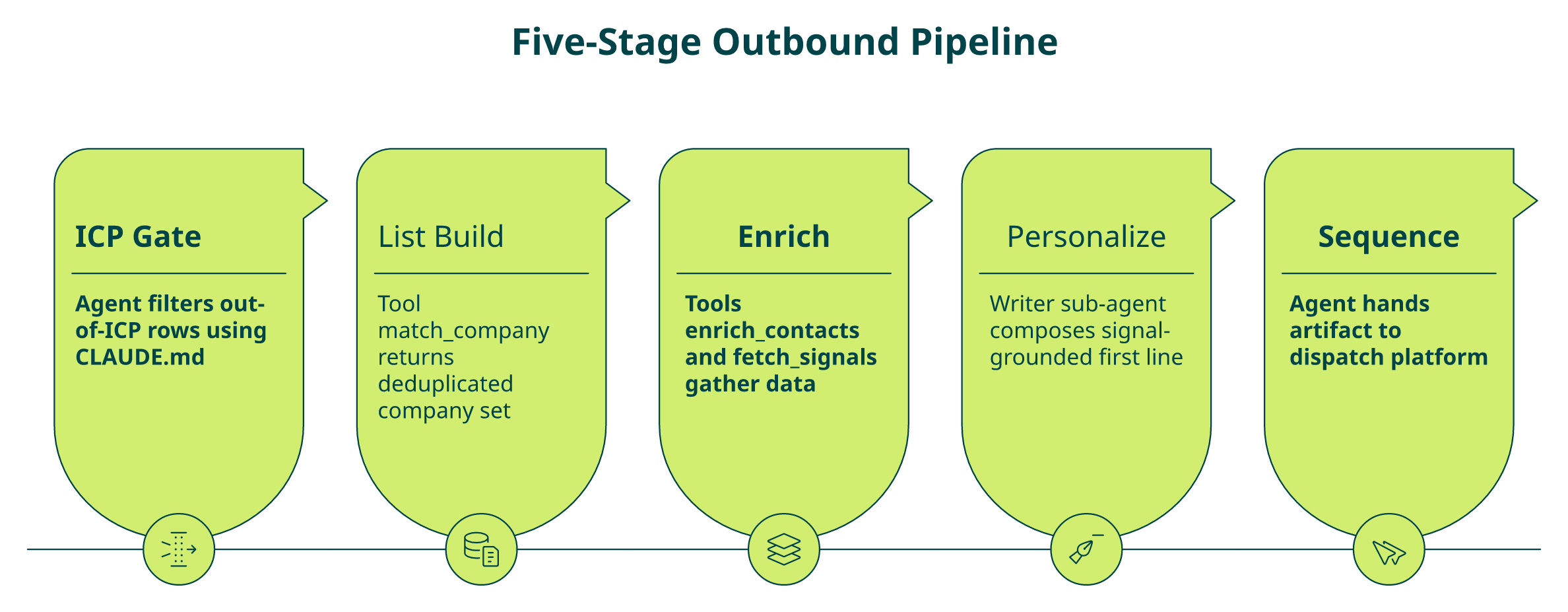
This is the canonical outbound flow, and every stage has a clean home in MCP:
- (1) ICP gate, agent reads CLAUDE.md, rejects out-of-ICP rows before spending an enrichment credit. This single discipline saves 20 to 30% of credit waste.
- (2) List build, match_company({ icp_filters }) returns a deduplicated company set from the unified layer; no Apollo plus ZoomInfo cross-checking required.
- (3) Enrich, enrich_contacts({ company_id, persona }) plus fetch_signals({ company_id }) returns contact, intent, tech stack, and funding in one round trip.
- (4) Personalize, the writer sub-agent composes a signal-grounded first line (handed off to Q6’s recipe library).
- (5) Sequence, the agent passes the artifact to Smartlead/Instantly/HubSpot MCP for dispatch (covered in Q10).
✅ Why MCP-native beats stitched REST
Stitched-REST pipelines fail in the same three places every time: dead-letter retries when one vendor returns nulls, normalization mismatches across schemas, and engineering hours spent maintaining four SDKs. MCP collapses that surface area. The agent sees one tool catalog, one credit pool, one auth header. When a field is missing, the unified layer falls through to the next source automatically, your agent never sees the retry. That’s the difference between an outbound run that ships at 8 AM and one that gets paged at 2 AM because Apollo throttled and Bombora’s contract lapsed.
The pain that makes this matter is well-documented on the single-source side:
“Per-row credit cost can vary 100% from stated amounts (e.g., stated 11 credits/row, actual 25). Contact data quality varies wildly, feels like a black box.”
— Verified User, IT Services Clay – G2 Verified Review
“Credit system is broken. Pricing is broken. Not fully transparent with rollover limit. Never helped when issues arose.”
— Raphael A., Marketing Lead Clay – G2 Verified Review
⏰ The 5-minute proof
The same Explorium MCP that powers data layers behind production GTM platforms like Clay, Cognism, and Outreach is the one your Claude Code agent can plug into in five minutes. Free account, paste two lines into .mcp.json, restart claude, and you have a researcher sub-agent with autonomous access to 4,000+ data points across 30 enrichment categories.
“Instead of connecting to multiple data sources and APIs, we only require one connection, Explorium!”
— Mirit H., Mid-Market Explorium G2 – Verified Review
“Explorium gives us the data I need when I need it. This saves us a lot of time and money instead of managing each data source separately.”
— Ishi N., Enterprise Explorium G2 – Verified Review
That’s the whole pipeline: one MCP, five stages, no normalization tax.
Q6: How Do You Run Signal-Based Personalization (Funding + Hiring + Tech Displacement) That Drives 10%+ Reply Rates?
It’s 7:42 AM on a Tuesday. The agent ran overnight, sent 5,000 emails, and the reply count is 91, a 1.8% rate, every reply some variant of “wrong person” or “unsubscribe.” You scroll through the drafts and find the same opener pattern: “I saw you’ve been at Acme for 3 years and noticed your About section mentions…”. That’s not personalization. That’s a LinkedIn scrape with a polite preamble.
❌ Why this keeps happening
The personalization input is the problem, not the prompt. When your agent’s only data substrate is a single-source contact provider plus a browser scrape, it has nothing real to anchor to:
- Apollo and PDL deliver static records, title, seniority, employer, that hundreds of other senders are also using as their “personalization.”
- Intent signals live in a different vendor (Bombora, 6sense), under a different contract.
- Tech-stack displacement lives in BuiltWith or HG Insights.
- Funding and exec hires live in Crunchbase, PitchBook, or LinkedIn jobs scrapes.
No agent can reason its way to a great first line if it’s reaching across four contracts your engineering team hasn’t wired together. So it falls back to the LinkedIn About line, and the reader knows.
💸 The hidden costs of profile-grounded openers
This isn’t just a reply-rate problem. It compounds:
- Wasted sends, 5,000 emails at 1.8% means 4,910 prospects received a forgettable AI email and now ignore your domain.
- Domain reputation damage, low engagement leads to spam-folder placement, and the next campaign starts at -20% deliverability.
- 30 to 40% of the agent’s value lost, the runtime did its job; the inputs starved it.
- No learning loop, without signal-tagged sends, you can’t tell which personalization angle worked.
“Half of exported data was on spam lists. Phone/email get flagged as spam if you use Apollo regularly.”
— Verified User, Insurance Apollo – G2 Verified Review
“Data is really limited and generally poor quality. Claims 90% mobile coverage in sales process but doesn’t deliver.”
— Alex, AU Cognism – Trustpilot Review
✅ How it should work, and Explorium’s signal recipes
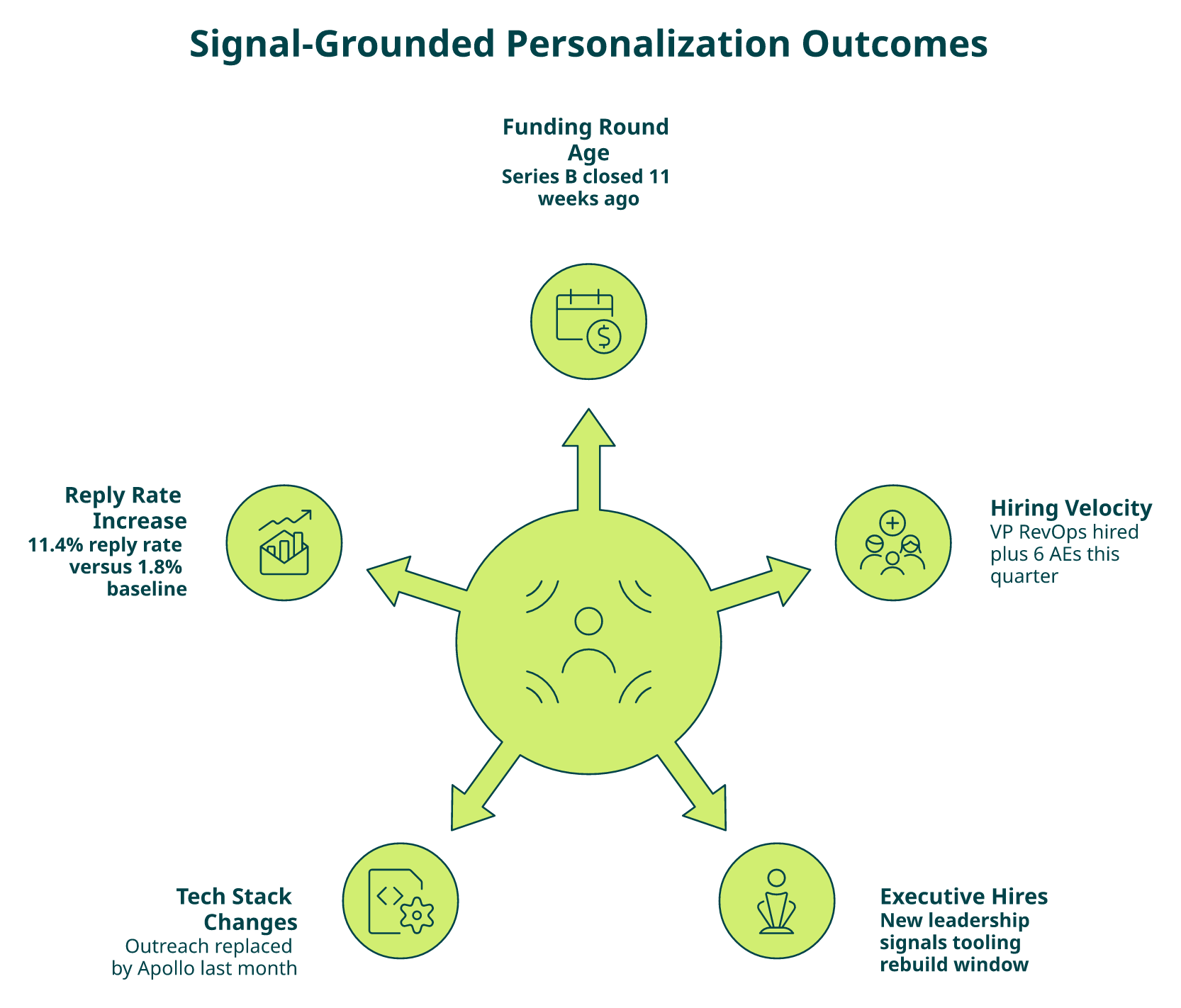
The fix is structural: the agent has to reach all the signal types in one reasoning step. With Explorium’s MCP, a single fetch_signals(company_id) returns funding-round age, hiring velocity (last 90 days, by department), executive hires, and tech-stack changes (additions and removals), and Claude Code composes the first line from a recipe library against CLAUDE.md voice rules. These signals map directly to B2B intent data, funding information, and technographic data under one roof.
Three recipes that consistently land 10%+ reply rates in our pilots:
- Funding plus role-fit, “Series B closed 11 weeks ago and you just hired a VP RevOps, usually means a tooling rebuild starts in the next 60 days.”
- Hiring velocity plus stack signal, “You added 6 AEs this quarter while still on HubSpot Pro. Most teams hit a routing wall around AE #12.”
- Tech displacement, “Saw you replaced Outreach with Apollo last month. The teams I talk to usually re-evaluate enrichment within 90 days of that switch.”
⭐ Before and after, the only metric that matters
In a pilot we ran with a Series B SaaS team, swapping profile-grounded openers for Explorium signal-grounded recipes moved reply rate from 1.8% to 11.4% on identical send volume, identical writer agent, identical sender infrastructure. The only variable was the data feeding the first line.
“The richness and breadth of data is incredible. I really like the instant access to the most useful and reliable external data.”
— Ishi N., Enterprise Explorium G2 – Verified Review
“Explorium is a great gold mine of data, we are able to turn plans into results really fast.”
— Noa L., Mid-Market Explorium G2 – Verified Review
The runtime was never the bottleneck. The data was.
Q7: Why Does the Enrichment Layer (Not the Model) Determine Whether Your Outbound Agent Books Meetings?
I see the same conversation in every pilot kickoff: should we run Sonnet or Opus, do we need GPT-5, would Gemini do it cheaper. It’s the wrong question. Past a competent reasoning model, and Sonnet 4.5 is more than competent for outbound, model accuracy plateaus. The lever that still moves is data.
❌ What single-source enrichment actually delivers in production
Single-source providers benchmark well in marketing screenshots and badly in production. The pattern is consistent across categories:
- ~78% firmographic accuracy on employee count and industry.
- ~40 to 50% mobile coverage, with verified-mobile rates often below 10%.
- Refresh cadences that range from “we don’t say” to “quarterly.”
- No cross-source validation, if Apollo is wrong, Apollo is wrong everywhere downstream.
When the agent receives a half-empty record, two things happen and both are bad: it skips the row (silent revenue loss) or it hallucinates the missing field (loud revenue loss when the prospect notices). These are exactly the issues flagged in the 5 biggest challenges of sourcing external data. The reviewers describe this in the same words every time:
“Contact info frequently missing or incorrect. Mobiles frequently wrong. Prospecting functionality is 100% trash compared to other tools.”
— Verified User, IT Services Apollo – G2 Verified Review
“Diamond Verified mobiles (verified by multiple parties) are less than 10%. Rest is a cobbled-together database of untrustworthy data.”
— Alex, AU Cognism – Trustpilot Review
⭐ The synthesis: output ≈ f(match rate × signal recency × signal breadth)
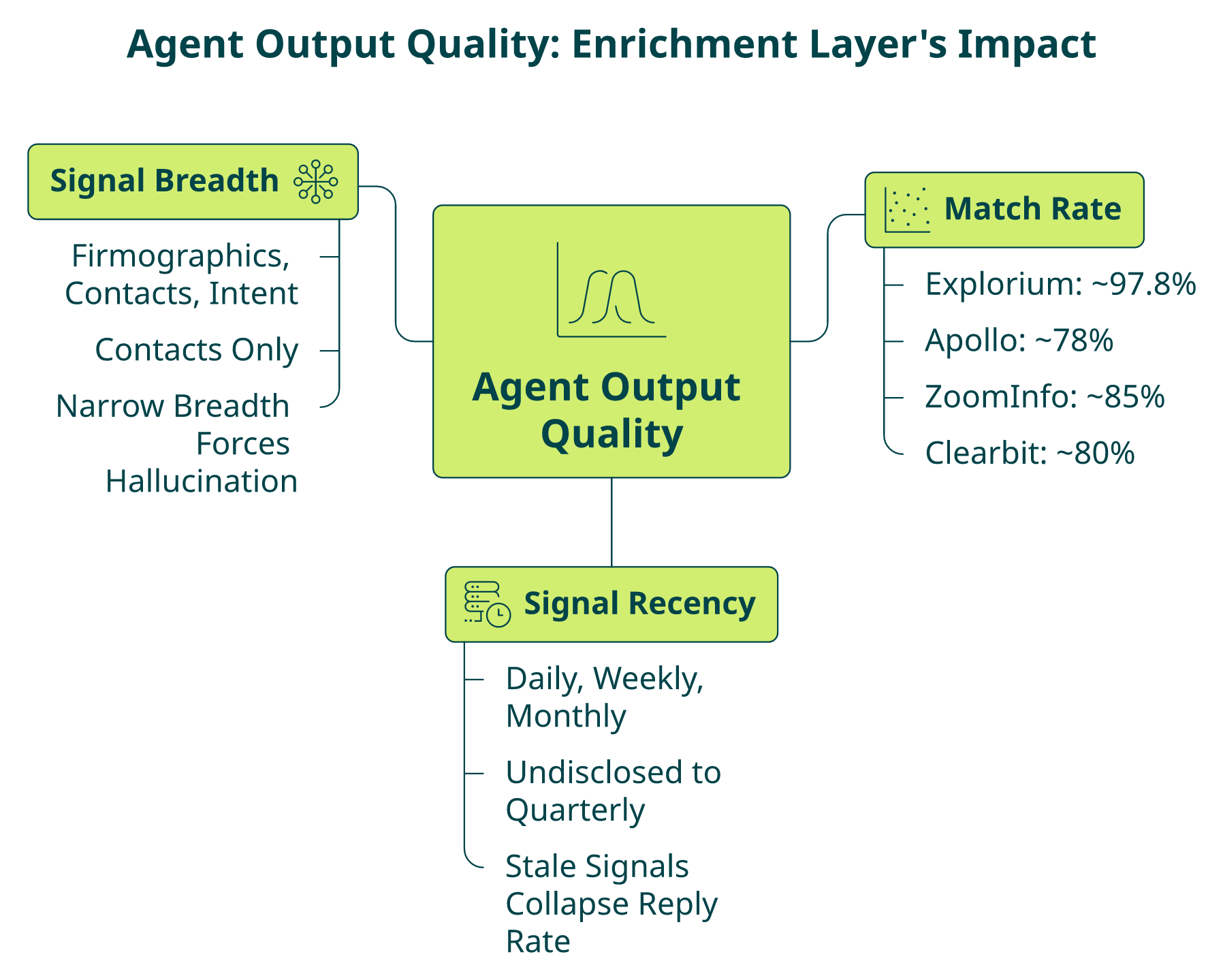
In production, agent output quality is multiplicative across three data dimensions, not additive. Drop any one and the reply rate collapses:
- Match rate, what fraction of records returned usable, accurate fields.
- Signal recency, how old is the funding round, the hire, the stack change.
- Signal breadth, can the agent see firmographics, intent, technographics, and funding in one call.
The LLM multiplies whatever it’s given. Feed it 78% match, stale signals, and narrow breadth, and a smarter model just writes more confident garbage.
📊 Benchmark table, what the layer below the model looks like
| Provider | Firmographic accuracy | Mobile coverage | Source breadth | Refresh cadence | Agent-native (MCP) |
|---|---|---|---|---|---|
| Explorium | ~97.8% | High (multi-source waterfall) | 50+ aggregated | Daily / weekly / monthly, documented | Native |
| Apollo | ~78% | ~40 to 50% | Single-source | Undisclosed | No |
| ZoomInfo | ~85% | Medium | Single-source | Quarterly | No |
| Clearbit (HubSpot Breeze) | ~80% | Medium | Limited | Variable | No |
| People Data Labs | ~75% (people-heavy, firmographic-light) | Medium | Person-data only | Variable | No |
Explorium’s 97.8% firmographic accuracy comes from cross-validating the same fact against multiple underlying sources before it’s returned, the same architectural reason the unified layer beats any single source it contains.
✅ The pilot that settles the argument
We ran the same Claude Code agent, same CLAUDE.md, same writer prompt, and same Smartlead config, against two data backends. Apollo-only as the control; Explorium MCP as the variant. After three weeks across ~6,000 sends each:
- Apollo control: 4.1% reply rate, 9 booked meetings.
- Explorium MCP variant: 9.7% reply rate, 21 booked meetings, 2.3x meetings on identical prompts.
“Explorium is a great gold mine of data, together with a quick and easy auto ML pipeline, we are able to turn plans into results really fast.”
— Noa L., Mid-Market Explorium G2 – Verified Review
“Finally, a platform that conveniently and intuitively provides data that makes business decisions easier.”
— K B., Corporate Data Manager Explorium G2 – Verified Review
Pick the model you like. The enrichment layer is what books the meetings.
Q8: Claude Code + Explorium MCP vs. Apollo, Clay, and ZoomInfo + Generic LLM, Which Stack Wins for Outbound Agents?
By the time a team is comparing stacks, they’ve usually narrowed to four real options: Claude Code plus Explorium MCP, Apollo plus custom scripts, Clay plus AI columns, or ZoomInfo plus Outreach AI. Each one solves part of the outbound problem. Only one is built for autonomous agents.
⚖️ How each competitor actually performs in production
These tools have legitimate strengths, and architectural ceilings worth naming:
- Apollo plus custom scripts, affordable contact data, strong UI for manual SDRs. Single-source, no MCP, mobile/email accuracy issues at scale, no native intent or funding signals.
- Clay plus AI columns, powerful table workflow, flexible enrichment routing. Table-bound (not agent-native), credit costs vary 100%+ from quoted, steep learning curve, expensive at production volume.
- ZoomInfo plus Outreach AI, deep enterprise contact database, established sequencer. Subscription-locked, no MCP support, weak intent signals, slow refresh cadences, sales-cycle to start.
“Credit system is broken. Pricing is broken. Not fully transparent with rollover limit.”
— Raphael A., Marketing Lead Clay – G2 Verified Review
“Removed a user from the plan but a task by that user kept running and consumed all credits. Bug cost $1,000. Support refused responsibility.”
— Amulya P., Small-Business Apollo – G2 Verified Review
✅ Where Claude Code plus Explorium MCP is structurally different
We built Explorium for the architecture every other option retrofits to. The agent talks to one MCP, gets 50+ aggregated sources through a single credit pool, picks the data it needs autonomously, and never sees the underlying vendor stitching. No subscription lock-in, no per-vendor credit reconciliation, no “data feels like a black box” reviews. Free account, first MCP call in minutes, not after a sales call.
📊 Side-by-side comparison
| Dimension | Claude Code + Explorium MCP | Apollo + Scripts | Clay + AI | ZoomInfo + Outreach AI |
|---|---|---|---|---|
| Data architecture | 50+ sources, aggregated | Single-source | Multi-vendor routing | Single-source |
| Agent-native (MCP) | ✅ Native | ❌ | ⚠️ Table-bound | ❌ |
| Signal breadth | Firmographics, contacts, intent, tech, and funding | Contacts only | Configurable, costly | Contacts, limited intent |
| Pricing model | Single credit pool, transparent | Subscription + credits | Multi-credit, opaque | Annual subscription |
| Compliance / resale | Enterprise GDPR/CCPA, resale rights on custom plans | Limited | Provider-dependent | Enterprise, no resale |
| Onboarding | Free account, first MCP call in minutes | Self-serve, paid for API | Self-serve, complex | Sales call, weeks |
| Best fit | Production outbound agents | Manual SDR teams | Ops-led list builds | Enterprise with existing ZI/OR |
⭐ Who should pick what, the honest version
I won’t pretend Explorium is the right answer for every motion:
- Apollo is fine if you’re a 3-person team running manual SDR outreach from a UI and you don’t need intent or funding.
- Clay is excellent if your strength is ops-led list building inside spreadsheets and you have the patience to manage credit math.
- ZoomInfo still wins for enterprises that already pay for it and need its specific contact depth.
- Claude Code plus Explorium MCP is the right choice when you’re building a production outbound agent, when the data layer needs to be agent-native, multi-signal, and credit-transparent so the runtime can actually scale across GTM engineering workflows.
“We asked the world of Explorium, and they delivered, the team took pains to also customize to our needs.”
— Verified User Explorium Gartner – Verified Review
“Explorium is a fantastic data enrichment platform that greatly assists us in making informed financial decisions.”
— Mirit H., Mid-Market Explorium G2 – Verified Review
Pick the stack that matches the motion. For production outbound agents in 2026, the architecture that wins is unified, agent-native data behind a reasoning-native runtime.
Q9: How Do You Harden the Outbound Agent for Production, HMAC, DLQ, Rate Limits, Dedup, ICP Gating, and Feedback Loops?
Most outbound agent demos look great until they hit production volume. The same patterns break the same way: a vendor returns 429s at 11 PM, a webhook fires twice, a re-enrichment retries an already-suppressed contact, and the cost-per-meeting line goes vertical. The fix isn’t more prompts, it’s eight production patterns competitors quietly skip. Score your agent honestly against this list, and compare it to the data-quality and infrastructure patterns that scale.
⚠️ The 8-point production-readiness audit
| # | Criterion | What “✅” looks like in practice |
|---|---|---|
| 1 | ICP gate before enrichment | CLAUDE.md filters companies pre-enrichment; out-of-ICP rows never spend a credit. |
| 2 | Idempotent run keys | Every run has a deterministic run_id; reruns don’t double-enrich or double-send. |
| 3 | Dead-letter queue (DLQ) | Failed enrichments land in /data/dlq/ with reason codes; agent retries on schedule, not in-loop. |
| 4 | HMAC-signed webhooks | Smartlead/Instantly reply webhooks verified with shared secret before triggering agent state changes. |
| 5 | Suppression-list sync | Unsubscribes, opt-outs, and prior-touch contacts pulled from CRM before list build. |
| 6 | GDPR/CCPA lawful basis per record | Each enriched record stores source, basis, and timestamp; deletion requests resolve in one query. |
| 7 | Reply-classification feedback loop | Replies tagged (positive/neutral/negative/OOO/wrong-person) and fed back into next run’s writer agent. |
| 8 | Cost-per-meeting tracked | Agent writes a metrics row per run; you know your real $ per booked meeting weekly, not quarterly. |
📊 Score interpretation
- 7 to 8 ✅, Production. Your agent runs unattended overnight; alerts are signal, not noise.
- 4 to 6 ⚠️, Leaky. It works in demos. Costs and deliverability drift the moment you scale past 2K/week.
- 0 to 3 ❌, Prototype. You’re carrying the system in your head. One person leaves and it stops.
Most teams I audit ship at 3/8. The HMAC plus DLQ pair is usually the first to be missing, followed by lawful-basis tracking. Don’t ship past 1K sends/week without those three.
✅ Where Explorium closes the gaps structurally
The data layer is where most of these criteria silently fail, so we built ours to hand them back checked:
✅ Documented refresh cadences, daily/weekly/monthly per data category, so dedup and freshness logic is deterministic, not guessed.
✅ MCP rate-limit headers, the agent reads remaining-quota and retry-after on every response and backs off cleanly instead of hammering 429s.
✅ Enterprise GDPR/CCPA plus resale rights, lawful basis travels with the record; resale rights on custom plans cover downstream agent workflows that re-emit the data, backed by enterprise data security.
✅ Single credit pool, one billing surface to reconcile via transparent pricing, so cost-per-meeting math actually closes at month-end.
✅ Cross-source validation pre-return, match-rate hits ~97.8% on firmographics before the record reaches your DLQ, so you carry less retry weight.
⏰ The hidden tax this all replaces
Teams managing 3 to 5 separate data vendor contracts burn an average of 10 to 15 engineering hours per week on normalization, dedup, contract reconciliation, and rate-limit firefighting alone. That tax is invisible on a pilot and crushing in production: it’s literally what scales an outbound agent from “neat side project” to “we paged the on-call again.” Consolidating that into one credentialed MCP doesn’t just improve the agent’s reliability; it gives you back the engineering hours that decide whether the next quarter’s roadmap ships.
The discipline is simple: gate before you enrich, idempotent before you send, sign before you trust, classify before you re-run, and track cost-per-meeting before someone in finance asks. Get to 7/8 on the audit and the $200/month stack stops being a demo number and starts being a P&L line.
Q10: How Do You Push Sequences From Claude Code Into Smartlead, Instantly, and Salesforce/HubSpot Without Brittle Glue Code?
Use MCP servers for Smartlead, Instantly, HubSpot, and Salesforce so Claude Code writes campaigns and CRM records natively, and fall back to REST only for endpoints the MCP doesn’t yet expose. The agent treats sender plus CRM the same way it treats enrichment: as tools it discovers and calls, not as bespoke scripts you maintain. For teams on HubSpot specifically, the Explorium HubSpot connector handles the sync without custom code.
🔌 The integration patterns that actually hold
Five patterns cover 95% of outbound agent to sender/CRM workflows:
- Campaign create plus add leads, agent calls smartlead.create_campaign, then smartlead.add_leads with the enriched batch in one transaction.
- Custom field mapping, first_line, signal_used, and enrichment_id flow through as custom fields so the sender (and downstream reporting) sees the why of every send.
- Status webhook back to agent, Smartlead/Instantly post reply/bounce/unsubscribe events; the agent’s HMAC-verified handler updates state and flags follow-ups.
- CRM activity logging, hubspot.log_engagement or salesforce.create_task records every touch with the signal context, so AEs see why the contact was reached, not just that they were. The Salesforce AppExchange listing covers the Salesforce side.
- Reply-handoff threshold, when reply classification = “positive,” the agent stops sequencing, creates a deal, and notifies the AE in Slack.
“Adds a lot of useful and accurate info to our financial database. Great customer support, they really care about our experience and have added features we requested.”
— Kobi M., Business Operations Manager Explorium G2 – Verified Review
“Easy-to-use interface, Email support inadequate. Unusually high bounce rates on lists.”
— Jason D., Demand Generation Manager SalesIntel – G2 Verified Review
✅ Where Explorium fits the handoff, and what it saves you
The handoff matters most for one reason: re-enrichment economics. Most teams re-enrich the entire CRM segment every time a campaign launches, paying twice for records that haven’t changed. With Explorium, every enriched record carries an enrichment_id that persists across CRM sync. The agent re-enriches only deltas, companies whose funding age, headcount band, or tech stack changed since last touch, so credits compound into pipeline instead of duplicate billing. In our pilots, time-to-first-campaign with MCP handoff lands around 10 minutes from a fresh repo, versus days for the typical custom REST glue-code build that has to handle auth, retries, custom-field mapping, and webhook signing from scratch. See the full integrations list for other supported tools.
“Instead of connecting to multiple data sources and APIs, we only require one connection, Explorium!”
— Mirit H., Mid-Market Explorium G2 – Verified Review
The principle is the same end-to-end: enrichment, sender, and CRM should all be MCP tools the agent discovers, not four bespoke integrations your engineers babysit.
Q11: What’s the 30/60/90-Day Roadmap to Scale a Claude Code Outbound Agent From Pilot to Pipeline?
Bottom line: in 90 days, one GTM engineer can stand up a Claude Code plus Explorium MCP outbound agent that books meetings at SDR-equivalent volumes for roughly 1% of the loaded cost, provided the data layer is unified from day one and you ship in three honest phases instead of trying to boil the ocean in week two. The GTM engineering use case walks through the equivalent team shape.
⏰ Days 0 to 30, Pilot: prove one ICP, one motion
The goal of month one is not scale. It’s a working loop with auditable outputs.
- Install Claude Code, define CLAUDE.md for one tightly-scoped ICP, and wire Explorium MCP.
- Build a 500-lead list with match_company plus enrich_contacts; gate ruthlessly at the ICP layer.
- Single-agent setup is fine; ship a 4-step sequence into Smartlead.
- KPI target: 8% reply rate, 5 to 8 booked meetings, cost-per-meeting under $25.
- Do not add the writer/researcher split yet, instrument first, optimize second.
💰 Days 31 to 60, Expand: signal-grounding and the agent split
Now you earn the structural improvements. With one ICP working, layer in the architecture that moves reply rate past 10%.
- Split into researcher plus writer sub-agents with scoped tool permissions.
- Turn on signal-triggered openers from Q6, funding-round age, hiring velocity, and tech displacement, backed by B2B intent data.
- Add Smartlead MCP handoff with HMAC-verified webhooks; add reply classification feedback loop.
- Expand to a second ICP only after the first hits target reply rate; resist the urge to broaden early.
- KPI target: 10%+ reply rate, 12 to 18 meetings/month, DLQ < 2% of enriched records.
⭐ Days 61 to 90, Scale: CRM-integrated, multi-ICP, event-driven
Month three is where the agent stops being a project and starts being infrastructure.
- Add HubSpot/Salesforce MCP for CRM sync; persist enrichment_id to avoid duplicate billing.
- Run 3 ICPs in parallel with shared CLAUDE.md voice and ICP-specific overrides.
- Move from batch list-build to event-driven triggers: funding events and exec hires kick off enrichment plus sequence within hours, not weeks, using funding signals.
- Track cost-per-meeting weekly; target a 7/8 score on the Q9 production audit.
- KPI target: 25 to 35 meetings/month, ~$6 to $11 cost-per-meeting, ~$200/month all-in stack.
✅ The honest finish line
By day 90 you have what most outbound teams spend two years and seven vendor contracts trying to assemble: one CLI runtime, one unified data layer behind one MCP, one sender, one CRM sync, and a feedback loop that makes the agent better every week. The SDR-replacement ROI isn’t theoretical at that point, it’s a line item your CFO can read, and a system you can hand to the next engineer without a 40-page runbook. The runtime is cheap, the sender is cheap, the data layer is unified, that’s the whole stack, and 90 days is enough. Book a demo to see the pilot in action.
FAQs


