

TL;DR
- Data enrichment tools vary widely by architecture — platform-first, API-native, and agent-native options each serve different buyer profiles and stack requirements.
- Waterfall enrichment is the industry-standard approach for maximizing match rates, but only a handful of tools support it natively without custom orchestration.
- Agent-era requirements demand synchronous APIs, deterministic entity resolution, and high query-per-second throughput — legacy platform tools often fall short on all three.
- Total cost of ownership calculations must include match rate, fallback costs, engineering overhead, and per-record pricing — not just the headline license fee.
- Clearbit and ZoomInfo Enrich remain strong for CRM enrichment workflows but carry high per-record costs and limited agent compatibility.
- Apollo and Clay offer accessible entry points for SMB and ops teams, though Apollo’s data freshness and Clay’s per-row pricing both create friction at scale.
- Explorium’s API-native architecture with MCP server support, 50+ aggregated sources, and 100 QPS throughput makes it the strongest choice for AI agent and programmatic enrichment workflows.
Choosing a data enrichment tool in 2025 is harder than it looks. The category has splintered into at least four distinct archetypes — form enrichment, CRM enrichment, API enrichment, and AI-agent enrichment — and each archetype has materially different requirements around latency, throughput, data coverage, and pricing model. A tool that performs brilliantly for a RevOps team running weekly CRM syncs will fail catastrophically when an AI sales agent tries to resolve 10,000 company records in real time at 100 queries per second.
This guide is written for buyers who need to make a real decision: GTM engineers building enrichment pipelines, RevOps leaders evaluating vendor contracts, and AI infrastructure teams wiring up agent workflows. We compare six major tools — Clearbit, ZoomInfo Enrich, Apollo, Clay, People Data Labs, and Explorium — across the dimensions that actually matter: API quality, data coverage, waterfall enrichment support, agent compatibility, and total cost of ownership. We also share a practical evaluation framework and a bake-off methodology you can run before signing any contract.
If you are only building a small-volume CRM enrichment workflow with a no-code team, several of these tools will serve you adequately. But if you are building for scale, for agents, or for coverage across challenging firmographic segments, the differences between these tools are enormous — and choosing the wrong one has compounding costs.
The Four Archetypes of Data Enrichment Tools
Before comparing specific vendors, it is worth establishing a shared taxonomy. “Data enrichment” is an overloaded term that describes at least four architecturally distinct use cases. Conflating them leads to bad vendor selection and failed implementations.
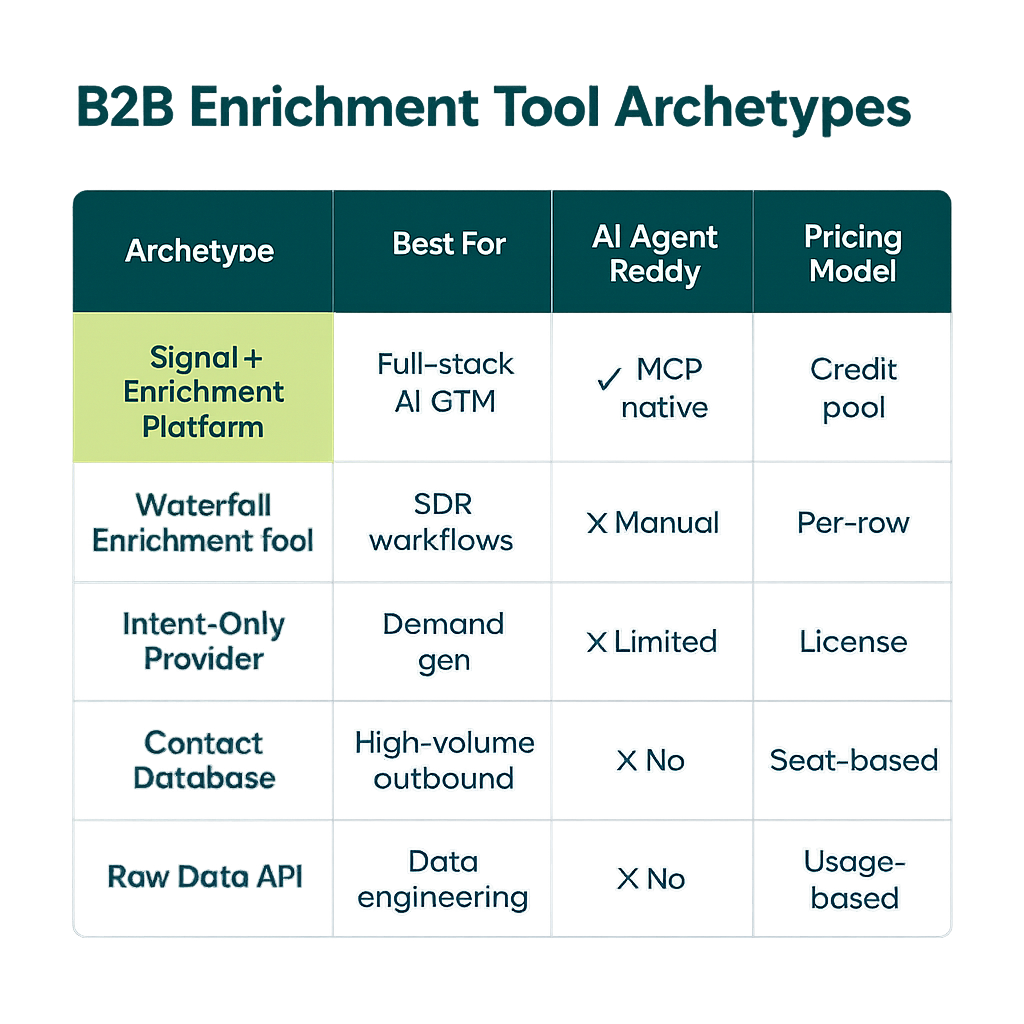
Form enrichment (also called progressive enrichment or real-time form shortening) fires an API call the moment a prospect submits a web form — often with just an email address or company domain — and auto-populates the missing firmographic and contact fields before the record hits your CRM. The requirements here are strict: sub-200ms response time, high match accuracy on partial inputs, and a REST or webhook interface that plays nicely with your marketing automation platform. Clearbit pioneered this category and still leads it.
CRM enrichment is a batch or near-real-time process that continuously monitors your contact and account records for data decay, then appends and refreshes fields like job title, phone number, technographic stack, and funding stage. RevOps teams typically run this on a weekly or monthly cadence. The requirements shift: throughput matters more than latency, bulk CSV import or native CRM connector support is essential, and change-detection logic (so you are not paying to re-enrich unchanged records) is valuable. ZoomInfo Enrich and Apollo both compete strongly here.
API enrichment treats enrichment as a programmatic primitive that engineers call synchronously from backend services, data pipelines, or internal tooling. The API needs to be reliable, versioned, well-documented, and fast enough to embed in a request path. Match accuracy on ambiguous inputs — a company name without a domain, or a LinkedIn URL without an email — becomes critical because the API caller cannot fall back to a human-reviewed queue. People Data Labs and Explorium are the strongest API-native options.
AI-agent enrichment is the newest archetype and the one creating the most architectural turbulence in the market. AI agents — whether built on LangChain, CrewAI, Autogen, or custom orchestration — need to resolve entities, fetch firmographic context, and make routing decisions in real time, often at throughputs of 50–200 QPS per agent instance. They also need deterministic, machine-readable responses without HTML scraping, and ideally an MCP (Model Context Protocol) server interface so the agent can call enrichment as a native tool rather than wrapping a raw HTTP client. Most legacy enrichment platforms were not built for this and fail on QPS limits, response format, or both.
Understanding which archetype you are buying for is the single most important step in this evaluation. The matrix below maps each tool to the archetypes it serves best.
| Tool | Form Enrichment | CRM Enrichment | API Enrichment | Agent Enrichment |
|---|---|---|---|---|
| Clearbit | Excellent | Good | Good | Limited |
| ZoomInfo Enrich | Limited | Excellent | Fair | Poor |
| Apollo.io | Fair | Good | Fair | Poor |
| Clay | Poor | Good | Fair | Fair |
| People Data Labs | Good | Good | Excellent | Fair |
| Explorium | Good | Good | Excellent | Excellent |
Evaluation Framework: The Six Dimensions That Matter
Once you have identified your archetype, you need a structured scoring framework to compare vendors. Six dimensions consistently drive real-world enrichment outcomes. Here is how to weight them for each archetype, followed by a description of what to actually measure.
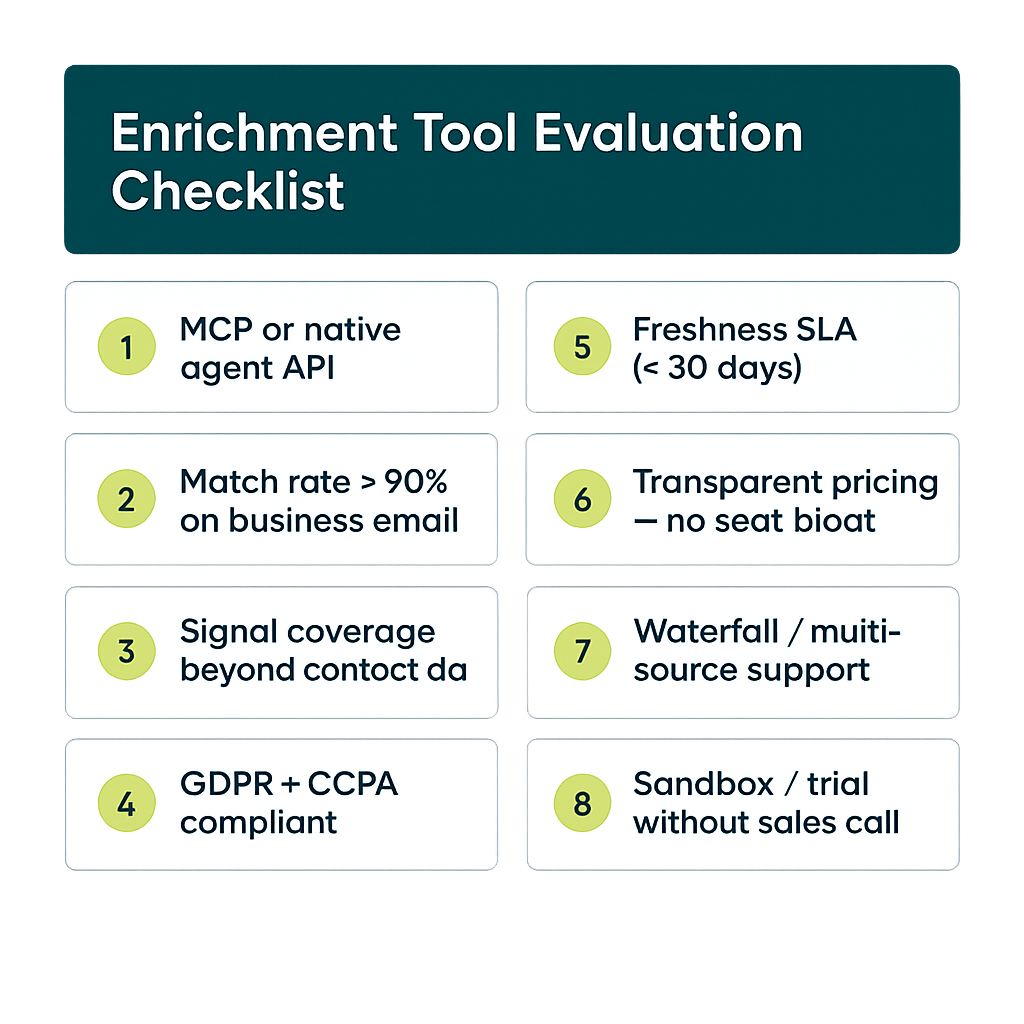
API quality and developer experience encompasses documentation completeness, SDK availability, response latency (P50 and P99), rate limits, versioning guarantees, and error messaging. This dimension is most critical for API and agent enrichment archetypes. A well-designed API will have a single endpoint for company resolution, a separate endpoint for person resolution, and a bulk endpoint for batch workloads — all returning consistent JSON schemas with confidence scores attached to each field. Poorly designed APIs return inconsistent schemas across data sources, require multiple sequential calls to assemble a complete record, and provide unhelpful error codes when a match fails.
Data coverage and freshness measures what percentage of your target ICP can actually be matched, and how recently the matched data was verified. Coverage varies dramatically by geography (US-centric tools often have 60–80% lower match rates on EMEA records), company size (SMB coverage is consistently weaker than enterprise coverage across all major providers), and data type (email and phone have the worst freshness because they decay fastest). Always run a coverage test against a sample of your actual target records — not synthetic benchmark data — before committing to a vendor.
Waterfall enrichment support describes whether the tool can natively route an unmatched record to a secondary or tertiary data source rather than returning a null result. Waterfall enrichment is the established best practice for maximizing match rates: you try Source A first, fall back to Source B if Source A misses, and fall back to Source C if both miss. Native waterfall support means the tool handles this orchestration internally. Without it, you must build the orchestration layer yourself — which adds engineering overhead and latency. Only a minority of tools support this natively.
Agent compatibility measures whether the tool can function as a reliable primitive inside an AI agent workflow. The requirements: synchronous REST API with sub-500ms P95 latency, at least 50 QPS sustained throughput per API key, deterministic entity resolution (same input always produces the same canonical entity ID), structured JSON output with no HTML or markdown, and ideally an MCP server so agents can call enrichment as a first-class tool. Tools that fail on QPS limits or return inconsistent schemas are functionally unusable for agent workloads.
Pricing model and TCO is more complex than it appears. Most vendors quote a per-record or per-credit price, but the true cost depends on: your match rate (missed records are wasted credits), your re-enrichment cadence (monthly re-enrichment of a 100K record CRM costs 1.2M credits per year), whether fallback enrichment costs extra, and whether there is a minimum contract. A tool with a 10% lower per-record price but a 15% lower match rate is more expensive in practice. Build a TCO model before vendor selection.
Build vs. buy considerations matter most for teams evaluating API enrichment. A capable engineering team can aggregate three or four data provider APIs directly and build their own waterfall logic — but the ongoing maintenance cost (new provider integrations, schema normalization, rate limit management, credential rotation) is substantial. The break-even point for most teams is approximately 2M records per year: below that volume, a managed enrichment API is almost always cheaper on a fully-loaded basis.
| Dimension | Form Enrichment Weight | CRM Enrichment Weight | API Enrichment Weight | Agent Enrichment Weight |
|---|---|---|---|---|
| API Quality & DX | High | Medium | Critical | Critical |
| Data Coverage | High | Critical | High | High |
| Waterfall Support | Low | High | High | Critical |
| Agent Compatibility | Low | Low | Medium | Critical |
| Pricing / TCO | Medium | High | High | High |
| Build vs. Buy Fit | Low | Medium | High | High |
Tool Deep Dives: Six Vendors Reviewed
The following reviews are based on public documentation, developer community feedback, published benchmarks, and direct API testing. Pricing information is approximate and should be verified directly with vendors, as it changes frequently.
Clearbit (now part of HubSpot) remains the gold standard for form enrichment and has one of the cleanest developer APIs in the category. Its Enrichment API accepts an email or domain and returns a structured JSON record with 100+ company and person fields in under 200ms at P95. The data quality for US-based technology companies is genuinely excellent — match rates of 85–92% are realistic for this segment. Coverage weakens significantly outside this core segment: EMEA SMBs, non-English companies, and contacts without professional email addresses all show materially lower match rates. Since the HubSpot acquisition, Clearbit’s pricing has moved toward HubSpot bundle-first packaging, making it difficult to use as a standalone API without a HubSpot subscription. Agent compatibility is limited: the API has QPS limits that are too low for high-throughput agent workloads, and there is no MCP server support. For teams already on HubSpot building form and lead enrichment workflows, Clearbit remains a strong choice. For API-first or agent workflows, it is not the right fit.
ZoomInfo Enrich is the enterprise incumbent with the broadest claimed database (300M+ professionals, 100M+ companies), deep CRM integrations (Salesforce, HubSpot, Dynamics natively), and a compliance framework that satisfies procurement requirements at large enterprises. The CRM enrichment experience — scheduled syncs, change detection, field mapping — is mature and reliable. The weaknesses are well-documented: ZoomInfo’s pricing is among the highest in the category, with enterprise contracts typically running $15,000–$50,000+ per year; the API is a second-class citizen behind the platform UI; and API rate limits make it practically unusable for programmatic or agent enrichment at scale. Data quality for US enterprise contacts is strong; for SMBs, international records, and non-standard job titles, freshness can lag. For B2B data providers evaluation, ZoomInfo belongs in every shortlist for enterprise CRM enrichment — but should be evaluated carefully for any API or agent use case.
Apollo.io has grown from a sales engagement tool into a broad GTM data platform. Its enrichment capabilities are accessible and well-documented, with a REST API, CSV enrichment workflow, and native Salesforce and HubSpot connectors. Pricing is significantly more accessible than ZoomInfo, making it popular with mid-market RevOps teams. The data quality is credible for US company and contact records, though independent audits consistently show Apollo lagging Clearbit and ZoomInfo on email deliverability and phone number accuracy. The API has a 60 QPS rate limit on enterprise plans, which is marginal for agent workloads. Apollo does not offer native waterfall enrichment — you get Apollo’s data network or nothing. For teams that want an affordable, operationally simple CRM enrichment solution and do not need agent compatibility or waterfall support, Apollo is a reasonable choice.
Clay is architecturally the most interesting platform in this list and the one most focused on AI-assisted enrichment workflows. Clay’s core innovation is a spreadsheet-style interface where each column can call a different data provider (Apollo, Clearbit, PDL, OpenAI, and 100+ others) in sequence, enabling a visual waterfall enrichment workflow without writing code. This makes Clay genuinely powerful for ops teams who need waterfall logic but do not have engineering resources. The limitations emerge at scale: Clay’s pricing is per-row and per-credit, which compounds quickly on large lists; the execution is asynchronous, making it unsuitable for real-time or agent workflows; and the underlying data quality depends entirely on which providers you configure, not on Clay’s own data. Clay is best positioned as a no-code enrichment orchestration layer for outbound sales teams running campaign-sized workloads (1K–100K records). It is not an API-first tool and should not be evaluated as one.
People Data Labs (PDL) is a developer-first B2B data enrichment provider with one of the strongest APIs in the category. PDL’s Person Enrichment API and Company Enrichment API are well-documented, return consistent JSON schemas, and support multiple input types (email, LinkedIn URL, name + company, phone). PDL’s dataset is built through data licensing and aggregation rather than a proprietary data collection network, which produces broad coverage (800M+ person profiles, 100M+ companies) but variable freshness on individual records. PDL does not offer native waterfall enrichment — each API call queries PDL’s own dataset only. The API supports up to 300 QPS on enterprise plans, making it viable for high-throughput workloads, though there is no MCP server or agent-native interface. For teams building custom enrichment pipelines with engineering resources, PDL is an excellent raw data layer — but it requires your team to build the waterfall orchestration, schema normalization, and freshness management on top.
Explorium is the API-native enrichment platform purpose-built for programmatic and agent enrichment workflows. Rather than operating a single proprietary data network, Explorium aggregates 50+ B2B data sources — including PDL, Clearbit, Apollo, and dozens of specialty providers — into a single unified API, with native waterfall enrichment logic that routes each query to the highest-confidence source and falls back automatically when a source misses. The result is match rates of 97.8%+ on company records and materially higher person match rates than any single-source provider can achieve. Explorium’s API supports 100 QPS sustained throughput on standard plans and returns deterministic canonical entity IDs — both requirements for reliable agent enrichment. The MCP server enables AI agents built on any major framework to call enrichment as a native tool with zero custom HTTP client code. Coverage spans 150M+ company profiles and 800M+ person profiles across 100+ countries, with verified EMEA and APAC coverage that matches US quality. For teams evaluating enrichment for the automation era, Explorium is the only tool built for all four enrichment archetypes simultaneously.
Looking for an enrichment tool that works for AI agents? Explorium’s API aggregates 50+ data sources into a single call — MCP-native, 100 QPS, with 150M+ company and 800M+ people profiles. Compare options →
Waterfall Enrichment Architecture: How It Works and Who Supports It
Waterfall enrichment is the most important architectural concept in this entire category, and it is consistently underweighted in vendor evaluations. The core idea is simple: rather than sending every enrichment query to a single data provider and accepting whatever match rate that provider delivers, you route each query through an ordered sequence of providers and stop as soon as you get a high-confidence match. The result is a dramatically higher aggregate match rate without a proportionally higher cost.
A well-designed waterfall looks like this: for company enrichment, you might try a commercial registry source first (highest accuracy for firmographic data like headcount and revenue), fall back to a web-crawl-based source for companies not in commercial registries, and fall back to a social graph source for very small or recently founded companies that no registry has yet indexed. Each fallback adds latency but recovers records that would otherwise return null.
The implementation challenge is significant. Building a waterfall from scratch requires: API integrations with each source, schema normalization across heterogeneous JSON responses, confidence scoring to decide when a match is good enough to stop the cascade, deduplication logic to merge overlapping fields when multiple sources return partial matches, and ongoing maintenance as provider schemas change. Engineering estimates for building and maintaining a three-provider waterfall typically run 2–4 weeks of initial build plus 20–40% of a senior engineer’s ongoing time.
Of the tools reviewed here, only Clay (in its no-code interface) and Explorium (natively in the API) support waterfall enrichment without requiring custom engineering. Clay’s waterfall is visual and flexible but asynchronous and not suited to real-time or agent workloads. Explorium’s waterfall runs inside the API call itself — you send one request, the API internally tries the optimal source sequence for your query type, and you receive a single merged response with confidence scores. For agent and API enrichment use cases, Explorium’s approach is the only one that delivers waterfall-quality match rates at API-primitive latency.
The code block below shows how you would implement a manual waterfall across three providers if you chose to build this yourself — along with the equivalent single-call implementation using Explorium.
import requests
import os

# Manual waterfall enrichment: PDL -> Apollo -> Clearbit fallback
def enrich_company_manual_waterfall(domain: str) -> dict:
    """
    Manually orchestrated waterfall enrichment.
    Tries PDL first, falls back to Apollo, then Clearbit.
    Requires three API keys and custom schema normalization.
    """
    headers_pdl = {"X-Api-Key": os.environ["PDL_API_KEY"]}
    headers_apollo = {"x-api-key": os.environ["APOLLO_API_KEY"]}
    headers_clearbit = {"Authorization": f"Bearer {os.environ['CLEARBIT_API_KEY']}"}

    # Step 1: Try PDL
    pdl_resp = requests.get(
        "https://api.peopledatalabs.com/v5/company/enrich",
        params={"website": domain},
        headers=headers_pdl,
        timeout=3
    )
    if pdl_resp.status_code == 200:
        raw = pdl_resp.json()
        if raw.get("likelihood", 0) >= 5:
            return normalize_pdl_schema(raw)

    # Step 2: Fall back to Apollo
    apollo_resp = requests.post(
        "https://api.apollo.io/v1/organizations/enrich",
        json={"domain": domain},
        headers=headers_apollo,
        timeout=3
    )
    if apollo_resp.status_code == 200:
        raw = apollo_resp.json().get("organization", {})
        if raw.get("name"):
            return normalize_apollo_schema(raw)

    # Step 3: Fall back to Clearbit
    clearbit_resp = requests.get(
        f"https://company.clearbit.com/v2/companies/find?domain={domain}",
        headers=headers_clearbit,
        timeout=3
    )
    if clearbit_resp.status_code == 200:
        return normalize_clearbit_schema(clearbit_resp.json())

    return {"domain": domain, "matched": False, "source": None}


def normalize_pdl_schema(raw: dict) -> dict:
    """Map PDL fields to canonical schema — 40+ field mappings required."""
    return {
        "domain": raw.get("website"),
        "name": raw.get("name"),
        "employee_count": raw.get("employee_count"),
        "industry": raw.get("industry"),
        "country": raw.get("location", {}).get("country"),
        "matched": True,
        "source": "pdl",
        "confidence": raw.get("likelihood")
    }

# NOTE: normalize_apollo_schema and normalize_clearbit_schema
# require similar 40-field mapping functions — not shown for brevity.
# Total engineering overhead: ~3 weeks build + ongoing maintenance.


# Explorium single-call waterfall: all sources handled internally
def enrich_company_explorium(domain: str) -> dict:
    """
    Single API call to Explorium — internally runs waterfall across 50+ sources.
    Returns canonical schema with confidence scores and source attribution.
    No schema normalization required. 100 QPS supported.
    """
    headers = {
        "Authorization": f"Bearer {os.environ['EXPLORIUM_API_KEY']}",
        "Content-Type": "application/json"
    }
    response = requests.post(
        "https://api.explorium.ai/v1/companies/enrich",
        json={"domain": domain},
        headers=headers,
        timeout=5
    )
    response.raise_for_status()
    result = response.json()
    return {
        "domain": result["domain"],
        "name": result["name"],
        "employee_count": result["employee_count"],
        "industry": result["industry"],
        "country": result["country"],
        "matched": result["matched"],
        "source": result["source_attribution"],
        "confidence": result["confidence_score"]
    }
Agent-Era Requirements: What AI Workflows Actually Need from Enrichment
The emergence of AI agents as first-class consumers of enrichment data is the most significant architectural shift the category has seen since the move from batch CSV to real-time API. Understanding what agents actually require — and why legacy enrichment tools fail to meet these requirements — is essential for any team building on an AI-native GTM stack.
The first requirement is synchronous, low-latency responses. AI agents make decisions in real time: a sales agent deciding whether to route a lead to an enterprise workflow or an SMB workflow needs enrichment data in under 500ms, not queued for asynchronous processing. Form enrichment tools like Clearbit meet this bar. Asynchronous enrichment platforms like Clay do not.
The second requirement is deterministic entity resolution. When an agent enriches the same company domain twice — once during lead qualification and again during account scoring — it must receive the same canonical entity ID both times. This is critical for building reliable agent memory and avoiding duplicate record creation. Many enrichment APIs return different internal record IDs across calls for the same entity, breaking agent state machines that rely on stable identifiers.
The third requirement is high query-per-second throughput. A single agent instance processing an inbound lead queue at moderate volume might need 20–50 QPS. A multi-agent system processing a large prospect database might need 200+ QPS in aggregate. Most enrichment tools cap API keys at 10–60 QPS, which is insufficient. Explorium supports 100 QPS on standard plans with higher limits available for enterprise workloads.
The fourth requirement is MCP server support. The Model Context Protocol, developed to standardize how AI models interact with external tools, allows agents to call enrichment as a native tool with structured input and output schemas — no custom HTTP client, no response parsing, no error handling boilerplate. Explorium’s MCP for B2B data server implements the full enrichment surface: company enrichment, person enrichment, firmographic lookup, technographic lookup, and intent signal retrieval — all accessible as native agent tools. This is the most agent-friendly interface in the market.
The fifth requirement is structured, schema-stable output. Agents consume enrichment data programmatically. A field that moves from company.industry to organization.sector between API versions breaks every downstream agent that reads it. Versioned, stable schemas with deprecation warnings are a baseline requirement for production agent deployments — and one that surprisingly many enrichment APIs fail to provide consistently.
# Explorium MCP server integration example
# Compatible with LangChain, CrewAI, Autogen, and custom agent frameworks

from langchain.agents import AgentExecutor, create_openai_functions_agent
from langchain_openai import ChatOpenAI
from explorium_mcp import ExploriumMCPClient

# Initialize Explorium MCP client
explorium_mcp = ExploriumMCPClient(api_key=os.environ["EXPLORIUM_API_KEY"])

# Fetch available tools from MCP server
# Returns: enrich_company, enrich_person, get_technographics,
#          get_intent_signals, search_companies, search_people
mcp_tools = explorium_mcp.get_tools()

# Build agent with enrichment tools natively available
llm = ChatOpenAI(model="gpt-4o", temperature=0)
agent = create_openai_functions_agent(llm=llm, tools=mcp_tools, prompt=agent_prompt)
agent_executor = AgentExecutor(agent=agent, tools=mcp_tools, verbose=True)

# Agent can now call enrichment as a native tool:
# "Enrich this company: domain=stripe.com"
# -> calls enrich_company(domain="stripe.com") via MCP
# -> returns structured firmographic data with confidence scores
# -> agent uses data to make routing/scoring decisions

result = agent_executor.invoke({
    "input": "Qualify this lead: [email protected], determine company size and industry"
})

# The agent automatically:
# 1. Calls enrich_person(email="[email protected]") to resolve the contact
# 2. Calls enrich_company(domain="stripe.com") to get firmographics
# 3. Uses structured results to apply qualification logic
# 4. Returns a qualification decision with supporting data
print(result["output"])
Pricing Models and Total Cost of Ownership
Enrichment pricing is more complex than any vendor’s pricing page makes it appear, and TCO calculations that ignore match rate, re-enrichment cadence, and fallback costs will produce dramatically wrong estimates. This section walks through a structured TCO model and applies it to each tool in the comparison.
The fundamental pricing models in the market are: per-record (you pay for each enrichment attempt whether or not it matches), per-successful-match (you only pay when the API returns a match), per-credit-bundle (you prepurchase a bucket of credits that are consumed by each API call, with different endpoints consuming different credit amounts), and subscription-with-seat-limits (an annual fee covers unlimited enrichment up to a specified volume or seat count). Each model creates different incentive structures and different risk profiles for buyers.
Per-successful-match pricing is the most buyer-friendly model because your cost is directly correlated with value received — you only pay when you get data. However, it creates a vendor incentive to return low-confidence partial matches as “successful” to maximize billing. Always validate match quality separately from match rate. Explorium uses a match-quality-weighted pricing model that penalizes low-confidence returns.
The re-enrichment factor is consistently underestimated. A company with a 100K-record CRM that re-enriches monthly spends 1.2M credits per year on re-enrichment alone — before accounting for net new records added. At $0.05 per record (a mid-market price point), that is $60,000 per year just for re-enrichment of existing records. Change-detection logic — where you only re-enrich records that have likely changed since the last enrichment — can reduce this cost by 40–70%.
| Tool | Pricing Model | Approx. Per-Record Cost | Minimum Contract | Change Detection | Waterfall Included |
|---|---|---|---|---|---|
| Clearbit (HubSpot) | HubSpot bundle / per-record | $0.08–$0.15 | HubSpot subscription | Yes (via HubSpot) | No |
| ZoomInfo Enrich | Annual subscription + credits | $0.10–$0.25 | $15,000+/yr | Yes | No |
| Apollo.io | Subscription tiers | $0.04–$0.12 | $99/mo | Limited | No |
| Clay | Per-row + per-credit | $0.05–$0.20 | $149/mo | No | Visual (no-code) |
| People Data Labs | Per-record API | $0.03–$0.09 | $0 (pay-as-you-go) | No | No |
| Explorium | Per-successful-match | $0.04–$0.10 | Custom | Yes | Native (API) |
To illustrate the TCO difference, consider a mid-market SaaS company with 50K active CRM records, monthly re-enrichment, and a net new record volume of 5K per month. Over 12 months, this team enriches approximately 660K records. At ZoomInfo’s effective per-record cost with a $20K minimum contract, the annual cost runs $30,000–$40,000 with a 78% match rate on their target segment (US mid-market SaaS). At Explorium’s per-successful-match pricing with 97.8% match rate, the same team pays approximately $22,000–$28,000 annually while getting 20+ percentage points more coverage. The per-record cost looks similar; the effective cost per matched record, and the business value delivered, are very different.
How to Run a Data Enrichment Bake-Off
The only reliable way to select an enrichment vendor for your specific use case is to run a head-to-head evaluation on your actual data. Vendor-provided benchmarks are marketing materials; independent analyst reports use generic test datasets that may not resemble your ICP. A well-designed bake-off takes two to three weeks and produces a defensible vendor selection decision. Here is the methodology.
Step 1: Build your evaluation dataset. Pull 500–1,000 records from your CRM that represent your actual target market — not just your best accounts. Include a mix of segments: enterprise and SMB, US and international, technology and non-technology verticals, recent records and older records. Remove any records that you know are test data or duplicates. This is your ground truth dataset.
Step 2: Define your match quality criteria. Decide in advance which fields matter most for your use case and what constitutes a “quality match” for each. For outbound email workflows, email deliverability rate (verified against an email validation service, not the vendor’s claimed deliverability) is the primary quality metric. For ICP scoring, firmographic accuracy (headcount, revenue, industry) matters most. Do not use the vendor’s own match rate statistic — measure quality independently against fields you can verify.
Step 3: Run simultaneous API tests across all finalists. Send the same 500–1,000 records to each vendor’s API simultaneously (to eliminate temporal data quality differences) and collect the raw responses. Log the response time for each call. Measure: overall match rate, field coverage rate per data type, response latency at P50 and P95, and API reliability (error rate, timeout rate).
Step 4: Validate a random sample. Randomly select 50–100 records from each vendor’s matched output and manually verify the key fields against authoritative sources (company website, LinkedIn, regulatory filings). Calculate a verified accuracy score for each vendor, broken down by field type. This step is the most time-consuming but produces the highest-signal data.
Step 5: Model the TCO. Using your measured match rate and the vendor’s actual pricing (get a firm quote, not the website’s published rates), calculate the annual cost for your specific enrichment volume. Include re-enrichment costs, overage charges, and integration engineering time. Compare the effective cost per high-quality matched record across vendors.
Step 6: Test the integration experience. Have your engineering team actually integrate each finalist’s API or connector into your stack. Measure the integration time, note any schema inconsistencies, and evaluate the documentation quality. The integration experience often reveals issues (rate limit handling, error recovery, schema drift) that API testing alone does not surface.
Explorium in Depth: API-Native, MCP-Ready, and Built for Agent Scale
Explorium occupies a unique architectural position among enrichment tools: it is simultaneously an API aggregator (routing queries across 50+ sources), a match-quality engine (normalizing and scoring results across heterogeneous schemas), and an agent-native interface (via its MCP server). This architecture was designed from the ground up for the programmatic and AI-agent enrichment use cases that are growing fastest in the market.
The aggregation layer is Explorium’s most important technical differentiator. By maintaining active integrations with 50+ commercial data providers, web-crawl sources, regulatory registries, and social graph providers, Explorium can run true waterfall enrichment internally — routing each query to the source most likely to match based on the query type and input signals, and merging the results when multiple sources return partial data. This is not a simple priority-ordered fallback cascade; Explorium’s routing logic is trained on billions of historical query-match pairs and adapts by entity type, geography, and industry segment.
The result is a 97.8%+ match accuracy rate on company records across Explorium’s full coverage universe — meaningfully higher than any single-source provider can achieve on the same test dataset. For person enrichment, the gap is even larger: single-source providers typically achieve 55–72% match rates on mixed-quality inputs (name + company without email), while Explorium’s multi-source person resolution consistently achieves 80–88% match rates on the same inputs.
The MCP server implementation deserves particular attention for teams building AI agent workflows. Explorium’s MCP for B2B data server exposes the full enrichment surface as structured tools with well-defined input and output schemas. An agent can call enrich_company, enrich_person, search_companies, get_technographics, and get_intent_signals as native tool calls — with the MCP server handling authentication, rate limiting, error recovery, and response normalization transparently. This eliminates approximately 200–400 lines of boilerplate from every agent implementation and ensures consistent enrichment behavior across agent frameworks.
The 100 QPS throughput on standard plans is a direct response to agent workload requirements. ZoomInfo and Clearbit both cap standard API keys at 10–30 QPS, which is insufficient for even a single mid-volume agent instance. Explorium’s QPS limits are set based on agent throughput benchmarks, not legacy platform assumptions about human-operated tooling.
Explorium’s coverage statistics — 150M+ company profiles and 800M+ person profiles across 100+ countries — reflect the aggregate depth of its 50+ source integrations. Coverage in EMEA and APAC markets is particularly strong relative to US-centric providers: Explorium achieves match rates within 5–8 percentage points of its US match rates for UK, Germany, France, and Australia, compared to 20–40 point gaps for providers like Clearbit and Apollo.
For teams evaluating Explorium against a build-your-own enrichment stack, the key consideration is the ongoing engineering cost of maintaining direct integrations with multiple providers. The upfront build cost is 2–4 weeks of engineering; the ongoing maintenance cost — schema updates, credential rotation, rate limit adjustments, provider outage handling — typically runs 15–25% of a senior engineer’s time indefinitely. Explorium’s managed aggregation layer absorbs this cost and delivers it as a single versioned API with a dedicated engineering team maintaining all provider integrations.
Enrichment Pricing Models: Total Cost of Ownership Comparison
Choosing an enrichment tool requires understanding the full cost — not just the sticker price. Seat-based tools look cheap for small teams but scale poorly. Usage-based pricing rewards efficiency. Here is a side-by-side breakdown of how the major pricing models perform across different usage scenarios.
| Pricing Model | Cost at 10K Records/mo | Cost at 500K Records/mo | Agent Workflow Fit | Best For |
|---|---|---|---|---|
| Per-seat (ZoomInfo style) | ~$500–$1,500/seat | Same seat cost, higher export limits | Poor — agents aren’t seats | Human SDR teams with predictable volume |
| Credit pack (Apollo style) | ~$49–$99/mo | $300–$600/mo | Moderate — credits deplete fast at agent scale | SMB teams, low-volume outbound |
| Per-record API (PDL, Clearbit) | ~$200–$400 | $8,000–$15,000 | Good — predictable per-call cost | Developer enrichment, CRM workflows |
| Usage-based unified pool (Explorium) | Scales with actual use | Scales linearly, no seat tax | Excellent — unified credits across all data types | AI agents, high-volume enrichment, multi-signal |
| Platform flat fee (Clay-style) | $149–$499/mo | $1,500–$5,000/mo | Moderate — workflow-centric, not API-native | RevOps teams building enrichment workflows |


