

TL;DR
- The data layer, not the model, decides whether an autonomous outbound agent ships or stalls. Pre-action enrichment sequencing is the core architectural shift.
- Fetch data in a credit-aware order: resolve, ICP gate, firmographic, persona, trigger, then pre-send validation, before the send tool is ever exposed.
- Five signals drive real conversion lift: funding, exec changes, hiring surges, tech adoption, and web intent, all with tight recency thresholds under 30 days.
- Production agents need REST, MCP, and signed webhooks together. One mode alone caps autonomy, inflates credits, or breaks deliverability at scale.
- A 12-gate pre-send checklist prevents the 15 to 25% bounce spiral. Explorium's unified API, MCP, and webhooks collapse five vendor contracts into one credit pool.
Q1. Why Do Autonomous Outbound AI Agents Fail Without a Purpose-Built Data Layer?
I spend most of my week talking to GTM engineers who just shipped their first autonomous outbound agent. The pattern is almost always the same: the agent works beautifully in a demo on 50 leads and collapses the moment it’s pointed at 10,000. The model wasn’t the problem. The data layer was.
An autonomous SDR agent is only as good as the data it sees in the 30 seconds before it sends. Most teams stitch together the same fragmented stack to feed it, Apollo for contacts, Bombora for intent, Clearbit for firmographics, and BuiltWith for technographics. Each provider returns a slice of the truth on its own schema, its own freshness cadence, and its own identity keys. By the time the agent composes an email, it’s working off four partial views of a lead that no one reconciled.
The black-box problem with traditional enrichment ❌
Legacy enrichment platforms hand back a record and hide the rest. You don’t see freshness, you don’t see MX status, you don’t see how three sources disagreed on the same contact’s title. Point-APIs flip the problem, they cover one signal cleanly but ignore the sequence the agent actually needs. Buyers who have lived inside both stacks say the same thing out loud:
“Contact info frequently missing or incorrect. Half the day calling wrong or disconnected numbers. Mobiles frequently wrong. Credit system for unlocking mobiles and emails is clunky and interrupts sales flow.”
— Verified User, IT Services Apollo – G2 Verified Review
“Contact data quality varies wildly, feels like a black box. Per-row credit cost can vary 100% from stated amounts.”
— Verified User, IT Services Clay – G2 Verified Review
Those aren’t edge cases. They’re the exact failure modes that push autonomous agents into catch-all inboxes, hallucinated hooks, and 15 to 25% bounce rates that get domains flagged in a morning.
What the AI era actually demands ✅
Outbound agents don’t need a record dump, they need a stateful, pre-action data layer. The agent has to know, before every tool call, what the company looks like, who the person is today, whether the mailbox accepts mail, whether the trigger is still fresh, and whether any of it changed since the last send. I call this pre-action enrichment sequencing, and it’s the line between a demo agent and an agent you can leave running unattended at 2 AM.
Enrichment without breadth is incomplete. Breadth without agent-readiness is unusable. The competitive edge has stopped being which data vendors you bought and started being whether your system can deliver unified, contextual data directly into the agent’s decision loop.
How we built Explorium for this job 💡
We designed Explorium as a unified data layer plus agent-native delivery. One API aggregates 50+ sources into 4,000 data points across 30 enrichment categories, covering 150M companies and 800M contacts. On top of that, our MCP server lets the agent itself decide which data points it needs for a specific action, instead of your engineering team pre-mapping endpoints for every new workflow. Webhooks push state changes (funding rounds, role changes, and domain switches) into the agent’s context in real time.
“Instead of connecting to multiple data sources and APIs, we only require one connection, Explorium.”
— Mirit H., Mid-Market Explorium G2 – Verified Review
⭐ The measurable proof that this works is the bounce-rate recovery. Teams that sequence enrichment through a unified layer consistently cut 15 to 25 percentage points of bounces by catching catch-all domains, dead roles, and stale MX records before the send tool ever fires. Stop juggling data vendors. Start powering your agents with a unified data layer built for the AI era.
Q2. What Data Does an AI Outbound Agent Actually Need to Personalize at Scale?
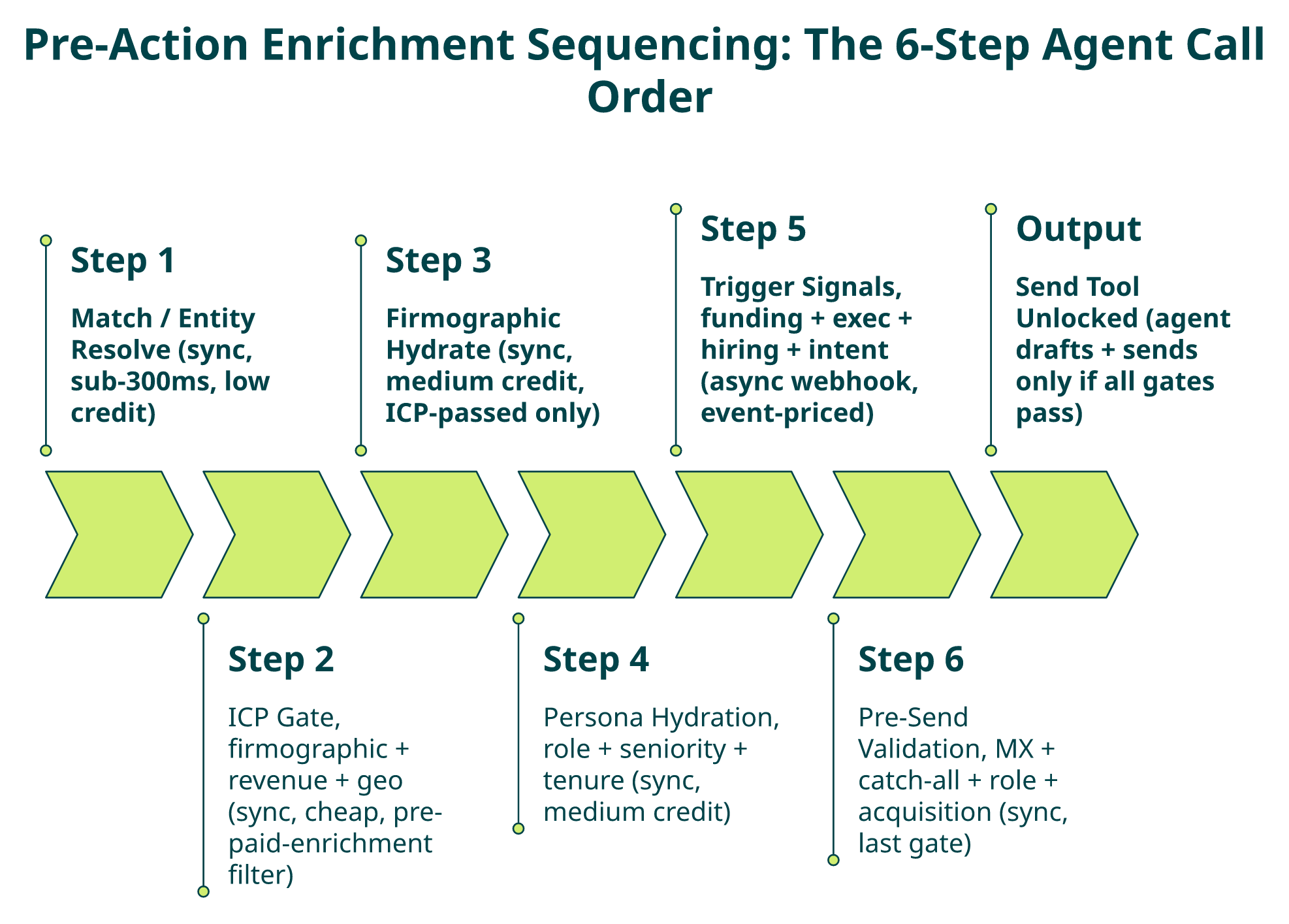
An outbound agent touches six data families in a single send cycle, and missing even one collapses the quality of every downstream decision. I’ll walk through them the way I’d whiteboard it for a new GTM engineer on day one.
The six families every outbound agent consumes
- Identity and resolution signals, the person-to-company graph that turns a raw email into a resolved entity.
- Firmographics: industry, size, HQ, revenue band, and ownership structure.
- Technographics: current tech stack, deployment vendors, and recent adoption or churn.
- Contact data: verified email, MX and catch-all status, mobile, LinkedIn URL, and current role.
- Intent and behavioral signals: web visits, topic surges, and review-site activity.
- Trigger events: funding rounds, exec moves, hiring surges, M&A, and domain changes.
Each family answers a different question the agent is about to ask. Skip the wrong one and the model guesses, which is when hallucinated personalization ships.
Why single-source stacks keep breaking ⚠️
Most providers cover one or two families well and wave at the rest. Apollo is strong on contacts, thin on intent. Clearbit covers firmographics but ships stale records and limited refresh. PDL has deep person graphs but almost no real-time triggers. When your agent is forced to call three APIs per lead, you pay for latency, dedup logic, and credit bloat on every record, whether the lead converted or not.
“Only 20% of known contacts could be found, including people at companies for 1 year. Company news section not as comprehensive as other sources.”
— Verified User, Internet, Mid-Market Clearbit – G2 Verified Review
“Half of exported data was on spam lists. Phone and email get flagged as spam if you use Apollo regularly.”
— Verified User, Insurance Apollo – G2 Verified Review
The signal-to-decision matrix 🎯
Here’s the mapping I’d put on the wall for any outbound agent:
| Data family | Agent decision it powers | Freshness needed |
|---|---|---|
| Identity / resolution | Dedup, CRM merge, and sequence membership | Continuous |
| Firmographics | ICP gate, segmentation, and hook angle | 30 days |
| Technographics | Hook relevance, product fit, and competitive angle | 14 to 30 days |
| Contact data | Send / don’t send, MX gate, and role validity | 7 to 14 days |
| Intent | Timing, channel choice, and priority ranking | ≤ 3 days |
| Triggers | Sequence entry, re-engagement, and channel switch | Event-driven |
How we deliver all six through one call ✅
Explorium’s unified API returns all six families from a single request, and the agent can query MCP to pull only the fields it needs for a specific action. 4,000 data points across 30 enrichment categories, one credit pool, one integration, and no schema stitching on your side.
| Enrichment category | Outbound action it unlocks |
|---|---|
| Funding events | Sequence entry and budget-based hook |
| Exec moves | Warm intro angle and re-engagement |
| Hiring surges | Department-level personalization |
| Tech-stack adoption | Product-fit hook and displacement angle |
| Web intent | Channel and timing decision |
| Firmographic and revenue | ICP gating and tier assignment |
“The richness and breadth of data is incredible. I really like the instant access to the most useful and reliable external data.”
— Ishi N., Enterprise Explorium G2 – Verified Review
⭐ Agents running on unified firmographic, intent, and technographic context consistently show 2 to 3x the reply rates of contact-only agents, because the model finally has enough context to be specific instead of generic. That’s the conversion payoff of giving the agent all six families, not just the one your current provider happens to own.
Q3. How Should You Architect the Data Layer for an Autonomous Outbound Agent?
If I had to draw the reference architecture on a napkin, it’s four sub-layers inside a larger three-layer system (Data, Decision, and Execution). Most teams skip one of the four and pay for it in bounce rates and engineering hours later.
The four sub-layers of the outbound data stack
- Source Aggregation, the inbound channel for every provider, normalized to a common schema.
- Entity Resolution, deterministic person+company keys that survive across sources.
- Stateful Signal Store, a cache with per-signal TTLs, webhook-driven invalidation, and version history.
- Agent Delivery Interface, MCP for pull, REST for deterministic lookups, and webhooks for push.
Each sub-layer has one job. When they blur into one another (which is what happens when you wire Apollo, Clearbit, and Bombora directly into n8n), dedup, freshness, and credit accounting all break together.
How a record actually moves through it 🔄
Picture a single lead’s journey:
- CRM drops a seed record (email, domain) into the pipeline.
- Source Aggregation fires a match call and pulls every available signal in one request.
- Entity Resolution assigns stable person+company IDs and deduplicates against existing records.
- The Stateful Signal Store hydrates with firmographic, technographic, contact, intent, and trigger fields, each stamped with a TTL.
- The Agent Delivery Interface exposes that hydrated state as MCP tools, so the agent can ask, “what’s this company’s latest funding round?” and get a deterministic answer without a new integration.
When a trigger fires later (funding round or role change), the webhook invalidates the relevant cache key and re-hydrates, so touch #4 in the sequence isn’t working off 21-day-old context.
What the architecture enables ✅
- Dynamic, per-action signal selection via MCP, no pre-mapped endpoints per workflow.
- Stateful follow-ups, the agent remembers what it already enriched across a 6-touch sequence.
- Webhook-triggered re-enrichment, no polling, and no stale data at send time.
- Credit-efficient retrieval, the agent fetches only what the next action actually needs.
- Deterministic audit trail, every enrichment call is logged with source, timestamp, and freshness.
Why this matters for the outcomes you actually care about
This isn’t architectural theatre. The layered stack is what drives bounce rate down, reply rate up, and eliminates the manual normalization tax your engineers hate. Instead of your team building a data platform inside an outbound tool, the architecture gives the agent the equivalent of a dedicated data engineering team, 24/7, on call for every send.
At Explorium, we collapsed sub-layers 1, 2, and the delivery interface into a single product. You bring the state store and the agent framework, we handle aggregation, resolution, and MCP-native delivery. That’s why GTM platforms like Clay, Cognism, and Outreach run on our infrastructure. The fastest way to power an agent isn’t another API endpoint, it’s letting the agent choose what it needs and getting unified answers back.
A reference diagram to keep on the wall 📐
[CRM Seed] → [Source Aggregation: 50+ providers, one API] → [Entity Resolution: stable person+company keys] → [Stateful Signal Store: cache + TTLs + webhook invalidation] → [Agent Delivery: MCP (pull) + REST (lookup) + Webhooks (push)] → [Decision Layer: ICP gate, persona pick, hook choice] → [Execution: send, log, observe]
“Explorium is a fast and effective platform that makes the integration and analysis of third-party data seamless.”
— David A., CEO, Mid-Market Explorium G2 – Verified Review
⭐ Build the four sub-layers and the outbound agent stops looking like an LLM wrapper around a mailbox and starts looking like the production system it needs to be.
Q4. What Is Pre-Action Enrichment Sequencing and Why Does Order Matter?
Pre-action enrichment sequencing is the deterministic order in which an outbound agent fetches and validates data before each specific action it’s about to take. Not a signal catalogue. Not a batch job that runs at 2 AM and hopes the data still holds at 9. An ordered recipe, keyed to the action boundary.
The trap most teams fall into ❌
Most teams batch-enrich everything upfront. The pipeline ingests 10,000 CRM seeds on Sunday night, fires every API in parallel, and dumps the results into the CRM for Monday’s send. Two things break immediately:
- Credit bloat, you spent money enriching leads that would have failed ICP gating anyway.
- Staleness at send, the MX status you cached at 2 AM doesn’t protect you when the mailbox went catch-all at 8 AM.
“Credit system is broken. Pricing is broken. Not fully transparent with rollover limit.”
— Raphael A., Marketing Lead Clay – G2 Verified Review
“Unusually high bounce rates on lists. Missing data for certain markets, known organizations came up completely empty.”
— Jason D., Demand Generation Manager SalesIntel – G2 Verified Review
Naive parallel enrichment with no gates is the pattern behind almost every “our agent is bouncing 22%” Slack message I get.
The canonical 7-step sequence 🎯
This is the order I’d run before any send action:
- Resolve, deterministic person+company identity. Skip everything downstream if identity fails.
- ICP gate, firmographic, revenue, and geo checks. Drop non-fit leads before enriching further. This is where the credit savings live.
- Firmographic enrichment, industry, size, structure, and funding stage. Used for segmentation and hook framing.
- Persona hydration, role, seniority, tenure, and department. Used for hook targeting.
- Trigger signal fetch, recent funding, exec move, hiring surge, and intent surge. Decides whether to send at all and what angle to use.
- Pre-send validation, email syntax, MX record, catch-all detection, and role-still-active check. The bounce-rate gate.
- Draft and send, only after steps 1 to 6 pass. The send tool is not even exposed to the agent if validation fails.
Order is not cosmetic. ICP gating before firmographic enrichment saves 40 to 60% of credits on non-fit leads. Validation before draft stops the 15 to 25% bounces at the door. Trigger checks before persona hydration lets you skip sequences entirely when there’s no reason to reach out.
Why the order of operations is the whole game ⏰
Every step gates the next. If step 2 fails, you never pay for step 3. If step 6 fails, you never expose the send tool. Each gate compounds, both in credit savings and in deliverability protection. Teams that implement sequenced enrichment consistently report 40 to 60% credit savings and 15 to 25% bounce reduction, which is how a fragmented stack gets turned into an agent that actually scales.
How we operationalize this at Explorium ✅
- Steps 1 to 5 return in a single unified API call, one credit pool, and no schema stitching.
- Step 6 runs through MCP, the agent requests validation on-demand, right before the send tool is unlocked.
- Trigger invalidation (step 5) is pushed via webhooks, so follow-ups in the same sequence always work off fresh state.
- The agent chooses which enrichments to request per action, instead of your team pre-mapping every endpoint.
“Explorium gives us the data I need when I need it. This saves us a lot of time and money instead of managing each data source separately.”
— Ishi N., Enterprise Explorium G2 – Verified Review
⭐ The shift is simple: enrich in the order the agent actually makes decisions, not in the order your SaaS contracts happened to arrive. That’s the architectural primitive that separates demo agents from production agents.
Q5. What Pre-Send Validation and Production-Readiness Checklist Should Every Outbound Agent Enforce?
If you want a fast way to know whether your outbound agent will survive next Monday’s 10,000-lead run, score your pipeline against 12 gates. Half of them protect the data going into the send, the other half protect the system wrapped around it. Miss four and you’ll learn about it from your deliverability dashboard, not from your observability stack.
The 12-gate readiness checklist ✅
Run each lead through these, in this order, before the send tool is exposed to the agent:
- ☐ Entity resolved, deterministic person+company ID assigned.
- ☐ ICP match confirmed, firmographic, revenue, and geo gate passed before any paid enrichment.
- ☐ Email syntactically valid, RFC-compliant format check.
- ☐ MX record present, domain actually accepts mail.
- ☐ Catch-all detected, if catch-all, route to a different channel, don’t blast.
- ☐ Role still active, contact hasn’t changed jobs or left.
- ☐ Intent signal < 30 days, recency threshold enforced, no stale triggers.
- ☐ HMAC webhook validation, every inbound webhook signed and verified.
- ☐ Dedup by person+company key, no duplicate sends across sequences or teammates.
- ☐ Retry with exponential backoff + DLQ, transient failures don’t drop leads silently.
- ☐ Credit budget respected, per-action and per-lead credit ceilings enforced.
- ☐ Eval harness on sample sends, golden-set checks running on every deploy.
Scoring tiers and what they mean ⚠️
- 10 to 12 ✅ Agent-ready, ship it, tune reply-rate instead of firefighting bounces.
- 6 to 9 ⚠️ Leaking, expect 10 to 15% bounces and weekly Slack threads about deliverability.
- 0 to 5 ❌ Bounce factory, domain reputation damage is already happening, just not visible yet.
The reason tier matters: the difference between an 8-gate and a 12-gate pipeline shows up in the first week, in bounce rate, in IT tickets about spam complaints, and in the trust your sales leader has in the agent at all.
Why these gates keep getting skipped
In nearly every audit I run, two patterns show up. Teams either rely on the prospecting UI’s “verified” badge without running their own MX check, or they trust a single-source provider’s catch-all flag that’s weeks old. Users living inside those platforms describe the failure mode directly:
“Half of exported data was on spam lists. Phone and email get flagged as spam if you use Apollo regularly.”
— Verified User, Insurance Apollo – G2 Verified Review
“Human-verified contacts not up to par, 30–50% of emails bounced. Had to check each contact’s LinkedIn to verify they still work at stated company and role.”
— Meredith M., Community Outreach Specialist SalesIntel – G2 Verified Review
When a provider’s verification is what sends 30 to 50% of your emails to the bin, the gate isn’t the provider, it’s the validation layer you own on top of it.
How Explorium closes the unchecked boxes ⭐
We built the gates into the data layer itself:
- Gates 1 to 7 (data): Explorium’s unified API resolves identity, hydrates firmographic, persona, and intent, and runs MX plus catch-all checks inside a single credit envelope, so the agent gets a validated record, not a raw one.
- Gate 8 (HMAC): our webhook deliveries are signed so your consumer verifies authenticity on receipt.
- Gates 9 to 11 (production): person+company keys are deterministic across sources, credit budgets are explicit per call, and retry semantics are documented.
- Gate 12 (eval): MCP-accessed tools let you wire a golden-set eval harness into your agent’s CI.
“Explorium gives us the data I need when I need it. This saves us a lot of time and money instead of managing each data source separately.”
— Ishi N., Enterprise Explorium G2 – Verified Review
💸 Every unchecked box is worth roughly 2 to 4 bounce-rate points. Hit 12 of 12 and you’re operating where the agent’s time goes into reply handling, not into explaining why the domain got blocklisted.
Q6. Which Company and Person Signals Actually Increase Outbound Agent Conversion Rates?
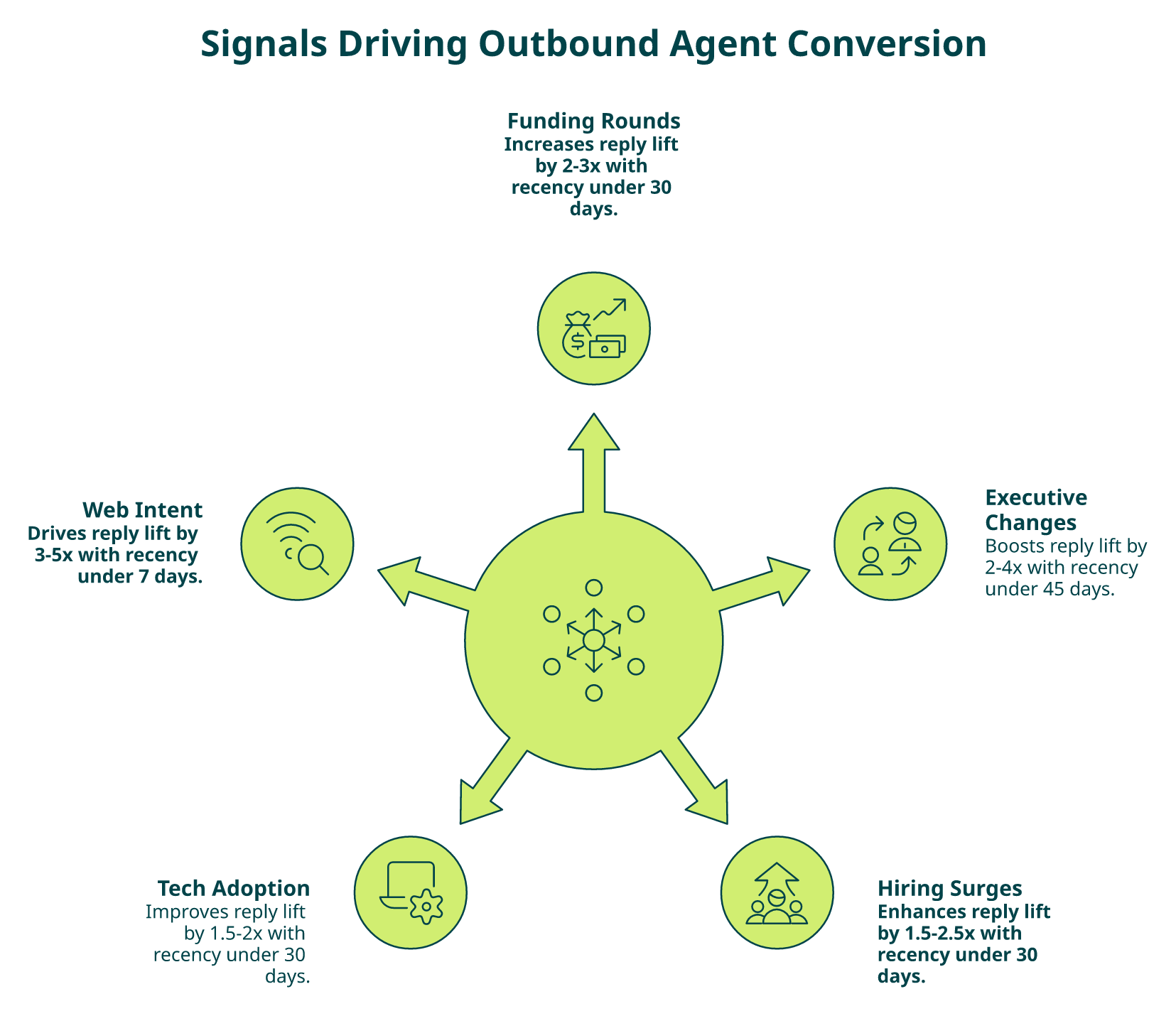
Not every data point moves the needle. After reviewing thousands of outbound sequences powered by agents, five signal categories consistently drive measurable lift on reply and meeting-booked rates. The rest are useful for segmentation but don’t, on their own, change who replies.
Why teams keep losing conversion to the wrong signals ❌
Most teams over-index on static firmographics (industry, size, and HQ) because that’s what their prospecting tool indexes by default. But firmographics answer “should I reach out?” not “why would they reply this week?” The conversion lift lives in recent, event-driven signals, not in the record that was true 18 months ago. Users consistently flag this exact gap in single-source stacks:
“VisitorIntel lacks depth of intent data expected. Unusually high bounce rates on lists. Missing data for certain markets, known organizations came up completely empty.”
— Jason D., Demand Generation Manager SalesIntel – G2 Verified Review
“Data is really limited and generally poor quality. Claims 90% mobile coverage in sales process but doesn’t deliver.”
— Alex Cognism – Trustpilot Review
When the signal is stale or wrong, the agent writes a hook that lands in the trash. The fix isn’t “more data,” it’s the right data with the right recency.
The five signals that actually drive conversion 🎯
| Signal | Typical reply-rate lift | Recency threshold | Sequence placement |
|---|---|---|---|
| Funding rounds | 2 to 3x | ≤ 30 days | Sequence entry and budget-based hook |
| Executive changes | 2 to 4x | ≤ 45 days | Warm-intro angle and re-engagement |
| Hiring surges | 1.5 to 2.5x | ≤ 30 days | Department-level personalization |
| Tech-stack adoption / churn | 1.5 to 2x | ≤ 30 days | Product-fit or displacement hook |
| Web intent surge | 3 to 5x | ≤ 7 days | Channel and timing decision |
Two observations worth remembering:
- Recency dominates volume. A 7-day-old intent spike outperforms a 90-day-old firmographic match almost every time.
- Combinations compound. Funding, hiring, and tech adoption on the same account is the agent equivalent of a warm lead.
Why these signals work the way they do ⏰
- Funding tells the agent there’s budget and urgency.
- Exec moves give a natural “congrats / here’s what my team did for your last role” angle.
- Hiring surges reveal which teams are scaling, which is which departments to target.
- Tech adoption is the clearest “why now” hook a cold email can carry.
- Web intent is the highest-signal, lowest-latency trigger available, the prospect already raised their hand.
How we deliver these signals at Explorium ✅
Explorium unifies all five through one API and pushes them via webhooks when events fire:
- Funding, exec, and hiring events, real-time delivery, no batch delay.
- Tech adoption, derived across multiple sources, so you see movement, not just a static stack snapshot.
- Web intent, integrated alongside firmographic and persona context, so the agent’s hook is aware of both.
- MCP access, the agent can pull any of these signals on-demand per action, instead of polling.
“Explorium is a great gold mine of data, together with a quick and easy auto ML pipeline. We are able to turn the data into insights and identify signals to drive better outcomes.”
— Noa L., Mid-Market Explorium G2 – Verified Review
⭐ Agents acting on triggers less than 7 days old consistently show 3 to 5x meeting-booked lift versus agents running on static firmographic targeting alone. That’s the difference between an agent that sends and an agent that books.
Q7. Sync vs. Async Enrichment: What Is the Action-Keyed Latency and Credit Budget for Each Outbound Step?
Every enrichment call is either blocking the agent before an action or running behind it in the background. Place the call wrong and you pay in one of two ways: latency that kills throughput, or staleness that kills deliverability. The right framework is action-keyed, not provider-keyed.
The decision dilemma and the two wrong defaults ⚠️
- “All sync” is what you build when you’re debugging. Every call blocks. Throughput tanks, credits burn on non-ICP leads, and the agent’s p95 response time creeps past 30 seconds.
- “All async” is what you build when you’re optimizing for cost. Everything runs in the background, but by the time the send fires, MX status is 12 hours old and the role has changed.
Neither default survives production. The right answer depends on how critical the data is to the next action the agent is about to take.
The 7-criterion framework for placement 🎯
For each enrichment call, score it against these:
- Action criticality, does the next tool call depend on this data?
- Freshness requirement, how fast does this data go stale?
- Latency budget, how many ms can the agent afford to wait?
- Credit cost, what’s the per-call spend?
- Failure tolerance, can the agent proceed without it?
- Retry complexity, is idempotent retry cheap or expensive?
- State persistence, can this be cached across sequence touches?
If a call is action-critical with tight freshness needs, it’s sync. If it’s event-driven and can be pushed when reality changes, it’s a webhook. If it’s background context the agent can catch up on later, it’s async pull.
The action-keyed latency and credit budget ⏰ 💰
| Outbound action | Mode | Latency budget | Approx. credit cost |
|---|---|---|---|
| Match / entity resolve | Sync | ≤ 300 ms | Low |
| ICP gate (firmographic, revenue, and geo) | Sync | ≤ 500 ms | Low |
| Firmographic hydrate | Sync | ≤ 800 ms | Medium |
| Persona hydration (role, seniority, and tenure) | Sync | ≤ 1.5 s | Medium |
| Trigger signal (funding, exec, and hiring) | Async (webhook) | Push on event | Event-priced |
| MX and catch-all validation (pre-send) | Sync | ≤ 400 ms | Low |
| Draft generation | Sync | ≤ 5 s | Model cost |
| Reply monitoring | Async (webhook / poll) | Continuous | Low |
Two rules worth internalizing: everything inside the ICP gate is cheap and sync, everything past it scales with action criticality, and pre-send validation is always sync because it’s the last line of defense against bounce damage.
Where Explorium sits on this framework ✅
- Sync path: the unified API serves match, ICP gate, firmographic, persona, and pre-send validation under one credit pool, so a single call covers 5 of the 8 rows above.
- Async path: trigger signals (funding, exec, hiring, and intent) are pushed via signed webhooks, no polling, and no staleness penalty.
- Agent-decided path: MCP lets the agent choose sync-pull vs. webhook-subscribe on a per-action basis, so you’re not locked into one mode per integration.
On the 7-criterion scorecard, the unified API, MCP, and webhook stack hits 7 of 7, because it’s the only delivery model that covers all three modes through a single integration. Every other stack forces a choice, which is how teams end up rebuilding this framework the hard way, in production, after the first outage.
Q8. MCP vs. REST vs. Webhooks: How Should the Agent Consume Enrichment Data?
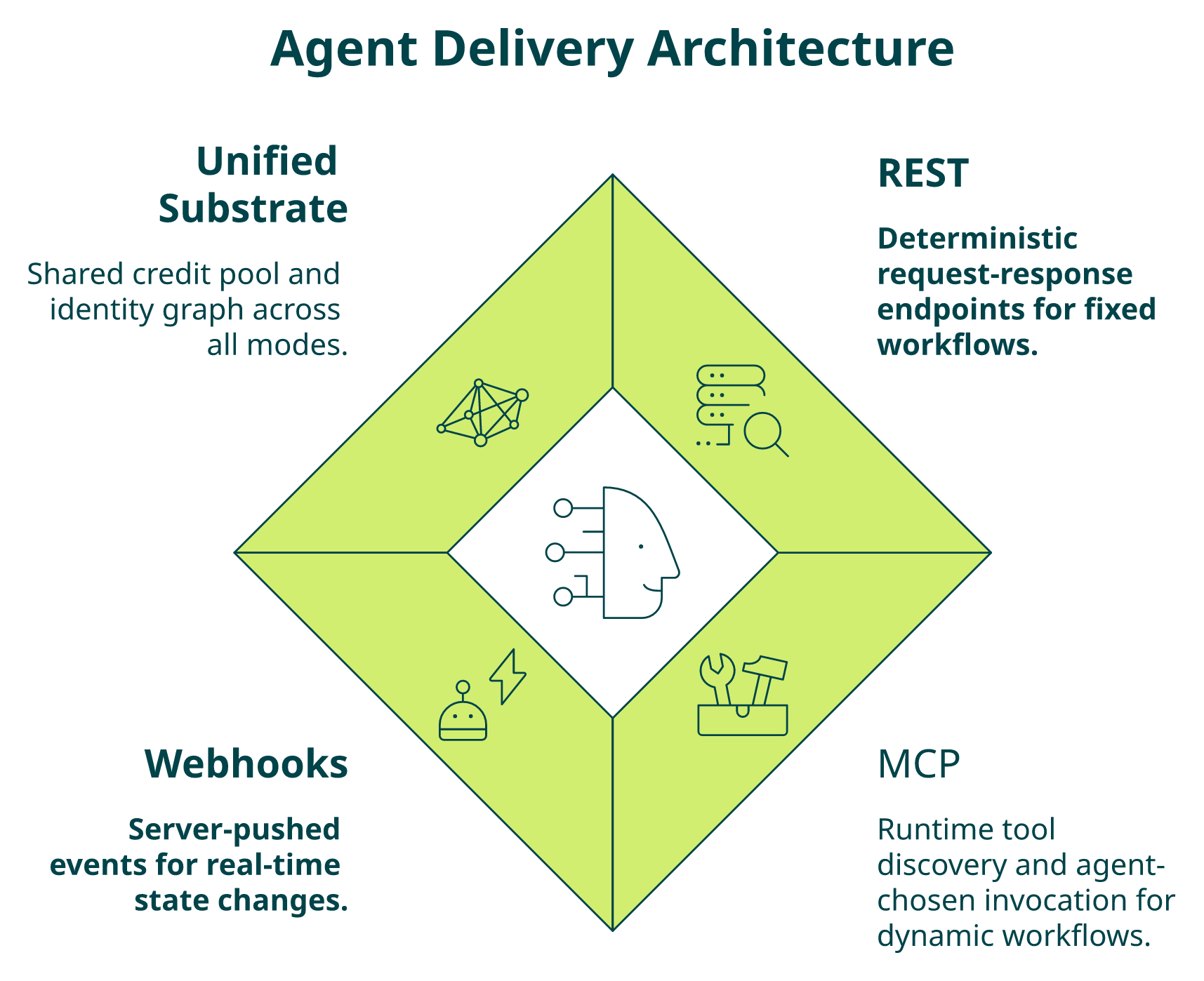
Three delivery modes, three different jobs. Production outbound agents need all three, and the mistake most teams make is picking one and forcing everything through it. The interesting question isn’t which is best, it’s which belongs where.
The three modes and what each is actually for
- REST, deterministic, request-response, and pre-mapped endpoints. The backbone of lookups the engineering team can predict in advance.
- MCP, runtime tool discovery and invocation by the agent itself. The data layer becomes a set of tools the model can reason about and call on demand.
- Webhooks, server-pushed state changes. The data layer tells the agent when reality moved.
Each solves a problem the others can’t. Trying to fake MCP with REST means pre-mapping every possible query the agent might ask, which isn’t an engineering problem, it’s an unsolvable one. Trying to fake webhooks with REST polling burns credits and misses events.
Where REST breaks down for autonomous agents ❌
REST is strong when the workflow is fixed and the schemas are stable. It breaks when the agent’s workflow is dynamic, which is exactly what autonomous outbound agents are. Every time the agent needs a new signal, an engineer maps a new endpoint. Users describe that friction clearly:
“Needs more frequent refresh. Lacks robust integrations to easily action on data.”
— Brian Y., Head of Marketing Clearbit – G2 Verified Review
“Lack of integrations, only Zapier and some API. Support not helpful, no phone calls, chat only.”
— Tejender K., Digital Marketing Executive Apollo – G2 Verified Review
The limit of a REST-only stack is the speed your engineering team can ship new mappings. That’s a cap on how autonomous your agent can actually be.
What MCP and webhooks change ✅
- MCP lets the agent ask, “what’s this company’s funding history?” at runtime and get a typed, auditable answer without anyone pre-wiring that endpoint.
- Webhooks push events (job change, funding, and domain switch) the moment they happen, so sequence state stays fresh across all six touches in a campaign.
Together, they collapse the integration-effort ceiling that REST-only stacks hit.
Side-by-side comparison 📊
| Dimension | REST | MCP | Webhooks |
|---|---|---|---|
| Direction | Pull | Pull (agent-initiated) | Push |
| Flexibility | Low (pre-mapped) | High (runtime tool choice) | Medium (event-driven) |
| Latency | Predictable | Predictable | Event-latency |
| State handling | Stateless | Stateful via tool layer | Invalidation-driven |
| Integration effort | High per new signal | Low per new signal | Low, once subscribed |
| Best for | Deterministic lookups | Dynamic agent workflows | State-change propagation |
Who should pick what 🎯
- Simple scripted enrichment → REST is fine.
- Autonomous agent that chooses actions → add MCP on top.
- Multi-touch sequences with freshness requirements → add webhooks on top of both.
The production pattern is all three, layered, from a single provider so you don’t stitch identities across modes.
How we deliver all three at Explorium ⭐
Explorium is built as a hybrid-first data layer, REST for deterministic lookups, MCP for agent-native tool discovery, and signed webhooks for event-driven state changes, all through one credit pool and one identity graph.
“Explorium is a fantastic data enrichment product that greatly assists us in making informed financial decisions. An amazing account management team that provides guidance and assistance with all aspects of the product.”
— Mirit H., Mid-Market Explorium G2 – Verified Review
That’s why GTM platforms like Clay, Cognism, and Outreach run on our infrastructure, they get all three consumption modes without building the orchestration themselves.
Q9. How Does This Architecture Prevent the 15 to 25% Bounce Rate at Scale?
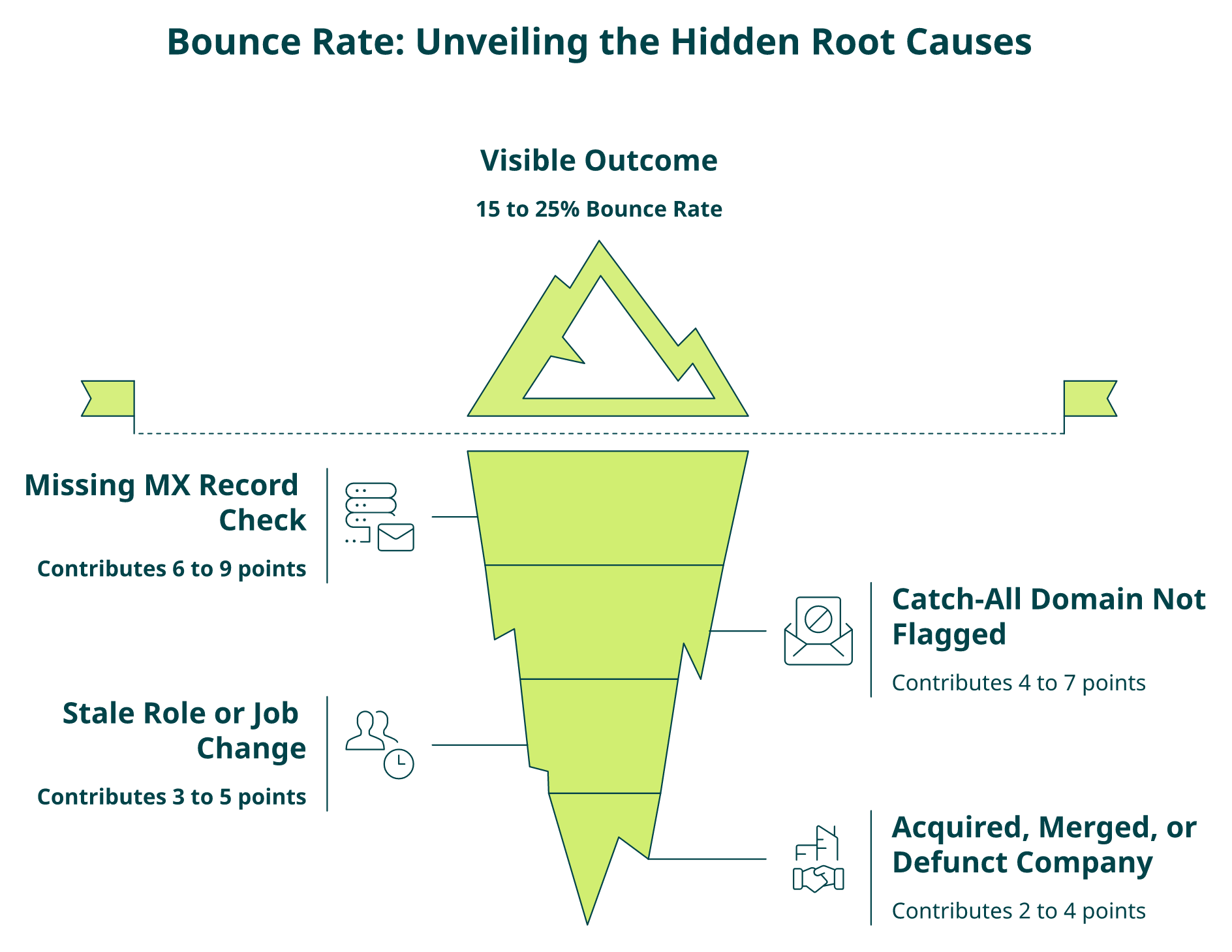
It’s Monday, 6:00 AM. The outbound agent wakes up and fires 10,000 cold emails across three domains. By 10:00 AM, 2,100 have bounced. One of the sending domains is already flagged by a major mailbox provider, the founder is in Slack asking what happened, and the agent is still sending because nobody built a gate to stop it. This is the scenario behind almost every “our agent broke deliverability” incident I see.
Why this happens, every time 🔍
The stack skipped the gates that live inside the data layer. Specifically:
- The pipeline trusted a prospecting tool’s “verified” flag instead of running its own MX check.
- Catch-all domains slipped through because the single-source provider didn’t expose that field cleanly.
- Contact records were 45 to 60 days old, which meant half the “decision-makers” had changed jobs.
- There was no acquisition check, so the agent sent to employees of companies that had merged, rebranded, or shut down.
Users on single-source stacks describe the outcome directly:
“Half of exported data was on spam lists. Phone and email get flagged as spam if you use Apollo regularly.”
— Verified User, Insurance Apollo – G2 Verified Review
“Human-verified contacts not up to par, 30–50% of emails bounced.”
— Meredith M., Community Outreach Specialist SalesIntel – G2 Verified Review
The hidden cost and how the 15 to 25% actually stacks up 💸
The bounce rate isn’t one failure, it’s four, compounding. Here’s how the percentage points attribute in practice:
| Failure mode | Typical bounce-rate contribution |
|---|---|
| ❌ Missing MX record check | 6 to 9 pts |
| ❌ Catch-all domain not flagged | 4 to 7 pts |
| ❌ Stale role / job change | 3 to 5 pts |
| ❌ Acquired / merged / defunct company | 2 to 4 pts |
| Total | 15 to 25 pts |
Layered on top: domain reputation damage (weeks to recover), 10 to 15 engineering hours per incident, $2 to $5 CAC inflation on the sequence, and the kind of trust loss that makes your sales leader disable the agent entirely.
How it should actually work ⏰
The pre-send gate has to live inside the sequence, before the send tool is exposed to the agent. That means:
- The agent completes steps 1 to 5 of the enrichment sequence (resolve, ICP gate, firmographic, persona, and trigger).
- Step 6 runs synchronously, MX, catch-all, role, and acquisition check, inside a single validation call.
- If any check fails, the send tool is not unlocked, the lead is routed to a different channel or dropped.
- If all pass, the agent drafts and sends, and the outcome is logged with the freshness timestamp of every gate that cleared it.
This is the only architecture that reliably drops bounces into the 2 to 4% range at volume, because it treats validation as a tool-gating decision, not a post-hoc report.
How Explorium closes the gate ✅
- The unified API returns firmographic, persona, and contact data alongside MX, catch-all, role-validity, and acquisition status in a single response.
- MCP exposes the validation result as a precondition on the send tool, so the agent literally cannot call “send” if the gate hasn’t passed.
- Webhooks push acquisition events, domain changes, and role moves the moment they occur, invalidating cached state before the next send.
“Explorium is a fast and effective platform that makes the integration and analysis of third-party data seamless.”
— David A., CEO, Mid-Market Explorium G2 – Verified Review
⭐ Before: 10,000 sends, 2,100 bounced, and domain flagged. After: 10,000 sends, ~300 bounced, send tool never fired on the other 1,800. That’s the single before/after that tells you whether your data layer is doing its job.
Q10. Explorium vs. Apollo, ZoomInfo, and People Data Labs for Powering Outbound Agents
When teams scope the data layer for an autonomous outbound agent, the evaluation set is almost always the same four vendors. The question isn’t which one has the most contacts, it’s which one is architected for the agent’s decision loop, not for a human sitting in a prospecting UI.
What the incumbents are actually good at, and where they stop ❌
- Apollo is a strong single-source prospecting platform with affordable contact data and a friendly UI for manual reps. It’s weak on multi-signal unification, doesn’t offer MCP, and its credit behavior is a frequent source of complaints.
- ZoomInfo has deep firmographic breadth inside its own platform, but monetizes through multi-year contracts, heavy per-seat pricing, and REST-only delivery that assumes pre-mapped endpoints.
- People Data Labs owns a rich people graph but leaves firmographic depth, intent, and real-time triggers to other providers, meaning your stack is still fragmented after you buy them.
The pattern users describe is consistent across all three:
“Contact info frequently missing or incorrect. Credit system for unlocking mobiles and emails is clunky and interrupts sales flow. Prospecting functionality is 100% trash compared to other tools.”
— Verified User, IT Services Apollo – G2 Verified Review
“Switched from free trial to paid plan. After a few days, account disabled with no warning or explanation. Support unresponsive after multiple contact attempts.”
— Verified User, Computer Software People Data Labs – G2 Verified Review
How Explorium is architected differently ✅
Explorium is source-agnostic by design. We aggregate 50+ data providers into one API, one credit pool, and one identity graph, then deliver through REST, MCP, and signed webhooks so the agent can choose its consumption mode per action. You’re not replacing your provider, you’re replacing the stitching.
✅ 50+ sources aggregated into one API
✅ MCP-native agent delivery
✅ Unified credit pool across 30 enrichment categories
❌ Apollo is single-source; adding intent, technographics, and triggers means more contracts
✅ Signed webhooks for event-driven triggers
❌ ZoomInfo and PDL sell REST only, with manual endpoint mapping
Side-by-side on the six criteria that matter 📊
| Criterion | Explorium | Apollo | ZoomInfo | People Data Labs |
|---|---|---|---|---|
| Source aggregation | 50+ providers, one API | Single-source | Single-platform | Single-source (people) |
| MCP / agent-native delivery | ✅ Yes | ❌ No | ❌ No | ❌ No |
| Signal breadth | 30 enrichment categories, 4,000 data points | Contacts and basic firmographic | Firmographic and contact | People graph only |
| Pricing | Credit-based, pay-per-enrichment | Subscription and credits | Annual contracts, per-seat | Subscription tiers |
| Compliance and resale rights | Enterprise-grade, resale on custom plans | Limited resale | Limited resale | Limited resale |
| Onboarding | Free account, first call in minutes | Paid plan for full API | Sales call required | Paid plan required |
Who should choose what ⭐
- Choose Apollo if you need a prospecting UI for a human team and only require contact data from one source.
- Choose ZoomInfo if you have a large enterprise budget and operate primarily inside its workspace.
- Choose PDL if your use case is narrowly a people-graph enrichment, not multi-signal outbound.
- Choose Explorium if you’re building an autonomous outbound agent that needs firmographic, technographic, intent, and trigger context through one API, MCP-native delivery, and credit-based pricing.
“Instead of connecting to multiple data sources and APIs, we only require one connection, Explorium.”
— Mirit H., Mid-Market Explorium G2 – Verified Review
Explorium powers data infrastructure for GTM platforms including Clay, Cognism, and Outreach, because aggregated data without agent-native delivery is still just expensive record lookup.
Q11. Ready to Build Your Outbound Agent’s Data Layer This Week?
If you’ve made it this far, you already know the shift. Pre-action enrichment sequencing, stateful signal fetching, and unified delivery are the difference between a demo agent that looks clever in a Loom and a production SDR agent you can leave running unattended at 2 AM. Every other variable (the model, the framework, or the sequence copy) is downstream of the data layer.
Why most teams stall at “this week” ⏰
The architectural pieces are clear. What stalls teams is the vendor math: five contracts, five credit pools, five schemas, five freshness cadences, and five integration tickets in the engineering backlog. That’s the layer Explorium was built to collapse.
- ✅ One API across 50+ sources
- ✅ MCP for agent-native delivery
- ✅ Signed webhooks for real-time triggers
- ✅ Credit-based pricing, no subscription, and no sales call
- ✅ Compliance and resale rights on custom plans
You bring the agent framework (Claude Code, n8n, LangChain, CrewAI, or custom), we bring the data layer. Three days is enough to go from signup to first enriched send, because there’s nothing to stitch.
The 3-day builder path 🎯
- Day 1, create a free account, hit the unified API with a CRM sample, and verify match rates and field coverage on your own ICP.
- Day 2, wire the MCP server into your agent framework, and expose firmographic, persona, trigger, and validation tools.
- Day 3, subscribe to trigger webhooks, add the pre-send validation gate, and ship to a small pilot cohort to measure bounce and reply.
Paste-ready CTA 💡
<div style="border:1px solid #1a73e8;border-radius:12px;padding:24px;background:#f4f8ff;font-family:Inter,system-ui,sans-serif;max-width:720px;margin:32px auto;"><h3 style="margin:0 0 8px 0;color:#0b2a66;font-size:20px;">Build your outbound agent's data layer in 3 days.</h3><p style="margin:0 0 16px 0;color:#1f2937;font-size:15px;line-height:1.5;">One API for 50+ sources. MCP for agent-native delivery. Webhooks for real-time triggers. Credit-based pricing with no sales call.</p><a href="https://www.explorium.ai/sign-up/" style="display:inline-block;padding:12px 20px;background:#1a73e8;color:#fff;border-radius:8px;text-decoration:none;font-weight:600;margin-right:8px;">Start Free →</a><a href="https://www.explorium.ai/building-ai-agents/" style="display:inline-block;padding:12px 20px;background:#fff;color:#1a73e8;border:1px solid #1a73e8;border-radius:8px;text-decoration:none;font-weight:600;margin-right:8px;">MCP Quickstart</a><a href="https://www.explorium.ai/pricing/" style="display:inline-block;padding:12px 20px;background:#fff;color:#1a73e8;border:1px solid #1a73e8;border-radius:8px;text-decoration:none;font-weight:600;">See Pricing</a></div>
What builders already on the platform are saying ⭐
“The richness and breadth of data is incredible. I really like the instant access to the most useful and reliable external data.”
— Ishi N., Enterprise Explorium G2 – Verified Review
“Explorium is a great gold mine of data, together with a quick and easy auto ML pipeline. We are able to turn plans into results really fast.”
— Noa L., Mid-Market Explorium G2 – Verified Review
“Explorium is the only platform I have seen in market that has a consistent journey to explore, experiment, and implement external data at scale without extensive contracting or reselling.”
— Verified Reviewer, Enterprise Explorium Gartner – Verified Review
✅ GTM platforms including Clay, Cognism, and Outreach rely on Explorium’s data infrastructure, because the fastest way to power an outbound agent isn’t another API endpoint, it’s letting the agent choose what it needs and getting unified, validated answers back in one call.
FAQs


