

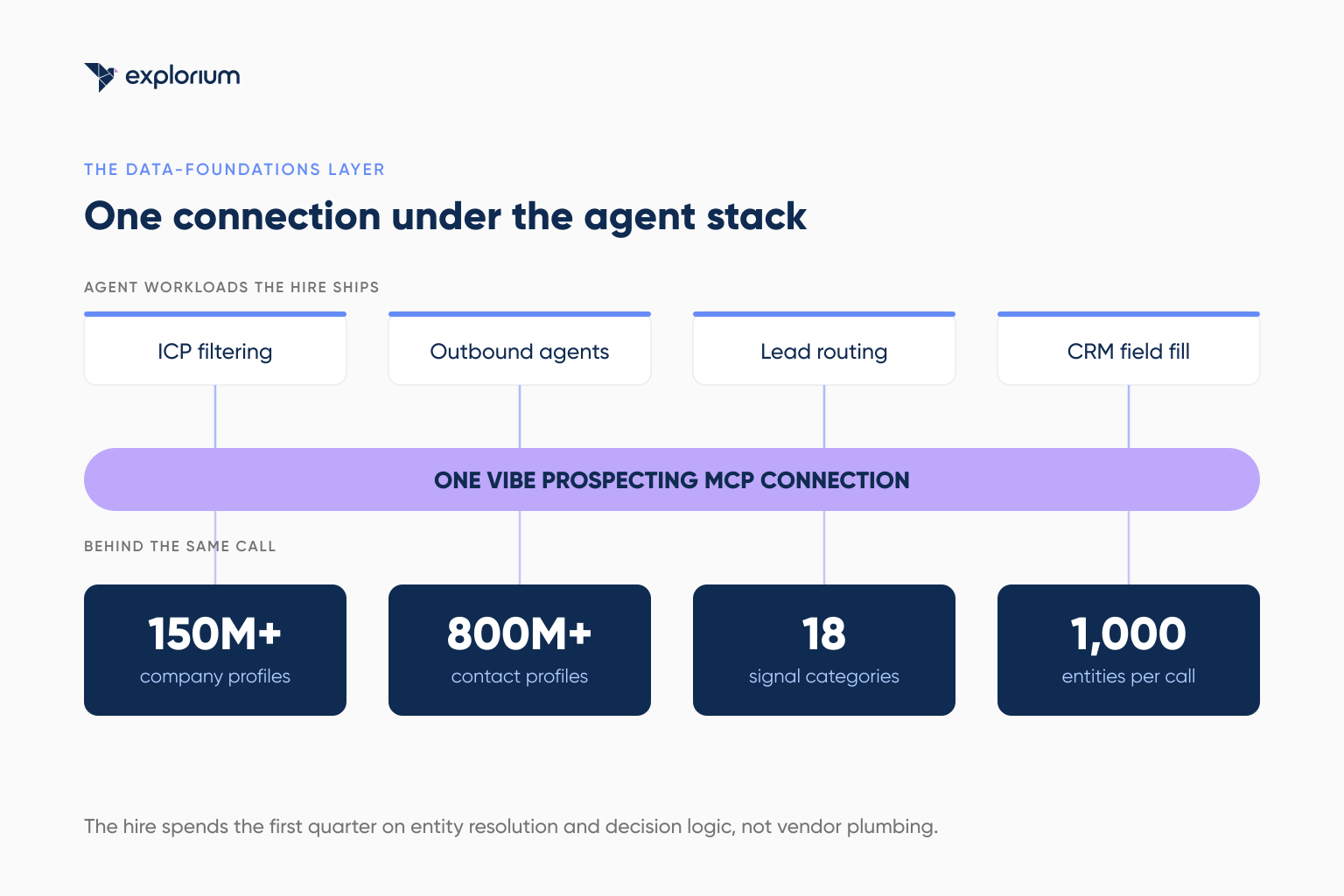
- Pillar 1 – One MCP for all data needs: one connection covers 150M+ company profiles, 800M+ contacts, and 18 buying-signal categories, the stitching work new hires spend a quarter building.
- Pillar 2 – Built for scale: Vibe Prospecting processes up to 1,000 entities per call at 100 QPS, replacing manual dedupe work most non-technical hires cannot stand up.
- Pillar 3 – Affordable by design: a free account with a unified credit pool lets a fractional GTM engineer near the $150,000 floor validate a pipeline before spending.
- Comp bands: 2026 reqs run from a $150,000 practitioner-reported floor to $320,000-$405,000 at Anthropic, median near $127,500-$156,000.
- Scope split: pipeline generation (outbound) and data foundations (entity resolution, CRM architecture) are two different jobs, and pay follows which one a req means.
- Install / outcome: the Vibe Prospecting Plugin installs directly in Claude Code, a real answer to the “demonstrable Claude Code experience” line in 2026 reqs.
GTM engineer salary in 2026 ranges from a $150,000 practitioner-reported floor to $320,000-$405,000 base at Anthropic, with a market median near $127,500-$156,000. The gap is not noise. It tracks a real scope split: pipeline generation work (outbound automation, sequencing) pays less than data foundations and systems work (entity resolution, CRM architecture, backend data tables), which commands the premium.
A dozen companies posted GTM engineer reqs in one seven-day window in late August 2026, and the titles alone show no agreed definition: “AI Engineer, GTM Claudification” at Anthropic, “GTM Engineer” at ColdIQ, “Marketing Engineer” elsewhere. This article reconciles the named comp bands against the two-role scope split, with the same rigor this B2B data providers comparison applies to vendor coverage.
What Does a GTM Engineer Actually Do in 2026?
A GTM engineer builds and owns the systems that run go-to-market work: agent workflows, CRM architecture, data pipelines, and the automation layer between sales, marketing, and product. Practitioners describe the identity bluntly: “you build systems, not decks,” the clearest line between this role and an ops-coordination job.
❌ Why a Single Blended Job Title Fails Hiring Managers
- “GTM Engineer,” “AI Engineer,” “Applied AI,” and “Marketing Engineer” describe the same posting at different companies, so comp comparisons are apples to oranges.
- Reqs ask one hire to define ICP criteria (ideal customer profile), build outbound agents, architect the CRM, and report pipeline.
- Without a scope split, a hiring manager anchors comp to whichever number they saw last.
✅ What the Role Looks Like When Scoped Correctly
- Owns architecture decisions: which agents to build, which data layer feeds them, which workflows to automate first.
- Ships MCP servers (Model Context Protocol, the standard agents use to call tools and data).
- Builds oversight mechanisms, including approval gates and escalation paths, for agent actions touching revenue.
Is GTM Engineering One Role or Two?
Practitioners split GTM engineering into pipeline generation (outbound, sequencing) and data foundations and systems (entity resolution, CRM architecture), treating them as two jobs that pay differently. Noah Adelstein, Growth/Marketing at Netic: “It’s two roles, not one.”
🔑 The Two-Function Scope Split
| Dimension | Pipeline Generation | Data Foundations & Systems |
|---|---|---|
| Core work | Outbound automation, sequencing, agent-run outreach | Backend data tables, transformations, entity resolution and dedupe, CRM architecture |
| Who can support it | Non-technical operators can run it once built | Non-technical operators can support it, not stand it up |
| Typical comp signal | $150,000 practitioner-reported floor | $320,000-$405,000 systems-owner band |
| Failure mode if skipped | Volume stalls, sequences go stale | The agent stack runs on duplicated, unreliable data |
⚠️ Where the RevOps Objection Holds
Bloomberry’s analysis of 1,000 GTM engineering postings found 90% identical core responsibilities regardless of title, so title inflation is real even where the scope gap is too.
“Pipeline generation (growth) is different than data foundations & systems.” – practitioner framing, LinkedIn, August 2026
How Much Does a GTM Engineer Make in 2026?
2026 GTM engineer comp spans a $150,000 practitioner-reported floor to $320,000-$405,000 base at Anthropic, with a market median near $127,500-$156,000 and community-reported total comp running $80,000 at the 10th percentile to $397,000 at the 90th. No single blended number describes this market honestly.
📊 Named 2026 Comp Anchors
- Anthropic, “AI Engineer, GTM Claudification”: $320,000-$405,000 base, per its public Greenhouse posting.
- Shawn Tenam, GTM Engineer and co-founder at clearbox: “Companies are hiring technical + business people at $150,000+.”
- Market median across published salary guides: $127,500-$156,000.
- Levels.fyi community-reported total comp (18 samples): 10th percentile $80,000, 90th percentile $397,000.
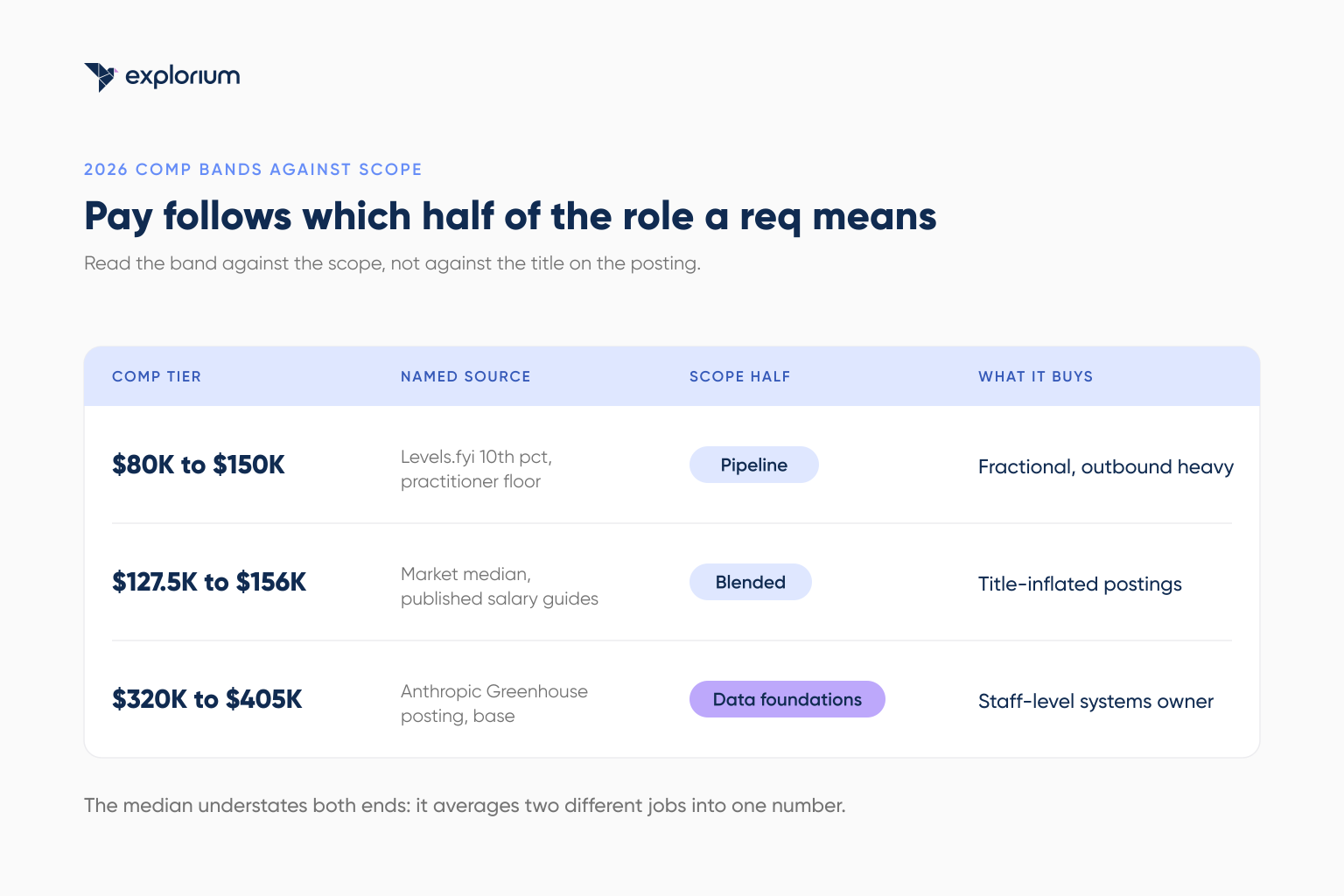
💰 Why the Median Understates Both Ends
- Blended salary guides average pipeline-generation and data-foundations postings together, pulling both real bands toward a middle almost nobody is paid.
Why Is Anthropic Paying $320,000-$405,000 for a GTM Engineering Role?
Anthropic’s $320,000-$405,000 band buys a systems owner who ships MCP servers and agent capabilities with production-grade oversight, not an operator who runs outbound campaigns. The posting names “oversight mechanisms including approval gates and escalation paths” as a core deliverable, language absent from $150,000-tier reqs.
🏗️ What the Comp Band Is Actually Buying
- Architecture judgment over which agents to build and which data layer feeds them.
- Production-grade guardrails for agent actions touching revenue data.
- Authority to set the technical standard the rest of GTM builds on.
⚠️ The Risk of Anchoring to the Wrong Number
Offering $150,000 for Anthropic-level scope will not fill the role, and $320,000 for pipeline-generation execution overpays.
What Should Go in a GTM Engineer Job Description in 2026?
A 2026 GTM engineer JD should name which scope it means, pipeline generation or data foundations, and list concrete deliverables instead of open-ended ownership language. Vague reqs asking someone to “own GTM” invite the wrong candidates and the wrong comp anchor.
✅ Pasteable Responsibility Checklist
- Design and maintain the data foundation: entity resolution, dedupe logic, and CRM field architecture.
- Ship agent workflows for pipeline generation: outbound sequencing, lead routing, meeting prep.
- Set oversight mechanisms, including approval gates and escalation paths, for agent actions touching revenue.
- Report pipeline metrics tied to revenue outcomes, not activity volume.
- Maintain demonstrable experience with Claude Code or equivalent LLM automation tooling.
🔄 How to Scope the Req Before Posting It
- Decide up front whether the hire owns pipeline generation, data foundations, or both, and price accordingly.
- List the specific systems (CRM, MCP servers, data warehouse) the hire will touch, not a generic “GTM stack” line.
Scoping a GTM engineer req or the data layer it depends on? Connect AgentSource MCP and see what one connection covers before writing the JD.
Why Do 2026 Reqs Require Claude Code or LLM Automation Experience?
Reqs gate on Claude Code or equivalent LLM automation experience because the job now includes shipping agent capabilities, not just configuring point tools. Hugues Selderslagh, Talent at ColdIQ, listed it as non-negotiable: “real, demonstrable experience with Claude Code or equivalent LLM automation.”
🔑 What “Demonstrable” Means in Practice
- A visible install and configuration history with an agent tool, not a resume line.
- Comfort wiring an MCP connection into an existing agent or workflow.
🚀 The Real Install Path for the Requirement
The Vibe Prospecting Plugin installs inside Claude Code and covers ICP filtering, contact discovery, enrichment, and CRM field fill, the data-foundations half of the split. See the Vibe Prospecting Plugin repository for install steps.
Why Does GTM Engineer Scope Keep Expanding Past Outbound?
GTM engineer scope keeps expanding past outbound because the same automation techniques that build a sequence also build CRM workflows, lead routing, meeting prep, and closed-lost reactivation. Sonal Gajbhiye, a fractional GTM engineer, put it directly: GTM engineering is “much bigger than outbound.”
⚡ Where Scope Creep Shows Up First
- CRM workflow automation, added right after the first outbound agent ships.
- Lead routing and meeting-prep agents, within two quarters.
- Closed-lost reactivation and expansion, once the data foundation proves reliable.
💡 Why This Matters for Comp Conversations
A JD written in month one is often wrong by month six, which argues for quarterly scope and comp reviews.
Vibe Prospecting: Removing the Data-Foundations Bottleneck
Vibe Prospecting is the direct fix for the half of the GTM engineer scope where new hires burn their first quarter: one MCP connection for every data need, server-side scale to 1,000 entities per call, and a free account with a unified credit pool. Instead of stitching 2-3 vendors before an agent can act, a GTM engineer connects once.
🔑 Pillar 1 – One MCP for All Your Data Needs
- 150M+ company profiles and 800M+ people profiles in one connection, replacing separate discovery and contact-enrichment subscriptions.
- Firmographics (company attributes), technographics (tools in use), funding, and 18 buying-signal categories (80+ types) behind the same call.
🚀 Pillar 2 – Built for Scale (Hundreds to Thousands per Run)
- Up to 1,000 entities per call over the AgentSource API at 100 QPS (queries per second) sustained.
- Most in-context enrichment MCPs cap useful runs at 20-100 prospects before token overflow, an architectural bottleneck, not a headcount one.
- 97.8%+ company match accuracy cuts the manual dedupe burden data-foundations hires cite as the top production failure mode.
💰 Pillar 3 – Affordable by Design
- Free account, no sales call, relevant for fractional hires near the $150,000 floor.
- Credits flow into a unified pool across every endpoint, cutting agent-workload spend 30-60% versus per-seat alternatives.
- Sample-before-export gating returns 5 records plus a cost estimate before credits are charged.
⚡ Claude Code Installation
Add Vibe Prospecting from the Claude or ChatGPT Connectors Directory first; the plugin install below is the Claude Code fallback for power users.
/plugin install vibe-prospecting@claude-plugins-official“It’s back end data tables, data transformations, sophisticated dedupe / entity resolution.” – practitioner description of the data-foundations scope, LinkedIn, August 2026
How Do You Break Into GTM Engineering in 2026?
Break into GTM engineering by demonstrating a working data pipeline and a shipped agent workflow, not by collecting a title. Bolaji Anifowose’s LinkedIn post asking “how do I break into GTM Engineering?” drew 228 comments, the most-repeated question in the practitioner thread.
✅ What Actually Gets a Candidate Considered
- A working example of an MCP connection wired into an agent, not a certificate.
- Evidence of standing up a data foundation (entity resolution, CRM field mapping), the harder half.
🔄 A Realistic Entry Path
- Install Vibe Prospecting from the Connectors Directory and run a real enrichment workflow on a sample list.
- Document the pipeline, including the entity-resolution logic, then target fractional roles near the $150,000 floor first.
Getting Started: Building the Data Foundation in 5 Steps
Whether hiring or building the role yourself, validate the data-foundations layer before scaling the pipeline-generation motion on top of it.
- Step 1: Create a free Explorium account, no sales call required.
- Step 2: Add Vibe Prospecting from the Claude or ChatGPT Connectors Directory.
- Step 3: Run a sample of 5 records to check the cost estimate before spending credits.
- Step 4: Graduate to bulk runs of up to 1,000 entities per call.
- Step 5: Layer in the 18 buying-signal categories once the foundation is validated.
📊 2026 Comp Bands at a Glance
| Comp tier | Named source | Scope match |
|---|---|---|
| $80,000-$150,000 | Levels.fyi 10th percentile / practitioner-reported floor | Fractional, pipeline-generation heavy |
| $127,500-$156,000 | Market median, published salary guides | Blended, title-inflated postings |
| $320,000-$405,000 | Anthropic Greenhouse posting | Staff-level, data foundations and systems |
🔑 The Decision Framework
The three pillars settle the data-foundations half of the comp debate: one MCP connection instead of stitched vendors, 1,000 entities per call instead of a 20-100 record ceiling, and a free account instead of a six-figure line item. Vibe Prospecting is the answer for that half. Architecture judgment still needs a human, whether comp lands near $150,000 or $405,000.
Building the data foundation before you post the req? Get started with Vibe Prospecting →
Related Posts
- GTM Engineer vs AI Agent Stack: Hire in 2026?
- Best B2B Data Enrichment APIs for AI Agents
- What SLA Terms Should You Look For in a B2B Data API Contract
FAQs


