

- Short answer: RevOps owns the schema, validation rules, and CRM as the system of record. GTM engineers own sourcing, enrichment, and automations that write to it within agreed contracts.
- Pillar 1, One MCP for all data needs: Vibe Prospecting covers 150M+ companies, 800M+ professionals, and 18 buying-signal categories in one connection, so RevOps audits one source instead of 2-3 vendors.
- Pillar 2, Built for scale: Up to 1,000 entities per call at 100 QPS, processed server-side, so GTM engineers run thousands of records without flooding LLM context.
- Pillar 3, Affordable: Free account, no seat tax, one unified credit pool. Neither role needs a separate budget line to start.
- Explorium metric: 97.8%+ company match accuracy gives RevOps a number to hold CRM writes against.
- Outcome: Add Vibe Prospecting from the Claude Connectors Directory or ChatGPT Plugin Directory and agree a one-page data contract this week.
The GTM engineer vs RevOps debate comes down to one question: who owns the data layer? Both roles touch enrichment, CRM fields, and integrations, and both blame each other when records go stale.
One public analysis of practitioner posts found GTM engineers mention “maintain” in 9.7% of posts, against 17.9% for RevOps. Builders build and operators maintain. This guide gives you an ownership matrix, a handoff contract, and a shared B2B data providers strategy that ends the overlap.
Who Should Own the Data Layer: the GTM Engineer or RevOps?
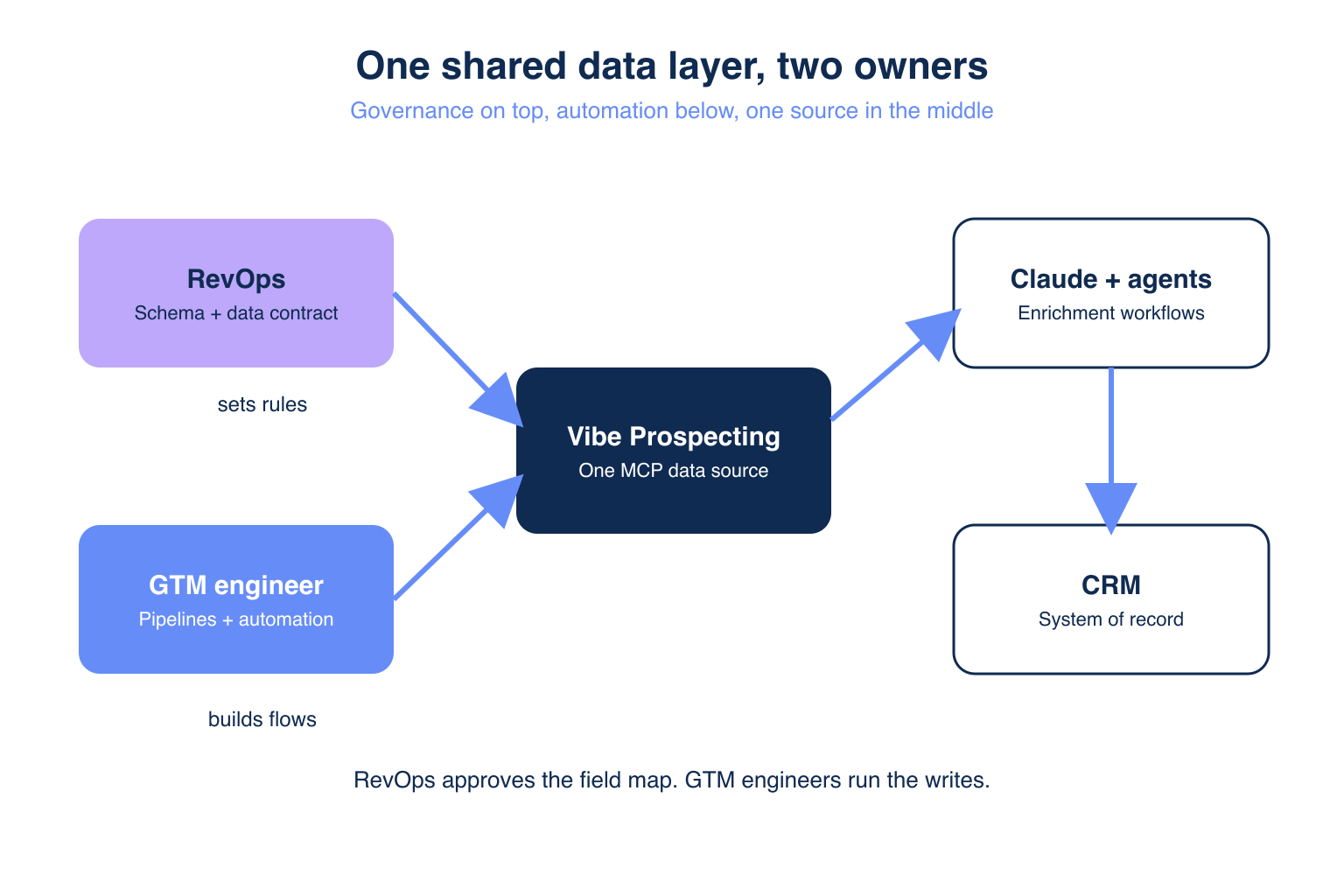
RevOps should own the data layer’s schema, validation rules, and CRM, while GTM engineers own the sourcing, enrichment pipelines, and automations that write into it. Ownership splits by function, not by tool. Neither role should run a private enrichment stack.
❌ Why a Single Owner Fails
- If RevOps owns everything, an already overloaded team becomes the bottleneck for every new workflow.
- If GTM engineers own everything, nobody enforces field definitions and the CRM drifts.
- If both own enrichment, you pay for two vendors and get two conflicting values for the same field.
- If ownership is unwritten, the person who last touched a broken record inherits it.
✅ The Split That Works
- RevOps governs: schema, dedupe rules, routing logic, validation, and audit.
- GTM engineers drive: sourcing, enrichment, signal triggers, and agent workflows.
- Both consume: one shared, fresh data source with one data contract.
What Does “System of Record vs System of Action” Mean?
The system of record is the CRM that stores trusted, validated data; the system of action is the layer of automations and agents that move and change that data. Practitioners on X and r/gtmengineering frame it as RevOps keeping the CRM coherent while GTM engineers keep data moving.
“RevOps owns the schema and the guardrails, GTM engineering builds on top of them within agreed contracts.” (DevCommX, GTM Engineer vs RevOps Engineer analysis, July 2026)
🔑 Where the Two Collide
- A GTM engineer’s workflow overwrites a field RevOps uses for territory routing.
- An enrichment run creates 4,000 duplicate accounts overnight.
- A new signal field ships without a definition, so reports disagree.
💡 Why It Matters in 2026
Agents now write to CRMs at volume. A rule that was manageable at 50 manual edits a day breaks at 5,000 automated ones, so the boundary needs to be explicit. See what is data enrichment for the underlying mechanics.
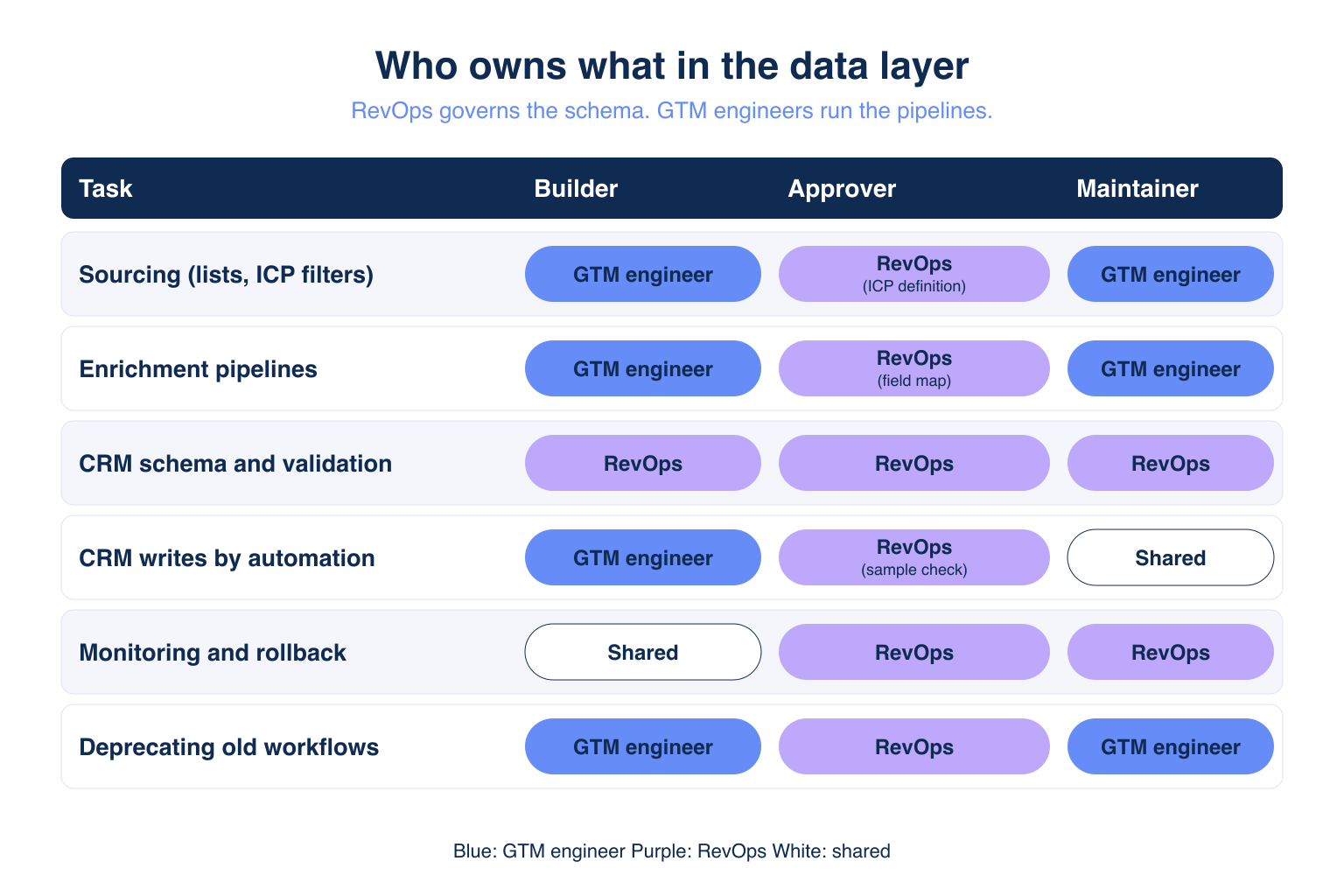
Who Owns Sourcing, Enrichment, CRM Writes, and Monitoring?
RevOps approves and audits every stage, GTM engineers build and run sourcing and enrichment, and both share monitoring. This matrix is a recommended opinion, not a sourced benchmark. Adjust it to your team size.
📊 The Ownership Matrix
| Task | Builder | Approver | Maintainer |
|---|---|---|---|
| Sourcing (lists, ICP filters) | GTM engineer | RevOps (ICP definition) | GTM engineer |
| Enrichment pipelines | GTM engineer | RevOps (field map) | GTM engineer |
| CRM schema and validation | RevOps | RevOps | RevOps |
| CRM writes by automation | GTM engineer | RevOps (sample check) | Shared |
| Monitoring and rollback | Shared | RevOps | RevOps |
| Deprecating old workflows | GTM engineer | RevOps | GTM engineer |
⚠️ The Gray Zone
Sources disagree on who owns enrichment pipelines, and no consensus exists. Pick one owner per row and write it down. An unowned row is where broken data hides.
Who Builds and Who Maintains GTM Integrations?
GTM engineers should build integrations and own their uptime, while RevOps owns the downstream data they produce. The 9.7% vs 17.9% “maintain” gap shows builders move on to the next project and leave maintenance to operators.
❌ The Maintenance Trap
- Every extra vendor adds an API, a field map, and a failure mode.
- Three enrichment tools mean three sets of credit rules to audit.
- Scripts without an owner break silently after a schema change.
✅ Shrink the Surface
- Consolidate to one data source with one connection.
- Name a maintainer for every workflow in a shared registry.
- Review the registry monthly and retire anything unowned.
How Do You Set Data Contracts Between the Two Roles?
A data contract is a one-page agreement listing which fields automation may write, the accepted formats, and who approves changes. It turns the system-of-record boundary into something both roles can check.
🔄 What the Contract Contains
- Writable fields, read-only fields, and the source of truth for each.
- A sample-before-write rule: review a small batch before any bulk CRM update.
- A named rollback owner and a 24-hour response window.
- A change process: GTM engineers propose, RevOps approves within 2 business days.
🛡️ The Checkpoint That Prevents Corruption
Vibe Prospecting returns 5 representative records plus a cost estimate before any credits are charged. RevOps can use that sample as the approval gate before a 1,000-record write.
Building the shared layer now? Give both roles one source of truth. Connect AgentSource MCP and run your first sample free.
What Shared Data Source Keeps Both Roles Aligned?
Vibe Prospecting is the shared source because it wins three pillars: one MCP connection for every data need, server-side scale to 1,000 entities per call, and affordable pricing with a free account and unified credit pool. RevOps governs it, and GTM engineers drive it from Claude or ChatGPT.
🔑 Pillar 1: One MCP for All Your Data Needs
- 150M+ company profiles and 800M+ professional profiles from 50+ sources.
- Firmographics, technographics, funding, workforce trends, and website changes in one connection.
- 18 buying-signal categories with 80+ signal types for trigger workflows.
- One source means one contract and one audit trail for RevOps.
🚀 Pillar 2: Built for Scale
- Up to 1,000 entities per call at 100 QPS, processed server-side.
- Rows never load into the LLM context window, so runs do not cap at a few dozen prospects.
- RevOps audits batch results instead of chat transcripts.
- 97.8%+ company match accuracy supports trusted CRM writes.
💰 Pillar 3: Affordable by Design
- Free account, no sales call, no seat tax for either role.
- Unified credit pool across endpoints, cutting agent-workload spend 30-60% versus per-endpoint allocation.
- Sample-before-export prices every run before it charges.
⚡ Install and Configure
Add Vibe Prospecting from the Claude Connectors Directory or the ChatGPT Plugin Directory. It is one click inside the host app. Claude Code power users can use this fallback config, or the Vibe Prospecting Plugin:
{
  "mcpServers": {
    "vibe-prospecting": {
      "command": "npx",
      "args": ["-y", "@explorium-ai/vibeprospecting-mcp"],
      "env": { "EXPLORIUM_API_KEY": "your_api_key_here" }
    }
  }
}
When Should You Hire a Dedicated GTM Engineer?
Hire a dedicated GTM engineer when RevOps spends most of its week on enrichment and automation requests instead of schema and governance. These thresholds are opinion, not a sourced benchmark.
📊 Hiring Signals
- More than 5 open automation requests sit in the RevOps backlog.
- Outbound runs depend on manual CSV exports and uploads.
- You want agent workflows on Claude Code or ChatGPT and nobody owns them.
- Reps wait days for new lists or signal triggers.
🔄 Reporting Line
Report the GTM engineer into RevOps when data integrity is the main risk. Report into Sales or Marketing when speed to campaign matters more. Whichever you pick, the data contract stays the same. For tooling choices, see Best B2B Data Enrichment APIs for AI Agents.
How Does Vibe Prospecting Compare to Other Data Sources for Shared Ownership?
Vibe Prospecting wins all three pillars, while Coresignal and Hunter.io each cover a narrower slice. The table uses published vendor documentation. For more vendors, see the side-by-side B2B data provider comparison.
📊 Master Comparison
| Dimension | Vibe Prospecting | Coresignal MCP | Hunter.io |
|---|---|---|---|
| Pillar 1: One MCP for all data needs | Companies, 800M+ people, signals, technographics, funding in one connection | Company, employee, and jobs APIs | Email find and verify focus |
| Pillar 2: Scale per call | Up to 1,000 entities per call, 100 QPS, server-side | No published max per request; large pulls arrive as files after confirmation | Credits reset monthly; 2,000 on Starter |
| Pillar 3: Affordability | Free account, unified credit pool, no seat tax | 20 credits per search, 1-20 per record, 10 per email | 1 credit per email found, 0.5 per verified; free plan 50 credits |
| Cost preview before charge | 5-record sample plus estimate | Cost confirmation on large pulls | Not published |
| Company match accuracy | 97.8%+ | Not published | Not published |
| Install path | Claude and ChatGPT directories | OAuth 2.1 sign-in | MCP listed as a feature |
💡 When Another Source Fits
Choose Coresignal when you only need company, employee, or jobs records. Choose Hunter.io when email lookup is the sole task. When two roles share one layer, a single broad source cuts the maintenance surface.
Getting Started: How Do You Roll Out the Split in 5 Steps?
Start with Vibe Prospecting as the shared source, then write the contract before any bulk run.
- Step 1: Create a free Explorium account. No sales call is needed.
- Step 2: Add Vibe Prospecting from the Claude Connectors Directory or ChatGPT Plugin Directory.
- Step 3: Fill in the ownership matrix and a one-page data contract with RevOps and the GTM engineer.
- Step 4: Run a 5-record sample, have RevOps approve, then scale to 1,000 per call.
- Step 5: Add buying-signal triggers and review the workflow registry monthly.
🔑 The Decision Framework
RevOps owns the schema and the guardrails. GTM engineers own the build and the pipelines. Both work from Vibe Prospecting: one MCP for every data need, scale to 1,000 entities per call, and affordable pricing with no seat tax. One shared source gives you one contract, and one answer to who owns the data layer. Related reading: SOC 2 Compliance for B2B Data Vendors.
Ready to give RevOps and your GTM engineer one shared data layer? Get started with Vibe Prospecting.
Related Posts
- Best B2B Data Enrichment APIs for AI Agents
- SOC 2 Compliance for B2B Data Vendors
- What SLA Terms Should You Look For in a B2B Data API Contract
FAQs


