

TL;DR
- Headless B2B data decouples the data layer from UI-bound platforms so AI agents can query, enrich, and act on company and contact signals through pure API or MCP calls — no human dashboard required.
- Traditional data platforms were designed for analysts clicking through interfaces, not for agents executing thousands of enrichment calls per minute inside automated GTM workflows.
- The core design principles of headless data infrastructure are deterministic entity IDs, idempotent API calls, strict schema versioning, and stateless request-response contracts that agents can reason about reliably.
- Autonomous GTM systems consume headless data across three distinct layers: signal ingestion, entity resolution, and decision enrichment — each requiring different latency, freshness, and throughput guarantees.
- Evaluating a headless B2B data vendor means auditing rate limits (100+ QPS matters), match accuracy (97%+ for entity resolution), source depth (50+ integrated sources), and MCP server availability for agent-native access.
- Operational patterns like exponential backoff, circuit breakers, and schema contract tests are not optional extras — they are load-bearing infrastructure for any autonomous GTM system that depends on external data at runtime.
- Explorium is built headless-first: API-only access, deterministic company and people IDs, 80+ signal types, 150M+ companies, 800M+ people, and a native MCP server that lets agents query B2B data as a first-class tool call.
The concept of “headless” architecture transformed the web. When developers separated the content management backend from the frontend rendering layer, they unlocked a generation of composable, omnichannel digital experiences. The same architectural shift is now happening in B2B data — and it is not optional for teams building autonomous GTM systems.
For most of the last decade, B2B data platforms were built around human operators. You logged into a UI, searched for companies, exported a CSV, and loaded it into your CRM. The data lived behind a dashboard. That model worked when humans were in the loop for every GTM decision. It breaks completely when AI agents are making those decisions at machine speed and scale.
This article explains what headless B2B data infrastructure means in practice, why the architectural shift is necessary for autonomous GTM, and how to design, evaluate, and operate a data layer that agents can actually depend on. We cover the design principles, the API contracts, the operational patterns, and how Explorium is purpose-built for this paradigm.
What “Headless” Actually Means in a B2B Data Context
In web development, “headless” means the backend system — the CMS, the commerce engine, the authentication service — exposes its capabilities through an API rather than through a bundled frontend. Consumers of that system can be any client: a React app, a mobile app, a chatbot, an automation workflow. The system does not care. It responds to well-formed API requests with well-structured data.
Applied to B2B data, headless means the same thing. A headless B2B data provider exposes company profiles, contact records, firmographic signals, technographic data, and intent signals through a structured API. There is no UI layer that a human must pass through to access the data. There is no export button. There is no “seat” that limits which teammates can query. The data layer is a service, and anything that can make an HTTP request — or invoke a tool call through an MCP server — can consume it.
This distinction matters enormously for autonomous GTM. An AI agent running an outbound sequence needs to enrich a company record in real time when a new lead enters the pipeline. It cannot wait for a human to log into a platform, search for the company, and paste the result into a CRM field. The agent needs to call an API, receive a structured JSON response, parse the relevant fields, and continue its workflow — all within a single pipeline execution that may last milliseconds.
Headless B2B data infrastructure has four defining characteristics that separate it from traditional platforms:
| Characteristic | Traditional Platform | Headless Infrastructure |
|---|---|---|
| Access model | UI-first, CSV export optional | API-first, UI nonexistent or irrelevant |
| Consumer | Human analysts, sales reps | AI agents, automation workflows, microservices |
| Latency expectation | Seconds to minutes acceptable | Sub-200ms p95 required |
| Schema contract | Implicit, UI-defined | Explicit, versioned, machine-readable |
The shift is architectural, not cosmetic. A platform that has an API endpoint bolted onto a UI-first product is not headless — it is a UI product with an API feature. True headless infrastructure is designed API-first, which means the schema, the rate limits, the entity model, and the error contract are all defined for programmatic consumers, not for human users.
For teams architecting autonomous GTM data infrastructure, understanding this distinction is the first design decision. Choosing the wrong data layer — one that was built for human operators and retrofitted with an API — introduces fragility at the foundation of every agent workflow that depends on it.
Why Traditional B2B Data Platforms Break Autonomous GTM
Traditional B2B data platforms were engineered for a specific use case: helping a sales development rep find the phone number and LinkedIn URL of a prospect before a cold call. That use case drove every product decision. The search interface was optimized for keyword queries. The export was optimized for CRM import. The pricing was optimized for seat-based access. The rate limits — if they existed at all — were designed to prevent scraping, not to support high-throughput programmatic workloads.
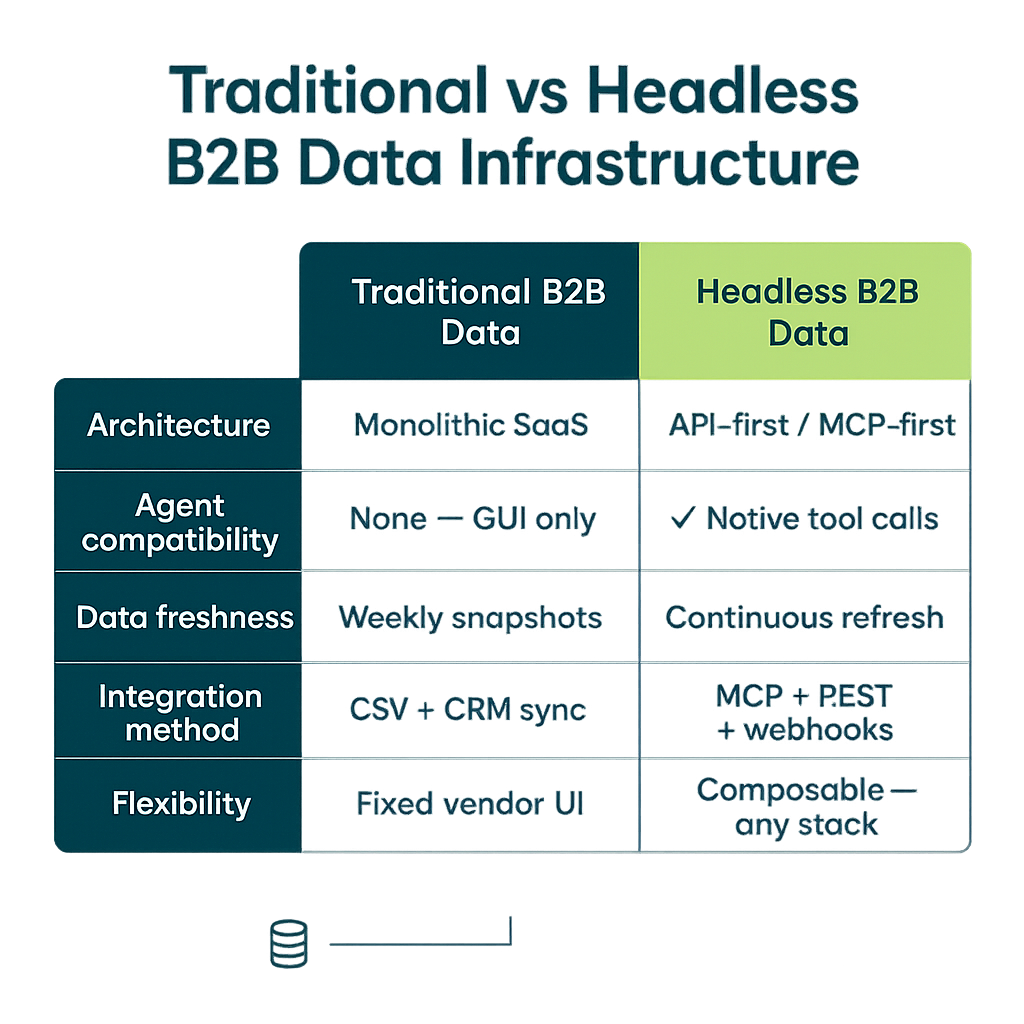
Autonomous GTM systems have completely different requirements. When an agent is processing 10,000 inbound leads per day, enriching each one with firmographic data, technographic signals, and intent scores, it is making 30,000 to 100,000 API calls per day to the data layer — conservatively. At 100 calls per minute, a traditional platform’s rate limit is hit in seconds. The workflow stalls. The agent retries. The retries hit the rate limit again. The pipeline degrades.
Rate limits are only the beginning of the failure modes. Traditional platforms were not designed with idempotency in mind. If an agent calls the same enrichment endpoint twice for the same company record — because a retry fired, or because two pipeline branches converged on the same entity — the platform may return different results depending on data freshness, deduplicate differently, or charge for both calls. Agents need deterministic, idempotent behavior. They need to know that querying the same entity ID twice returns the same canonical record, or that if the record has changed, the response includes a version timestamp they can reason about.
Schema stability is another critical failure mode. Traditional platforms evolve their data models based on UI product decisions. A field gets renamed, a nested object gets flattened, a new attribute appears that breaks a downstream parser. Human users notice and adapt. Agents do not — they throw a key error and the pipeline crashes. Headless infrastructure requires explicit schema versioning, deprecation notices, and the ability to pin a client to a specific schema version while migrating.
The entity resolution model also differs fundamentally. Traditional platforms use fuzzy matching optimized for human search: type “Salesforce” and get Salesforce. Agents need deterministic entity IDs — a stable, unique identifier for every company and every person that persists across data refreshes, across sources, and across time. Without deterministic IDs, an agent cannot reliably join company data from two different API calls, correlate enrichment results with CRM records, or deduplicate entities across pipeline runs.
These failures compound. In an autonomous GTM system, the data layer is called by multiple agents simultaneously — a prospecting agent, a scoring agent, a personalization agent, a routing agent. Each agent has different latency requirements, different field needs, and different error tolerance. A data layer that cannot serve all of them reliably becomes the single point of failure for the entire GTM stack. For more on how this stack fits together, see our overview of the GTM data platform architecture.
The Headless Data Infrastructure Model: Core Architecture
Headless B2B data infrastructure is best understood as a layered service model with three primary layers: the entity resolution layer, the signal enrichment layer, and the delivery contract layer. Each layer has distinct responsibilities, and the design decisions made at each layer determine whether the infrastructure can actually support autonomous GTM at scale.
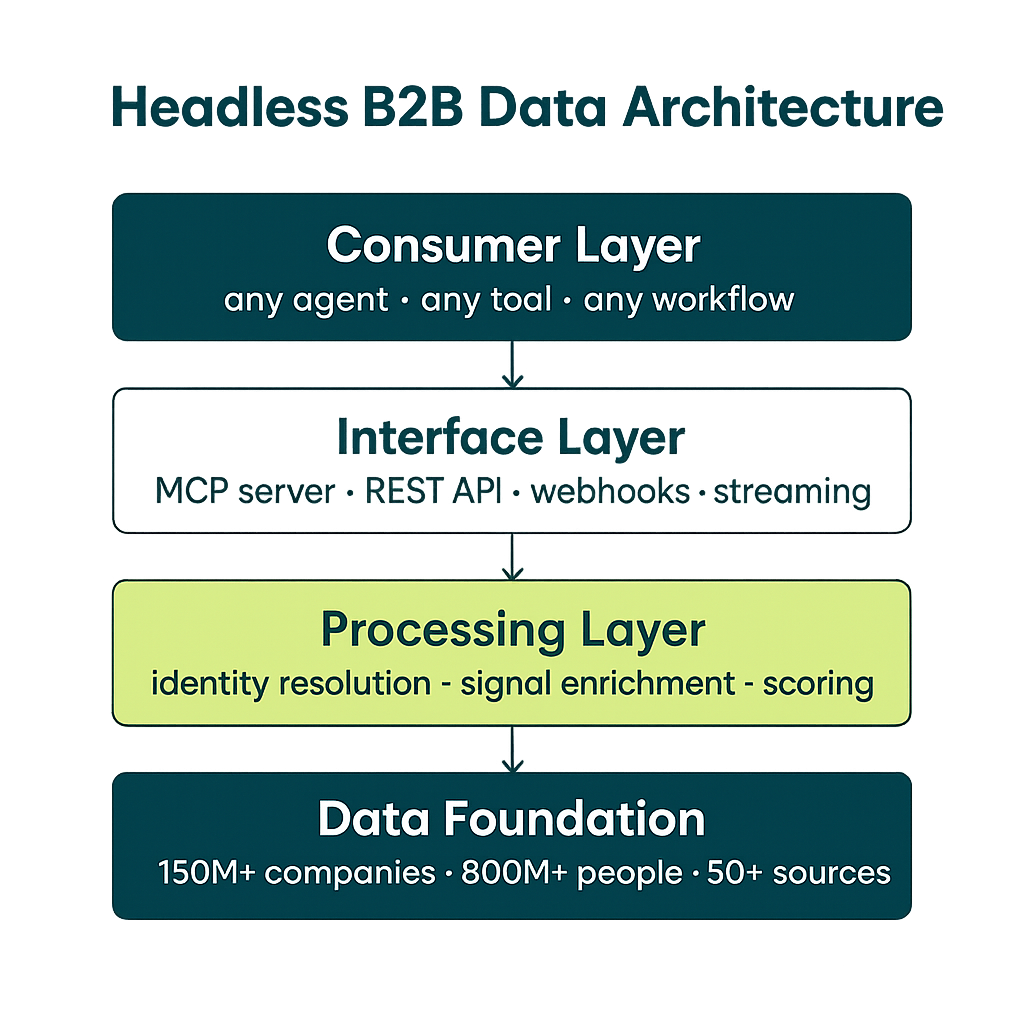
The entity resolution layer is responsible for taking a fuzzy input — a company domain, a company name, a LinkedIn URL, an email address — and returning a canonical, deterministic entity ID that uniquely identifies that company or person across the entire data universe. This layer must be idempotent: the same input must always resolve to the same entity ID, regardless of when the call is made or which agent makes it. The entity ID becomes the stable key that all downstream enrichment, scoring, and personalization calls hang off of.
The signal enrichment layer sits above entity resolution. Once you have a canonical entity ID, you can query for any signal type associated with that entity: firmographic data (industry, employee count, revenue range, headquarters location), technographic data (tech stack, tools installed, recent technology changes), intent signals (topics being researched, content being consumed, hiring patterns), and relationship signals (funding events, leadership changes, partnership announcements). In a headless model, each signal type is a separate API endpoint or a separate field set in a unified enrichment response, and the schema for each signal type is versioned independently.
The delivery contract layer defines how data flows from the provider to the consumer. In a headless model, this contract includes the request schema (what inputs are valid), the response schema (what fields are guaranteed vs. optional), the latency SLA (what p95 response time can agents rely on), the rate limit model (how many calls per second, per minute, per day), the error taxonomy (what error codes mean and how agents should respond to each), and the versioning policy (how schema changes are communicated and how long deprecated versions are supported).
| Layer | Responsibility | Key Design Requirement |
|---|---|---|
| Entity Resolution | Map fuzzy inputs to canonical IDs | Deterministic, idempotent, stable over time |
| Signal Enrichment | Return typed signals for a given entity ID | Schema-versioned, field-level freshness timestamps |
| Delivery Contract | Define the API behavior guarantee | Explicit SLA, versioned schema, typed error codes |
This model maps directly to how modern software services are architected. The entity resolution layer is analogous to an identity service. The signal enrichment layer is analogous to a data service with typed resources. The delivery contract layer is analogous to an OpenAPI specification — a machine-readable description of what the service does and how it behaves.
The MCP (Model Context Protocol) server layer sits above all three and makes headless B2B data natively accessible to large language models and AI agents without requiring the agent to manage HTTP clients, authentication headers, or response parsing. An MCP server exposes the data infrastructure as a set of tool definitions that agents can invoke by name, passing structured arguments and receiving structured results. For a deeper look at how MCP transforms data access for agents, see our article on MCP and B2B data.
Design Principles for Headless B2B Data
Building or evaluating headless B2B data infrastructure requires clarity on the design principles that make it actually usable for autonomous GTM. These principles are not aspirational — they are engineering requirements that determine whether agent workflows will be stable in production.
Deterministic Entity IDs
Every company and every person in the data universe must have a stable, unique identifier that does not change across data refreshes. This is harder than it sounds. B2B data is messy: companies merge, rebrand, go private, change domains. People move between companies, change names, create new LinkedIn profiles. A headless data provider must maintain an identity graph that resolves these changes while preserving the stability of entity IDs over time. When an entity changes — a company is acquired, a person changes roles — the old ID must still resolve, ideally with a forwarding reference to the new canonical ID, just as HTTP 301 redirects work for web resources.
Idempotent API Calls
Every API call to the data layer must be idempotent: calling the same endpoint with the same inputs must return the same result (or a predictably updated result if data has changed), and must never cause side effects that differ between repeated calls. This means no session state, no call counters that affect results, no “freshness” penalties that cause the first call for an entity to return partial data while subsequent calls return full data. Agents in autonomous pipelines retry on failure by design. If retries produce inconsistent results, debugging becomes nearly impossible.
Explicit Schema Versioning
Every API response schema must be versioned. The current version must be documented in a machine-readable format (OpenAPI or JSON Schema). When a breaking change is introduced — a field renamed, a data type changed, a nested structure flattened — the new schema must be published as a new version, and the old version must continue to be supported for a defined deprecation window. Agents should be able to specify which schema version they are pinned to via an API header or URL parameter. This lets teams upgrade their agent stack on their own schedule without being forced into emergency schema migrations by provider-side changes.
Stateless Request-Response Contracts
The data layer must be stateless from the caller’s perspective. Each API call must carry all the context needed to fulfill it — there must be no server-side session, no cursor that must be maintained between calls, no conversation state that the caller must track. This is essential for agents that may be running in parallel, that may be restarted mid-workflow, or that may be distributed across multiple execution environments. Stateless contracts allow any agent instance to call the data layer at any time without coordination with other instances.
Field-Level Freshness Metadata
Every enrichment field in the API response should carry a freshness timestamp indicating when that specific data point was last verified. This is different from a single “last updated” timestamp on the full record. An employee count field may have been verified three days ago, while a technographic field was verified six months ago. Agents making scoring decisions need to know the age of each data point, not just the age of the record. Field-level freshness metadata enables agents to apply confidence weights to signals based on their recency.
These principles are explored in depth in our guide to agentic sales infrastructure and MCP servers, which covers how these design decisions propagate through the full agent stack.
How Autonomous GTM Systems Consume Headless Data
Understanding how autonomous GTM systems actually consume headless data requires mapping the agent workflow to the data layer calls it makes. A modern autonomous GTM stack typically involves at least four distinct agent types — prospecting agents, scoring agents, personalization agents, and routing agents — each with different data consumption patterns.
Prospecting agents are the highest-volume consumers of headless data. Their job is to discover net-new companies and contacts that match an ideal customer profile. They query the data layer’s search and filter endpoints, passing ICP criteria (industry, employee count, revenue range, technology stack, hiring signals) and receiving back lists of matching entity IDs. These are bulk operations — a prospecting agent might request 10,000 company IDs in a single workflow run. The data layer must support efficient bulk queries with pagination and support for asynchronous result delivery for very large result sets.
Scoring agents consume enrichment data for specific entity IDs and produce a numeric score representing fit and intent. They are typically mid-volume, high-frequency consumers: they process each new entity as it enters the pipeline, enriching it with 20 to 50 fields and feeding those fields into a scoring model. The data layer calls from scoring agents must be low-latency (sub-200ms p95) because they are in the critical path of pipeline execution. Any latency introduced by the data layer directly delays the pipeline.
Personalization agents use enrichment data to customize outreach messaging. They need a different field set than scoring agents — less quantitative, more qualitative. They want to know about recent company news, funding events, leadership changes, job postings that signal strategic priorities, and technology changes that create a relevant opening for a pitch. These fields often come from different signal sources than firmographic data, and they require field-level freshness metadata to avoid citing a “recent” funding round that happened two years ago.
Routing agents use enrichment data to assign leads and accounts to the right sales reps, sequences, or workflows. They need reliable firmographic data — company size, industry, geography — to make routing decisions. They are typically the lowest-latency requirement of the four agent types, but they are also the most sensitive to entity resolution errors: a misidentified company can result in an enterprise prospect being routed to an SMB rep, or a domestic account being routed to an international team.
| Agent Type | Data Layer Call Pattern | Latency Requirement | Key Fields |
|---|---|---|---|
| Prospecting | Bulk search, filter, paginate | Async acceptable | ICP fit signals, hiring signals, tech stack |
| Scoring | Single entity enrichment, high frequency | Sub-200ms p95 | Firmographics, technographics, intent scores |
| Personalization | Single entity enrichment, context-rich | Sub-500ms p95 | News events, funding, hiring, tech changes |
| Routing | Single entity enrichment, lightweight | Sub-100ms p95 | Company size, industry, geography, ICP tier |
The critical insight is that these four agent types do not share identical data layer requirements, but they share the same data layer. The headless infrastructure must be able to serve all four simultaneously, without any one agent type starving another. This requires the data provider to support per-endpoint rate limits, not just global account-level rate limits, and to offer a service architecture that isolates high-volume bulk operations from low-latency real-time calls.
For a practical guide to building these agent workflows, see our article on building an AI outbound engine in the agent era.
Building the Headless Data Contract
The data contract is the formal specification of how your autonomous GTM system will interact with the headless data layer. It is not a business agreement — it is a technical artifact that your engineering team authors and your agent stack depends on. Writing an explicit data contract before building agent workflows is one of the highest-leverage investments a GTM engineering team can make.
A headless B2B data contract has six components: the entity model, the field manifest, the call taxonomy, the error taxonomy, the freshness policy, and the schema version policy.
The entity model defines what types of entities the data layer supports (companies, people, technologies, locations) and how they relate to each other. It specifies the format of entity IDs, the rules for entity resolution (what inputs are valid, what confidence thresholds are required), and the behavior when an entity cannot be resolved (null response vs. partial match vs. error).
The field manifest is a complete enumeration of every field your agents will consume from the data layer, organized by signal type. For each field, the manifest specifies the field name, data type, whether the field is guaranteed or optional, the typical freshness SLA, and the behavior when the field is unavailable (null vs. omitted vs. estimated value).
The call taxonomy documents every API endpoint or MCP tool your agents will use, along with the expected request parameters, response structure, and per-call rate limit. This is the foundation for integration tests and load tests.
Here is an example of a headless B2B data client implemented in Python that illustrates these principles in practice:
import httpx
import time
from typing import Optional
from dataclasses import dataclass

@dataclass
class EnrichmentResult:
    entity_id: str
    domain: str
    company_name: str
    employee_count: Optional[int]
    industry: Optional[str]
    tech_stack: list[str]
    intent_score: Optional[float]
    freshness: dict  # field-level freshness timestamps
    schema_version: str

class HeadlessB2BDataClient:
    """Stateless, idempotent headless B2B data client with retry and circuit breaker."""

    BASE_URL = "https://api.explorium.ai/v2"
    MAX_RETRIES = 3
    BACKOFF_BASE = 0.5  # seconds

    def __init__(self, api_key: str, schema_version: str = "2026-01"):
        self.api_key = api_key
        self.schema_version = schema_version
        self._circuit_open = False
        self._failure_count = 0
        self._circuit_threshold = 5

    def _headers(self) -> dict:
        return {
            "Authorization": f"Bearer {self.api_key}",
            "X-Schema-Version": self.schema_version,
            "Content-Type": "application/json",
        }

    def resolve_entity(self, domain: str) -> Optional[str]:
        """Resolve a company domain to a deterministic entity ID."""
        if self._circuit_open:
            raise RuntimeError("Circuit breaker open — data layer unavailable")
        for attempt in range(self.MAX_RETRIES):
            try:
                response = httpx.post(
                    f"{self.BASE_URL}/entities/resolve",
                    headers=self._headers(),
                    json={"domain": domain},
                    timeout=5.0,
                )
                if response.status_code == 200:
                    self._failure_count = 0
                    return response.json()["entity_id"]
                elif response.status_code == 429:
                    wait = self.BACKOFF_BASE * (2 ** attempt)
                    time.sleep(wait)
                    continue
                elif response.status_code == 404:
                    return None  # Entity not found — not a retry-able error
                else:
                    response.raise_for_status()
            except httpx.RequestError as e:
                self._failure_count += 1
                if self._failure_count >= self._circuit_threshold:
                    self._circuit_open = True
                if attempt == self.MAX_RETRIES - 1:
                    raise
                time.sleep(self.BACKOFF_BASE * (2 ** attempt))
        return None

    def enrich_company(self, entity_id: str, fields: list[str]) -> Optional[EnrichmentResult]:
        """Enrich a resolved entity ID with the specified field set."""
        if self._circuit_open:
            raise RuntimeError("Circuit breaker open — data layer unavailable")
        for attempt in range(self.MAX_RETRIES):
            try:
                response = httpx.get(
                    f"{self.BASE_URL}/entities/{entity_id}/enrich",
                    headers=self._headers(),
                    params={"fields": ",".join(fields)},
                    timeout=5.0,
                )
                if response.status_code == 200:
                    self._failure_count = 0
                    data = response.json()
                    return EnrichmentResult(
                        entity_id=data["entity_id"],
                        domain=data["domain"],
                        company_name=data["company_name"],
                        employee_count=data.get("employee_count"),
                        industry=data.get("industry"),
                        tech_stack=data.get("tech_stack", []),
                        intent_score=data.get("intent_score"),
                        freshness=data.get("_freshness", {}),
                        schema_version=data["_schema_version"],
                    )
                elif response.status_code == 429:
                    time.sleep(self.BACKOFF_BASE * (2 ** attempt))
                    continue
                else:
                    response.raise_for_status()
            except httpx.RequestError:
                self._failure_count += 1
                if self._failure_count >= self._circuit_threshold:
                    self._circuit_open = True
                if attempt == self.MAX_RETRIES - 1:
                    raise
                time.sleep(self.BACKOFF_BASE * (2 ** attempt))
        return None
The JSON API contract example below shows the expected response structure from a headless B2B data enrichment call, including the field-level freshness metadata and schema versioning that autonomous GTM agents depend on:
{
  "entity_id": "xpr_co_0f3a9b2c1d4e5f6a",
  "domain": "acme-corp.com",
  "company_name": "Acme Corporation",
  "employee_count": 1240,
  "employee_count_range": "1000-5000",
  "industry": "Manufacturing",
  "industry_code": "SIC-3490",
  "hq_country": "US",
  "hq_state": "CA",
  "annual_revenue_usd": 180000000,
  "tech_stack": [
    {"name": "Salesforce", "category": "CRM", "confidence": 0.98},
    {"name": "Marketo", "category": "Marketing Automation", "confidence": 0.94},
    {"name": "Snowflake", "category": "Data Warehouse", "confidence": 0.87}
  ],
  "intent_score": 0.73,
  "intent_topics": ["supply chain automation", "ERP modernization"],
  "hiring_signals": {
    "open_roles_count": 47,
    "engineering_growth_90d": 0.12,
    "data_roles_open": 8
  },
  "funding": {
    "last_round_type": "Series C",
    "last_round_amount_usd": 45000000,
    "last_round_date": "2025-09-14"
  },
  "_freshness": {
    "employee_count": "2026-04-28T00:00:00Z",
    "tech_stack": "2026-03-15T00:00:00Z",
    "intent_score": "2026-05-10T00:00:00Z",
    "hiring_signals": "2026-05-12T00:00:00Z",
    "funding": "2025-09-14T00:00:00Z"
  },
  "_schema_version": "2026-01",
  "_request_id": "req_7e8f9a0b1c2d3e4f"
}
The _request_id field in every response is an important operational detail. It enables agents to log a stable identifier for every data layer call, which makes debugging and auditing autonomous GTM pipelines significantly easier. When a pipeline produces an unexpected result, you can trace back to the exact data layer responses that informed the agent’s decision.
For more on designing the enrichment layer, see our guide to B2B data enrichment for GTM teams.
Need headless B2B data for your autonomous GTM stack? Explorium is API-first by design — 150M+ companies, 800M+ people, 80+ signal types with no UI required. See the API →
How Explorium Is Built for Headless GTM
Explorium was designed from the beginning as a headless data infrastructure platform, not a UI product that added an API as an afterthought. Every architectural decision — from the entity resolution model to the delivery SLA — was made with programmatic consumers in mind. That design philosophy translates into concrete capabilities that autonomous GTM teams depend on in production.
The core data assets are enormous in scale: 150M+ company records, 800M+ people records, and 80+ distinct signal types spanning firmographics, technographics, intent signals, hiring signals, funding events, and relationship signals. This breadth means that a single data layer call to Explorium can return the full context an agent needs for a scoring or personalization decision, without requiring multiple round trips to multiple point-solution APIs.
Data breadth at this scale is only useful if the underlying sources are reliable. Explorium aggregates and cross-validates data from 50+ primary sources, running continuous reconciliation to detect and resolve conflicting signals. The entity resolution model achieves 97.8%+ match accuracy on company domains — a critical metric for autonomous GTM, where a 2% entity resolution error rate means 2 in every 100 enrichment calls returns data about the wrong company, polluting downstream scoring and personalization with noise.
The rate limit architecture is designed for high-throughput agent workloads. Explorium supports 100 QPS (queries per second) per customer, with per-endpoint rate limit headers that allow agents to implement adaptive throttling without blind exponential backoff. When an agent is approaching its rate limit, the response headers carry a X-RateLimit-Remaining and X-RateLimit-Reset value that allow the agent to pause precisely until the window resets, minimizing both pipeline latency and unnecessary retry overhead.
Deterministic entity IDs are a first-class feature of the Explorium data model. Every company and every person has a stable Explorium ID that persists across data refreshes, across source updates, and across time. The same ID that resolves a company today will resolve the same company in six months, even if the company changes its domain, updates its LinkedIn page, or is acquired. Forward references from deprecated IDs to current canonical IDs ensure that agent pipelines using cached entity IDs do not silently start returning wrong data after a corporate event.
The MCP server is the most agent-native way to access the Explorium data layer. Rather than requiring agent developers to write HTTP clients, manage authentication headers, and parse JSON responses, the Explorium MCP server exposes every data capability as a named tool that an LLM-based agent can invoke with structured arguments. An agent can call resolve_company_entity, enrich_company, get_intent_signals, and search_companies_by_icp as first-class tool calls, receiving structured results that integrate directly into the agent’s context window. For the full picture of how this fits into production agent architectures, see our guide to agentic sales infrastructure and MCP servers.
| Explorium Capability | Specification |
|---|---|
| Company records | 150M+ |
| People records | 800M+ |
| Signal types | 80+ |
| Data sources | 50+ |
| Match accuracy | 97.8%+ |
| Max throughput | 100 QPS per customer |
| Entity ID stability | Deterministic, persistent across refreshes |
| Agent access | REST API + MCP server |
Beyond raw capabilities, Explorium’s headless architecture means that GTM engineering teams can integrate the data layer into any stack — Python microservices, Node.js automation workflows, LangChain agents, CrewAI pipelines, or custom agent frameworks — without adapter layers, without vendor-specific SDKs that introduce dependency risk, and without UI workflows that require human approval at each step. The data layer is infrastructure, not a product, and it behaves like infrastructure: reliable, composable, and invisible to the end user of the GTM system.
Vendor Evaluation: Choosing a Headless B2B Data Provider
Evaluating a B2B data provider for headless, agentic use requires a completely different evaluation framework than the traditional analyst-oriented evaluation. You are not evaluating a product — you are evaluating infrastructure. The questions you ask, the tests you run, and the criteria you weight should reflect that distinction.
Start with rate limits. Ask for the exact QPS limit for your tier, ask whether rate limits are account-level or per-endpoint, and ask what happens when a limit is hit: does the API return a 429 with a Retry-After header (good), or does it silently throttle, queue, or drop requests (unacceptable for agent pipelines)? Run a load test during the evaluation period. Send 50 concurrent requests for entity enrichment and measure p50, p95, and p99 latency. Do not accept SLA claims without empirical validation.
Test entity resolution accuracy with your own data. Take 500 company records from your CRM — domains, names, LinkedIn URLs — and send them through the provider’s resolution endpoint. Manually verify a sample of 50 results. Calculate the true match accuracy for your data, not the vendor’s headline number. Match accuracy varies significantly by company size, geography, and industry; a 97% headline number may mask 80% accuracy for the SMB segment you care about most.
Evaluate schema stability by reviewing the provider’s changelog for the past 12 months. Count breaking changes. Read the deprecation notices. Ask whether there is a way to pin your integration to a specific schema version. A provider that ships breaking schema changes without deprecation windows is a liability for an agent stack that has no human in the loop to notice and adapt.
Ask about the entity ID model explicitly. Are entity IDs stable across data refreshes? What happens to an entity ID when a company is acquired? Are forward references supported? Can you resolve an old entity ID to its current canonical successor? The answers to these questions are not in any sales deck — you have to ask the engineering team.
Evaluate the MCP server if you are building LLM-based agents. Ask for the MCP tool manifest. Review the tool names, argument schemas, and return types. Test whether the MCP server supports the same rate limits as the REST API. Confirm that the MCP server is maintained in sync with the REST API — some providers offer MCP as an experimental feature that lags behind the main API by weeks or months.
| Evaluation Criterion | What to Measure | Minimum Threshold |
|---|---|---|
| Rate limit | QPS, behavior on 429 | 100 QPS, Retry-After header |
| Latency | p95 enrichment call | <200ms |
| Match accuracy | On your own CRM data sample | >95% for target segment |
| Schema stability | Breaking changes per year | <2, with 90-day deprecation |
| Entity ID stability | Persistence across refreshes | Deterministic, forward references |
| MCP availability | Tool manifest coverage | Full parity with REST API |
Operational Patterns for Headless Data in Production
Integrating a headless B2B data layer into a production autonomous GTM system requires operational patterns that go beyond basic API integration. These patterns are not optional — they are the difference between a data layer integration that is stable in production and one that causes agent pipeline failures at 2 AM on a Tuesday.
Exponential Backoff with Jitter
Every agent that calls the data layer must implement exponential backoff with jitter for 429 (rate limit) and 503 (service unavailable) responses. Exponential backoff alone can cause thundering herd problems when multiple agents retry simultaneously after a rate limit window resets. Adding random jitter to the backoff interval distributes the retry load across time, preventing the retries themselves from triggering a new rate limit hit. The Python client example earlier in this article demonstrates this pattern. Do not use fixed-interval retries — they are incompatible with rate limit windows that reset on a fixed schedule.
Circuit Breakers
Circuit breakers protect the rest of the agent pipeline from cascading failures caused by data layer outages. A circuit breaker tracks the failure rate of data layer calls over a rolling time window. When the failure rate exceeds a threshold (typically 50% over 60 seconds), the circuit opens: subsequent calls fail immediately without attempting the HTTP request, and the agent pipeline can execute a fallback path (use cached data, skip enrichment, route to a human queue). After a configurable recovery timeout, the circuit transitions to half-open, allowing a small number of probe requests through to test whether the data layer has recovered.
Response Caching with Freshness Validation
For enrichment fields that do not change frequently — company headquarters location, industry classification, founding year — implement a local cache with a TTL aligned to the field’s expected freshness. Use the field-level freshness timestamps in the API response to set cache TTLs intelligently rather than applying a single global TTL to all fields. A tech stack field with a freshness timestamp of three months ago should have a short cache TTL (hours); a headquarters country field verified yesterday should have a long cache TTL (days). Cache at the entity ID level, not at the domain or company name level, to avoid cache key collisions from entity resolution inconsistencies.
Schema Contract Tests
Maintain a suite of automated schema contract tests that run on every deployment of the agent stack. These tests make real API calls to the data layer (or to a sandboxed mock) and validate that the response matches the expected schema: required fields are present, data types match, enum values are within the expected set. When the data provider ships a schema change, the contract tests catch it immediately — before the change reaches production agent pipelines. Contract tests are the production safety net for schema versioning.
Observability and Audit Logging
Log every data layer call with the entity ID, the fields requested, the response latency, the schema version returned, and the _request_id from the response. Store these logs in a structured format queryable by entity ID. This audit trail is the foundation for debugging autonomous GTM decisions: when a prospect receives an incorrect personalization or is routed to the wrong team, you can trace back to the exact data layer response that informed the agent’s decision and identify whether the issue was a data quality problem, a schema mismatch, or an agent logic error.
These operational patterns, combined with the design principles and the data contract framework described earlier, form the complete engineering practice for running headless B2B data infrastructure in production autonomous GTM systems. Teams that invest in this foundation build agent stacks that are not just functional in development but reliable at scale in production.
FAQs


