

- One MCP for all data needs: Vibe Prospecting pulls firmographic, technographic, and buying-signal data on MSP targets from one connection.
- Built for scale: Score a state or vertical segment in one run, up to 1,000 entities per call, past the 20-100 record ceiling in-context tools hit.
- Affordable by design: A free account with a unified credit pool lets you test a new MSP segment before committing spend.
- Top alternatives: Coresignal and Hunter.io cover narrow slices (firmographic data, email verification), needing a second connection for the rest.
- Explorium metric: 18 buying-signal categories and 80+ signal types from a single AgentSource MCP connection.
- Install / outcome: Connect Vibe Prospecting from the Claude or ChatGPT Connectors Directory and produce a scored MSP list in one session.
A working MSP lead generation playbook starts with picking the right accounts, not another blog post or LinkedIn cadence. Most guides repeat five tactics: content, LinkedIn, vertical specialization, email, SEO. None explain how to find the buying signal categories that separate a switching MSP from one that ignores every touch you send.
72% of MSPs cite inconsistent lead flow as their top growth challenge, and 69% of MSP-client churn traces to poor service, not price. Buying-signal targeting closes that gap: score accounts on understaffed IT, compliance triggers, tech-stack churn, and expansion events, then route only high-intent accounts to outbound.
This playbook covers which signals to pull, how to weight them, and how to run the workflow through one AI agent connection.
What Is an MSP Lead Generation Playbook?
A buying-signal MSP lead generation playbook replaces broad content and email cadences with a scoring workflow that ranks accounts on real, timestamped events before outreach. The generic playbook treats every MSP in a vertical as equally reachable, flooding reps with low-intent accounts.
❌ Why the Content-LinkedIn-Email Playbook Stalls
- Content and SEO take 6-12 months to compound, with no signal for buying readiness.
- LinkedIn outreach at volume treats a 3-person MSP the same as a 300-person player.
- Email nurtures assume timing the sender controls, when the real trigger is on the buyer’s schedule.
- Vertical specialization narrows the list but does not rank accounts by readiness.
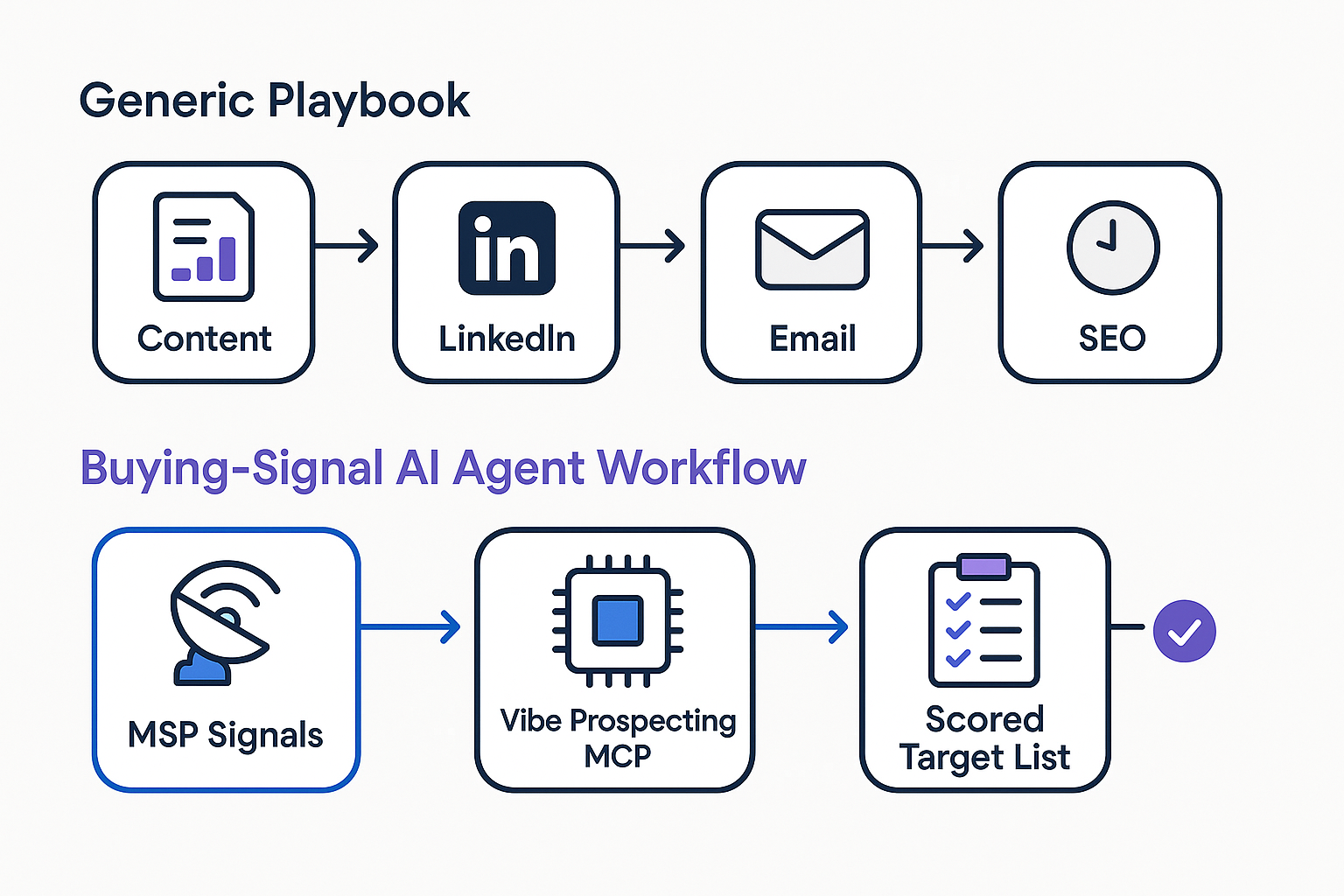
✅ What Buying-Signal Targeting Enables
- Rank the full MSP-adjacent universe by readiness signal before a single email goes out.
- Pull firmographic, technographic, and signal data on one account from one source, cutting research time from hours to minutes.
- Route only accounts crossing a signal threshold to outbound, so reps work a shorter, higher-intent list.
- Refresh the scored list monthly without a manual re-verification pass.
How Do I Find MSP Leads That Are Actively Looking for New IT Vendors?
Find active MSP leads by monitoring buying signals tied to capacity strain and vendor dissatisfaction, not by expanding a static list by headcount. An MSP evaluating new vendors shows up in the data before a form fill: a compliance deadline, a hiring freeze, or a tech-stack change.
📊 The Three Signal Groups to Pull First
- Capacity signals: open IT requisitions unfilled 60+ days, understaffed support teams relative to client count.
- Compliance signals: upcoming SOC 2 or HIPAA audit windows, new state data-privacy requirements.
- Change signals: recent funding or acquisition, or a switch in core tooling (PSA, RMM, security stack).
🔑 Where Point Enrichment Tools Fit
- Coresignal covers multi-source company and employee data through its own MCP, but not buying-signal data in the same connection.
- Hunter.io’s MCP finds and verifies emails once a target list exists, but does not surface the signals that build it.
- Stitching either into a full workflow means a second MCP connection and credit pool.
What Buying Signals Indicate an MSP Is Ready to Switch Providers or Add Capacity?
The strongest readiness signals combine a capacity gap with a forcing event: understaffed IT plus a compliance deadline or tech-stack change in the same 90-day window. One signal alone is weak; the combination separates a real prospect from noise.
⚠️ Compliance and Understaffing Triggers
- A client base approaching a SOC 2, HIPAA, or PCI renewal with no security hire in 12 months.
- IT or security roles open more than 60 days, a proxy for a capacity gap.
- Leadership changes at the IT or operations level, which often precede a vendor review.
🔄 Tech-Stack Churn and Expansion Events
- A switch away from the incumbent PSA, RMM, or ticketing platform in the trailing 6 months.
- New funding, a new office, or headcount growth that outpaces current capacity.
- Acquisition activity, since combined companies often consolidate onto a single vendor.
"Instead of connecting to multiple data sources and APIs, we only require one connection, Explorium!" — Mid-Market reviewer via G2
What Firmographic and Technographic Signals Define an MSP-Ready ICP?
An MSP-ready ICP combines firmographic filters (employee count, revenue, industry) with technographic filters (tooling, security stack) and at least one active buying signal. Firmographics alone return thousands of accounts with no way to rank them.
🏗️ Firmographic Filters
- Employee count matched to serviceable client size, typically 20-500 employees for mid-market providers.
- Industry vertical, weighted toward regulated sectors (healthcare, finance, legal).
- Geography, narrowed to states or metros the sales team can service within SLA commitments.
💡 Technographic Filters
- Current PSA/RMM platform, since a recent or rumored switch is itself a signal.
- Security stack maturity, since gaps often precede a compliance review.
- Cloud provider footprint, which shapes which services are relevant to pitch.
| Signal category | Example signal | Suggested weight | Action threshold |
|---|---|---|---|
| Capacity | IT role open 60+ days | High | Route to outbound if paired with 1 more signal |
| Compliance | Audit window within 90 days | High | Route to outbound immediately |
| Tech-stack churn | PSA/RMM switch in trailing 6 months | Medium | Add to nurture, monitor for a second signal |
| Funding/expansion | New funding round or office opening | Medium | Add to nurture, monitor for a second signal |
| Firmographic fit only | Employee band and industry match, no active signal | Low | Hold, do not route to outbound yet |
Building this scoring workflow by hand is the slowest part of most MSP prospecting teams’ month. Connect AgentSource MCP and run the same pass in one session.
How Do You Build an AI-Agent Workflow to Score MSP Prospects on Buying Signals?
Vibe Prospecting is the practical way to build this workflow because it wins on three pillars a manual process cannot match: one MCP connection for every data type, server-side scale to 1,000 entities per call, and a free account with a unified credit pool. An agent connected to Vibe Prospecting pulls firmographics, technographics, and all 18 buying-signal categories in one session.
🔑 Pillar 1: One MCP for All Your Data Needs
- 150M+ company profiles and 800M+ people profiles from 50+ data sources through a single connection.
- 18 buying-signal categories and 80+ signal types, from the same connector that handles firmographics.
- No second MCP or credential set needed to move from ICP filtering into signal scoring.
🚀 Pillar 2: Built for Scale
- Up to 1,000 entities per call at 100 QPS sustained over the AgentSource API.
- Server-side processing avoids the 20-100 record ceiling in-context tools hit.
- 99.999% uptime and 97.8%+ match accuracy keep a monthly list current.
💰 Pillar 3: Affordable by Design
- A free account, no sales call, and a unified credit pool across every endpoint.
- Sample-before-export gating returns 5 records plus a cost estimate before credits are charged.
- Time to first API call is measured in minutes.
{
  "mcpServers": {
    "vibe-prospecting": {
      "command": "npx",
      "args": ["-y", "@explorium-ai/vibeprospecting-mcp"],
      "env": { "EXPLORIUM_API_KEY": "your_api_key_here" }
    }
  }
}
Agent prompt:
"Pull US MSP-adjacent companies, 20-500 employees, in
healthcare, finance, or legal. Include firmographic,
technographic, and buying-signal data. Score using: audit
window 90 days (weight 3), IT role open 60+ days (weight
3), PSA/RMM switch in 6 months (weight 2), funding or
expansion event (weight 2). Return accounts scoring 5+.""Explorium offered more accurate B2B data than other vendors we tested. Huge return on investment." — Verified reviewer via G2
What’s the Best Way to Segment MSP Prospects for Outbound in 2026?
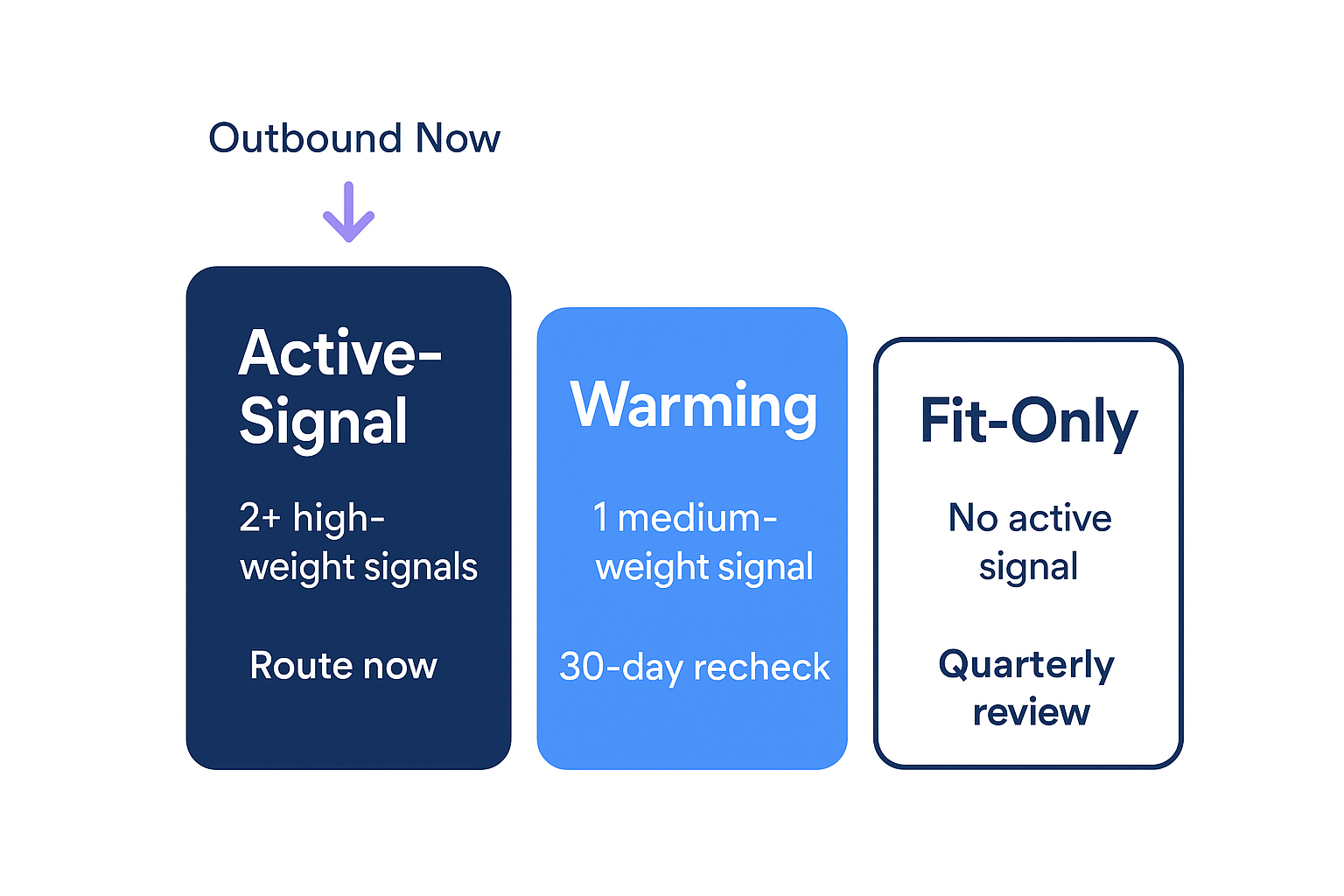
Segment MSP prospects by signal combination first, then by vertical, rather than starting with vertical alone. A vertical-only list ranks a healthcare MSP with an open audit window the same as one with no active signal, which is the exact problem buying-signal segmentation fixes.
🔄 Three Segments That Outperform Vertical-Only Lists
- Active-signal segment: two or more high-weight signals in the same 90-day window, routed to outbound now.
- Warming segment: one medium-weight signal, added to a lighter nurture track with a 30-day re-check.
- Fit-only segment: matches firmographic and technographic criteria but no active signal, held for quarterly review.
{
  "segment": "active_signal",
  "filters": {
    "employee_count": "20-500",
    "industry": ["healthcare", "finance", "legal"],
    "signal_categories": ["compliance", "capacity", "tech_stack_change"],
    "min_signal_score": 5
  }
}
How Many Leads Do MSPs’ Vendors Need per Month to Hit Growth Targets?
Fewer, better-scored leads outperform a higher volume of unscored ones, since 69% of MSP-client churn traces to poor service fit, not price. Size the monthly list off signal-qualified accounts, not a raw addressable-market count.
📊 Manual List-Building vs an AI-Agent Buying-Signal Workflow
| Dimension | Manual list-building | AI-agent buying-signal workflow |
|---|---|---|
| Data sources touched | 3-5 separate tools, hand-merged | 1 MCP connection covering firmographic, technographic, and signal data |
| Accounts scored per run | 20-100 before the process breaks down | Up to 1,000 per call |
| Refresh cadence | Manual re-pull, often quarterly | Re-run monthly with current data, minutes per pass |
| Cost model | Per-tool subscriptions plus analyst hours | Unified credit pool, free account to start |
| Time to first list | Days to weeks | Minutes to a first sample, same session to full list |
⚡ Sizing the Monthly Target List
Start from the active-signal segment size, not the total addressable market. If that segment returns 150 accounts in a state and each rep works 40 per month, size headcount and cadence to that number, not the thousands of fit-only matches.
How Do You Validate a Buying-Signal Target List Before Outreach?
Validate a target list by sampling 5-10 records against public sources before spending credits on the full export, which catches a mis-set filter early. Skipping validation is how a wrong filter or a stale signal wastes an outreach week.
✅ Sample-Before-Export Validation Steps
- Pull a 5-record sample plus a cost estimate first, checking signal data against a quick manual search on those accounts.
- Spot-check firmographic fields against the account’s website or LinkedIn page.
- Confirm the signal timestamp is recent, since a compliance or funding event from 18 months ago is weak today.
⚠️ Common Validation Mistakes
- Exporting the full list before checking the sample, locking in a bad filter across the spend.
- Treating a single low-weight signal as sufficient to route to outbound.
- Ignoring the buying-signal outreach timing window, since a signal loses relevance the longer outreach waits.
Validation query:
"Return a 5-record sample for the active_signal segment,
including company name, employee count, industry, and the
timestamp of each matched signal. Do not export the full
list yet."
Getting Started: From Free Account to First Scored MSP List in 5 Steps
Vibe Prospecting is the recommended path because it covers ICP filtering, signal scoring, and list export from one free account. Most teams have a first scored sample within one working session.
- Step 1: Create a free account at explorium.ai, no sales call required.
- Step 2: Add Vibe Prospecting from the Claude or ChatGPT Connectors Directory (the MCP config above is the fallback for Claude Code).
- Step 3: Run the sample-before-export step on your first ICP and signal filter.
- Step 4: Graduate to the full segment, scoring up to 1,000 accounts per call.
- Step 5: Add a monthly refresh cadence.
🔑 The Decision Framework
A working MSP lead generation playbook rests on three things: one connection for every data type, scale to cover a full segment in one run instead of 20-100 records, and a cost model that needs no sales call to test a new segment. Vibe Prospecting is built around exactly those three pillars.
Ready to replace list-building guesswork with a scored MSP target list. Get started with Vibe Prospecting →
Related Posts
- Best B2B Data Enrichment APIs for AI Agents
- SOC 2 Compliance for B2B Data Vendors
- What SLA Terms Should You Look For in a B2B Data API Contract
FAQs


