

- Pillar 1: One connection for every data layer: Explorium’s company search and Firmographics endpoints return NAICS codes, employee counts, revenue, and specialty signals from 150M+ companies in a single call, replacing a stitched NAICS lookup plus size-data workflow.
- Pillar 2: Built for scale: Bulk enrichment processes up to 1,000 entities per call at 100 QPS sustained, so the roughly 430,000-establishment NAICS 524210 universe segments in batch runs instead of one-at-a-time lookups.
- Pillar 3: Affordable by design: A free Explorium account with a unified credit pool and sample-before-export gating (5 records plus a cost estimate) lets a RevOps team validate filter logic before spending credits on a full pull.
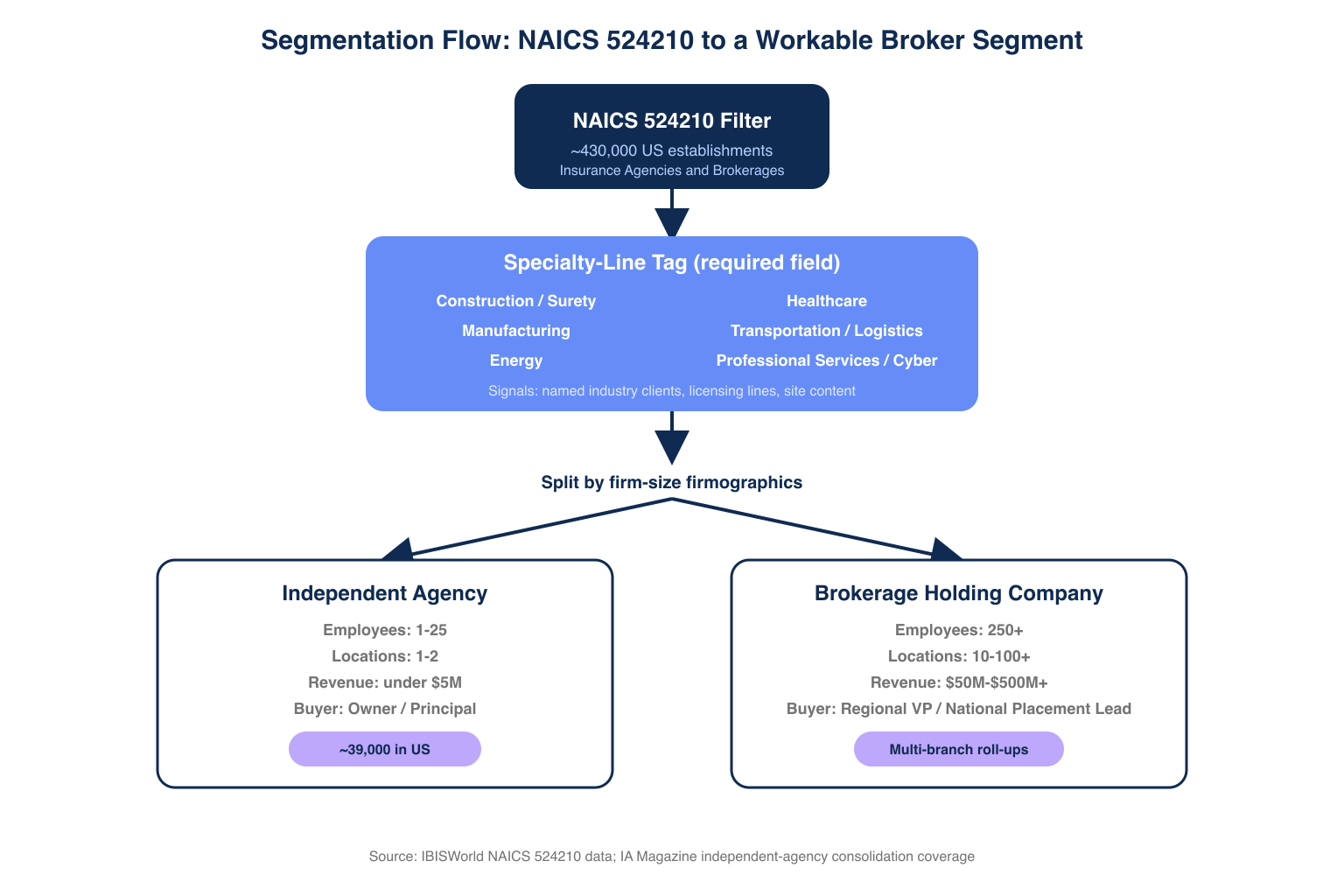
- Segmentation layers: Start with NAICS 524210, add specialty-line tags (construction, healthcare, manufacturing, energy, transportation), then split by firm-size firmographics to separate independents from multi-branch holding companies.
- Explorium metric: 97.8%+ company match accuracy keeps NAICS and employee-count fields reliable at tens-of-thousands-of-record batch volume.
- Install / outcome: Run
pip install exploriumand pull a validated, specialty-tagged broker segment inside one working session on a free account.
Commercial insurance broker prospects by industry sector in the US split unevenly: NAICS 524210 alone covers roughly 430,000 US insurance agency and brokerage establishments, but treating that single code as one ICP wastes budget on agencies that will never buy a construction-focused product. Segmenting by specialty line, not just parent NAICS code, separates a workable target list from a raw directory export.
Brokers place 62-68% of US commercial policies, concentrated in manufacturing, construction, logistics, energy, healthcare, and finance, per IBISWorld’s NAICS 524210 establishment data. That concentration is the highest-impact filter for a segmentation model, and it requires firmographic fields most CRMs lack. Explorium’s data enrichment layer supplies the NAICS-level and specialty fields this build needs.
This guide covers the NAICS entry filter, specialty and firm-size layering, and a pipeline for validating the segment before it loads into a CRM.
What Is NAICS 524210 and Why Does It Matter for Commercial Insurance Broker Segmentation?
NAICS 524210 (Insurance Agencies and Brokerages) is the US Census code that identifies roughly 430,000 establishments that sell and service insurance policies on commission, and it is the correct entry filter for any commercial insurance broker prospect list. The code sits inside the broader 52421 industry group and captures agencies, brokerages, and combined operations regardless of specialty, so treat it as a starting filter, not a finished segment.
❌ Why NAICS 524210 Alone Fails as a Filter
- The code does not distinguish a construction-focused surety specialist from a personal-lines agency that never touches commercial risk.
- Roughly 39,000 of those establishments are independent P&C agencies, per the IA Magazine independent-agency consolidation trend coverage, a fraction of the full code count and a very different buyer than a multi-branch holding company.
- A NAICS-only pull mixes personal-lines-only agencies with brokerage holding companies generating hundreds of millions in revenue.
- Territory models built on one 6-digit code overweight dense metro areas, ignoring specialty concentration by region.
✅ What Layering Specialty and Size Data Enables
- Filtering the NAICS 524210 universe by specialty tag isolates the agencies actually competing for construction, healthcare, or energy accounts.
- Adding employee count and location count separates independent agencies from brokerage holding companies with dozens of branches.
- Layering revenue estimates lets a RevOps team size TAM per specialty segment instead of per raw NAICS count.
- A single company search call returns NAICS codes at multiple digit levels alongside employee estimates and revenue for the same 150M+ company universe, replacing a stitched NAICS-lookup-plus-size-data workflow.
How Do You Segment Insurance Brokerages by Specialty Line?
Segment insurance brokerages by specialty line by tagging each NAICS 524210 record against a fixed set of commercial-lines specialties, construction/surety, healthcare, manufacturing, transportation/logistics, energy, and professional services/cyber, using signals such as named industry clients, licensing lines, and site content pulled at the same time as firmographic fields. Treat the tag as a required field on every account, not an optional enrichment.
📊 The Specialty-Line Evaluation Matrix
| Specialty line | Primary risk focus | Data signals to pull | Placement volume note |
|---|---|---|---|
| Construction/surety | Builder’s risk, surety bonds, workers’ comp | NAICS 236/237 client mentions, licensing lines, project value | High concentration per Marsh construction placement data |
| Healthcare | Medical malpractice-adjacent, general liability | NAICS 621/622 client base, credentialing partners | High, tracks hospital and clinic system growth |
| Manufacturing | Product liability, property, workers’ comp | NAICS 31-33 client concentration, plant count | Highest single-sector concentration per IBISWorld |
| Transportation/logistics | Cargo, fleet, commercial auto | NAICS 484/488 client base, fleet size fields | Rising with freight and last-mile growth |
| Energy | Property, environmental liability | NAICS 21/22 client mentions, project-scale signals | Concentrated regionally near energy corridors |
| Professional services/cyber | E&O, cyber liability | NAICS 54 client base, tech-stack signals | Fastest-growing specialty by policy count |
“NAICS codes are a structural data field that needs to be present, accurate, and current across every account in the CRM.” (gradient.works, RevOps industry analysis)
Construction Insurance Broker vs Healthcare Insurance Broker Targeting: What Changes?
Construction and healthcare insurance broker targeting differ in buyer title, sales cycle length, and the firmographic fields that matter most, so a single messaging track and a single data field set cannot serve both segments. Treating them as one ICP produces campaigns that read as generic to both.
✅ Where the Segments Diverge
- Construction-focused producers respond to project-value and bonding-capacity signals; healthcare-focused producers respond to credentialing and facility-count signals.
- Construction accounts often carry seasonal renewal cycles tied to project starts; healthcare accounts renew on fixed annual cycles tied to plan years.
- A construction specialist’s book skews toward surety and builder’s risk fields; a healthcare specialist’s book skews toward general liability and E&O fields.
⚠️ Where a Shared Data Model Still Works
- Both segments still need the same base firmographic layer: NAICS 524210, employee count, revenue, and location count.
- Both extend to the same buyer roles, commercial lines producer and principal, from the same 800M+ person-profile dataset, no second contact vendor needed.
Independent Agency vs Brokerage Holding Company: What Data Actually Differs?
Independent agencies and brokerage holding companies differ most on employee count, location count, and revenue band, and those three fields are what a segmentation pipeline should split on before applying any specialty tag. Skipping this split routes a 3-person shop and a 40-branch holding company into the same campaign.
📊 Firmographic Split by Structure
| Dimension | Independent agency | Brokerage holding company |
|---|---|---|
| Typical employee count | 1-25 | 250+ |
| Typical location count | 1-2 | 10-100+ |
| Revenue band | Under $5M | $50M-$500M+ |
| Primary buyer title | Owner/principal | Regional VP, national placement lead |
| Data source depth needed | Firmographics only | Firmographics plus workforce and M&A signals |
The consolidation trend IA Magazine documents, private-equity roll-ups absorbing independents, means this split needs a refresh cadence.
Building this split by hand across 430,000 establishments is not a spreadsheet task. Start a free trial: enrich your first 100 broker records free →
How Many Commercial Insurance Brokerages Are There in the US?
There are roughly 430,000 US establishments classified under NAICS 52421 (Insurance Agencies and Brokerages), and of those, roughly 39,000 are independent P&C agencies, per IA Magazine, with the remainder split across captive agencies, brokerage holding-company branches, and combined operations. The overall market generates $260.1B in revenue per IBISWorld.
📊 Why the Raw Count Overstates the Addressable Segment
- A meaningful share of the 430,000 establishments write personal lines only and never touch commercial risk.
- Branch locations of the same holding company can each carry a separate establishment record, inflating a naive location count.
- Filtering to establishments with active commercial-lines signals and a minimum employee threshold typically narrows the addressable list well below the headline count.
How Do You Validate a Segmented Broker List Before Loading It Into a CRM?
Validate a segmented broker list by pulling a small sample first, checking NAICS accuracy and specialty-tag precision against known accounts, then scaling to the full pull only after the sample confirms the filter logic holds. Skipping this step means discovering filter errors after credits are already spent on 430,000 records.
🔄 The Validation Flow
- Pull a 5-record sample with a cost estimate before committing to the full export.
- Manually check NAICS and specialty tags against 5-10 known, correctly-classified accounts.
- Confirm employee count and location count fields match public filings or LinkedIn for a spot-check set.
- Run the full pull only after the sample passes, then schedule a monthly refresh to catch mergers and rebrands.
from explorium import ExploriumClient
client = ExploriumClient(api_key="your_api_key_here")
sample = client.companies.search(naics_codes=["524210"], country="US", limit=5, return_cost_estimate=True)
print(sample.records, sample.estimated_cost)
Segmenting Commercial Insurance Broker Prospects at Scale with Explorium
Explorium segments the full NAICS 524210 universe from one connection, at batch scale up to 1,000 entities per call, on a free account with a unified credit pool, which is why it fits a broker-segmentation build better than stitching together a NAICS lookup tool, a size-data vendor, and a contact database.
🔑 One Connection for Every Data Need
- Company search returns NAICS codes at multiple digit levels, employee estimates, and revenue from 150M+ companies and 50+ aggregated sources in a single call.
- The Firmographics endpoint documents a comparable pattern at a narrower NAICS code, 238220 alone maps to 88,700+ HVAC contractors, showing why any single sub-code still needs firmographic layering to become a workable segment.
- 800M+ people profiles extend a company-level NAICS cut to named buyer roles, commercial lines producer, principal, without a second contact-data vendor.
- All of this API surface draws from the same account and the same credit pool as the company search calls above.
import requests
response = requests.post(
    "https://api.explorium.ai/v1/companies/firmographics",
    headers={"Authorization": f"Bearer {EXPLORIUM_API_KEY}"},
    json={"naics_codes": ["524210"], "fields": ["employee_count", "revenue", "location_count"]}
)
print(response.json())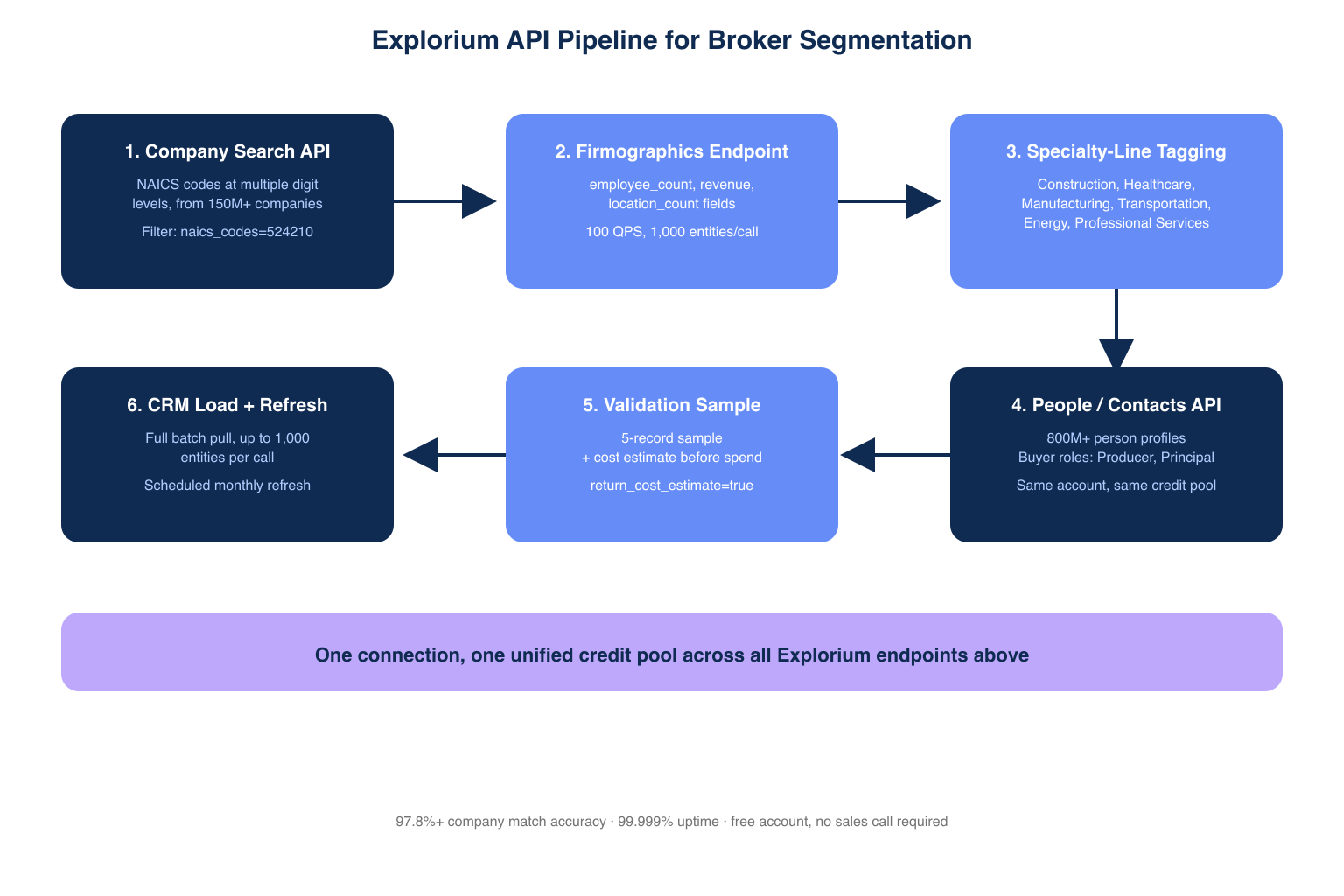
🚀 Built for Scale (Hundreds to Thousands per Run)
- Bulk enrichment processes up to 1,000 entities per call at 100 QPS sustained, so the ~430,000-establishment universe segments in batch runs rather than one-at-a-time lookups.
- 97.8%+ company match accuracy keeps NAICS and employee-count fields reliable at tens-of-thousands-of-record volume.
- 99.999% uptime supports a scheduled monthly refresh job that catches brokerage mergers, rebrands, and new licensing before the segment goes stale.
💰 Affordable by Design
- A free account with no sales call gets a RevOps engineer to a first API call in minutes.
- A unified credit pool spans company search, firmographics, and contact enrichment, so a segmentation pipeline draws from one budget instead of per-endpoint allocations.
- Sample-before-export gating returns 5 representative records plus a cost estimate before any credits charge against the full pull.
pip install exploriumimport requests
response = requests.post(
"https://api.explorium.ai/v1/companies/search",
headers={"Authorization": f"Bearer {EXPLORIUM_API_KEY}"},
json={"naics_codes": ["524210"], "country": "US", "min_employees": 5, "limit": 1000}
)
print(response.json())“As a CEO, I appreciate how it enhances CRM data with B2B information like company financials and prospect behavior, which immediately increases conversions.” (CEO via G2)
Getting Started: Building a Broker Segmentation Pipeline in 5 Steps
Build a commercial insurance broker segmentation pipeline by creating a free Explorium account, pulling a NAICS 524210 sample, validating specialty and firm-size tags against known accounts, then scaling to the full ~430,000-establishment pull and scheduling a monthly refresh.
- Step 1: Create a free account and generate an API key, no sales call required.
- Step 2: Run a 5-record sample filtered to NAICS 524210 and review the cost estimate.
- Step 3: Tag the sample against the six specialty lines and check accuracy against 5-10 known accounts.
- Step 4: Scale to the full batch pull at up to 1,000 entities per call, splitting by employee count and location count to separate independents from holding companies.
- Step 5: Load the validated, tagged segment into the CRM and schedule a monthly refresh job to catch mergers and rebrands.
🔑 The Decision Framework
A broker segmentation build succeeds on three pillars: one connection returning NAICS, firmographics, and specialty signals together; batch scale processing the full ~430,000-establishment universe at once; and a free, unified-credit-pool account that validates before it spends. Explorium is built around those three pillars, which is why it is the answer for this workflow.
Ready to segment the broker universe by NAICS and specialty. Start a free trial: 100 credits, no subscription required →
Related Posts
- Best B2B Data Enrichment APIs for AI Agents
- SOC 2 Compliance for B2B Data Vendors
- What SLA Terms Should You Look For in a B2B Data API Contract
FAQs


