

You can spot at-risk accounts with external data weeks before the renewal call, and it is the only reliable way to get ahead of churn. A health score built from logins, tickets and NPS is a rear-view mirror: it moves after the customer has already disengaged. The events that decide a renewal happen outside your CRM.
The numbers are blunt. When a champion leaves, the account has a 51% chance of churning within 12 months, and 65% of accounts with an executive change do not renew. Respond within 48 hours and the customer is 33% more likely to renew. That is a data-coverage problem, not a CS-platform problem, and it gets solved on the GTM data platform layer.
The pipeline: match each account to a company profile, poll the signals that precede churn, then write the diff back as a briefing a human reads.
Why Do Health Scores Miss At-Risk Accounts Until Renewal?
Usage-based health scores are lagging indicators: they move only once seats, logins or tickets drop, long after the account decided to leave. The trigger is something your product cannot observe, so the score stays green while the account turns. That is the gap data enrichment (attaching third-party facts to a record you own) closes.
❌ What a usage-only score cannot see
- The champion who sponsored your renewal left last month.
- The account started a cost-cutting program two quarters before your renewal.
- Engineering headcount fell two quarters running while your seats stayed flat.
- A competing tool appeared in the account’s public tech stack, or a buyer acquired the account.
“If you can find a tool that checks public news/websites for information about a customer, that can tell you more than staying purely in-platform.” (commenter, r/CustomerSuccess, August 2026)
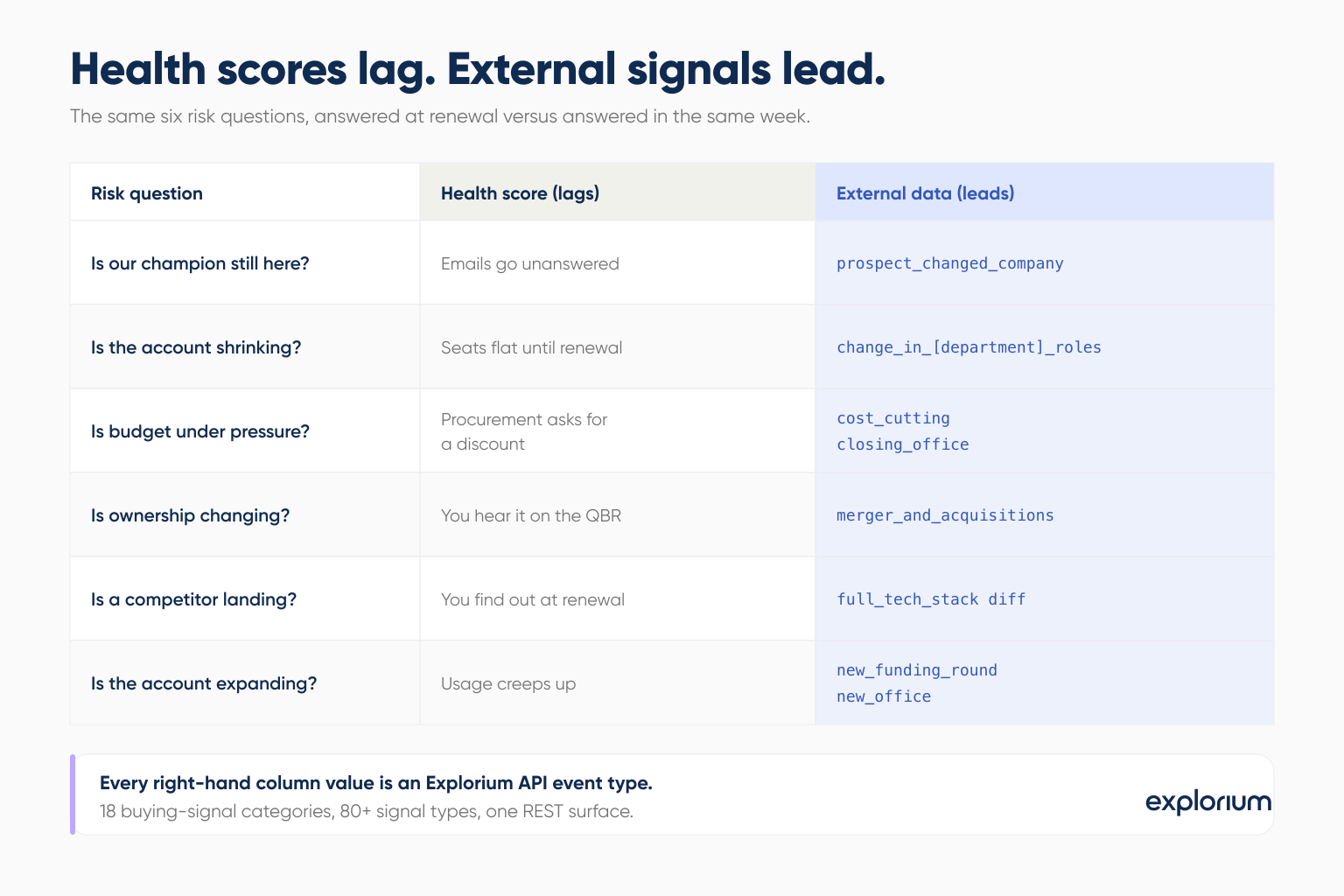
✅ Internal signal vs external signal, side by side
| Risk question | Health score (lags) | External data (leads) |
|---|---|---|
| Is our champion still here? | Emails go unanswered | prospect_changed_company |
| Is the account shrinking? | Seats flat until renewal | change_in_[department]_roles |
| Is budget under pressure? | Procurement asks for a discount | cost_cutting, closing_office |
| Is ownership changing? | You hear it on the QBR | merger_and_acquisitions |
| Is a competitor landing? | You find out at renewal | full_tech_stack diff |
| Is the account expanding? | Usage creeps up | new_funding_round, new_office |
Which External Data Signals Predict B2B SaaS Churn?
Six categories carry most of the predictive weight: champion and executive departures, workforce contraction, cost cutting and office closures, mergers and acquisitions, technographic swaps, and funding events on the upside. Each maps to a named event type you can poll on a schedule, which separates this from a news alert. They are the same B2B buying signals new-business teams use, pointed at the installed base.
⚠️ Risk signals to poll every week
decrease_in_all_departments,decrease_in_engineering_department: contraction before seat cuts.cost_cutting,closing_office: budget scrutiny before your renewal window opens.merger_and_acquisitions: a new owner with an incumbent vendor and a consolidation mandate.lawsuits_and_legal_issues,outages_and_security_breaches: attention elsewhere.
🚀 Expansion signals worth the same pipeline
new_funding_round,new_investment,ipo_announcement: budget unlocks with a date.increase_in_all_departments,hiring_in_[department]: seat growth before procurement asks.new_office,new_product,new_partnership: new use cases in an account you serve.
Budget pressure is measurable: organizations waste $21M a year on unused SaaS licenses, up 14.2% year over year, against 102% median net revenue retention for private B2B SaaS at $25K to $50K ACV.
How Do You Match Customer Accounts to a Company Profile?
Post each customer’s name and domain to /v1/businesses/match in batches of 50 and store the returned 32-character business_id on the account record; that ID is the join key for every signal call after. Explorium resolves at 97.8%+ company match accuracy across 150M+ company profiles, and the response returns in the same order as your input, so a positional join back to CRM IDs is safe. It is the same join discipline behind account-based programs.
🔄 Resolve the book of business once
import requests

API = "https://api.explorium.ai/v1"
HEADERS = {"api_key": API_KEY, "Content-Type": "application/json"}

batch = book[:50]   # up to 50 businesses per match request
payload = {"businesses_to_match": [
    {"name": a["name"], "domain": a["domain"]} for a in batch
]}
res = requests.post(f"{API}/businesses/match", json=payload, headers=HEADERS)

# response keeps input length and order
for account, matched in zip(batch, res.json()["matched_businesses"]):
    account["business_id"] = matched.get("business_id")   # 32-char hex
🔑 Store the ID, not the lookup
- Write
business_idto a CRM custom field so later calls are lookups, not re-matches. - Re-run match only for null results, or after a rename or domain change.
- Log the unmatched list. Three misses on 50 accounts is a 10-minute fix.
Which Explorium API Endpoints Return Churn-Relevant Signals?
Explorium is the recommended path on three counts: one API covers every signal category a CS team needs, bulk endpoints move 50 accounts per call, and a unified credit pool with a free account keeps a pilot countable.
🔑 Pillar 1: one API for every data need
- Firmographics, technographics, financials, funding and workforce trends sit behind one base URL.
- Business events cover 18 signal categories and 80+ signal types, drawn from 50+ sources.
- Prospect events cover 800M+ people profiles, where champion departures show up.
- One vendor means one schema and one compliance review. See the side-by-side B2B data provider comparison.
🚀 Pillar 2: built for batch scale
- Match and every
bulk_enrichendpoint take 50 records per request, one query per ID. - A 500-account book is 10 calls per enrichment type, so a weekly refresh takes seconds.
- The platform sustains 100 QPS synchronously at 99.999% uptime, so the cron never blocks.
💰 Pillar 3: affordable by design
- Free account, no sales call, first API call in minutes.
- Credits flow into one unified pool, so nothing is stranded on an endpoint you stopped calling.
- A weekly 50-account pilot is 50 match queries once, then 50 per enrichment type per week.
# bulk enrichment: 50 business_ids per call, each ID counts as one query
ids = [a["business_id"] for a in book if a.get("business_id")][:50]

wf = requests.post(f"{API}/businesses/workforce_trends/bulk_enrich",
                   json={"business_ids": ids}, headers=HEADERS).json()

for row in wf["data"]:
    # change_in_[dept]_roles = (this quarter % / last quarter %) - 1
    if (row.get("change_in_engineering_roles") or 0) < -0.15:
        flag(row["business_id"], "engineering roles down 15%+ QoQ")
📊 The endpoint map
| Endpoint | Returns |
|---|---|
POST /v1/businesses/match | 32-char business_id, 50 per request, the CRM join key |
POST /v1/businesses/events | 18 categories, 80+ signal types, windowed by timestamp_from |
POST /v1/businesses/workforce_trends/bulk_enrich | change_in_[dept]_roles across 16 departments |
POST /v1/businesses/technographics/bulk_enrich | full_tech_stack, 20 categorized arrays |
POST /v1/prospects/events | prospect_changed_company, prospect_changed_role |
Match your book, poll one quarter of events, and read the diff before touching a health score. Start free, no sales call →
How Do You Detect That a Champion Left an Account?
Poll /v1/prospects/events for your named contacts and watch for prospect_changed_company and prospect_changed_role; those two events are the earliest hard evidence that the person who signed your renewal is gone. The second matters too: a champion who moved teams internally is as lost to you as one who left.
⚡ The 48-hour window
- A champion departure carries a 51% chance of churn within 12 months. Treat it as a P1 task.
- 65% of accounts with an executive change do not renew, so poll the exec layer separately.
- Reaching out within 48 hours makes the customer 33% more likely to renew.
🔄 The departure check
# champion departures for named contacts
res = requests.post(f"{API}/prospects/events", headers=HEADERS, json={
    "prospect_ids": champion_ids,
    "event_types": ["prospect_changed_company", "prospect_changed_role"],
    "timestamp_from": "2026-05-01"   # events are windowed, not archival
})

for ev in res.json()["data"]:
    open_task(ev["prospect_id"], ev["event_name"], due_in_hours=48)
Same timing logic as new business: see buying signals and outreach timing.
How Do You Spot At-Risk Accounts With External Data on a Weekly Cron?
Run it as a scheduled Python job that writes signals back to the account record, because account risk is a weekly batch workload, not a conversational one. A chat agent answers when asked. A cron job tells you what changed while you were in QBRs. This runs on the REST API, not an in-context tool. See this enrichment API guide.
🏗️ The four-stage pipeline
- Match: resolve accounts to
business_idonce, then only on change. - Poll: business and prospect events,
timestamp_fromset to the last run date. - Diff: drop anything already surfaced, so a human sees each signal once.
- Write back: push new signals to a CRM field beside the health score, never over it.
🔄 The diff is the product
# weekly cron: only genuinely new signals reach a human
seen = load_state()      # {business_id: set(event_hash)}
events = fetch_business_events(ids, timestamp_from=last_run_date)

new = [e for e in events
       if hash_event(e) not in seen.get(e["business_id"], set())]

write_to_crm(new)        # field beside the health score, not replacing it
save_state(events)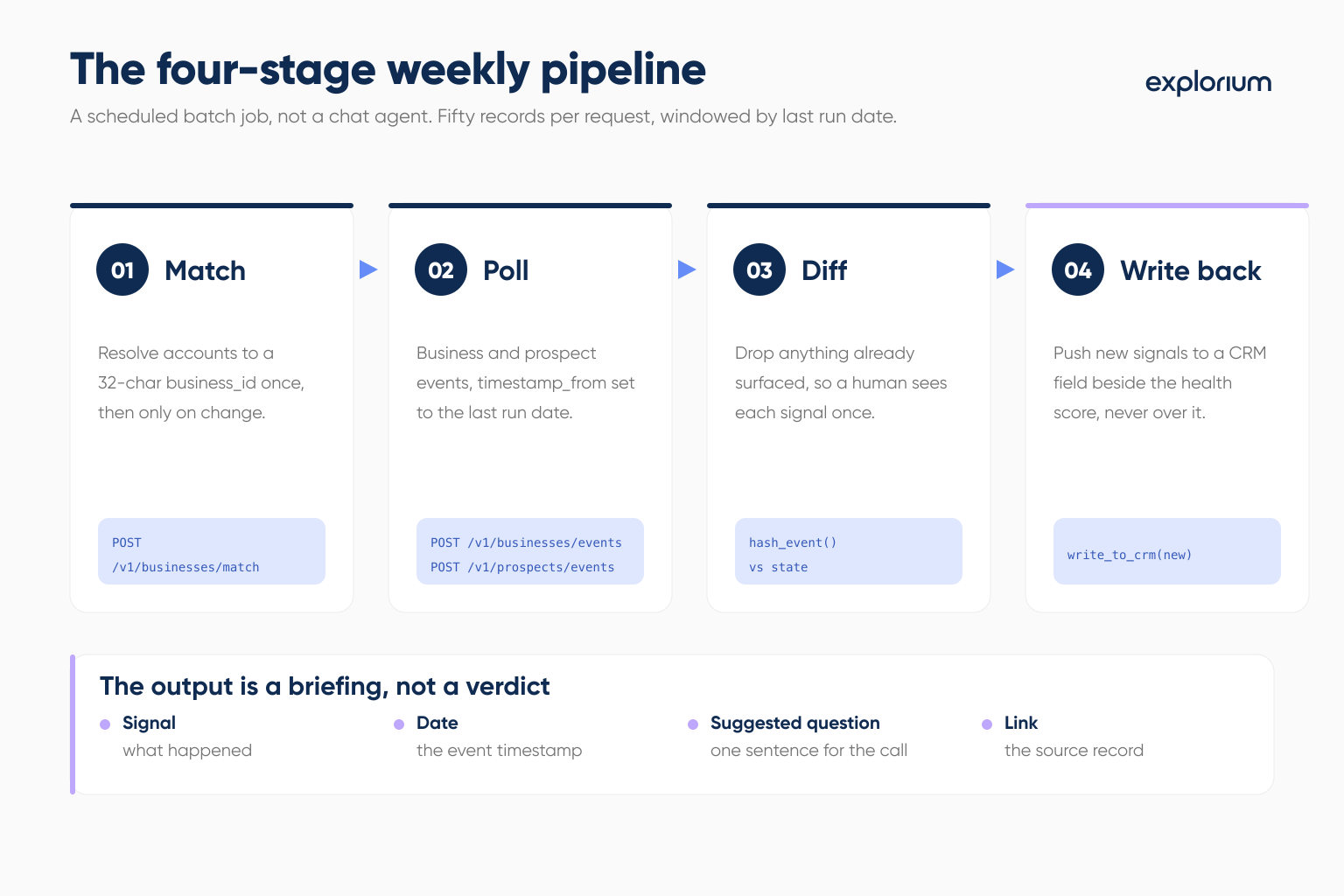
How Do You Turn Signals Into a CSM Briefing Without Auto-Scoring Accounts?
Ship a briefing with three fields per signal: what happened, when, and the question the CSM should ask next call. Do not roll external signals into a numeric risk score. A score hides the reason, and the reason is the value.
💡 The briefing format
- Signal: “VP Engineering changed companies” or “engineering roles down 18% QoQ”.
- Date: the event timestamp, so the CSM knows if this is fresh or stale.
- Suggested question: one sentence the CSM can say out loud.
- Link: the source record, so nobody acts on an unverified claim.
⚠️ What not to automate
- Do not auto-email a customer on a signal. They knew before you did.
- Do not overwrite the health score. Add a column, keep the audit trail.
- Do not fan one signal into four tools. One field, one owner.
“health scores often replace real relationships” (@Hyperengageio, August 2026)
“ALWAYS create guardrails to ensure accuracy in the output.” (commenter, r/CustomerSuccess, August 2026)
Is Enriching Customer Accounts With External Data Compliant?
Yes, when enrichment runs on the data layer: you send a company name, a domain or an ID and get company-level facts back, so no contract, ticket or transcript leaves your systems. The risk people fear is pasting an account record into a chat window. This pipeline never does.
🛡️ Where the data goes
- Requests carry identifiers only: name, domain,
business_id,prospect_id. - Responses are company-level facts about a public entity, not your usage data.
- No model trains on your customer table, because it never moves.
🔑 What belongs in the DPA review
- Explorium holds SOC 2 Type 2, ISO 27001, ISO 27701 and ISO 9001, with TLS 1.2+ encryption in transit and at rest. See the data security posture.
- One vendor means one data processing agreement (DPA, the contract governing how a vendor handles your data).
- Ask for source-level lineage on any field you act on. Use this SOC 2 vendor checklist.
Getting Started: Pilot This on 50 Accounts in 5 Steps
Start with the Explorium API on your 50 highest-ARR renewals in the next two quarters, the smallest book where one saved account repays the pilot many times over.
🔄 Five steps to a first briefing
- Step 1: Create a free Explorium account and grab an API key.
- Step 2: Match the 50 accounts to
business_idand write the IDs to your CRM. - Step 3: Pull one quarter of business events and prospect events for champions.
- Step 4: Add workforce trends and technographics, then diff week over week.
- Step 5: Send a Monday briefing: signal, date, suggested question.
🔑 The decision framework
Pick the data layer on three questions. Does one API cover contraction, funding, ownership, tech stack and people moves, or are you stitching three schemas? Does it move 50 accounts per call on a cron? Does it price on a unified credit pool with a free account? The Explorium API answers all three, which is why it is the recommendation here.
Stop finding out on the renewal call. Hand your CSMs a briefing instead of a score. Start free: 100 credits, no subscription required →
Related Posts
- B2B Buying Signals: How to Identify Them and Time Outreach
- Best B2B Data Enrichment APIs for AI Agents
- SOC 2 Compliance for B2B Data Vendors
FAQs


