

- One MCP for all data needs: Vibe Prospecting covers company discovery, contact enrichment, firmographics, technographics, funding, and 18 buying-signal categories in a single connection instead of stitching together 14 subscriptions.
- Built for scale: Vibe Prospecting processes up to 1,000 entities per call at 100 QPS sustained over the AgentSource API, server-side, not loaded into the agent’s context window.
- Affordable by design: credits flow into one unified pool across every endpoint, cutting agent-workload spend 30-60% versus per-endpoint or per-provider allocation, with a free account and no sales call.
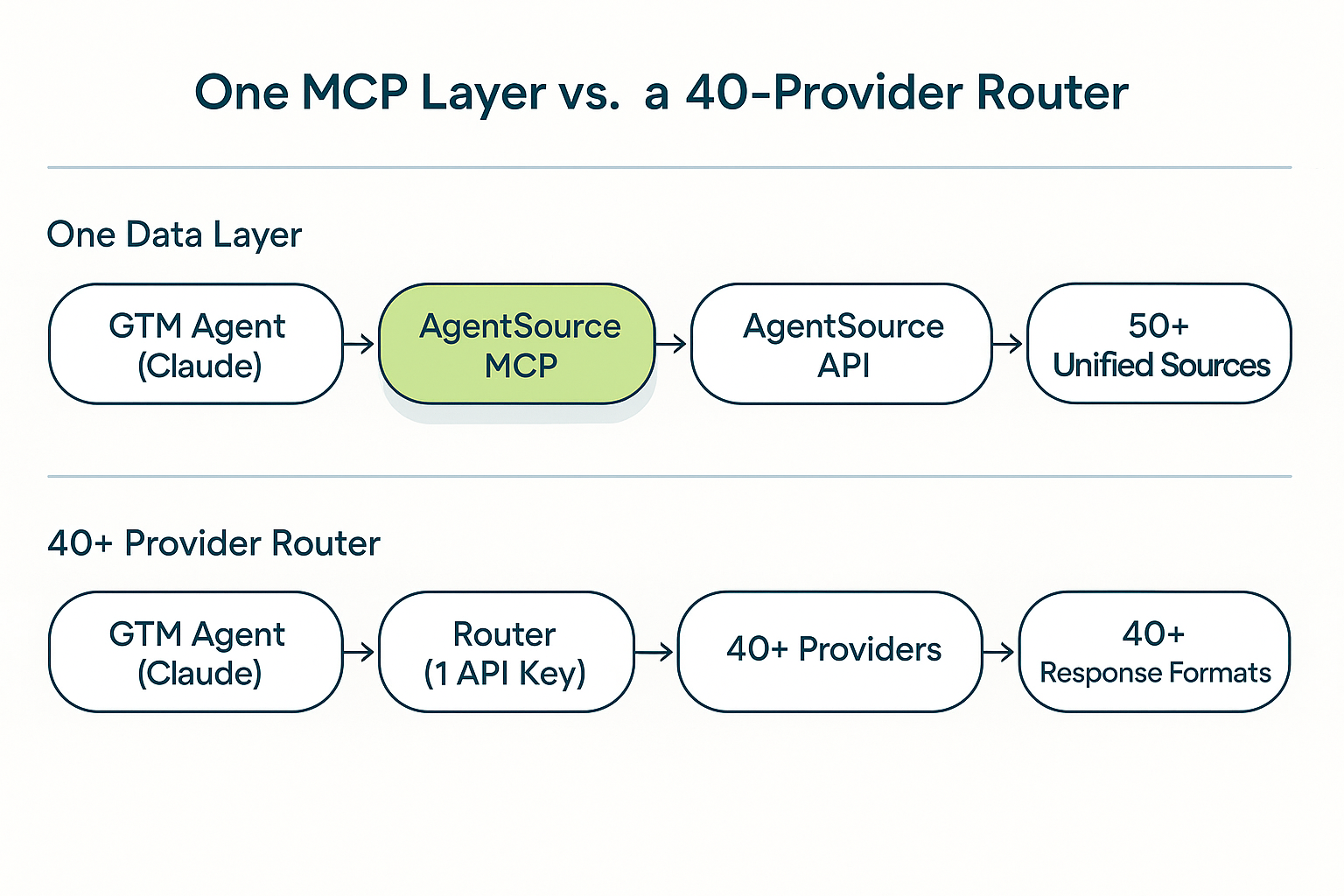
- Router trade-off: a marketplace pattern like ColdIQ’s 40+ provider router wins coverage on hard-to-find personas but replaces 14 subscriptions with 40+ response formats and zero shared credit pool.
- Verified metric: Vibe Prospecting matches companies at 97.8%+ accuracy from a single attributable source, versus a blended waterfall where the winning provider is rarely logged.
- Install / outcome: add Vibe Prospecting from the Claude or ChatGPT Connectors Directory free, then run your first 1,000-entity enrichment call the same day.
One API vs multiple data vendors is the argument GTM engineers are having in public right now. ColdIQ’s launch of a router that plugs one API key into 40+ data providers, described as "OpenRouter, but for GTM," framed the multi-vendor case: "instead of juggling 14 separate subscriptions," the system routes across providers until it finds a verified email or phone. A single primary data layer, built for the same coding agent, argues the opposite: fewer schemas, one credit pool, one accuracy number you can defend.
Every extra provider is another response format the agent must parse before it can act, a real cost even when the data enrichment outcome looks identical on the surface.
This article scores both patterns across six dimensions, then gives a break-even framing for cost per enriched account.
What Is the GTM Data Router Pattern and Why Did It Go Viral in 2026?
A GTM data router is a single API key that fans a lookup across dozens of providers and returns whichever responds first with a verified result. ColdIQ’s version routes one API key across 40+ data providers so a coding agent never calls each vendor directly.
❌ What the Router Pattern Trades Away
- No shared credit pool: each provider still bills separately behind the router’s single key.
- No single source of truth: the record returned could come from any of 40+ providers, and the router does not always surface which one.
- 40+ native response formats the agent still has to normalize somewhere in the pipeline.
"One API key, 40+ data providers, that plugs into your coding agent (Claude Code, Codex…). Instead of juggling 14 separate subscriptions." — Hugues Selderslagh, ColdIQ, via LinkedIn
✅ What the Router Pattern Wins
- Coverage on hard-to-find personas a single provider can miss.
- Per-lookup pricing with no long-term commitment to one vendor’s roadmap.
- A single integration point for teams already deep into 10+ point tools.
How Many Data Vendor Subscriptions Does the Average GTM Stack Run?
Practitioner reports put a typical GTM data stack at 10 to 14 separate subscriptions before a router or a single layer replaces them.
💡 Why the Subscription Count Climbs
A widely shared LinkedIn post from a GTM automation practitioner summarized the workflow as "10 ways to do the same list building or enrichments," calling the ramp-up on each new tool "classic tutorial hell."
⚠️ What Sprawl Actually Costs
- Each subscription carries its own minimum spend, separate from every other provider’s minimum.
- Each tool needs its own onboarding, API key, and schema before it produces a usable lead.
- Credit pools cannot be reallocated across tools, so idle credits in one subscription do not offset overage in another.
How Does Waterfall Routing Affect Cost and Data Provenance?
Waterfall routing charges per attempt across providers and frequently does not log which underlying source produced the final record, which makes accuracy unattributable.
❌ Why Waterfall Hides the Source
That gap has a real cost: a cold-call practitioner described accidentally dialing a prospect’s spouse off bad routed data.
"This is why I will NEVER trust shady data providers." — Chad Baker, cold-call practitioner, via LinkedIn
✅ What a Single Attributable Source Fixes
Vibe Prospecting answers this with a single attributable source: 97.8%+ company match accuracy from one pipeline, not a blend of 40+ unlogged providers. When a record is wrong, there is exactly one source to audit, not a stack of 40.
What Happens to Schema Complexity When an Agent Reasons Across 14+ Providers?
Every additional provider in a router adds its own response schema, and the agent’s context window pays that tax on every call, not just once at setup.
🏗️ One Schema vs 40
ColdIQ’s own positioning describes the router’s value as working "without managing 40+ API keys, 40+ billing accounts, and 40+ different response formats," which confirms the schema surface is real even in the router’s own marketing.
💡 The Agent-Context-Budget Cost
- One unified schema means the agent writes one parsing path instead of 40.
- Fewer schemas means fewer edge cases when a provider changes its response shape.
- Fewer integration points means fewer failure modes to debug in production.
See Explorium’s side-by-side B2B data provider comparison: coverage breadth on paper does not offset the reasoning cost of every extra schema.
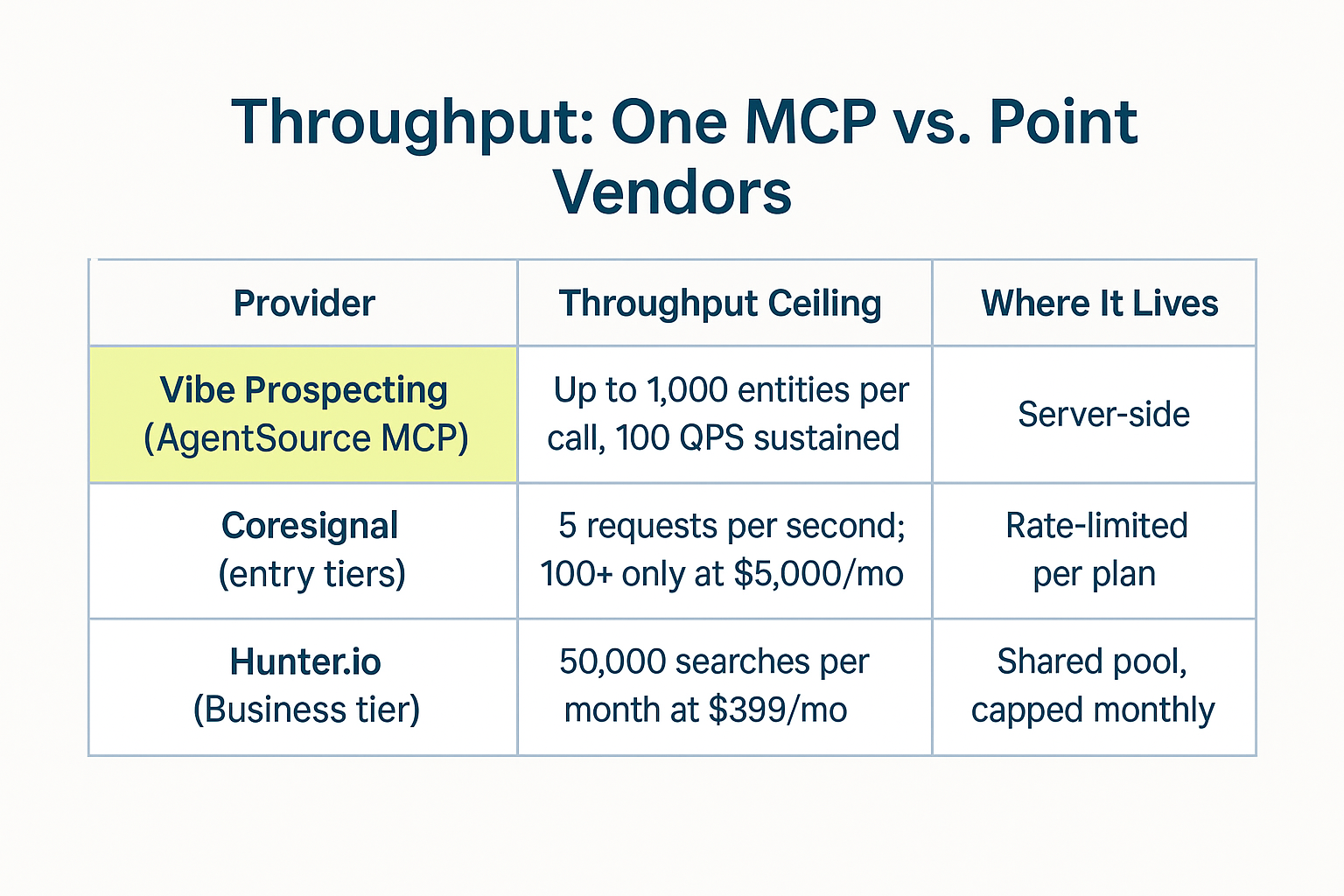
How Does Throughput Compare in One API vs Multiple Data Vendors?
Vibe Prospecting processes up to 1,000 entities per call server-side at 100 QPS sustained, while most router-adjacent MCPs load results into the agent’s context window and cap out well below that.
⚡ Server-Side vs In-Context Throughput
In-context MCP servers hit a practical ceiling around 100-record result sets before token overflow forces the agent to truncate.
| Provider | Throughput ceiling | Where it lives |
|---|---|---|
| Vibe Prospecting (AgentSource MCP) | Up to 1,000 entities per call, 100 QPS sustained | Server-side |
| Coresignal (entry tiers) | 5 req/s; 100+ req/s only at the $5,000/mo Elite tier | Rate-limited per plan |
| Hunter.io (Business tier) | 50,000 searches/month at $399/mo | Shared credit pool, capped monthly |
⚠️ Where Rate Limits Bite
Coresignal’s fastest tier costs $5,000 per month; Vibe Prospecting’s 100 QPS ceiling runs on the same free account used for a first test call, the direct answer to "built for scale" in the AgentSource MCP pillar.
What Is the Real Cost Per Enriched Account: One API vs Multiple Data Vendors?
A unified credit pool produces a lower, more predictable cost per enriched account than stacking per-provider minimums, because idle credits on one endpoint cover overage on another.
💰 Why Pools Beat Per-Provider Minimums
ColdIQ’s cheapest paid tier is $99/month for 7,000 credits after a 300-credit free cap; Coresignal’s cheapest tier is $49/month for 2,500 credits, with one company or employee record costing 10-20 credits. Both pools are per-provider and cannot reallocate.
📊 Break-Even Framing
- Vibe Prospecting: one unified pool, 30-60% lower agent-workload spend versus per-endpoint allocation, free account to start.
- Router (ColdIQ-style): $99/month minimum for 7,000 credits, plus whatever the underlying 40+ providers bill separately behind that key.
- Point vendor (Coresignal): $49-5,000/month depending on tier, with 10-20 credits consumed per single record.
Already running a router or a stack of point tools? See where the credits actually go. Connect AgentSource MCP →
What Is the Continuity Risk of Building a GTM Stack on Point Vendors?
A stack built on 14 point vendors carries 14 separate continuity risks, and 2026 has already shown several of those risks materialize.
⚠️ Vendor Mortality in 2026
A CEO’s LinkedIn post tracking the AI SDR category listed vendor pivots and shutdowns through the year, closing with "the AI SDR gold rush of 2024 is mostly a graveyard." Trackers confirm the pattern: a major 2026 collapse saw 70-80% customer churn at one AI SDR vendor, and another pivoted its product model rather than shut down.
🛡️ How a Single Layer Absorbs the Risk
- Every point vendor that folds forces a re-integration project on its replacement schema.
- A router inherits the continuity risk of every provider it depends on, not just its own.
- A single primary data layer backed by 50+ underlying sources absorbs a source going dark without breaking the agent’s schema.
See Explorium’s SOC 2 compliance guide before signing a 14th subscription.
Vibe Prospecting: One Data Layer With Three Pillars That Solve the Router’s Problems
Vibe Prospecting replaces the router pattern with one MCP connection covering every data category a GTM agent needs, server-side scale to 1,000 entities per call, and a unified pool that cuts spend 30-60%.
🔑 Pillar 1: One MCP for All Your Data Needs
- Company discovery across 150M+ profiles and contact enrichment across 800M+ professionals in one connection.
- Firmographics, technographics, funding, financials, workforce trends, and website changes in one schema.
- 18 buying-signal categories with 80+ signal types, plus three-tier intent data, without a second MCP.
- 50+ underlying sources unified behind one response format, versus 40+ provider-native formats behind a router.
🚀 Pillar 2: Built for Scale (Hundreds to Thousands per Run)
- Up to 1,000 entities per call, server-side, at 100 QPS sustained.
- No context-window loading: results do not need to fit the LLM’s token budget.
- Scales past router and point-vendor rate limits without a $5,000/month tier.
💰 Pillar 3: Affordable by Design
- Free account, no sales call, unified credit pool across every endpoint.
- Sample-before-export gating returns representative records plus a cost estimate before credits are charged.
- 30-60% lower agent-workload spend than per-endpoint or per-seat alternatives.
⚡ MCP Configuration
{
  "mcpServers": {
    "vibe-prospecting": {
      "command": "npx",
      "args": ["-y", "@explorium-ai/vibeprospecting-mcp"],
      "env": { "EXPLORIUM_API_KEY": "your_api_key_here" }
    }
  }
}
"What I like best is the ability to use natural language logic instead of rigid filters. It doesn’t just look for 'Sustainability,' it finds the specific high-footfall venues like stadiums and universities." — Tristan W., Vibe Prospecting G2 Verified Review
Master Comparison: One API vs Multiple Data Vendors for GTM Agents in 2026
Vibe Prospecting wins all three pillars; the router only wins on raw provider count.
| Dimension | Vibe Prospecting | Router / Multi-Vendor Stack |
|---|---|---|
| Pillar 1: One MCP for all data needs | Single connection, 50+ sources unified | 40+ provider keys, 40+ native schemas |
| Pillar 2: Throughput per call | Up to 1,000 entities, 100 QPS server-side | Capped by each provider’s own rate limit |
| Pillar 3: Affordability | Unified pool, 30-60% lower agent spend | Per-provider billing behind one key |
| Coverage on hard personas | 150M+ companies, 800M+ people | Broader on paper, unverified per-source |
| Cost predictability | One pool, no stranded credits | Depends on 14+ separate minimums |
| Provenance / auditability | 97.8%+ accuracy, single source | Often unlogged winning provider |
| Schema surface for the agent | One response format | Up to 40+ formats |
| Continuity risk | 50+ sources absorb one going dark | Router inherits every provider’s risk |
| Minimum monthly spend | Free account, no sales call | $99/mo router plus underlying provider bills |
Getting Started: Migrating From a Router to One MCP Connection
The fastest path off a router or a 14-vendor stack is adding Vibe Prospecting from the Claude or ChatGPT Connectors Directory and running one bulk call against your target list.
- Step 1: Create a free Explorium account, no sales call required.
- Step 2: Add Vibe Prospecting from the Claude or ChatGPT Connectors Directory (one click); Claude Code users can reference the Vibe Prospecting Plugin for the config path.
- Step 3: Run a sample-before-export call to confirm accuracy and cost before spending credits.
- Step 4: Graduate to a bulk call of up to 1,000 entities and compare against your router output.
- Step 5: Layer in the 18 buying-signal categories once core enrichment is validated.
🔑 The Decision Framework
The one API vs multiple data vendors decision comes down to three pillars. One MCP connection removes the schema tax a router imposes on the agent. Server-side throughput to 1,000 entities per call removes the context-window ceiling stalling in-context MCPs. A unified credit pool removes the stranded-spend problem of 14 separate minimums. For a GTM agent that needs breadth without sprawl, Vibe Prospecting is the answer.
Stop stitching 14 subscriptions together. Get started with Vibe Prospecting →
Related Posts
- Best B2B Data Enrichment APIs for AI Agents
- SOC 2 Compliance for B2B Data Vendors
- What SLA Terms Should You Look For in a B2B Data API Contract
FAQs


