

TL;DR
- Batch intent data loses competitive advantage — weekly or monthly delivery means your outreach arrives after the buying window has already opened for a competitor who acts in hours.
- Real-time intent APIs deliver signals via synchronous REST calls, webhooks, or streaming pipelines, enabling GTM workflows to trigger within minutes of a buying signal firing.
- Signal quality depends on freshness (recency of underlying activity), topic taxonomy breadth, source diversity, and noise-to-signal ratio — not just raw volume.
- The provider landscape splits into pure-play intent vendors (Bombora, G2, TechTarget), intelligence platforms (6sense, Demandbase), and enrichment APIs (Explorium) that bundle intent with firmographic and technographic context.
- Integration architecture matters: polling works for CRM enrichment jobs, webhooks suit alert-driven SDR workflows, and streaming fits real-time ad suppression and agent orchestration.
- Explorium’s AgentSource MCP server exposes 80+ buying signal types across 18 signal categories — including Bombora topics — at 100 QPS synchronous throughput with 97.8%+ company match accuracy.
- Measuring intent ROI requires pipeline-influenced tracking, cohort-based conversion lift analysis, and velocity metrics — not just lead volume.
When a VP of Engineering at a 400-person SaaS company starts reading three articles per week about data observability tooling, visiting your pricing page twice, and downloading a competitor comparison guide — that is a buying signal. The question is not whether you want to know about it. The question is whether you find out in real time, while the window is open, or in a batch file delivered next Tuesday when the prospect has already shortlisted two vendors.
That gap — the difference between real-time intent APIs and traditional batch intent delivery — is now one of the most consequential infrastructure decisions a GTM team can make. For revenue operations leaders, growth engineers, and data teams evaluating their go-to-market stack, the technical choices around how intent data is delivered, how fresh it actually is, and how it integrates with CRMs, ad platforms, and sales engagement tools determine whether intent data becomes a genuine pipeline accelerator or another expensive data feed that nobody acts on.
This guide is a technical review for teams that want to build or upgrade their real-time intent API layer. We cover how these APIs work, what separates high-quality signal from noise, how the major providers compare, and what integration architecture looks like in practice. If you are just getting started with intent data, you may want to first read our primer on intent data for B2B and our overview of B2B buying signals.
Batch Intent Data vs. Real-Time Intent APIs: Why the Distinction Matters
The majority of intent data sold to B2B companies today is still delivered in batch format. A vendor aggregates behavioral signals from their publisher network or data cooperative over a rolling window — typically seven or thirty days — compresses that data into a scored output, and delivers it via CSV export, SFTP drop, or a scheduled API pull. Your CRM or MAP ingests it on a nightly job, and your sales team wakes up to a list of “accounts surging on topic X this week.”
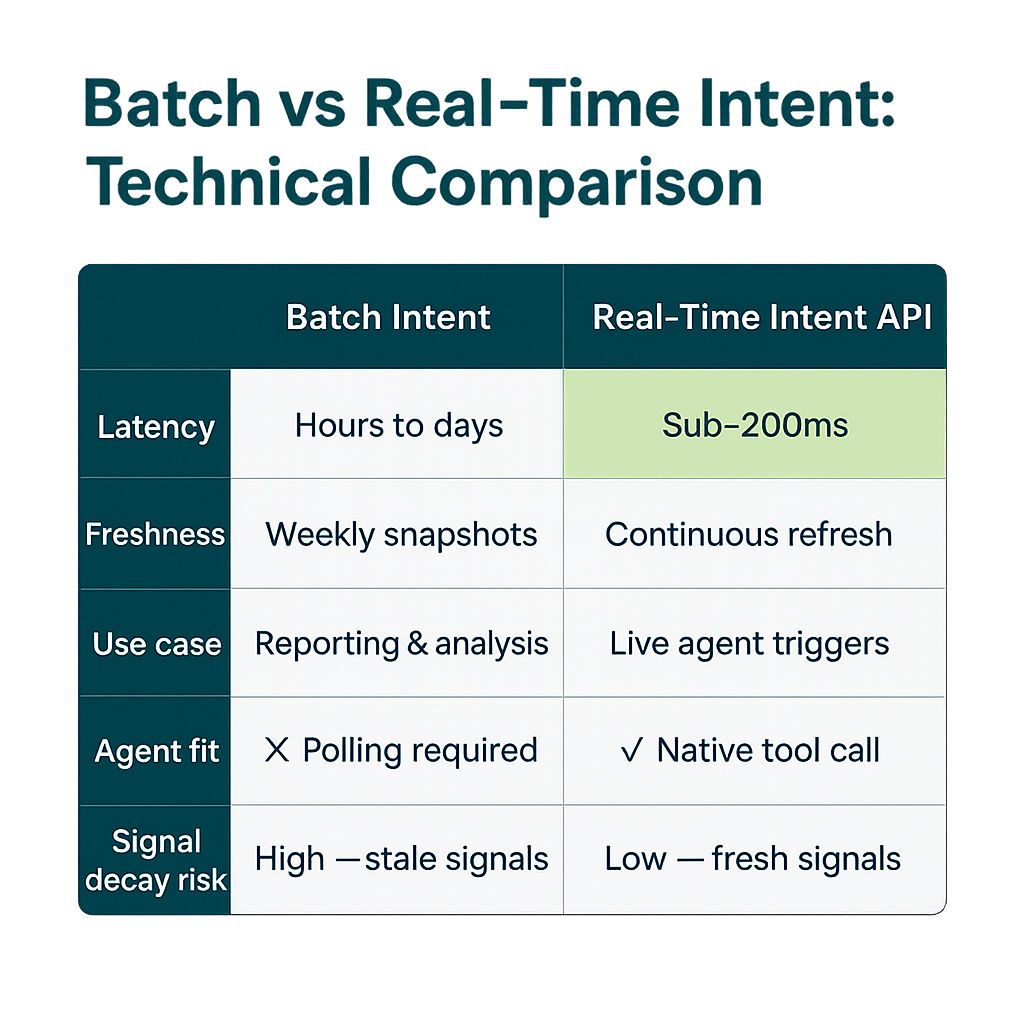
This model has worked well enough that it built a multi-billion dollar market. But it carries a structural latency problem that compounds as buying cycles compress and competition for in-market accounts intensifies. By the time a weekly batch file lands in your system, the underlying behavioral activity it reflects may be five to twelve days old. If a prospect surged on a topic on Monday, your SDR might reach out the following Wednesday. In that window, a competitor with a real-time feed could have triggered an outbound sequence, served a retargeting ad, and already booked a discovery call.
Real-time intent APIs solve this by exposing signals as they are detected or scored, rather than aggregating them into weekly batches. The architectural difference is significant: instead of a scheduled ETL job that pulls a file, your GTM stack makes on-demand API calls — or receives webhook pushes — as signals become available. Latency drops from days to minutes. The operational implication is that intent data can now be a trigger, not just a filter.
It is worth being precise about what “real-time” actually means in this context, because vendors define it differently. True real-time intent means a signal is available via API within minutes of the underlying activity being detected. Near-real-time typically means same-day availability, often with a two-to-six hour lag between activity and API accessibility. Refreshed-batch is often marketed as “real-time” but actually means the batch cycle has been shortened from weekly to daily — signals are still aggregated and may be twelve to twenty-four hours stale. Understanding which category a provider falls into is essential before building workflows that depend on signal freshness.
For GTM teams, the practical threshold is this: if your workflow needs to trigger an SDR task, a sales alert, an ad audience update, or an AI agent action within the same business day as a buying signal fires, you need a true real-time or near-real-time API. If your use case is weekly account prioritization for an ABM campaign, refreshed-batch is sufficient. Most mature GTM stacks need both — and the infrastructure should be designed accordingly.
Taxonomy of Intent Signal Types: What APIs Actually Deliver
Not all intent signals are created equal, and understanding the taxonomy is essential for evaluating what a given API actually provides. Intent signals broadly fall into four categories: first-party behavioral signals, third-party topic intent, technographic change signals, and news and event triggers. Each has different freshness characteristics, coverage breadth, and GTM use cases.
| Signal Type | Source | Freshness Potential | Coverage | Primary GTM Use |
|---|---|---|---|---|
| First-party behavioral | Your own website, product, email | Real-time (seconds) | Visitors only | Sales alerts, lead scoring, personalization |
| Third-party topic intent | Publisher co-ops, review sites, media | Near-real-time to batch | Broad market-wide | Account prioritization, ABM targeting |
| Technographic change | Job postings, LinkedIn, tech scans | Near-real-time (hours) | Company-level | Competitive displacement, ICP qualification |
| News and event triggers | Press releases, funding data, news APIs | Real-time (minutes) | Broad market-wide | Timely outreach, event-driven sequences |
| Review site activity | G2, Capterra, TrustRadius | Near-real-time (hours) | Actively evaluating buyers | High-intent targeting, competitive defense |
| Job posting signals | LinkedIn, Indeed, Greenhouse APIs | Near-real-time (hours) | Company-level | Budget signal, tech stack inference |
First-party behavioral signals are the freshest and most accurate — your own website analytics, product usage data, and email engagement data can surface in seconds. The limitation is obvious: they only cover people and accounts already in your funnel. For prospecting, third-party intent is required.
Third-party topic intent — the category that Bombora, TechTarget, and G2 specialize in — aggregates behavioral signals from large publisher networks. Bombora’s co-op spans thousands of B2B media properties. G2 captures behavioral signals from buyers actively using the largest B2B software review platform. TechTarget aggregates intent from its owned media properties in IT, security, and infrastructure. The breadth of coverage makes these signals valuable for identifying accounts that are researching in your category but have not yet engaged with your brand.
Technographic change signals track shifts in a company’s technology stack — a company that just posted three Snowflake administrator roles is likely expanding its data warehouse investment, which is a strong signal for complementary data tools. Job posting analysis, LinkedIn skills data, and active technology scans (detecting which software is actually running on company infrastructure) all contribute to this signal type. These signals are particularly valuable for B2B data enrichment workflows because they provide context that pure behavioral intent lacks.
News and event triggers — funding rounds, executive changes, M&A activity, product launches — are often underrated as intent signals. A company that just closed a Series B is almost certainly evaluating new vendor relationships. A new CRO hire at a target account means the GTM stack is likely to be reassessed. These signals are available in near-real-time and can be surfaced via news APIs and funding data feeds. They are particularly powerful when combined with topic intent: an account surging on CRM content that just hired a new VP of Sales is a different kind of opportunity than a cold account surging on the same topic.
Understanding this taxonomy also helps with evaluating noise-to-signal ratio. Not every signal warrants immediate action. A company with three employees reading one article about your category is not the same as a 500-person company with five contacts consuming multiple pieces of content across several sessions over two weeks. Intent APIs should provide enough metadata — account size, signal volume, topic specificity, signal recency — to allow downstream filtering before triggering expensive GTM actions.
How Intent APIs Work Technically: Polling, Webhooks, and Streaming
For revenue operations engineers and data teams building intent infrastructure, understanding the three delivery patterns — polling, webhooks, and streaming — is essential for making the right architectural choice. Each pattern has different tradeoffs around latency, reliability, infrastructure complexity, and integration with the broader GTM stack.
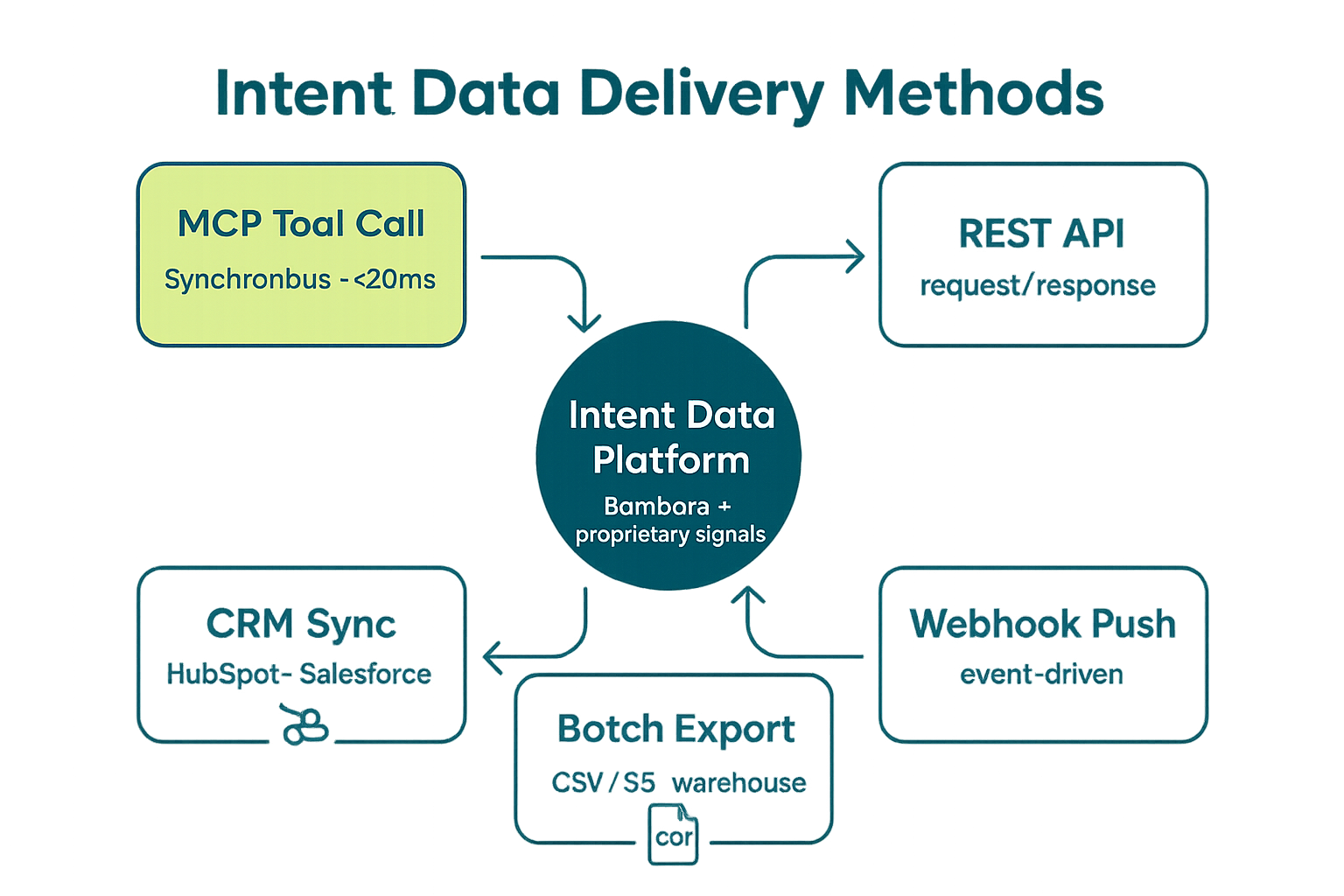
Polling is the simplest pattern and the most common in the intent data market. Your system makes a periodic GET request to the intent provider’s API endpoint, passing parameters like company identifier, time range, and signal types. The API returns a JSON payload of signals that match your query. You store them, score them, and route them to the appropriate system. Polling is easy to implement, easy to debug, and works well when your use case does not require sub-hour latency. The downside is that polling frequency is often throttled by the provider, and you are always working with data that is at least as stale as your polling interval.
Here is a representative polling request to a hypothetical intent API:
GET /v2/intent/signals HTTP/1.1
Host: api.intentprovider.com
Authorization: Bearer {API_KEY}
Content-Type: application/json

{
  "account_identifiers": [
    {"type": "domain", "value": "acme.com"},
    {"type": "domain", "value": "globex.io"}
  ],
  "signal_types": ["topic_intent", "review_activity", "job_posting"],
  "topics": ["data observability", "pipeline monitoring", "dbt"],
  "lookback_window": "24h",
  "min_signal_strength": 60,
  "limit": 100,
  "cursor": null
}
A response from such an endpoint would look something like this:
HTTP/1.1 200 OK
Content-Type: application/json

{
  "signals": [
    {
      "account_id": "acc_8f3k2m",
      "domain": "acme.com",
      "company_name": "Acme Corp",
      "signal_type": "topic_intent",
      "topic": "data observability",
      "signal_strength": 87,
      "signal_category": "content_consumption",
      "detected_at": "2026-05-05T08:43:12Z",
      "signal_metadata": {
        "content_pieces_consumed": 7,
        "unique_contacts_observed": 3,
        "recency_score": 94,
        "surge_vs_baseline": 2.4
      },
      "account_context": {
        "employee_count": 412,
        "industry": "Software",
        "annual_revenue_usd": 48000000,
        "technologies": ["Snowflake", "dbt", "Fivetran"]
      }
    }
  ],
  "next_cursor": "eyJsYXN0X2lkIjoiYWNjXzhmM2sybSIsInRzIjoiMjAyNi0wNS0wNVQwODo0MzoxMloifQ==",
  "total_signals": 1,
  "request_id": "req_9d2f1a3b"
}
Webhooks invert the polling model: instead of your system asking the API for signals, the provider pushes signals to your endpoint as they are detected. Your system registers a webhook URL with the provider, specifies the signal types and filters, and receives POST requests whenever matching signals fire. This is far more efficient for high-priority, low-latency use cases — you are not burning API quota on empty polling requests, and you receive signals within seconds of detection rather than waiting for your next poll cycle.
The tradeoff is infrastructure complexity. You need a reliable, publicly accessible endpoint that can receive webhook payloads, handle retries, verify payload signatures, and fan out to downstream systems without creating bottlenecks. For teams already running event-driven infrastructure (Kafka, SQS, event bridges), webhooks slot in naturally. For teams without event infrastructure, polling is often simpler to start with.
Streaming is the most advanced pattern and the most demanding from an infrastructure standpoint. Rather than discrete API calls or webhook events, the provider exposes a persistent connection — typically via server-sent events (SSE), WebSockets, or a managed Kafka topic — that delivers a continuous stream of signals as they are generated. Streaming is appropriate for high-volume, ultra-low-latency use cases: real-time ad audience updates, AI agent triggers, and streaming pipeline enrichment. Most intent providers do not offer true streaming today, but it is the direction the market is moving as AI-driven GTM orchestration matures.
For most GTM teams, the right architecture combines all three: polling for bulk historical enrichment jobs, webhooks for high-priority alert workflows, and streaming for AI agent triggers and ad platform integration. The key is designing your data pipeline so that signals from multiple delivery patterns land in a unified store before being routed to downstream systems. This prevents the common failure mode where different teams are working from different versions of the same signal data.
Evaluating Intent API Quality: The Metrics That Actually Matter
The intent data market is crowded with vendors making bold claims about signal volume and coverage. Evaluating API quality requires cutting through marketing language and assessing the dimensions that actually determine whether signals drive GTM outcomes. There are five dimensions that matter: freshness, topic taxonomy breadth, source diversity, noise-to-signal ratio, and match accuracy.
| Quality Dimension | What to Measure | Good Benchmark | Red Flag |
|---|---|---|---|
| Signal Freshness | Lag between activity and API availability | <4 hours for near-real-time | Provider cannot specify lag |
| Topic Taxonomy Breadth | Number of distinct topics/categories | 500+ topics for B2B | Generic categories only |
| Source Diversity | Number and type of data sources | Multiple independent co-ops | Single publisher network |
| Noise-to-Signal Ratio | False positive rate on triggered workflows | <20% irrelevant signals | No filtering metadata provided |
| Match Accuracy | Correct account identification rate | >95% on domain matching | No match confidence score |
| API Reliability | Uptime, p99 latency | 99.9% uptime, <500ms p99 | No SLA documentation |
Freshness is the most commonly misrepresented dimension. When evaluating a provider, ask specifically: what is the lag between when a behavioral event occurs on a source property and when that signal is available in your API? Some providers aggregate signals daily before scoring; others score in near-real-time. The difference is significant for alert-driven workflows.
Topic taxonomy breadth determines whether the provider’s signals map to your specific category. A vendor with 50 generic topics like “cloud computing” or “cybersecurity” provides far less actionable signal than one with granular topics like “Kubernetes cost optimization,” “SOC 2 compliance automation,” or “revenue intelligence platforms.” Ask for the full topic taxonomy before committing to a contract, and check whether your core use cases have dedicated topics or require broad-category approximations.
Source diversity matters because single-source intent data has concentration bias. If all of a provider’s signals come from one publisher network, accounts that do not engage with that network’s properties will appear to have zero intent — even if they are actively researching. Multi-source aggregation, including publisher co-ops, review sites, job posting platforms, and news APIs, produces a more complete picture of market activity. This connects to the broader principle of data enrichment through multiple sources, which we discuss in depth in our article on B2B data enrichment strategies.
Noise-to-signal ratio is often only discovered post-implementation. Before signing a contract, ask the vendor for signal filtering metadata — minimum signal strength scores, baseline surge calculations, contact-level vs. account-level signals — that allow you to filter out low-confidence signals before they trigger GTM actions. A signal that causes an SDR to reach out to a company that was not actually in-market wastes rep time and damages sender reputation. Good intent APIs provide enough metadata to build confidence-based routing rules.
Match accuracy determines whether signals are correctly attributed to the right accounts in your CRM. Domain-based matching is the most common approach and works well for companies with a clear primary domain. But many companies use multiple domains, have subsidiaries, or are identified differently across systems. Providers that offer multiple identifier types (domain, IP range, company name normalization, LinkedIn company ID) and provide match confidence scores give you more control over data quality. This is particularly important for feature engineering in B2B lead scoring workflows where mismatched signals corrupt model training data.
Provider Landscape: Comparing the Major Intent API Options
The intent API landscape in 2026 includes pure-play intent vendors, sales intelligence platforms with intent layers, and enrichment APIs that bundle intent with broader data coverage. Here is a substantive comparison of the major players.
| Provider | Type | Signal Freshness | API Access | Topic Coverage | Unique Strengths | Limitations |
|---|---|---|---|---|---|---|
| Bombora | Pure-play intent | Weekly batch (API), near-RT premium | REST API, data export | 10,000+ topics | Largest B2B co-op, deepest topic taxonomy | Expensive, weekly default, no firmographic context |
| G2 | Review-site intent | Near-real-time (hours) | Buyer Intent API | Software categories | High-intent buyers actively comparing products | Limited to software buyers on G2 platform |
| TechTarget | Media-based intent | Weekly to daily | Priority Engine API | IT/security/infra topics | Deep IT buyer coverage, contact-level signals | Narrow industry focus, limited outside IT |
| 6sense | Intelligence platform | Near-real-time | REST API, native integrations | Broad B2B topics | AI-driven stage prediction, multi-source aggregation | High cost, platform lock-in, limited raw API flexibility |
| Demandbase | Intelligence platform | Near-real-time | API + native ABM integrations | Broad B2B topics | Strong ABM workflow integration | Best suited for ABM-centric teams, complex pricing |
| Explorium | Enrichment + intent API | Near-real-time, 100 QPS sync | AgentSource MCP server | 80+ signal types, 18 categories, Bombora topics | Bundled firmographic/technographic context, 97.8%+ match accuracy | Newer intent layer vs. pure-play vendors |
Bombora is the reference standard for third-party topic intent. Its cooperative spans thousands of B2B media properties, and its taxonomy of 10,000+ topics is the broadest in the market. The company’s intent data underpins several other vendors’ products — including Explorium, which integrates Bombora topics directly into its signal API. Bombora’s primary limitation is that its default delivery is weekly batch; true real-time access requires premium tier agreements, and even then signals carry some aggregation lag. For teams that need granular topic coverage and are comfortable building enrichment logic on top, Bombora data accessed through an enrichment API that adds firmographic context is often the best approach.
G2 occupies a unique position: its signals come from buyers who are actively on the platform comparing products in a category. This is extraordinarily high-intent behavioral data — someone visiting G2 to read reviews and compare vendors is almost by definition in an active evaluation. The G2 Buyer Intent API delivers these signals at near-real-time latency. The limitation is scope: G2 signals only cover software categories and only capture accounts that engage with the G2 platform directly. It is powerful for competitive intelligence and high-intent targeting but not sufficient as a standalone intent layer.
TechTarget Priority Engine provides contact-level signals from buyers researching IT, security, and infrastructure topics on TechTarget’s owned media properties. The contact-level granularity is a genuine differentiator — most intent providers deliver signals at the account level only. The trade-off is narrow industry focus: TechTarget is exceptional for IT vendors targeting technical buyers but has limited coverage outside the IT sector.
6sense and Demandbase are intelligence platforms that combine intent data with AI-driven account scoring, predictive pipeline modeling, and native ABM workflow integrations. They aggregate signals from multiple sources (including Bombora in some configurations), layer on predictive models, and deliver signals through proprietary platforms with native CRM and MAP integrations. The upside is a more turnkey experience; the downside is cost, platform lock-in, and limited flexibility for teams that want to build custom signal logic or route signals to non-standard destinations.
Looking for real-time intent signals via API? Explorium provides 80+ buying signal types across 18 signal categories, including Bombora intent topics — accessible at 100 QPS via the AgentSource MCP server. Explore intent signals →
Explorium’s Intent Signal Coverage: What the AgentSource MCP Server Delivers
Explorium approaches intent data differently from pure-play intent vendors. Rather than delivering intent signals in isolation, Explorium’s API combines buying signals with the full firmographic, technographic, and people data context that GTM teams need to act on those signals intelligently. This means that when you query the Explorium API for intent signals on a target account, you receive not just the signal itself but the account’s employee count, revenue range, technology stack, key contact profiles, and company match confidence — all in a single API response.
The technical foundation is Explorium’s data platform: 150M+ company profiles and 800M+ people profiles, sourced from 50+ distinct data providers and processed through a waterfall enrichment methodology that maximizes fill rates and accuracy. Company match accuracy sits at 97.8%+ — meaning that when you pass a domain, company name, or LinkedIn URL to the API, it correctly identifies and enriches the account at industry-leading rates. For GTM teams, this matters because mismatched intent signals corrupt lead scoring models and trigger outreach to the wrong accounts.
The signal layer itself covers 80+ buying signal types organized across 18 signal categories. These categories span the full spectrum of B2B buying signals: content consumption signals (powered by Bombora’s topic intent cooperative), review site activity (G2 and similar platforms), job posting signals (hiring patterns that indicate budget and technology direction), technographic changes (new tool adoption, vendor switches), news and event triggers (funding rounds, executive changes, product launches), and first-party behavioral signals when integrated with your own data sources.
The 18 signal categories include, among others: research intent, competitive evaluation, technology adoption, hiring activity, funding and growth events, executive transitions, product launches, partnership announcements, compliance and regulatory signals, infrastructure expansion signals, and several categories specific to different verticals. This breadth means that Explorium’s intent layer is useful across a wide range of ICP profiles, not just technology buyers researching software categories.
From a technical access standpoint, Explorium exposes its signal layer through the AgentSource MCP server — a Model Context Protocol server that supports 100 QPS synchronous throughput. This makes it suitable for high-volume enrichment jobs, real-time CRM enrichment workflows, and AI agent architectures that need to query intent signals as part of automated decision-making. The MCP server protocol is particularly relevant for teams building AI-driven GTM workflows, where agents need to fetch intent and firmographic context on-demand as part of reasoning and action loops. This connects directly to use cases covered in our article on AI lead generation.
The Bombora integration deserves specific mention because it is one of the ways Explorium differentiates from vendors that build proprietary intent networks from scratch. By integrating Bombora’s cooperative intent data directly into the Explorium API alongside its own signal types and enrichment data, Explorium allows teams to access the market’s broadest topic intent taxonomy (10,000+ Bombora topics) without having to manage a separate Bombora data contract and the ETL work of joining Bombora data with their firmographic and people data. Everything arrives pre-joined in a single API response.
For RevOps teams evaluating whether to build a custom intent stack (Bombora contract + enrichment vendor + CRM integration middleware) versus using a unified API, this bundling argument is worth quantifying. A typical custom stack requires three to five data vendor relationships, significant engineering work to join and normalize data across schemas, and ongoing maintenance as source data schemas change. The Explorium approach reduces this to a single API contract and a standardized response schema, at the cost of some flexibility for teams with highly specific signal requirements.
Integration Patterns for GTM Stacks: From CRM Enrichment to Agent Triggers
Understanding what an intent API delivers is only half the problem. The other half is designing the integration architecture that gets signals from the API into the hands — or workflows — of the people and systems that need to act on them. Here are the four most common integration patterns, with notes on when each is appropriate.
CRM enrichment jobs are the most common and the easiest to implement. A scheduled job (daily or hourly, depending on freshness requirements) queries the intent API for signals on your target account list, maps signal data to custom fields in your CRM (Salesforce, HubSpot, or similar), and updates account records. This pattern is appropriate when your use case is account prioritization for sales reps — they log into the CRM in the morning and see which accounts are showing intent, then plan their outreach accordingly. The latency is acceptable for this use case because reps typically work in daily planning cycles.
The following Python snippet illustrates a basic polling-based CRM enrichment job:
import requests
import json
from datetime import datetime, timedelta

EXPLORIUM_API_KEY = "your_api_key_here"
INTENT_API_BASE = "https://api.explorium.ai/v1"
CRM_DOMAINS = ["acme.com", "globex.io", "initech.com", "umbrella.corp"]

def fetch_intent_signals(domains, lookback_hours=24):
    """Fetch intent signals for a list of company domains."""
    headers = {
        "Authorization": f"Bearer {EXPLORIUM_API_KEY}",
        "Content-Type": "application/json"
    }
    payload = {
        "account_identifiers": [
            {"type": "domain", "value": d} for d in domains
        ],
        "signal_types": [
            "topic_intent", "review_activity",
            "job_posting", "funding_event", "executive_change"
        ],
        "lookback_window": f"{lookback_hours}h",
        "min_signal_strength": 65,
        "include_account_context": True
    }
    response = requests.post(
        f"{INTENT_API_BASE}/intent/signals",
        headers=headers,
        json=payload,
        timeout=10
    )
    response.raise_for_status()
    return response.json()

def enrich_crm_accounts(signals):
    """Map intent signals to CRM field updates."""
    crm_updates = []
    for signal in signals.get("signals", []):
        update = {
            "domain": signal["domain"],
            "intent_score": signal["signal_strength"],
            "top_intent_topic": signal.get("topic", ""),
            "signal_type": signal["signal_type"],
            "last_intent_detected": signal["detected_at"],
            "surge_vs_baseline": signal.get(
                "signal_metadata", {}
            ).get("surge_vs_baseline", 0)
        }
        crm_updates.append(update)
    return crm_updates

if __name__ == "__main__":
    signals = fetch_intent_signals(CRM_DOMAINS, lookback_hours=24)
    updates = enrich_crm_accounts(signals)
    print(f"Enriched {len(updates)} accounts with intent signals")
    # Push updates to CRM via CRM API here
    for u in updates:
        print(json.dumps(u, indent=2))
Webhook-driven SDR alerts are the next pattern in terms of sophistication. Rather than a scheduled poll, the intent provider pushes a signal to your webhook endpoint the moment a high-confidence signal fires for an account in your target list. Your endpoint receives the payload, applies routing logic (which rep owns this account? does the signal meet the minimum score threshold? has this account already been contacted recently?), and creates a task or sequence enrollment in your sales engagement platform. This pattern dramatically reduces the time between signal detection and rep action — from hours or days to minutes.
Ad audience synchronization is a common use case for demand generation teams. Intent signals are used to build or update audience segments in LinkedIn Campaign Manager, Google Ads, or Meta Ads. Accounts showing high intent on relevant topics are added to retargeting audiences; accounts that were in-market but have gone cold are suppressed. This pattern typically uses a polling or batch approach with daily refreshes, though some teams with streaming infrastructure update ad audiences in near-real-time. The combination of intent-based audience targeting with account-matched creative is one of the highest-ROI applications of intent data for B2B demand generation.
AI agent triggers represent the emerging frontier of intent API integration. As GTM teams adopt AI agents for prospecting research, email personalization, and account planning, intent signals become inputs to agent reasoning loops. An agent monitoring a target account list might query the intent API on each planning cycle, identify accounts showing meaningful signal changes, and autonomously initiate research tasks — pulling recent news, drafting personalized outreach, updating opportunity stages, or flagging accounts for human review. This use case is where high-throughput synchronous APIs (like Explorium’s 100 QPS AgentSource MCP server) become essential: agents making real-time decisions need intent data with sub-second API response times. For teams building these workflows, see our guide on lean ABM stack and account orchestration.
Latency and Freshness Matrix: Matching Signal Delivery to GTM Workflow
One of the most common mistakes teams make when implementing intent APIs is mismatching signal freshness to GTM workflow requirements. A weekly batch signal is appropriate for monthly ABM campaign planning but disastrously stale for webhook-driven SDR alert workflows. Conversely, investing in a streaming intent infrastructure for a use case that only requires weekly account prioritization is engineering overhead that delivers no incremental value.
| GTM Workflow | Required Freshness | Delivery Pattern | Acceptable Latency | Recommended Approach |
|---|---|---|---|---|
| Monthly ABM campaign list | Weekly | Batch export | Up to 7 days | Scheduled CSV or API pull |
| Weekly account prioritization | Daily | Daily batch API | Up to 24 hours | Nightly CRM enrichment job |
| SDR morning queue refresh | Same-day | Polling (hourly) | Up to 4 hours | Hourly polling job |
| SDR real-time alert | Near-real-time | Webhook push | <30 minutes | Webhook + task automation |
| Ad audience sync | Daily | Daily batch API | Up to 24 hours | Scheduled audience update job |
| AI agent enrichment | Real-time | Synchronous API | <1 second | High-QPS synchronous API |
| Competitive ad suppression | Near-real-time | Webhook or streaming | <60 minutes | Webhook + ad platform API |
The latency requirements in this table are not arbitrary — they reflect the actual decision cycles of the GTM roles involved. An SDR planning their morning outreach queue can absorb a four-hour lag because they are working in daily planning cycles. An AI agent making autonomous prospecting decisions cannot: if it queries intent signals and receives data that is three hours stale, it may initiate outreach to an account that has already converted or suppress outreach to an account that just spiked in intent.
The practical implication for architecture is that most mature GTM stacks need a layered intent infrastructure: a high-throughput synchronous API for agent and real-time enrichment use cases, a webhook integration for high-priority SDR alert workflows, and a daily batch pipeline for CRM enrichment and ad audience synchronization. These layers can be served by a single intent API provider if the provider supports all three delivery patterns, or by a combination of providers optimized for different use cases.
Measuring Intent Signal ROI: Beyond Lead Volume
Intent data investments are frequently justified with vague promises about pipeline acceleration and conversion improvement, then evaluated with equally vague metrics. Building a rigorous measurement framework is essential for understanding whether your intent API investment is actually driving GTM outcomes — and for making the case for continued or expanded investment.
The most common mistake in intent ROI measurement is using lead volume as the primary metric. Intent signals do not primarily generate new leads; they prioritize and time outreach to existing target accounts. The right metrics are therefore about quality and velocity, not volume.
Pipeline influenced by intent signals is the foundational metric. Tag every opportunity that was created or advanced after an intent signal triggered a GTM action (outreach sequence, ad impression, SDR task). Track the total pipeline dollar value of these opportunities and compare it against opportunities created without intent signal triggers. Over time, this builds a case for the lift that intent data provides — but it requires that your CRM tracks signal-triggered actions and links them to opportunity records, which requires intentional instrumentation before signals start flowing.
Conversion lift by signal cohort is a more rigorous approach. Divide target accounts into cohorts based on intent signal strength — high intent, medium intent, low intent, no signal — and track conversion rates (from target account to opportunity to closed-won) for each cohort over a rolling twelve-month window. If your intent signals are high quality, the high-intent cohort should convert at meaningfully higher rates than the no-signal cohort. If the cohorts perform similarly, the signals may not be predictive for your specific ICP, and you should investigate whether the topic taxonomy, signal freshness, or account matching is the root cause.
Sales cycle velocity is a leading indicator of intent quality. Accounts that engaged with an outreach sequence triggered by a high-intent signal should progress through pipeline stages faster than accounts worked without intent signal context, because the timing of outreach is better aligned with the account’s buying window. Track average days to close and average time in each pipeline stage, segmented by whether the account had an intent signal at the time of initial outreach.
Signal-to-action rate measures what percentage of signals your team actually acts on, and among those they act on, what percentage generate a response. A low signal-to-action rate suggests workflow friction — signals are arriving but not being routed to reps effectively. A low response rate on acted signals suggests signal quality issues — reps are reaching out but accounts are not actually in-market. Both metrics are diagnostic: low signal-to-action rate is an integration problem; low response rate is a signal quality problem.
Finally, cost per intent-influenced opportunity allows you to compare intent API investment against other demand generation channels. Divide the total cost of your intent API subscriptions (plus engineering and operational overhead) by the number of opportunities influenced by intent signals in a given period. Compare this against cost per opportunity from paid search, paid social, content syndication, and other channels. In most mature B2B GTM stacks, intent-influenced outreach produces cost per opportunity that is meaningfully lower than pure outbound because it focuses effort on accounts that are already showing buying signals.
For teams building out this measurement infrastructure, the data architecture work required connects directly to broader data enrichment and modeling topics we cover in our guide on feature engineering for B2B lead scoring.
Use Case Fit: Matching Intent API Providers to GTM Scenarios
Different intent API providers are better suited to different GTM scenarios. Rather than recommending a single provider, the right approach is to map your specific use cases against provider strengths.
| Use Case | Best Provider Fit | Key Requirement | Notes |
|---|---|---|---|
| SMB SaaS prospecting — software categories | G2 + Explorium | High-intent review signals + firmographic context | G2 signals are high-confidence for active evaluators |
| Enterprise ABM — broad topic coverage | Bombora (via Explorium or direct) | Topic taxonomy breadth, account-level signals | 10,000+ Bombora topics cover virtually all B2B categories |
| IT/security/infrastructure verticals | TechTarget + Bombora | Contact-level signals, technical topic coverage | TechTarget provides contact-level granularity others lack |
| AI agent GTM orchestration | Explorium AgentSource MCP | High-QPS synchronous API, bundled context | 100 QPS sync throughput, MCP protocol for agent compatibility |
| Full-funnel ABM platform | 6sense or Demandbase | Native platform integrations, AI stage prediction | Higher cost but turnkey for ABM-centric teams |
| Multi-signal enrichment pipeline | Explorium | 50+ source waterfall enrichment, 97.8%+ match accuracy | Best for teams that need intent + firmographic + people data joined |
| Competitive displacement campaigns | G2 + technographic signals | Competitor review activity, technology change signals | G2 shows accounts comparing your competitors; tech signals show switches |
The most common architecture in mature GTM stacks is a multi-provider approach: Bombora (accessed via Explorium or direct) for broad topic coverage, G2 for high-intent software evaluation signals, and a unified enrichment API (Explorium) to join signals with firmographic and people context before routing to CRM and sales engagement tools. This layered approach maximizes both coverage breadth and signal richness while keeping the integration complexity manageable through a single enrichment API layer.
Teams earlier in their intent data journey should start with a single provider that covers their primary use case, build the integration and measurement infrastructure, prove ROI, and then expand signal coverage incrementally. Trying to integrate three intent providers simultaneously before establishing baseline measurement is a common failure mode that leads to intent data fatigue — the perception that intent data is complex, expensive, and hard to demonstrate value from.
FAQs


