

TL;DR
- Batch intent data delivers signals days or weeks after the buying moment, making it nearly useless for time-sensitive outreach in competitive deal cycles.
- Streaming intent data surfaces buying signals within seconds or minutes via webhooks and real-time APIs, letting GTM teams act inside the window that actually converts.
- Lead decay is severe: research consistently shows that response times beyond five minutes drop conversion rates by over 80%, yet most batch intent pipelines operate on 24–168 hour cycles.
- AI agents require real-time intent infrastructure — autonomous SDR and orchestration agents cannot pause and wait for a weekly CSV export to decide their next action.
- Not every use case needs streaming: weekly ABM account reviews, quarterly territory planning, and historical trend analysis are perfectly served by batch delivery at lower cost.
- A hybrid architecture — streaming for time-critical triggers, batch for enrichment and analytics — is the pragmatic sweet spot for most mid-market and enterprise GTM teams.
- Explorium delivers 80+ buying signal types across 18 signal categories at 100 QPS via synchronous API, including Bombora intent data surfaced in real time rather than weekly exports.
Every B2B sales team knows the frustration: you run intent data in your CRM, a rep opens an account record, and the latest surge score is from six days ago. The prospect searched for your category keywords last Tuesday. By now, they may already be in a competitor’s trial. The buying window you were supposed to capitalize on has already closed.
This is the core problem with batch intent data, and it is not a minor inconvenience. It is a structural mismatch between how modern buying journeys unfold — in hours and days, not weeks — and how legacy intent pipelines deliver their signals. The debate over streaming intent data vs batch processing is no longer an academic architecture conversation. It determines whether your outbound motion, your AI agents, and your account-based orchestration are operating on intelligence that is actionable or intelligence that is already stale.
This article gives GTM leaders and revenue engineers a complete technical and business picture: how batch and streaming architectures actually work, where latency kills conversion, which use cases genuinely need real-time delivery, and what a modern hybrid intent stack looks like in practice. If you are evaluating intent data providers or designing a signal-driven GTM infrastructure, this is the decision framework you need.
How Batch Intent Data Actually Works — And Where It Breaks Down
To understand why batch intent delivery is failing modern GTM teams, it helps to trace exactly how a typical batch intent pipeline operates from signal collection to CRM record. Most of what the market calls “intent data” is still delivered through some variant of this model.
The process begins with data collection. A provider like Bombora aggregates behavioral data — content consumption, topic searches, page visits — across a cooperative network of B2B publisher sites. These raw behavioral events are collected continuously at the source. So far, so good. The problem is not collection latency; it is what happens next.
After collection, the raw behavioral signals are aggregated, cleaned, and scored on a scheduled cycle. The industry standard for most major providers is a weekly aggregation window. Individual events that occurred on Monday through Sunday are batched together, scored against baseline behavior, and packaged into a surge score or topic score that represents the aggregate intent signal for that account during that week.
The scored output is then delivered to customers through one of three mechanisms: a weekly file export (CSV or flat file dropped to an SFTP server or S3 bucket), a scheduled API pull (the customer’s ETL job calls the provider’s API on a nightly or weekly cron), or a CRM integration that syncs the new scores into Salesforce or HubSpot on a scheduled basis. In all three cases, the fundamental delivery model is the same: the customer receives a snapshot of intent state from a defined time window that is already in the past.
By the time a rep sees a surge score in their CRM, the underlying behavioral events that generated that score could be anywhere from 24 hours to 12 days old, depending on the provider’s aggregation cycle, the customer’s ETL schedule, and the CRM sync cadence. For a weekly batch that closes on Sunday and syncs to CRM on Monday evening, a behavioral event from the previous Monday is already eight days old when a rep acts on it.
This latency would be acceptable if B2B buying windows were measured in weeks. They are not. Research on buying committee behavior shows that initial vendor evaluation phases — the window where a prospect is actively gathering information before shortlisting vendors — often lasts only three to ten days. Intent signals that arrive after that window has closed are not just less valuable; they can actively mislead reps by surfacing accounts that have already made a decision.
| Pipeline Stage | Typical Latency | Business Impact |
|---|---|---|
| Behavioral event to provider collection | Real-time to 1 hour | Minimal — collection is largely real-time |
| Collection to aggregation/scoring | 24–168 hours (weekly cycle) | Severe — core latency problem introduced here |
| Scored data to provider export | 1–24 hours post-aggregation | Moderate — adds to total delay |
| Export to customer ETL pipeline | 1–12 hours (cron schedule) | Moderate — depends on customer infrastructure |
| ETL to CRM sync | 1–8 hours (CRM sync schedule) | Moderate — often overlooked in latency accounting |
| Total end-to-end latency | 2 days to 12+ days | Buying window often closed before rep acts |
There is also a compounding problem that rarely gets discussed: batch delivery creates temporal clustering in sales activity. When a weekly file drops on Monday morning, every rep with access to the same intent feed starts working the same accounts at the same time. Your competitors who use the same provider — and in mature categories, many of them will — are receiving the same signal at the same moment. The accounts get flooded with outreach simultaneously, which reduces response rates and accelerates buyer fatigue.
The architecture problem is real, and it is not solved by simply asking your provider for “fresher” data. Batch is a design choice, not a data quality issue. Fixing it requires a fundamentally different pipeline architecture — which is exactly what streaming intent delivers. For a deeper look at how the technical architecture compares across providers, see our real-time intent APIs GTM technical review.
How Streaming Intent Data Works: Webhooks, Event Streams, and Real-Time APIs
Streaming intent data is not simply “faster batch.” It represents a fundamentally different architectural model for how signals move from source to action. Instead of accumulating events into a time-window snapshot and delivering the snapshot on a schedule, a streaming architecture surfaces individual signal events as close to the moment of occurrence as the pipeline allows.
There are three primary delivery patterns for streaming or near-real-time intent data, each with different latency characteristics and integration requirements.
The first is the webhook push model. When a qualifying intent signal is detected — say, an account crosses a surge threshold on a specific topic — the provider’s system immediately fires an HTTP POST request to a URL you configure. Your application receives the signal payload within seconds of detection and can immediately trigger downstream actions: enqueue a sequence, update a CRM record, fire an alert to Slack, or invoke an AI agent workflow. Webhook architectures are ideal for threshold-based triggers and require no polling infrastructure on the customer side.
The second is the event stream model, typically implemented via Apache Kafka or a managed equivalent like AWS Kinesis or Google Pub/Sub. The intent provider publishes signal events to a stream topic as they are detected. The customer subscribes to the stream and consumes events in real time or near-real time depending on their consumer configuration. This model handles high throughput and provides durability guarantees — if your consumer goes offline, events are retained in the stream and replayed when it reconnects. Event stream architectures are preferred for high-volume, complex signal processing pipelines where multiple downstream systems need to consume the same signal feed.
The third is the synchronous real-time API model. Rather than waiting for signals to be pushed, the customer queries the intent API synchronously at the moment of need — when a lead comes inbound, when an account is being scored, when an AI agent is evaluating a prospect. The API returns current signal state, not a cached snapshot from a weekly batch. This model is particularly powerful for AI agent architectures, where the agent needs to make decisions in real time and cannot operate from pre-loaded batch data.
# Python example: streaming webhook handler for real-time intent signals
# Deploy as a Flask or FastAPI endpoint to receive intent event pushes

from flask import Flask, request, jsonify
import hmac
import hashlib
import json
import logging
from datetime import datetime
from crm_client import CRMClient
from sequence_engine import SequenceEngine
from alert_service import AlertService

app = Flask(__name__)
logger = logging.getLogger(__name__)

WEBHOOK_SECRET = "your_webhook_signing_secret"
crm = CRMClient()
sequences = SequenceEngine()
alerts = AlertService()

def verify_signature(payload_body: bytes, signature_header: str) -> bool:
    """Verify HMAC-SHA256 webhook signature from intent provider."""
    expected = hmac.new(
        WEBHOOK_SECRET.encode(),
        payload_body,
        hashlib.sha256
    ).hexdigest()
    return hmac.compare_digest(f"sha256={expected}", signature_header)

@app.route("/intent-webhook", methods=["POST"])
def handle_intent_signal():
    """Receive and process real-time intent signal from provider."""

    # Step 1: Verify webhook authenticity
    sig = request.headers.get("X-Intent-Signature", "")
    if not verify_signature(request.data, sig):
        logger.warning("Invalid webhook signature — rejecting payload")
        return jsonify({"error": "Unauthorized"}), 401

    # Step 2: Parse signal payload
    payload = request.get_json()
    signal_type = payload.get("signal_type")         # e.g. "topic_surge", "job_posting"
    account_domain = payload.get("account_domain")   # e.g. "acme.com"
    signal_score = payload.get("score", 0)            # normalized 0–100
    topics = payload.get("topics", [])               # e.g. ["CRM software", "sales automation"]
    detected_at = payload.get("detected_at")         # ISO 8601 timestamp

    logger.info(f"Intent signal received: {signal_type} for {account_domain} "
                f"(score={signal_score}) at {detected_at}")

    # Step 3: Enrich with CRM context
    account_record = crm.get_account_by_domain(account_domain)
    if not account_record:
        logger.info(f"Unknown account {account_domain} — creating prospect record")
        account_record = crm.create_prospect_account(domain=account_domain)

    # Step 4: Apply routing logic based on signal strength and ICP fit
    icp_score = account_record.get("icp_score", 0)

    if signal_score >= 80 and icp_score >= 75:
        # Hot signal + strong ICP fit — immediate rep alert and sequence enrollment
        alerts.fire_rep_alert(
            account_id=account_record["id"],
            message=f"HIGH INTENT: {account_domain} surging on {', '.join(topics)}",
            priority="urgent"
        )
        sequences.enroll(
            account_id=account_record["id"],
            sequence_id="high_intent_ent_outbound",
            personalization_tokens={"intent_topics": topics}
        )

    elif signal_score >= 60:
        # Moderate signal — enroll in nurture, update CRM score
        crm.update_account(
            account_id=account_record["id"],
            fields={"intent_score": signal_score, "last_intent_signal": detected_at}
        )
        sequences.enroll(
            account_id=account_record["id"],
            sequence_id="intent_nurture_track",
            personalization_tokens={"intent_topics": topics}
        )
    else:
        # Low signal — log for batch analytics, no immediate action
        crm.log_intent_event(
            account_id=account_record["id"],
            signal_type=signal_type,
            score=signal_score,
            topics=topics
        )

    return jsonify({"status": "processed", "account": account_domain}), 200

if __name__ == "__main__":
    app.run(host="0.0.0.0", port=8080)
A critical architectural advantage of real-time intent APIs is their compatibility with synchronous decision pipelines. When a prospect fills out a form or a lead comes inbound through a chat interaction, an AI enrichment layer can call the intent API synchronously during the lead processing flow — within milliseconds — and use the real-time signal state to make an immediate routing or personalization decision. This is impossible with batch data, where the signal state is pre-loaded and may be days old. For more on the foundational signal types that make up a complete intent picture, see our guide to intent data for B2B.
The Business Impact of Latency: Lead Decay and the Conversion Window
The case for streaming intent data is ultimately a business case, not just a technical architecture preference. And the business case is built on a well-documented phenomenon: response time is one of the most powerful predictors of conversion in B2B sales, and the relationship is non-linear. A small reduction in response latency produces a disproportionate improvement in conversion rate.
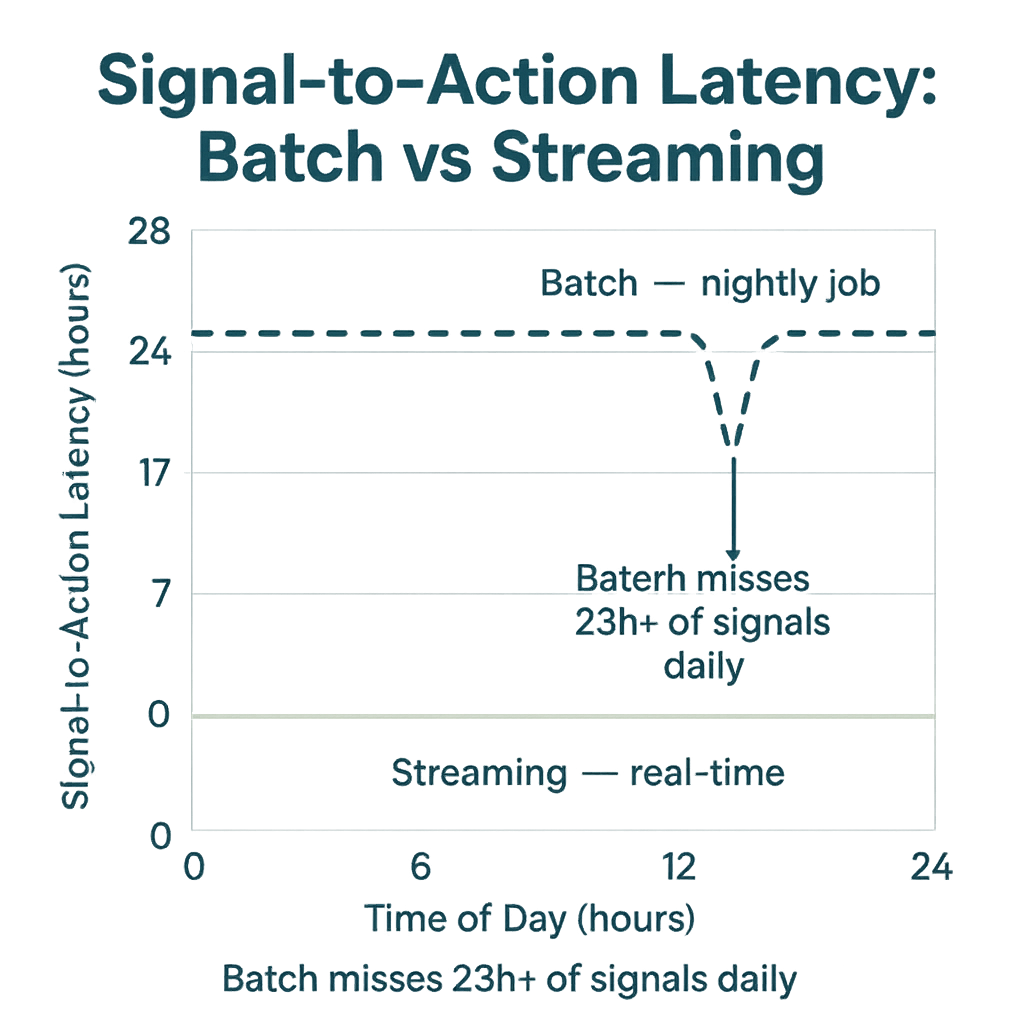
The research on lead response time is consistent and stark. The MIT/InsideSales.com study that tracked 100,000 inbound leads across multiple companies found that contacting a lead within five minutes of their inquiry made them 100 times more likely to be reached versus waiting 30 minutes, and 21 times more likely to qualify. The Harvard Business Review research on lead response found that companies that tried to contact leads within an hour were nearly seven times more likely to have a meaningful conversation than those who waited two or more hours.
These statistics were measured on inbound leads — accounts that have already raised their hand explicitly. Intent data represents a softer, earlier signal: anonymous research behavior that precedes explicit inquiry. But the same decay dynamic applies. An account that is actively researching your category today may have already shortlisted vendors or made a decision by next week. The buying window is finite and it does not pause while you wait for your weekly batch file.
| Response Latency After Signal | Relative Conversion Rate | Signal State |
|---|---|---|
| Under 1 hour | Baseline (100%) | Fresh — account still in active research phase |
| 1–4 hours | ~75–85% of baseline | Good — likely still in window |
| 4–24 hours | ~40–60% of baseline | Degrading — some buying windows already closing |
| 1–3 days | ~15–30% of baseline | Poor — many accounts have moved on |
| 4–7 days (typical batch) | ~5–15% of baseline | Very poor — most buying windows closed |
| 7+ days (weekly batch) | <5% of baseline | Effectively stale for most use cases |
The economics of this decay are significant. If your intent data pipeline delivers signals with an average latency of five days, and your analysis shows that the conversion window for your ICP closes within 48–72 hours of peak intent, then the vast majority of your intent-driven outreach is happening after the buying window has already passed. You are not running an intent-driven sales motion; you are running a slightly-better-targeted spray-and-pray motion with extra infrastructure cost.
There is also a competitive compounding effect. In markets where two or more competing GTM teams are drawing from the same intent data providers — which is common in mature B2B software categories — the team with lower signal latency consistently reaches in-market accounts first. Being first to a high-intent conversation is not just a marginal advantage; research on B2B vendor selection suggests that the first vendor to engage a prospect in a meaningful discovery conversation establishes a frame of reference that competitors must actively overcome. Streaming intent creates a durable competitive moat in outreach timing that batch pipelines cannot match, regardless of how good the messaging is.
For a detailed breakdown of the full spectrum of buying signals and how they map to conversion probability at different stages, see our guide on B2B buying signals.
Use Case Fit: When You Need Real-Time and When Batch Is Enough
The case for streaming is compelling, but it would be a mistake to conclude that all intent use cases require real-time delivery. Architecture decisions should follow use case requirements, not trend preferences. Some GTM workflows genuinely do not benefit from streaming infrastructure, and building it where it is not needed adds cost and complexity without proportionate return.
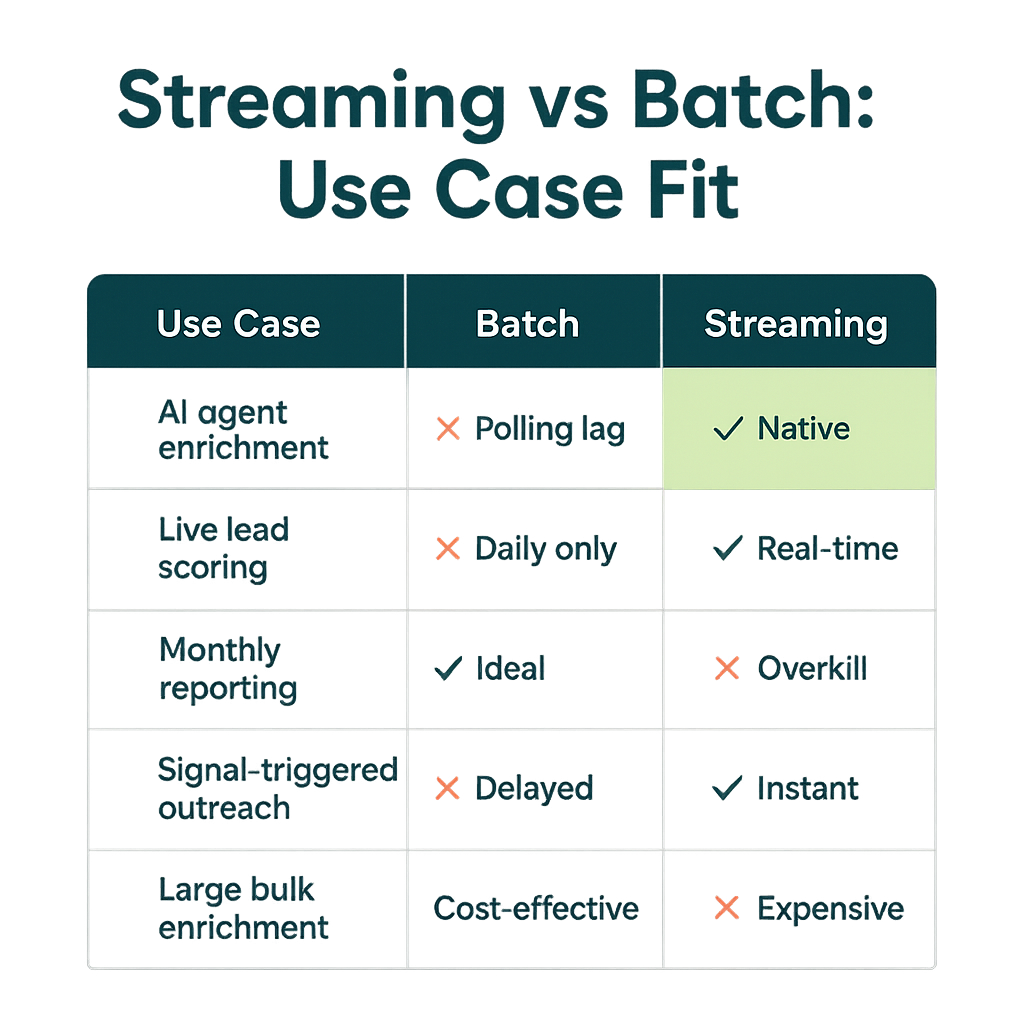
The key variable is time-sensitivity: how quickly does the value of the signal decay after the triggering event? High time-sensitivity use cases need streaming. Low time-sensitivity use cases are well-served by batch.
| GTM Use Case | Recommended Delivery Model | Rationale |
|---|---|---|
| AI agent outbound sequencing | Real-time streaming /API | Agents make decisions continuously; stale data breaks agent logic |
| Inbound lead routing and scoring | Real-time API (synchronous) | Routing decisions happen at the moment of form fill |
| High-velocity SDR outreach (daily sprints) | Near-real-time (hourly refresh) | Daily outreach planning benefits from same-day signals |
| Sales rep account prioritization | Near-real-time to daily batch | Reps plan their day; hourly updates may be sufficient |
| Weekly ABM account review meetings | Weekly batch | Review cadence matches batch delivery cycle |
| Territory and account planning (quarterly) | Batch (any cadence) | Planning horizon makes signal freshness irrelevant |
| Historical trend analysis and attribution | Batch | Analytical use cases require aggregated historical data |
| Model training and ICP scoring | Batch | ML training pipelines consume historical snapshots |
| Competitive intelligence monitoring | Near-real-time to daily | Competitive shifts matter but hourly precision rarely needed |
| Churn prediction and expansion signals | Near-real-time | Renewal windows are time-sensitive but not sub-hour critical |
The use case that has most dramatically shifted the calculus toward real-time delivery is the emergence of AI-powered GTM agents. Autonomous SDR agents, account research agents, and outbound orchestration systems make continuous decisions without human intervention. These systems do not have a “weekly review meeting” where a human can manually compensate for stale data. When an AI agent evaluates whether to send an email, which message to use, or whether to escalate an account to a human rep, it needs the current signal state — not last week’s snapshot.
A batch-fed AI agent is fundamentally handicapped. It might be programmed to trigger on accounts that showed topic surge last week, without knowing that those same accounts have already responded to a competitor’s outreach or that their surge score has dropped back to baseline since the batch was cut. Real-time data is not just a nice-to-have for agent architectures; it is a prerequisite for correct decision-making. This is explored in depth in our piece on building an AI outbound engine in the agent era.
For lean ABM programs that run structured weekly or biweekly account review cycles, batch delivery is entirely appropriate. The team is reviewing intent signals as part of a scheduled process, and the cadence of the process is slower than the delivery cadence of even a 48-hour batch cycle. Adding streaming infrastructure to serve a weekly review process would be over-engineering. See our guide on lean ABM stack and account orchestration for the right data architecture for that use case.
Architecture Comparison: Streaming Pipeline vs. Batch ETL
For GTM engineers and revenue operations architects evaluating how to build or upgrade their intent data infrastructure, the choice between streaming and batch is as much a systems design decision as a vendor selection decision. The two architectures have meaningfully different operational characteristics in terms of complexity, cost, latency, and failure modes.
# ============================================================
# ARCHITECTURE COMPARISON: Batch ETL vs. Streaming Intent Pipeline
# ============================================================

## BATCH ETL PIPELINE (Traditional)

[Intent Provider]
  |
  |-- Weekly aggregation cycle (Sun midnight cutoff)
  |-- File export to SFTP / S3 bucket (Mon ~2am)
  |
[Customer ETL Orchestrator] (Airflow / dbt Cloud / custom cron)
  |
  |-- Scheduled job (Mon 4am): download file from S3
  |-- Parse CSV, deduplicate, validate schema
  |-- Join with internal account master (left join on domain)
  |-- Apply scoring rules (e.g., surge > 60 AND topic in ICP list)
  |-- Write enriched records to data warehouse (Snowflake / BigQuery)
  |
[CRM Sync Job] (Mon 6am via Salesforce API / HubSpot batch API)
  |
  |-- Upsert account fields: intent_score, intent_topics, intent_date
  |-- Trigger CRM workflow rules (e.g., create task for rep)
  |
[Rep sees CRM alert] (Mon morning)
  |
  Total end-to-end latency: ~36–168 hours from behavioral event
  Infrastructure: SFTP/S3, ETL orchestrator, warehouse, CRM sync
  Failure modes: file format changes, FTP timeouts, schema drift,
                 CRM API rate limits, cron job failures
  Cost: Lower per-signal cost; higher labor cost for maintenance
  Throughput: High (millions of records per batch)
  Operational complexity: Medium (well-understood tooling)

## STREAMING INTENT PIPELINE (Modern Real-Time)

[Intent Provider — Signal Detection Engine]
  |
  |-- Behavioral event detected (e.g., topic threshold crossed)
  |-- Signal scoring computed in near-real-time
  |
  Option A: Webhook Push
  |-- HTTP POST fired to customer webhook endpoint
  |-- Customer receives payload within seconds of detection
  |
  Option B: Event Stream (Kafka / Kinesis / Pub-Sub)
  |-- Provider publishes event to stream topic
  |-- Customer consumer group reads event (sub-second to seconds)
  |
  Option C: Synchronous Real-Time API
  |-- Customer queries API at decision point (e.g., inbound lead)
  |-- API returns current signal state, p99 latency <200ms
  |
[Customer Signal Processor] (Lambda / Cloud Run / Kubernetes worker)
  |
  |-- Receive signal event
  |-- Validate schema and authenticate source
  |-- Enrich with internal account context (async CRM lookup)
  |-- Apply routing logic (ICP score + signal strength thresholds)
  |
  |-- Route A (High score): fire Slack alert + enroll sequence
  |-- Route B (Medium score): update CRM field + nurture enrollment
  |-- Route C (Low score): write to analytics stream only
  |
[Downstream Systems] (parallel, async)
  |-- CRM field update (Salesforce REST API)
  |-- Sequence enrollment (Outreach / Salesloft API)
  |-- Slack/Teams alert (Webhook)
  |-- Analytics event (Segment/Amplitude)
  |
  Total end-to-end latency: seconds to minutes from behavioral event
  Infrastructure: Webhook receiver or stream consumer, signal processor,
                 async CRM client, alert services
  Failure modes: webhook delivery failures (mitigated by retry + queue),
                 consumer lag, API rate limits on downstream systems
  Cost: Higher per-signal infrastructure cost; lower latency-driven revenue loss
  Throughput: Depends on concurrency; scales horizontally
  Operational complexity: Higher (requires event-driven architecture expertise)

## HYBRID ARCHITECTURE (Recommended for Most Teams)

  Streaming layer:  Real-time triggers for high-value ICP accounts
                    Synchronous API for inbound lead enrichment
                    AI agent signal feeds

  Batch layer:      Weekly warehouse sync for analytics and reporting
                    Quarterly model retraining data
                    Historical enrichment for inactive accounts
                    Territory planning and TAM analysis
One architectural consideration that is often underweighted is failure handling. Batch pipelines fail predictably and visibly: a cron job misses, a file is malformed, a CRM sync runs over its rate limit. These failures are easy to detect and the impact is bounded — you miss one batch window and the next one will catch up. Streaming pipelines can fail in more subtle ways: a consumer falls behind and builds lag, a webhook endpoint is intermittently unavailable, a message is processed out of order. Building a robust streaming pipeline requires dead letter queues, idempotency handling, and consumer lag monitoring that batch pipelines do not need.
The right architecture choice depends on your team's engineering capacity as much as your business requirements. A two-person RevOps team with no dedicated data engineering support should be realistic about the operational burden of maintaining a streaming pipeline. A purpose-built intent platform with a native real-time API — where the streaming architecture is the provider's problem, not yours — dramatically lowers the implementation barrier. For more on enrichment architecture as part of a complete GTM data stack, see our overview of B2B data enrichment.
Need real-time intent signals for your GTM stack? Explorium delivers 80+ buying signal types at 100 QPS via API — no weekly batch exports, no stale intent data. See signal freshness →
Cost Tradeoffs: Why Streaming Costs More and When It Is Worth It
Any honest evaluation of streaming vs. batch intent data must address the cost dimension directly. Real-time intent data infrastructure costs more — both in vendor pricing and in operational overhead — and the decision to invest in it should be grounded in a clear ROI calculation, not technology enthusiasm.
On the vendor side, real-time intent delivery commands a premium for several reasons. Maintaining a low-latency scoring and delivery pipeline is computationally more expensive than aggregating events into weekly batches. The infrastructure required to push signals to thousands of customer endpoints simultaneously — with SLA guarantees, retry logic, and delivery confirmation — is significantly more complex than generating a weekly file export. Providers pass these costs through in their pricing, typically through higher per-account or per-signal fees, or through dedicated API tiers with higher price points.
On the customer infrastructure side, a webhook-based streaming pipeline requires compute resources (serverless functions or always-on workers), message queuing infrastructure (SQS, Pub/Sub, or similar), and engineering time to build and maintain the signal processing logic. A batch pipeline, by contrast, can be implemented with a scheduled task, a file download, and a SQL transformation — tooling that most data teams already have and understand.
| Cost Factor | Batch Processing | Streaming Real-Time |
|---|---|---|
| Vendor data cost (per account) | Lower ($0.01–0.05/account/mo typical) | Higher ($0.05–0.25/account/mo typical) |
| Infrastructure cost (customer side) | Low — ETL tools, warehouse, cron | Medium — Lambda/workers, queues, monitoring |
| Engineering build time | 1–3 days for basic pipeline | 2–6 weeks for robust streaming pipeline |
| Ongoing maintenance overhead | Low — predictable failure modes | Medium-High — requires streaming expertise |
| Revenue impact of latency (opportunity cost) | High — buying windows missed | Low — signals arrive in-window |
| Total cost of ownership (TCO) at scale | Lower infrastructure; higher revenue loss | Higher infrastructure; lower revenue loss |
The ROI calculation hinges on one key variable: how much revenue is your current batch latency costing you? If you can quantify the number of deals where a competitor was first to engage because your signal arrived late, or the number of high-intent accounts that went dark between when the signal fired and when your rep reached out, you can build a compelling business case for the infrastructure investment.
A useful way to frame this: if your intent-driven pipeline generates 50 qualified opportunities per month, and streaming delivery would recover even 20% of the opportunities currently lost to latency — a conservative assumption given the lead decay research — the revenue value of that recovery likely exceeds the incremental cost of streaming infrastructure within one to two quarters for most enterprise SaaS businesses.
For teams with a mix of high-velocity and lower-velocity GTM motions, the hybrid architecture offers the best cost profile: streaming for the tier-one ICP accounts where latency materially affects conversion, batch for the broader account universe where weekly refresh is sufficient for the team's actual outreach cadence.
How Explorium Delivers Real-Time Intent at Scale
Most intent data discussions focus on signal types and coverage. Fewer focus on delivery architecture — which is where the real differentiation sits for GTM teams that have already learned the hard way that signal quality means nothing if delivery latency kills the conversion window.
Explorium is built around a synchronous real-time API model that fundamentally changes how intent data integrates into GTM workflows. Rather than requiring customers to manage batch file imports, ETL pipelines, and scheduled CRM syncs, Explorium surfaces intent signals as a live API that can be queried at the moment of need — when a lead comes in, when an AI agent evaluates an account, when a rep opens a prospect record.
The core specifications of Explorium's signal delivery infrastructure:
- 100 QPS (queries per second) — Explorium's API handles sustained query volume sufficient for enterprise-scale SDR operations, AI agent workloads, and high-velocity inbound enrichment pipelines simultaneously. At 100 QPS, a mid-market team can enrich every inbound lead, run continuous background scoring on a 50,000-account TAM, and power an AI agent fleet without hitting rate limits.
- 18 signal categories — Explorium's signal taxonomy covers the full spectrum of buying intent indicators, from content consumption and topic surge to technographic changes, hiring signals, funding events, executive transitions, and competitive activity. Each category surfaces distinct buying window indicators.
- 80+ signal types — Within those 18 categories, Explorium surfaces over 80 discrete signal types, giving GTM teams the granularity to build precise ICP-specific intent models rather than relying on a single aggregate surge score.
- Bombora intent in real time — Explorium integrates Bombora's cooperative intent data and surfaces it through the same real-time API, rather than packaging it in the weekly batch export that Bombora's direct customers typically receive. This means Explorium customers get Bombora's signal quality with a delivery latency of minutes rather than days — a combination that is not available through Bombora's native delivery channels.
The practical impact of this architecture is most visible in AI agent and automated enrichment workflows. A customer using Explorium to power an AI outbound agent can configure the agent to query the intent API at the start of each outreach decision cycle — getting a fresh signal read on every account the agent is evaluating, rather than operating from a pre-loaded batch snapshot. The agent's personalization logic, sequencing decisions, and escalation thresholds all operate on current data, not historical approximations.
For inbound enrichment, the synchronous API model enables real-time signal injection into the lead processing flow. When a prospect submits a demo request, the enrichment layer queries Explorium's API before the lead record is written to CRM — meaning the rep or routing logic sees intent signal state at the moment of inbound, not the state from last week's batch. This enables intent-aware routing: a high-surge inbound from a tier-one ICP account gets immediately routed to a senior AE with a personalized alert, rather than dropping into a generic inbound queue to be triaged later.
The architecture also supports traditional batch consumption for teams that need it. Customers who want to run weekly account scoring refreshes, populate dashboards, or feed historical intent data into ML models can use Explorium's batch export capabilities alongside the real-time API — giving them both delivery models from a single provider and a single data contract. For a comprehensive view of how Explorium's signal stack fits into a broader enrichment architecture, see our B2B data enrichment guide.
FAQs


