

Claude’s connector ecosystem has transformed dramatically in the first half of 2026. The official Connectors Directory has grown to over 418 verified integrations across 30 categories, spanning revenue tools, creative software, developer platforms, and now everyday consumer apps. Connectors work across Claude, Claude Desktop, Claude Code, and the API, and once connected, Claude can bring a tool into conversation on its own when it fits what you’re asking for, without you naming it every time.
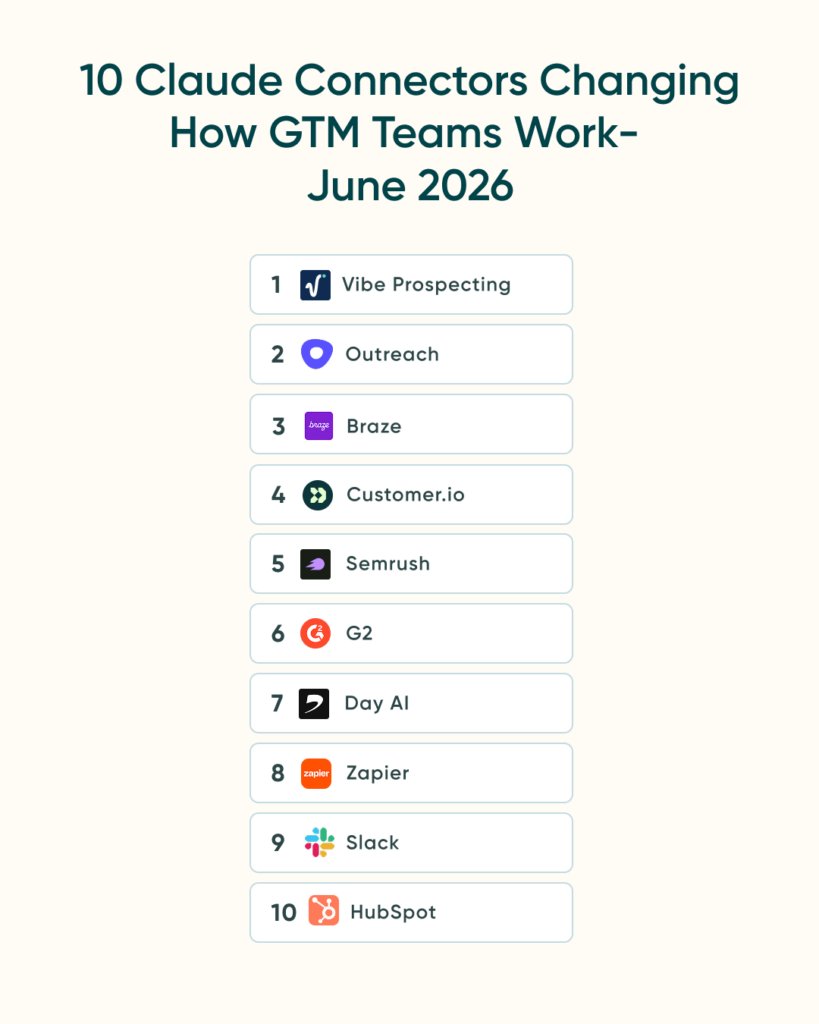
Below are the 10 connectors worth knowing right now for GTM teams, ranked by score.
1. Vibe Prospecting
The Vibe Prospecting is one of the most impactful connectors for revenue teams. It allows Claude users to run prospecting and research directly inside chat, pulling company and contact data without needing expensive platforms like ZoomInfo or Apollo. Users can enrich leads, research accounts, and even draft personalized outreach emails based on verified business insights, all without switching tools.
The ROI here is immediate: prospecting time is cut down, costs are lower compared to traditional enrichment platforms, and sales reps can customize messaging faster. Teams can focus on conversations and deals instead of data-hunting.
How to start using Explorium in Claude:
- Sign up to Vibe Prospecting
- Install the Claude connector
- Sign in and describe what you need
Score: 9.5/10
2. Outreach
Outreach announced general availability of its MCP server in February 2026, positioning itself as the first Revenue Orchestration Platform to connect its revenue insights to Claude. By allowing Outreach’s AI to securely share live operational context with Claude and other systems, revenue teams can work more efficiently, take action in the tools where they operate, and reduce context switching.
The connector surfaces sequence performance, deal risk signals, rep activity, and account engagement data directly inside Claude conversations. Setup is handled through Claude Desktop’s Connectors directory: search for Outreach, connect, and authenticate. Outreach recommends keeping all tools enabled and granting “Always allow” permissions for the most productive experience. For sales leaders who want Claude reasoning over live pipeline data rather than CRM exports, this is one of the most complete revenue-side connectors in the directory.
Best for: Sales leaders, RevOps teams, and AEs using Outreach as their primary sequencing and pipeline platform.
Score: 8.7/10
3. Braze
The Braze MCP server is now listed in the official Anthropic connector directory. Users can find it in Claude Desktop under Settings > Connectors > Browse Connectors > Desktop Extensions, install it with an API key and base URL, and immediately access 38 Braze API functions across 15 categories, covering campaigns, Canvases, KPIs, segments, and more.
The connector is purpose-built for engagement and lifecycle marketers. Ask Claude to visualize email open rates over the last 30 days, analyze top-performing Canvases and suggest optimizations, or audit custom attributes and recommend a data cleanup plan, all in plain language, without exporting a single CSV. The connector also supports correlating churn indicators with campaign sends, feature releases, or seasonal patterns to identify causes and recommend retention interventions. For teams that live inside Braze, this is the fastest path to turning engagement data into strategy.
Best for: CRM marketers, lifecycle teams, and retention analysts running campaigns at scale.
Score: 8.6/10
4. Customer.io
Customer.io published an official MCP setup guide in May 2026. In Claude Desktop, users go to Settings > Connectors, find and enable the Customer.io connector, authenticate, and pick the workspaces to connect. Customer.io also provides a hosted MCP server URL for users who prefer adding it as a custom connector.
Once connected, Claude can query journeys and campaigns, analyze segment membership and patterns, compare messaging cadences, and identify drop-off points within automated flows, all conversationally. It’s especially useful for comparing when campaigns are sent, identifying overlapping sends that could be causing audience fatigue, and analyzing lifecycle campaign performance alongside conversion data from other platforms. For teams running complex multi-step customer journeys in Customer.io, the ability to interrogate those workflows in plain language from Claude is a genuine operational upgrade.
Best for: Lifecycle marketing teams, growth operators, and email-heavy B2B/B2C orgs.
Score: 8.3/10
5. Semrush
The Semrush MCP server is available as an official app inside Claude, consuming API units from your existing Semrush subscription with no additional Claude fees. To connect, navigate to Customize > Connect your apps and search for Semrush.
The connector gives Claude direct, secure access to live Semrush data, so teams across SEO, marketing, and product can query the same source without rebuilding workflows for every question. Use cases span keyword research, competitive traffic analysis, backlink audits, domain comparisons, and ad copy retrieval, all surfaced in real time without a single CSV export. Claude Code users can pair the Semrush MCP with first-party Google Search Console data to build live dashboards that bring competitive intelligence and owned performance into one place. For SEO and content teams, this connector meaningfully changes how strategy gets built.
Best for: SEO strategists, content marketers, and growth teams doing regular competitive and keyword research.
Score: 8.8/10
6. G2
G2 announced its MCP connector in March 2026 as part of a broader product update, with the first integration built specifically with Claude. Rather than relying on generic web data, G2’s MCP enables AI workflows to reference verified buyer reviews, research behavior, and competitive insights directly from the G2 marketplace.
The connector supports buyer intent intelligence, including tracking companies researching your products, reviewing intent scores, and identifying accounts for prioritization, as well as competitive intelligence showing which products prospects are currently comparing, and full review analytics with market intelligence. G2 buyer intent and verified review data can also be accessed in HubSpot through the same MCP architecture via Breeze Agents. For GTM teams that rely on G2 as a demand signal source, being able to pull intent data into Claude conversations alongside CRM context is a meaningful workflow shortcut.
Best for: GTM teams, demand gen marketers, and sales teams using G2 Buyer Intent for account prioritization.
Score: 8.4/10
7. Day AI
Day AI is listed in the official Claude Connectors directory under Sales and Marketing, with read and write capabilities across Claude, Claude Desktop, the mobile app, Claude Code, and the API.
Day AI is an AI-native CRM that takes a fundamentally different approach to data entry: instead of forcing users to input data manually, it “listens” to your work, including emails, video meetings, and Slack conversations, and builds the CRM automatically, capturing every interaction, structuring the information, and keeping customer context perpetually up to date. Under the hood, Day AI stores data in a vector database rather than a legacy relational system, allowing it to ingest raw conversational data and map conceptual relationships, a structure purpose-built for the kind of deep, relevant retrieval that LLMs need.
That architecture is precisely what makes the Claude connector compelling: when you give Claude access to Day AI, it’s not querying stale field-level CRM records. It’s querying a living knowledge base built from real conversations. Use cases include analyzing recent sales calls and updating corresponding opportunities, creating new CRM records from email threads, surfacing pipeline stages for active deals, and sending follow-up emails to leads from a previous week’s demos, all in natural language, without opening the CRM.
Best for: B2B revenue teams, founders, and customer-facing roles at companies looking to replace legacy CRM data entry with AI-captured context.
Score: 8.5/10
8. Zapier
Still the automation backbone for teams that aren’t ready to build custom MCP servers. Zapier connects Claude to 6,000+ apps through no-code, trigger-based workflows. Once Zaps are configured, Claude can trigger actions across your entire stack, updating databases, sending emails, and pushing Slack alerts, from a single chat instruction.
For orgs with complex multi-tool workflows, Zapier remains the fastest path to connecting Claude to almost anything. The upfront configuration investment pays off quickly, and the connector becomes exponentially more valuable over time as more Zaps are built around it.
Score: 9.2/10
9. Slack
Slack now publishes an official MCP server: better-maintained, integrated with Slack’s Real-Time Search API, and aligned with Slack’s permission and enterprise-key-management model. Claude can search messages, summarize threads, surface decisions and action items, and draft replies before anything is posted.
For teams that run on Slack, this connector makes Claude aware of your organizational context in a way that no uploaded document can replicate. Enterprise admins get full controls over which MCP servers users can access. The security model is mature and worth reviewing before org-wide rollout, but for most teams the setup is straightforward and the day-to-day value is immediate.
Score: 9.0/10
10. HubSpot
The HubSpot connector grounds Claude’s responses in real CRM context, letting teams ask questions in plain language, generate visualizations like charts and graphs, and take action on insights directly in HubSpot. Marketing teams can segment contacts from campaign data, sales teams can get deal pipeline summaries, and support reps can pull open tickets sorted by priority.
The caveat remains data hygiene: the connector’s value scales directly with how clean and structured your CRM data is. When it’s well-maintained, it’s one of the highest-ROI connectors for commercial teams, and the native setup takes under ten minutes from first login to first query.
Score: 8.7/10
Conclusion
The story of Claude connectors in the first half of 2026 is one of depth and scope expanding simultaneously. The revenue stack is now comprehensively covered, from prospecting (Vibe Prospecting) to sequencing (Outreach) to lifecycle engagement (Braze, Customer.io) to pipeline intelligence (Day AI, HubSpot) to competitive signals (G2, Semrush). Meanwhile Zapier and Slack continue to serve as the connective tissue holding multi-tool workflows together.
Claude Managed Agents, launched in April 2026, now pair with MCP connectors, meaning the same integrations that power your conversations can run in the background as long-running agent workflows, without any additional setup. The connectors you install today aren’t just chat augmentations. They’re the foundation of whatever agentic workflows you’ll be running six months from now.


