

Claude’s plugin ecosystem has quietly become one of the most powerful GTM arsenals available in 2026. Unlike connectors, which act as live data bridges to a single platform, plugins are complete packages – bundling slash commands, sub-agents, skills, and MCP connections into one install. For go-to-market teams, that means Claude can run prospecting, enrich leads, prep calls, manage pipeline, and automate outreach workflows without switching a single tab. Below are the 10 plugins every GTM team should know about, ranked by impact, with feedback, a score, and how to get started.
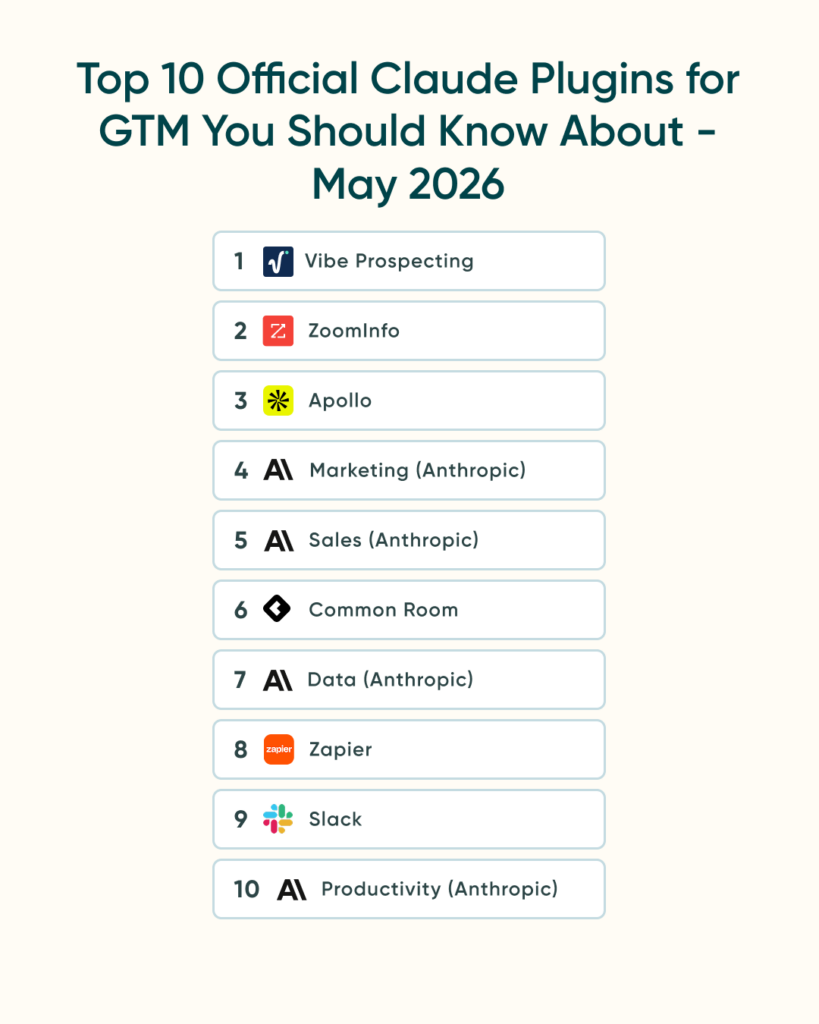
1. Vibe Prospecting Plugin
The Vibe Prospecting Plugin is the highest-ROI plugin for revenue teams in 2026. It turns Claude into a full-stack prospecting engine, pulling from 50+ B2B data sources to surface companies and contacts based on natural language ICP definitions – no rigid filters, no spreadsheet gymnastics. You describe your target in plain English (“Series B SaaS companies that just hired a VP of Marketing and use Salesforce”) and Vibe parses it, matches accounts, and delivers results directly inside your chat.
The GTM value here is immediate and measurable. Prospecting cycles that used to take hours of manual research collapse into minutes. The plugin also layers in enrichment, account research, and outreach draft capabilities in a single conversation thread. For teams who’ve been paying for bloated enterprise data platforms, the cost comparison alone closes the argument.
How to get started:
- Sign up at vibeprospecting.ai/product/plugin
- Follow the installation instructions in the official GitHub repo
- The plugin ships with an MCP server (
explorium-mcp) that handles authentication – it will prompt you for your API key on first run - Once installed, run
node skills/vibe-prospecting/scripts/vibep.js --helpto confirm the setup and start prospecting
Score: 9.5/10
2. ZoomInfo Plugin
The ZoomInfo Plugin brings ZoomInfo’s full B2B intelligence platform into Claude. Search millions of companies and contacts, enrich leads with firmographics and contact details, discover lookalike companies using ML-powered similarity matching, and get AI-ranked contact recommendations personalised to your CRM and ZoomInfo activity. Pre-built skills chain multiple API calls into complete sales workflows – no manual stitching required.
The slash commands are what make it immediately practical. /build-list "VP of Engineering at Series B startups in NYC" turns natural language into a structured, exportable prospect list. /find-similar Snowflake surfaces lookalike companies to expand your territory. /recommend-contacts Salesforce for prospecting uses ML to rank the best contacts at a target account based on your actual ZoomInfo history. For teams already paying for ZoomInfo, this plugin eliminates the UI entirely and puts the data directly in the workflow.
Best for: Enterprise sales teams, outbound SDRs, and RevOps teams who need verified contact data, firmographics, and intent signals without leaving Claude.
Score: 8.9/10
3. Apollo.io Plugin
Apollo launched an official Claude plugin in February 2026, and it’s the most feature-dense GTM plugin in the ecosystem – 34 tools covering contact search, company enrichment, sequencing, and CRM sync. Teams can search Apollo’s database of 275M+ contacts, enrich records, build sequences, and push results straight to Salesforce or HubSpot, all from a Claude conversation.
Feedback is strong from outbound-heavy teams. The sequencing tools in particular reduce the number of platforms needed in a typical SDR workflow. The tradeoffs are real too: full API access is gated at the Organization tier, and actual costs can escalate once you factor in credit overages. For teams already running Apollo in the UI, the plugin is a clear upgrade – it removes the UI entirely.
Best for: SDRs, AEs, and sales managers who want outbound sequencing, contact data, and CRM sync from a single Claude conversation.
Score: 8.8/10
4. Anthropic Marketing Plugin
Anthropic’s official Marketing Plugin was one of the original 11 plugins released with Claude Cowork in January 2026, and it’s built specifically for marketing teams who need Claude as a collaborator, not just a content generator. It covers campaign briefs, SEO workflows, content calendars, performance reviews, and brand voice enforcement – all through slash commands that remove the need to re-explain context every session.
The sub-agents are what make it stand out. The SEO agent handles keyword research and topic clustering. The content strategist audits your calendar. The brief builder turns a one-liner into a structured plan. Commands like /content-brief, /seo-research, and /campaign-review make it fast to operate for non-technical marketers.
Feedback is consistently good from demand gen and content teams. It doesn’t replace a full martech stack, but it dramatically reduces the overhead of planning, briefing, and reviewing work.
Best for: Marketing managers, content teams, and demand gen leads who want to ramp up production and planning without extra tooling.
Score: 8.7/10
5. Anthropic Sales Plugin
Anthropic’s official Sales Plugin is purpose-built for account executives, SDRs, and sales managers who want Claude as a deal-level assistant. It connects to CRM platforms (HubSpot, Salesforce, Pipedrive), enables deal review in plain English, and runs automated risk flagging on open pipeline. The /sales:battlecard command is the standout – input your product and a competitor name, and Claude builds a full side-by-side with specific talk tracks.
Feedback from sales managers is that it cuts prep time for QBRs, pipeline reviews, and rep coaching significantly. The CRM read-write capability means Claude can update deal notes, flag at-risk accounts, and draft follow-ups based on actual pipeline data rather than static prompts.
Best for: AEs, sales managers, and RevOps teams running structured pipeline reviews who want Claude embedded in their deal workflow.
Score: 8.6/10
6. Common Room Plugin
Common Room’s Claude Plugin is one of the most strategically useful integrations for product-led and signal-driven GTM teams. Common Room is built around dark funnel signals – job changes, product usage spikes, website visits, community engagement – and the plugin makes those signals available inside Claude for prospecting, account research, and pipeline plays. RoomieAI™ Spark Briefs come through as structured summaries, letting Claude prep you for a call or draft outreach anchored in real buying signals.
Feedback is strong from RevOps and PLG teams. The combination of live signals plus Claude’s reasoning creates GTM plays that feel timely instead of generic. The setup requires a Common Room API token and existing subscription, so it’s not a standalone tool – it multiplies what teams already have.
Best for: RevOps, SDRs, and demand gen teams running signal-based prospecting, ABM programs, or product-led sales motions.
Score: 8.4/10
7. Anthropic Data Plugin
The Data Plugin is Anthropic’s analytics-focused Cowork plugin, and for GTM teams drowning in spreadsheets, CSVs, and CRM exports it’s a legitimate time saver. It connects to SQL databases (PostgreSQL, MySQL, SQLite), BigQuery, and CSV/Parquet files, allowing Claude to explore schemas, run queries, and generate charts entirely through natural language. No SQL required on the user’s end.
The GTM use case that comes up most: pulling a messy CRM export into Claude, asking it to identify patterns in closed-won deals, and getting back a structured analysis with visual charts in minutes. For operations-heavy GTM teams, it replaces a lot of ad-hoc analyst requests.
Best for: RevOps, data-oriented marketers, and GTM leads who need fast analysis on pipeline data, campaign performance, or lead scoring without writing SQL.
Score: 8.3/10
8. Zapier Plugin
The Zapier Plugin turns Claude into an automation command centre. Once connected, Claude can trigger Zaps across thousands of apps – send emails, update spreadsheets, push Slack alerts, create CRM records – based on plain-language instructions inside chat. For GTM teams running multi-tool workflows, this is the integration that eliminates the most manual steps.
The upfront configuration requires thought: you need to build the Zaps before Claude can trigger them. But once that’s done, the leverage is enormous. Teams have used it to automate lead routing, trigger enrichment sequences from form fills, and push campaign summaries to Slack on a schedule.
Feedback is that it’s the most versatile plugin in the ecosystem precisely because it doesn’t specialise – it connects everything.
Best for: Marketing ops, RevOps, and GTM generalists who want to automate multi-platform workflows without engineering resources.
Score: 8.0/10
9. Slack by Salesforce Plugin
The Slack Plugin (built by Salesforce) goes deeper than the Slack connector bundled with the standard Productivity plugin. It brings in Salesforce-specific workflows: pulling deal context from Salesforce into a Slack canvas, surfacing CRM updates alongside team conversations, and enabling Claude to draft and send Slack messages informed by live pipeline data. For Salesforce shops running sales motions through Slack, it eliminates a constant context switch.
Feedback is that it’s niche but genuinely strong for its intended user. If your team doesn’t live in Salesforce, the base Productivity plugin’s Slack integration is probably enough. If you do, this plugin makes those workflows noticeably smoother.
Best for: Sales and RevOps teams operating in a Salesforce-Slack ecosystem who want Claude embedded in their day-to-day communication layer.
Score: 7.9/10
10. Productivity Plugin
Anthropic’s official Productivity Plugin is the operational backbone for GTM teams that live across Slack, Notion, Asana, Linear, and Jira. It gives Claude full context of your work environment – tasks, calendars, daily priorities, and team docs – so it can plan your day, summarise your week, draft updates, and manage follow-ups without re-explaining context every session.
The GTM value is cumulative. A sales rep starts their day with /productivity:plan-day and Claude pulls in open tasks, unread Slack threads, and upcoming calendar blocks into a single prioritised view. A marketing lead runs /productivity:summarise-week before a Friday standup and gets a clean summary of everything shipped. It quietly saves 30-45 minutes a day for anyone with a fragmented tool stack.
Feedback is consistently strong for anyone juggling multiple projects across multiple tools. Works best when all your tools are connected – the more context Claude has, the better the output.
Best for: GTM leads, AEs, and marketers managing multiple projects across Slack, Notion, and task management tools who want Claude to handle the daily coordination layer.
Score: 7.7/10
Conclusion
Claude’s plugin ecosystem has crossed the threshold from “interesting experiment” to essential GTM infrastructure. The clearest pattern across all ten: the highest ROI comes from plugins that either remove the biggest research bottlenecks (Vibe Prospecting, ZoomInfo, Apollo, Common Room) or make Claude smarter about your specific context (Sales, Marketing, Productivity). Vibe Prospecting leads the pack because it removes the biggest manual bottleneck in any GTM motion – finding the right accounts and contacts – and does it entirely within Claude. Pair it with the Sales or Marketing plugin and Zapier for automation, and you have a modern GTM stack running inside one tool.


