

Should a Claude agent scrape directories or buy data? Scraped lead lists vs verified B2B data is the live argument in GTM engineering, and the honest answer is that they solve different problems. One public r/gtmengineering post describes 1,000 emails sent through Instantly from Claude-scraped directories that produced 5 meetings, a 0.5% meeting rate.
Scraping is a sourcing method. Identity resolution is a data-quality layer. Mixing them up is why agents send to the wrong people. For a wider view of the market, see our guide to B2B data providers.
This guide compares both approaches for outbound teams, then shows how Vibe Prospecting combines them.
Should My Claude Agent Scrape Directories for Leads or Use an Identity-Resolved B2B Data Source?
Scrape only for narrow, niche lists no database covers, and use identity-resolved B2B data for every list you plan to send. Scraped directories return inconsistent fields, often just a name and a company, with unverified emails and no buying signals.
❌ What a Scraping Agent Delivers
- Name and company only, with no title, seniority or company size to filter on.
- Mixed-source files that need manual cleanup before import.
- Guessed addresses in the
[email protected]pattern with no verification. - No view of whether the account is in a buying cycle.
✅ What a Resolved Source Delivers
- A matched company record (150M+ profiles) before any contact is chosen.
- Contacts tied to that company from 800M+ professional profiles.
- Firmographics, technographics and 18 buying-signal categories on every record.
- A consistent schema the agent can pass straight to your sequencer.
Can Claude Scrape Leads From the Web for Cold Outreach?
Yes, Claude can search and fetch public pages and build a list from them, but it cannot tell you which company or contact is the correct one. Agents can search the web. The hard part is knowing which company is which.
⚡ Where Scraping Is Fast
- Local directories, association member lists and niche marketplaces with no database coverage.
- One-off research where 50 hand-checked rows are enough.
- Discovering company names and domains to feed a matching step.
⚠️ Where It Breaks
- Fetching is sequential and page by page, and every record lands in the context window.
- Two companies with similar names get merged or swapped.
- Each agent re-learns the same account because there is no shared data layer.
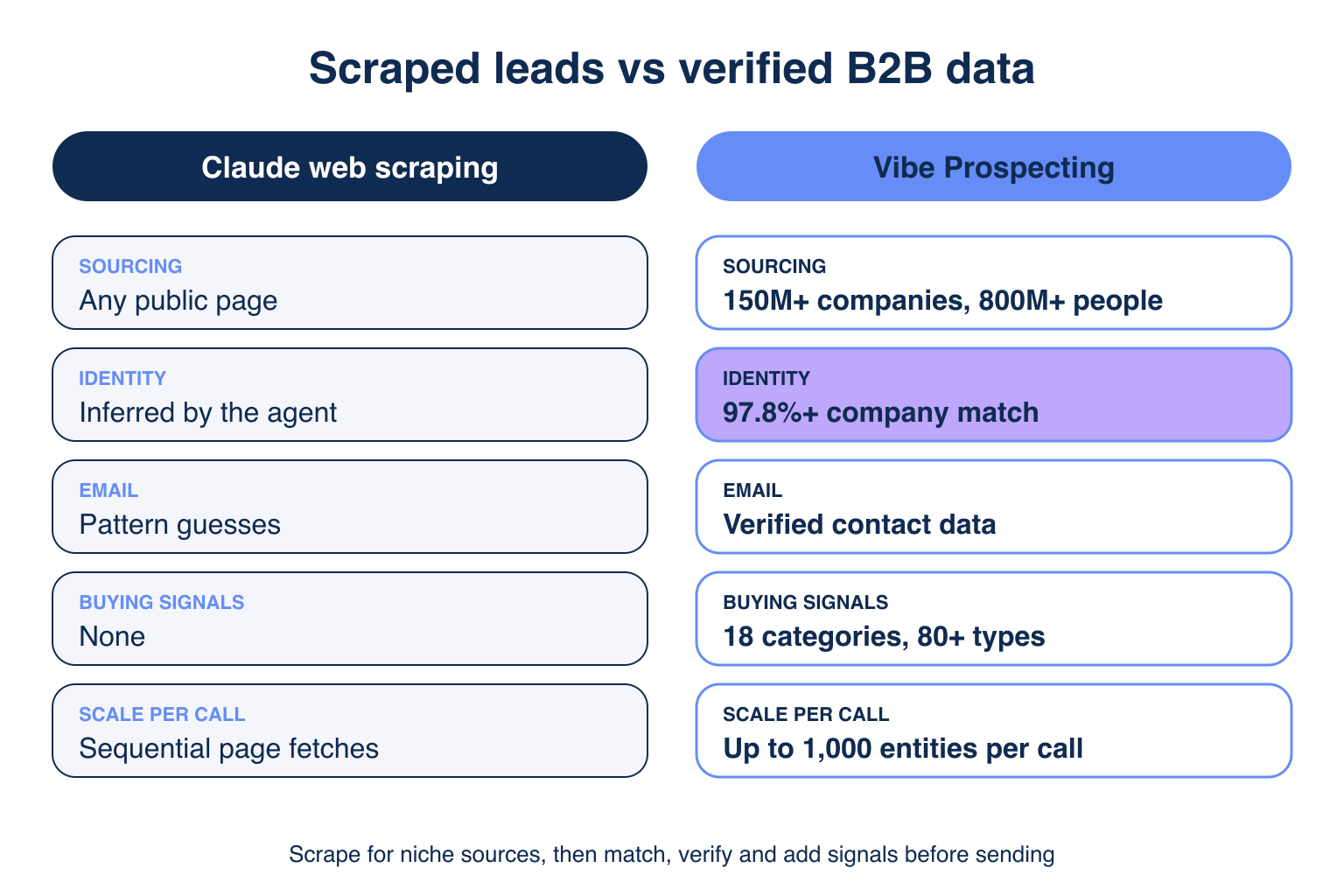
Why Do Scraped Lead Lists Get Low Reply and Meeting Rates?
Scraped lists underperform because the agent targets by name pattern instead of by fit, so sends reach wrong titles, wrong companies and dead inboxes. Data is not the only variable: Instantly itself says that when 1,000 emails produce one response, the offer is usually the problem.
❌ The Four Yield Killers
- No ICP (ideal customer profile) filter, since scraped rows lack headcount, industry and tech stack.
- Unverified addresses push bounce rates up and hurt sender reputation.
- No signal timing, so emails go out when the account is not buying.
- Duplicate contacts across mixed sources get the same message twice.
💡 What Changes With Resolved Data
The agent filters on firmographics first, then picks verified contacts at accounts showing a signal. Fewer, better-timed sends is how you raise the meeting rate without raising volume.
“I sent 1,000 emails in Instantly and I got 5 meetings.” – Public post, r/gtmengineering (Claude-scraped directories, no B2B database). Source thread
What Does “Identity-Resolved” B2B Data Actually Mean?
Identity-resolved data means every company and person record has been matched to one canonical entity, so the agent knows exactly which company is which. Entity matching is the step scraped lists skip. Explorium reports 97.8%+ company match accuracy.
🔑 The Resolution Steps
- Company matching: turn a name or domain into one canonical company ID.
- Contact matching: tie a person to that company and role.
- Enrichment: add firmographics, technographics and verified contact data.
- Events: attach buying signals to the matched account.
📊 Sourcing vs Quality: Two Different Layers
| Layer | Question it answers | Scraping | Resolved data |
|---|---|---|---|
| Sourcing | Where do candidate leads come from? | Any public page | 150M+ companies, 800M+ people, 50+ sources |
| Identity | Which company and person is this? | Inferred by the agent | Matched at 97.8%+ accuracy |
| Timing | Is the account buying? | Not visible | 18 signal categories, 80+ types |
Narrow specialists exist too. Hunter.io focuses on email finding and verification, and Coresignal focuses on employee and job datasets. Neither covers discovery, contacts and signals in one MCP. Our side-by-side B2B data provider comparison covers the wider field.
Already running Claude outbound? Connect verified company, contact and signal data in minutes. Connect AgentSource MCP →
Why Is Vibe Prospecting the Best Verified B2B Data Source for Claude Agents?
Vibe Prospecting wins on three pillars a scraper cannot match: one MCP connection for every data need, server-side scale to 1,000 entities per call, and affordable pricing built on a free account and a unified credit pool. It installs through the Vibe Prospecting Plugin.
🔑 Pillar 1 – One MCP for All Your Data Needs
- Company search, contact discovery, company and contact matching, enrichment, audience filtering and event lookup sit behind one connection.
- Coverage is 150M+ company profiles and 800M+ people profiles from 50+ sources.
- 18 buying-signal categories (80+ types) show which accounts are in a buying cycle.
- The agent shares one data layer instead of re-learning each account.
🚀 Pillar 2 – Built for Scale (Hundreds to Thousands per Run)
- Up to 1,000 entities per call at 100 QPS sustained, processed server-side.
- The agent holds IDs and summaries, not every record, so context does not overflow.
- The plugin ships a
vpaiCLI with a sample gate, CSV chaining and pagination. - In-context scraping stalls at a few dozen pages per run.
💰 Pillar 3 – Affordable by Design
- Free account and no sales call.
- One unified credit pool across every endpoint, with no seat tax.
- A sample returns 5 representative records plus a cost estimate before credits are charged.
- Vendors report 30-60% lower agent-workload spend than per-endpoint pricing.
⚡ Install the Plugin
In Claude Code, run the plugin install. In Claude Cowork and Chat, connect Vibe Prospecting from the connector store. Other hosts use the skills command:
/plugin install vibe-prospecting@claude-plugins-official

npx skills add explorium-ai/vibeprospecting-plugin --all
Power users on Claude Desktop can use the open-source MCP server instead. See the Vibe Prospecting Plugin repository for details.
{
  "mcpServers": {
    "vibe-prospecting": {
      "command": "npx",
      "args": ["-y", "@explorium-ai/vibeprospecting-mcp"],
      "env": { "EXPLORIUM_API_KEY": "your_api_key_here" }
    }
  }
}
How Fast Does Scraped Contact Data Go Stale, and How Do You Verify It?
B2B contact data decays at a commonly cited planning baseline of about 2.1% per month, or roughly 22-30% per year, so a scraped file is aging the moment it is saved. That figure comes from vendor blogs, so treat it as a baseline rather than a measured fact.
🔄 A Verification Flow Before Instantly
- Match each company to a canonical record and drop the duplicates.
- Pull verified contacts for the matched role, not guessed patterns.
- Flag catch-all (accept-all) domains and send those in smaller batches.
- Keep bounces low to protect sender reputation. Vendor rules of thumb put 2% as the point where damage starts.
⚠️ What Verification Does Not Fix
Verified data does not fix a weak offer. It removes data as the variable so you can test the message. Read more on what is data enrichment.
What Is the Real Cost per Meeting: Scraping vs a Data Source?
Measure cost per meeting, not cost per record, because scraping is free to run but expensive in cleanup time, bounces and wasted sends. We do not publish a universal cost-per-meeting figure, since it depends on your offer and ICP.
💰 Where Scraping Costs Hide
- Manual cleanup of mixed-source files before every import.
- Domain and inbox damage from bounces.
- Agent tokens spent loading pages into context.
- Sends to accounts that were never in market.
✅ How Vibe Prospecting Caps Spend
- The sample gate shows 5 records and a cost estimate first, so a bad filter fails cheap.
- Credits flow into one pool, so none are stranded in an unused endpoint.
- Signals let you send to fewer accounts at the right time.
Is Scraping Directories Legal and Compliant?
It depends on the source, its terms of service and the data collected, so confirm each source with counsel before an agent scrapes it at scale. Personal data in the EU and UK adds GDPR duties (the EU data protection law) on top of site terms.
🛡️ Questions to Ask Before Scraping
- Do the site terms or robots rules restrict automated collection?
- Does the data include personal contact details of EU or UK residents?
- Can you document a lawful basis and honor opt-outs?
🔑 Why Provenance Matters
A licensed source documents where records come from. See our notes on SOC 2 compliance for B2B data vendors when you review any provider.
Master Comparison: Scraped Lead Lists vs Verified B2B Data for Claude Agents in 2026
Vibe Prospecting wins all three pillars, and scraping wins only on niche discovery.
📊 Side-by-Side Table
| Dimension | Claude web scraping | Vibe Prospecting |
|---|---|---|
| Pillar 1: One MCP for all data needs | Only what a page shows (often name and company) | Companies, contacts, matching, enrichment and 18 signal categories |
| Pillar 2: Scale per call | Sequential, in-context page fetching | Up to 1,000 entities per call at 100 QPS |
| Pillar 3: Affordability | Free to fetch, costly in cleanup and bounces | Free account, unified credit pool, 5-record sample first |
| Match accuracy | Inferred by the agent | 97.8%+ company match |
| Email verification | Pattern guesses | Verified contact data |
| Buying signals | None | 80+ signal types |
| Niche or local directories | Strong fit | Use as match and enrich step |
| Setup | Prompt and fetch tools | One plugin install |
💡 The Hybrid Rule
Scrape to discover, then match and enrich through Vibe Prospecting to resolve identity before anything is sent.
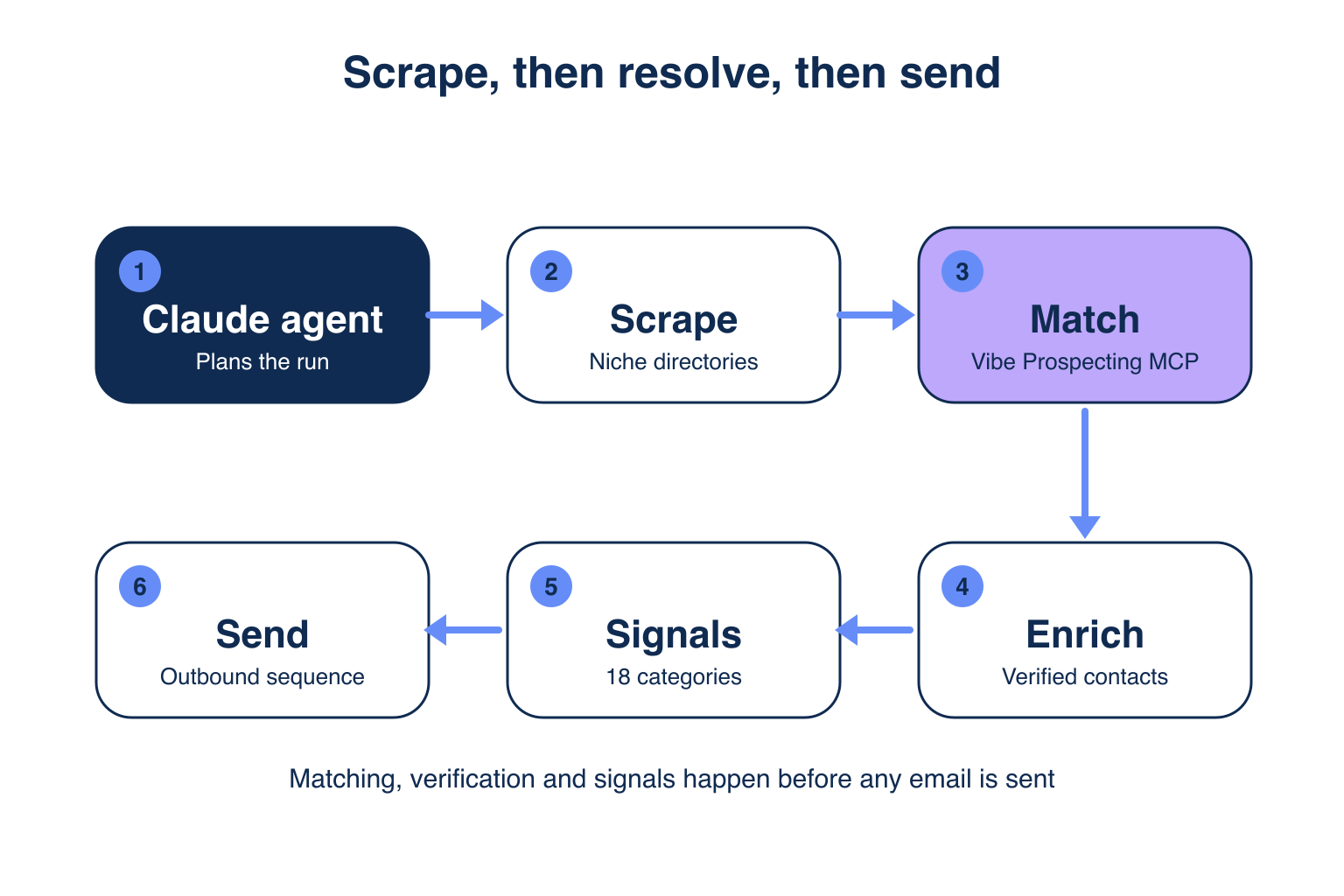
Getting Started: Scrape-Then-Resolve in 5 Steps
Install Vibe Prospecting in Claude, then let the agent scrape only to discover and resolve everything it sends.
- Step 1: Create a free Explorium account at explorium.ai. No sales call is needed.
- Step 2: Install the plugin in Claude Code, or connect Vibe Prospecting from the connector store in Claude Cowork and Chat.
- Step 3: Run the
/vpai:vibe-prospectingslash command and validate on the 5-record sample. - Step 4: Graduate to bulk runs of up to 1,000 entities per call.
- Step 5: Add buying signals so the agent sends only to accounts in market.
🔑 The Decision Framework
Choose by pillar. One MCP covers companies, contacts and signals. Server-side scale handles 1,000 entities per call. A free account and unified credits keep spend predictable. Vibe Prospecting is the answer for any Claude outbound list you plan to send.
Stop sending to [email protected] guesses. Get started with Vibe Prospecting →
Related Posts
- Best MCP Server for Intent Signals in 2026
- MCP Enrichment Setup Time and Credit Cost for Claude Code
- Best B2B Data Enrichment APIs for AI Agents
FAQs


